






Wednesday, 11 November 2026 07:00 AM
Company Update
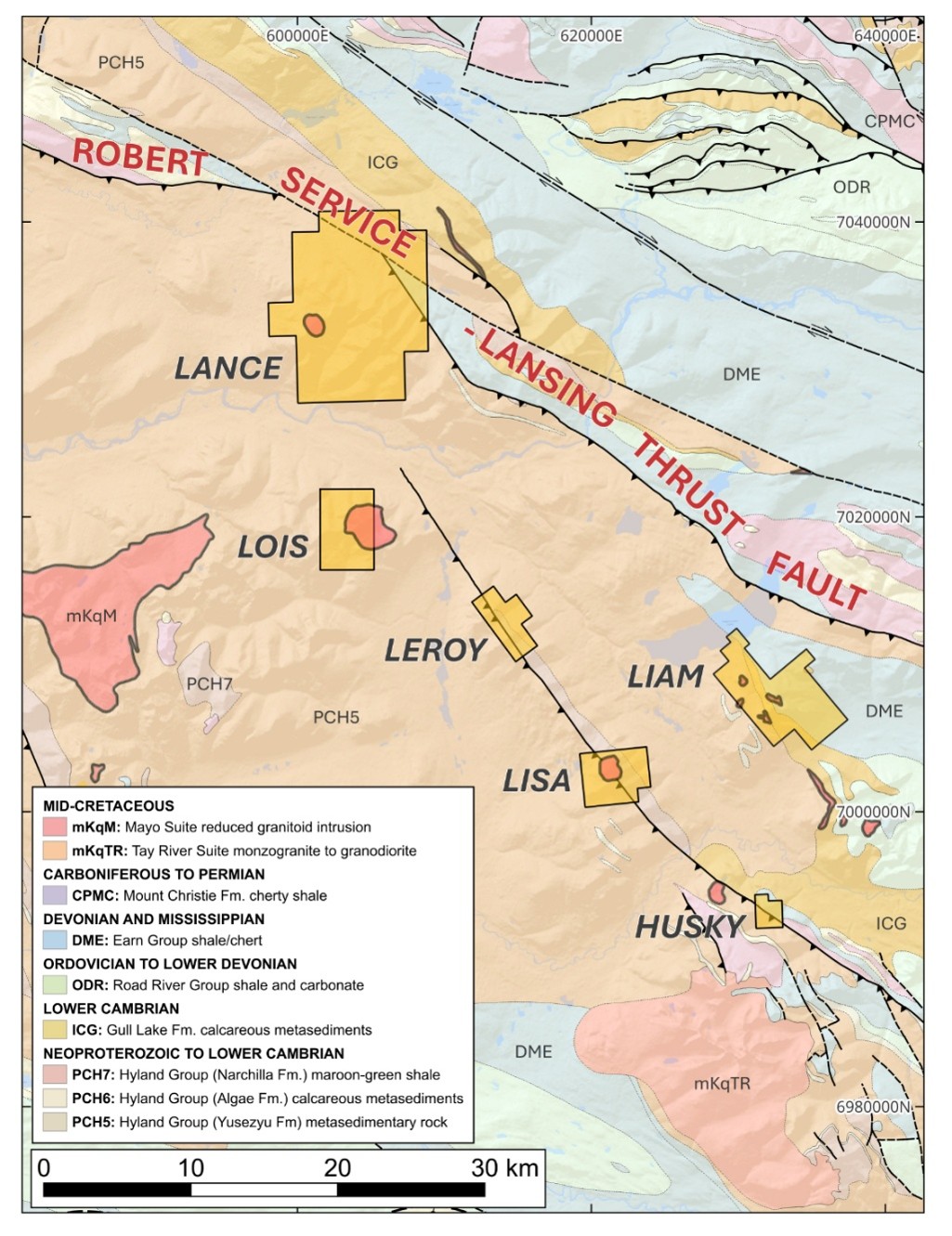
VANCOUVER, BC / ACCESS Newswire / November 11, 2026 / Trifecta Gold Ltd. (TSXV:TG)(OTCQB:TRRFF) ("Trifecta" or the "Company") is pleased to report analytical results from its 2026 exploration programs on the wholly owned Liam and Lois projects, located in the Tombstone Gold Belt of east-central Yukon. Liam and Lois are located approximately 100 km north of the community of Faro and 75 km west-southwest of Snowline Gold Corp.'s Valley Deposit (Figure 1). Trifecta's 2026 field programs in the Tombstone belt included drilling at the Rye project (results announced October 29, 2026) and field work at the Liam and Lois projects directed toward defining potential drill targets.
Highlights
Liam
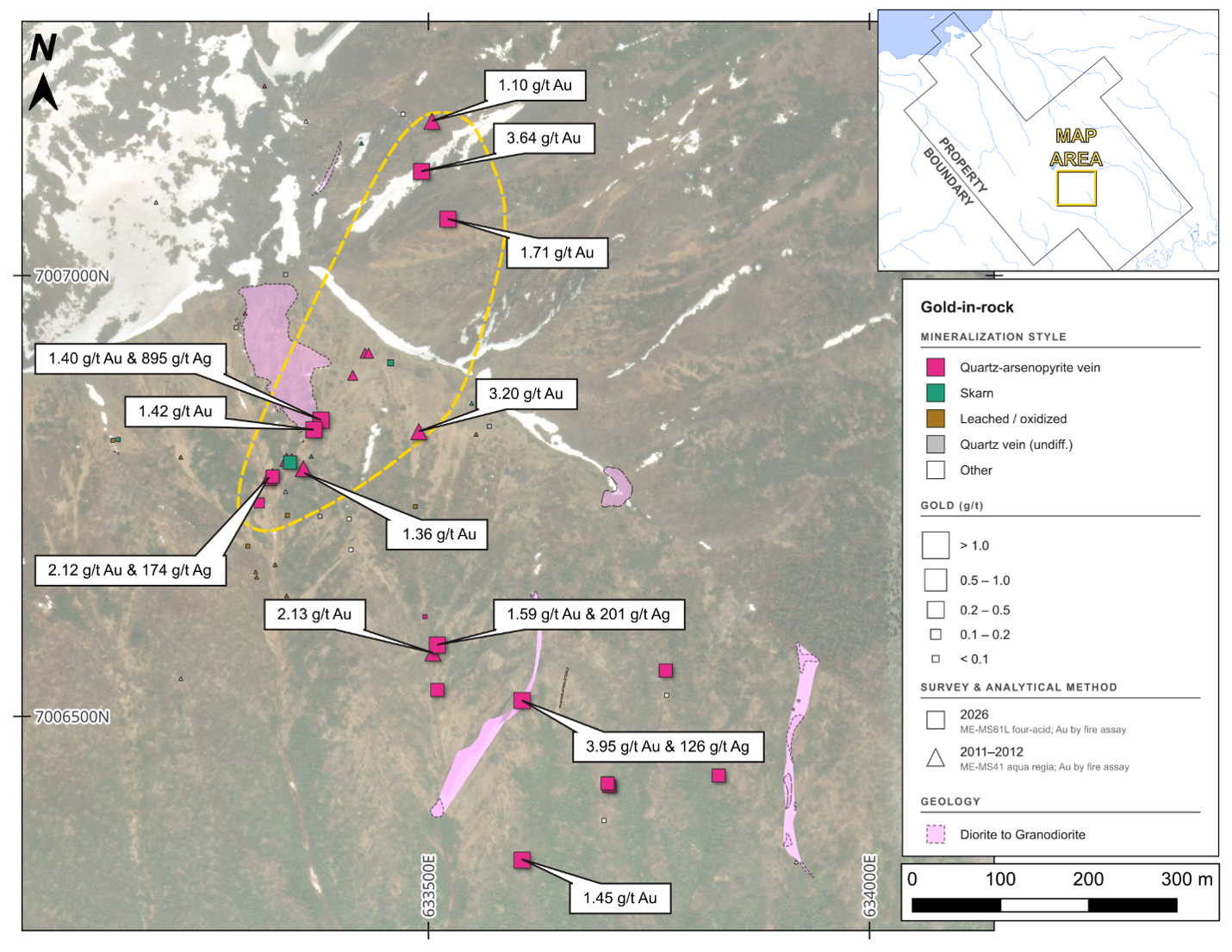
- Multiple, cm-scale quartz-arsenopyrite veins define a gold-bearing corridor traced along a known 525 m strike length. The Gallagher and Neeson showings are now understood to be two points along it, rather than separate occurrences. Eleven rock samples within it exceed 0.5 g/t gold and four exceed 1.5 g/t, including 3.64 g/t gold with 2.27% lead, 3.20 g/t gold , and a vein returning 1.40 g/t gold, 895 g/t silver and 17.85% lead.
- A separate cluster of veins 200 to 500 m south-southeast of the corridor returned the strongest 2026 rock result on the property - 3.95 g/t gold, 126 g/t silver, 1.11% lead and 0.28% copper - with other sample results from all work to date yielding 2.13 g/t gold and 1.59 g/t gold.
- Veining occupies the hornfels aureole around the apex of a locally exposed intrusion, consistent with a minimally eroded cupola previously indicated by magnetic data.
Lois
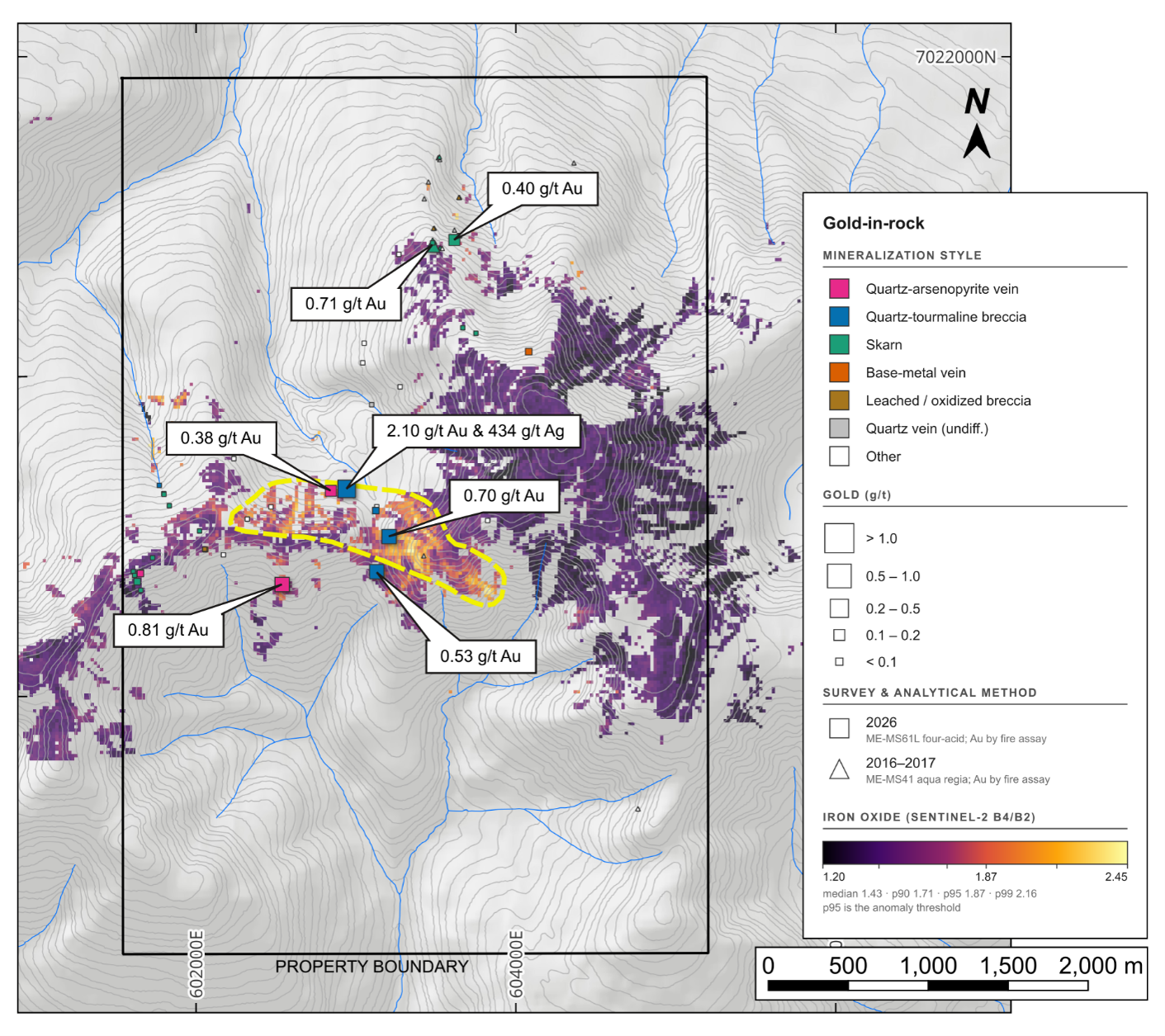
- Quartz-tourmaline breccia defines a corridor approximately 640 metres long, with a further occurrence 1.1 km to the west. A 2026 float sample of the breccia returned 2.10 g/t gold with 434 g/t silver and the corridor's only in-place exposure returned 0.70 g/t gold, while previously uncompiled 1999 rock sampling returned 0.95 g/t gold from its southeast end.
- Processing of Sentinel-2 satellite imagery has delineated iron-oxide anomalies over a 1.6 by 0.8 kilometre area enclosing the corridor. Vegetation obscures roughly half of the area, and the most strongly responding exposed ground has not been rock sampled.
- Four skarn horizons are now recognised on the property, and a highlight 2026 rock sample returned 0.31% copper with 43.6 ppm tin and 106.5 ppm bismuth , a metal association indicating proximity to an intrusive source.
Liam Project
The 2026 program at Liam comprised prospecting, geological mapping and the collection of 50 rock samples and 160 soil samples. Fifteen of the rock samples are quartz-arsenopyrite veins, with the balance comprising quartz veins, skarn, leached and oxidized material, and country rock.
Gold at Liam is hosted in discrete, closely spaced quartz-arsenopyrite veins ranging from approximately 0.5 to 15 centimetres in width, most commonly 1 to 6 centimetres. Individual veins have been traced up to 35 metres along strike and occur in groups in which several veins may be separated by anywhere from tens of centimetres to tens of metres of intervening rock. Gold values are accompanied by elevated bismuth and tellurium, consistent with a reduced intrusion-related gold system. However, gold correlates most strongly with antimony, lead, zinc and silver. This association is interpreted to represent a distal expression of a zoned system, in which the proximal, higher-temperature core has not yet been identified.
Lois Project
2026 exploration work at Lois was supported by a grant for Target Evaluation from the Yukon Mineral Exploration Program (YMEP). The Company conducted prospecting, geological mapping, and the collection of 48 rock samples and 156 soil samples.
Skarn mineralization at Lois has been identified in four separate horizons characterised by pyrrhotite and pyrite with lesser chalcopyrite in tremolite-epidote-diopside alteration, locally accompanied by garnet and magnetite. Nineteen skarn samples were collected in 2026, including chip samples of 0.25 to 1.00 metres across horizons logged at up to two metres thick. The skarns carry copper and bismuth more consistently than gold. A subcrop sample of massive pyrrhotite-chalcopyrite-pyrite from the western-most skarn yielded 0.31% copper, where nearby chip samples returned 190 to 620 ppm copper. The best gold result from 2026 was returned from a skarn 2.9 km away, assaying 0.401 g/t over 0.25 metres. This sample is from an area where prior sampling returned 0.706 g/t gold with 141.5 ppm bismuth.
Quartz-tourmaline breccia occurs intermittently along a corridor of gossanous talus approximately 640 m long, mainly as float with a single in-place exposure, and at a further occurrence 1.1 km to the west. The corridor lies adjacent to a mid-Cretaceous Mayo Suite intrusion. Relative to the other forty 2026 rock samples from Lois, eight rock samples of the breccia were markedly enriched in gold, bismuth and tellurium - the characteristic geochemical signature of reduced intrusion-related gold systems. Gold in these samples ranges from 0.011 to 2.10 g/t and further work will be required to establish the width, grade and continuity of the body.
Upcoming Events
Trifecta Gold management will be attending and/or presenting at the following events:
- Yukon Geoscience Forum - Whitehorse, YK: November 16-19, 2026
- Sphene Capital Mining Dinner Series - Germany: November 23-26, 2026
- AME Roundup - Vancouver, BC: January 25-28, 2027
Quality Assurance / Quality Control (QAQC)
Analytical work for the Rye Project was performed by ALS Minerals, with sample preparation in Whitehorse, Yukon and assays and geochemical analyses in North Vancouver, British Columbia. All rock and soil samples were analysed for 48 elements by four-acid digestion with inductively coupled plasma mass spectrometry and atomic emission spectrometry (ME-MS61L). Gold was determined by fire assay on a 30 gram charge, with an inductively coupled plasma atomic emission finish for samples from Liam (Au-ICP21) and an atomic absorption finish for samples from Lois (Au-AA23). Copper, lead and zinc results exceeding the upper reporting limit of ME-MS61L were re-analysed by ore-grade methods (Ag-/Cu-/Pb-/Zn-OG62).
Technical information in this news release has been approved by Trifecta's Vice President, Jackson Morton, P.Geo., a qualified person as defined under the terms of National Instrument 43-101.
Tombstone Gold Belt
Extending more than 1000 km from the Fairbanks district in Alaska eastward across the entire width of Yukon, the Tombstone Gold Belt hosts many large Reduced Intrusion-Related Gold System (RIRGS) mines such as Fort Knox in Alaska (>10 million oz), Eagle and Olive in Yukon (>4 million oz) and the past-producing Brewery Creek Mine, also in Yukon. Since May 2020 over 20 million additional ounces of gold have been discovered in the Yukon portion of the belt, including Snowline Gold's Tier 1 Valley discovery, Sitka Gold's RC deposit, Banyan Gold's AurMac deposits and Victoria Gold's Raven deposit.
Tombstone Gold Belt systems are characterized by sheeted, auriferous quartz veins forming in the carapace zones of Cretaceous-age plutons. They have a characteristic geochemical signature with a gold-bismuth-tellurium±tungsten core within a broader gold-arsenic halo. The deposits are found within and surrounding the reduced intrusions and typically exhibit a geophysical signature comprising a magnetic low (ie. reduced) coinciding with a conductivity low. Veining in RIRGS is typically zoned with a core of sheeted veins surrounded by more discrete gold-arsenic veins and more distal silver-lead-zinc veins.
About Trifecta Gold Ltd.
Trifecta is a Canadian-based precious metals exploration company dedicated to increasing shareholder value through the discovery and development of 100% held gold projects in mining friendly jurisdictions. Trifecta holds a 100% interest in Mt. Hinton, and 10 other highly prospective, intrusion-related gold projects located in Yukon's Tombstone Gold Belt where over 20 million ounces of gold have been discovered since May 2020. The Company's Eureka Project hosts an 8 x 2.5 kilometre belt of surface showings and anomalous gold-in-soil that straddle the headwaters of two of the most productive placer creeks in Yukon's southern Klondike Goldfields. Trifecta's Treble Project covers a large hydrothermal system, located midway between Western Copper and Gold Corporation's Casino Deposit, the largest copper and gold deposit in the Yukon, and Rockhaven Resources Ltd.'s Klaza Deposit, a high-grade gold-silver deposit. The Company's Yuge (Pearl Gold) Project, located in northern Nevada is under option to Nortec Minerals.
ON BEHALF OF THE BOARD
"Richard Drechsler"
President and CEO
For further information concerning Trifecta or its various exploration projects please visit www.trifectagold.com or contact:
Corporate Information
Trifecta Gold Ltd.
Richard Drechsler
President and CEO
Tel: (604) 687-2522
This news release may contain forward looking statements based on assumptions and judgments of management regarding future events or results that may prove to be inaccurate as a result of exploration and other risk factors beyond its control, and actual results may differ materially from the expected results.
Neither the TSX Venture Exchange nor its Regulation Services Provider (as that term is defined in the policies of the TSX Venture Exchange) accepts responsibility for the adequacy or accuracy of this news release.
SOURCE: Trifecta Gold Ltd.