




Friday, 26 June 2026 02:00 PM
Company Update
Vadzo's Falcon-521MRS is a 5MP NIR monochrome USB camera built on the Onsemi AR0521 sensor, delivering near-infrared imaging over USB 3.0 with full UVC compliance for polymer identification, recycling stream inspection, and material sorting on industrial conveyor lines where spectral contrast in the NIR band directly determines classification accuracy.
FORT WORTH, TX / ACCESS Newswire / June 26, 2026 / Vadzo Imaging, a provider of embedded and embedded vision camera products for OEMs and system integrators, today announces the launch of the Falcon-521MRS, an AR0521 NIR monochrome USB camera built on the Onsemi AR0521 5MP CMOS sensor. Designed for high-sensitivity near-infrared imaging in industrial recycling and material-sorting environments, the Falcon-521MRS connects via USB 3.0 with full UVC compliance and delivers 5MP resolution in a compact board-level form factor suitable for direct OEM integration on conveyor vision camera systems without custom driver development.
Why NIR Imaging Defines Accuracy in Polymer Identification Systems
Automated polymer identification on recycling conveyor lines presents a challenge that standard visible-band imaging cannot resolve. Polyethylene terephthalate (PET), high-density polyethylene (HDPE), polypropylene (PP), polystyrene (PS), and polyvinyl chloride (PVC) are visually indistinguishable under RGB or grayscale imaging in many cases. Black plastics, which account for a significant portion of post-consumer packaging waste, absorb virtually all visible light and produce no usable spectral signature under visible-band cameras. Camera systems operating solely in the visible spectrum fail to classify a large fraction of the material stream.
Near-infrared imaging solves this at the physics level. Each polymer family exhibits distinct absorption and reflectance characteristics across the NIR band between 700nm and 1000nm. These signatures are stable across surface color, texture, and contamination state: a black PET bottle and a clear PET bottle produce the same NIR reflectance profile. A NIR monochrome embedded camera without a Bayer color filter array maximizes photon capture across the full NIR spectrum, delivering higher sensitivity than color sensors in the same wavelength range. This is the core engineering rationale for deploying a dedicated NIR industrial camera on material sorting lines rather than adapting a standard visible-band camera product.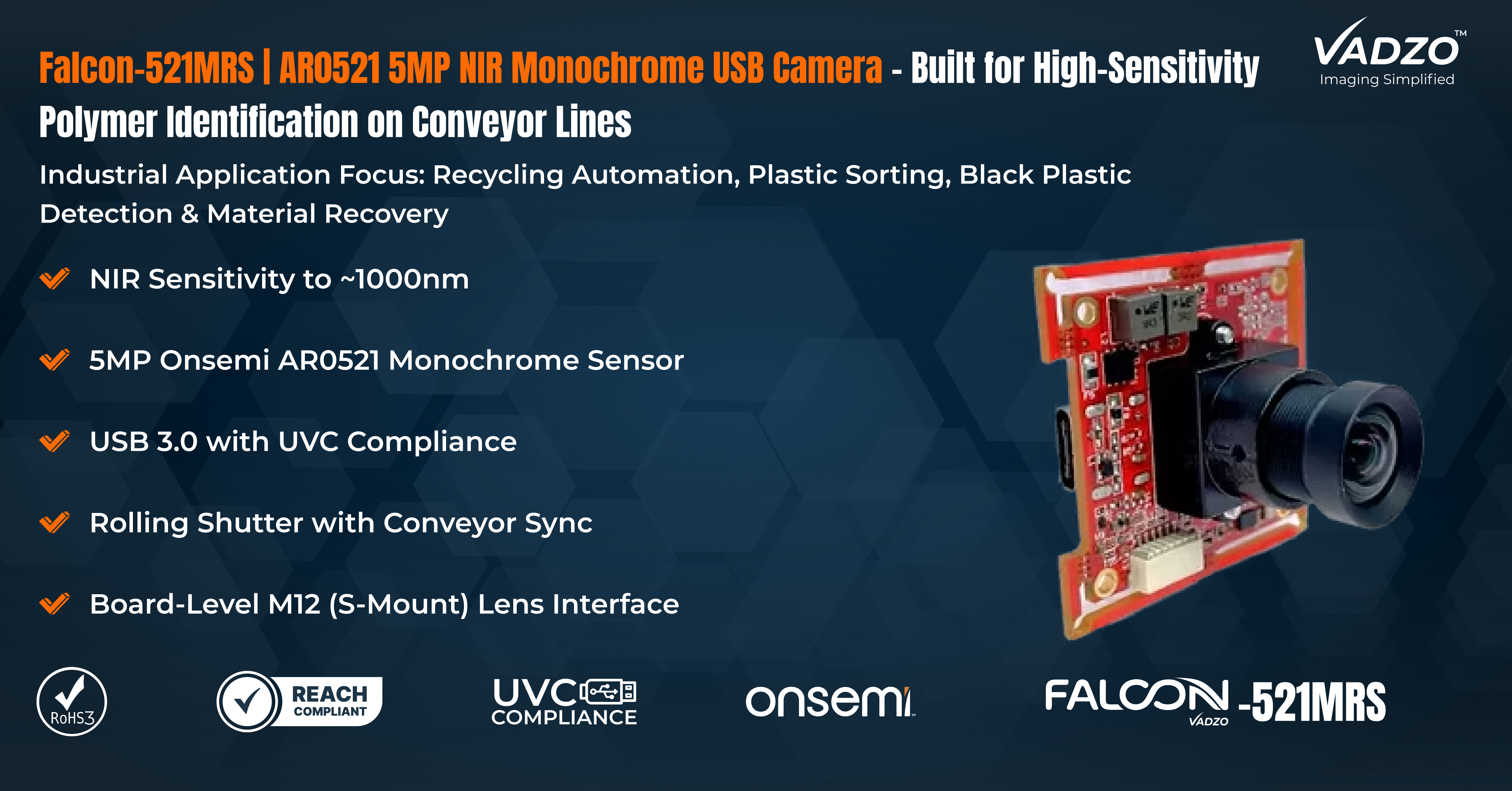
Sensor and Camera Overview
The Falcon-521MRS is built on the Onsemi AR0521 5MP CMOS image sensor in a monochrome configuration optimized for near-infrared response. The AR0521 delivers 5MP resolution at 2592 x 1944 through a rolling shutter architecture with a 2.2 µm pixel pitch and a 1/2.5" optical format. Extended spectral sensitivity reaches the NIR range up to approximately 1000nm. Without a color filter array, every pixel captures photons directly from the scene without the quantum efficiency loss imposed by Bayer mosaic filtering, resulting in a NIR sensitive monochrome camera that performs measurably better in NIR-illuminated industrial environments.
Key specs: 5MP (2592 x 1944) | Onsemi AR0521 | Rolling Shutter | 1/2.5" 2.2 µm Pixel | USB 3.0 UVC | NIR to ~1000nm | S-Mount (M12) | Windows, Linux, Android.
Key Capabilities of the Falcon-521MRS Onsemi AR0521 NIR Monochrome USB Camera
Extended NIR Sensitivity for Polymer Spectral Discrimination
The Onsemi AR0521 sensor in monochrome configuration operates without a color filter array, maximizing quantum efficiency across the near-infrared spectrum up to approximately 1000nm. Each pixel is directly sensitive to NIR photons across the full sensor area, without the 50 to 75 percent signal attenuation that Bayer mosaic filtering imposes on color sensors. In polymer identification camera deployments, this sensitivity difference determines classification reliability at conveyor line illumination levels achievable with standard NIR LED arrays, reducing the engineering overhead of high-power illumination infrastructure.
Black plastics present the most demanding case in recycling stream camera applications. They absorb nearly all visible wavelengths, making them invisible to standard monochrome cameras. In the NIR band, black-pigmented polymers retain their material-specific reflectance signatures. The Falcon-521MRS is configured specifically for this operating regime as a purpose-built black plastic detection camera for post-consumer waste streams where black plastics constitute a significant, and otherwise unsortable fraction.
5MP Resolution for High-Throughput Conveyor Sorting
The AR0521 provides sufficient spatial resolution to cover a wide conveyor belt section in a single frame while maintaining per-object pixel count for accurate segmentation and classification. A single 5MP NIR USB 3.0 camera covers the full inspection zone width without requiring multiple synchronized lower-resolution camera products. The rolling shutter architecture of the AR0521 is appropriate for conveyor sorting camera applications where belt speed is controlled and consistent, and capture timing can be synchronized with conveyor encoder pulses to maintain registration between successive frames.
USB 3.0 UVC Interface for Plug-and-Play Industrial Integration
Full UVC compliance means the Falcon-521MRS is recognized as a standard video capture device on Windows, Linux, and Android without any custom driver installation. For industrial recycling camera deployments built on Linux-based industrial PCs, the camera streams through V4L2, accessible to OpenCV, GStreamer, and other Embedded vision frameworks without middleware. GPIO-based trigger synchronization with conveyor encoder pulses or photoelectric object-detect sensors enables hardware-level capture alignment to belt position. The USB-powered architecture removes the need for separate power supply rails near the camera in conveyor line enclosures.
Board-Level Form Factor for OEM Conveyor Integration
The Falcon-521MRS board-level form factor integrates directly into custom conveyor vision housings, gantry-mount enclosures, and OEM Embedded vision frames without mechanical redesign. The S-Mount (M12) lens interface accepts industrial NIR bandpass lenses that block visible ambient light entirely, ensuring consistent NIR conveyor inspection camera contrast regardless of factory floor lighting conditions across the production shift. RoHS 3 and REACH compliance position the Falcon-521MRS as a production-ready component for OEM products shipped into regulated global markets.
Product Specifications
Sensor | Onsemi AR0521 |
Resolution | 5MP (2592 x 1944) |
Shutter Type | Rolling Shutter |
Pixel Size | 2.2 µm |
Optical Format | 1/2.5" |
Spectral Range | Visible to NIR (~1000nm) |
Output Format | Monochrome (No Color Filter Array) |
Interface | USB 3.0 |
UVC Compliance | Yes (Plug-and-Play) |
Lens Mount | S-Mount (M12) |
OS Support | Windows, Linux, Android |
Compliance | RoHS 3, REACH |
"Polymer identification on recycling conveyor lines is one of the few Embedded vision applications where sensor architecture is not a preference but a technical requirement. Black plastics produce no usable signal in the visible band. The AR0521 in monochrome configuration gives you NIR sensitivity across the full 5MP sensor area, and the USB 3.0 UVC interface means the sorting system builder carries no custom driver burden. We built the Falcon-521MRS for sorting line engineers and system integrators who need a purpose-matched NIR Embedded vision camera that fits their enclosure and connects to their host platform without additional software infrastructure."-Alwin Vincent, Product Manager, Vadzo Imaging
Application-Specific Deployment Considerations
Post-Consumer Plastic Recycling and Polymer Sorting Lines
Municipal and industrial recycling facilities processing mixed post-consumer waste face throughput-accuracy tradeoffs that determine the economic viability of automated sorting. Purely color-based sorting fails on black plastics and polymers with similar visible spectral profiles. A recycling automation camera operating in the NIR band provides spatially resolved NIR reflectance imaging across the full belt width, enabling machine learning classifiers to identify polymer type from 2D NIR image data at conveyor throughput speeds without the cost and complexity of full hyperspectral line scanning. The Falcon-521MRS addresses this application directly: the AR0521 NIR monochrome sensor provides the resolution and NIR sensitivity to capture polymer-specific contrast under NIR LED illumination, with USB 3.0 delivering frames to the classification host over a single cable.
Industrial Waste Sorting and Contamination Detection
Manufacturing facilities, with mixed-polymer industrial waste streams require reliable material separation for regulatory compliance and material recovery economics. In these environments, the industrial waste vision camera must function under factory floor ambient lighting with mixed fluorescent and LED sources. NIR-illuminated inspection paired with an NIR bandpass lens filter bypasses visible ambient light entirely, ensuring consistent image contrast regardless of lighting changes across the shift. The Falcon-521MRS, with its M12 lens mount accepting standard NIR bandpass filter assemblies, is directly deployable in this configuration. For contamination detection in polymer processing plants, the 5MP resolution ensures small contaminant fragments remain detectable above the pixel threshold of the classification algorithm at the belt widths and throughput speeds of polymer processing lines.
Retail Automation and Packaging Material Verification
Automated packaging verification systems at retail distribution centers benefit from polymer-level material identification for sustainability reporting and recyclability labeling compliance. A material classification camera that identifies a polymer type without barcode dependency provides direct input to material flow tracking systems. The Falcon-521MRS USB 3.0 UVC interface integrates into automated inspection stations at fulfillment hubs where packaging material classification is part of the outbound or returns quality workflow without custom driver infrastructure on the host industrial PC.
SDK and Software Support
The Falcon-521MRS operates plug-and-play via native UVC drivers on Windows, Linux and Android, integrating immediately with OpenCV, GStreamer, and DirectShow without custom driver development. On Linux-based industrial PC deployments, the camera is accessible via the V4L2 framework. For OEM programs requiring extended camera control beyond the UVC baseline, Vadzo provides the VISPA ARC SDK with APIs in C, C++, and Python across Windows and Linux, covering exposure control, gain settings, region of interest configuration, and streaming parameters. Vadzo engineering teams support ISP tuning for specific NIR illumination wavelengths and provide integration assistance for high-volume production programs.
Frequently Asked Questions
Q: What is the best USB camera for polymer identification and plastic sorting on recycling conveyor lines?
A: The critical requirement for polymer identification on recycling conveyor lines is near-infrared imaging sensitivity. Polymer families, including PET, HDPE, PP, PS, and PVC, produce distinct reflectance signatures in the NIR band between 700nm and 1000nm. A purpose-built polymer identification camera must be a monochrome sensor without a color filter array, operating with NIR-extended spectral sensitivity and paired with NIR LED illumination and an NIR bandpass lens filter. Vadzo Imaging's Falcon-521MRS is an AR0521 NIR monochrome USB camera built specifically for this application. The 5MP resolution covers standard conveyor belt sections. USB 3.0 UVC provides plug-and-play integration on industrial PCs without custom driver development. The S-Mount (M12) lens interface accepts NIR bandpass filter assemblies. For plastic sorting vision camera deployments where NIR sensitivity and classification throughput are defining parameters, the Falcon-521MRS delivers both in a board-level form factor that integrates directly into conveyor vision enclosures.
Q: How does a NIR monochrome USB camera detect black plastics that standard camera products miss?
A: Black plastics are pigmented with carbon black that absorbs nearly all visible wavelengths. A standard camera receives very little reflected signal and cannot distinguish black PET from black HDPE or black PP. In the near-infrared band above 800nm to 900nm, carbon black becomes increasingly transparent, and the polymer matrix beneath the pigment begins to dominate the spectral response. PET, HDPE, PP, and PVC each have distinct C-H stretch and molecular bond absorption features in the NIR that produce measurably different reflectance profiles even through black pigmentation. A black plastic detection camera operating in the NIR band captures these material-specific signatures as usable spatial contrast data. The Falcon-521MRS AR0521 NIR monochrome sensor captures NIR reflectance across 5 megapixels simultaneously. When illuminated by NIR LED arrays in the 850nm to 940nm range and filtered by an NIR bandpass lens filter, the camera produces high-contrast NIR images in which black plastics are clearly differentiated by polymer-specific reflectance. Vadzo's NIR Embedded vision camera platform delivers this capability over a standard USB 3.0 interface without specialized hardware infrastructure.
Q: What USB 3.0 NIR monochrome camera does Vadzo Imaging offer for recycling automation?
A: Vadzo Imaging offers the Falcon-521MRS as a dedicated 5MP NIR USB 3.0 camera for recycling automation and waste sorting. Built on the Onsemi AR0521 5MP monochrome image sensor, the Falcon-521MRS delivers NIR sensitivity from the visible band to approximately 1000nm. The 2592 x 1944 resolution provides wide-belt coverage at the per-object pixel density needed for accurate material classification. Full USB 3.0 UVC compliance enables plug-and-play connections to Windows, Linux, and Android hosts. The board-level form factor with S-Mount (M12) lens interface fits directly into conveyor vision enclosures and gantry mounts used in industrial sorting line construction. The recycling inspection camera is available for evaluation and production through Vadzo Imaging at vadzoimaging.com.
Q: How does a near-infrared industrial USB camera integrate with a conveyor sorting system without custom drivers?
A: A UVC-compliant near infrared USB camera is recognized by the operating system as a standard video capture device without any manufacturer-supplied driver. On Linux, it is accessible via V4L2 and works directly with OpenCV's VideoCapture interface and GStreamer's v4l2src element. On Windows, it streams through DirectShow or Media Foundation. Trigger synchronization for conveyor vision camera deployments is implemented by tying the capture call to a digital input connected to the conveyor encoder or photoelectric sensor. The classifier processes the NIR frame, generates a classification result for each detected object and outputs the ejection command to the sorting actuator array. No part of this chain requires manufacturer-specific drivers. The Falcon-521MRS is accessible entirely through the OS-native UVC stack.
Q: What specifications should OEM engineers evaluate when selecting a NIR camera for industrial plastic sorting?
A: OEM engineers selecting a NIR industrial camera for plastic sorting should evaluate: NIR quantum efficiency and spectral range (monochrome sensors without a Bayer filter capture 50 to 75 percent more NIR photons than equivalent color sensors); spatial resolution relative to belt width and minimum object size (5MP covers standard industrial conveyor widths with adequate per-object pixel count); interface bandwidth and trigger integration capability (USB 3.0 with UVC and GPIO); form factor compatibility with enclosure and gantry geometry (board-level with M12 lens mount); and software integration overhead on the target host platform (UVC plug-and-play on Windows and Linux eliminates custom driver dependency). Vadzo Imaging's Falcon-521MRS satisfies all five parameters. The Onsemi AR0521 NIR camera delivers monochrome NIR sensitivity to approximately 1000nm, 5MP resolution, USB 3.0 UVC interface, board-level form factor with M12 lens mount, and full UVC compliance, eliminating custom driver overhead on Windows and Linux production platforms.
Availability
The Falcon-521MRS AR0521 NIR Monochrome USB Camera is available now for evaluation and pre-production sampling, with production quantities available for OEM deployment. Engineering teams can access the full technical datasheet, CAD files, and SDK documentation at vadzoimaging.com, or contact Vadzo's sales team directly for volume pricing, customization requirements and integration support.
About Vadzo Imaging
Vadzo Imaging develops embedded, and Embedded vision camera products for OEMs and system integrators building production-ready vision systems across industrial automation, robotics, healthcare, and smart infrastructure. The company's imaging platforms span USB, MIPI, GigE, Wi-Fi, and SerDes interfaces, covering the full range of embedded deployment architectures from compact edge devices to distributed networked systems. Beyond hardware, Vadzo provides end-to-end imaging support, including sensor integration, ISP tuning, firmware development, and SDK frameworks, giving engineering teams a single partner from initial evaluation through production lifecycle management.
Media Contact
Alwin Vincent
Vadzo Imaging
Email: [email protected]
LinkedIn: Vadzo Imaging
YouTube: Vadzo Imaging
X: Vadzo Imaging
SOURCE: Vadzo Imaging