





Friday, 26 June 2026 10:15 PM
Advertorial
As interest in daily vision support and screen-related eye wellness continues rising in 2026, this VISIVRA review explores the brand-stated ingredient profile, how the formula is positioned for ocular nutrition support, what buyers are checking before ordering, and which transparency factors may influence individual experiences.
AURORA, CO / ACCESS Newswire / June 26, 2026 / Disclaimers: This article contains affiliate links and is promotional in nature. A commission may be earned on purchases at no extra cost to you. These statements have not been evaluated by the FDA. This product is not intended to diagnose, treat, cure, or prevent any disease. See full disclosures at the bottom of this article.
Explore VISIVRA's Current Packages and Pricing on the Official Site
VISIVRA Consumer Research 2026: Reviewing What Buyers Should Know Before Ordering This Eye Health Support Supplement
VISIVRA Quick Summary: What You Can Verify Before You Buy
If you're 30 seconds from clicking "buy" on VISIVRA, stop here first. There is one thing Vigorus's product page doesn't publish - specific ingredient dosages - and it's the most important number for evaluating whether this formula matches what the published research actually studied. That gap is the reason this article exists. What follows gives you everything the brand's page gives you, plus what it doesn't: an ingredient-level research breakdown, the exact terms of the 60-day refund policy as written on the returns page, and a 12-point buyer checklist you won't find in any ad. VISIVRA is a dietary supplement sold by Vigorus and processed through BuyGoods, built around Lutein, Zeaxanthin, Bilberry Extract, Astaxanthin, Zinc, and Vitamin A under a framework the brand calls "The Ocular Support & Visual Clarity Matrix." It's not a drug. It's not FDA-approved. Here's what you need to know before you decide.
VISIVRA 2026 Fast Facts: What Every Buyer Should Know in 30 Seconds
VISIVRA product category: dietary supplement for eye health and visual wellness support
VISIVRA brand operator: Vigorus (named in the brand's published Terms of Service and Disclaimer at visivra.online)
VISIVRA retailer: BuyGoods (referenced for identification of the checkout and retailer relationship only; BuyGoods is a Delaware corporation at 1201 N Orange Street Suite #7223, Wilmington, DE 19801)
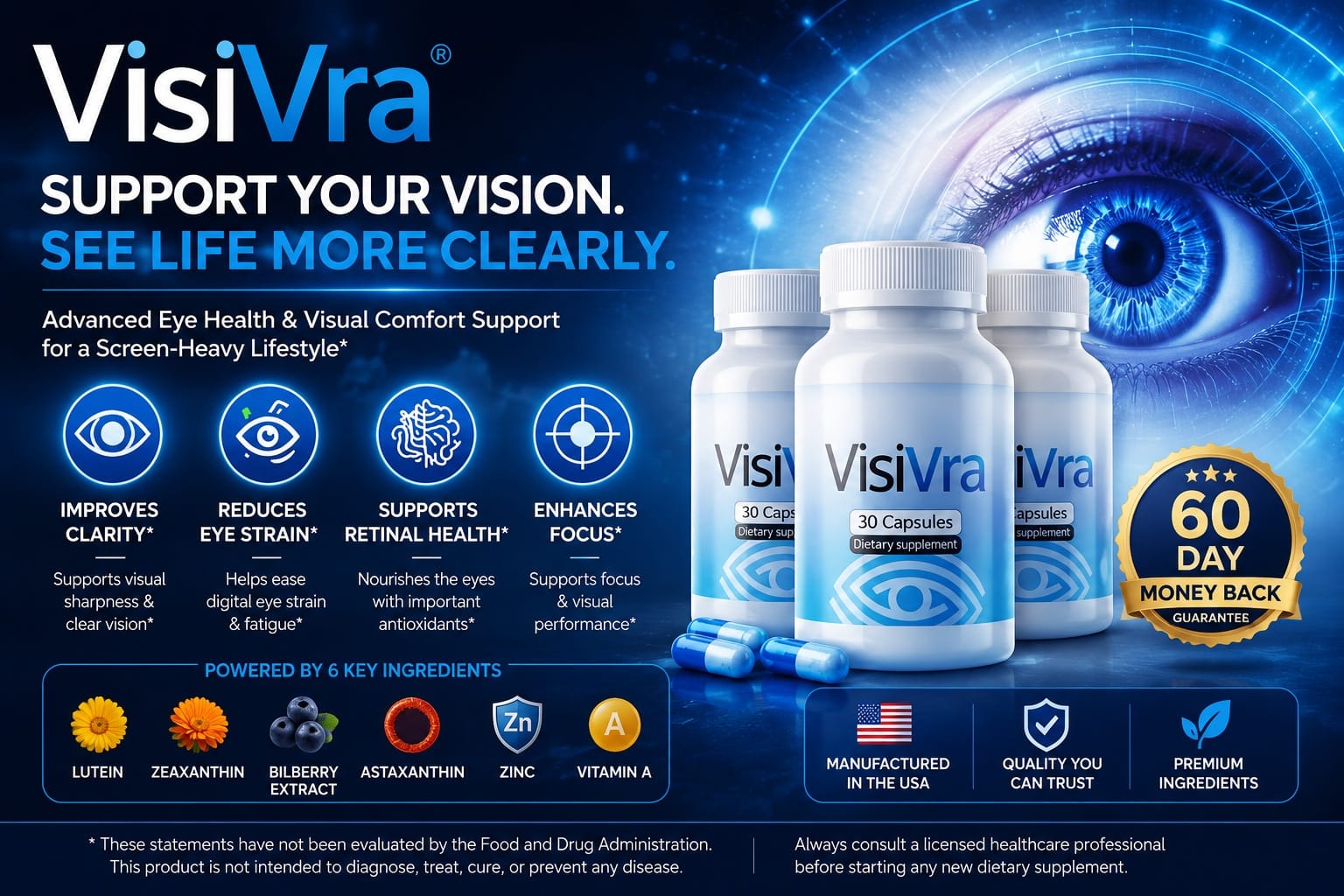
VISIVRA ingredients (brand-stated): Lutein, Zeaxanthin, Bilberry Extract, Astaxanthin, Zinc, Vitamin A
VISIVRA formula framework (brand-named): "The Ocular Support & Visual Clarity Matrix"
VISIVRA dosage transparency: specific mg amounts per ingredient are NOT published on the brand's official page as of June 2026 - this is the one thing to resolve before ordering, not after
VISIVRA manufacturing (brand-stated): manufactured in the United States
VISIVRA third-party certification: not disclosed on the official brand page as of June 2026 - ask the brand directly at [email protected] if certification status affects your purchase decision
VISIVRA pricing (brand-stated, as of June 2026): 2-bottle $158 plus shipping; 3-bottle $207 plus shipping; 6-bottle $294 with shipping costs as displayed at checkout - verify current total before ordering
VISIVRA per-bottle pricing (brand-stated): $79 for 2-bottle; $69 for 3-bottle; $49 for 6-bottle
VISIVRA refund policy: brand-published 60-day window from purchase date - NOT from delivery; if your order takes 10 days to arrive, your practical trial window is already under 7 weeks; contact support before returning; buyer pays return shipping; all bottles plus packing slip required
VISIVRA contact: [email protected] | +1 323-347-4522 | SHIPOFFERS, 19655 E 35th Dr #100, Aurora, CO 80011
VISIVRA FDA status: not FDA-approved; not intended to diagnose, treat, cure, or prevent any disease
VISIVRA testimonials: brand site discloses that some names on the site have been changed to protect privacy
VISIVRA Accesswire/Newswire publication status: publisher records should be consulted to verify prior wire publication history before including first-release claims
Information current as of: June 2026
Buyer Takeaway: VISIVRA combines six brand-stated ingredients with a published research history relevant to eye health. Specific dosages per ingredient aren't disclosed on the brand's product page - that's the one question worth resolving before you order, not after your package arrives. The brand-published 60-day refund window starts at purchase date, giving you a real trial option, but only if you start using the product promptly. Verify every detail that affects your decision at Visivra.online before you complete your order.
Explore VISIVRA's Current Packages and Pricing on the Official Site
Disclosure: If you buy through this link, a commission may be earned at no extra cost to you.
Quick Answer: What Is VISIVRA?
VISIVRA is a dietary supplement from Vigorus combining Lutein, Zeaxanthin, Bilberry Extract, Astaxanthin, Zinc, and Vitamin A for eye health support. Three things to know before ordering: specific ingredient dosages aren't published on the brand page as of June 2026; the 60-day refund window starts at purchase date, not delivery; and you must contact support before returning any bottles. It's not a drug and not FDA-approved. Individual results vary.
Why This Review Gives You More Than the Brand's Page Does
You've already seen Vigorus's product page. It tells you the six ingredients, the pricing, the guarantee headline, and the brand's take on its own formula. What it doesn't tell you: the specific dosage per ingredient, exactly what the returns policy requires step by step, or what the published research on each ingredient category actually says versus what the marketing implies.
That's the gap this article fills. You'll get a straight ingredient-by-ingredient research breakdown, the exact returns process pulled directly from the brand's published policy page, a 12-point checklist of things to confirm before you order, and an honest read on where the evidence is strong and where it isn't. Think of it as the conversation you'd want with a friend who's spent time reading the eye health research - someone who'll tell you what's worth knowing without trying to sell you something or scare you off something that doesn't deserve dismissal.
One note before you read: if you're managing a diagnosed eye condition - macular degeneration, glaucoma, cataracts - this article is useful background, but that conversation belongs with your eye care provider, not a supplement review. For everyone else, read on.
How to Read VISIVRA's Marketing Language
Before we look at the ingredients and the research, it's worth spending a moment on the language the brand uses - because understanding what those phrases actually mean puts you in a much better position to evaluate everything else.
"The Ocular Support & Visual Clarity Matrix" is Vigorus's brand-created framework name. It's not a clinically recognized term, a standardized formulation category, or a third-party certification. It's the brand's way of describing its multi-ingredient approach. It tells you Vigorus has thought about how these ingredients work together - it doesn't tell you the specific combination has been independently tested as a finished product.
"Designed to support visual clarity" is structure-function language within the meaning of DSHEA, the Dietary Supplement Health and Education Act. Under DSHEA, a supplement brand may describe how a product is intended to support a body structure or function - as long as it has substantiation for that claim and includes the required FDA disclaimer. It does not mean the product has been proven to improve clinical visual acuity, and it does not mean FDA has evaluated or approved that statement.
"Premium formula" and "breakthrough concept" are marketing descriptors reflecting the brand's confidence in its product. They don't correspond to a regulatory standard or an independent benchmark.
"Generally well tolerated" means the brand believes the ingredients at intended use levels don't carry a high adverse-event profile for most healthy adults. It's not a clinical safety clearance for every individual, and it doesn't mean there are no contraindications for people on specific medications or with specific health conditions.
Knowing what each of these phrases does and doesn't mean puts you in control of the conversation - which is exactly where a buyer should be.
Buyer Takeaway: VISIVRA's promotional language reflects Vigorus's brand positioning and marketing intent. None of it represents independent third-party verification, FDA review, or publication-substantiated performance claims. Read each phrase as "what the brand says about this product" - then evaluate the ingredients and research separately.
Does VISIVRA Work for Eye Health?
Here's the honest version of this answer: the six ingredients Vigorus uses have published research relevance to eye health nutrition. Lutein and Zeaxanthin sit at the top of the evidence stack for macular support. Astaxanthin has been specifically studied in screen-use populations alongside those two carotenoids, with measurable results in at least one published randomized, placebo-controlled trial. Bilberry Extract, Zinc, and Vitamin A each have well-documented roles in eye tissue function in nutritional science.
What that doesn't mean: VISIVRA is not a drug and isn't FDA-approved to treat, cure, or prevent any eye condition. The research is at the ingredient level - on individual compounds or combinations studied under controlled conditions - not on VISIVRA as a finished product. No eye supplement can legally claim to treat a diagnosed condition, and this article won't imply otherwise. But "not a drug" doesn't mean "not worth evaluating." The question is whether the ingredient profile is research-grounded enough to warrant a trial - and that answer takes a closer look at each compound.
What that ingredient-level research suggests, at a category level: the six compounds Vigorus uses are among the more commonly studied nutrients in eye health research. Lutein and Zeaxanthin, in particular, have a substantial published research history around macular pigment and blue light filtration. Astaxanthin has been studied alongside Lutein and Zeaxanthin specifically in screen-use populations. Zinc and Vitamin A both have well-established roles in retinal function. Bilberry Extract has an established presence in the category, with documented antioxidant activity.
What the ingredient-level research does NOT tell you: how much of each ingredient is in VISIVRA's formula, whether those amounts align with the amounts studied in published trials, whether the specific combination in VISIVRA produces any particular outcome for you, or whether results will be noticeable within any given timeframe. Individual results vary significantly.
For buyers dealing with a diagnosed clinical condition - AMD, cataracts, glaucoma, diabetic retinopathy - the research picture is more nuanced than most supplement marketing acknowledges. The strongest evidence in eye supplement research comes from the AREDS and AREDS2 studies, which used specific formulas in specific populations with intermediate-to-advanced AMD. VISIVRA is not presented here as an AREDS or AREDS2-equivalent formula unless Vigorus publishes matching dosages and ingredient alignment - which hasn't happened on the official product page as of June 2026.
Buyer Takeaway: VISIVRA's six brand-stated ingredients have published research relevance to eye health at the ingredient level. The research tells you the ingredients are worth knowing about - it doesn't guarantee any individual result. The way to find out if this formula makes a difference for you is to try it within the brand-published 60-day refund window. But the clock starts at purchase, not delivery - so if you're going to order, don't delay starting. Individual results vary.
VISIVRA Ingredients List: What's in the Formula and What Each One Is Studied For
The following breakdown covers what each brand-stated ingredient has been studied for at the category level. The research cited here is ingredient-level research, not clinical testing of VISIVRA as a finished product. Specific dosages in VISIVRA aren't published on the official brand page as of June 2026, so this analysis covers what each compound is, what the published research discusses, what VISIVRA hasn't disclosed, and what that means for buyers.
Lutein
What it is: Lutein is a carotenoid pigment naturally concentrated in the macular region of the human retina. Along with Zeaxanthin, it forms the macular pigment, which acts as the eye's built-in blue-light filter.
What ingredient-level research suggests: Published research - including studies referenced by NCCIH, the National Center for Complementary and Integrative Health - documents Lutein's role in supporting macular pigment optical density (MPOD) and filtering high-energy visible blue light. The AREDS2 study found that replacing beta-carotene with a Lutein and Zeaxanthin combination may further reduce AMD progression in people already at increased risk - a meaningful finding for a specific at-risk population. For general healthy adults, the dietary gap in Lutein is real: most people who don't regularly eat kale, spinach, or eggs in substantial amounts aren't getting meaningful amounts through diet alone.
What VISIVRA doesn't disclose: The specific milligram amount of Lutein in VISIVRA's formula isn't published on the official product page as of June 2026. Without knowing the dose, it's not possible to compare VISIVRA's Lutein content to the amounts studied in published trials.
Buyer Takeaway: Lutein is one of the most research-backed ingredients in the eye health supplement category. The research is strongest for macular support in at-risk AMD populations, with meaningful relevance for general adults addressing dietary gaps. The specific Lutein dose in VISIVRA isn't publicly disclosed - that's a question worth putting to the brand at [email protected] before you order, not after the bottles are sitting on your counter.
Zeaxanthin
What it is: Zeaxanthin is Lutein's partner carotenoid in the macular pigment, concentrating primarily in the central fovea - the part of the retina responsible for sharp central vision. The two carotenoids work together as complementary filters across different zones of the macula.
What ingredient-level research suggests: Published research has examined Zeaxanthin's contribution to MPOD alongside Lutein. A published randomized, placebo-controlled trial examining the combination of Astaxanthin, Lutein, and Zeaxanthin in adults who work with visual display terminals (VDTs) found the active group showed significantly improved eye-hand coordination at eight weeks and a significant increase in MPOD. That's ingredient-level evidence specifically relevant to the screen-heavy population VISIVRA is positioned for - though it's research on the ingredient combination, not on VISIVRA as a product.
What VISIVRA doesn't disclose: The exact amount of Zeaxanthin isn't published on the brand's official page. The AREDS2 context involves a specific 5:1 Lutein-to-Zeaxanthin ratio - without published dosages, buyers can't verify alignment.
Buyer Takeaway: Zeaxanthin pairs synergistically with Lutein for macular support and has specific ingredient-level research relevance for screen users alongside Astaxanthin. Dosage transparency from Vigorus would strengthen confidence in this ingredient's inclusion.
Bilberry Extract
What it is: Bilberry (Vaccinium myrtillus) is a European berry plant whose anthocyanin content has been studied in the context of ocular circulation and visual adaptation. It's a recognized ingredient in the eye health supplement category.
What ingredient-level research suggests: Published category research connects Bilberry Extract's anthocyanins to antioxidant activity and potential support for the blood vessels supplying retinal tissue. The clinical evidence is less definitive than the Lutein/Zeaxanthin literature - most Bilberry studies are smaller, and the findings are more exploratory. That said, its antioxidant mechanism and consistent presence in eye health formulations reflect a recognized nutritional rationale.
What VISIVRA doesn't disclose: The extraction ratio and milligram amount are not published. The specific form of Bilberry Extract (standardized anthocyanin percentage vs. raw berry extract) matters for evaluating relevance to published research - that detail isn't available on the brand's page as of June 2026.
Buyer Takeaway: The inclusion of Bilberry Extract aligns with standard eye supplement formulation practices. Its evidence base is less robust than the macular carotenoids but reflects a recognized nutritional category. Dosage and extract form details would help buyers assess alignment with published research.
Astaxanthin
What it is: Astaxanthin is a fat-soluble carotenoid with documented antioxidant activity - including in in vitro contexts where it has been compared favorably to other common antioxidants. In the context of eye health, published research has examined Astaxanthin's contribution to visual performance in adults who use digital screens.
What ingredient-level research suggests: The randomized, placebo-controlled trial examining Astaxanthin combined with Lutein and Zeaxanthin in VDT operators found the active group showed significantly improved eye-hand coordination and increased MPOD at eight weeks. This trial is directly relevant to VISIVRA's target population - adults managing screen-heavy work and lifestyle demands. Astaxanthin's fat-soluble nature means it absorbs best with food, which is worth noting for daily supplement timing.
What VISIVRA doesn't disclose: The specific milligram amount isn't published. Published trials on Astaxanthin for eye health have used specific dose ranges - without knowing VISIVRA's amount, alignment with those ranges can't be confirmed.
Buyer Takeaway: Astaxanthin is one of the stronger differentiators in VISIVRA's ingredient profile - it has been specifically studied alongside Lutein and Zeaxanthin in screen-use contexts. Take VISIVRA with food for optimal fat-soluble carotenoid absorption. Dosage transparency from the brand would allow better comparison to studied amounts.
Zinc
What it is: Zinc is a trace mineral with an established role in retinal biochemistry, including as part of the antioxidant enzyme system that supports retinal tissue. It's a component of the original AREDS formulation - among the most studied nutritional approaches to AMD risk.
What ingredient-level research suggests: The NCCIH and the research behind the AREDS studies both identify Zinc as relevant to macular health and retinal antioxidant function. Its inclusion in VISIVRA reflects that established research context.
What VISIVRA doesn't disclose: The Zinc amount isn't published on the brand's page. This matters for a practical reason: Zinc is present in many multivitamins and specialty supplements. Excessive total daily Zinc intake over time can deplete copper and may interact with certain antibiotics (quinolones, tetracyclines) and diuretics. Without knowing VISIVRA's dose, buyers who take other Zinc-containing supplements can't accurately calculate combined intake.
Buyer Takeaway: Zinc has strong research backing for retinal function and appears in the AREDS formulation context. Before starting VISIVRA, total your daily Zinc from all sources - and if you're on antibiotics or diuretics, talk to your prescribing doctor first. The dose in VISIVRA isn't published on the brand page as of June 2026.
Vitamin A
What it is: Vitamin A is a fat-soluble vitamin essential for producing rhodopsin - the photopigment in retinal rod cells that enables low-light and night vision. It also supports the health of the eye surface and tear film integrity.
What ingredient-level research suggests: Vitamin A's role in visual function is one of the most established connections in nutritional science. Deficiency is one of the leading preventable causes of vision impairment globally. For adults with adequate Vitamin A status, however, additional supplementation is unlikely to produce dramatic functional improvements - the benefit is most pronounced when addressing a genuine deficiency.
What VISIVRA doesn't disclose: The Vitamin A amount isn't published. This is particularly relevant because Vitamin A is fat-soluble and accumulates in the body - long-term high-dose supplementation carries a risk of toxicity. Buyers already taking a multivitamin, cod liver oil, or other Vitamin A-containing supplements need to know VISIVRA's dose to calculate safe combined intake. Pregnant women and women who may become pregnant should discuss any Vitamin A supplementation with a healthcare provider, as excess Vitamin A is associated with fetal risk.
Buyer Takeaway: Vitamin A is critical for retinal and night vision function. Because it's fat-soluble and accumulates, total daily intake across all supplements matters. Calculate your combined Vitamin A before adding VISIVRA - and if you're pregnant or planning pregnancy, consult a healthcare provider first. The specific amount in VISIVRA isn't on the brand's page as of June 2026.
What the Ingredient Research Adds Up To - and What It Doesn't Prove
Let's be direct about what the ingredient-level research on VISIVRA's six brand-stated compounds actually tells a buyer.
Lutein and Zeaxanthin are the most rigorously studied nutrients in eye health supplementation. Their roles in macular pigment, blue-light filtration, and retinal antioxidant protection are documented across multiple research contexts, including the AREDS2 trial funded by the National Eye Institute. For adults who don't consistently eat lutein-rich foods, there's a plausible nutritional rationale for supplementation.
Astaxanthin combined with Lutein and Zeaxanthin has been examined in at least one published, randomized, placebo-controlled trial specifically in VDT operators - the screen-heavy adult population that VISIVRA is positioned for. That combination is a legitimate differentiator from simpler single-carotenoid formulas.
Bilberry Extract's anthocyanins have antioxidant activity and are well-established in eye health research, with a more exploratory evidence base than the macular carotenoids.
Zinc and Vitamin A both have well-established roles in retinal function - Zinc in the antioxidant enzyme system and AREDS context, Vitamin A in rhodopsin production and eye surface health.
What the research does NOT establish: none of this tells you how much of each ingredient is in VISIVRA, whether the combination has been tested as a finished product, or whether VISIVRA will produce any particular result for any individual buyer. Results depend on starting nutritional status, dietary intake, consistency of use, age, genetics, and other individual factors.
AREDS and AREDS2 are important contexts for eye supplement research - but VISIVRA is not presented here as an AREDS or AREDS2-equivalent formula unless Vigorus publishes matching dosages and ingredient alignment.
Buyer Takeaway: VISIVRA's six brand-stated ingredients each have a published research context relevant to eye health nutrition. The three-carotenoid combination is a genuine differentiator in this category. Dosage transparency is the central unresolved question - without it, you can't confirm alignment with the amounts studied. That's a question for the brand before you order, not something to hope for after. Individual results vary.
The Honest Evidence Balance: What NIH Research Says About Eye Supplements in 2026
Most supplement reviews in this category either ignore the research limitations entirely or lead with so many caveats that the useful information gets buried. Neither serves you. Here's what the NIH's published guidance actually says about eye health supplements in 2026 - the evidence that's strong, the evidence that isn't, and what that means for your decision.
According to the NCCIH (National Center for Complementary and Integrative Health, part of the National Institutes of Health), the strongest evidence for nutritional supplementation in eye health comes from the AREDS and AREDS2 studies. These trials examined specific formulations in people with intermediate or advanced AMD in one eye. AREDS2 found that replacing beta-carotene with a Lutein and Zeaxanthin combination may further reduce the risk of AMD progression in that specific population. These findings apply to a specific clinical context, with specific dosages and combinations - they don't automatically extend to all adults taking any eye supplement.
The NCCIH also notes that current data don't support dietary supplementation with vitamins A, C, or E specifically for glaucoma. For general adult populations without diagnosed AMD, the evidence that nutritional supplementation measurably improves visual acuity or prevents eye disease isn't as straightforward as most supplement marketing suggests.
What the evidence does support more consistently: nutritional support through adequate Lutein and Zeaxanthin intake for adults whose diets are low in leafy greens and eggs. The published research on the Astaxanthin-Lutein-Zeaxanthin combination specifically in screen-heavy adults adds meaningful ingredient-level support for that use case.
A physician reviewing this category would likely say: the ingredients aren't harmful at reasonable doses for most healthy adults, the research is most established for macular support in AMD-risk populations, and supplementation makes the most sense for adults with documented dietary gaps in these carotenoids. That's a fair summary to carry into your own healthcare conversation.
Buyer Takeaway: Published eye supplement research is most robust for adults with intermediate AMD, using AREDS-validated formulas with specific dosages. For general adults seeking nutritional support for visual comfort and macular health, Lutein, Zeaxanthin, and Astaxanthin represent ingredient categories with a defensible research rationale. The research doesn't promise individual outcomes. Neither does this article.
Who Is VISIVRA Positioned For?
According to Vigorus's published product page, VISIVRA is positioned for adults seeking daily nutritional support for visual clarity, retinal function, and visual comfort - particularly in the context of screen-heavy modern lifestyles. The brand's materials describe it as positioned for people who spend extended hours in front of digital devices, experience eye fatigue or visual discomfort during screen exposure, or want a consistent nutritional approach to ocular wellness as they age.
That framing maps directly to the ingredient profile. Adults whose diets are consistently low in Lutein and Zeaxanthin-rich foods - which describes most people who don't eat meaningful amounts of kale, spinach, or eggs on a daily basis - have a plausible nutritional rationale for a supplement covering that gap. The inclusion of Astaxanthin specifically ties to the screen-use population in a way that simpler formulas don't.
Who VISIVRA is not positioned for: Vigorus doesn't claim the product treats diagnosed eye conditions. No responsible reading of the ingredient profile supports using it as a replacement for clinical treatment of AMD, glaucoma, cataracts, or diabetic retinopathy. Adults managing diagnosed conditions should have a conversation about supplementation with their eye care provider before starting VISIVRA.
Buyer Takeaway: VISIVRA is positioned by Vigorus for adults who want daily nutritional support for visual comfort and eye wellness in screen-heavy contexts - not as a treatment for diagnosed eye disease. If you're managing a diagnosed condition, bring VISIVRA's ingredient list to your ophthalmologist or optometrist before adding it to your routine.
Is VISIVRA Legitimate?
Short answer: yes, by every measure a buyer can actually check. Here's what "legitimate" means in the context of this article - and what it doesn't. Legitimate means publicly verifiable: a live website, named brand operator, documented retailer, published support channels, stated refund policy, and recognizable ingredients with a research history. It doesn't mean this publication tested the product, verified every Supplement Facts number, or confirmed clinical outcomes. With that scope set, here's what the record shows on VISIVRA.
Does Vigorus have verifiable public-facing infrastructure? It does. The brand has a live published website with clear contact information, a documented retailer relationship through BuyGoods (a Delaware corporation with publicly available registration details), a brand-published refund process with a verifiable returns address (SHIPOFFERS, 19655 E 35th Dr #100, Aurora, CO 80011), and email and phone support contacts that are publicly disclosed. That's a more publicly documented infrastructure than many supplement brands in this space.
Are the ingredients documented? Lutein, Zeaxanthin, Bilberry Extract, Astaxanthin, Zinc, and Vitamin A are all commercially recognized compounds with established supply chains and a published research history relevant to eye health. The brand hasn't published specific dosages, which is a transparency gap - but the ingredients themselves are not invented or implausible.
Are the brand's claims within regulatory guardrails? The structure-function language Vigorus uses - "supports visual clarity," "promotes healthy retinal function," "maintains long-term eye wellness" - is consistent with DSHEA-appropriate supplement positioning. Brands using this language must substantiate their claims and include the required FDA disclaimer. Both are present on Vigorus's site.
What VISIVRA doesn't disclose: specific dosages, third-party certification (USP, NSF, or equivalent), or clinical trial data for the specific product formulation. These are real transparency gaps that buyers can address by contacting the brand directly at [email protected] and asking to see the Supplement Facts panel before committing to a purchase.
Buyer Takeaway: By the narrow definition used here - publicly verifiable infrastructure - VISIVRA passes the legitimacy check. Real company, documented retailer relationship, real contact channels, brand-published refund process, recognizable ingredient profile. Transparency gaps on dosages and third-party certification remain the main unresolved questions before purchase.
Quick Answer: Is VISIVRA a Verifiable Product?
VISIVRA appears strongest as a consumer-verifiable eye health supplement candidate because Vigorus discloses a live official website, a named brand operator, a documented retailer relationship through BuyGoods, published support channels, a brand-stated refund policy with a verifiable returns address, and a recognizable ingredient profile with a published research history. The main unresolved issue is dosage transparency - specific ingredient amounts aren't published on the brand's official page as of June 2026. Buyers who want maximum verifiability before purchasing should contact [email protected] to request Supplement Facts panel details.
VISIVRA Pricing and Packages: What You're Actually Paying
According to Vigorus's official product page as of June 2026, VISIVRA is available in three purchase configurations. All prices below are brand-stated promotional prices, are subject to change without notice, and should be verified at checkout before completing any purchase.
The 2-bottle (60-day supply) package is priced by the brand at $79 per bottle, for a total of $158, plus shipping calculated at checkout. The brand's stated comparison price is $358 - this is a brand-stated reference point and may not reflect prevailing market prices.
The 3-bottle (90-day supply) package is priced by the brand at $69 per bottle, for a total of $207, plus shipping. The brand's stated comparison price is $537 - a brand-stated reference point.
The 6-bottle (180-day supply) package is priced by the brand at $49 per bottle, for a total of $294, with shipping costs as shown at checkout. The brand's stated comparison price is $1,074 - a brand-stated reference point.
All comparison "before" prices are Vigorus's stated reference points and may not reflect prevailing market pricing. EU buyers should be aware that the EU Omnibus Directive imposes requirements on reference price disclosures that Vigorus, as the brand, is responsible for meeting. Verify your final order total - including any shipping - directly at visivra.online before placing your order. No subscription or auto-renewal program is disclosed on the official brand page as of June 2026; purchases appear to be one-time transactions.
Buyer Takeaway: VISIVRA's pricing rewards larger purchases with lower per-bottle costs. All "before" prices are brand-stated reference points. One practical note: if you're starting with the 2-bottle option specifically because you want the shortest commitment, remember the 60-day refund window runs from purchase date - the 2-bottle supply and the refund window are roughly the same length, which means you'll need to act promptly if you decide the formula isn't working. Verify your final total including shipping before completing your order.
See VISIVRA's 60-Day Refund Policy and Current Pricing on the Official Page
The VISIVRA Refund Policy: What the Returns Page Actually Says
The brand's published returns page at visivra.online/returns was fetched directly for this article. What follows is what that page actually says - not the marketing copy's version of the guarantee. This matters because the marketing language and the returns policy details aren't always the same thing.
The refund window is 60 days from the purchase date - not from delivery or from when you first open the box. If your order takes 7 to 14 days to arrive, your practical trial window before the refund deadline is reduced to 6 to 7 weeks, not the 8 to 9 weeks implied by the marketing language. If you order VISIVRA and decide to try it, start the day it arrives. Don't wait a week to see if you feel like it. The clock started running the moment you paid, not the moment you opened the package.
To initiate a return, buyers must contact VISIVRA's support team for return instructions before sending anything back. Don't ship bottles without completing this step - the published process requires it. Contact options: [email protected] or +1 323-347-4522.
Buyers must return all bottles - the returns page specifies "whether empty or not" - plus the packing slip, to SHIPOFFERS, 19655 E 35th Dr #100, Aurora, CO 80011. Include your full name, email address, and order ID inside the package.
Return shipping is the buyer's responsibility and is non-refundable. Refunds are processed within 5 to 10 business days after the returned package is received and inspected, and applied back to the original payment method.
Buyer Takeaway: The brand-published 60-day refund policy is a real consumer option, but it has specific procedural requirements - contact support first, return all bottles with packing slip, pay your own return shipping. If you're not satisfied, act before your 60-day window closes and follow the published process at visivra.online/returns to activate the refund.
Quick Answer: What Is VISIVRA's Money-Back Policy?
According to the brand's published returns page, the refund window is 60 days from the purchase date. Buyers must contact support first, return all bottles (empty or full) along with the packing slip to SHIPOFFERS in Aurora, CO, at the buyer's expense, and allow 5 to 10 business days for the refund to post upon receipt. Return shipping costs are non-refundable. Verify current terms at visivra.online/returns before purchasing.
VISIVRA Testimonials: What Vigorus's Own Site Discloses
The official VISIVRA product page includes a disclosure that reads: "Some names and personal identifying information on this site have been changed to protect the privacy of individuals." This applies to testimonials on the site. It's a standard privacy practice - and under the FTC's guidelines on endorsements (16 CFR Part 255), testimonials must reflect genuine experiences and cannot be presented in a misleading context.
Testimonials are brand-reported and have not been independently audited by this publication. Individual results vary significantly. Customer experiences referenced on any brand's page should not be interpreted as typical, guaranteed, or predictive of any individual buyer's outcome. This publication reproduces no testimonial names and makes no independent claim about the representativeness of any described experience.
Per FTC 16 CFR Part 255, the material connection between VISIVRA's brand and testimonials displayed on its own page is inherent in the commercial relationship. Buyers evaluating testimonials should weigh them as brand-published content, not as independently verified data.
Buyer Takeaway: Testimonials on VISIVRA's site are brand-reported and may use modified names per the brand's own published disclosure. They reflect individual experiences and should not be interpreted as typical or guaranteed outcomes. Individual results vary.
How Does VISIVRA Work as an Eye Health Supplement?
According to Vigorus's published framework, VISIVRA works through what the brand calls "The Ocular Support & Visual Clarity Matrix" - a multi-ingredient approach positioning each component to address a different aspect of ocular nutrition. This is a brand-created positioning framework, not a proprietary delivery technology or clinically validated protocol. Here's what each ingredient is positioned to contribute, in both the brand's framework and the ingredient-level research context:
Lutein and Zeaxanthin together form the macular pigment layer - filtering high-energy blue light and providing antioxidant protection to the central retina. They're the carotenoid foundation of the formula and the most research-backed ingredients in the stack.
Bilberry Extract is marketed by Vigorus for ocular circulation support and antioxidant activity, attributed to its anthocyanin content. This mechanism has been discussed in eye health research, though with less definitive evidence base than the macular carotenoids.
Astaxanthin is positioned by Vigorus as a potent antioxidant carotenoid that supports eye cell protection and visual resilience under digital strain. The published trial examining the Astaxanthin-Lutein-Zeaxanthin combination in VDT operators found support for eye-hand coordination and increased MPOD at eight weeks - ingredient-level research directly relevant to screen-heavy adults.
Zinc supports the antioxidant enzyme system in the retina, including the pathway through which Vitamin A is processed for rhodopsin production. Its presence in the AREDS formulation reflects its functional importance in macular biochemistry.
Vitamin A enables rhodopsin production - the photopigment that makes low-light and night vision possible - and supports the eye surface and tear film. Its role in visual function is one of the most established connections in nutritional science.
The combination is positioned by Vigorus to work synergistically - the carotenoids providing layered antioxidant and blue light defense, Zinc supporting the enzyme systems that process Vitamin A and protect retinal tissue, and Vitamin A maintaining the fundamental photoreceptor chemistry of the retina. This is a plausible nutritional rationale. It's not a substitute for published evidence on VISIVRA as a finished product formula.
Buyer Takeaway: VISIVRA's mechanism is brand-described as multi-pathway ocular nutrition across six ingredient categories. Each ingredient has a distinct published research relevance to eye tissue function at the ingredient level. Whether the specific combination and amounts in VISIVRA reflect the amounts studied in the research is the key question that dosage transparency would answer.
VISIVRA and Digital Eye Strain: What the Research Context Means for Screen Users
Screen-related visual fatigue is one of the fastest-growing complaints in modern occupational health. Adults spending six, eight, or ten hours daily on phones, tablets, and laptops commonly report dry eyes, difficulty focusing, increased light sensitivity, and a general tired-eye feeling by the end of the day. These symptoms don't represent a single disease - they reflect the cumulative effects of prolonged visual demand, reduced blink rate during screen use, and blue light exposure on a visual system that evolved under very different conditions.
Where do supplements fit in this picture? Published ingredient-level research points to macular pigment as a relevant target - higher MPOD is associated with better blue-light filtration and reduced glare sensitivity. The randomized, placebo-controlled trial examining Astaxanthin combined with Lutein and Zeaxanthin specifically in VDT operators found the active group showed improvements in eye-hand coordination at eight weeks and increased MPOD - suggesting measurable effects of the carotenoid combination in exactly the population VISIVRA is positioned for. That's ingredient-level evidence on a relevant population, not evidence on VISIVRA as a finished product.
VISIVRA is positioned by Vigorus for adults who spend extended time in front of digital devices and experience eye fatigue or visual discomfort. That positioning maps directly to the use case with the most ingredient-level research relevance in this formula's stack.
Buyer Takeaway: Adults experiencing screen-related visual fatigue have a plausible ingredient-level research rationale for supplementation with Lutein, Zeaxanthin, and Astaxanthin. VISIVRA's brand positioning and ingredient profile align with this use case. Specific results depend on individual nutritional baseline, consistency of use, and the actual dosages in the formula - none of which VISIVRA's brand page currently discloses.
VISIVRA and Blue Light: What the Research Says vs. What Gets Oversold
Blue light is both a real phenomenon with a genuine research context and a marketing term that has been overclaimed across the supplement and device accessory markets. Let's be clear about which is which.
What ingredient-level research documents: Lutein and Zeaxanthin form the macular pigment, which functions as a biological blue light filter in the human retina. This filtering function and its relevance to reducing oxidative stress on macular cells from high-energy visible light is documented in peer-reviewed science. This is a real, established mechanism.
What the research doesn't establish: that Lutein and Zeaxanthin supplementation prevents the symptoms of digital eye strain as effectively as behavioral interventions (screen breaks, reduced brightness, the 20-20-20 rule), or that typical screen-level blue light is causing permanent eye damage in healthy adults. The blue light from modern screens is substantially less intense than sunlight, and research on screen-specific blue light damage in healthy populations is more equivocal than marketing suggests.
The most evidence-consistent framing: supporting macular pigment density through adequate Lutein and Zeaxanthin intake provides the eye with its natural biological blue-light defense layer. Whether that matters more or less than behavioral adjustments is a matter of individual judgment. VISIVRA addresses the nutritional support piece. It does not replace the lifestyle piece.
Buyer Takeaway: The blue-light framing in VISIVRA's positioning is grounded in real-world macular pigment science. Lutein and Zeaxanthin genuinely filter high-energy light in the retina - that mechanism is documented. Complete visual comfort during screen use involves multiple factors beyond nutrition. VISIVRA addresses one piece of that picture.
VISIVRA Side Effects and Safety: What to Know Before You Start
Vigorus describes VISIVRA as "generally well tolerated" when used as directed - and for most healthy adults not on specific medications or doubling up on nutrients they're already getting elsewhere, that's a reasonable description of the ingredient profile at typical supplement doses.
That said, a few things are worth knowing before you start, especially if you take a multivitamin or any other supplements:
Zinc at higher doses over time can deplete copper and may interact with certain antibiotics - specifically quinolones and tetracyclines - as well as some diuretics. If you're taking any of these, talk to your prescribing doctor before starting VISIVRA.
Vitamin A is fat-soluble and accumulates rather than being excreted like water-soluble vitamins. Long-term high-dose Vitamin A supplementation carries a toxicity risk that's real and documented. Buyers already taking a multivitamin, cod liver oil, or any other Vitamin A-containing supplement need to calculate total daily Vitamin A before adding VISIVRA. Pregnant women and women who may become pregnant should discuss Vitamin A supplementation with their OB or midwife, specifically - excess Vitamin A is associated with fetal risk.
All four carotenoids in the formula - Lutein, Zeaxanthin, Astaxanthin, and Bilberry's anthocyanins - are fat-soluble and absorb better when taken with food. Taking VISIVRA with a meal containing healthy fats (eggs, avocado, olive oil, nuts) improves absorption efficiency.
For individuals on blood thinners or with clotting concerns, Bilberry Extract at higher doses may theoretically interact with anticoagulant medications. If anticoagulants are part of your regimen, discuss this with your prescribing doctor before starting.
This is a practical starting checklist, not an exhaustive review of drug interactions. Anyone managing a complex medication regimen or pre-existing health conditions should consult a healthcare professional before starting VISIVRA.
Buyer Takeaway: VISIVRA's ingredient profile is considered safe for most healthy adults at typical supplement doses - but Zinc and Vitamin A carry specific over-supplementation risks worth reviewing if you take other supplements. Take it with food. Talk to your doctor first if you're pregnant, on blood thinners, antibiotics, or diuretics.
How Should You Take VISIVRA?
The brand's product page doesn't publish specific serving size instructions as of June 2026. Best practice, based on the ingredient categories: take the product consistently at the same time each day, with a meal that contains healthy fats to support fat-soluble nutrient absorption. Carotenoid research consistently shows that macular pigment density changes develop over weeks to months of consistent daily supplementation, not days - so patience and consistency matter more than any single dose.
For serving size details - capsule count and daily timing - check the Supplement Facts label on your VISIVRA packaging or contact the brand at [email protected] before you start.
Buyer Takeaway: Consistency with food is the practical rule for fat-soluble supplements like this one. Check the product label for serving instructions. Don't expect immediate results - ocular nutrition changes operate on a weeks-to-months timeline.
VISIVRA vs. Other Eye Health Supplements: Honest Comparison
The eye health supplement category is crowded. Lutein-Zeaxanthin combinations appear in everything from mass-market multivitamins to specialty macular support formulas. Here's what's worth comparing honestly:
VISIVRA's six-ingredient approach covers more of the eye health supplement category than simpler two-ingredient Lutein-Zeaxanthin capsules. The addition of Astaxanthin is meaningful - it connects to the specific published trial on VDT operators that simpler formulas miss. The inclusion of Zinc puts the formula in closer alignment with the AREDS research context's core minerals. The Bilberry and Vitamin A additions round out the formula toward a more complete ocular nutrition profile.
Where VISIVRA doesn't currently match some alternatives: it doesn't publish specific dosages, doesn't disclose third-party USP or NSF certification, and doesn't include Vitamin C or Vitamin E - which are part of the full AREDS2 formulation alongside Zinc and the carotenoids. For buyers who want maximum AREDS-formula alignment or third-party dosage verification, VISIVRA's current public disclosure doesn't fully support those comparisons.
If you're managing AMD under a physician's care, the specific formulation and dosages your doctor recommends should guide your choice, not a general comparison article.
Buyer Takeaway: VISIVRA's six-ingredient profile competes meaningfully with simpler carotenoid formulas, particularly with the addition of Astaxanthin. Against AREDS-validated products or third-party-certified alternatives, VISIVRA's current disclosure gaps limit a direct comparison. Contact the brand for full Supplement Facts before making a side-by-side evaluation.
VISIVRA and the AREDS Research Context: What Buyers Need to Know
The AREDS and AREDS2 studies are the most-cited research framework in eye supplement marketing - and for good reason. Funded by the National Eye Institute and conducted over years with thousands of participants, AREDS2 identified specific combinations and amounts of nutrients that may slow AMD progression in people already at intermediate-to-advanced risk. The formula that came out of that research - Lutein 10mg, Zeaxanthin 2mg, Vitamin C 500mg, Vitamin E 400 IU, Zinc 80mg, and Copper 2mg - is what most serious eye supplement discussions reference when they cite "the evidence."
VISIVRA shares some ingredients with the AREDS2 framework: Lutein, Zeaxanthin, and Zinc. It does not disclose whether its amounts align with the AREDS2-studied doses, and it doesn't include Vitamin C, Vitamin E, or Copper - three components of the full AREDS2 stack. That doesn't make VISIVRA wrong for the use case it's positioned for, which is daily nutritional eye support for general adults, not clinical AMD management. But its context is worth having.
If you or a family member has been diagnosed with AMD and your eye doctor has discussed the AREDS formulation specifically, the question of whether VISIVRA aligns with that clinical recommendation belongs in that conversation. VISIVRA is not presented here as an AREDS or AREDS2-equivalent formula. For general adults seeking daily ocular nutritional support, the ingredient overlap is a meaningful research context - not a clinical equivalence claim.
Buyer Takeaway: VISIVRA shares key ingredient categories with the AREDS2 research framework but doesn't publish matching dosages and doesn't include the full AREDS2 stack. For general daily eye nutrition it's a relevant formula. For clinical AMD management, follow your ophthalmologist's specific guidance on the exact formulation and amounts your situation requires.
Verify VISIVRA's Formula and Confirm Current Pricing on the Official Site
VISIVRA Buyer Verification Checklist: 12 Things to Confirm Before Ordering
Work through this before you complete your order. It's designed to help you buy with confidence - or catch the one thing you need to clarify first.
Have you consulted your eye care provider if you're managing a diagnosed eye condition? VISIVRA isn't positioned as a treatment - if you have AMD, glaucoma, cataracts, or diabetic retinopathy, supplement decisions belong in that clinical conversation.
Have you reviewed the Supplement Facts label or requested it from the brand? Specific dosages per ingredient aren't published on the product page as of June 2026 - contact [email protected] or check your package label.
Have you totaled your daily Zinc from all supplements and diet? Excess Zinc over time depletes copper and can interact with certain medications.
Have you totaled your daily Vitamin A from all sources? It's fat-soluble, it accumulates - check your multivitamin, any cod liver oil, and other A-containing supplements.
Are you on blood thinners, quinolone or tetracycline antibiotics, or diuretics? If yes, discuss Bilberry Extract and Zinc interactions with your prescribing physician before starting.
Are you pregnant or might you become pregnant? Vitamin A supplementation requires discussion with your OB or midwife.
Have you noted that the 60-day refund window starts at purchase date, not delivery? Plan your trial timeline accordingly.
Have you reviewed the returns process at visivra.online/returns? Contact support first, return all bottles with packing slip, buyer pays return shipping.
Have you verified your final checkout total including shipping? Promotional prices can change; shipping is calculated at checkout.
Have you noted that purchases go through BuyGoods as the retailer? Keep your BuyGoods order confirmation for any future support or refund needs.
Are you planning to take VISIVRA with food? Fat-soluble carotenoids and vitamins absorb better with a meal containing healthy fats.
Do you have realistic timeline expectations? Nutritional supplementation for eye health operates on a weeks-to-months timeline. Consistency of use determines whether the formula has time to make a difference.
Buyer Takeaway: Running through this checklist before ordering takes five minutes. Skipping it and discovering a problem after you've paid - especially a Zinc overlap with your multivitamin, or a Vitamin A stacking issue - is the kind of thing that turns a good trial into a frustrating return process. Five minutes now, not after the package arrives.
Quick Answer: Where Can You Buy VISIVRA?
According to Vigorus's published guidance, VISIVRA should be purchased through the official website or authorized sources to ensure authenticity and coverage under the refund policy. The brand explicitly cautions against purchasing from unauthorized third-party sellers. Orders are processed through BuyGoods. The official product site is visivra. online. You can also access the official VISIVRA site through this affiliate link - a commission may be earned at no additional cost to you if you purchase through it.
Buyer Takeaway: VISIVRA's support channels are publicly disclosed and verifiable. For refund authorization, contact support before shipping anything back to the Aurora CO address.
VISIVRA FAQ: 15 Buyer Questions, Answered Directly
What is VISIVRA?
VISIVRA is a dietary supplement from Vigorus, processed through BuyGoods, combining Lutein, Zeaxanthin, Bilberry Extract, Astaxanthin, Zinc, and Vitamin A under a brand framework Vigorus calls "The Ocular Support & Visual Clarity Matrix." It's positioned by Vigorus as daily nutritional support for visual clarity, retinal health, and eye comfort - not as a drug or FDA-approved treatment for any eye condition. Individual results vary.
Is VISIVRA FDA-approved?
No. VISIVRA is a dietary supplement. Dietary supplements are not subject to pre-market FDA approval. The FDA has not evaluated VISIVRA's formula for safety, efficacy, or quality prior to its marketing. These statements have not been evaluated by the Food and Drug Administration. This product is not intended to diagnose, treat, cure, or prevent any disease. If you have a diagnosed eye condition, consult your eye care provider - don't rely on a supplement as a substitute for professional evaluation.
What ingredients are in VISIVRA?
According to Vigorus's published product page, VISIVRA contains Lutein, Zeaxanthin, Bilberry Extract, Astaxanthin, Zinc, and Vitamin A. Specific milligram amounts per ingredient aren't published on the official brand page as of June 2026. Review the Supplement Facts label on your product packaging for complete dosage information, or contact [email protected] before ordering.
How long does it take to see results with VISIVRA?
No specific result timeline can be stated - individual results vary based on starting nutritional status, dietary intake, age, consistency of use, screen habits, and overall health. Published ingredient-level research on Lutein and Zeaxanthin typically measures meaningful changes in macular pigment optical density over weeks to months of consistent daily use. Expecting fast results from nutritional supplementation isn't realistic. Consistent daily use throughout the brand-published 60-day trial window gives you a fair test of whether the formula makes a noticeable difference for you individually.
Does VISIVRA really work for eye strain?
VISIVRA is not a drug approved to address eye strain. Its brand-stated ingredients - particularly Lutein, Zeaxanthin, and Astaxanthin - have ingredient-level research relevant to visual comfort, macular pigment density, and antioxidant eye nutrition. A published randomized, placebo-controlled trial examining Astaxanthin, Lutein, and Zeaxanthin in VDT operators found the combination supported eye-hand coordination and MPOD at eight weeks. That is ingredient-level research, not clinical testing of VISIVRA as a finished product. Individual results vary.
Who makes VISIVRA?
VISIVRA is operated by Vigorus, named in the Terms of Service and Disclaimer on the official product website. The product is processed through BuyGoods as the retailer of record. The physical address for customer service and returns is SHIPOFFERS, 19655 E 35th Dr #100, Aurora, CO 80011.
Is VISIVRA a one-time purchase or a subscription?
Based on the brand's published product page and terms as of June 2026, VISIVRA purchases appear to be one-time transactions with no disclosed subscription or auto-renewal component. Verify current purchase terms at visivra.online before ordering - policies can change after publication.
Does VISIVRA have a money-back policy?
Yes. Vigorus publishes a brand-stated 60-day money-back policy. The refund window runs from the purchase date. To use it: contact support first for return instructions, return all bottles plus packing slip to the Aurora CO address, pay your own return shipping (non-refundable), and allow 5 to 10 business days for the refund to post after the return is received. Review the full policy at visivra.online/returns before purchasing.
Can I take VISIVRA with other supplements?
VISIVRA contains Zinc and Vitamin A, both present in many multivitamins and specialty supplements. Because both can accumulate at excessive levels, calculate your total daily intake across all supplements before adding VISIVRA. Discuss with a healthcare professional if you're taking blood thinners, antibiotics, diuretics, or managing any health condition. Most healthy adults on no specific medications tolerate this ingredient profile at typical supplement doses without problems - but individual variation is real.
Where is VISIVRA manufactured?
According to Vigorus's brand-stated information, VISIVRA is manufactured in the United States. Specific facility details or third-party certifications (GMP certification, FDA-registered facility, third-party testing) aren't published on the official product page as of June 2026. Contact [email protected] for additional manufacturing documentation if that matters to your purchasing decision.
What is "The Ocular Support and Visual Clarity Matrix"?
"The Ocular Support & Visual Clarity Matrix" is Vigorus's brand framework name for VISIVRA's multi-ingredient approach to eye nutrition. It's not a clinically recognized term or a standardized formulation category - it's how Vigorus describes the positioning of its six-ingredient combination across multiple aspects of ocular nutrition: macular pigment, antioxidant protection, ocular circulation, and retinal function. Think of it as the brand's shorthand for the formula's design rationale, not a third-party-validated system.
Is there bilberry in VISIVRA?
Yes. Bilberry Extract is one of six brand-stated ingredients in VISIVRA per Vigorus's published product page. The specific extraction ratio and milligram amount aren't disclosed on the brand page as of June 2026.
Is VISIVRA the same as an AREDS formula?
No. VISIVRA shares some ingredient categories with the AREDS2 framework - Lutein, Zeaxanthin, and Zinc - but doesn't publish specific dosages, doesn't include Vitamin C, Vitamin E, or Copper (components of the full AREDS2 stack), and isn't presented here as an AREDS or AREDS2-equivalent formula. For clinical AMD management under a physician's care, discuss the specific formulation with your ophthalmologist. For general daily eye nutritional support, see the dedicated AREDS context section above for a full breakdown.
Does VISIVRA help with night vision?
VISIVRA is not a drug approved to address night vision. Vitamin A in the formula plays an established role in rhodopsin production - the photopigment that enables low-light vision. Vitamin A deficiency is associated with impaired night vision, and supplementation can address that specific deficiency. In adults with already-adequate Vitamin A status, additional supplementation is unlikely to produce dramatic night vision improvements. Individual results vary.
What do VISIVRA reviews say?
Testimonials on the brand's product page are brand-reported and have not been independently audited by this publication. The brand's own disclaimer notes that some names have been changed to protect privacy. Individual results vary significantly. This publication cannot independently verify the representativeness, sourcing, or incentive structure of any testimonials posted on Vigorus's site or third-party platforms. Customer experiences should not be interpreted as typical, guaranteed, or predictive of any individual buyer's outcome.
Does VISIVRA publish its ingredient dosages?
As of June 2026, specific milligram amounts per ingredient are not published on Vigorus's official product page at visivra.online. The brand lists six ingredients - Lutein, Zeaxanthin, Bilberry Extract, Astaxanthin, Zinc, and Vitamin A - but does not disclose the per-ingredient dose publicly. To get specific dosage information before purchasing, contact the brand at [email protected] and ask for the Supplement Facts panel. Alternatively, verify the dosages on the product label after your first order arrives - but note the 60-day refund window starts at purchase date, so if dosage alignment matters to your decision, asking before ordering is the more practical approach.
Does the VISIVRA refund deadline run from purchase or from delivery?
According to the brand's published returns page at visivra.online/returns, the 60-day refund window runs from the purchase date - not from the date the product is delivered, and not from the date you open the package. If your order takes 7 to 14 days to arrive, your practical trial period before the deadline is already 6 to 7 weeks, not 8. Start using VISIVRA the day it arrives if you want to give yourself the longest useful trial window within the brand-published refund period. Contact [email protected] for return instructions before shipping anything back.
What should I check before buying VISIVRA?
Before ordering VISIVRA, work through these five checks: first, confirm whether you're currently taking other supplements containing Zinc or Vitamin A - both are in VISIVRA and both accumulate or interact at higher intake levels. Second, ask the brand for the Supplement Facts panel if dosage alignment with published research matters to your decision. Third, note that the 60-day refund window starts at purchase date, so plan your trial timeline before you order. Fourth, if you're on blood thinners, antibiotics, or diuretics, discuss the ingredient profile with your prescribing doctor. Fifth, confirm your final checkout total including shipping before completing your order, since promotional prices can change. Running through these five checks takes five minutes and eliminates the most common post-purchase surprises.
What happens to my refund window if I wait before starting VISIVRA?
The brand-published refund window is 60 days from purchase date. Every day between your purchase and when you start using the product reduces the trial time available before the deadline. If your order takes 10 days to ship and you wait another week before starting, you're working with roughly 6.5 weeks of actual trial time instead of 8 weeks - and you still need to contact support and ship the bottles back before the deadline closes. Starting VISIVRA the day it arrives gives you the fullest possible trial within the brand-published 60-day policy terms.
How do I contact VISIVRA customer support?
As of June 2026: email [email protected]; call +1 323-347-4522 for order status inquiries; mail returns to SHIPOFFERS, 19655 E 35th Dr #100, Aurora, CO 80011 (after contacting support for return instructions first). Your BuyGoods order confirmation is your primary record for any customer service or refund needs.
What Honest Evaluation of VISIVRA Requires Acknowledging
Every honest supplement review has to say some things that don't appear in the marketing copy. Here are the three things a buyer deserves to know before deciding on VISIVRA.
First: the dosage transparency gap is real and it matters. You can't compare VISIVRA's ingredient amounts to clinically studied amounts if the brand doesn't publish them. The six ingredients are well-chosen for this category - but "the right ingredients" and "the right amounts" are two different things. Buyers who care about dosage alignment with published research should contact the brand directly and ask to see the Supplement Facts panel before purchasing.
Second: eye health supplements aren't a substitute for eye exams. Nutritional support for the eye is a real thing - but it exists alongside, not instead of, regular professional eye care. If you're over 40 and haven't had a dilated eye exam in the past two years, that's the most important investment you can make in your long-term eye health. A supplement can support your eye nutrition. It can't detect early macular changes, measure intraocular pressure, or identify early diabetic retinopathy. Only your eye care provider can do those things.
Third: individual variation in supplement response is significant. The same daily Lutein intake produces meaningfully different MPOD changes across individuals, based on genetics, dietary baseline, absorption, and other factors. Population research describes averages. Your response will be your own.
Buyer Takeaway: VISIVRA's ingredient profile is well-documented and research-grounded. The dosage transparency gap is the main unresolved question before purchase. Regular eye exams are non-negotiable alongside any supplement approach. The brand-published 60-day refund policy exists precisely so you can find out whether this formula makes a difference for you - and recover your purchase price if it doesn't.
VISIVRA Review Methodology and Information Sources
This article was prepared using: Vigorus's official product page at visivra.online/pv, the brand's published Returns Policy, Terms of Service, and Disclaimer pages fetched directly, published research from NCCIH and peer-reviewed journals on the individual ingredient categories used in VISIVRA's brand-stated formula, and regulatory guidance from FTC and FDA published sources. No product sample was received. No brand personnel were interviewed. No laboratory testing of any VISIVRA product was conducted by this publication. All claims described as "according to the brand," "brand-stated," or "brand-positioned" reflect Vigorus's published marketing materials - not independent verification by this publication. Information reflects conditions as of June 2026.
Final Buyer Verdict: What VISIVRA Gets Right and What to Verify Before You Order
You've done the reading. Here's what it adds up to.
What VISIVRA gets right: the ingredient selection is solid. Lutein, Zeaxanthin, Bilberry Extract, Astaxanthin, Zinc, and Vitamin A are well-documented, research-grounded components of an eye health nutritional approach. The Astaxanthin addition to the carotenoid stack is a genuine differentiator - it connects to published ingredient-level research on screen-use populations that simpler formulas don't cover. The pricing model is clear and follows standard supplement tier logic. The brand-published refund policy, while procedurally specific, provides a real consumer option. Vigorus has verifiable public-facing infrastructure: a live website, named operator, documented retailer relationship, and published contact and returns information.
What to verify before ordering: specific dosages per ingredient, since they're not published on the product page. Whether your existing supplement stack already delivers Zinc and Vitamin A at levels that make additional amounts worth calculating. Whether the 60-day window from purchase date gives you enough practical trial time. Whether your eye care is current - no supplement replaces a dilated eye exam.
For adults who spend meaningful time on screens, whose diets don't consistently include lutein-rich foods, and who want a convenient daily approach to ocular nutritional support, VISIVRA's ingredient profile makes it a reasonable candidate to evaluate within the brand-published 60-day refund window. The policy gives you the ability to find out whether this formula makes a difference for your eyes - and to recover your purchase price through the brand's published process if it doesn't.
Buyer Takeaway: VISIVRA has a verifiable ingredient set, publicly disclosed company structure, and a brand-published 60-day refund policy with documented terms. The main unresolved question is dosage transparency - resolve that with a quick email to [email protected] before you order, not after. Use the trial window actively: start the day the product arrives, note what changes (if anything) over 4 to 6 weeks, and act within the 60-day purchase-date window if you're not satisfied. And get a dilated eye exam if you haven't had one recently - no supplement replaces that.
Check VISIVRA's Current Pricing and Availability on the Official Site
Contact Information
Contact information published by Vigorus on the official product page as of June 2026. Verify current details directly at visivra. online before reaching out.
Company: VISIVRA
Email: [email protected].
Phone for order status: +1 323-347-4522.
Returns Address: SHIPOFFERS, 19655 E 35th Dr #100, Aurora, CO 80011
Disclaimers
Advertorial and Paid Advertising Disclosure: This article is an advertorial and paid promotional content. This content is promotional and intended for consumer education about a commercially available product. This article contains affiliate links. A commission may be earned on qualifying purchases made through links in this content, at no additional cost to the reader. Affiliate relationships do not influence the editorial content or the evaluation of products. Disclosure is provided in accordance with FTC 16 CFR Part 255. For further information on affiliate relationships in this content, contact the publishing source directly.
FDA Disclaimer: These statements have not been evaluated by the Food and Drug Administration. VISIVRA is not intended to diagnose, treat, cure, or prevent any disease. VISIVRA is a dietary supplement and is not a drug. Dietary supplements are not subject to pre-market FDA approval. If you have a medical condition or take prescription medications, consult a licensed healthcare professional before starting any new supplement.
Individual Results Disclaimer: Testimonials are brand-reported and have not been independently audited by this publication. Individual results vary significantly. Customer experiences should not be interpreted as typical, guaranteed, or predictive of any individual buyer's outcome. No statement in this article should be construed as a guarantee of specific results for any buyer. The brand's disclaimer on its product page acknowledges that some names on the site have been changed to protect privacy of individuals. This publication reproduces no testimonial names and makes no independent claim about the representativeness of any described experience.
Trademark Acknowledgment: VISIVRA is a product name of Vigorus as identified in the brand's published Terms of Service and Disclaimer. No registered trademark symbol has been independently verified for this mark as of June 2026; the mark is used in this article for identification purposes only. BuyGoods is referenced in this article for identification of the retailer and checkout relationship only. BuyGoods is a registered trademark of BuyGoods, a Delaware corporation located at 1201 N Orange Street Suite #7223, Wilmington, DE 19801. BuyGoods' role as retailer does not constitute an endorsement, approval, or review of this product or any claim made in promotion of this product.
California Proposition 65 Disclosure: This product may be sold to California residents. Dietary supplements sold in California may be subject to Proposition 65 requirements regarding certain chemicals and contaminants. This article did not independently verify Proposition 65 compliance status, contaminant testing results, or third-party certification for VISIVRA. Third-party certification status - including testing for heavy metals, pesticides, and microbial contaminants - has not been disclosed on the brand's official product page as of June 2026. California residents are encouraged to ask Vigorus directly about Proposition 65 compliance and third-party testing by contacting [email protected] before purchase.
Geographic and Jurisdiction Disclosure: This article is intended for a general adult audience in the United States. Availability, pricing, regulatory status, and consumer rights protections for VISIVRA may vary by country, state, or province. EU buyers should be aware that the European Union's Distance Selling Directive and Omnibus Directive may provide additional consumer rights, including cooling-off periods and reference price disclosure obligations. All "before" prices referenced in this article are Vigorus's stated comparison prices and may not comply with EU Omnibus Directive reference price requirements for EU-based purchasers. Buyers outside the United States should verify local regulatory status and consumer protection rights before purchasing.
Pricing and Article Accuracy: All pricing information in this article is attributed to Vigorus's official product page as of June 2026 and is subject to change without notice. Promotional offers, package configurations, shipping terms, refund policy terms, and contact information may change after publication. This publication makes no warranty that the information will remain accurate after publication. Readers should verify all material information - including pricing, shipping, and return terms - directly at visivra.online before completing any purchase.
Material Limitations of This Review: This review is based exclusively on publicly available materials, including the official Vigorus product page at visivra.online, the brand's published Returns Policy, Terms of Service, and Disclaimer pages, and published research from NCCIH-affiliated and peer-reviewed sources on the ingredient categories in VISIVRA's brand-stated formula. This publication has not received compensated product samples for testing, has not interviewed brand personnel, has not been granted access to internal product specifications beyond what is publicly published, and has not conducted laboratory or field performance testing of VISIVRA. Claims described as "according to the brand," "brand-stated," or "brand-positioned" reflect what Vigorus has publicly stated and have not been independently substantiated by this publication. Buyers are encouraged to verify any claim that materially affects their purchase decision by contacting the brand directly at [email protected].
Third-Party Consumer Feedback Platforms: This article references third-party consumer feedback platforms only in general terms. This publication does not endorse, vouch for, audit, or accept responsibility for the accuracy, completeness, or fairness of customer reviews posted on any third-party platform, including general-purpose review sites, social media platforms, or online discussion forums. Buyers consulting third-party reviews are encouraged to evaluate them critically, look for verified-purchase indicators where available, and weigh reviewer-specific context against their own situation.
Forward-Looking Statements and Article Accuracy: This article reflects information available as of June 2026 and was prepared using reasonable care to be accurate and useful at the time of publication. Product specifications, pricing, promotional offers, shipping policies, refund policy terms, contact information, and customer feedback data may change after publication without notice. Statements describing expected buyer outcomes, performance expectations, or category trends are educational, forward-looking observations, not guarantees. No representation is made that the information will remain accurate in the future, and no warranty of merchantability, fitness for a particular purpose, or non-infringement is provided in connection with the editorial content of this article. Readers should rely on the official Vigorus website at visivra.online as the authoritative source for current product information before any purchase.
Reasonable Consumer Standard: This article is written for a general adult consumer audience and intends statements to be interpreted as a reasonable consumer would interpret them in context. Where a statement could otherwise be read as a brand-substantiated fact, attribution language such as "according to the brand," "brand-stated," "brand-positioned," or "per the official page" identifies it as a brand claim that has not been independently verified by this publication. All performance and mechanism claims in this article are attributed to Vigorus's published marketing materials or to category-level published research on individual ingredients - not to independent laboratory testing or clinical evaluation of VISIVRA as a finished product by this publication.
SOURCE: Visivra