




Saturday, 23 May 2026 05:10 PM
Advertorial
New informational review examines the Neck Glide ergonomic stretcher pillow, including its dual-sided foam design, published pricing, 90-day guarantee, usage guidance, and research context for passive cervical traction devices.
COMMERCE, CA / ACCESS Newswire / May 23, 2026 / Disclaimers: This article contains affiliate links and represents sponsored content. A commission may be earned on qualifying purchases made through links in this content, at no additional cost to the reader. Affiliate relationships do not influence the editorial evaluation of products described herein. Disclosure is provided in accordance with FTC 16 CFR Part 255. The statements in this article have not been evaluated by the Food and Drug Administration. The product discussed is not intended to diagnose, treat, cure, or prevent any disease. Information provided is for general informational purposes only and does not constitute medical advice. Readers with existing neck conditions, injuries, or health concerns should consult a licensed healthcare professional before using any cervical traction device.
Neck Glide Cervical Traction Pillow 2026 Research: Consumer Analysis of Foam Neck Stretcher Design, Pricing, and At-Home Use
Last Updated: May 2026 | First-look analysis based on published brand materials, verified pricing, independently verifiable research on cervical traction, and publicly available contact and return policy information.
TL;DR: The Neck Glide Ergonomic Stretcher Pillow is a foam cervical traction device - also called a neck stretcher or chiropractic pillow - the brand markets as supporting neck pain relief in 10 minutes per day. It starts at $49.99, carries a 90-day money-back guarantee, and ships via USPS within 48 hours. Research on cervical traction shows a plausible physiological basis supported by traction literature, though long-term data on passive home foam devices is limited. The brand's featured Best Seller is the 3-pack at $119.97.
View current Neck Glide pricing and bundle options here.
Disclosure: If you buy through this link, a commission may be earned at no extra cost to you.
What Is a Cervical Traction Device - and Is It the Same as a Neck Stretcher?
A cervical traction device is any tool designed to create gentle separation between the vertebrae of the neck, reducing compressive load on the discs and surrounding soft tissue. The term is used interchangeably in common usage with neck stretcher, neck decompression device, and chiropractic pillow - but they describe the same basic mechanism: pulling or positioning the head to create space in the cervical spine.
Passive foam versions, like the Neck Glide, use the weight of the user's own head against shaped foam to generate that decompression. No motors, no inflation, no harness system. You lie down, position the device under your neck, and the geometry of the foam does the work.
This distinction matters when you're researching options: inflatable neck braces, over-the-door pulley systems, and foam stretcher pillows all claim to be "cervical traction devices," and they are - but they generate very different amounts of force and are suited to different situations. A foam passive stretcher is the lowest-force, most portable, and easiest daily-use option in the category. A clinical-grade motorized traction unit is on the other end of the spectrum.
Neck Glide sits firmly in the passive foam category. The official site is getneckglide.com.
Why Desk Workers' Necks Are in Trouble - and Why This Category Exploded
If your neck hurts at the end of the workday, there's a straightforward mechanical reason for it. A study by Hansraj published in Surgical Technology International (2014) calculated that a head tilted 60 degrees forward - a typical screen-gazing position - places roughly 60 pounds of effective force on the cervical spine, compared to around 10 to 12 pounds in neutral upright posture. Do that for six or eight hours a day and the cumulative load may contribute to muscular strain over time.
That's the driver behind what clinicians now routinely call "tech neck" - forward head posture caused by prolonged device use. And it's why the at-home cervical stretching category has grown into a large consumer market: there are a lot of people whose necks hurt specifically because of how they spend their days, and they want something accessible they can do between - or instead of - clinic visits.
The Neck Glide is one of the more visible direct-to-consumer foam cervical traction devices in that category. This review covers what the brand claims, what the research actually says, what the pricing and guarantee look like, and where the device's realistic limits are - so the right reader can figure out whether it's worth $49.99 of their money or not.
What Is the Neck Glide Ergonomic Stretcher Pillow?
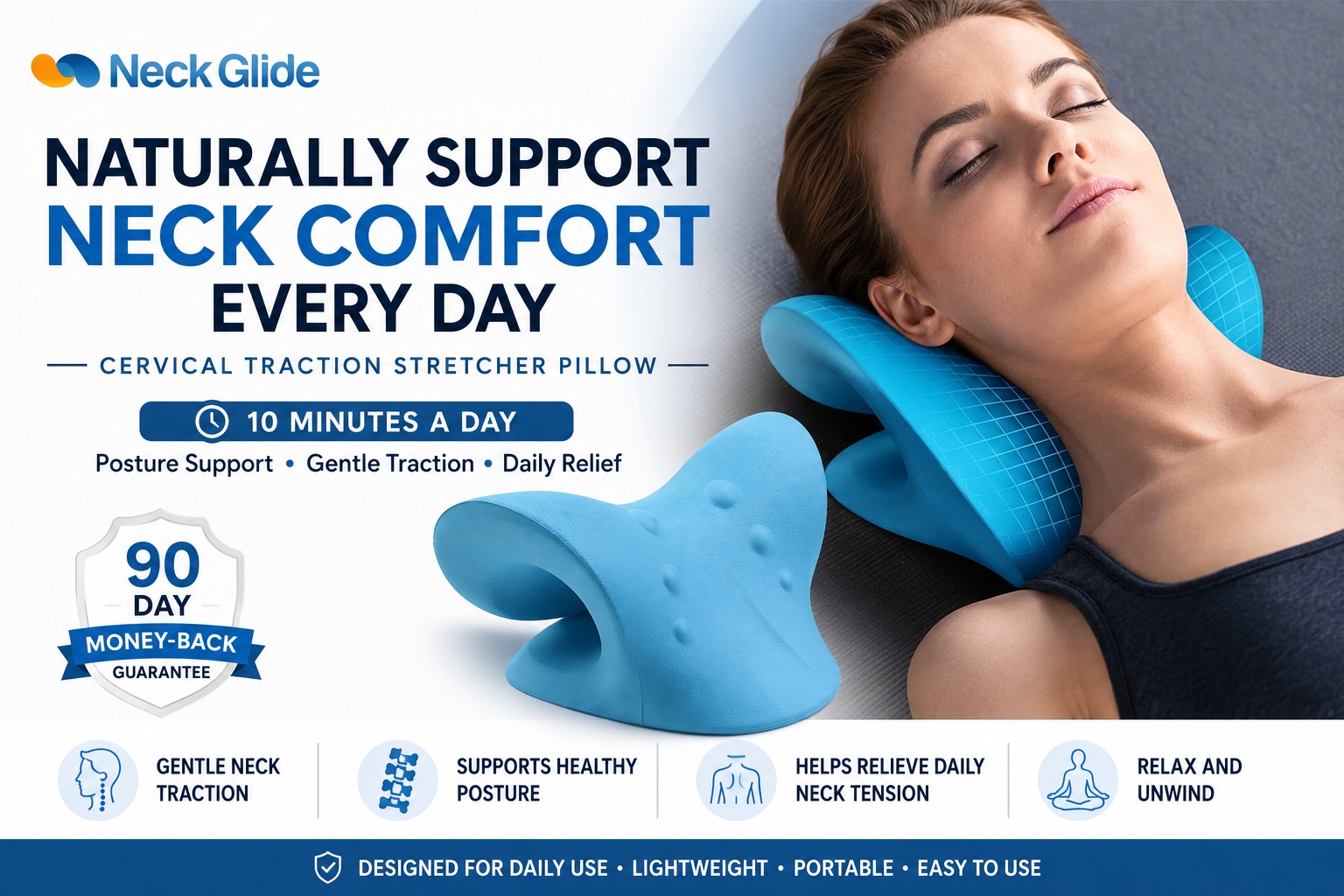
Neck Glide is a passive foam cervical traction device - a neck stretcher pillow - constructed from high-density elastic self-skinning foam. According to the company, this material is firm, lightweight, and engineered to hold its shape under repeated daily use without deforming.
The brand describes the design as an ergonomic C-curve intended to match the natural curvature of the cervical spine. When a user lies down with the device positioned under the neck, the shape is meant to deliver what the company characterizes as three simultaneous effects: vertical support, horizontal support, and curvature stretch for cervical spine alignment. The brand states this positioning promotes neck decompression and reduces spinal pressure.
The device has two sides with different traction intensities:
Convex side: The brand describes this as the gentler option - a reduced traction starting point the company recommends for new users or those with more significant tension and limited current range of motion.
Concave side: According to the company, this delivers a deeper cervical stretch and is intended for users who have already adapted to the device.
The brand also describes six contact points built into the device's surface targeting the muscles of the neck and the base of the skull - the company's framing is that these points help relax surrounding musculature while the traction geometry works on spinal spacing. The company states the device was designed and recommended by chiropractors, though no specific practitioners or clinical affiliations appear on the product page reviewed.
One important usage note the brand makes explicitly: this is a 10-minute daily tool, not an all-night pillow. The brand's FAQ states it cannot be used as an ordinary overnight pillow. Setting that expectation before purchase matters.
Quick Reference - Neck Glide at a Glance:
Type: Passive foam cervical traction device (neck stretcher / chiropractic pillow)
Material: High-density elastic self-skinning foam
Design: Dual-sided (convex/concave) ergonomic C-curve
Intended for: Posture-related neck tension, tech neck, desk-work strain, tension headaches, TMJ-related neck discomfort (per brand)
Recommended daily use: 10 minutes per session; start with 2 x 5-minute sessions
Weight capacity: Up to 150kg / 330lbs per brand specifications
Surface compatibility: Hard floors and soft surfaces (bed, sofa, yoga mat)
Comes with: Travel nylon bag
Starting price: $49.99 (single unit)
Guarantee: 90 days
What the Research on Cervical Traction Actually Says
The physiological mechanism behind cervical traction is well understood: creating gentle separation between the vertebrae reduces compressive load on the discs and surrounding tissue, allows musculature to relax, and - in clinical settings - can reduce pressure on nerve roots. This mechanism has a plausible basis in the traction literature and has been studied in rehabilitation contexts for decades.
What the evidence actually shows, honestly stated:
A 2018 systematic review and meta-analysis by Romeo, Vanti, Boldrini et al., published in Physical Therapy (Vol. 98(4):231-242; PMID 29315428), found moderate-quality evidence suggesting mechanical cervical traction may help reduce neck pain in certain populations - both immediately after treatment and at six-month follow-up. A separate systematic review in the literature noted that traction therapy results are "statistically significant but not always clinically relevant" - which means a measurable effect was detected, but whether that effect is large enough to make a meaningful daily difference varied by population and method.
The practical takeaway: the mechanism is real, short-term relief from consistent daily use is plausible for posture-driven neck discomfort, and the risk profile of a passive foam device is low for that audience. What it doesn't mean: this is a clinically equivalent replacement for professional cervical traction, and it hasn't been studied as a standalone treatment for serious structural conditions.
For the desk worker with tech neck and accumulated daily tension, the evidence supports trying a passive foam stretcher as part of a daily maintenance routine. For anyone managing a specific diagnosis, professional guidance on appropriate protocols should come first.
Neck Stretcher vs. Cervical Traction Device vs. Chiropractic Pillow: Is There a Difference?
These three terms appear constantly in product listings and SERP results, and buyers often aren't sure whether they're searching for the same thing. Here's how to read them:
Neck stretcher and cervical traction device are functionally interchangeable in the consumer space. Both describe tools intended to decompress the neck. "Cervical traction device" is the clinical term; "neck stretcher" is the consumer-friendly version. You'll see both used to describe the same class of product.
Chiropractic pillow is a marketing term rather than a technical one. It typically implies the device was designed with input from or is endorsed by chiropractic professionals. Many foam cervical stretchers are marketed this way - including the Neck Glide, which the brand states was designed and recommended by chiropractors. The term doesn't indicate regulatory clearance or clinical testing.
Neck decompression device refers to the same mechanism - creating space in the cervical spine to relieve compressive load. It emphasizes the decompression outcome rather than the stretching motion.
All of these terms describe the same broad category. What distinguishes devices within that category is the delivery mechanism: passive foam (like Neck Glide), inflatable air collar, over-the-door pulley, or motorized clinical unit. Those differences matter far more than the terminology used to describe them.
Neck Glide Pricing: Current Bundle Options
Neck Glide sells direct-to-consumer at getneckglide.com. Pricing verified at time of publication reflects the following tiered structure. Per-unit cost decreases with each tier, and the 3-pack is the brand's featured Best Seller.
1-Pack: $49.99 total - listed as 50% off a retail reference of $99.98
2-Pack (Studio): $89.98 total ($44.99/unit) - 55% off; labeled "Popular"
3-Pack (Multi Pack): $119.97 total ($39.99/unit) - 60% off; labeled "Best Seller"
4-Pack (Expansive): $139.96 total ($34.99/unit) - 65% off
5-Pack (Deluxe): $149.95 total ($29.99/unit) - 70% off; lowest per-unit cost
All orders ship via USPS within 48 hours of order confirmation. Standard delivery is 2-5 business days. Tracking is emailed after shipment. Promotional pricing observed at time of publication may not reflect future offers - the official site at getneckglide.com is the authoritative source for current pricing and active promotions.
View current Neck Glide bundle pricing and availability here
The 90-Day Guarantee and Return Process
The brand publishes a 90-day money-back guarantee. According to the company's materials, customers who are unsatisfied for any reason can contact customer service to initiate a return, with the brand describing the process as hassle-free.
Important procedural note: a Return Merchandise Authorization number (RMA#) must be obtained from customer service before sending anything back. Packages returned without that number may not be processed. Return shipping is the buyer's responsibility and is non-refundable.
Who This Is Actually Designed For - and Where the Real Value Is
The brand's FAQ describes the device as designed for users experiencing general neck tension, tight or sore neck muscles, desk-related postural strain, tension headaches, and upper back and shoulder discomfort. The company also names specific structural conditions in its FAQ as contexts where customers have sought out the product. Those characterizations belong to the brand and are presented as the company's stated target use cases, not independent clinical claims.
The clearest real-world fit for this device is the person whose neck pain is driven primarily by posture and daily screen time - not someone in the middle of a diagnosed structural crisis who hasn't spoken to a professional yet. The value is accessible daily maintenance: 10 minutes before bed or after a long desk session, done consistently, at a one-time cost well below most individual clinic visits.
For anyone experiencing radiating symptoms, numbness, worsening pain, or symptoms that started after an injury: a physical therapist, chiropractor, or physician is the right first move. A home foam stretcher is a complement to professional care, not a substitute for it.
What Customers Are Saying
The brand's product page features reviews from verified buyers. These are individual self-reported experiences as published by the company - not clinical outcomes, not representative of all purchasers. Individual results vary.
Among the reviews on the brand's site: one buyer described using the device after long days of physical work, noting that a 10-minute daily session helped relieve the neck tension and upper back tightness that had been building up. Another described using it on days with heavy computer work to address accumulated soreness. A third user noted consistent nightly use providing relief from neck pain and postural discomfort, and mentioned the included travel nylon bag as a useful practical feature.
Customer reviews on brand product pages are curated by the seller and may not reflect the full range of purchaser experiences.
See current Neck Glide pricing and ordering details here
Frequently Asked Questions About the Neck Glide Neck Stretcher
What does a cervical traction device actually do to your neck?
A cervical traction device - whether a foam stretcher pillow, inflatable collar, or mechanical unit - works by creating gentle separation between the vertebrae of the cervical spine. This decompression reduces compressive load on the discs and the soft tissue surrounding them, allows the muscles supporting the neck to relax, and in some cases can reduce pressure on nerve roots that have been compressed by postural strain or structural changes. For a passive foam device like Neck Glide, this effect is generated by the weight of the user's head pressing against the shaped foam as they lie down, with no external force, mechanical system, or inflation involved. The company states that 10 minutes of daily use can support neck decompression and cervical spine alignment, though individual response varies and claims like these belong to the brand's characterization of the product.
Is cervical traction safe to use at home?
For healthy adults with posture-driven neck tension and no diagnosed structural conditions, low-force passive cervical traction - the kind a foam stretcher pillow delivers - is generally considered a low-risk daily maintenance option. The risk profile of a passive foam device is lower than mechanical or over-the-door traction units because the force is limited by the user's own head weight and the foam's geometry. That said, home cervical traction is not appropriate for everyone. People with osteoporosis, recent neck injuries, spinal instability, active infections of the spine, severe rheumatoid arthritis affecting the cervical spine, or neurological symptoms should consult a healthcare professional before using any cervical traction device. If using a device produces increased pain, numbness, dizziness, or tingling, the brand's own product materials recommend discontinuing use immediately and seeking professional guidance. This article is for general informational purposes only and does not constitute medical advice.
How do you use the Neck Glide neck stretcher pillow?
According to the brand's published materials and product FAQ, the recommended approach is to place the device on a flat surface - the floor, a bed, a sofa, or a yoga mat all work - and carefully lie back so the device sits under the neck in the cervical region. The brand recommends starting with the convex side, which delivers a gentler level of traction, for the first sessions. Once comfortable with that side, users can progress to the concave side for a deeper cervical stretch. The brand suggests beginning with two 5-minute sessions per day and gradually working up to one continuous 10-minute session. The device should not cause pain during use - the brand's own materials note it cannot be used as an overnight pillow and recommend discontinuing use if discomfort increases.
Can a neck stretcher help with forward head posture or a neck hump?
Forward head posture - the condition where the head sits in front of the body's center of gravity rather than directly above the shoulders - develops over time from prolonged downward-angled screen use, and can eventually contribute to the appearance of a postural hump at the base of the neck. Passive cervical traction promotes cervical spine alignment by gently repositioning the head and decompressing the neck in its natural curve. Whether a foam stretcher pillow used for 10 minutes daily can meaningfully reverse established forward head posture depends on how developed the postural pattern is, how consistently the device is used, and whether other corrective habits (ergonomic setup, strengthening exercises) are part of the routine. The brand's product page includes forward head posture and postural correction framing in its description of the device's intended benefits, attributed to the company's own characterizations. For significant forward head posture or a developed neck hump, evaluation by a physical therapist or chiropractor alongside any home device use would be the most effective approach.
How long before someone might notice a difference?
The brand states that some users notice a difference during or shortly after their first session. Per the company's FAQ, consistent use over approximately two weeks is described as the point at which cumulative benefits - beyond what a single session provides - are expected to develop. The company recommends starting with two 5-minute periods per day, then building toward a continuous 10-minute daily session as comfort increases. Expectations should be calibrated to what the device is: a low-force passive stretcher. It's not equivalent to clinical-grade traction, and individual response times vary based on the nature of the discomfort, how consistently it's used, and each person's specific situation.
How often should you use a cervical traction device?
For a passive foam device like the Neck Glide, the brand's own protocol recommends daily use - two 5-minute sessions per day when starting out, progressing to one 10-minute session as the neck adjusts. This is consistent with general guidance for low-force home cervical stretching: daily use builds cumulative benefit more effectively than sporadic sessions. More is not necessarily better - the brand's FAQ explicitly notes the device is not suitable for overnight use, and 10 minutes is the recommended session ceiling. Anyone using the device to address a specific diagnosed condition should follow the protocol recommended by their healthcare provider rather than consumer product guidelines.
What is the difference between a neck stretcher and a neck brace?
A neck brace (also called a cervical collar) is a supportive device worn around the neck to restrict movement and stabilize the cervical spine - typically used after an injury, surgery, or to provide support during recovery. Its purpose is immobilization and protection, not decompression. A neck stretcher or cervical traction device works in the opposite direction: it creates gentle movement and separation between the vertebrae to decompress the spine, relax musculature, and promote cervical alignment. Neck braces are most commonly prescribed by healthcare providers for specific recovery situations. Neck stretchers like Neck Glide are consumer wellness tools for daily postural maintenance. Using a cervical traction device during an acute injury or when a neck brace has been recommended is not appropriate without specific professional guidance.
Is the Neck Glide safe for someone with a herniated disc or pinched nerve?
The brand's published FAQ lists these conditions among contexts where customers have sought out the product - those are the company's stated characterizations of its intended audience, presented here as the brand's claims. From a general standpoint, low-force passive cervical traction is used in clinical contexts as part of broader rehabilitation programs for certain disc and nerve-related complaints. Suitability is highly condition-specific, however. Anyone managing a diagnosed structural condition - disc problems, nerve compression, or related issues - should consult a licensed physical therapist, chiropractor, or physician before using any home cervical device. This article is not medical advice.
What is the weight limit for the Neck Glide?
According to the brand, the device's high-density elastic self-skinning foam is rated to support up to 150 kilograms - approximately 330 pounds - of body weight without deforming. The brand describes the material as firm, strong, and capable of providing consistent support on both hard and soft surfaces.
Can the Neck Glide be used on a bed, couch, or yoga mat?
The brand states the device is designed for both hard surfaces (floors, firm outdoor ground) and soft surfaces including beds, sofas, and yoga mats. The key requirement is simply lying down with the device under the neck - the surface itself is secondary to that positioning. One buyer whose review appears on the brand's product page noted using the device on a bed and found it more comfortable than the floor.
What is the return policy and how does the 90-day guarantee work?
The company publishes a 90-day money-back guarantee. To initiate a return, customers must first obtain a Return Merchandise Authorization number (RMA#) by contacting customer service at [email protected] or 1 (888) 836-0984 (7AM-5PM PST). Returns sent without an RMA# may not be processed. Return shipping is the buyer's responsibility. The return address is: Attn: Neck Glide Return, 6413 Bandini Blvd, Commerce, CA 90040, USA. The brand describes the process as hassle-free, and the 90-day window provides meaningful time to evaluate the device with consistent use before the guarantee period closes.
How does the two-sided design work - which side should a first-time user start with?
The device has two functional sides delivering different traction intensities. The convex side provides a gentler, reduced stretch - the brand recommends this as the starting point for new users or those with more significant tension and a limited current range of motion. The concave side delivers a deeper cervical stretch and is intended for users who have adapted to the device and are comfortable with greater range of motion. The general approach built into the brand's design is to start with the convex side and transition to the concave side as comfort and range of motion improve over the first days or weeks of use.
How does Neck Glide compare to using an over-the-door traction device?
Over-the-door systems use a pulley, harness, and adjustable weight to apply a measured upward force to the head while the user sits. The force is quantifiable and can be set to specific therapeutic levels - this format has the longer research history in clinical settings. Passive foam neck stretchers like Neck Glide generate traction using only the user's head weight against the foam, with no external weights or setup complexity. The practical trade-off: over-the-door systems can deliver higher, precisely calibrated force for clinical applications; foam stretchers are more portable, require no setup, and are better suited to daily low-force maintenance. The brand describes Neck Glide as "your own in-home chiropractor" - which is the company's marketing characterization of the convenience value, not a clinical equivalence claim.
Is there free shipping, and how fast does Neck Glide arrive?
Orders ship via USPS within 48 hours of confirmation. Standard delivery is estimated at 2-5 business days. Email tracking is sent after shipment, and buyers can monitor packages at USPS.com. Current shipping cost details - including whether any free shipping thresholds apply - are best confirmed at getneckglide.com at time of purchase, as terms can change.
The Bottom Line: Is the Neck Glide Worth Buying?
For the specific type of person this device is built for - someone whose neck tightness comes from desk work, prolonged screen time, and the kind of daily postural strain that builds up quietly over weeks and months - the Neck Glide Ergonomic Stretcher Pillow is a low-barrier, accessible option in a category that has real physiological reasoning behind it.
The cervical traction mechanism has a plausible physiological basis supported by traction literature. The 2018 Romeo et al. meta-analysis in Physical Therapy found moderate-quality evidence suggesting cervical traction may help reduce neck pain in certain populations. The passive foam version of that mechanism delivers it at lower force, which fits daily maintenance and tension relief rather than acute clinical intervention.
At $49.99 for a single unit - less than most single chiropractic visits - and backed by a 90-day money-back guarantee, the financial risk is manageable. The 3-pack at $119.97 ($39.99 per unit, the brand's Best Seller) makes sense for households or buyers confident the device fits their situation. The brand has a traceable address, working customer service, and a published return process.
The honest limits: consistent daily use over multiple weeks is how the brand frames realistic benefit accumulation - this is a 10-minute daily tool, not a one-session fix. The brand's aspirational claims about outcomes should be read as the company's marketing voice rather than guaranteed results. And anyone with worsening, radiating, or neurological symptoms needs professional evaluation before trying any home traction device.
For the desk worker whose neck has been paying the price for their work setup - that's a reasonable value proposition worth evaluating with a 90-day safety net behind it.
View current Neck Glide pricing, bundles, and ordering information on the official website
Contact Information
Verified contact information from the official website:
Company: Neck Glide
Email: [email protected]
Phone: 1 (888) 836-0984 | Hours: 7AM-5PM PST
Address: Neck Glide, 6413 Bandini Blvd, Commerce, CA 90040, USA
Return Address: Attn: Neck Glide Return, 6413 Bandini Blvd, Commerce, CA 90040, USA
Disclaimers
FDA Disclaimer: The statements in this article have not been evaluated by the Food and Drug Administration. The product discussed is not intended to diagnose, treat, cure, or prevent any disease. The Neck Glide Ergonomic Stretcher Pillow is marketed as a consumer wellness and cervical traction support device. This article does not assess the device's regulatory classification, and no content herein should be interpreted as a representation of the product's regulatory status. Information provided is for general informational purposes only and does not constitute medical advice. Individuals with existing medical conditions, neck injuries, or health concerns should consult a licensed healthcare professional before using any cervical traction device.
FTC Affiliate Disclosure: This article contains affiliate links. A commission may be earned on qualifying purchases made through links in this content, at no additional cost to the reader. This promotional content was created in connection with a paid affiliate advertising arrangement. Affiliate relationships do not influence the editorial content or the evaluation of products described herein. Disclosure is provided in accordance with FTC 16 CFR Part 255.
Results Disclaimer: Individual results from using the Neck Glide Ergonomic Stretcher Pillow vary based on individual physiology, consistency of use, the nature and underlying cause of neck discomfort, and other factors outside the control of the brand or this publication. Customer accounts referenced in this article represent individual self-reported experiences as published by the brand and are not guaranteed outcomes. No claim of universal effectiveness is made by this article.
Medical Advice Disclaimer: Nothing in this article constitutes medical advice, diagnosis, or treatment recommendation. The information provided is for general informational purposes only. Readers experiencing neck pain, neurological symptoms, radiating pain, or worsening conditions should consult a licensed physician, physical therapist, or chiropractor for individualized evaluation and care before using any home cervical device.
Pricing Disclaimer: Pricing information reflects the brand's published pricing at time of publication. Prices, discounts, bundle structures, and promotional offers are subject to change without notice at the brand's sole discretion. Promotional pricing observed at time of publication may not reflect future offers. The official brand website at getneckglide.com is the authoritative source for current pricing.
Publisher Independence Disclaimer: This content was produced for editorial and informational purposes in connection with an affiliate relationship. The publisher maintains editorial independence in the evaluation and description of the product. The presence of affiliate links does not constitute an unconditional endorsement. Readers are encouraged to conduct independent research and consult appropriate professionals before making purchasing decisions related to health and wellness products.
Platform and Retailer Disclaimer: This article is distributed via press release syndication networks including Accesswire and Newswire.com. The content is the sole responsibility of the content producer and does not represent the views, endorsements, or editorial positions of Accesswire, Newswire.com, or any other platform on which this content may appear. The brand operates its direct-to-consumer sales channel independently; purchasing decisions and post-sale matters are between the buyer and the brand.
SOURCE: Neck Glide