



Wednesday, 17 June 2026 07:20 PM
Advertorial
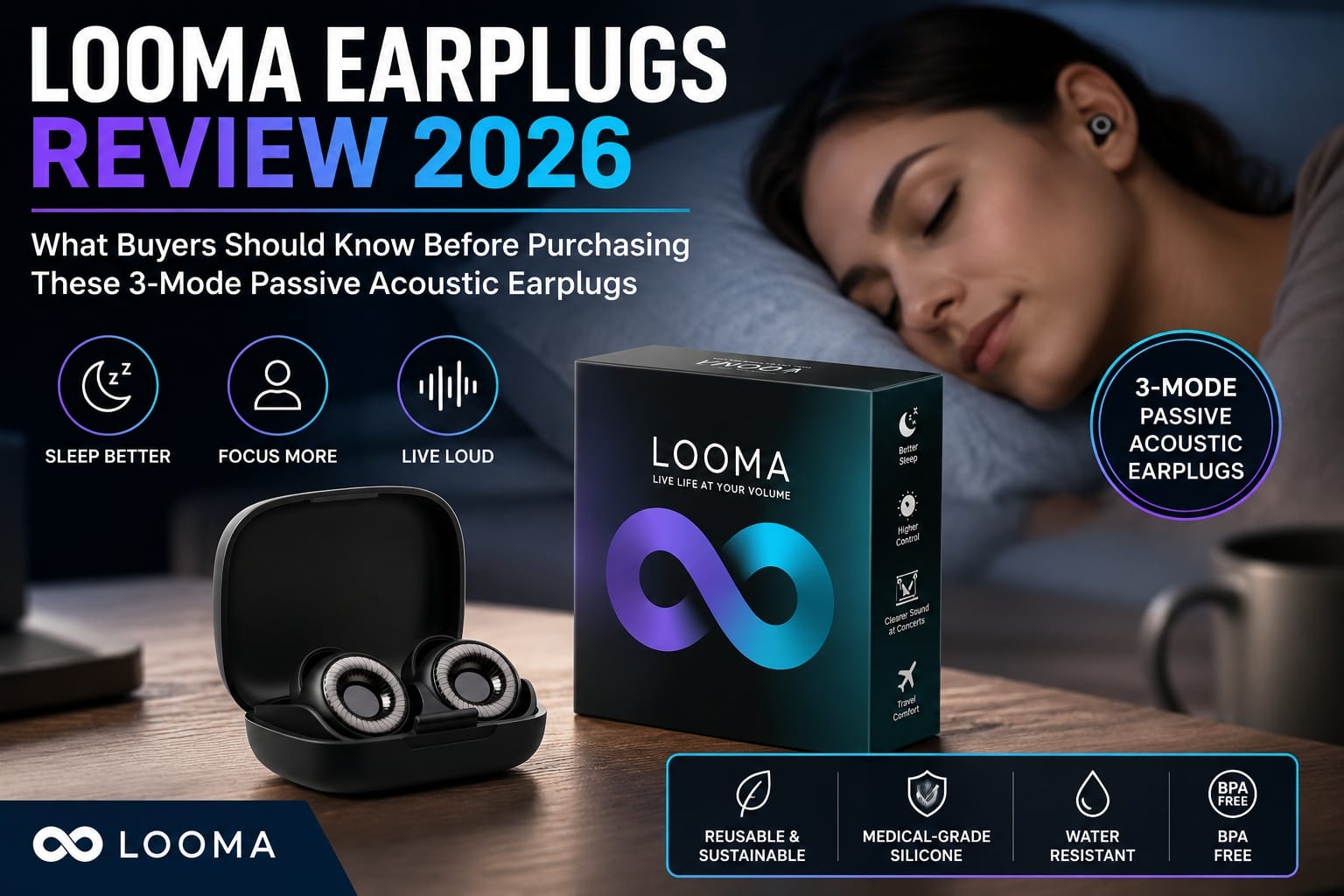
As more consumers compare reusable earplugs for sleep, focus, travel, and everyday noise management in 2026, this Looma Earplugs review explores how the brand's three-mode rotating dial design is positioned for passive noise reduction, what buyers should know before ordering, and why published NRR details, pricing, and return terms may matter.
CHICAGO, IL / ACCESS Newswire / June 17, 2026 / Disclaimers: This content is promotional in nature and is intended for consumer education regarding a commercially available product. This article contains affiliate links. A commission may be earned on qualifying purchases made through links in this content, at no additional cost to the reader. Affiliate relationships do not influence editorial content or the evaluation of products. Disclosure is provided in accordance with FTC 16 CFR Part 255.
Looma Earplugs Research 2026: Not Loop - 3-Mode Rotating Dial Earplug, No Published NRR, and What the Return Policy Actually Says
If you landed here after seeing Looma Earplugs in an ad or on social media, you're in the right place - and yes, this is a review of Looma, not Loop. They're two entirely different brands with similar-sounding names, and the confusion is common enough that it's worth clearing up right at the start. Looma Earplugs are a three-mode passive acoustic earplug sold direct-to-consumer, featuring a rotating dial on each plug that lets you switch between noise-reduction levels without removing them from your ears. Loop is a Belgian brand with a different product line entirely. If you're looking for Looma specifically, you're in exactly the right place.
Now, the questions you're probably here to answer: does this actually work, is there anything you should know before handing over your payment information, and is there a catch buried in the return policy? Smart questions. This review covers all three - using only what the brand has publicly disclosed, what verified category research confirms, and the specific terms you should read before you buy.
Why this review exists: Looma Earplugs currently have no independent review coverage online. Every search result for the brand name returns content about an unrelated earplug brand. This article fills that gap using live fetches of all published Looma brand subpages - product page, Terms of Service, Returns policy, Warranty page, Shipping page, and Contact page - conducted in June 2026. No product sample was received. No brand personnel were interviewed. What you'll find here is what the brand has publicly confirmed, what it hasn't disclosed, and what you should verify directly before purchasing.
Still have questions? The brand's phone line is live. Visit the Official Looma Earplugs Page for Contact Details and Support
Disclosure: If you buy through this link, a commission may be earned at no extra cost to you.
Looma Earplugs Fast Facts (2026): Everything You Need in 30 Seconds
Looma Earplugs are a reusable, battery-free passive acoustic earplug with three selectable noise-reduction modes operated by a rotating dial built into each earplug
The three modes - as described by the brand - are Clear Mode (low reduction, positioned for focus and conversation), Ambient Mode (medium reduction, positioned for commuting and daily wear), and Silent Mode (maximum reduction, positioned for concerts and sleep)
No NRR (Noise Reduction Rating) or SNR value is publicly disclosed anywhere on the brand's website - this is a meaningful gap you'll want to understand before you buy
Materials are described by the brand as medical-grade silicone, 100% BPA-free, recyclable, and water resistant
Each pair ships with four sizes of ultra-soft ear tips and a magnetic travel case, per the brand's published FAQ
The system is fully passive - no electronics, no batteries, no app, no charging, nothing to pair
Shipping: the brand's published FAQ states orders leave a New Jersey warehouse within 48 business hours via USPS, FedEx, UPS, or DHL; standard delivery is estimated at 5-7 days
Return window: 30 days from delivery, items must be in original condition and original packaging
Restocking fee: the brand's published Returns policy and Terms of Service both reserve the right to charge a minimum 15% restocking fee - so the "money-back guarantee" headline doesn't tell the whole financial story
Return shipping: your responsibility, and non-refundable
Customer support: +1 (866) 697 4823 and the email address on the brand's contact page
Optional paid extended protection plan: $9.95 at checkout (brand-stated price as of this review), covering defects, scratches, dents, internal damage, loss, and theft - this is separate from the 30-day guarantee and requires opting in at checkout
Brand-reported rating: 4.8 out of 5 based on 3,758 reviews, per the product page - these figures are brand-reported and have not been independently audited by this publication; individual experiences vary
Pricing (brand-stated as of June 2026): 1 pair at $59.99; 2 pairs at $53.99 each ($107.98 total); 3 pairs at $47.99 each ($143.97 total) - tiers are presented alongside a brand reference price of $133.31 per unit; confirm current pricing and shipping total at checkout before purchasing
The brand describes itself as American-owned with NJ warehouse fulfillment; country of manufacture was not independently verified for this review
Quick Verification Snapshot - As of June 2026
Product: Looma Earplugs (3-Mode Passive Acoustic)
Mode system: Clear / Ambient / Silent - rotating dial, no electronics
Materials (brand-stated): Medical-grade silicone, BPA-free, water resistant, hypoallergenic
Tip sizes included: 4 sizes (brand-stated)
Case: Magnetic travel case (brand-stated)
NRR / SNR: Not publicly disclosed by the brand
Return window: 30 days from delivery
Restocking fee: Minimum 15% per brand's published Terms and Returns policy
Return shipping: Buyer's cost, non-refundable
Extended warranty option: $9.95 optional plan at checkout (3 years, brand-described)
Warehouse: New Jersey (brand-stated)
Phone: +1 (866) 697 4823
Email response target: 24 hours (brand-stated)
Estimated delivery: 5-7 business days after 48-hour processing
Pricing (brand-stated, June 2026): 1 pair - $59.99 | 2 pairs - $53.99/ea ($107.98) | 3 pairs - $47.99/ea ($143.97); brand reference price shown as $133.31/unit; confirm all-in total at checkout
Review date: June 2026
Review methodology: Live URL fetch of all published brand subpages (product, Terms, Returns, Warranty, Shipping, Contact) conducted June 2026; category NRR data sourced from official competitor brand pages; no product sample received; no brand compensation accepted
Independent NRR verification: Not possible from brand's current public materials - no NRR or SNR published by Looma at time of review
Visit the Official Looma Earplugs Page for Contact Details and Support
What does that add up to? A battery-free earplug with a genuinely useful three-mode rotating dial, no published attenuation certification, a 30-day return window that costs real money to exercise, and contact channels you can actually reach before and after you buy. That's the honest picture in 30 seconds. Every section below fills in a specific layer - and if you're already close to a decision, skip straight to the return policy section and the pre-buy checklist.
What Is NRR and Why Does It Matter for Looma Earplugs?
NRR stands for Noise Reduction Rating. It's the standardized decibel figure tested under ANSI S3.19 by accredited independent labs that tells you exactly how much sound attenuation an earplug provides. European markets use the equivalent SNR (Sound Reduction Rating), tested under ISO 4869-1 - the two figures are derived differently but serve the same purpose. A 24 dB NRR earplug reduces the noise reaching your ear by roughly 12 dB in real-world conditions (OSHA recommends halving the rated NRR to account for real-world fit variation). A 12 dB NRR earplug reduces it by roughly 6 dB in practice. The difference between those two numbers at a 100 dB concert is the difference between 88 dB and 94 dB at your eardrum - and sustained exposure above 85 dB causes cumulative hearing fatigue and long-term risk per NIOSH guidelines. NRR is the only standardized, lab-verified basis for comparing passive earplugs before you buy. Looma Earplugs do not publish an NRR or SNR for any of their three modes in currently available brand materials. That's the specific transparency gap this review is built around.
Does Looma Earplugs Work?
Looma Earplugs are a consumer passive acoustic earplug. This article has not verified FDA clearance, registration, or medical-device status for this product, and the product should not be described as intended to diagnose, treat, cure, or prevent any disease or medical condition. Individual results vary. With that stated clearly upfront, here's what you can actually evaluate.
The basic mechanics are real and confirmed by the brand's own FAQ. Sound enters each earplug through a small opening, travels through a hollow channel containing an acoustic filter, and reaches your ear canal at a reduced level. That's exactly how passive acoustic earplugs work across the entire category - the same core mechanism used by Loop, EarPeace, Alpine, and Eargasm in their filter-based designs. What Looma adds is a rotating dial on each earplug that physically shifts between three filter positions - lower attenuation, medium attenuation, maximum attenuation - without requiring you to remove the plug. That's a real and useful design feature, not marketing language.
Here's where the honest gap shows up: Looma doesn't publish a Noise Reduction Rating (NRR) or Sound Reduction Rating (SNR) for any of the three modes. NRR is the decibel figure tested under ANSI S3.19 by accredited independent labs - it tells you specifically how much sound attenuation you're getting and at which frequencies. Every major certified earplug brand publishes it. Looma doesn't, at least not in any publicly available materials reviewed for this article. That doesn't mean the product fails to reduce noise - it clearly filters sound by mechanical design. It means you can't verify the specific attenuation level against a published standard before you buy. Whether that gap matters depends entirely on what you're trying to accomplish, which the use-case sections below address directly.
Buyer Takeaway: The core mechanism is legitimate and consistent with how the category works. The mode-switching dial is a real feature the brand's own FAQ confirms. The missing piece is NRR data. If you need a certified decibel figure to feel confident, you won't find it in Looma's current public materials. If you're comfortable evaluating on qualitative mode descriptions within a 30-day trial window, you have enough verified information to move forward.
What Are the Three Modes on Looma Earplugs?
This is the product's headline feature, so it's worth understanding exactly what the brand says each mode does - and, just as importantly, what the brand doesn't say.
Clear Mode is described as low noise reduction, designed for focus and conversation. The brand's product page describes it as lowering "harsh background noise while keeping voices clear." Picture an open office on a loud afternoon, a coffee shop with too many conversations happening at once, or a commute where you want to reduce the edge without losing the ability to hear someone address you directly. It's the lightest setting - enough to take the harshness out without putting a wall between you and the room.
Ambient Mode is described as medium noise reduction, designed for commuting and everyday wear. It's the dial's middle position - more isolation than Clear Mode, noticeably less than Silent. The brand positions this as the default daily setting for environments where you want consistent background noise lowered without disappearing into full quiet. Think transit noise, city streets, or a busy workspace where you're not in conversation but you're not trying to sleep either.
Silent Mode is described as maximum reduction, designed for concerts, sleep, and situations where your environment is genuinely overwhelming. This is the highest-attenuation position on the dial and the one the brand emphasizes most in its marketing. It's where you'd land when the show starts, when you finally want the plane cabin to go quiet, or when you're trying to fall asleep in a noisy environment.
Visit the Official Looma Earplugs Page for Contact Details and Support
The real usability argument for this design: the dial switching happens on-ear. You don't need to take the earplugs out to change modes. That matters in practice. Swappable-filter earplug designs require you to remove the plug, swap a cartridge, and reinsert - which is fine in a calm setting but genuinely inconvenient when you're at a concert and the opening act just switched to the headliner, or you're half-asleep and the street noise outside suddenly picked up.
What the brand doesn't give you: mode-specific decibel figures. There's no published breakdown of "Clear Mode reduces X dB, Ambient reduces Y dB, Silent reduces Z dB" anywhere in Looma's publicly available materials. Comparable products with selectable filter levels - like EarPeace's three-filter system - publish per-filter NRR values (17, 20, and 26 dB depending on the filter). Looma's three positions are mechanically real, but the specific attenuation spec behind each one isn't publicly verifiable at this time.
Buyer Takeaway: The three modes are mechanically real and confirmed by the brand's own FAQ. The on-ear dial switching is a genuine convenience feature with practical advantages over swappable-filter alternatives. The gap is that you're working with qualitative mode descriptions rather than certified attenuation specs per position - so if you need to know exactly how many decibels each mode removes, that data isn't currently available from the brand's public materials.
Three Things Honest Evaluation Has to Acknowledge
You deserve a review that doesn't just repeat the sales page back at you. Here are the three things any fair evaluation of Looma has to put on the table.
The NRR gap is real, and it matters more for some buyers than others. Every major earplug brand that makes noise-reduction claims publishes a Noise Reduction Rating - it's tested under ANSI S3.19 by accredited independent labs and delivers a specific decibel figure with frequency breakdown. Loop Quiet 2 publishes 24 dB NRR. Loop Experience 2 publishes 12 dB NRR. EarPeace High Fidelity publishes up to 26 dB NRR depending on filter. Eargasm High Fidelity publishes 16 dB NRR. Looma publishes none of these figures, at least not in any materials reviewed for this article. That doesn't mean the product fails to attenuate sound - passive acoustic filtering is real regardless of whether a certification number is published alongside it. It means you're buying on description rather than verified specification. For everyday noise management in lower-stakes environments, that's likely fine. For concert hearing protection, where sound levels routinely exceed 100 dB and your specific decibel reduction determines whether your ears are actually protected, the gap carries more weight.
The sales platform is newer, and that's worth factoring into how you buy. Looma sells through buyskyline.co, which has a relatively short domain registration history. At the time of this review, some third-party domain-review services have flagged it with mixed trust signals based primarily on domain age. To be clear: this isn't documentation of fraud. A newer domain carrying a DTC product naturally looks different to trust-scoring tools than a brand that's been live for five years. The verifiable anchors here are a real US phone number (+1 866 697 4823), a stated New Jersey warehouse, a published Florida-law Terms of Service, and a Returns policy that lays out actual terms. Take those for what they are. The practical response is simply: use a credit card with dispute resolution rather than a debit card, and keep your order confirmation email somewhere you can find it.
The 30-day guarantee comes with costs you should understand before you order. The brand's published Returns policy and Terms of Service (Section 21) both explicitly reserve the right to charge a minimum 15% restocking fee. Return shipping is your cost and isn't refundable. At the current brand-stated single-pair price of $59.99, a return after trialing the product would yield a refund of approximately $50.99 after the minimum 15% restocking fee ($9.00) - minus whatever shipping was charged at checkout, which is also non-refundable - minus your return postage. Multi-pair purchases scale this cost upward: a two-pair return on $107.98 carries a minimum $16.20 restocking fee, and a three-pair return on $143.97 carries a minimum $21.60 fee before any shipping costs. The 30-day window is genuine. The guarantee covers legitimate returns. But "money-back guarantee" and "risk-free trial" are not the same statement here, and knowing that before you buy is a lot easier than being surprised by it afterward.
Buyer Takeaway: None of these three points is necessarily a dealbreaker - they're the facts that change how you approach the purchase. Buy on a credit card, understand the return math upfront, accept that you're evaluating a product without published NRR data in exchange for the on-ear mode-switching design, and use the 30-day window deliberately rather than casually.
Who Is Looma Earplugs Actually Built For?
Based on what the brand publishes, here's who this product is genuinely designed to serve - and one use case that's underrepresented on the product page but worth calling out.
If you're a light-to-moderate sleeper dealing with environmental noise, the Silent Mode positioning is worth evaluating. The brand specifically names city noise, ambient sound, and general sleep-environment disruption as target use cases. Passive acoustic earplugs are a well-established and widely used tool in the sleep space - the silicone tip design, four-size fit system, and reusability all suit nightly use. The caveat is that without a published NRR, you can't verify in advance whether Silent Mode delivers enough attenuation for your specific environment. That's what the 30-day window is for - use it as the evaluation period it's meant to be, keeping the return cost math in mind.
If you work in a noisy open office or spend time in loud shared spaces, Clear Mode is where Looma makes the most immediate sense. Low attenuation, voices still audible, harshness reduced. This is also where the NRR gap matters least. You're not trying to hit a specific decibel threshold for occupational safety - you're trying to reduce cognitive noise fatigue in a shared environment. Even modest passive attenuation from a properly fitting silicone tip is enough to do that, and the on-ear dial means you can drop the filter level during a conversation and bring it back up without breaking your workflow.
If you experience noise sensitivity or sensory overload, the three-mode design is worth noting specifically. A growing number of people who deal with sensory sensitivity - including those with ADHD, anxiety, or auditory processing differences - have adopted passive acoustic earplugs as an everyday management tool in noisy public environments: grocery stores, transit, busy restaurants, crowds. The ability to dial between light and maximum attenuation on the fly, without removing the earplugs, is a practical feature for this use case that deserves more attention than it gets on the product page.
If you go to concerts regularly, this is the use case that requires the most careful thought. Sound levels at live events routinely exceed 100 dB SPL. According to NIOSH, sustained exposure above 85 dB over an eight-hour period creates occupational noise risk - at concert volumes, you can accumulate equivalent exposure in a fraction of that time. The brand positions Silent Mode for concerts and describes the product as allowing you to enjoy music "without distortion" - language that's brand-stated and identified here as marketing characterization, not an independently verified acoustic claim. Without a published NRR, you can't verify from brand materials whether Looma provides meaningful hearing protection at concert-level volumes. If that's your primary motivation, compare Looma against alternatives that publish certified per-filter NRR values before you decide.
If you travel frequently, Clear or Ambient Mode for flights, transit, and travel noise is a natural fit. The magnetic travel case is compact. The passive design means no battery anxiety on long-haul trips, no TSA questions, and nothing to charge. No app, no pairing - just twist and go. It's one of the cleaner use cases for this category of earplug generally.
Buyer Takeaway: The strongest match for Looma, based on verifiable features, is everyday multi-environment noise management - sleep, focus work, transit, and sensory management - especially if you're drawn to the on-ear mode switching and don't require a certified NRR figure. The weakest match is someone whose primary motivation is documented hearing protection at high-volume events, where the NRR gap is most consequential.
How to Read Looma's Marketing Claims
A few phrases on the product page deserve a plain-English translation so you know exactly what you're looking at.
"Adaptive Noise Reduction" - the brand uses this in the hero section. Per their own FAQ, the system is 100% passive and mechanical. There are no microphones, no electronics, no adaptive signal processing of any kind. "Adaptive" here means the user manually selects one of three fixed filter positions by twisting the dial. That's user-adaptive - not technology-adaptive. If you're thinking active noise cancellation, it's not that.
"Featherlight Comfort" - this is a qualitative brand descriptor, not a specification. Comfort with in-ear earplugs is highly individual: it depends on your ear canal shape, which tip size fits your anatomy, and how long you're wearing them. The four included tip sizes give you the best shot at a good fit, but "featherlight" is the brand's marketing characterization of their wearing experience, not a weight measurement or fit guarantee.
"Focus & Sleep Modes" - these are the brand's descriptive labels for Clear Mode and Silent Mode respectively. The underlying mechanism in both cases is passive acoustic filtering at different attenuation levels. There's no dedicated electronic tuning for focus or sleep states - it's the same filter mechanism at different dial positions.
"4.8 out of 5 based on 3,758 reviews" - this is a brand-reported figure from the product page. This publication has not independently audited the reviews, reviewer identities, purchase verification status, or representativeness of that sample. Per FTC 16 CFR Part 465 (the Fake Review Rule, effective October 2024), customer ratings and testimonials reproduced from brand materials are identified here as brand-reported. Individual buyer experiences vary.
"Trusted by experts, backed by science" - the product page attributes a quote to "Dr. Evan Moore, neuroscientist and sleep specialist." This quote comes directly from the brand's published marketing materials. This publication has not independently verified Dr. Moore's credentials, academic affiliation, professional licensure, or whether any financial relationship exists between Dr. Moore and the brand. Treat it as brand-presented expert positioning, not as independently sourced professional endorsement.
"Buy Now & Save 50%" - the 50% discount is relative to a comparison price set by the brand. Per FTC Junk Fees Rule guidance (November 2024) and CA SB 478 (effective 2024), comparison "before" prices are the brand's own stated reference points and may not reflect prevailing market prices. Your final cost also depends on shipping and any optional add-ons at checkout. Confirm the complete total before you hit purchase.
Buyer Takeaway: None of this means the product doesn't work or that the brand is acting in bad faith. It means you're reading these claims accurately rather than at face value. The product is a passive mechanical earplug with user-selectable modes. Everything beyond that is brand positioning - worth knowing, not worth building your entire decision on.
Is Looma Earplugs Legit?
Direct answer: yes - with the context that matters.
Looma Earplugs is a real consumer product. There's a publicly disclosed US phone number, a stated New Jersey warehouse, an active Terms of Service under Florida law, a published Returns policy, and a Warranty page with specific terms. None of those are hallmarks of a phantom listing. The product description is specific and internally consistent - the FAQ answers detailed questions about the mode mechanism, the materials, the tip sizes, the case, and the shipping carriers. Products built to defraud buyers typically don't invest in that level of specific, checkable detail.
The honest caveat is the domain. buyskyline.co has a shorter registration history, and some third-party trust-scoring services have flagged it with mixed signals based primarily on that. That's a real data point worth acknowledging - not because it proves anything fraudulent, but because it's the kind of thing that informs how cautiously you should approach the purchase. Newer DTC product domains aren't automatically suspicious; they're just less proven. The response is the same either way: buy on a credit card, keep your order confirmation somewhere accessible, document any communications with customer service, and know your 30-day window before it starts counting down.
A few things you can verify independently before buying: call +1 (866) 697 4823 to confirm the line is live. Check that the contact page and returns page load correctly at the brand's site. Read Section 14 of the Terms of Service - purchasing means you're agreeing to mandatory binding arbitration through the AAA and waiving your right to a jury trial or class action. That's standard in DTC e-commerce in 2026, but it's worth knowing before you're bound by it.
Buyer Takeaway: Looma looks like a legitimate product from a newer DTC brand. The gaps are the NRR data, the domain's shorter history, and the return policy's real cost. None of those are disqualifying on their own. They're exactly what you should factor in before you buy - and now you have them.
How Does Looma Compare to Other Multi-Mode Earplugs?
The passive acoustic earplug market has grown sharply over the last few years, driven by demand for noise management tools that don't require Bluetooth, batteries, or the bulk of over-ear headphones. Before you decide, it's worth knowing where Looma sits in that landscape - particularly because the dominant category brand, Loop, sounds similar enough to cause real confusion.
Loop Earplugs (no affiliation with Looma) is the most-searched brand in this space. Their Experience 2 publishes 17 dB SNR and 12 dB NRR. Their Quiet 2 publishes 24 dB NRR. Their Switch 2 - the model most structurally similar to what Looma describes - has a rotating dial that cycles between three modes (Quiet, Experience, and Engage) and publishes the attenuation spec for each position (20-26 dB SNR range). EarPeace's High Fidelity system publishes per-filter NRR values of 17, 20, and 26 dB across three interchangeable cartridges. Eargasm High Fidelity publishes 16 dB NRR. Alpine's MusicSafe Pro publishes per-filter attenuation curves.
What Looma offers that most of these don't: an on-ear rotating dial with no need to handle separate filter cartridges, medical-grade silicone construction, and a battery-free passive design. What Looma doesn't offer that all of these do: a certified, publicly published NRR figure. Whether that trade-off makes sense depends entirely on your use case. For everyday noise management, the mode-switching convenience is the differentiator. For documented hearing protection, the NRR gap is the deciding factor.
The price picture is now confirmed. According to the brand's checkout page, Looma is priced at $59.99 for a single pair, $53.99 per pair when buying two ($107.98 total), and $47.99 per pair when buying three ($143.97 total) - all brand-stated prices as of June 2026, subject to change. Confirm current pricing and your shipping total at checkout before purchasing. For context: Loop's Switch 2 - the most structurally comparable rotating-dial alternative - runs around $55 for a single pair, and EarPeace High Fidelity runs around $45. Looma's single-pair price is competitive with that field. The multi-pair tiers offer meaningful per-unit savings if you're confident the product suits you - though note the 15% restocking fee applies per unit on returns, so factor that into the multi-pair value math before committing to two or three pairs.
Buyer Takeaway: Looma competes in a category where the leading brands publish NRR specs and Looma doesn't. The differentiation is the on-ear rotating dial, the silicone-first construction, and the no-electronics-required design. If specification transparency is your primary criteria, certified alternatives exist at comparable and higher price points. If the Looma design speaks to you and you're comfortable with a 30-day trial evaluation, you know what you're getting into.
What's in the Box
Per the brand's published FAQ, your Looma Earplugs purchase includes:
One pair of Looma 3-Mode Earplugs
Four sizes of ultra-soft ear tips
A magnetic travel case
A quick-start guide
The four tip sizes matter more than they sound. With any passive acoustic earplug, the tip size determines whether you achieve a proper seal - and the seal is what determines how much noise reduction you actually get. An undersized tip won't seal and won't attenuate. An oversized tip is uncomfortable, and you'll take it out. The brand's four-size offering gives you the best chance of finding the right fit, which is why you should try all four systematically in your first session rather than just picking one and running with it.
The magnetic travel case is a nice addition. It keeps the earplugs together, protects the tips, and is compact enough to live in a pocket or bag without being annoying about it. It's not a hard-shell case, but for a passive earplug this size, magnetic closure is a reasonable choice.
Buyer Takeaway: The package contents are clearly specified and appropriate for the category. Prioritize tip sizing when you first open the box - it's the single biggest variable in how well these perform for you.
Materials: What the Brand Says
Here's exactly what the brand has publicly stated about materials - no inference, no editorial addition:
Medical-grade silicone (described for both the earplug body and the tips)
100% BPA-free
Recyclable
Water resistant (described as a feature; no specific IP rating is published)
Hypoallergenic (described in the brand's "Built to Last" section)
Medical-grade silicone is a real material class - it's non-porous, chemically inert, and generally considered hypoallergenic, which is why it shows up in medical equipment, food-contact applications, and personal-care products. The "medical-grade" designation is a brand claim and not independently verified by this publication, but it's a legitimate material term rather than invented marketing language. What isn't published: the specific silicone grade (LSR, HTV, or RTV), the durometer rating, or an independent material certification.
"Water resistant" without an IP rating means you can reasonably expect it to handle sweat and the occasional splash, but you shouldn't take these swimming or leave them in a soaking rain. The brand's care instructions - rinse with water and store in the case - are consistent with water-resistant, not waterproof, construction.
Buyer Takeaway: The material claims are reasonable and consistent with what you'd expect from a premium-positioned passive earplug. Buyers with known silicone sensitivities should consult their healthcare provider before use. The water-resistant claim is brand-stated and doesn't carry an independent IP rating, so treat it as splash-resistant rather than immersion-proof.
Visit the Official Looma Earplugs Page for Contact Details and Support
Shipping: What to Expect
Per the brand's published shipping page, here's exactly what the timeline looks like:
Processing: products leave the New Jersey warehouse within 48 business hours of your order
Delivery estimate: 5-7 business days standard
Carriers: USPS, FedEx, UPS for domestic; DHL for international customers
Tracking: emailed after shipment
Support for shipping questions: +1 (866) 697 4823
The brand's shipping page includes this line: "This is an American-owned business that doesn't believe it should take 45 days to receive your product from China." That's a brand statement emphasizing domestic fulfillment speed over international shipping timelines - not a manufacturing origin claim. Country of manufacture has not been independently verified by this publication. If where the product is made matters to you, contact the brand directly at +1 (866) 697 4823 before ordering.
Buyer Takeaway: The NJ warehouse fulfillment model and 5-7 day standard window are specific and verifiable with the brand's customer service. Tracking is included. International buyers should confirm DHL delivery terms and any applicable customs implications before ordering.
The Return Policy - The Actual Fine Print
This section matters more than most reviews let on. Here's the complete picture from the brand's published Returns policy and Terms of Service - not the headline, the actual terms.
Window: 30 days from receipt of your order. The brand offers a refund or replacement.
Condition requirement: The item must be returned in the same condition you received it, in the original packaging. If it arrives in unacceptable condition, the brand may reject the return.
What you need to include: A note with your full name and the email address you used to purchase.
Restocking fee: The brand's Returns policy and Terms of Service (Section 21) both explicitly reserve the right to charge a minimum 15% restocking fee. That language is in both documents. It's not a hidden clause - it's there if you look - but it's also not something the "30-day money-back guarantee" headline makes obvious.
Return shipping: Your cost. Non-refundable. The brand doesn't cover return shipping.
Refund timeline: 5-10 business days after the brand receives and inspects your return. Refund goes back to your original payment method.
Exchanges: Available only for defective or damaged items, same item only.
Here's the math that matters: if you buy at the checkout price, use the product, decide it's not for you, and return within 30 days - you're looking at your purchase price minus a 15% restocking fee, minus your original shipping (non-refundable), minus your return shipping. The product's 30-day guarantee is real and the return process is described clearly. Just know that "money-back guarantee" and "risk-free" aren't synonymous here.
The timing detail most buyers miss: the 30-day window runs from the date of delivery - not the date you open the box, not the date you first use the earplugs. If your package sits on the counter for a few days before you try it, those days count against your window. And you need time at the end to actually ship a return - most carriers require 2-5 business days for return transit. Plan your evaluation accordingly: open the package on delivery day, try all four tip sizes and all three modes within the first week, and make your keep-or-return decision by day 20 at the latest.
Buyer Takeaway: The 30-day window is genuine. The cost of using it is real. Use a credit card with dispute resolution, understand the restocking fee math upfront, and make your keep-or-return decision with enough time to ship before day 30 closes.
Warranty: Default Coverage vs. the Paid Option
The brand offers two distinct layers of coverage - and knowing which is which matters before checkout.
Default coverage: The 30-day money-back guarantee described above. This is a satisfaction guarantee, not a warranty in the Magnuson-Moss federal sense. It covers the evaluation window.
Optional paid extended plan: At checkout, the brand offers what it describes as "3 Years Warranty and Extended Protection" for $9.95 (brand-stated price as of this review). According to the brand's warranty page, this plan covers defects, scratches, dents, internal component damage, and - notably - loss or theft. That last item is unusual in a standard product warranty; loss and theft coverage is typically a service contract or insurance product, not a warranty.
Under the Magnuson-Moss Warranty Act (15 USC §2303), written warranties on consumer products over $15 must be designated as either "Full" or "Limited." Federal law under Magnuson-Moss recognizes only those two designations. Given the exclusions and conditions described on the brand's warranty page, the optional plan functions as a limited warranty or service contract in regulatory terms. Evaluate it on its own merits - if you're buying multiple pairs or want long-term coverage on a product you plan to use daily, $9.95 may be worth it. If you're evaluating whether the product suits you within 30 days, the default guarantee covers that window.
Buyer Takeaway: Default coverage = 30 days. Anything beyond that requires the $9.95 opt-in at checkout. Decide at purchase time - you won't be able to add it after.
Contact: How to Reach the Brand
Per the brand's published contact page, here's how you can reach Looma directly:
Phone: +1 (866) 697 4823
Email: Published on the brand's contact page at the official website
Response target: 24 hours for email, per the brand's published statement
If you're dealing with a time-sensitive issue - a return approaching the 30-day deadline, an order that hasn't shipped, or a tracking number that isn't updating - call the phone line. For anything where you want a written record (return authorization, refund confirmation, policy clarification), use email and keep the thread.
If you ever need to escalate beyond the brand, your credit card issuer's dispute resolution process is the backstop. Document everything: the purchase date, the order confirmation, any communications with customer service, and the date you initiated a return if applicable.
Buyer Takeaway: Real contact channels are there. Use them proactively if anything looks wrong - don't wait until a deadline is about to close.
What Happens If Something Goes Wrong With Your Looma Order
This section exists because most buyers don't think about it until they need it. Here's the escalation path, step by step, based on the brand's published policies.
If your order doesn't arrive within the estimated window: contact the brand at +1 (866) 697 4823 with your order confirmation and tracking number. The brand's shipping page lists a 48-business-hour processing window and 5-7 business day standard delivery. If your tracking number isn't updating after 10 business days, contact the brand and your carrier simultaneously. If you can't reach the brand or get a resolution, contact your credit card issuer to initiate a dispute - card dispute windows are typically 60-120 days from the charge date depending on your card's terms, so don't wait too long.
If the product arrives damaged or defective: contact the brand immediately at +1 (866) 697 4823 or by email. The brand's published Returns policy allows exchanges for defective or damaged items (same item). Document the damage with photos before contacting support. Keep the original packaging - condition and original packaging are both stated requirements for the return process.
If you decide to return within the 30-day window: contact the brand to initiate the return before shipping anything back. Include your full name and order email address with the return. Expect the 15% restocking fee on the return value and plan for your return shipping cost. The brand states refunds are processed within 5-10 business days of receiving and inspecting the return.
If your refund is delayed beyond 10 business days: check with your bank first - processing times at the card network level can add 3-7 additional business days before a credit posts to your statement. If the brand has confirmed the refund was issued but it still hasn't appeared after 15 business days total, contact your card issuer.
If the brand is unresponsive: your credit card dispute process is your primary protection. Most card issuers allow disputes up to 60-120 days from the transaction date. File the dispute with documentation of your purchase, your return attempt, and any communications. Under the brand's Terms of Service (Section 14), disputes beyond the card dispute process go to AAA arbitration under Florida law - which is standard for DTC e-commerce but worth knowing before you need it.
Buyer Takeaway: Problems with DTC purchases are manageable when you've used a credit card and kept documentation. The brand has real contact channels. Your card issuer is your escalation backstop. Know the sequence before you order so you're not figuring it out under time pressure.
Visit the Official Looma Earplugs Page for Contact Details and Support
10 Things to Verify Before You Buy
If you're ready to seriously consider a purchase, here's the practical pre-buy checklist based on what this review found. A few of these take under two minutes and could save you real money - specifically items 4, 5, and 6, which address the terms most buyers only read after they've already ordered.
Brand-stated pricing as of June 2026: 1 pair at $59.99, 2 pairs at $53.99 each ($107.98 total), 3 pairs at $47.99 each ($143.97 total) - confirm current prices and any shipping charges at checkout before entering payment information, as these figures are subject to change
Confirm whether shipping is included in that price or calculated separately - your all-in total is what matters, not the displayed discount
Decide in advance whether you'll add the $9.95 optional extended plan - you can only do it at checkout, not after
Read the brand's published Returns policy and note the 15% restocking fee and buyer-paid return shipping before you finalize your order
Check Section 14 of the Terms of Service - you're agreeing to mandatory binding arbitration through the AAA and waiving class-action rights by purchasing; that's standard in DTC e-commerce but worth knowing
If country of manufacture matters to you, call +1 (866) 697 4823 before ordering - the brand's shipping page references China-based fulfillment timelines in context but manufacturing origin wasn't independently confirmed in this review
Use a credit card with dispute resolution, not a debit card - it's the best buyer protection tool available given the domain's shorter history
Save your order confirmation email the moment it arrives
On the day your package arrives, try all four tip sizes and identify the one that creates the best seal before settling on your regular use size - seal quality is the primary performance variable in any passive earplug
Test all three modes within the first week and evaluate whether the attenuation levels match your actual use case - you want to make that determination well before day 30 so you have time to return if needed
Buyer Takeaway: Ten minutes of homework before you buy is worth far more than two weeks of back-and-forth if something goes wrong. The list above is everything this review found that matters specifically for a Looma purchase.
Looma Earplugs for Sleep: What You Need to Know
Silent Mode is the brand's recommended setting for sleep, described as "maximum reduction, ideal for concerts, sleep, or overstimulation." If you're evaluating Looma specifically for sleeping in a noisy environment - city traffic, a snoring partner, a loud HVAC system - here's the honest breakdown.
Passive acoustic earplugs work for sleep by physically reducing the sound transmission reaching your ear canal. How well they work depends on three things: whether you've found the tip size that creates a proper seal, what attenuation level the Silent Mode filter actually provides, and whether that attenuation level is sufficient for the specific type of noise you're dealing with. You can verify the first thing yourself on day one. The second thing - Silent Mode's actual dB reduction - isn't published by the brand, so you're evaluating it experientially rather than on specification. The third thing is individual: a partner's snoring is different noise from traffic outside a window, which is different from an HVAC unit on the roof.
For reference: established sleep earplug alternatives that publish NRR values in the 24-27 dB range give you a documented baseline for what kind of noise reduction "strong sleep earplugs" deliver. Looma doesn't publish an equivalent figure, so you're evaluating Silent Mode's performance through actual use within the 30-day window.
One practical note: for side sleepers, the profile of an earplug matters. The brand describes the product as comfortable for extended wear, but whether an in-ear tip-based design works for your sleeping position is something you'll know after the first few nights, not before.
Buyer Takeaway: Looma may be a good fit for sleep noise management - the design is appropriate and the Silent Mode positioning is consistent with how the category works. You won't know whether the attenuation level matches your specific environment until you try it. The 30-day return window is your evaluation period; use it, accounting for the return cost math.
Looma Earplugs for Concerts: What You Need to Know
This is the use case where the NRR gap matters most, and where honest evaluation requires being the most direct.
Live music events regularly reach 100 dB SPL and above. NIOSH guidance identifies 85 dB over an eight-hour exposure period as the occupational recommended limit for hearing safety - at concert levels, you can accumulate equivalent noise exposure in under 30 minutes. Passive acoustic earplugs are a well-established tool for managing this: they reduce the volume reaching your ear canal while preserving sound clarity in a way foam plugs don't. The question is whether they reduce it enough.
Looma positions Silent Mode for concerts and describes the product as designed to let you "enjoy music without distortion" - that's brand-stated language and is identified here as the brand's marketing characterization, not an independently verified acoustic performance claim. The mechanical design - passive filter, silicone construction, proper seal - is capable of providing real attenuation. But without a published NRR, you can't verify how much.
Loop Experience 2 publishes 12 dB NRR for concert use. EarPeace publishes up to 26 dB NRR depending on filter selection. Those figures give you a documented benchmark to evaluate whether you're getting meaningful attenuation at typical live-music volumes. Looma doesn't give you that benchmark from public materials.
If your primary motivation for buying Looma is hearing protection at concerts - not just comfort management, but actual protection against noise-induced hearing loss - the absence of published NRR data is a meaningful gap worth weighing against alternatives that give you that specification.
The cost-of-inaction consideration: noise-induced hearing loss is cumulative and permanent. A single high-volume event without adequate protection doesn't necessarily cause immediate damage - but repeated exposure over months and years does. Choosing an earplug without a published NRR for concert use isn't necessarily a bad decision; it's an unverifiable one. If that distinction matters to you - and for regular concert-goers it should - verified alternatives exist at comparable price points.
Buyer Takeaway: Looma is positioned for concert use and the passive mechanism is capable of providing attenuation. But for buyers who need to verify decibel reduction level before using earplugs at high-volume events, Looma's current public materials don't give you that figure. Certified-NRR alternatives exist in the same price range if that verification matters to your decision.
Looma Earplugs for Focus and Work: What You Need to Know
This is actually where Looma makes the most immediately verifiable case, and where the NRR gap matters least.
Clear Mode is designed for exactly this: open offices, coffee shops, commutes where you want to take the edge off ambient noise without cutting yourself off. You still want to hear your name called, catch a colleague's question, notice the barista calling your order. Clear Mode's low-attenuation design is specifically for that balance.
In this context, you're not trying to hit a decibel threshold or protect against sustained high-volume exposure. You're managing cognitive fatigue from background noise. Even modest passive attenuation from a properly sealing silicone tip is enough to make a noticeable difference in that environment - and the on-ear mode switching means you can drop to Clear for a meeting, push to Ambient for a loud commute, and go to Silent on a flight without removing the earplugs to adjust.
That's actually the strongest use case the Looma design supports, and it's one where the primary evaluation variable is comfort and fit rather than certified attenuation spec.
Buyer Takeaway: For everyday noise management in work and focus environments, Looma's three-mode design is well-matched to the use case. The NRR gap matters significantly less here than it does for hearing protection at high-volume events. If this is your primary reason for buying, what you're really evaluating is comfort, fit, and whether the dial switching works as described - all of which are assessable within the first week.
Looma Earplugs Pricing: All Three Tiers, the Reference Price Math, and What You Actually Pay
Pricing information for Looma Earplugs is now confirmed from the brand's checkout page. There are three quantity tiers available, each with different per-unit pricing. The following figures are brand-stated as of June 2026 and are subject to change without notice. Always confirm current pricing, shipping charges, and any applicable taxes at checkout before completing your purchase.
Tier 1 - Buy 1 Looma Earplug (1 pair): $59.99, per the brand's checkout page. The brand presents this alongside a crossed-out reference price of $133.31, described as a "50% OFF + 10% OFF" promotion. Under FTC Junk Fees Rule guidance (November 2024) and CA SB 478 (effective 2024), the $133.31 figure is the brand's own stated reference price and may not reflect the prevailing market price for the product. Confirm the final checkout total - including any shipping calculated separately - before purchasing.
Tier 2 - Buy 2 Looma Earplugs (2 pairs): $53.99 per pair, $107.98 total, per the brand's checkout page. The brand presents this alongside a crossed-out reference price of $266.62 (equivalent to $133.31 per unit), described as a "55% OFF + 10% OFF" promotion. The per-unit savings versus Tier 1 is $6.00 per pair. If you're considering two pairs, factor in the restocking fee implications: a return on both units would incur two separate 15% fees plus return shipping on both, reducing the multi-unit value advantage if the product doesn't work for you.
Tier 3 - Buy 3 Looma Earplugs (3 pairs): $47.99 per pair, $143.97 total, per the brand's checkout page. The brand describes this as the "Recommended Deal" and presents it alongside a crossed-out reference price of $399.93 (equivalent to $133.31 per unit), described as a "60% OFF + 10% OFF" promotion. The "Recommended Deal" label is a brand-applied marketing designation, not an independent editorial recommendation from this publication. At $47.99 per pair, the three-pack offers the lowest per-unit price - but also the highest upfront commitment. If all three pairs were returned under the 30-day guarantee, the minimum 15% restocking fee would apply to the full order value, plus buyer-paid return shipping for all three units.
Understanding the discount framing: The brand displays a stacked promotional structure ("50% OFF + 10% OFF," "55% OFF + 10% OFF," "60% OFF + 10% OFF") against a consistent reference price of $133.31 per unit. Per FTC Junk Fees Rule and EU Omnibus Directive Article 6a requirements, comparison "before" prices are the brand's own stated reference points. This publication has not independently verified whether $133.31 reflects a price at which these earplugs were previously sold at regular retail or for a substantial period of time. EU buyers should confirm EU-specific pricing compliance directly with the brand before purchasing.
The optional extended protection plan adds $9.95 to your total if selected at checkout - this covers defects, scratches, dents, internal damage, and loss or theft for three years per the brand's warranty page, and must be opted in at time of purchase.
Return cost math by tier: Because the 15% restocking fee applies to the return value and return shipping is the buyer's responsibility, the effective cost of exercising the 30-day guarantee scales with the quantity purchased. A single-pair return at $59.99 costs approximately $9.00 in restocking fees plus return postage. A two-pair return at $107.98 costs approximately $16.20 in restocking fees plus return postage on two units. A three-pair return at $143.97 costs approximately $21.60 in restocking fees plus return postage on three units. Evaluate which tier matches your actual confidence level in the product before committing to a multi-pair purchase.
Buyer Takeaway: Looma's single-pair price of $59.99 is competitive with certified passive acoustic earplug alternatives in the same category. The multi-pair tiers offer genuine per-unit savings - but the savings only materialize if you keep the product. Given the 15% restocking fee on returns, the most financially conservative starting point is a single pair. Confirm pricing, shipping, and your all-in total at checkout before purchasing, as these figures are brand-stated and subject to change.
See Current Looma Earplugs Pricing and Choose Your Package
Looma Earplugs - Frequently Asked Questions
What are Looma Earplugs?
Looma Earplugs are a reusable passive acoustic earplug with three selectable noise-reduction modes operated by a built-in rotating dial on each earplug. The system uses no electronics or batteries - it's entirely mechanical. The three modes are Clear (low reduction, for focus and conversation), Ambient (medium reduction, for commuting and daily wear), and Silent (maximum reduction, for concerts and sleep). The product is not an FDA-cleared medical device and is not intended to diagnose, treat, cure, or prevent any disease or health condition. This article has not independently verified FDA clearance or medical-device status for this product. Individual experiences vary.
How does the three-mode dial work on Looma Earplugs?
According to the brand's published FAQ, each Looma Earplug has a rotating dial that moves between three filter positions. You twist the dial to select a mode, and the brand states you can do this while the earplugs are still in your ears - no removal or reinsertion required. The mechanism is entirely passive and mechanical: no electronics, no Bluetooth, no app pairing, no battery. The three positions correspond to Clear Mode (low attenuation), Ambient Mode (medium), and Silent Mode (maximum). Mode-specific decibel reduction values are not published in the brand's current public materials.
Does Looma Earplugs publish an NRR rating?
No. At the time of this review, Looma's official website and all published subpages do not contain a Noise Reduction Rating (NRR) or Sound Reduction Rating (SNR). NRR is tested under ANSI S3.19 by accredited third-party labs and tells you specifically how many decibels of attenuation the product provides. Without a published NRR, you can't independently verify Looma's attenuation level against a certified standard from publicly available brand materials. This matters more for some use cases (concert hearing protection) than others (everyday focus noise management).
Are Looma Earplugs reusable?
Yes, per the brand's published FAQ. They're made from durable, hypoallergenic materials and described as built for everyday use. The brand recommends rinsing with water and storing in the included magnetic travel case. Silicone-bodied earplugs typically maintain hygiene with regular rinsing and periodic soap-and-water cleaning. This positions them as a longer-use alternative to single-use foam plugs.
Does Looma Earplugs have a restocking fee?
Yes. The brand's published Returns policy and Terms of Service (Section 21) both explicitly reserve the right to charge a minimum 15% restocking fee on returns. This language appears in two separate brand documents, not just a buried footnote. Return shipping is also the buyer's responsibility at non-refundable cost. So if you purchase and return within the 30-day window, your net refund will be the purchase price minus the restocking fee, minus your original shipping cost, minus your return shipping cost. The 30-day money-back guarantee is genuine - but it isn't the same as a fee-free return. Contact the brand at +1 (866) 697 4823 before initiating a return to confirm current policy terms.
What's the catch with Looma Earplugs?
There are three things worth calling out. First: no NRR or SNR is published for any of the three modes, which means you can't independently verify the attenuation level from brand materials before buying. Every major certified earplug brand publishes this figure - Looma doesn't. Second: the 30-day money-back guarantee includes a potential 15% restocking fee and buyer-paid return shipping, so exercising the guarantee has a real net cost. Third: the brand's sales domain (buyskyline.co) has a shorter registration history than established earplug brands, which third-party trust tools reflect in mixed scores - not fraud documentation, but a reason to use a credit card rather than a debit card. None of these is necessarily disqualifying, but all three are things the sales page doesn't volunteer. This review does.
What's the actual return policy on Looma Earplugs?
The brand's 30-day money-back guarantee allows returns within 30 days of delivery. The item must be in original condition and original packaging. Important terms to know: the brand's published Returns policy and Terms of Service both reserve the right to charge a minimum 15% restocking fee on returns, and return shipping is the buyer's responsibility at non-refundable cost. Refunds are processed within 5-10 business days of the brand receiving and inspecting your return. Exchanges are only available for defective or damaged items. To initiate a return, contact the brand at +1 (866) 697 4823 or via email on their contact page.
How long does shipping take?
Per the brand's published shipping page, orders are processed and leave the New Jersey warehouse within 48 business hours. Standard delivery is estimated at 5-7 business days via USPS, FedEx, or UPS domestically; DHL for international customers. You'll receive a tracking link by email after shipment. These are brand-stated timelines and may vary by carrier conditions and order volume.
Are Looma Earplugs safe to wear every night for sleep?
Looma Earplugs are not a medical device, and this publication is not qualified to give medical advice. Generally, reusable silicone earplugs are a common sleep-comfort tool used regularly by many adults. That said, regular nightly earplug use can be associated with considerations like earwax accumulation and ear canal hygiene - topics worth discussing with a healthcare provider if you plan to use any earplug daily over an extended period. The brand recommends rinsing with water and case storage to maintain hygiene. Individual experiences vary.
Can you hear a phone alarm while wearing Looma in Silent Mode?
The brand's published materials don't specifically address alarm audibility in Silent Mode. With any passive acoustic earplug, alarm audibility depends on the earplug's attenuation level, the alarm's volume, the frequencies the alarm uses, and how close the phone is to your head. Because Looma doesn't publish mode-specific attenuation data, there's no decibel figure to calculate against. Category context: users of certified sleep earplugs with 20-27 dB NRR ratings commonly report still hearing standard phone alarms at normal volumes. Test this during your evaluation period - it's an easy first-night check - and keep your return window open while you do.
What materials are in Looma Earplugs?
Per the brand's official product page: medical-grade silicone, 100% BPA-free, hypoallergenic, water resistant, and recyclable. The brand doesn't publish a specific silicone grade designation or independent material certification in publicly available materials. Buyers with known silicone sensitivities should consult their healthcare provider before use.
How do I switch between the three modes?
Per the brand's FAQ: there's a built-in rotating dial on each earplug. You twist it to move between modes. The brand says this can be done while the earplugs are still in your ears. The mechanism is purely mechanical - no button, no app, no electronics involved.
What sizes of ear tips come in the box?
Per the brand's FAQ: four sizes of ultra-soft ear tips are included. Correct tip sizing is the single most important variable in passive earplug performance - a tip that doesn't seal won't attenuate, and one that's too large will be uncomfortable. Try all four sizes on first use before settling on your regular fit.
Is Looma Earplugs good for concerts?
The brand positions Silent Mode for concert use and describes the product as designed for "enjoying music without distortion" - language identified here as brand marketing characterization, not an independently verified acoustic claim. Whether Looma provides adequate attenuation at concert-level volumes (which routinely exceed 100 dB) can't be verified from publicly available brand materials because no NRR is published. For buyers who specifically need documented hearing protection at high-volume events, the absence of published NRR data is a meaningful gap relative to certified alternatives. For buyers who want general volume reduction at events and are comfortable evaluating the product during a 30-day trial, the mode system is designed for exactly that context.
What's in the box?
Per the brand's FAQ: one pair of Looma 3-Mode Earplugs, four sizes of ultra-soft ear tips, a magnetic travel case, and a quick-start guide.
How do I clean Looma Earplugs?
Per the brand's FAQ: rinse with water and store in the included magnetic travel case. For deeper cleaning, soap and water is generally appropriate for medical-grade silicone - check with the brand's customer support for their specific guidance if you want to confirm before doing so.
What warranty coverage comes with Looma Earplugs?
Default coverage is the 30-day money-back guarantee. An optional paid extended plan ($9.95 at checkout, brand-stated as of this review) adds three years of coverage per the brand's warranty page, including defects, scratches, dents, internal damage, and loss or theft. That plan must be selected at checkout - it isn't added automatically. Under the Magnuson-Moss Warranty Act, the optional extended plan functions as a limited warranty or service contract in regulatory terms. Evaluate it at checkout based on how you plan to use the product.
Is Looma Earplugs the same brand as Loop Earplugs?
No - and the confusion is common enough that it's worth a direct answer. Looma and Loop are completely separate, unaffiliated companies with no connection to each other. Loop Earplugs is a Belgian brand founded in 2016 that sells certified passive acoustic earplugs with published NRR and SNR values through its own website and major retail channels including Amazon. Looma Earplugs is a distinct brand that sells direct-to-consumer through its own website. The similar-sounding names appear to be coincidental - the products, policies, pricing, and ownership are entirely different. If you searched for "Looma earplugs" and landed on a Loop product page, or vice versa, double-check the URL and brand name before you purchase. This article is specifically about Looma.
Where does Looma ship from?
Per the brand's published shipping page: a New Jersey warehouse. Carriers are USPS, FedEx, UPS, and DHL. Processing time is 48 business hours and standard delivery is 5-7 business days. Tracking is emailed after shipment.
How is Looma different from regular foam earplugs?
The difference comes down to how each type blocks sound and what that does to audio quality. Foam earplugs work by physically expanding inside your ear canal to block sound - effective at high attenuation, but everything gets muffled roughly equally. Music sounds like it's coming through a wall. Conversations become hard to follow. The world just goes flat.
Passive acoustic earplugs like Looma take a different approach. Instead of simply blocking the canal, they route sound through an acoustic filter channel - sound enters, passes through a filter designed to attenuate while preserving frequency clarity, and reaches your ear at a lower but cleaner level. When the fit is right, it's the difference between turning the volume down versus throwing a blanket over the speakers. The rotating dial on Looma adds something most passive earplugs skip: three distinct filter positions on each plug, switchable on-ear without removal, so you're not locked into one attenuation level for an entire event or workday. Foam plugs can't do any of that.
15 Buyer Takeaways From This Review
Takeaway 1: Looma Earplugs is a real consumer product with a live phone line, a NJ warehouse, a published Terms of Service, and a published Returns policy. It isn't a phantom listing.
Takeaway 2: The three-mode rotating dial is a real feature confirmed by the brand's own FAQ. You can switch modes without removing the earplugs. The mechanism is fully mechanical - no electronics, no batteries.
Takeaway 3: No NRR or SNR is published anywhere in the brand's current public materials. This is the single most significant specification gap relative to certified earplug alternatives. Its importance depends on your specific use case.
Takeaway 4: The 30-day money-back guarantee is genuine, but exercising it has a real cost: a minimum 15% restocking fee per the brand's Terms, plus buyer-paid return shipping. Your net refund won't be the full purchase price.
Takeaway 5: Brand-stated pricing: 1 pair at $59.99, 2 pairs at $53.99/ea ($107.98), 3 pairs at $47.99/ea ($143.97). Start with one pair on a first purchase - multi-pair per-unit savings only matter if you keep the product. Confirm prices and shipping at checkout before purchasing.
Takeaway 6: The optional $9.95 extended protection plan is an opt-in at checkout - not automatic. Decide at purchase time because you can't add it after.
Takeaway 7: "Dr. Evan Moore" is quoted in the brand's marketing as a neuroscientist and sleep specialist. His credentials have not been independently verified by this publication. Treat that quote as brand-presented positioning, not an independently sourced professional endorsement.
Takeaway 8: The "4.8 out of 5 based on 3,758 reviews" figure is brand-reported and hasn't been independently audited. Individual buyer experiences vary.
Takeaway 9: "Adaptive Noise Reduction" means the user manually selects among three passive filter positions - not active, automatic, or electronic noise cancellation.
Takeaway 10: The buyskyline.co domain is relatively new, which is reflected in mixed scores from third-party domain-review tools. The response to that is simply: buy on a credit card with dispute resolution, keep your confirmation, and know your return window.
Takeaway 11: For concert hearing protection specifically, the NRR gap matters most. Certified alternatives publish per-mode or per-filter attenuation specs; Looma doesn't. If documented hearing protection is the primary driver, compare on that basis.
Takeaway 12: For everyday focus and work noise management, the NRR gap matters least. Even modest passive attenuation from a properly fitting tip reduces perceptible noise fatigue in those environments.
Takeaway 13: Tip sizing is everything in passive earplug performance. Try all four included sizes in your first session before concluding whether the product works for you.
Takeaway 14: The Terms of Service include a mandatory binding arbitration clause and class-action waiver (Section 14). That's standard in DTC e-commerce, but you should know you're agreeing to it.
Takeaway 15: Evaluate all three modes in the first week of your 30-day window. Don't leave the keep-or-return decision until day 28 - you need time to ship a return if that's where you land.
Should You Buy Looma Earplugs? A One-Minute Decision Framework
Looma Earplugs are worth evaluating if you want a versatile battery-free passive earplug with on-ear mode switching for sleep, focus work, travel, or everyday noise management - and you're comfortable using a credit card to trial the product within a 30-day window, understanding that the return carries a minimum 15% restocking fee. They're not the right fit if you specifically need a certified NRR figure for concert hearing protection, or if you require an established brand with a multi-year review footprint before committing.
Buy if: Your primary use is sleep, focus work, transit, or daily noise management - the mode-switching convenience is real, the NRR gap matters least here, and the 30-day window gives you enough time to evaluate fit and comfort
Buy if: You've used passive acoustic earplugs before, understand that tip sizing determines performance, and want on-ear mode switching without carrying a separate filter set
Buy if: You deal with noise sensitivity or sensory overload in public environments - the three-mode dial lets you adjust attenuation on the fly without removing the earplugs
Consider alternatives if: Concert hearing protection is your primary use case - without a published NRR, you can't verify from brand materials whether Silent Mode provides sufficient attenuation at event volumes above 100 dB
Consider alternatives if: You need a full refund guarantee with no restocking fee - the 15% fee and buyer-paid return shipping mean exercising the 30-day guarantee has a real net cost
Verify first either way: The brand-stated single-pair price is $59.99; two pairs are $107.98 ($53.99 each); three pairs are $143.97 ($47.99 each). Start with one pair if you're evaluating for the first time - the per-unit savings on multi-pair tiers only matter if you keep the product. Confirm current pricing and shipping at checkout, read the Returns policy before ordering, use a credit card with dispute resolution, and test all four tip sizes within the first week of your 30-day window
Bottom Line: Is Looma Earplugs Worth Buying?
Here's the honest answer.
Looma Earplugs are a well-described passive acoustic earplug with a genuinely useful three-mode rotating dial, appropriate materials, a proper four-size tip system, and real contact channels. The product concept is solid and it addresses a real, growing consumer need: versatile everyday noise management without batteries, Bluetooth, app pairing, or the physical bulk of over-ear headphones. The on-ear mode switching is a genuine design advantage over swappable-filter alternatives. The silicone construction is appropriate for daily and nightly use.
The gaps are equally real. No published NRR means you're evaluating on qualitative description rather than verified specification. A newer sales domain means you buy with a credit card and your documentation in order. A 30-day return window with a 15% restocking fee means you do your evaluation deliberately, not leisurely - you need a verdict with time left to act on it. And at a confirmed price of $59.99 per pair ($53.99 or $47.99 per pair if you go multi-unit), this isn't a trivial purchase to reverse if the fit doesn't work.
If that matches how you shop - seriously, on a credit card, within a real trial window - Looma is worth evaluating. If you specifically need documented hearing protection at concert-level volumes, or you require a brand with a years-long review footprint before you're comfortable committing, certified alternatives in this category give you both.
You came here with a question. You're leaving with the full answer - the verified features, the real gaps, the return policy math, and the brand's actual contact information. That's everything you need to make the call yourself.
Ready to confirm the return policy and warranty terms yourself? Read the Complete Looma Earplugs Purchase and Policy Page
Contact Information
Company: Looma
Email: [email protected].
Phone Support: +1 (866) 697 4823
Disclaimers
Advertorial Disclosure: This content is promotional in nature and is intended for consumer education regarding a commercially available product. This article contains affiliate links. A commission may be earned on qualifying purchases made through links in this content, at no additional cost to the reader. Affiliate relationships do not influence editorial content or the evaluation of products. Disclosure is provided in accordance with FTC 16 CFR Part 255.
FDA and Medical Disclaimer: Looma Earplugs are presented as consumer passive acoustic earplugs. This article has not verified FDA clearance, registration, or medical-device status for this product. The product should not be described as intended to diagnose, treat, cure, or prevent any disease or medical condition. Nothing in this article constitutes medical or hearing health advice. Individuals with ear health concerns, hearing conditions, questions about hearing protection for specific environments, or concerns about noise-induced hearing loss should consult a licensed healthcare provider or audiologist.
Material Limitations of This Review: This review is based exclusively on publicly available materials, including the official Looma brand website, the brand's published Terms, Returns, Shipping, Warranty, and Contact pages, and category-level publicly available guidance on passive acoustic consumer earplugs. This publication has not received compensated product samples for testing, has not interviewed brand personnel, has not been granted access to internal product specifications beyond what is publicly published, and has not conducted laboratory or field performance testing of Looma Earplugs. Claims described in this article as "according to the brand," "brand-stated," or "per the brand's published materials" reflect what the brand has publicly stated and have not been independently substantiated by this publication. Buyers are encouraged to verify any claim that materially affects their purchase decision by contacting the brand directly at +1 (866) 697 4823 or through the contact page at the official website.
Third-Party Consumer Feedback Platforms: This article references the existence of third-party consumer feedback platforms in general category terms only. This publication does not endorse, vouch for, audit, or accept responsibility for the accuracy, completeness, or fairness of customer reviews posted on any third-party platform, including but not limited to general-purpose review sites, social media platforms, and online discussion forums. Buyers consulting third-party reviews are encouraged to evaluate them critically, look for verified-purchase indicators where available, and weigh reviewer-specific context against their own situation.
Forward-Looking Statements and Article Accuracy: This article reflects information available as of June 2026 and was prepared using reasonable care to be accurate and useful at the time of publication. Product specifications, pricing, promotional offers, shipping policies, warranty terms, return policies, contact information, and customer feedback data may change after publication without notice. Statements describing expected buyer outcomes, performance expectations, or category trends are educational forward-looking observations, not guarantees. No representation is made that the information will remain accurate in the future, and no warranty of merchantability, fitness for a particular purpose, or non-infringement is provided in connection with the editorial content of this article. Readers should rely on the official Looma brand website as the authoritative source for current product information prior to any purchase decision.
Reasonable Consumer Standard: This article is written for a general adult consumer audience and intends statements to be interpreted as a reasonable consumer would interpret them in context. Where a statement could otherwise be read as a brand-substantiated fact, attribution language such as "according to the brand," "brand-stated," "brand-reported," or "per the official Terms" identifies it as a brand claim that has not been independently verified by this publication. Promotional superlatives and headline marketing phrases appearing on the brand's website - including, without limitation, "Adaptive Noise Reduction," "Featherlight Comfort," "Buy Now and Save 50%," "Trusted by experts, backed by science," and similar designations - are explicitly identified in this article (including in the "How to Read Looma's Marketing Claims" section) as brand-asserted marketing language and are not represented as independent third-party rankings, performance guarantees, or laboratory-verified claims by this publication.
Trademark Acknowledgment: Product and brand names referenced in this article are the property of their respective owners. No trademark infringement is intended. Named competitor brands (Loop, EarPeace, Eargasm, Alpine) are referenced for nominative fair use category comparison purposes only; this publication has no affiliation with any named competitor brand, and competitor NRR figures cited reflect publicly published brand specifications available at the time of research.
California Proposition 65 Notice: For California consumers: this product is a consumer electronic device. California buyers are directed to verify product labeling, packaging, and seller-provided materials for any applicable Proposition 65 warnings before purchase. This article has not independently verified whether any Proposition 65 warning applies to Looma Earplugs.
Geographic Jurisdiction and Consumer Rights: Consumer protection rights vary by jurisdiction. EU buyers should be aware that applicable EU consumer protection law, including rights under the EU Consumer Rights Directive and EU distance-selling regulations, may provide rights in addition to those described in this article. UK buyers should consult applicable UK consumer protection provisions. The brand's Terms of Service identify Florida as governing law, with dispute resolution through the AAA in arbitration. Buyers in other jurisdictions should verify applicable consumer rights and review the full Terms of Service before purchasing. EU buyers should note that comparison pricing is subject to the EU Omnibus Directive Article 6a; confirm applicable EU pricing compliance directly with the brand before completing an EU purchase.
FTC Review and Testimonial Disclosure (16 CFR Part 465, effective October 21, 2024): Customer ratings and testimonials referenced in this article are brand-reported and have not been independently audited by this publication. Individual buyer experiences vary. This publication has not paid for, incentivized, or solicited any reviews referenced herein. Named customer testimonials appearing on the brand's product page (including "Anna S.," "Jordan B.," "Ashley N.," and "Mark S.") are reproduced from the brand's published marketing materials; this publication has not independently verified the identity, purchase verification status, or authenticity of any named testimonial figure.
Country of Origin and Made-in-USA Context: The brand's shipping page describes the business as American-owned with New Jersey warehouse fulfillment and references China-based lead times as a contrast to their own fulfillment speed. Country of manufacture has not been independently verified by this publication. Buyers for whom country of manufacture is a material purchase consideration should confirm this directly with the brand at +1 (866) 697 4823 before ordering.
Pricing and Fee Disclosure: Pricing information in this article is based on brand-stated figures observed on the Looma checkout page as of June 2026 and is subject to change without notice. Brand-stated pricing tiers: 1 pair at $59.99; 2 pairs at $53.99 per pair ($107.98 total); 3 pairs at $47.99 per pair ($143.97 total). The brand displays these prices alongside crossed-out reference prices of $133.31 per unit ($133.31, $266.62, and $399.93 for 1, 2, and 3 units respectively). Per FTC Junk Fees Rule guidance (November 2024) and CA SB 478 (effective 2024), these reference prices are the brand's own stated reference points and may not reflect prevailing market prices. The stacked discount presentation ("50% OFF + 10% OFF," "55% OFF + 10% OFF," "60% OFF + 10% OFF") is the brand's promotional framing and is identified here as brand-asserted marketing language, not independently verified discount calculations. EU buyers should note that the EU Omnibus Directive Article 6a requires that reference prices in promotional displays reflect the lowest price in the prior 30 days; confirm EU-specific pricing compliance directly with the brand before completing a purchase. Buyers should confirm the final all-in total - including any shipping and tax calculated at checkout, plus any optional add-ons - before completing a purchase.
SOURCE: Looma