



Thursday, 11 June 2026 08:45 PM
Advertorial
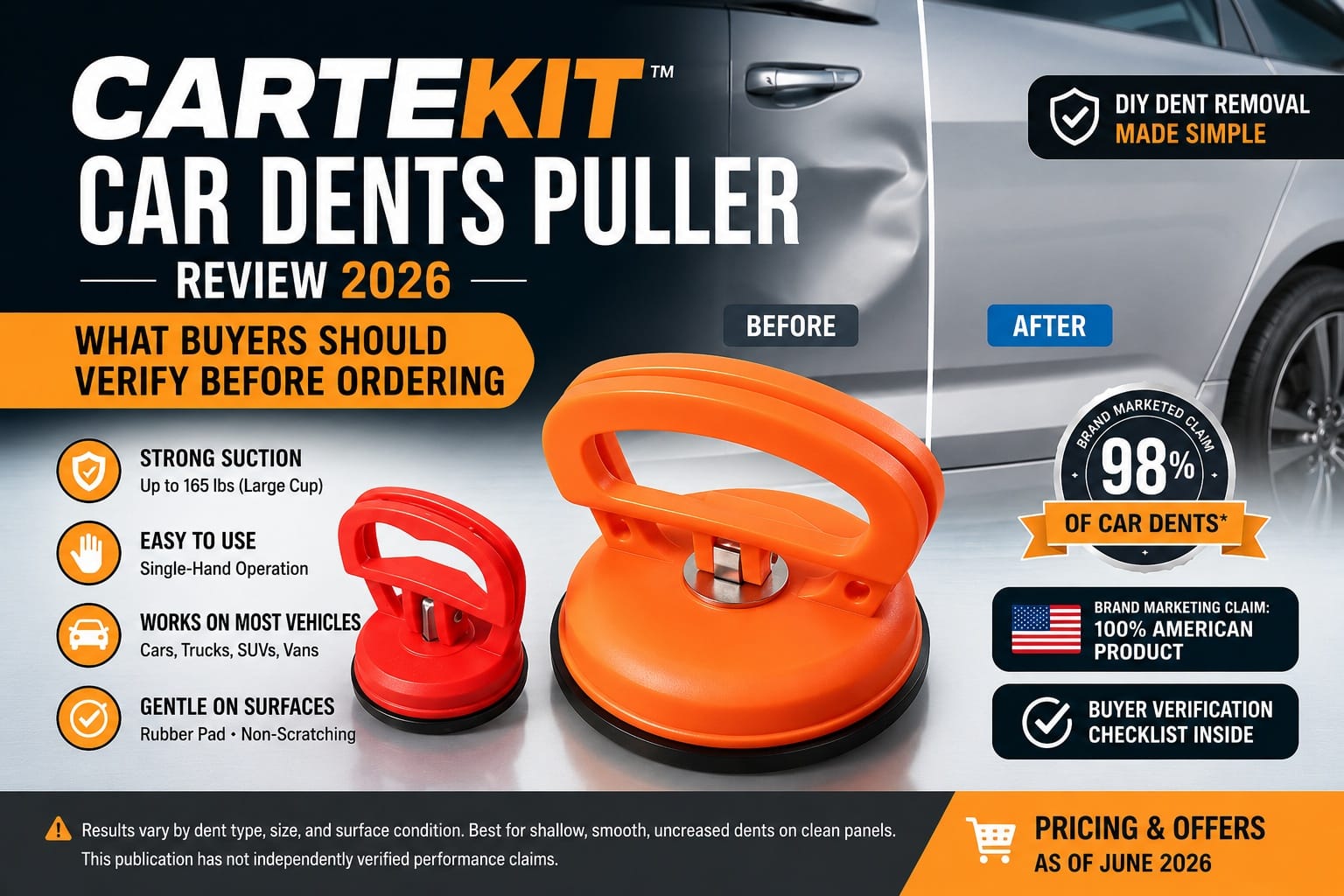
As repair costs keep minor dent removal in focus, this Cartekit Car Dent Puller review explores how the suction-style auto body tool is positioned for shallow, smooth, uncreased dents, what buyers should know before ordering, and which dent-type factors may influence results.
CHICAGO, IL / ACCESS Newswire / June 11, 2026 / Disclaimers: This article contains affiliate links. A commission may be earned on qualifying purchases made through links in this content, at no additional cost to the reader. Affiliate relationships do not influence editorial content or the evaluation of products. Disclosure is provided in accordance with FTC 16 CFR Part 255. This content is promotional in nature and is intended for consumer education regarding a commercially available product.
Cartekit Dent Puller Research 2026: Does It Really Work?
TL;DR: Professional dent repair starts at $75 to $150 per dent. Cartekit is a suction-style dent puller listed at $39.99 that's designed for shallow, smooth, uncreased dents on clean body panels. If your dent qualifies, trying a $39.99 tool before calling a body shop is rational math. If it doesn't qualify, no suction puller at any price will give you a satisfying result - and knowing the difference takes about 60 seconds. That's what this article gives you.
Before you order - or decide to skip it - there are three things about Cartekit that the brand's own website doesn't make obvious. This article covers all three: the dent-type test, the return policy condition most buyers miss, and the origin discrepancy between the brand's marketing and its operator's registered address.
Quick Verification Snapshot - Prices and Terms as of June 2026
Product: Cartekit Car Dents Puller
Checkout-Listed Price (1 unit): $39.99
Checkout-Listed Price (2 units): $79.99 - $39.99 per unit
Checkout-Listed Price (3 units): $89.99 - $29.99 per unit
Checkout-Listed Price (4 units): $104.99 - $26.25 per unit (lowest per-unit price listed)
Reference Prices (brand-stated, not independently verified): $59.99 / $119.98 / $179.97 / $239.96 - brand-stated checkout comparison figures not independently verified against prevailing market pricing; confirm final total at checkout
Suction Capacity (brand-stated): Large cup up to 165 lbs; small cup up to 120 lbs
Materials (brand-stated): ABS plastic body, natural rubber suction pad, alloy bearing
Return Window: 30 days from receipt - item must be unused and in original packaging; not a satisfaction-based return on tried products
Shipping (US): Brand-stated 10-15 business days transit; 1-4 day processing period applies before shipment
Pricing and promotional terms can change without notice - verify current totals at checkout before purchasing
Operator: Cartekit Technology International Co., Limited - OFFICE NO.12 ON 19 FLOOR, HO KING COMMERCIAL CENTRE, NO. 2-16 FA YUEN STREET, MONGKOK, KOWLOON, HK
Origin Alert: The brand's marketing uses "100% American product." The published operator address is Hong Kong. Buyers for whom origin is a deciding factor should verify with the brand before ordering.
Contact: [email protected] - 24/7, response target within 24 hours
Official Site: cartekit.com
Buyer Takeaway #1: Every figure above comes from Cartekit's published materials. Pricing and shipping timelines can change - always confirm your final checkout total before completing any order.
Check If Your Dent Qualifies - See Current Cartekit Pricing
Disclosure: If you buy through this link, a commission may be earned at no extra cost to you.
The 60-Second Dent Test: Do This Before You Order Anything
This section is here first because it's the only thing that actually determines whether Cartekit - or any suction dent puller - is worth your time and money. It takes about 60 seconds with a phone flashlight, and it's the single most valuable thing this article can give you - more useful than any performance claim, any star rating, or any marketing phrase the brand publishes.
Go outside. Take your phone. Hold the flashlight at a low angle across the dented panel - not pointing straight at it, but raking across it from the side. This is called raking light, and it makes dent geometry unmistakable.
What you see tells you everything:
Gradual shadow gradients, smooth curves, a bowl-shaped indentation: That's a shallow, uncreased dent - the exact type suction-style pullers are designed for. Cartekit is a rational first attempt before calling a body shop.
A hard shadow line running through the dent: That's a crease. Suction force applies outward pull - it can't address both the low point and the adjacent high spots a crease creates at the same time. No suction tool at any price resolves a creased dent cleanly. Go straight to a professional PDR technician.
Wrinkled, irregular, or stretched-looking metal: The panel's elastic memory has been exceeded. Suction won't recover it. Professional bodywork is the path.
Paint chipping, cracking, or flaking in the dented area: Broken paint is exposed metal. Disturbing that area with any tool before it's properly sealed creates corrosion risk. Professional repair first, before any DIY attempt.
That's the entire test. If your dent passed - smooth, shallow, no crease, intact paint - read on, because Cartekit's $39.99 entry point is worth understanding in full before you decide. If it didn't pass, you've just saved $39.99 and avoided a frustrating experience with a tool that wasn't designed for your dent type in the first place. Either outcome is genuinely useful information.
Buyer Takeaway #2: The 60-second test is more useful than any marketing claim. Do it before you read another word of any product review in this category - including this one - because the answer it gives you is more specific, more reliable, and more immediately actionable than anything a written review can provide about your particular dent on your particular vehicle.
Cartekit Car Dents Puller 2026 Fast Facts: What Every Buyer Should Know in 30 Seconds
Cartekit is a single-handle, pump-action suction dent puller for DIY auto body use
Best for: shallow, smooth, uncreased dents on clean panels - the type that passes the 60-second raking-light test above
Mechanism: single-stroke pump creates vacuum seal; pulling the handle applies outward force to dented metal
Large cup (brand-stated): up to 165 lbs suction capacity
Small cup (brand-stated): up to 120 lbs suction capacity
Materials (brand-stated): ABS plastic housing, natural rubber pad, alloy bearing
Vehicle types (brand-stated): cars, trucks, SUVs, vans
Surface types (brand-stated): smooth sheet metal, plate, glass
"98% of car dents" claim: brand-stated marketing language - not independently verified by this publication
Entry price (June 2026 checkout): $39.99 single unit vs. $75-$150 per dent for professional PDR
Return policy reality: 30 days from delivery - unused, original packaging required; not a try-it-and-return policy
Warranty: limited defect/damage replacement coverage within stated window
Origin note: brand says "100% American product"; operator address is Hong Kong - verify if this matters to you
Support: [email protected] - 24/7
Raking-light test: 60 seconds with a phone flashlight tells you whether your dent qualifies before you spend a dollar
Buyer Takeaway #3: These facts come from Cartekit's published materials. The "98% of dents" figure and "100% American product" claim both deserve scrutiny - this article addresses both in detail.
What Is the Cartekit Car Dents Puller?
You walked out to your car and there's a dent. Maybe it's a door ding from a crowded parking lot, a hail hit from last week's storm, or a low-speed bump you'd rather not think about. The body shop wants $150 minimum. That number stings - especially if the dent is cosmetic, the paint is fine, and you suspect the damage isn't that complicated.
That's the gap Cartekit is designed for.
It's a single-handle, pump-action suction dent puller sold exclusively through the brand's own website. You press the rubber cup against the dented panel, use the single-stroke pump to pull the air out and create a vacuum seal, then pull the handle to apply outward force. The idea - and the physical principle behind every suction dent tool in this category - is that steel body panels have elastic memory. Push the metal inward and it retains a tendency to return to its original shape. The right outward force, applied to the right spot on the right type of dent, is all it takes to close that gap.
One practical note before you comparison-shop: Cartekit isn't sold through Amazon, Walmart, or auto parts retailers - it's sold exclusively through the brand's own website, which means any third-party listing you find on another platform comes with no guarantee that the brand's pricing, return terms, or replacement coverage applies to that transaction.
Buyer Takeaway #4: Cartekit is a suction-based entry point into DIY dent repair - sensible for the right dent type, and the wrong tool for the wrong dent type. The 60-second test at the top of this article tells you which situation you're in before you spend a dollar.
How Does the Cartekit Car Dents Puller Work?
Quick Answer: Cartekit creates a vacuum seal on a body panel using a rubber suction cup and single-stroke pump. Pulling the handle applies outward force to the dented metal, exploiting the elastic memory of steel - its natural tendency to return toward its original shape. The mechanism is established and functional for shallow, smooth, uncreased dents. Whether it works on your specific dent depends on dent geometry, not brand name.
The underlying physics are worth understanding because they tell you exactly when this tool works and when it doesn't.
Steel body panels hold their shape through a combination of material properties and structural geometry. When an impact pushes metal inward, the panel stores a kind of mechanical tension - it "wants" to return to where it was. Suction-pull tools exploit that tension: the vacuum cup grips the displaced surface, and pulling outward gives the metal a controlled path back to its original position.
What determines success or failure isn't the brand or the suction rating - it's the geometry of the dent. A smooth, shallow bowl-shape preserves the metal's elastic range and gives suction a clean surface to grip. A crease changes the geometry fundamentally: the metal has been folded, not just pushed, and the fold creates opposing stress points that a single outward pull can't resolve simultaneously. That's not a product limitation - it's physics.
The brand markets Cartekit with a "repairs 98% of car dents" claim - a figure this publication has not independently verified and that buyers should treat as brand-stated marketing language positioning the product within its category, not as a guaranteed result for every dent type. Suction-style dent pullers are most appropriate for shallow, smooth, uncreased dents on clean panels where the cup can form a full vacuum seal.
Buyer Takeaway #5: Understanding why the mechanism works tells you more about whether it'll work for you than any review score. The 60-second raking-light test translates physics into a visible answer in real time, on your actual dent.
Is the Cartekit Car Dents Puller Worth It?
Quick Answer: Worth it - if your dent passed the 60-second test. Shallow, smooth, uncreased, intact paint, accessible panel: Cartekit's $39.99 entry point makes rational sense before a $75-$150 minimum professional PDR visit. Not worth it - if your dent has a crease, damaged paint, or stretched metal. No suction tool will resolve those dent types, regardless of brand or price, and you're better served going directly to a professional.
Here's the complete worth-it framework - no soft hedging.
Worth it if all of these apply:
Your dent passed the raking-light test - smooth, shallow, no visible crease
Paint is intact in and around the dented area
The panel surface is accessible and smooth enough for a complete cup seal
You understand the return policy covers unused items only - not a tried product
You've confirmed current pricing and shipping at checkout before ordering
Not worth it if any of these apply:
You can see a crease or fold line in the metal
Paint is chipped, cracked, or flaking in the dented area
The dent sits on a sharp body line where a suction cup can't seal
The metal looks wrinkled, stretched, or irregularly distorted
You're expecting to try it and return it if it doesn't work - the policy doesn't cover that
The cost comparison is real: professional paintless dent repair runs $75-$150 per dent for minor single-panel damage, according to 2025 industry data from Relux Collision. Conventional bodywork with paint runs higher. At $39.99, a DIY first attempt on a qualifying dent saves you that entire minimum spend - or confirms you need the professional, having lost only $40 and a few minutes.
Buyer Takeaway #6: The worth-it answer is a direct function of your dent type. That single variable determines everything else. If you haven't done the 60-second test yet, do it before reading further.
Is the Cartekit Car Dents Puller Legit?
Quick Answer: Cartekit is a commercially available product from an identifiable operator - Cartekit Technology International Co., Limited - with a published Hong Kong address, working support contact, and disclosed policies. The suction-pull mechanism reflects an established approach used within the dent-removal category. Two things buyers should know: the brand's "100% American product" claim conflicts with the operator's Hong Kong registration, and the 30-day return window applies to unused items only.
Verify Cartekit's Current Pricing and Terms - Official Checkout
Breaking this into the specific questions buyers are actually asking:
Is it a commercially available product from an identifiable company?
Yes. Cartekit Technology International Co., Limited is the registered operator. The company has a published business address in Hong Kong, a working support email at [email protected], and published Terms of Service, Privacy Policy, and Returns Policy. The checkout is functional and the product ships.
Does the mechanism work?
The suction-pull approach reflects an established technique in the dent-removal category - applied in both consumer and professional contexts for decades. What it can and can't address is consistent with the broader product category: highly effective on qualifying dents, less effective on dents outside that profile. The brand's "98% of car dents" figure is brand-stated and not independently verified by this publication.
What about "100% American product"?
This is the genuine discrepancy worth flagging. The brand's marketing uses this phrase. The published operator information identifies Cartekit Technology International Co., Limited with a Hong Kong address. Buyers for whom manufacturing origin is a deciding factor should contact [email protected] directly to verify before ordering.
Is the 30-day guarantee what it sounds like?
Read the terms precisely. The 30-day window applies to unused items in original packaging only. If you open the tool, try it on your dent, and the result isn't what you hoped - the standard return terms don't apply. Your decision to buy needs to be based on dent-type fit, not on the assumption of a no-questions-asked return.
What about the checkout urgency messaging?
The checkout page may display countdown timers and availability messaging. This publication has not independently verified inventory levels, countdown timing, or any scarcity claims displayed on the brand's checkout. Purchase decisions should be driven by dent-type fit and pricing, not by urgency cues.
Buyer Takeaway #7: Cartekit is a commercially available product with an identifiable operator and an established mechanism in its category. The origin discrepancy is real - resolve it with the brand directly if it matters. The return policy is more limited than its summary language implies. Both are knowable before you order.
What Dent Types Is Cartekit Car Dents Puller Designed For?
Quick Answer: Cartekit is designed for shallow, smooth, uncreased dents on clean panels where the suction cup can form a full vacuum seal - door dings, moderate hail hits, and light low-speed impacts where the paint is intact. It's not designed for creased dents, stretched metal, deeply curved panel sections, or dents with paint damage. Dent type is the single variable that determines the outcome.
Most consumer dent-puller reviews skip this section entirely. That's why buyers end up frustrated - not because the tool is defective, but because the wrong tool was used on the wrong dent type.
Dent types generally more suitable for suction-pull technique:
Shallow depth - metal pushed inward but not far; elastic memory intact
Smooth, rounded profile - the dent looks like a bowl, not a fold or point
No visible crease - no line running through the deformed area when viewed in raking light
Intact paint - no chips, cracks, or flaking in or around the dent
Sufficient flat surface area - the cup edge needs solid contact all the way around
Accessible location - room to position and pull without panel obstructions
Dent types generally less suitable for suction-pull technique:
Creased dents - metal bent along a line; the geometric complexity exceeds what outward suction force can address
Deep impacts - metal stretched or wrinkled beyond elastic recovery range
Very small, concentrated impacts - contact area too small for a cup to seat fully
Sharp body-line sections - panel curvature prevents a complete vacuum seal
Compromised paint - broken paint is exposed metal; disturbing the area before it's sealed adds corrosion risk
Near sensors, cameras, or structural reinforcement - appropriate repair involves calibration or structural assessment beyond surface work
The 60-second raking-light test at the top of this article is the fastest way to determine which category your dent falls into. No amount of reading replaces looking at your specific dent.
Buyer Takeaway #8: Dent type is the entire decision. Everything else in a product review of a suction dent puller is secondary to whether your specific damage falls within the technique's operating range.
What the Brand Claims - and What This Article Has Verified
There's a significant difference between what a brand publishes about its own product and what an independent review can verify. Here's an explicit breakdown of both, so you can distinguish between the two.
Brand claims reviewed for this article (all sourced from Cartekit's publicly available materials):
"Repairs 98% of car dents" - brand-stated headline marketing claim; this publication has not independently verified this figure. Treat it as category positioning language, not a performance guarantee for your specific dent. Suction-style pullers are most appropriate for shallow, smooth, uncreased dents on clean panels.
Large cup up to 165 lbs, small cup up to 120 lbs - brand-stated suction capacity figures; not independently tested by this publication
ABS plastic, natural rubber pad, alloy bearing - brand-stated material specifications
"Soft rubber pad that won't scratch painted surfaces" - brand-stated; not independently tested
"Takes less than 1 minute" - brand's description of operation setup time; refers to speed of a single pull attempt, not guaranteed repair completion time
"Works with most vehicles" - brand-stated; compatibility in suction-tool category is determined by panel material and dent geometry, not vehicle brand
"100% American product" - brand marketing language; operator's published Terms of Service lists a Hong Kong address. Buyers for whom origin is material should verify directly with the brand.
What this article independently confirmed from the brand's own published documents:
Operator identity: Cartekit Technology International Co., Limited
Registered business address: Hong Kong (per brand's own Terms of Service)
Return policy conditions: 30 days from delivery, unused, original packaging required
Checkout-listed prices as of June 2026: $39.99 / $79.99 / $89.99 / $104.99
Support contact: [email protected], 24/7, 24-hour response target
No subscription or auto-renewal component - one-time purchase only
Exclusive direct-to-consumer sales channel - not available through third-party retail
Customer ratings and testimonials on the brand's website are brand-reported and have not been independently audited by this publication. Individual experiences may vary depending on dent type, surface condition, and user technique.
Buyer Takeaway #9: The distinction between "brand-stated" and "independently verified" is the most useful frame for evaluating any product review. This article makes that distinction explicit throughout so you always know which column a given claim falls into.
How to Read Cartekit's Marketing Language
Consumer tool marketing uses confident, sweeping language. That's the convention. Here's the translation layer that turns brand phrases into actionable buyer information.
"Repairs 98% of Car Dents"
Source: Cartekit brand marketing website
Translation: Category positioning claim for broad applicability - not an independently audited figure. Suction-style pullers work well on a specific subset of dent types; "98%" isn't a number buyers should treat as a personal guarantee.
Your action: Run the 60-second raking-light test to determine whether your dent falls in that subset.
"100% American Product"
Source: Cartekit brand FAQ
Translation: Marketing positioning phrase. The published operator, Cartekit Technology International Co., Limited, lists a Hong Kong address in its own Terms of Service. These two claims conflict. Under the FTC's Made in USA Labeling Rule (16 CFR Part 323), an unqualified "Made in USA" or "American product" claim is only permissible when final assembly and virtually all components are of U.S. origin - a standard the brand has not publicly demonstrated it meets. This publication does not repeat this claim as a verified fact.
Your action: If origin is a deciding factor, email [email protected] before ordering and ask for specific manufacturing location documentation.
"Less Than 1 Minute"
Source: Cartekit brand website
Translation: Speed of setup and a single pull attempt - not a guarantee of complete dent resolution in under 60 seconds. Complex or borderline dents may need multiple attempts, and some types won't respond to suction regardless of time.
Your action: Set expectations based on dent characteristics, not a stopwatch.
"30-Day Money-Back Guarantee"
Source: Cartekit published returns policy
Translation: Return window for unused items in original packaging. This is not a satisfaction-based policy on tried products - that distinction is critical.
Your action: Read the full return terms before buying, especially if your plan depends on returning the tool if it doesn't work on your dent.
Buyer Takeaway #10: Marketing phrases are designed to create purchase confidence. Reading them with a translation layer means you buy with accurate expectations - which is the only foundation for a decision you won't regret.
Cartekit Car Dents Puller Pricing and Where to Buy
Quick Answer: As of the checkout page reviewed in June 2026: $39.99 for one unit, $79.99 for two, $89.99 for three, and $104.99 for four. Shipping and tax calculated separately at checkout - confirm your final total before purchasing. Sold exclusively through the brand's official website. Pricing can change without notice.
Pricing from Cartekit's checkout page, as reviewed for this article:
1x Cartekit: $39.99 (checkout-listed reference: $59.99)
2x Cartekit: $79.99 - $39.99 per unit (checkout-listed reference: $119.98)
3x Cartekit: $89.99 - $29.99 per unit (checkout-listed reference: $179.97)
4x Cartekit: $104.99 - $26.25 per unit (checkout-listed reference: $239.96)
Reference prices and savings percentages are brand-stated checkout figures not independently verified against prevailing market pricing. Shipping and applicable tax are calculated separately - confirm your final order total at checkout.
On the multi-unit options: the 4-pack shows the lowest per-unit checkout price at $26.25, while the 3-pack may be a practical middle option for buyers who want more than one unit without committing to the largest bundle. For a first-time buyer who hasn't yet confirmed the tool works for their specific dent type, the single unit at $39.99 is the lower-commitment entry point that lets you verify the approach before deciding whether additional units make sense.
Cartekit is sold exclusively through the brand's official website. Any listing on Amazon, eBay, Walmart, or any other platform is a third-party seller - the brand's pricing, return policy, and warranty terms don't automatically apply to those transactions.
Check Current Cartekit Pricing - Official Site
Buyer Takeaway #11: Single unit at $39.99 for a first attempt on a qualifying dent - the math works. Multi-packs reward buyers who know they'll use the tool across multiple vehicles or situations. Don't let per-unit pricing push you toward a larger quantity before confirming the approach works for your specific dent.
Cartekit vs. Professional Body Shop Repair: The Real Cost Comparison
Most buyers aren't choosing between Cartekit and a competing suction tool. They're comparing $39.99 against making a phone call to a body shop - and that comparison deserves real numbers.
According to 2025 industry pricing data from Relux Collision, professional paintless dent repair runs $75 to $150 per dent for minor single-panel damage. More complex or multi-panel repairs reach $500 or more. Conventional body repair requiring paint work is a separate, higher tier. Auto body repair costs rose approximately 7% for materials and 3% for labor in early 2025 - so those numbers are trending upward, not down.
What a professional brings that Cartekit can't:
A trained assessment of whether the dent is even a PDR candidate before any work starts
Multiple techniques - suction, glue tabs, interior push rods - for dents that don't respond to suction alone
Access to the interior side of the panel, which is how professional PDR actually works most of the time
Handling for creases, compound-curve panels, and structural complications
Service warranty on completed work
What Cartekit offers that a body shop can't:
No appointment, no wait, no drop-off - available right now, in your garage
A fraction of the cost for qualifying dent types
A reusable tool for every future ding (and they will come)
Zero delay between deciding to fix it and fixing it
The practical sequence: if the dent passed the 60-second test, try the $39.99 tool first, using the controlled-force technique described in this article - and if the attempt doesn't fully resolve it, call a professional, knowing that you haven't made their job harder as long as you used appropriate force and stopped when the metal stopped responding. If the dent didn't pass the test, go straight to a professional; you've just saved both the $40 and the frustration of a tool mismatch.
Buyer Takeaway #12: The choice isn't really Cartekit vs. professional PDR - it's whether your dent type justifies a $39.99 first attempt before a $75-$150 minimum. The 60-second test answers that question in real time.
What Happens If Cartekit Doesn't Work on My Dent?
Most product reviews skip this question. It's the most important one for setting honest expectations - so here's the direct answer.
Partial improvement but not full resolution
This is the most common non-ideal outcome when suction is applied to a dent near the edge of its compatibility range. The panel looks better but not perfect. Options: accept the partial improvement, follow up with a glue-tab PDR system for finer refinement, or call a professional PDR technician for a final pass. Partial improvement doesn't make the professional repair more expensive or more difficult.
The cup won't seal
This means either the surface isn't clean enough for a full vacuum contact, or the panel geometry in that location doesn't allow a complete seal - usually a panel area with too much compound curve. Clean the area more thoroughly first. If it still won't seal after a proper clean, that location may simply not be compatible with suction-cup technique.
Metal not responding despite a good seal
This signals the metal has been stretched or creased beyond suction-pull recovery range, and continuing past that signal by applying more force is how a manageable dent becomes a significantly more expensive repair - so stop here, release the tool, and contact a professional PDR technician. Continuing to apply force to unresponsive metal tends to create "high spots" adjacent to the original dent - areas now raised above the surrounding surface - which are harder and more expensive to professionally repair than the original inward dent was.
The one firm rule: don't escalate force on a dent that isn't responding. If the cup seals and the metal doesn't move, that's the signal to change approaches - not to pull harder. Recognizing that signal early keeps the subsequent professional repair as clean and inexpensive as possible.
Buyer Takeaway #13: Knowing when to stop is as important as knowing how to start. A dent that isn't responding to suction needs a different technique, and catching that signal early protects both your car and your repair budget.
Cartekit Complaints and Common Buyer Concerns
Common buyer concerns identified during this review of Cartekit's published materials and the broader suction dent-puller product category include the following. This publication has not conducted an independent analysis of customer complaint volumes and has not independently identified a specific body of Cartekit complaints through third-party review sources.
Return policy confusion - the most commonly cited frustration in this product category
Buyers expect "30-day guarantee" to mean they can try the tool and return it if it doesn't work. Cartekit's published terms require the item to be unused and in original packaging. That gap between expectation and policy is the single most preventable source of buyer disappointment - and it's entirely resolved by reading the return terms before purchasing rather than after.
Dent compatibility mismatch
The second most common concern across suction dent-puller reviews broadly: buyers apply the tool to creased or deeply stretched dents and are disappointed when suction technique doesn't fully resolve them. This isn't a product defect - it's a technique mismatch. The 60-second raking-light test at the top of this article is specifically designed to prevent this scenario before it happens.
Origin verification questions
The brand's "100% American product" marketing language alongside a Hong Kong operator address creates an obvious question. Buyers should email [email protected] before ordering if manufacturing origin is a material factor in their decision.
Shipping timeline expectations
The brand's stated 10-15 business day US transit time - plus a separate 1-4 day processing period - means total delivery can run 11 to 19 business days under normal conditions. Buyers expecting faster delivery based on domestic shipping assumptions may find this timeline longer than expected. The brand's published shipping policy documents this; review it before ordering if delivery speed matters.
Checkout urgency messaging
The brand's checkout page may display countdown timers and availability messaging. This publication has not independently verified inventory levels, countdown timing, or scarcity claims. Purchase decisions should rest on dent-type fit, not on checkout urgency cues.
Buyer Takeaway #14: Every concern on this list is fully preventable with about 10 minutes of reading before you order. Return terms, dent-type assessment, origin verification, and shipping timelines are all addressed in this article and in the brand's own published policies. The information is there - the question is whether you read it before or after the purchase.
How to Use the Cartekit Car Dents Puller - Step by Step
The setup is fast - "less than 1 minute" for a single pull attempt is accurate for the operation itself. Here's the full sequence based on Cartekit's published instructions:
Step 1: Clean the panel surface. The cup needs clean, dry contact to form a proper vacuum seal. Road grime, wax residue, or any surface contamination reduces suction effectiveness. Wipe the dented area with a clean cloth. If the panel has been recently waxed, a light clean to remove wax from the contact zone helps the cup grip properly.
Step 2: Position the cup on the dent. Place the cup directly over the center of the dent. For a dent larger than the cup's diameter, work in progressive sections - start from one edge and move inward, rather than trying to address the entire dent in a single pull.
Step 3: Activate the pump. Press the cup firmly against the surface and use the single-stroke pump to create the vacuum seal. Confirm the cup has fully seated before pulling - a partial seal delivers less force and less effective results.
Step 4: Apply steady, controlled outward force. Pull with even, controlled pressure - not a sudden jerk. Gradual outward force gives the metal a path back toward its original position. Sharp, sudden pulls tend to break the seal before the metal can respond.
Step 5: Release and assess in good light. Release the seal and evaluate the panel. A single pull may produce significant improvement, partial improvement, or minimal change, depending on the dent. Partial improvement is normal for the first pass - work from the outer edges of the dent progressively toward the center on subsequent pulls.
One technique borrowed from professional PDR practice: keep a reflective surface or a phone flashlight at a low angle while you work. The reflection shows panel movement more accurately than a straight-on view, letting you track your progress in real time.
Buyer Takeaway #15: The steps are quick and designed for non-professionals. The skill develops in reading the panel's response - adjusting position, working edge-to-center progressively, and recognizing the signal that tells you to stop versus keep going.
What's the Cartekit Car Dents Puller Return Policy?
This section matters more than it would for most consumer purchases because a surprising number of buyers in this product category misread the return terms - and end up disappointed as a result. Here's exactly what Cartekit's published policy says.
What qualifies for a standard return (per brand's published policy):
Return initiated within 30 days of the delivery date shown on tracking records
Item must not have been used - must be in the same condition as received
Original packaging required
Proof of purchase required
What the standard policy does not cover:
Items that have been opened and used
Returns after the 30-day window
Returns without proof of purchase
Replacement coverage for defective or damaged items: The brand offers a replacement - not a refund - for items received defective or damaged, requested within 30 days of delivery. No additional shipping charge on the replacement. Standard returns: buyer pays return shipping.
The brand describes this coverage as replacement for defective or damaged items within the stated window. This should be treated conservatively as limited defect/damage replacement coverage, not a broad performance guarantee. Buyers should review the brand's full return and warranty terms before purchase.
The core practical implication - and the one that catches buyers off guard most often - is this: if you buy Cartekit, try it on your dent, and the result isn't what you hoped for, the standard return path is closed because the item has been used and the brand's published conditions explicitly require unused, original-packaging condition. Your purchase decision needs to stand on dent-type fit, confirmed before you order - not on the assumption of a post-use return.
Buyer Takeaway #16: 30-day return window - real. "Unused items only" condition - the part most people miss. Know both before you buy. The distinction between these two things is the difference between a purchase decision based on accurate information and one based on a pleasant-sounding assumption.
Cartekit Car Dents Puller Specifications
Everything below is brand-stated - no independent lab testing was conducted by this publication.
Materials (brand-stated): ABS plastic housing; natural rubber suction pad (brand states non-scratching on painted surfaces when properly applied); high-quality alloy bearing (brand credits for pull stability and longevity)
Suction capacity (brand-stated): Large cup up to 165 lbs; small cup up to 120 lbs
Operation (brand-stated): Single-stroke pump activation; single-handed ergonomic handle design
Vehicle compatibility (brand-stated): Cars, trucks, SUVs, vans
Surface compatibility (brand-stated): Smooth sheet metal, plate, glass; secondary use for moving flat objects in garages and body shops
Specifications not publicly disclosed: Exact cup diameter measurements, total tool weight, specific panel curvature tolerances. Contact [email protected] for these details if needed before purchasing.
Buyer Takeaway #17: The specification most relevant to your purchase decision isn't the ABS material or the suction rating - it's whether suction-pull technique fits your dent geometry. The 60-second test at the top of this article answers that question more precisely than any spec sheet.
Cartekit Car Dents Puller Frequently Asked Questions
What is the Cartekit Car Dents Puller?
Cartekit is a consumer suction-style dent removal tool sold exclusively through the brand's official website. It uses a single-stroke pump to create a vacuum seal on a vehicle body panel, then allows controlled outward pulling force on the dented area. The brand markets it with a "repairs 98% of car dents" claim - not independently verified by this publication. Buyers should assess their specific dent against the 60-second test described in this article before ordering.
Does the Cartekit Car Dents Puller actually work?
The suction-pull mechanism reflects an established approach used within the dent-removal category - effective on shallow, smooth, uncreased dents on clean panels where the cup can form a full seal. The brand's "98% of car dents" claim is brand-stated and not independently verified. Whether it works for your dent depends entirely on the damage characteristics. The 60-second raking-light test described at the top of this article tells you before you spend a dollar.
How much does Cartekit cost?
As of the checkout page reviewed in June 2026: $39.99 for one unit, $79.99 for two, $89.99 for three, $104.99 for four. Shipping and tax are calculated separately - confirm the final total at checkout before purchasing. Reference prices shown on the checkout page are brand-stated figures not independently verified against prevailing market pricing. Pricing can change without notice.
What is Cartekit's return policy?
Cartekit's published return window is 30 days from delivery - but the item must be unused and in original packaging. This is not a satisfaction-based return policy on tried products. For items received defective or damaged, the brand offers a replacement within 30 days, with no additional shipping charge on the replacement unit. Contact [email protected] to initiate a return or replacement.
Where is Cartekit made?
The brand's marketing materials use the phrase "100% American product." The published operator information identifies Cartekit Technology International Co., Limited with a Hong Kong address. These two claims conflict. Buyers for whom manufacturing origin is material should contact [email protected] before ordering to verify the actual manufacturing location.
What dent types does Cartekit work best on?
Shallow, smooth, uncreased dents on clean panels where the cup can form a complete vacuum seal - door dings, moderate hail hits, and minor impacts where paint is intact. Not designed for dents with visible creases, stretched or distorted metal, compound-curve panel sections where the cup can't seal, or dents with compromised paint. Run the 60-second raking-light test described in this article to identify which category your dent falls into before ordering.
Is the Cartekit Car Dents Puller legit or a scam?
Cartekit is a commercially available product from an identifiable operator - Cartekit Technology International Co., Limited - with disclosed contact information, published policies, and a functional checkout. The suction-pull mechanism reflects an established technique in the dent-removal category. It is not a scam in the traditional sense. Two things buyers should verify independently before ordering: the origin discrepancy (brand says "100% American product"; operator address is Hong Kong) and the return policy (30 days, unused items only - not a satisfaction guarantee on tried products).
Are there any Cartekit complaints?
Public concerns associated with suction-style dent pullers broadly - and with Cartekit's category of product - generally involve return policy expectations, dent compatibility mismatch, shipping timelines, and manufacturing-origin questions. This publication has not conducted an independent analysis of customer complaint volumes. Buyers should review the brand's published policies and verify product suitability for their specific dent type before purchasing.
Is there a warranty on the Cartekit Car Dents Puller?
The brand offers replacement coverage for defective or damaged items within 30 days of delivery. This should be treated conservatively as limited defect/damage replacement coverage, not a broad performance guarantee. Under the Magnuson-Moss Warranty Act, coverage with conditions and limitations may be characterized as a limited warranty under federal warranty classifications based on conditions described in the brand's published materials. Contact [email protected] for specific warranty questions.
How long does Cartekit shipping take?
Per the brand's published shipping information, US orders are estimated at 10-15 business days from the shipment date, with a separate 1-4 day processing period before shipment - making the total expected delivery window 11 to 19 business days under normal conditions. Puerto Rico is estimated at approximately 25 business days. Holiday volume and customs processing can extend these timelines.
Can the Cartekit Car Dents Puller scratch my paint?
The brand states the rubber suction pad is designed to be non-damaging to painted surfaces when properly applied - brand-stated, not independently tested. Best practice for any suction dent tool: ensure the cup contact area is completely free of debris or grit before pressing against the panel. Particulate matter trapped between the rubber pad and the paint is a more common source of surface marring than the rubber itself.
What vehicles is Cartekit compatible with?
According to the brand's FAQ: most vehicles, including cars, trucks, SUVs, and vans. In the suction-tool category, compatibility is determined more by panel material and dent geometry than vehicle make or model. The tool works on smooth metal and glass. It's less effective on panels with heavy compound curves and doesn't apply to composite or fiberglass body panels the same way it does to steel.
How does Cartekit compare to professional PDR?
Professional paintless dent repair runs $75-$150 per dent for minor damage (2025 Relux Collision data), with complex repairs reaching $500+ - and with auto body labor and materials both rising in 2025, those minimums are trending upward rather than down. At $39.99, a first attempt with Cartekit before committing to the professional minimum is rational math for a qualifying dent. For complex dents involving creases, stretched metal, or structural complications, go directly to a professional - no suction tool at any price is the right approach for those damage types, and the sooner you make that call, the simpler and less expensive the professional repair will be.
Can suction dent pullers make a dent worse?
Yes, under specific conditions. Applying escalating force to metal that isn't responding - particularly if it's been stretched or creased - can create "high spots" adjacent to the original dent that are harder and more expensive to professionally repair than the original damage was. The prevention: assess your dent type before starting, use controlled force, and stop immediately if the metal isn't moving rather than increasing pull strength. The signal to stop is the cup sealing but the metal not responding.
Is Cartekit available at Amazon or Walmart?
Based on materials reviewed in June 2026, Cartekit is sold exclusively through the brand's official website. Any listing on a third-party platform is not the brand's official channel - the brand's pricing, return policy, and warranty coverage may not apply to those transactions.
What should I do before ordering Cartekit?
Three steps: First, do the 60-second raking-light test to confirm your dent is the shallow, smooth, uncreased type that suction tools are designed for. Second, read the return terms in full - specifically that the 30-day window requires unused, original-packaging condition. Third, confirm the final checkout total including shipping and tax before completing the purchase. Those three steps cover every decision variable that matters.
Buyer Verification Checklist - Everything to Confirm Before You Order
Your dent:
You did the 60-second raking-light test - smooth bowl shape, no crease or fold line visible
Paint is intact in and around the dented area
Panel surface is smooth enough for a complete suction seal
The dent location is accessible - not behind trim, not on a sharp body line
The brand's terms:
You've noted the 30-day return requires unused condition - this is not a try-and-return policy
You've verified the checkout-listed price matches what you saw advertised
If origin matters to you, you've emailed [email protected] to confirm manufacturing location
You've confirmed the final checkout total including shipping before purchasing
Your expectations:
"98% of car dents" is brand marketing language - not a guarantee for your specific dent
Your dent passes the 60-second test and qualifies for suction technique
You know your next step if suction doesn't fully resolve it: professional PDR
Buyer Takeaway #18: This checklist exists to send you into the purchase with accurate information, not to talk you out of it. The buyer who goes in knowing their dent type, understanding the return terms, and carrying calibrated expectations is the buyer who comes out satisfied.
Final Verdict: Cartekit Car Dents Puller 2026
Here's the complete answer - direct, no qualifications that don't earn their place.
If your dent passed the 60-second test: shallow, smooth, bowl-shaped, intact paint, accessible panel location - Cartekit is worth trying at $39.99. The mechanism is established. The price point makes a DIY first attempt rational before a $75 to $150 professional PDR minimum. If it works, you've saved at least $35 and a body shop trip. If it partially works, you've made visible improvement and the professional touch-up job is simpler than the original repair would have been. If it doesn't work on your specific dent despite passing the test, you've spent $40 to confirm the professional is the right call - which is still cheaper than most shop diagnostic fees.
If your dent didn't pass the 60-second test: visible crease, stretched metal, damaged paint, or a panel location where a cup can't seal - go directly to a professional PDR technician. Don't spend $39.99 to confirm what the raking-light test already told you. Save the time and go straight to the solution that works.
Two things that deserve your attention regardless of which group you're in:
The origin question won't go away on its own. "100% American product" is what the brand's marketing says. A Hong Kong operator address is what the brand's own Terms of Service discloses. If where this tool is manufactured matters to your purchase decision, resolve that with a quick email to [email protected] before you order - not after.
The return policy means what it says, not what it implies. "30-day guarantee" sounds like consumer protection. "Unused items in original packaging only" is the actual coverage. Your purchase decision needs to rest on the dent-type match being right - not on the ability to return a tried product. Go in knowing that, and you've closed the gap where most buyer disappointment in this category originates.
The bottom line: this is a straightforward tool that does what it's designed to do on the dent type it's designed for. The 60-second test is the only variable that matters. Everything else - the price, the brand, the claims - is secondary to whether your dent geometry is compatible with suction-pull technique.
Buyer Takeaway #19: Do the test. Read the return terms. Verify origin if it matters. Those three steps take under 10 minutes and they're the difference between a purchase you're confident about and one you're hoping works out.
View Current Pricing and Order Cartekit - Official Site
Contact Information
Company: Cartekit
Email: [email protected]
Availability: Customer service available 24/7, response target within 24 hours.
Address: OFFICE NO.12 ON 19 FLOOR, HO KING COMMERCIAL CENTRE, NO. 2-16 FA YUEN STREET, MONGKOK, KOWLOON, HK
Related: Cartekit Car Coating Spray Research (2026)
Disclaimers
Advertorial Disclosure: This article is an advertisement and a paid promotional placement produced in connection with affiliate marketing relationships. This content is promotional in nature and is intended for consumer education regarding a commercially available product. The content producer may receive compensation when a qualifying purchase is made through affiliate links in this content; this compensation may affect which products are covered and how they are described, though it does not affect factual accuracy or the article's independent identification of compliance concerns, product limitations, or buyer risk factors. Disclosure is made in accordance with the Federal Trade Commission's guidelines on endorsements and testimonials (16 CFR Part 255), the FTC's guidance on native advertising (FTC Enforcement Policy Statement on Deceptively Formatted Advertisements, 2015), and the FTC's Endorsement Guides as updated in 2023.
FDA Disclaimer: The Cartekit Car Dents Puller is a consumer mechanical tool. It is not a medical device, dietary supplement, or food product. No FDA evaluation of this product is applicable. This article does not make any medical claims.
Material Limitations of This Review: This review is based exclusively on publicly available materials, including the official Cartekit website, the brand's published Terms and Returns policies, checkout page pricing, and general industry guidance on suction-style dent removal tools. This publication has not received compensated product samples for testing, has not interviewed brand personnel, has not been granted access to internal product specifications beyond what is publicly published, and has not conducted laboratory or field performance testing of the Cartekit Car Dents Puller. Claims described as "brand-stated," "according to the brand," or "brand-reported" reflect what the brand has publicly stated and have not been independently substantiated by this publication. Buyers are encouraged to verify any claim that materially affects their purchase decision by contacting the brand directly at [email protected].
Third-Party Consumer Feedback Platforms and FTC Consumer Review Rule (16 CFR Part 465): Customer ratings and testimonials on the brand's website are brand-reported and have not been independently audited, solicited, collected, or curated by this publication. This publication does not reproduce specific consumer testimonials, does not verify reviewer identity or purchase status, and does not amplify brand-attributed star ratings as independently verified data. Individual experiences vary depending on dent type, surface condition, and user technique. This publication does not endorse, vouch for, audit, or accept responsibility for the accuracy or fairness of customer reviews posted on any platform - including the brand's own website, general-purpose review sites, social media platforms, or online forums. Buyers consulting third-party reviews are encouraged to evaluate them critically, look for verified-purchase indicators where available, and weigh reviewer-specific context against their own situation. This disclosure is provided in accordance with 16 CFR Part 465 (FTC Consumer Review Rule, effective October 21, 2024).
Forward-Looking Statements and Article Accuracy: This article reflects information available as of June 2026 and was prepared using reasonable care to be accurate and useful at the time of publication. Product specifications, pricing, promotional offers, shipping policies, warranty terms, return policies, contact information, and customer feedback data may change after publication without notice. No representation is made that the information will remain accurate in the future. Readers should rely on the official Cartekit website as the authoritative source for current product information prior to any purchase decision.
Reasonable Consumer Standard: This article is written for a general adult consumer audience. Attribution language including "brand-stated," "according to the brand," or "brand-reported" identifies claims not independently verified by this publication. Promotional claims on the brand's website - including "repairs 98% of car dents," "100% American product," "less than 1 minute," and "ultimate dent-pulling tool" - are explicitly identified throughout this article as brand-asserted marketing language, not independent third-party performance guarantees or laboratory-verified claims.
Magnuson-Moss Warranty Act: The Cartekit brand's 30-day replacement coverage for defective or damaged items may be characterized as a limited warranty under federal warranty classifications based on conditions described in the brand's published materials, consistent with the Magnuson-Moss Warranty Act (15 U.S.C. §2303).
FTC Made-in-USA Rule Disclosure (16 CFR Part 323 and Executive Order 14392, March 13, 2026): The Cartekit brand's marketing materials use the phrase "100% American product." The FTC's Made in USA Labeling Rule requires unqualified "Made in USA" claims to meet the "all or virtually all" standard - meaning final assembly and virtually all components must be of U.S. origin. The registered operator - Cartekit Technology International Co., Limited - lists a Hong Kong business address in its published Terms of Service, which creates an apparent conflict with any unqualified American-origin claim. This publication has disclosed this discrepancy throughout the article and has not independently verified the manufacturing origin of this product. This article does not repeat, endorse, or amplify the brand's "100% American product" claim as a verified fact. Buyers for whom manufacturing origin is material should confirm actual manufacturing location with the brand at [email protected] before purchase. This disclosure is provided in light of the FTC's April 2026 enforcement sweep targeting deceptive Made in USA claims following Executive Order 14392.
FTC Junk Fees Rule and Pricing Transparency: Prices in this article are the brand's checkout-listed unit prices. Shipping and applicable tax are calculated separately at checkout. Reference prices and savings percentages are brand-stated checkout figures not independently verified against prevailing market pricing. The FTC requires that comparison "before" prices reflect actual prices at which meaningful sales were made; this publication has not verified whether the brand's listed reference prices meet that standard. Confirm the final all-in total at checkout before completing any purchase.
Checkout Urgency Messaging Disclaimer: The checkout page may display urgency or availability messaging, including countdown timers and scarcity statements. This publication has not independently verified inventory levels, countdown timing, or scarcity claims displayed on the brand's checkout page.
California Consumer Notice: Cartekit Technology International Co., Limited operates internationally and sells into the United States. California consumers should be aware of their rights under California consumer protection law (CLRA §1770, UCL §17200). Governing terms for a purchase are set forth in the brand's published Terms of Service, governed by the laws of Hong Kong per the brand's own disclosures.
EU Consumer Notice: Buyers in European Union member states should note that comparison prices should be evaluated in light of applicable EU pricing transparency requirements. Reference prices in this article are brand-stated checkout figures. EU buyers should verify current EU-applicable pricing and their local consumer rights before purchasing.
Geographic Jurisdiction: This article is written for a US-primary audience. Product availability, pricing, shipping timelines, consumer protection laws, and return rights may differ by country. Buyers outside the United States should verify applicable local terms with the brand before ordering.
Trademark Acknowledgment: Cartekit and Cartekit Car Dents Puller are product names used throughout this article for identification purposes. All product names referenced are the property of their respective owners. Reference is for editorial identification and does not imply endorsement.
Content Production Note: This article was produced using technology-assisted content creation workflows and reviewed for accuracy and compliance by human editorial oversight prior to publication. This disclosure is provided in light of evolving content transparency standards in multiple jurisdictions.
SOURCE: Cartekit