



Wednesday, 17 June 2026 08:50 PM
Advertorial
As daily screen time keeps digital eye comfort and evening device habits in focus, this Blue Edge Glasses review explores how the eyewear is positioned for screen-heavy users, what buyers should know about pricing and return terms, and how current blue light glasses research may shape purchase expectations.
CHICAGO, IL / ACCESS Newswire / June 17, 2026 / Disclaimers: This article contains affiliate links. A commission may be earned on qualifying purchases made through links in this content, at no additional cost to the reader. Affiliate relationships do not influence editorial content or the evaluation of products. Disclosure is provided in accordance with FTC 16 CFR Part 255. This content is promotional and intended for consumer education about a commercially available product.
Blue Edge Glasses Research 2026: Pricing, Return Policy, and What the Science Actually Says
The Short Answer Before You Read Further
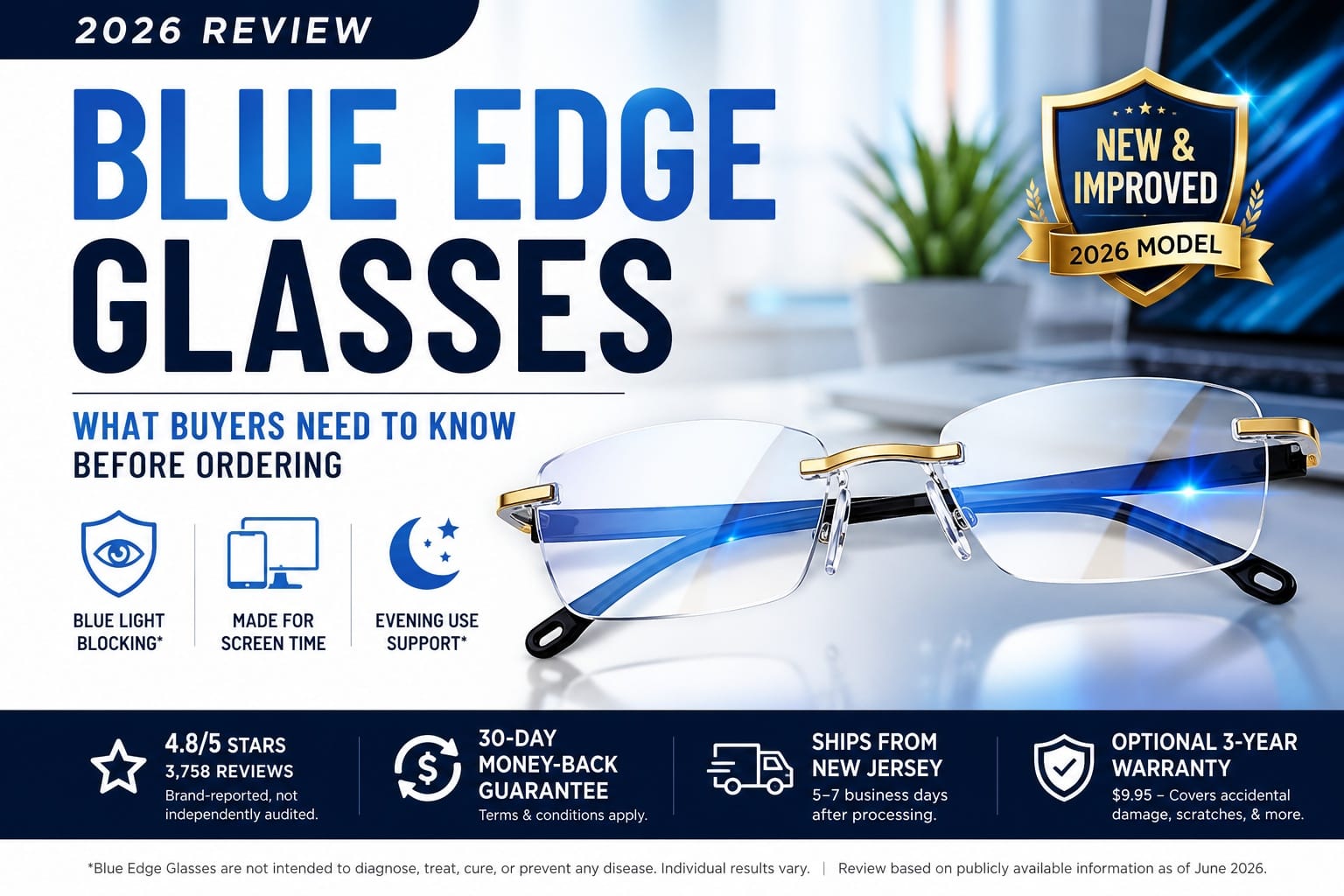
Blue Edge Glasses is a blue-light-blocking eyewear product that the brand positions for daily screen users experiencing eye fatigue, disrupted sleep, and digital eye strain. The brand reports 3,758 customer reviews and a 4.8-star rating on its official site - brand-reported figures, not independently audited, and individual experiences vary. Before you order, this article covers what the brand publicly claims, what independent science says about the blue-light glasses category, and the specific return and refund terms - including a 15% restocking fee - that affect your actual purchase risk in 2026.
Blue Edge Glasses 2026 Fast Facts: What Every Buyer Should Know in 30 Seconds
Blue Edge Glasses is: A blue light blocking eyewear product marketed for daily screen use, gaming, and evening device use
Brand positioning is: "Shield Your Eyes from Harmful Blue Light with Blue Edge Glasses" - this is the brand's own marketing language, published on the official checkout page at blueedgeglasses. buyskyline.co
Model designation is: "New & Improved 2026 Model" - per the brand's official checkout page
Price range is: $88.87 per pair (1-pack) to $444.33 total (5-pack at $88.87 per pair) - before shipping and taxes, which are added separately at checkout
Money-back guarantee is: 30 days from purchase - item must be returned in original condition and original packaging
Restocking fee is: Up to 15% - per the brand's published Returns Policy and Terms of Service, Section 21
Return shipping is: Buyer's responsibility - non-refundable
Brand-reported rating is: 4.8 based on 3,758 reviews - brand-reported, not independently audited; individual experiences vary
Ships from: New Jersey warehouse, per the brand's shipping page
Delivery estimate is: 5-7 business days after a 48-business-hour processing window
Optional paid warranty is: $9.95 for 3-year extended coverage - covers accidental damage, scratches, and loss/theft; not included in base price
Contact is: +1 (866) 697-4823 or [email protected]
Business origin is: Brand describes itself as "American-owned" - manufacturing country not disclosed on official pages
Science status is: The 2023 Cochrane systematic review of 17 randomized controlled trials and the American Academy of Ophthalmology both conclude that current evidence doesn't support blue light filtering glasses for reducing eye strain or improving sleep quality in most users
Quick Verification Snapshot - As of June 2026
What a review of publicly available sources confirmed:
Pricing: Confirmed on official checkout page - 1-pack at $88.87/ea; 5-pack totals $444.33; shipping and tax calculated separately at checkout
30-day money-back guarantee: Confirmed on returns page - subject to up to 15% restocking fee and buyer-paid return shipping
Brand-stated rating: 3,758 reviews at 4.8 stars - per brand's own site; not independently audited; individual experiences vary
Ships from New Jersey warehouse: Confirmed on shipping page
Optional $9.95 extended warranty plan: Confirmed on warranty page - paid add-on, not standard base coverage
15% restocking fee: Confirmed in Returns Policy and Terms of Service Section 21
Contact information: +1 (866) 697-4823 / [email protected] confirmed on shipping page
Check current Blue Edge Glasses pricing and availability
Disclosure: If you buy through this link, a commission may be earned at no extra cost to you.
What a review of publicly available sources could not confirm:
Manufacturing country or production facility
Lens material specifications beyond the brand's "advanced blue light filtering technology" language
Percentage of blue light blocked across specific wavelength ranges
Brand operator legal entity name or physical business address
Independent third-party verification of the 3,758 review count or 4.8 rating
The publication, organization, or methodology behind the brand's "best Blue Light Glasses of 2026" claim
Buyer Takeaway: The 30-day money-back guarantee is real, but the fine print matters. A potential 15% restocking fee on an $88.87 purchase could run up to $13.33 before return shipping is added. Read the full Returns Policy before you order, not after.
What Blue Edge Glasses Claims to Do
Blue Edge Glasses sits in the blue-light-blocking eyewear category - a market that's grown steadily alongside remote work, gaming, and the kind of back-to-back video calls that make your eyes feel like sandpaper by 4 p.m. According to the brand's official product pages, the glasses are designed to "shield your eyes from harmful blue light" emitted by digital screens. That phrase - "harmful blue light" - is the brand's own marketing language, not an independently established scientific classification. What the science says about that claim is covered in detail a few sections down.
The brand's FAQ frames the product's purpose in terms of three main use cases. First, it says the glasses have "advanced blue light filtering technology that blocks harmful blue light emitted from digital screens," which the brand says "helps to reduce eye strain, dryness, and fatigue, allowing for more comfortable extended screen use." Second, the brand's FAQ states the glasses "help to improve sleep quality by minimizing blue light exposure, especially during evening screen time." Third, the brand positions the product as working across "all digital screens, including computers, smartphones, tablets, and TVs."
The official checkout page features a testimonial from "Jamie C., Verified Buyer," who says: "I spend 8+ hours a day in front of a computer, and these glasses have made a huge difference." This testimonial is brand-reported and has not been independently verified by this publication. Individual experiences vary.
The brand also confirms that the glasses can be worn comfortably with contact lenses and recommends cleaning them with a microfiber cloth and a lens cleaner specifically suited for optical lenses - practical care details worth knowing before your first week with the product.
Buyer Takeaway: The brand makes three core claims - reduced eye strain, improved sleep quality, and compatibility with all screen types. These are the exact same claims that run throughout the blue-light glasses category. Whether those claims hold up for most buyers is a different question entirely, and it's one where the science and the marketing tell different stories. That story is up next.
What the Science Actually Says About Blue Light Glasses in 2026
You're probably not just researching Blue Edge Glasses - you're also wondering whether blue light glasses do anything at all. That's the right question to start with, and the honest answer might surprise you.
The American Academy of Ophthalmology - one of the most authoritative voices in eye health in the United States - has stated publicly: "There is no scientific evidence that the kind or amount of light coming from computer screens is damaging to the eyes. The Academy does not recommend any special eyewear for computer use." That's their official position, and it's been consistent.
In 2023, Cochrane - whose systematic reviews represent the gold standard of clinical evidence - published a review of 17 randomized controlled trials examining blue-light filtering spectacles. The conclusion: blue-light filtering glasses probably make no meaningful difference to eye strain, eye health, or sleep quality for most people. The College of Optometrists has reviewed the same body of evidence and reached the same place: there's not strong evidence that these lenses improve visual performance or sleep for most users. And a 2023 systematic review, with updates still examined in 2026 peer-reviewed summaries, concluded similarly that blue-light filtering spectacle lenses may not reduce eye strain with computer use.
So if it isn't blue light causing your screen fatigue, what is? According to the American Optometric Association, the real culprits are well-documented: reduced blinking during screen use (your blink rate can drop from roughly 15 times per minute to as few as 5-7), prolonged near-focus strain as your eyes lock onto a fixed distance for hours, screen glare, poor ambient lighting, and a screen that isn't positioned correctly relative to your eye level and distance. These are behavioral and ergonomic factors - not wavelength problems - and addressing them typically produces more measurable relief than adding a filter.
There is one scenario in which some researchers see greater potential for blue light filtering: evening use by people with specific circadian rhythm disruption linked to late-night screen exposure. The biological pathway - blue light suppressing melatonin production - has reasonable mechanistic support, even if clinical trials haven't consistently confirmed the real-world benefit at the population level. But even here, turning on your device's built-in Night Mode, reducing screen brightness before bed, or simply putting the phone down an hour earlier may do as much or more.
None of this means Blue Edge Glasses can't provide real subjective comfort to a specific buyer. Anti-reflective coatings - which many blue light glasses include - have moderate evidence for reducing glare, and some researchers believe the AR coating contributes more to screen comfort than the filter itself. There's also a genuine behavioral dimension: wearing glasses during screen sessions can serve as a cue to take breaks and blink deliberately, which directly addresses the evidence-supported causes of strain. The placebo effect in wearables is real and documented.
The point isn't to talk you out of a purchase. It's that you deserve to know where the clinical evidence stands before you spend $88.87 on a pair, so you can make that call with your eyes open.
Buyer Takeaway: The American Academy of Ophthalmology and a Cochrane review of 17 randomized controlled trials both conclude that blue-light-filtering glasses don't produce clinically meaningful improvements in eye strain or sleep quality for most people. Individual subjective benefits are real for some buyers, and may stem from anti-reflective coating properties, behavioral cues, or subjective factors rather than the filter itself. The most evidence-supported practices for screen fatigue - the 20-20-20 rule, screen ergonomics, a current eye exam - cost little or nothing.
Does Blue Edge Glasses Work?
Whether Blue Edge Glasses "works" depends entirely on what you're asking it to do.
According to the brand's FAQ, Blue Edge Glasses is designed to filter blue light using "advanced blue light filtering technology," which the brand says reduces "eye strain, dryness, and fatigue." That's the brand's own characterization of how the product functions. This publication hasn't conducted independent laboratory testing, and the brand's publicly available materials don't disclose the specific percentage of blue light filtered or the wavelength range the lenses target - technical details that would actually let you evaluate filtering performance against competing products.
What's worth knowing about the category: Consumer electronics emit blue light most prominently around 460 nanometers. Independent testing by optical reviewers has found that many clear-lens blue light products block meaningful amounts of near-violet light at 400nm but are less consistent at that 460nm peak where device screens actually emit. The brand doesn't publish wavelength-specific data, so you can't assess this comparison from the official pages alone.
For buyers interested in evening use and sleep support - where the melatonin suppression pathway is the relevant mechanism - amber-tinted lenses that filter a broader wavelength range tend to perform differently than clear-lens products. Blue Edge Glasses appears to use clear or near-clear lenses based on the product images on the checkout page, though lens characteristics aren't specified in the brand's own published materials.
The brand's FAQ describes a product that works with all types of screens, can be worn with contact lenses, and is designed for all-day use. Those are the claims the brand makes, framed as the brand makes them.
Buyer Takeaway: According to the brand, Blue Edge Glasses filter blue light to reduce screen fatigue. This publication hasn't independently tested the product. The brand doesn't publish wavelength-specific filtering data, which limits your ability to comparison shop on technical grounds. If filtering specs matter to your decision, contact the brand directly at [email protected] before purchasing.
Blue Edge Glasses Pricing: What You'll Actually Pay at Checkout
The pricing structure on the Blue Edge Glasses checkout page is worth reading carefully because the per-unit framing can create confusion about what you're actually spending.
Here's how the packages break down as of June 2026, with actual order totals:
One pair runs $88.87.
The 2-pack is listed as $88.87 per unit, with a stated 52% savings, bringing the total to approximately $177.73.
The 3-pack - which the brand designates as the "Recommended Deal" - comes to $266.60 total with a stated 55% discount.
The 4-pack and 5-pack continue this structure at $355.47 and $444.33 total respectively.
On those savings percentages, the brand presents "Save 50% OFF" and "Save 52% OFF" labels across the multi-pack options. Savings percentages reflect the brand's stated reference prices and have not been independently verified as bona fide former prices. Under FTC deceptive pricing guidance (16 CFR Part 233), a comparison price is a legitimate basis for a savings claim only if it reflects the genuine price at which the product was actually offered for a reasonable period. Whether the brand's reference prices meet that standard is something this publication can't confirm from public materials alone.
One more thing to factor in: shipping and taxes aren't shown at the package selection step. They're "settled upon checkout confirmation" - meaning you won't see the true total until you've entered your address and payment information. If all-in cost matters to your decision, run the checkout through to the shipping estimate step before committing.
At checkout, two optional add-ons appear: the Blue Edge Glasses Coverage plan for $9.95 and the Journey Package Protection for $3.50. Both are opt-in items - they don't automatically apply to your order - but it's worth knowing they're available before you reach the final total.
You'll also likely see a pop-up offering a 10% discount with a countdown timer that says the offer is available to "only 5 lucky visitors per week." That's urgency marketing. This publication found no verifiable basis for the 5-visitors-per-week limitation or the 5-minute expiration window. Take your time.
Buyer Takeaway: A 3-pack order totals $266.60 before shipping - not $88.87. Savings percentages are the brand's stated reference points and haven't been independently verified as bona fide former prices per FTC 16 CFR Part 233. Shipping and taxes are calculated at checkout. The 10% coupon pop-up with a countdown clock is standard urgency marketing, not a verified scarcity event.
Check Blue Edge Glasses pricing before you decide
How Does Blue Edge Glasses Work as a Screen-Use Eyewear Product?
Blue Edge Glasses works, according to the brand, by filtering a portion of the high-energy blue light wavelengths emitted by digital screens - the band of visible light that runs roughly 380-500 nanometers. The brand's FAQ describes the mechanism as "advanced blue light filtering technology" that "selectively blocks high-energy wavelengths while maintaining visual clarity."
In practical terms, blue light glasses filter light either through a coating applied to the lens surface or through a tint built into the lens material itself. Products with heavier filtering tend to show a more visible yellow or amber tint; clear-lens products like what Blue Edge Glasses appears to offer provide lighter filtering with less color shift. The tradeoff is that lighter-tinted lenses filter less of the spectrum while preserving more natural color perception - useful for work that involves color accuracy.
Here's what the clinical picture says about this filtering mechanism: the American Optometric Association identifies the primary drivers of digital eye strain as reduced blink rate, near-focus fatigue, glare, poor lighting, and improper screen positioning. Blue light wavelength isn't in that list of primary drivers. That doesn't mean filtering has no subjective effect - many users report real comfort improvements. It does mean the brand's mechanism explanation and the clinical explanation for screen comfort point in somewhat different directions.
Anti-reflective coatings are worth mentioning separately. Many blue light glasses - potentially including Blue Edge Glasses, based on third-party reviews of the product, though the brand's own pages don't confirm this specification - include AR coatings that reduce surface glare from ambient light sources like overhead fluorescents and windows. Clinical guidance notes that AR coatings have moderate evidence for glare reduction, and that for many screen users, the AR coating is likely contributing more to their comfort than the blue light filter itself.
Buyer Takeaway: According to the brand, Blue Edge Glasses filters blue light wavelengths to reduce screen fatigue. The clinical evidence for that specific mechanism is disputed. Comfort benefits some users experience in this product category may be driven by anti-reflective properties, behavioral cues to take breaks, or subjective factors rather than the filter alone. Anyone with underlying vision correction needs should address those first - they're a more reliably addressed cause of screen discomfort.
Blue Edge Glasses Complaints, Returns, and Refund Terms
The most important thing to understand about the Blue Edge Glasses return policy isn't the headline - it's the fine print. And the fine print contains two terms that don't appear on the checkout page where the buying decision gets made.
First, the restocking fee. Section 21 of the Terms of Service states explicitly: "We reserve the right to charge a minimum of a 15% restocking fee to process your returns." The Returns Policy page mirrors this language. That's up to $13.33 deducted from your refund on a single-pair purchase at $88.87 - before return shipping. On a 3-pack at $266.60, the restocking fee could reach $39.99. The 30-day guarantee is real, but it isn't free.
Second, return shipping. The cost of sending the product back is the buyer's responsibility, and shipping costs are non-refundable. Depending on your location, this could add another $8-$15 or more to the real cost of a return.
Here's how the return process works in practice: contact support at +1 (866) 697-4823 or [email protected], return the product in its original condition and original packaging within 30 days, and include your full name and email address inside the return package. Once the brand receives and inspects the item, refunds are processed within 5-10 business days to the original payment method.
Exchanges are available only for items that are defective or damaged. If the product arrived in working condition but simply doesn't suit you, the return-and-refund path applies - with the restocking fee in play.
Payment methods accepted include Visa, Mastercard, American Express, Discover, and PayPal. Buyers using credit cards or PayPal may have additional buyer protection options through those processors beyond the brand's own return process. If you can't reach support or encounter difficulty with a return, your credit card's dispute process or PayPal's resolution center is the practical next step.
Buyer Takeaway: The 30-day money-back guarantee is confirmed and real. But "money-back" here means the purchase price minus up to 15% restocking fee and minus return shipping costs. That's material information. Read the full Returns Policy page before your order, not the morning you decide to send something back.
Is Blue Edge Glasses a Real Product? Here's What You Can Verify
Given how many "blue glasses" complaints flood the search results - mostly aimed at Clarity Blue Glasses and Blue Ease Optics, which are entirely separate companies - it makes sense to separate what's verifiable about Blue Edge Glasses from what you're taking on faith.
Based on a review of publicly available sources, Blue Edge Glasses appears to be an operational direct-to-consumer product with a live website, listed support channels, published shipping terms, and a posted returns policy. The website is functional. Payment processing is in place. Shipping dispatches from a stated New Jersey warehouse. A customer support phone number (+1 (866) 697-4823) and support email ([email protected]) are publicly listed. A returns policy is published. An optional paid warranty plan is documented.
These operational markers distinguish Blue Edge Glasses from the category of outright non-delivery situations that generated widespread BBB and Trustpilot complaints against Clarity Blue Glasses and Blue Ease Optics - products from completely different companies that have nothing to do with this one. The name overlap in the category creates search confusion. Don't transfer complaints from those brands to this product without independent verification of the specific seller and product.
What you can't verify from publicly available materials: a physical business address, the brand's legal entity name, and the source of the "best Blue Light Glasses of 2026" claim that appears on the checkout page without a cited organization or publication. According to what's published on the checkout page, the product "was rated as the best Blue Light Glasses of 2026," but the source, testing body, or methodology behind that designation couldn't be identified in a review of publicly available materials. Treat that as brand marketing language until the source is named.
Buyer Takeaway: Blue Edge Glasses appears to be an operational direct-to-consumer product with verified contact information, published policies, and a live shipping operation. It's a separate product from Clarity Blue Glasses and Blue Ease Optics. The "best of 2026" claim couldn't be source-verified; it's brand-asserted marketing language as published on the checkout page.
Is Blue Edge Glasses FDA Approved?
No FDA approval claim was identified on the Blue Edge Glasses official pages reviewed for this article, and the brand doesn't appear to make one. That said, this doesn't mean the product exists outside the FDA's regulatory framework entirely.
Eyewear products can fall under FDA ophthalmic device categories. The FDA classifies certain products - including spectacle lenses, spectacle frames, and some non-prescription sunglasses - as Class I medical devices. Many of these are exempt from pre-market approval (510(k)) requirements but remain regulated under FDA rules. Whether Blue Edge Glasses falls under one of these exempt categories can't be determined from publicly available materials alone. The product doesn't claim to diagnose, treat, cure, or prevent any medical condition.
What this means practically: the absence of an FDA approval claim isn't unusual or alarming for a consumer eyewear product in this category. Most blue light blocking glasses don't carry FDA approval claims because they don't need to under the regulatory pathway they fall into. But buyers who want confirmation of the specific regulatory status of this product should contact the brand directly or consult an ophthalmologist or optometrist who can evaluate the product in the context of their specific vision needs.
Buyer Takeaway: No FDA approval claim was identified in a review of publicly available Blue Edge Glasses materials. Eyewear products may fall under FDA ophthalmic device categories, including Class I devices that are often 510(k)-exempt. Regulatory status for this specific product can't be determined from public materials; buyers who need that confirmation should contact the brand directly.
Are Blue Edge Glasses Suitable for Daily Wear?
Blue light blocking glasses are generally well-tolerated for daily use by many users, and major ophthalmology organizations haven't flagged typical use as harmful. The American Academy of Ophthalmology notes there's no evidence that typical screen-emitted blue light damages the eyes, which means there's no documented clinical reason to expect harm from wearing a filter. The College of Optometrists takes the same view: no basis for avoiding them, but also no strong clinical evidence to rely on them as your primary comfort strategy. That said, every buyer's situation is different, and this publication hasn't conducted product-specific safety testing on Blue Edge Glasses. Anyone with a specific eye condition, a concern about vision changes, or a medical history involving their eyes should check with their eye care provider before adding any new eyewear to their routine.
For most buyers without underlying eye conditions, wearing non-prescription blue light glasses for extended periods is generally well-tolerated. The situations worth flagging are more specific. Buyers who need vision correction - for near, far, or intermediate distances - may find that non-corrective glasses don't address the real root of their screen fatigue. Optometrists routinely note that an outdated prescription is one of the most underdiagnosed causes of screen-related eye strain. If you're buying Blue Edge Glasses to solve a discomfort problem but haven't had a comprehensive eye exam in the past year or two, that exam is a more diagnostically useful starting point.
Color temperature is worth a quick note too. Blue Edge Glasses appears to use clear or near-clear lenses from its product imagery, which typically means lighter filtering and less color shift during use - a practical advantage for anyone doing color-sensitive work or competitive gaming where accurate color perception matters.
Buyer Takeaway: Blue light blocking glasses are generally well-tolerated for daily use by many users, and ophthalmology organizations haven't flagged typical use as harmful. This publication hasn't conducted product-specific safety testing on Blue Edge Glasses; buyers with specific eye conditions should check with their provider. Buyers whose screen fatigue may stem from an uncorrected or outdated prescription should address that first - it's the more reliable solution for prescription-driven strain.
Check current Blue Edge Glasses pricing and availability
The Checkout Experience: Urgency Tactics to Know About in Advance
Several things happen at the Blue Edge Glasses checkout that are worth knowing about before you get there, because they're designed to create purchase pressure and they're common across this product category.
When you land on the checkout page, a pop-up typically appears offering an extra 10% off with a countdown clock. The pop-up says the offer is available to "only 5 lucky visitors per week" and that you have 5 minutes before it "will be given away to another customer." This publication found no verifiable basis for either the 5-visitors-per-week scarcity claim or the 5-minute expiration. These are standard direct-to-consumer conversion tactics. If the coupon represents a genuine discount worth using, use it on your terms - not because a timer is running.
After attempting to exit the checkout page, you may see a "WAIT - Don't miss out" pop-up stating items are "almost SOLD OUT" and urging you to secure your order immediately. A social proof notification may also appear showing a recent purchase by a named customer. These are common checkout features designed to create urgency through scarcity and social proof signals. They don't reflect verified inventory constraints, and this publication noted them specifically so you can recognize them for what they are.
None of this speaks to the product itself - these checkout tactics are widespread in this category. But buyers who prefer to make considered purchases without artificial pressure should know what's coming and make their decision on their own timeline.
Buyer Takeaway: The Blue Edge Glasses checkout experience includes a countdown timer, scarcity messaging, and social proof pop-ups. These are standard direct-to-consumer conversion tactics and don't reflect verified inventory limits. Take whatever time you need - the product won't disappear while you think it over.
What the Current Evidence Balance Looks Like for Blue Light Glasses
Let's put the science in one place so you can see the full picture clearly.
The 2023 Cochrane review - based on 17 randomized controlled trials, the most rigorous level of clinical evidence available - concluded that blue-light-filtering spectacles "probably make no difference to eye strain, eye health, or sleep quality" for most people. The American Academy of Ophthalmology says screen-emitted blue light isn't considered a cause of eye disease and that no special eyewear is recommended for computer use. The College of Optometrists finds insufficient evidence that these lenses improve visual performance or sleep for most users. Summaries of 2026 peer-reviewed literature continue to echo the same finding.
These conclusions don't mean that wearing blue light glasses produces no benefit. They mean that in controlled studies comparing filtering lenses to standard clear lenses, the filtering effect didn't produce statistically meaningful differences for the average participant. Individual variation is real. Some buyers - especially those who use screens heavily in the two to three hours before sleep, when the circadian melatonin pathway is most active - may represent a subgroup for whom filtering has a genuinely useful effect.
What the clinical consensus does support, clearly and consistently: the 20-20-20 rule (every 20 minutes, look at something at least 20 feet away for at least 20 seconds) is an evidence-based, zero-cost approach to accommodation fatigue. Screen positioning - center of screen about 4-5 inches below eye level, roughly 25 inches from your face - reduces the exposed ocular surface and directly addresses dry eye caused by wide-open eyes aimed upward. Brightness matching between screen and ambient light reduces contrast-driven strain. A current comprehensive eye exam remains the single highest-value step for anyone with persistent screen discomfort that hasn't responded to ergonomic adjustments.
Trying Blue Edge Glasses alongside those behavioral practices is a reasonable personal experiment. Relying on them as your primary solution while skipping the behavioral fixes is where the evidence gap matters most.
Buyer Takeaway: Cochrane, the AAO, and the College of Optometrists all conclude that blue light filtering glasses don't produce clinically meaningful results for eye strain or sleep in most users. Individual subjective benefits are real for some people. The most evidence-backed screen comfort strategies - the 20-20-20 rule, ergonomic screen positioning, anti-reflective coatings, and a current eye exam - are either free or routine. Blue Edge Glasses is worth considering as one piece of a multi-factor approach, with realistic expectations about what the filtering component alone is likely to contribute.
What Does Blue Edge Glasses Cost Compared to the Category?
At $88.87 per pair, Blue Edge Glasses sits at the premium end of the direct-to-consumer blue light glasses market, where you'll find everything from $12 options on major e-commerce platforms to $200+ prescription-ready frames from established optical brands like Zenni and Warby Parker.
Here's the uncomfortable truth about price in this category: it doesn't reliably predict filtering performance. Independent optical testing published by several review outlets has found that some products priced under $30 test comparably to $100+ alternatives in blocking blue light at the 460nm peak that device screens emit most strongly. What price tends to reflect more reliably is frame build quality, brand marketing investment, and customer support infrastructure - not filtering efficacy.
What the $88.87 price gets you with Blue Edge Glasses: a branded product, US-based customer service contacts, domestic shipping, and a 30-day return window (subject to restocking fee and return shipping costs). What it doesn't provide that some alternatives do: published filtering specifications by wavelength, prescription lens compatibility, or independent third-party certification of blue-light-blocking performance.
If you're comparison shopping in this category, look for products that disclose what percentage of blue light they block and at which specific wavelength range. That technical transparency is a more reliable basis for comparison than price point or brand presentation.
Buyer Takeaway: Blue Edge Glasses is priced at $88.87 per pair - toward the premium end of the DTC market. Price doesn't reliably predict filtering performance in this category. The brand doesn't publish wavelength-specific data, which limits technical comparison shopping. Contact the brand for filtering specifications before purchasing if performance comparisons matter to your decision.
How Does Blue Edge Glasses Handle Shipping?
Blue Edge Glasses ships from a New Jersey warehouse, per the brand's shipping page. Orders are processed within 48 business hours after purchase. Standard domestic delivery runs 5-7 business days from the point of shipment via USPS, FedEx, or UPS. International orders ship via DHL. You'll receive an emailed tracking link once your order ships.
One point worth noting on the brand's language: the shipping page describes the company as "an American-owned business that doesn't believe it should take 45 days to receive your product from China." That's a positioning statement about the owner's nationality and the warehouse location, not a claim about where the product is manufactured. Under FTC Made in USA labeling rules (16 CFR Part 323), an unqualified "Made in USA" claim requires that a product be "all or virtually all" manufactured domestically. "American-owned" is a different and narrower designation. The shipping page's reference to the "45 days from China" contrast implies prior or industry-standard sourcing tied to Chinese manufacturing timelines, but the manufacturing country of this specific product isn't disclosed on any official page reviewed for this article.
Shipping costs and applicable taxes are calculated at checkout after you enter your address - they're not shown during package selection. If all-in cost matters, run the process through to the shipping estimate before you finalize.
Buyer Takeaway: Blue Edge Glasses ships from a New Jersey warehouse with 5-7 day standard delivery after processing. Shipping and tax are calculated at checkout. "American-owned" is the brand's own descriptor and doesn't constitute a "Made in USA" manufacturing claim under FTC rules. The manufacturing country is not disclosed on any official page reviewed.
What Is the Warranty on Blue Edge Glasses?
The warranty picture for Blue Edge Glasses has two distinct tiers, and it's worth understanding both before you reach checkout.
The base product comes with the 30-day money-back guarantee documented in the Returns Policy. Within 30 days of purchase, you can return the product in original condition for a refund - subject to the potential 15% restocking fee and buyer-paid return shipping. This is the only post-purchase protection included in the base price. The brand doesn't appear to publish a separate manufacturer's warranty on the product itself beyond this return window.
The optional $9.95 "Blue Edge Glasses Coverage" plan is a paid add-on, presented at checkout. According to the brand's warranty page, it's marketed as a "3 Years Warranty and Extended Protection" for new customers and covers defective products, scratches, dents, internal component damage, and loss or theft. Under the Magnuson-Moss Warranty Act, written warranties on consumer products over $15 must be designated as either "Full" or "Limited." The $9.95 plan covers a specific list of damage types - which means it functions as a limited warranty under federal designation. Read the full terms on the brand's warranty page before purchasing the add-on.
A second optional add-on, Journey Package Protection at $3.50, covers transit-specific damage, loss, and theft during shipping only. It's separate from the Blue Edge Glasses Coverage plan.
Buyer Takeaway: The base product includes only the 30-day return window as post-purchase protection. The $9.95 Coverage plan is an optional paid limited warranty for 3-year coverage, including accidental damage, loss, and theft. The $3.50 Journey Package Protection covers transit risks only. Buyers who want longer-term coverage will need to purchase the $9.95 plan at checkout.
Who Is Blue Edge Glasses Best Positioned For?
Based on the brand's own positioning, the pricing, and what the category science shows, here's an honest read on who this product is and isn't suited for.
The brand positions Blue Edge Glasses for screen-heavy users - people logging 6-10 hours daily across computers, tablets, smartphones, and TVs, who experience end-of-day eye fatigue or have trouble winding down on evenings when screen use runs late. The brand's FAQ specifically calls out gaming and extended computer work as target contexts.
Buyers who've already tried behavioral adjustments, have a current eye exam confirming their prescription is fine, and simply want to experiment with a physical filter as an additional layer may find the product a reasonable trial - especially if they're a frequent evening screen user where the circadian angle is most relevant. The 30-day window does give you a real trial period, even if it's not cost-free to return.
Buyers who might be better served by other steps first: anyone whose screen fatigue might stem from an outdated prescription (a comprehensive eye exam is the diagnostic tool, not a new pair of non-corrective glasses); anyone who hasn't yet implemented the 20-20-20 rule and basic ergonomic adjustments; and anyone considering this product as a substitute for device Night Mode, which is already on your phone, tablet, and computer and costs nothing to turn on. Try Night Mode for a week before spending $88.87 and let that experience inform your decision.
Buyer Takeaway: Blue Edge Glasses is positioned for screen-heavy users who want a dedicated eyewear approach. Buyers who haven't yet tried a current eye exam, behavioral ergonomic practices, or device Night Mode have lower-cost options to explore first. For buyers who've done those things and still want to add a physical filter, this product is positioned for that use case.
Blue Edge Glasses vs. Device Night Mode: An Honest Comparison
One of the most useful questions you can ask before buying any blue light glasses is whether your device's built-in Night Mode does the same thing - because it might, for free.
Device-integrated blue light settings (Apple Night Shift, Android Eye Comfort Shield, Windows 11 Night Light) adjust the screen's color output directly, reducing blue wavelength emission at the hardware level. Some independent reviews suggest software-based filtering can actually outperform clear-lens glasses at reducing total blue light reaching the eye, while also maintaining better color accuracy for tasks that require it. You can schedule these modes to activate automatically at sunset and schedule off at sunrise, which means zero friction once it's set up.
Blue light glasses work differently: they filter light at the point of your eye rather than at the screen, which means they also catch ambient blue light from overhead lighting, sunlight through windows, and any other screens in the room. For buyers who spend time across multiple light environments - not just one monitor - that broader filtering application is where a physical lens has an advantage software doesn't.
There's also the behavioral element. Some people find that putting on glasses when sitting down to work creates a useful routine signal - a cue that says "screen time is starting" - that also prompts more deliberate breaks and blinking. Night Mode doesn't do that. It just runs quietly in the background.
The practical recommendation: enable Night Mode on your primary devices tonight and use it for a week before buying glasses. If it moves the needle on your fatigue or your sleep, you've saved $88.87. If it doesn't, you've narrowed the question and you'll have a better baseline for evaluating what a physical filter adds.
Buyer Takeaway: Built-in Night Mode on most devices filters blue light at the hardware level and is already available at no cost. Blue light glasses like Blue Edge Glasses filter ambient light beyond just the primary screen and may offer behavioral advantages as a dedicated tool. Test Night Mode for a week first; use that experience as your baseline for evaluating whether a physical filter adds meaningful additional comfort for your specific situation.
Blue Edge Glasses Buyer Verification Checklist: 12 Things to Confirm Before You Order
Work through this list before completing your order. Every item on it has come up in this review for a specific reason.
Do you know the actual total price? Confirm shipping and tax at checkout before finalizing - the package selection page shows per-unit pricing without either of those components
Have you read the restocking fee terms? Up to 15% applies to returns per the Returns Policy and Terms Section 21 - the checkout badge says "30 Days Money Back Guarantee" but doesn't mention this fee
Do you understand what the guarantee actually covers? It's a 30-day return window, not free returns - you're responsible for return shipping costs, and a restocking fee may apply
Have you tried the device's Night Mode first? Turn on Night Shift, Eye Comfort Shield, or Night Light on your primary devices and use it for a week before spending $88.87
Have you had a comprehensive eye exam recently? Screen fatigue from an outdated prescription won't respond to non-corrective blue light glasses - a current exam is the diagnostic first step
Have you tried the 20-20-20 rule consistently? Every 20 minutes, look at something at least 20 feet away for 20 seconds - this is the evidence-supported, zero-cost approach to accommodation fatigue
Do you understand what the optional add-ons cost? The $9.95 Coverage plan and the $3.50 Journey Package Protection are separate opt-in items at checkout - they're not included in the product price
Are you buying more pairs than you're confident you'll keep? Multi-pair bundles lower per-unit cost but scale up the restocking fee significantly if you return - factor that math before going above a single pair on a first order
Are you clear on the "American-owned" vs. "Made in USA" distinction? The brand uses "American-owned" - manufacturing country is undisclosed; these are legally different claims under FTC rules
Have you looked up the source of the "best of 2026" claim? It's on the checkout page without a cited organization, publication, or testing body - treat it as brand marketing language until that source is named
Do you have contact information saved before you order? +1 (866) 697-4823 and [email protected] - having these before any issue arises is more useful than looking for them after
Do you know your payment processor's buyer protection terms? PayPal and credit cards offer dispute and chargeback options beyond the brand's own return process - useful to know in advance
What Can Be Concluded About Blue Edge Glasses in 2026
Let's pull this together for the buyer who's at the decision point right now.
What's confirmed from public sources: Blue Edge Glasses is a direct-to-consumer eyewear product the brand positions for screen-heavy users. It's priced at $88.87 per pair with multi-pack bundle options. A 30-day money-back guarantee exists, subject to a potential 15% restocking fee and buyer-paid return shipping. The brand is "American-owned" per its own language and ships from New Jersey. Customer support is reachable at +1 (866) 697-4823 and [email protected]. An optional paid limited warranty plan is available at $9.95. These details are publicly verifiable from the brand's own pages.
What isn't confirmed from public sources: Manufacturing country, lens filtering specifications, wavelength-specific blocking data, the brand's legal entity name, a physical business address, and the source of the "best Blue Light Glasses of 2026" claim are all absent from the official pages reviewed for this article.
What the science says: The 2023 Cochrane systematic review of 17 randomized controlled trials, the American Academy of Ophthalmology, and the College of Optometrists all conclude that blue-light filtering glasses don't produce clinically meaningful improvements in eye strain or sleep quality for most people. Individual subjective benefits are documented for some buyers. The clinical consensus attributes screen comfort to behavioral and ergonomic factors - the 20-20-20 rule, screen positioning, anti-reflective coatings, and a current eye exam - not blue light filtering wavelengths.
What that means for your decision: Blue Edge Glasses appears to be an operational product from an accessible brand with verifiable contact information and published policies. The evidence base for the core mechanism it markets doesn't consistently support the mechanism claims for the typical buyer. Read the return policy before ordering, try Night Mode first if you haven't, and if you're genuinely curious about whether a physical filter adds comfort beyond what software filtering provides, the 30-day window lets you find out - with realistic expectations about what it's likely to cost to send back if it doesn't work for you.
Buyer Takeaway: Blue Edge Glasses appears to be an operational direct-to-consumer product with publicly verifiable pricing, policies, and contact information. The clinical evidence for blue light filtering doesn't consistently support the mechanism claims for most buyers. Read the return policy fully before ordering. The 30-day window is real, but it isn't free.
If you're ready to order, the link below goes to the official product page:
Explore Blue Edge Glasses pricing and current availability
Frequently Asked Questions About Blue Edge Glasses
Do Blue Edge Glasses actually work for reducing eye strain?
According to the brand's FAQ, Blue Edge Glasses works by filtering "harmful blue light emitted from digital screens" to reduce "eye strain, dryness, and fatigue." That's the brand's positioning. What independent science says is different: the 2023 Cochrane systematic review of 17 randomized controlled trials concluded that blue-light filtering glasses probably make no meaningful difference to eye strain for most people, and the American Academy of Ophthalmology doesn't recommend special eyewear for computer use. Some buyers report real subjective comfort improvements; controlled studies suggest those benefits may stem from anti-reflective coating properties or behavioral factors rather than the filter itself. Individual experiences vary. Buyers should weigh both the brand's claims and the clinical evidence when setting expectations.
What is the return policy for Blue Edge Glasses?
The brand offers a 30-day money-back guarantee. To return a product, contact support, send the item back in original condition and original packaging within 30 days, and include your full name and email in the return package. Refunds are processed within 5-10 business days of receipt and inspection. The brand reserves the right to charge a minimum 15% restocking fee per Section 21 of the Terms of Service and the Returns Policy page. Return shipping is the buyer's responsibility and non-refundable. On an $88.87 purchase, a 15% restocking fee would run up to $13.33, plus whatever return shipping costs in your area. Exchanges are available only for defective or damaged items.
Is there a restocking fee for Blue Edge Glasses returns?
Yes. Section 21 of the Blue Edge Glasses Terms of Service states: "We reserve the right to charge a minimum of a 15% restocking fee to process your returns." The Returns Policy page confirms the same. This fee is deducted from the refund upon receipt of the returned item. For a single-pair purchase at $88.87, up to $13.33 may be deducted before the refund is issued. Multi-pair orders face proportionally larger potential deductions. Return shipping is also non-refundable and the buyer's cost. This is a material term that meaningfully affects the real cost of a return.
How much do Blue Edge Glasses cost?
Blue Edge Glasses is priced at $88.87 per pair on the official checkout page. Multi-pair options include a 2-pack at approximately $177.73 total (stated 52% savings), a 3-pack at $266.60 total (stated 55% savings, designated "Recommended Deal"), a 4-pack at $355.47 total, and a 5-pack at $444.33 total. Shipping and taxes are calculated separately at checkout. Savings percentages reflect the brand's stated reference prices and have not been independently verified as bona fide former prices under FTC deceptive pricing guidance (16 CFR Part 233). Optional add-ons at checkout include a $9.95 limited warranty plan and $3.50 transit protection. Prices are per the official checkout page as of June 2026 and are subject to change.
Where does Blue Edge Glasses ship from?
The brand's shipping page states orders ship from a New Jersey warehouse via USPS, FedEx, or UPS domestically, and DHL for international orders. Processing runs within 48 business hours, with standard domestic delivery estimated at 5-7 business days from shipment. A tracking link is emailed after shipment. The brand describes itself as "American-owned." Manufacturing country isn't disclosed on any official page reviewed for this article.
Are Blue Edge Glasses the same as Clarity Blue Glasses or Blue Ease Optics?
No - these are separate products from different sellers. They appear in overlapping search results because the category names are similar, but they're operated by completely different companies with separate review histories. Clarity Blue Glasses and Blue Ease Optics have generated significant consumer complaints about non-delivery and product misrepresentation on BBB Scam Tracker and Trustpilot. Those complaints involve different companies and should not be attributed to Blue Edge Glasses without independent verification. Always confirm the exact product name, seller, and website before purchasing in this category.
Do Blue Edge Glasses improve sleep quality?
The brand's FAQ states the product "help[s] to improve sleep quality by minimizing blue light exposure, especially during evening screen time." That's the brand's claim. The clinical evidence is mixed: the 2023 Cochrane review of 17 randomized controlled trials found no significant difference in sleep outcomes between blue-light-filtering glasses and standard lenses among study participants. Some researchers see greater potential for a specific subgroup - people with circadian disruption who use screens heavily in the two to three hours before bed - but population-level evidence hasn't consistently confirmed this. Free alternatives like device Night Mode and reducing screen time before bed have some evidence to support and cost nothing to try first.
What does the $9.95 warranty plan cover?
The $9.95 "Blue Edge Glasses Coverage" is an optional paid add-on presented at checkout. According to the brand's warranty page, it covers defective products, scratches, dents, internal component damage, and loss or theft for a 3-year period for new customers. This is a limited warranty under the Magnuson-Moss Warranty Act - it covers specific categories of damage, not all possible issues. It's not included in the base product price and must be selected at checkout. A separate $3.50 Journey Package Protection covers transit-specific risks during shipping only. Buyers who want coverage beyond the 30-day return window need to add the $9.95 plan at checkout.
What payment methods does Blue Edge Glasses accept?
The checkout page accepts Visa, Mastercard, American Express, Discover, and PayPal. Credit card transactions are encrypted. Buyers using PayPal or credit cards may have buyer protection options through those payment processors that provide additional recourse beyond the brand's own return process - worth knowing before you order, not after an issue arises.
Is Blue Edge Glasses FDA approved?
No FDA approval claim was identified on the official Blue Edge Glasses pages reviewed for this article, and the brand doesn't appear to make any. However, eyewear products can fall under FDA ophthalmic device categories, and the FDA classifies certain spectacle lenses and frames as Class I medical devices - many of which are exempt from pre-market approval (510(k)) requirements. Whether this specific product falls under one of those exempt categories can't be determined from publicly available materials alone. The product doesn't claim to diagnose, treat, cure, or prevent any medical condition. Buyers who need clarity on regulatory status should contact the brand directly or consult an eye care professional.
What should I do if there's a problem with my Blue Edge Glasses order?
Contact customer support at +1 (866) 697-4823 or [email protected]. For returns, the Returns Policy requires items to be sent back in their original condition and packaging within 30 days, with your full name and email inside the package. Refunds are processed within 5-10 business days of receipt. If you can't reach support through the brand's channels, buyers who paid by credit card or PayPal can initiate a dispute or chargeback through those payment processors under applicable buyer protection programs.
Are Blue Edge Glasses safe for contact lens wearers?
The brand's FAQ states the glasses "can be comfortably worn with contact lenses" and are "designed to provide eye protection without interfering with your contact lenses." Non-prescription blue light glasses sit over the eye and don't physically interact with contact lenses worn underneath. Contact lens wearers who already have vision correction through their lenses might also ask their optometrist about adding a blue light filtering coating to their next pair of prescription lenses, which integrates the filtering into correction they're already wearing.
How should I clean Blue Edge Glasses?
The brand's FAQ recommends a microfiber cloth and a lens cleaner specifically suited for optical lenses. Paper towels and rough fabrics can scratch coated lenses. This is standard care guidance for optical-coated eyewear - if the product includes an anti-reflective or blue-light coating, abrasive cleaning materials can degrade the coating over time, so the microfiber and optical cleaner combination is worth following, even if it seems like more care than a pair of glasses needs.
Are Blue Edge Glasses suitable for gaming?
The brand positions Blue Edge Glasses for gaming use alongside computer, tablet, and TV use, per the brand's FAQ. For gamers who play primarily in evening hours, the circadian angle - where blue light filtering has more plausible mechanistic support - is more relevant than daytime use. Color accuracy during gaming is worth noting: clear-lens blue light glasses, like what Blue Edge Glasses appear to offer, typically introduce less color distortion than heavily amber-tinted alternatives, which is an advantage for competitive gaming where color discrimination affects performance.
Can I wear Blue Edge Glasses while driving?
Blue light filtering glasses with any tint - even light filtering - can reduce overall light transmission, which may affect visual performance in low-light or nighttime driving conditions. Blue Edge Glasses appears to use clear or near-clear lenses based on product imagery, which generally perform better for driving than heavily tinted alternatives. However, this publication can't confirm the exact lens characteristics, and any buyer who wears non-prescription eyewear while driving should verify the specific lens properties with the brand before doing so. Questions about driving safety and specific vision needs are best directed to an eye care professional.
What's the practical difference between the 30-day guarantee and the $9.95 warranty?
The 30-day guarantee is a satisfaction-based return window included in every purchase at no additional cost. It lets you return the product within 30 days if you're not satisfied, subject to a potential 15% restocking fee and buyer-paid return shipping. It covers the decision to return - not damage or loss. The $9.95 Blue Edge Glasses Coverage plan is an optional paid limited warranty that activates for 3 years from purchase. It covers specific damage categories: defects, scratches, dents, internal component damage, and loss or theft. These are two separate protections operating on different terms, covering different scenarios. Buyers who want protection against damage or loss after the 30-day window need to purchase the $9.95 plan at checkout.
How to Read Blue Edge Glasses' Marketing Language
The blue light glasses category runs on a specific vocabulary of marketing phrases that buyers encounter repeatedly across competing products. Here's what the key phrases in Blue Edge Glasses' marketing actually mean - and what they don't.
"Shield Your Eyes from Harmful Blue Light" is the brand's own positioning statement, as published on the official checkout page. The word "harmful" implies a documented risk from screen-level blue light exposure. The American Academy of Ophthalmology's official position is that there is no scientific evidence that the kind or amount of light from computer screens is damaging to the eyes. Buyers should understand "harmful blue light" as the brand's characterization, not an independently established scientific classification.
"New & Improved 2026 Model" is a freshness and iteration claim. Without prior model specifications available for comparison, you can't evaluate what was changed or improved from a previous version. Treat it as a current-availability indicator, not a performance specification.
"Blue Edge Glasses were rated as the best Blue Light Glasses of 2026" appears on the checkout page. According to what's published there, the product received this designation, but this publication couldn't identify the source, publication, testing body, or methodology behind it. Until that source is named and verifiable, this is brand-asserted marketing language.
"3,758 Verified Customer Reviews / Rated 4.8" are brand-reported figures from the brand's own product page. They're not independently audited by a third-party platform. Under the FTC's Fake Review Rule (16 CFR Part 465, effective October 2024), manufactured or purchased reviews are prohibited. Buyers who want independent verification should look for third-party platform reviews of this specific product from verified purchasers.
"American-owned business" is a description of business ownership, not product origin. The FTC Made in USA rule (16 CFR Part 323) requires that an unqualified "Made in USA" claim reflect a product that is "all or virtually all" manufactured domestically. "American-owned" doesn't meet that standard and is a legally distinct designation. The brand's shipping page references a contrast with receiving products "from China" but doesn't state where Blue Edge Glasses specifically is manufactured.
Buyer Takeaway: Marketing language in the blue light glasses category consistently runs ahead of clinical evidence. Read brand claims as brand claims - and verify the specific terms that matter to your purchase decision from the actual policy pages, not the checkout narrative.
Additional Buyer Resources
The following links go directly to the relevant pages on the brand's official site. Read the Returns Policy and Terms before you order - not after a question comes up.
Official Website: blueedgeglasses.buyskyline.co
Returns Policy: Returns page
Warranty Details: Warranty page
Shipping Information: Shipping page
Terms of Service: Terms of Service
FAQ: FAQ page
For independent category science, the American Academy of Ophthalmology's position on blue light and computer glasses is publicly available at aao.org. The Cochrane review of blue-light filtering spectacles (2023) is available through the Cochrane Library.
See current Blue Edge Glasses options and pricing
Contact Information
Company: Blue Edge Glasses
Email: [email protected]
Phone: +1 (866) 697-4823
Disclaimers
Disclosure: This article contains affiliate links. A commission may be earned on qualifying purchases made through links in this content, at no additional cost to the reader. Affiliate relationships do not influence editorial content or the evaluation of products. Disclosure is provided in accordance with FTC 16 CFR Part 255.
Material Limitations of This Review: This review is based exclusively on publicly available materials, including the official Blue Edge Glasses website (blueedgeglasses.buyskyline.co), the brand's published Terms, Returns, Warranty, Shipping, and FAQ pages, and category-level independent scientific guidance from the American Academy of Ophthalmology, the Cochrane Database of Systematic Reviews, and the College of Optometrists. This publication has not received compensated product samples for testing, has not interviewed brand personnel, has not been granted access to internal product specifications beyond what is publicly published, and has not conducted laboratory or field performance testing of Blue Edge Glasses. Claims described as "according to the brand" or "brand-stated" reflect what the brand has publicly stated and have not been independently substantiated by this publication. Buyers are encouraged to verify any claim that materially affects their purchase decision by contacting the brand directly using the published support channels listed above.
Third-Party Consumer Feedback Platforms: This article references third-party consumer feedback platforms in general category terms only. This publication does not endorse, vouch for, audit, or accept responsibility for the accuracy, completeness, or fairness of customer reviews posted on any third-party platform, including general-purpose review sites, social media, and online forums. Customer ratings and testimonials referenced in this article - including the brand-reported 4.8 rating from 3,758 reviews - are brand-reported figures, not independently audited; individual experiences vary. Buyers consulting third-party reviews are encouraged to look for verified-purchase indicators and weigh reviewer context against their own situation.
Forward-Looking Statements and Article Accuracy: This article reflects information available as of June 2026 and was prepared using reasonable care to be accurate at the time of publication. Product specifications, pricing, promotional offers, shipping policies, warranty terms, return policies, contact information, and customer feedback data may change after publication without notice. No representation is made that the information will remain accurate in the future. Readers should rely on the official Blue Edge Glasses website as the authoritative source for current product information prior to any purchase decision.
Reasonable Consumer Standard: This article is written for a general adult consumer audience. Where a statement could otherwise be read as a brand-substantiated fact, attribution language such as "according to the brand," "brand-stated," "brand-reported," or "per the official Terms" identifies it as a brand claim not independently verified by this publication. The brand-reported rating of 4.8 from 3,758 reviews, the claim that Blue Edge Glasses "were rated as the best Blue Light Glasses of 2026," and the "Save 50%-60% OFF" pricing comparisons are explicitly identified in this article as brand-asserted marketing language and are not represented as independent third-party rankings, performance guarantees, or laboratory-verified claims by this publication.
Pricing Disclosure: Prices listed reflect the brand's checkout page as of June 2026. Shipping costs and applicable taxes are calculated separately at checkout. Savings percentages reflect the brand's stated reference prices and have not been independently verified as bona fide former prices under FTC deceptive pricing guidance (16 CFR Part 233), which requires comparison prices to reflect genuine former prices. EU buyers should verify EU-specific pricing compliance with the brand directly, as EU consumer law requires the lowest price in the prior 30 days as the reference for promotional discounts (EU Omnibus Directive Article 6a).
Origin and Made in USA Disclosure: The brand describes Blue Edge Glasses as an "American-owned business" with a New Jersey shipping warehouse. "American-owned" is a descriptor of business ownership and is legally distinct from a "Made in USA" manufacturing claim under FTC 16 CFR Part 323. The manufacturing country of the Blue Edge Glasses product is not disclosed on the brand's publicly available pages reviewed for this article. Buyers who require country-of-origin information should contact the brand directly before purchasing.
Warranty Designation: The optional $9.95 Blue Edge Glasses Coverage plan is a limited warranty under the Magnuson-Moss Warranty Act. It covers specific categories of damage for a 3-year period and is purchased separately at checkout. The base 30-day money-back guarantee is a satisfaction-based return window, not a durability warranty.
California Consumer Notice: California residents should be aware of their rights under California consumer protection laws, including California Civil Code Section 1770 (CLRA) and Business and Professions Code Section 17200 (UCL). California buyers should verify any Proposition 65 disclosures on the product packaging upon receipt, as this publication could not confirm whether the product carries a Proposition 65 warning from the brand's publicly available pages.
Geographic and Jurisdiction Notice: This article is published for a general audience and does not constitute legal, medical, or financial advice. Consumer protection rights vary by jurisdiction. EU and UK consumers may have additional protections under applicable consumer law, including the EU Omnibus Directive and the UK Consumer Rights Act. Readers outside the United States should verify product availability, warranty coverage, and return rights directly with the brand.
Trademark Acknowledgment: "Blue Edge Glasses" is used in this article to identify the product being reviewed. No trademark registration for Blue Edge Glasses was confirmed on the official pages reviewed for this article. Use of the brand name is for nominative identification purposes only and does not imply endorsement, affiliation, or trademark ownership by this publication.
SOURCE: Blue Edge Glasses