




Wednesday, 12 August 2026 07:00 AM
Product Announcements
CHANTILLY, VA / ACCESS Newswire / August 12, 2026 / In consumer AI, attention tends to focus on what a model has learned to do next: write longer stretches of code, generate more realistic content, or handle more complex reasoning.
Network operations have a more practical concern. Devices are distributed, operating environments vary, and even a small mistake can take critical equipment offline. Knowing networking concepts is not the same as being able to work inside a live network.
Behind that concern is the steady expansion of the network. More retail locations, factories, vehicles and unmanned sites are coming online. Devices and data can be managed centrally, but diagnosing faults and deciding how to handle operational risk still depend heavily on engineering judgment. As the network grows, that expertise becomes harder to extend to every site.
What network operations teams need, then, is not another chatbot that can answer networking questions. They need an operational AI agent that can work with real network context, investigate an issue and participate in a task.
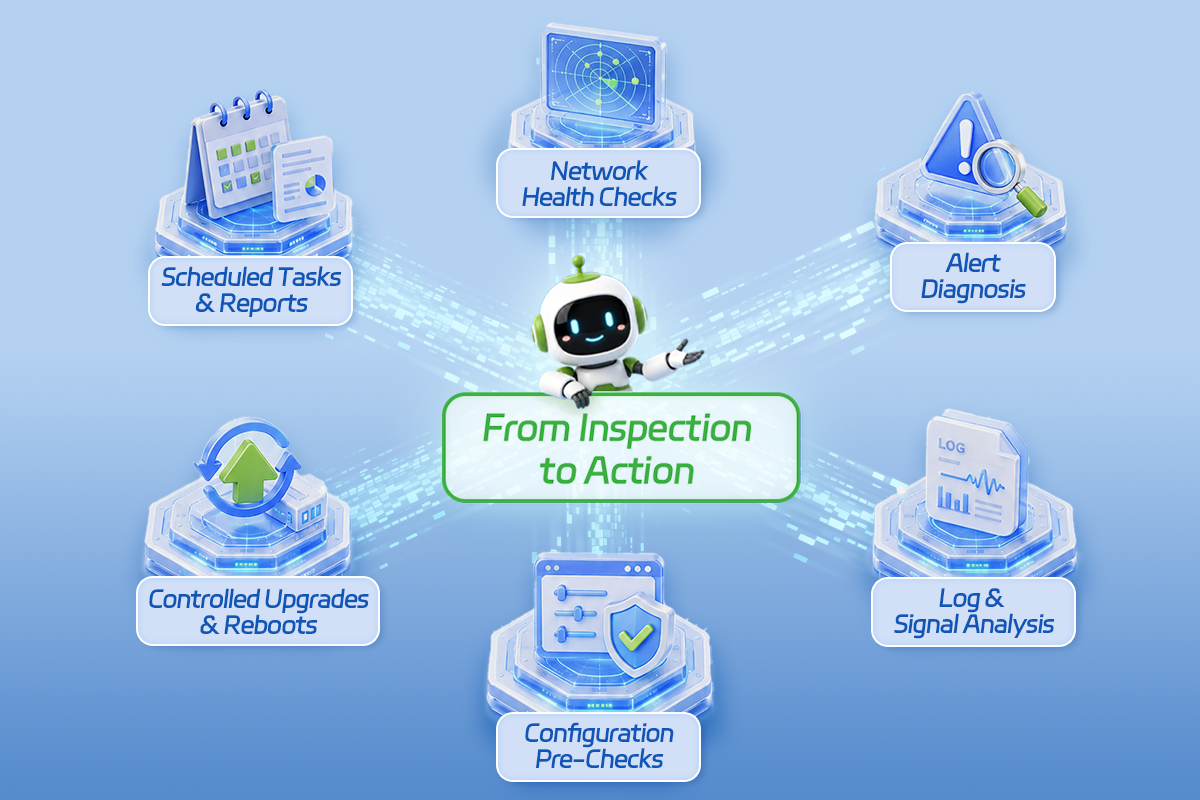
InHand Networks recently introduced InCloud Agent. To understand the problem this network operations agent is designed to solve, it helps to start with four questions operations leaders are likely to ask.
01
Four Questions Network Operations Leaders Will Ask
Before allowing an AI agent into a live network, operations leaders are likely to ask four questions:
Is it looking at the actual network, or merely offering generic advice?
Can it still work with devices that have not been onboarded to the cloud, or that sit inside private networks and cannot be reached through the cloud?
Could it overstep its authority or make a change that takes a device offline?
Can the troubleshooting knowledge held by a small group of experts be reused by more engineers and applied across more devices?
Together, these questions point to the four barriers any operational AI must overcome: context, reachability, control and expertise.
An AI system that can only list common causes of a 4G outage has not yet entered the operational environment. A useful system needs to know which organization, site and device the user is working with. It must be able to connect alerts, logs, signal data, links and configuration into a goal-driven investigation.
It also has to respect the uneven boundaries of real-world networks. Some devices are cloud-managed; others sit inside private networks or environments that cannot reach the cloud. Some actions can proceed directly, while others require permission and operating checks, followed by user approval where necessary. Some engineers bring years of experience; frontline teams may need a repeatable troubleshooting path.
These are not abstract tests of AI intelligence. They are practical criteria for deciding whether an agent belongs in a real network operations workflow.
02
InCloud Agent: The What, Why and How
InHand Networks' answer is InCloud Agent. It is not designed to replace network engineers. Its role is to participate in inspection, diagnosis, controlled remediation and outcome verification within defined authorization boundaries.
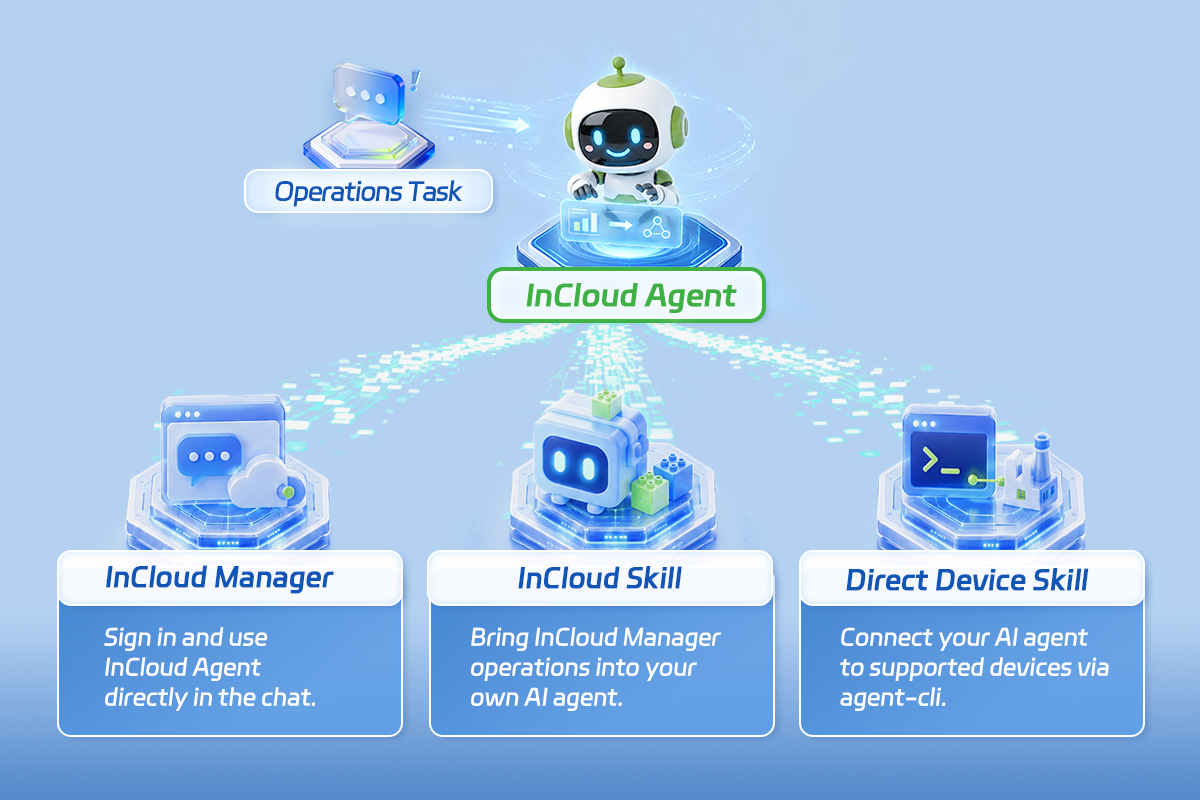
InCloud Agent can be used in three ways.
InCloud Manager:Users can access InCloud Agent directly within InCloud Manager, InHand Networks' proprietary network management platform.
InCloud Skill:Teams that want to bring network operations into their existing AI workflows can use InCloud Skill, allowing their own AI agents to access device data, alerts and network operations in InCloud Manager.
Device Direct Skill: For devices that have not been onboarded to InCloud Manager or are located inside private networks, Device Direct Skill allows the computer running the AI agent to connect directly to the device through `agent-cli`.
The first question it addresses is what the AI can see. Within the InCloud Manager portal, InCloud Agent works with live platform data and operational capabilities, rather than relying on generic networking knowledge alone. A user can ask it to "run a network health check" or "diagnose the root cause of this alert," and the agent can bring together context spanning organizations, sites, devices, alerts, logs, configurations, traffic and firmware.
If a user asks, "How has this device been doing lately?" from a device page, the agent knows which device "this" refers to. If the request starts from an alert, it can retrieve the relevant data and summarize the symptoms, likely cause and recommended action. The user no longer has to decide which page or tool to open first; the starting point becomes the operational goal.
The second question is how AI reaches the device. The three options use two routes: the agent built into InCloud Manager and InCloud Skill access managed devices through the cloud platform, while Device Direct Skill uses `agent-cli` to connect directly to the device.
The third question is how the AI acts. Queries and diagnostics can proceed within the user's permissions. When a task involves a configuration change, firmware upgrade or device reboot, the system first checks permissions and operating conditions; any action that requires user approval proceeds only after confirmation. Once the task is complete, the system reports its status and checks the device again to verify the outcome.
In this sense, InCloud Agent is not simply a chat interface added to network management. It brings network data, device operations, expert workflows and safety controls into one operational workflow.
03
Following a Network Problem All the Way Through
Network issues rarely have a single isolated cause. A device that drops offline may be affected by signal changes, SIM status, cellular registration, modem connection behavior or a recent configuration update. A configuration change can create a different kind of risk: one invalid value may be enough to make a remote device unreachable.
Consider a routine morning inspection. An engineer responsible for a group of 20 devices could ask: "Check whether all 20 devices are online and list any that are not." A process that once required logging in to each device can instead produce a consolidated exception list.
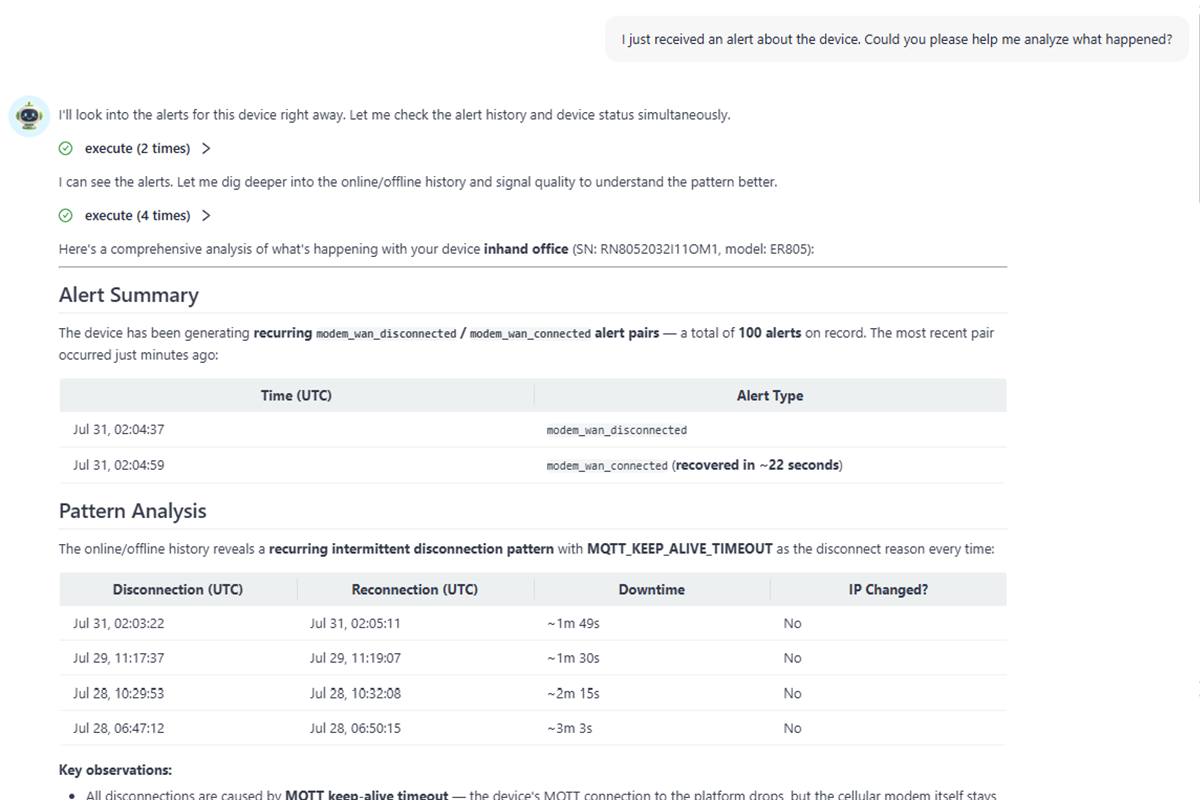
The same task-oriented approach applies when a branch gateway repeatedly disconnects. Rather than collecting raw data for the engineer to reorganize, the agent can retrieve logs, signal information and link data, then structure the investigation around the problem being reported.
Cellular troubleshooting makes the distinction especially clear. A 4G or 5G device may fail to connect, drop frequently or perform poorly because of weak signal, an unrecognized SIM or a failed network registration. With Device Direct Skill, the AI agent uses `agent-cli` to check signal strength and SIM status first, then moves through registration information and modem logs to narrow the issue systematically.
The operating model also changes when a device sits inside a factory, substation or restricted government network. The site may intentionally have no public internet access, or the device may simply be new and not yet configured for cloud management. If an engineer's laptop can reach the device locally, Device Direct Skill allows the AI agent running on that computer to connect through `agent-cli` and begin inspection, commissioning and diagnosis without waiting for cloud onboarding or sending operational traffic over the public internet.
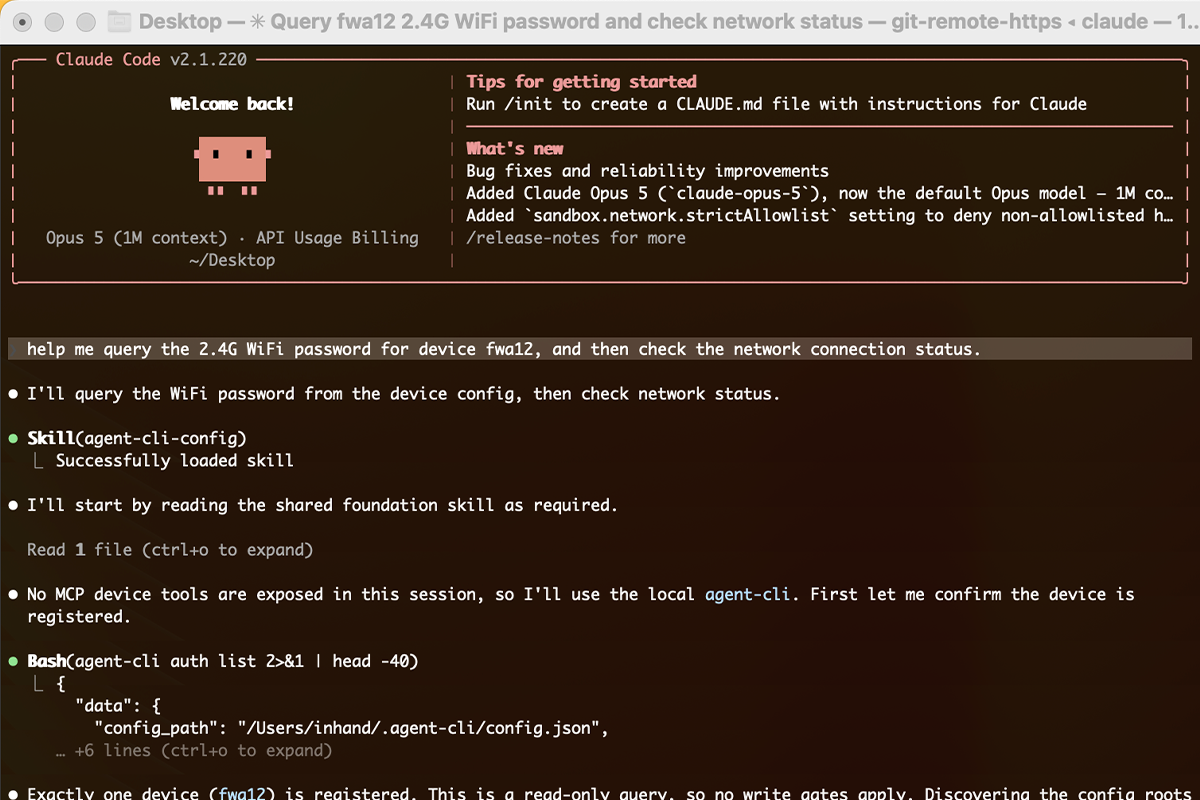
The cloud and local paths are complementary. The cloud provides the broad view and supports fleet-scale tasks; the local path reaches the last mile. In both cases, the workflow shifts from finding the right feature to stating the goal, while the answer remains grounded in real devices and operational evidence.
04
Beyond a Standalone AI Tool: Scaling Operational Know-How
It would be easy to underestimate InCloud Agent as a tool that merely generates networking advice. The larger opportunity is to scale not only the number of managed devices, but also the methods experts use to solve problems.
For complex faults involving specific device models, Device Direct Skill can use `agent-cli` to access device capabilities and follow troubleshooting paths developed by experienced engineers. When firmware may be involved, related skills can compare official release notes to determine whether an issue is already known and whether it has been addressed in a later version, giving teams a stronger basis for upgrade decisions.
This turns the sequence of "what to check first, what to check next, and what evidence supports a conclusion" into a reusable workflow. Senior engineers spend less time gathering routine information. Frontline staff gain a more consistent path through complex problems. Operations teams can extend a method proven on one device across an entire group.
For example, teams using Claude Code, Codex CLI or another compatible AI agent can simply ask, "Check the signal quality of this device." InCloud Skill retrieves the relevant device, alert and network data from InCloud Manager under the user's existing account permissions.
The same capabilities can be incorporated into existing automation workflows and tools. For enterprises and managed service providers, this gives one team a more consistent way to support more sites and customers without bypassing the existing permission model.
## 05 / What Comes Next for AI in Network Operations
The next stage of network AI may depend less on teaching models more networking terminology and more on helping them understand the context of each operational task.
An agent needs to know which site an alert belongs to, what environment a device is operating in and what the current user is authorized to do. It also needs to distinguish between actions that can continue and actions that must pause for approval. Natural-language goals must become troubleshooting workflows; fragmented data must become evidence-backed conclusions; once an action is complete, its outcome must be returned to engineers for verification.
That is the difference between an operational agent and a general-purpose question-answering tool. The former works within a specific organization, device estate and operational process. The latter is primarily a way to retrieve knowledge.

With InCloud Agent, InHand Networks is not promising that AI will automatically resolve every network failure. The proposition is more grounded: the cloud provides scale, the local path reaches the last mile, the agent brings proven operational methods into each task, and people retain control over consequential decisions.
For network operations leaders, the evaluation can still return to the four questions posed at the beginning. Can the agent understand the real network? Can it work when devices are not cloud-connected? Can it act within clear permissions and safety boundaries? Can it make expert practices available to more people?
When those answers become clear, AI moves beyond generating advice and begins to participate in the work.
About InHand Networks
InHand Networks provides IoT and networking solutions for business networking, industrial IoT, smart commerce, digital energy and mobility. Its products and cloud services help organizations connect and manage operations across distributed sites. Learn more at https://www.inhand.com.
Media Contact
Eleanor Chen
Marketing & Communications
[email protected]
SOURCE: InHand Networks