




Friday, 28 August 2026 02:30 PM
Product Announcements
Designed from the ground up for 24/7 staffing, compliance, field operations, dispatch, payroll, billing, patrol verification, and client transparency, Guardix aims to replace fragmented security software with one unified command center.
DALLAS, TX / ACCESS Newswire / August 28, 2026 / Guardix is introducing a new approach to security workforce technology: a purpose-built, AI-powered operating system created specifically around the realities of running a modern private security company.
For years, security firms have been forced to operate through a patchwork of scheduling platforms, guard-tour applications, spreadsheets, payroll systems, dispatch tools, GPS tracking software, recruiting platforms, client portals, training systems, and accounting applications.
Guardix was built around a different idea:
What if the entire security company could operate from one connected system?
From the moment an applicant applies for a security position to the moment a client receives an invoice, Guardix is designed to connect the entire operational lifecycle including recruiting, hiring, onboarding, licensing, scheduling, dispatch, field operations, guard tours, reporting, training, compliance, payroll preparation, billing, client management, contracts, proposals, and analytics.
The Architecture: Purpose-Built for the Realities of Security
Most workforce management platforms were originally created for desk employees, retail stores, hospitality, healthcare, or traditional shift-based work and later adapted to serve the security industry.
Contract security operations are fundamentally different.
A security company may have hundreds of officers across dozens or hundreds of client locations, operating 24 hours a day, seven days a week.
Officers call off unexpectedly.
Clients request emergency coverage.
Licenses expire.
Post orders change.
Supervisors must inspect multiple locations.
Dispatch must know where officers are in real time.
Schedules may change minutes before a shift begins.
Billing rates vary by client, post, service type, holiday, and contract.
An ordinary workforce-management system was never designed for that level of operational complexity but Guardix is the solution for all your security operation problems, Its architecture is being developed directly around the physical, regulatory, financial, and operational realities of private security.
24/7 Dynamic Staffing
Security operations do not stop at 5:00 PM.
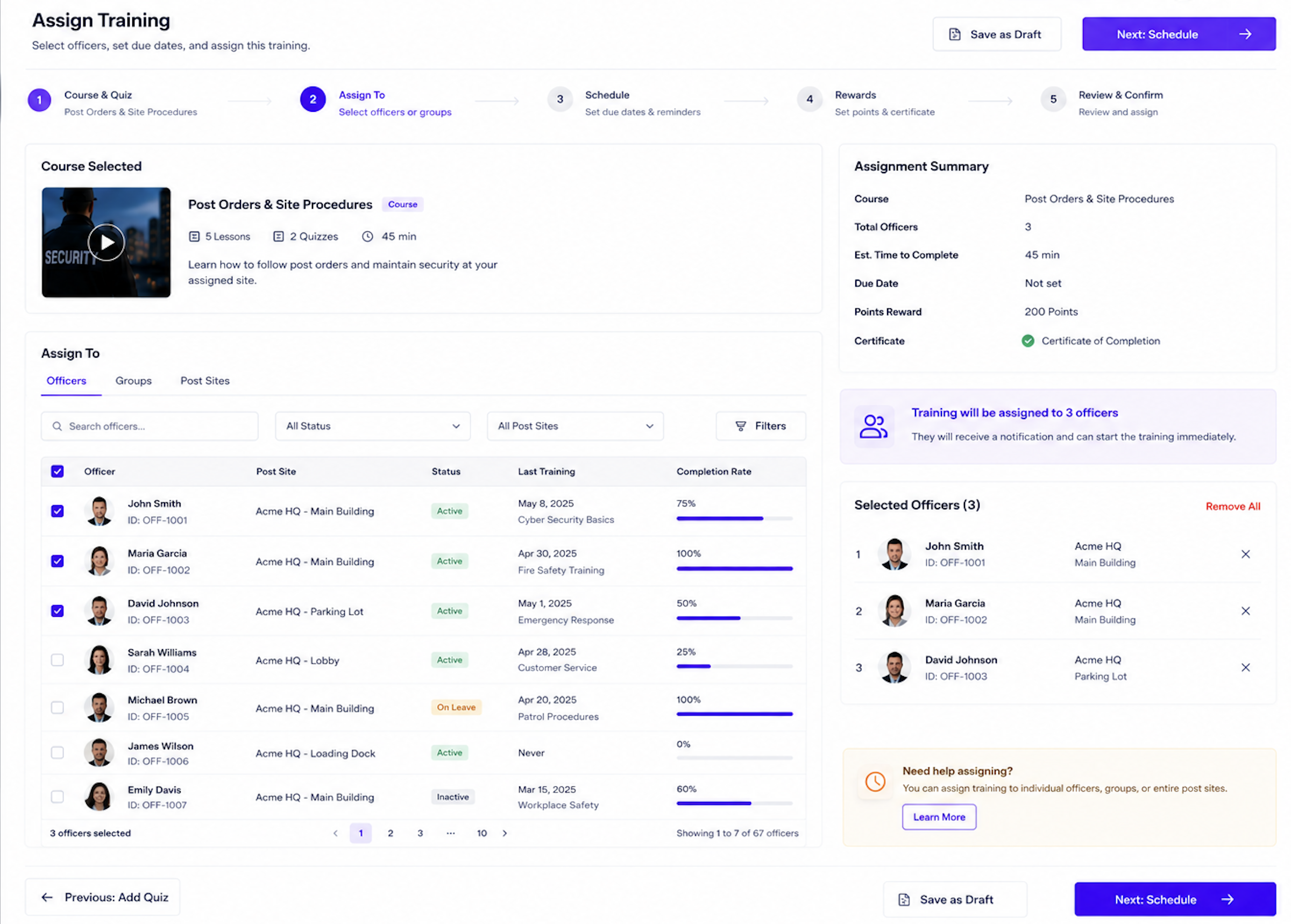
Guardix is designed to help dispatchers, schedulers, and operations managers respond to emergency coverage requirements, last-minute call-offs, open shifts, schedule changes, and rolling post coverage quickly.
The platform can help identify qualified and available officers while simultaneously considering scheduling rules, availability, overtime exposure, location, qualifications, and post requirements.
Instead of searching through spreadsheets, group messages, and employee lists, operations teams can work from a centralized staffing environment.
The goal is simple:
Fill the post quickly without losing control of labor cost, compliance, or operational visibility.
Compliance-First Operations
Compliance is not treated as a separate administrative function inside Guardix.
It is designed to become part of the operating workflow itself.
Officer licenses, guard cards, certifications, expiration dates, training requirements, site qualifications, and other compliance information can be connected directly to the employee and scheduling environment.
If a specific site requires a certain license, certification, training course, or qualification, Guardix can use those requirements when determining which employees are eligible for deployment.
This creates an important operational safeguard: The system should help prevent an unqualified, uncertified, or expired employee from being assigned to a post that requires credentials they do not possess.
Compliance can therefore move from a reactive administrative task to an integrated operational control.
Field-to-Finance Traceability
One of Guardix's most important architectural concepts is connecting what happens in the field directly to what happens financially.
An officer's scheduled shift, geofenced clock-in, time worked, patrol activity, NFC or QR checkpoint verification, reports, and site activity can become part of the same operational record used for timekeeping, payroll preparation, and client billing.
This creates what Guardix calls Field-to-Finance Traceability.
Instead of operations maintaining one set of records, payroll maintaining another, and accounting attempting to reconstruct billable hours later, Guardix creates a connected chain of information.
Schedule → Deployment → Verification → Timekeeping → Payroll → Billing → Client Record
The objective is to ensure that the hours performed in the field are supported by operational data and accurately reflected throughout the organization.
This can reduce manual reconciliation, payroll discrepancies, billing disputes, missing documentation, and administrative friction.
AI That Understands Security Operations
Guardix is also being developed around a fundamentally different use of artificial intelligence.
Many business applications have added generic AI chat tools on top of existing software.
Guardix's vision is to place intelligence inside the operational workflows themselves.
AI can assist security companies with functions such as:
Identifying potential staffing conflicts before they become uncovered posts
Detecting overtime risks
Recommending qualified available officers for emergency shifts
Summarizing Daily Activity Reports and incident reports
Identifying unusual patterns in officer or site activity
Highlighting missing reports or incomplete operational documentation
Assisting dispatch with prioritization
Reviewing patrol activity and checkpoint performance
Generating training quizzes from company training material
Organizing large volumes of field information
Identifying recurring incidents across sites
Helping management understand operational trends
Supporting client-report preparation
Detecting compliance risks before deployment
Assisting with scheduling and workforce optimization
The goal is not to remove supervisors, dispatchers, HR teams, or operations managers from the decision-making process.
It is to give them a system capable of analyzing thousands of operational data points and presenting the information that matters most.
AI becomes an operational assistant not just a chatbot.
Why Guardix Represents a Different Category
Private security companies have traditionally faced two choices.
The first is purchasing multiple disconnected applications: one platform for scheduling, another for guard tours, another for payroll, another for recruiting, another for client reporting, another for contracts, and several spreadsheets to connect everything together.
The second is adopting older legacy security-management software that may provide many functions but was built years before modern mobile experiences, real-time data, intelligent automation, and AI became operational requirements.
Guardix is being developed as a third category:
A unified AI operating system built specifically for security companies.
Capability | Traditional Legacy Security Software | Generic Workforce Applications | Guardix AI Operating System |
|---|---|---|---|
System Architecture | Separate or aging modules accumulated over time | Built primarily for traditional shift-based industries | Natively connected ecosystem spanning applicant, employee, site, operations, finance, and client |
Artificial Intelligence | Primarily alerts and predefined business rules | Generic AI assistants with limited security context | AI embedded into scheduling, dispatch, reporting, training, compliance, and operational analysis |
Field Operations | Often complex or outdated mobile workflows | Limited support for guard-specific workflows | Mobile experience designed around officers, supervisors, post orders, GPS, patrols, reports, and checkpoints |
Scheduling & Dispatch | Scheduling often separated from real-time field activity | Standard shift scheduling | Dynamic security staffing connected to qualifications, availability, compliance, locations, and field status |
Guard Tours | Often a separate patrol product | Typically unavailable | Integrated NFC/QR tours, checkpoints, questions, photographs, reports, and patrol verification |
Compliance | Separate administrative tracking | Basic document storage | Licensing, certification, training, and qualification requirements connected to deployment decisions |
Billing & Payroll | Exports and manual reconciliation common | Standard time-clock workflows | Field-to-finance workflow connecting verified work activity to payroll and client billing rules |
Client Transparency | Periodic emailed reports | Minimal security-specific client visibility | Client portal designed for reports, incidents, tours, schedules, and operational transparency |
Reporting | Static operational reports | Generic workforce analytics | Security-specific operational reporting combined with AI-assisted analysis |
Scalability | Additional growth can create administrative burden | Handles employees but not complete security operations | Designed to help security organizations scale clients, officers, sites, and operations from one platform |
One Platform From Applicant to Invoice
Guardix is being designed to cover virtually every operational department inside a contract security organization.
Recruiting & Hiring
The workflow can begin before someone even becomes an employee.
Candidates can enter the Guardix recruiting environment, where companies can manage applications, candidate information, interviews, notes, qualification reviews, and hiring decisions.
Once approved, the candidate can transition into onboarding without creating another disconnected employee record.
Employee Onboarding
New officers can receive employment documents, policies, correspondence, electronic signatures, training assignments, licensing requirements, and other onboarding materials digitally.
Training
Training content can be delivered through the platform, while AI can assist administrators in generating quiz questions and knowledge checks from the training material.
Scheduling
Employees can then move directly into the scheduling system, where availability, qualifications, site requirements, licenses, overtime, and other operating rules can be considered.
Dispatch
When shifts begin, dispatch receives visibility into active officers, scheduled posts, clock-in status, call-offs, late arrivals, open shifts, and operational events.
Mobile Field Operations
Officers can use the Guardix mobile application to access:
Schedules
Clock-in and clock-out
GPS and geofence verification
Post orders
Daily Activity Reports
Incident reports
Photographs
Guard tours
NFC and QR checkpoints
Site questions
Tasks
Training
Company correspondence
Electronic documents
Signatures
Notifications and operational instructions
Supervisor Operations
Supervisors can manage routes, visit multiple client locations, verify officers, conduct site inspections, document findings, review activity, and submit reports directly through the Guardix ecosystem.
Client Management
Clients, sites, contacts, service agreements, post orders, schedules, rates, reports, incidents, and operational history can remain connected under one account.
Proposals & Contracts
Security companies can manage prospective customers, proposals, pricing, electronic approvals, contracts, signatures, and follow-up workflows.
Once the client becomes active, information can flow directly into operations rather than being manually recreated.
Payroll & Billing
Verified operational data can then move toward payroll preparation and invoicing.
Hours can be connected to client rates, post rates, service types, schedules, holidays, overtime rules, fixed billing arrangements, and other contract terms.
The same ecosystem that knows who worked, where they worked, when they worked, and what happened during that shift can help determine how the employee should be paid and how the client should be billed.
A Digital Command Center for the Entire Security Organization
Guardix is not intended to become another application employees need to check.
Its goal is to become the digital command center connecting every major department:
Recruiting → HR → Compliance → Training → Scheduling → Dispatch → Officers → Supervisors → Clients → Payroll → Accounting → Management
Every department works with different responsibilities, but they operate from a shared underlying ecosystem.
This enables information created in one department to become immediately useful somewhere else.
A license uploaded during onboarding can affect scheduling eligibility.
A call-off can immediately affect dispatch.
A clock-in can affect attendance.
A completed patrol can affect client visibility.
An incident report can alert supervisors and management.
Verified hours can feed payroll.
The same hours can support billing.
Client reports can be generated from operational activity already inside the system.
This is the advantage of a unified architecture.
Data does not simply sit inside Guardix. It moves through the operation.
The New Standard for Modern Security Operations
Security companies operate in one of the most demanding workforce environments in the service industry.
They manage employees who rarely work from an office.
Their workforce is distributed across client properties.
Operations run continuously.
Compliance requirements are significant.
Turnover can be high.
Emergencies are unpredictable.
Clients demand visibility.
Margins depend heavily on controlling labor.
And operational failures can immediately affect both safety and customer relationships.
Technology serving this industry should be designed around those realities.
Guardix is being built to provide security companies with the infrastructure to reduce administrative drag, protect operating margins, improve accountability, automate repetitive work, and scale their book of business without proportionally increasing administrative overhead.
It represents a shift from security software to a security operating system.
One Workforce. One Operation. One Source of Truth.
Rather than asking security companies to connect six, eight, or ten different products, Guardix is building one environment where the organization's people, clients, sites, operations, compliance, field activity, and finances can work together.
About Guardix
Guardix is an AI-powered security operations platform being developed specifically for private security companies. The platform connects recruiting, onboarding, workforce management, licensing and compliance, scheduling, dispatch, GPS and geofence verification, guard tours, NFC/QR checkpoints, incident and activity reporting, supervisor operations, training, client management, proposals, contracts, payroll preparation, billing, invoicing, analytics, and client transparency through one unified web and mobile ecosystem.
Guardix's mission is to modernize private security operations by replacing fragmented systems with one intelligent platform capable of connecting the entire security business from applicant to invoice.
Guardix, The AI Operating System for the Security Industry.
Samuel Hanna
CEO / Guardix.com
[email protected]
SOURCE: Guardix