



Thursday, 06 August 2026 09:30 AM
Environmental, Social and Governance
NORTHAMPTON, MA / ACCESS Newswire / August 6, 2026 / As global trade becomes more interconnected and unpredictable, the competitive advantage is shifting. Success is no longer determined solely by the size of a port, the depth of a harbor, or the capacity of a warehouse. Increasingly, it's about how well every part of the supply chain works together.
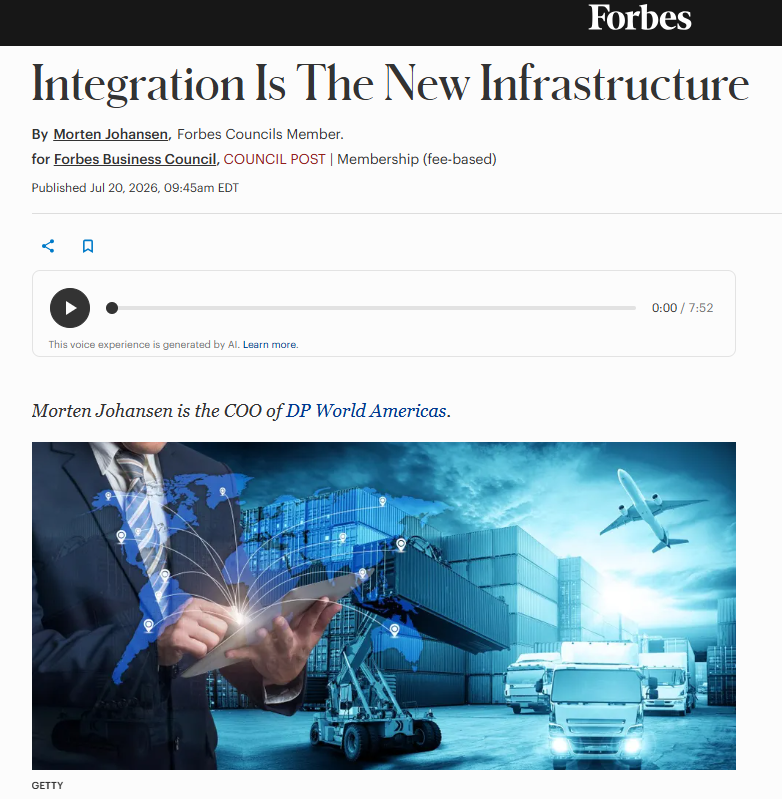
In his latest Forbes Business Council article, "Integration Is the New Infrastructure," Morten Johansen, COO of DP World in the Americas, argues that the next era of supply chain performance will be defined not by standalone assets, but by integrated logistics ecosystems that connect ports, inland transportation, customs, economic zones, and digital platforms into a single, coordinated network.
The shift comes as global trade continues to grow in both scale and complexity. According to UN Trade and Development, global trade reached a record $35 trillion in 2025, while the World Bank estimates that roughly half of all containers now require at least one transshipment - adding an average of 18 days to maritime lead times. Those realities make coordination just as important as capacity.
Moving Beyond Physical Infrastructure
For decades, companies evaluated supply chains primarily through physical assets: ports, roads, warehouses, and terminals. While those investments remain essential, today's supply chains depend equally on the digital and operational connections between them.
Integrated trade ecosystems reduce friction by improving visibility across cargo movements, aligning customs and documentation processes, connecting inland transport with production and consumption centers, and enabling businesses to make faster, more informed decisions.
As Morten explains, "integration transforms infrastructure into competitive advantage." Rather than asking what needs to be built next, organizations should ask what needs to work together.
Integration in Action
DP World is putting this integrated approach into practice across the Americas.
In British Columbia, the new Salish Sea Gateway connects coastal shipping with road, rail, and global ocean services, creating a more resilient trade corridor for Vancouver Island and the Lower Mainland. Meanwhile, in the Dominican Republic, DP World's integrated ecosystem combines the Port of Caucedo, a world-class Free Trade Zone and value-added logistics services to help manufacturers and exporters move goods more efficiently while supporting regional economic growth.
Building Supply Chains for What's Next
As businesses rethink supply chain strategies amid evolving trade patterns, geopolitical uncertainty and changing customer expectations, integration is becoming a critical differentiator.
For leaders evaluating logistics partners or future investments, the question is no longer simply where capacity exists - it's whether every component of the supply chain can operate as one connected system.
Read Morten Johansen's full Forbes Business Council article, "Integration Is the New Infrastructure," to learn why integrated logistics ecosystems will define the next generation of global trade.
Find more stories and multimedia from DP World at 3blmedia.com.
Contact Info:
Spokesperson: DP World
Website: https://www.3blmedia.com/profiles/dp-world
Email: [email protected]
SOURCE: DP World