



Monday, 25 May 2026 06:25 PM
Advertorial
New buyer-focused analysis covers TRU KAVA product formats, published quality controls, federal kava safety guidance, kratom-adulteration concerns, and verification steps for adults comparing functional alcohol alternatives.
FAYETTEVILLE, AR / ACCESS Newswire / May 25, 2026 / Disclaimers: This article contains affiliate links. A commission may be earned on qualifying purchases made through links in this content, at no additional cost to the reader. Affiliate relationships do not influence editorial content or the evaluation of products. Disclosure is provided in accordance with FTC 16 CFR Part 255. The statements in this article have not been evaluated by the Food and Drug Administration. Products discussed are not intended to diagnose, treat, cure, or prevent any disease.
TRU KAVA Consumer Guide Examines Kava Ingredients, Safety Considerations and Non-Alcoholic Beverage Pricing
TL;DR: TRU KAVA at a Glance
TRU KAVA is a kava-based functional beverage line marketed as a non-alcoholic social tonic. Products include sparkling kava drinks ($29.94 per 6-pack), KAVAPLEX premium kava oil ($68.74), instant sachets ($44.95 for 12 servings), and kava shots ($29.94 per 6-pack). According to the brand, the line uses traditional aqueous-style preparation with third-party batch testing for contaminants. Founded by kava researcher Cameron George. Note: The FDA has issued a consumer advisory regarding kava and potential liver injury, and the CDC published a fresh April 2026 warning about kratom-containing kava products. Both are covered in the safety section below.
Quick Verdict: What This Buyer's Guide Actually Covers
The functional beverage category around kava has exploded over the past two years. Leilo, Kava Haven, Hiyo, Melo, Kava Hana, Botanical Brewing Co, Kalm with Kava, Bula Kava House - the list keeps growing. Most coverage compares them on flavor profile or kavalactone milligrams per can. Almost none of it walks the reader through the conversation that actually matters: whether kava is safe, how to distinguish a reputable brand from the kratom-laced gray market the CDC just flagged in April 2026, and which verified facts a prospective buyer should personally check before clicking "order."
This article walks through TRU KAVA's full product line, verified pricing as of publication, the founder's published background, the brand's stated quality controls, the FDA's documented regulatory position on kava, the NCCIH's safety guidance, the CDC's April 2026 MMWR report on kratom-containing kava products, a noble-versus-tudei cultivar explanation that most brand reviews skip entirely, a side-by-side context with Leilo and Kava Haven, and a complete buyer-verification checklist. The brand's official website at trukava.com is the source for all product, pricing, and policy information referenced below.
View current TRU KAVA pricing and product availability on the official website here.
Disclosure: If you buy through this link, a commission may be earned at no extra cost to you.
What Is TRU KAVA, and Who Is It Actually For?
TRU KAVA is a functional beverage and supplement line built around Piper methysticum, commonly known as the kava plant. Kava is a botanical native to the South Pacific that has been consumed ceremonially for centuries in Polynesian, Melanesian, and Micronesian cultures. The active compounds, called kavalactones, are described by the brand as the source of kava's traditional reputation for promoting a relaxed, socially engaged state without the impairment associated with alcohol.
According to the company, the brand was founded by Cameron George, described on the official site (trukava.com) as a researcher and writer focused on kava who has built TRU KAVA around what the brand calls "the first fully modernized traditional kava product." The positioning is clear. This is not a synthetic anxiolytic. It is not an alcohol substitute in the sense of mimicking ethanol. It is not a stimulant. It is a botanical beverage line intended for adults who want a social or wind-down ritual without alcohol.
The target buyer, based on the brand's published materials and endorser stack, appears to be the sober-curious adult, the high-performance professional managing stress without pharmaceuticals, and the alcohol-replacement consumer who wants something to hold at a dinner or social event that produces a noticeable experience without inebriation. Public figures who have endorsed the brand on its official site include Dave Asprey, Dr. Josh Axe, Aubrey Marcus, Ben Greenfield, UFC bantamweight champion Miesha Tate, Thomas DeLauer, and Luke Storey. All quotes appear directly on the brand's homepage.
The TRU KAVA Product Line and Current Pricing
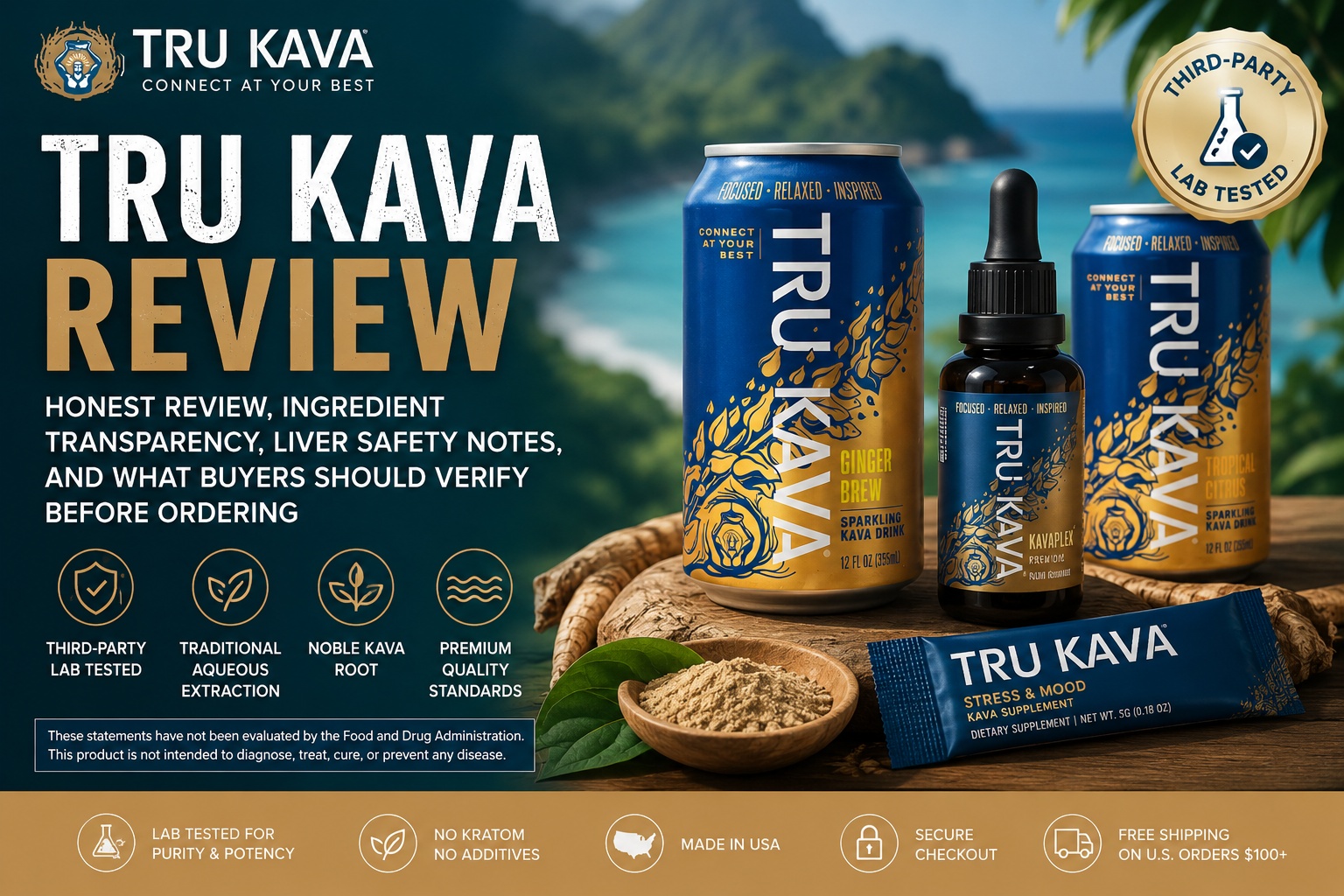
The current product lineup, verified directly against the official brand site at the time of writing, includes the following SKUs at the listed pricing:
KAVAPLEX Premium Kava Oil at $68.74. A concentrated kava oil positioned by the brand as their flagship potency format.
KAVAPLEX MIND Nootropic Oil at $68.74. A separate oil formulation positioned for focus and cognitive function.
Ginger Brew Kava Drink (6-pack) at $29.94. A sparkling, ready-to-drink canned kava beverage.
Tropical Citrus Kava Drink (6-pack) at $29.94. A second flavor in the canned beverage line.
Tropical TRU KAVA Shots (6-pack) at $29.94. A concentrated shot format. At the time of writing, the product page indicated this SKU was sold out, which is an availability signal prospective buyers should verify before counting on this format.
Tropical Stress and Mood Sachets (12 servings) at $44.95. An instant powder format for at-home preparation.
The brand also offers bundle savings and a subscription option with a 20% discount on first and recurring orders. Subscription billing is not automatic. According to the brand's published subscription terms, subscribers receive an email payment link before each shipment, which is a meaningful trust signal in a category where auto-renewal disputes are common.
Free shipping applies to U.S. orders over $100. The brand does not ship internationally, citing import restrictions in some countries. This is normal for kava brands in the U.S. and is consistent with how the category is regulated abroad.
See the full TRU KAVA product lineup and current bundle pricing here.
Is Kava Safe?
What the FDA, NCCIH, and CDC Actually Say
Buyers in this category deserve the full picture before spending money. This section presents the published positions of the FDA, NCCIH, and CDC directly, with attribution.
The U.S. National Center for Complementary and Integrative Health (NCCIH) states that kava products have been linked to rare cases of liver injury, including serious or fatal cases, and warns specifically against combining kava with alcohol or with sedative medications. This is the most current consumer-facing safety language from a federal health agency, and it should anchor any prospective buyer's decision-making.
In March 2002, the U.S. Food and Drug Administration issued a consumer advisory stating that kava-containing dietary supplements may be associated with severe liver injury, including hepatitis, cirrhosis, and liver failure. The advisory followed reports of adverse events in the United States, Germany, Switzerland, and other countries. The FDA reaffirmed and expanded its position in a scientific memorandum dated August 2020. That memorandum concluded the available data suggests indiscriminate kava consumption is not safe for human consumption in certain contexts, and it listed kava as an unapproved food additive for use in conventional foods.
Several European countries - including Germany, France, Switzerland, the United Kingdom, and others - implemented restrictions or bans on kava-containing supplements following the 2002 advisories. Canada also restricted kava during this period and later overturned the restriction in 2012.
Kava remains legally sold in the United States. Kava-containing dietary supplements are regulated under the Dietary Supplement Health and Education Act of 1994 (DSHEA), which does not require pre-market FDA approval. Use of kava as an ingredient in conventional beverages is treated differently. The FDA's 2020 scientific memorandum classified kava as an unapproved food additive when used in conventional foods, while kava-containing dietary supplements remain legally marketed. The original liver-injury reports have been the subject of ongoing scientific debate. Several review papers note that the mechanism of toxicity is not fully established, that the implicated cases often involved concurrent alcohol use or prescription medications, and that traditional aqueous preparations have not been reproducibly linked to liver injury in preclinical models.
The most recent regulatory development is significant. In April 2026, the U.S. Centers for Disease Control and Prevention published an MMWR (Morbidity and Mortality Weekly Report) documenting an increase in poison-center calls related to kratom-containing kava products. That is, products marketed as "kava" that contained undisclosed kratom - a separate and more concerning botanical with its own regulatory profile. This is the gray-market problem prospective buyers need to understand before purchasing any kava product from any source. It is also why source verification and ingredient-list reading matter more in this category than in nearly any other functional beverage category right now.
The practical takeaways for any prospective buyer:
Anyone with a history of liver disease, current liver concerns, or who takes medications metabolized through the liver should consult a licensed healthcare professional before using any kava product.
Combining kava with alcohol or with sedative medications is specifically warned against by NCCIH and is broadly discouraged across the published safety literature.
Pregnant or nursing women should not use kava products.
Verify that any kava product purchased contains only kava and does not include undisclosed kratom or other adulterants. Read the ingredient list on the official site for each specific SKU before purchase.
Choose brands that publish third-party batch testing for contaminants and that disclose the cultivar (noble vs. tudei) used in their products.
This is a category where transparency matters more than marketing. The reader should weigh the published regulatory information against the brand's published quality controls and make an informed decision in consultation with a healthcare provider.
Noble vs. Tudei: The Kava Distinction Most Buyers Have Never Heard
If a prospective buyer takes only one piece of technical information away from this article, it should be the difference between noble kava and tudei kava. Noble cultivars are the traditional kava varieties used ceremonially across the South Pacific for centuries. They are generally regarded in the published kava literature as having a more favorable safety profile and a more predictable effects profile. Tudei (sometimes spelled "two-day" because of its reputed extended duration) and other non-noble cultivars are generally regarded as less suitable for daily or social consumption and have been associated in some reviews with a higher proportion of adverse reports.
The Vanuatu government, which is one of the world's leading kava-producing regions, formally regulates kava exports and recognizes the noble-tudei distinction as central to product safety. Fiji and Hawaii are the other major producing regions with established quality controls.
This distinction matters because the FDA's liver-injury concern is most often discussed in the published literature in the context of non-noble cultivars and solvent-based extractions rather than traditional aqueous preparations of noble kava. Buyers who want the most cautious possible kava experience should look for explicit noble-cultivar disclosure on the product label or brand site. According to the brand, TRU KAVA's products are built around traditional aqueous-style preparation, though prospective buyers who want explicit cultivar disclosure on each SKU should confirm directly with customer service before purchase.
How TRU KAVA Positions Itself on Quality and Safety
According to the company's published materials, TRU KAVA addresses the safety conversation directly through several brand-stated quality controls:
Traditional aqueous-style preparation. The brand describes its products as built around traditional kava preparation methods rather than solvent-based extractions that have historically been associated with higher concentrations of compounds outside the kavalactone profile.
Third-party batch testing. The brand states on its official site that each batch is subjected to third-party laboratory testing for known contaminants.
Founder credentials. Cameron George is described on the official site as a researcher focused specifically on kava with stated industry involvement in quality and safety education.
FDA disclaimer compliance. The brand carries the standard FDA dietary-supplement disclaimer on its site and explicitly recommends consulting a healthcare professional before purchase for individuals with liver concerns, alcohol use, or active medications.
No kratom co-formulation. Based on the brand's published ingredient information, TRU KAVA products are kava-only and do not contain kratom. This is a meaningful distinction given the CDC's April 2026 MMWR report on kratom-containing kava products.
What the brand has not published, and what discerning buyers should ideally have access to, includes specific kavalactone concentration per serving, explicit cultivar disclosure on each SKU (noble varieties are generally regarded in the published kava literature as having a more favorable safety profile than non-noble or "tudei" cultivars), and direct downloadable copies of the third-party lab certificates of analysis. Buyers who want this level of detail can request it from the brand directly through customer service.
These statements describe the brand's published positioning and are not medical claims. TRU KAVA products are not intended to diagnose, treat, cure, or prevent any disease.
What Buyers Actually Report About TRU KAVA
The brand publishes a 4.5-star average across what it states is over 30,000 subscribers. Customer testimonials on the official site describe experiences ranging from feelings of relaxation and calm without heavy sedation, a centered mental state, social ease without intoxication, and improved sleep quality on the night following consumption. Several testimonials reference using the product as an alternative to alcohol at social events. Ratings reflect brand-reported customer data. Individual experiences and results vary.
The endorser stack on the official site is unusually high-profile for the kava category. Dave Asprey, founder of Bulletproof, publicly described KAVAPLEX as part of his personal evening routine. Aubrey Marcus stated the product has replaced his casual alcohol consumption. Miesha Tate, the UFC bantamweight champion, stated that kava has substantially replaced alcohol in her routine. Dr. Josh Axe, co-founder of Ancient Nutrition, framed the product as a category-changing functional beverage. These endorsements appear directly on the brand's site and are presented as the brand's own attributed claims.
Endorsements reflect individual opinions or experiences and are not clinical evidence. Customer ratings reflect brand-reported customer data. Individual results vary, and no specific outcome is implied or guaranteed by the inclusion of any testimonial.
How TRU KAVA Compares to Leilo, Kava Haven, Hiyo, and the Wider Kava Beverage Category
The functional beverage space around kava has expanded significantly over the past two years. The current category includes ready-to-drink brands such as Leilo, Kava Haven, Hiyo, Kava Hana, Melo, and Botanical Brewing Co, alongside traditional powder and oil brands like Kalm with Kava and Bula Kava House. Brands in this category typically compete on flavor profiles, kavalactone milligram disclosures, lifestyle positioning, and pricing tier. Coverage of the documented FDA liver-safety advisory and the recent CDC kratom-kava warning varies meaningfully by brand and by review source.
TRU KAVA's differentiation, based on its published materials, appears to be the combination of a kava-focused founder with a research background, multiple product formats (oils, drinks, shots, sachets) under one brand, a stated emphasis on traditional aqueous-style preparation, and a high-visibility endorser stack. The brand does not publish a competitor comparison on its own site, which is consistent with FTC guidance discouraging unsubstantiated comparative claims.
Buyers who prioritize a single explicit kavalactone milligram count printed on the can may find competitors that lead with that specific metric. Buyers who prioritize traditional preparation method, third-party testing, format variety, and a transparent founder story may find TRU KAVA more aligned with their personal preferences. Neither approach is wrong. The right answer depends on what each individual buyer values most.
Compare the TRU KAVA product line and current offers on the official website.
Pricing, Subscriptions, Returns, and Shipping: The Verified Numbers
Per the brand's official site as of the time of writing, current pricing is as follows. KAVAPLEX Premium Kava Oil and KAVAPLEX MIND Nootropic Oil are listed at $68.74 each. Sparkling Ginger Brew and Tropical Citrus kava drinks are listed at $29.94 per 6-pack. Tropical TRU KAVA Shots are listed at $29.94 per 6-pack. Tropical Stress and Mood Sachets are listed at $44.95 for 12 servings.
Free shipping applies to U.S. orders over $100. Subscription customers receive a 20% discount on first and recurring orders. The brand states that subscribers receive an email payment link before each shipment rather than being auto-charged, which is an unusually consumer-friendly subscription structure in this category.
The brand's published return policy allows returns of unused, unopened product within 30 days of the purchase date. Original shipping charges on the order are not refundable. Returns are processed by contacting [email protected]. Returns are mailed to: TRU KAVA, Inc., 1895 N. Pluto Drive, Fayetteville, AR 72703, USA. Products purchased from unauthorized resellers (including unauthorized third-party marketplace listings) are not covered under the brand's warranty.
The brand does not ship internationally.
Buyer Verification Checklist Before Ordering Any Kava Product
Before purchasing any kava product from any brand, the published safety literature suggests the following due-diligence steps are appropriate:
Confirm the product contains kava only, with no undisclosed kratom or other botanical adulterants.
Confirm the brand publishes third-party batch testing for contaminants. If a Certificate of Analysis is not available, ask customer service for it before ordering.
Confirm the cultivar used. Noble kava is generally regarded as the safer choice over tudei or other non-noble varieties.
Confirm the product is being purchased from the official brand website or an authorized reseller, not from a gray-market marketplace listing.
Review the FDA's published advisory on kava and liver health, and the NCCIH consumer guidance.
Consult a licensed healthcare professional if there is any personal history of liver disease, current alcohol use, or active medication use.
Read the full ingredient disclosure and FDA disclaimer language before purchase.
Verify pricing and current promotions on the official brand site rather than relying on third-party reviews.
Confirm the brand's return policy and the window for unopened returns before ordering.
Save the order confirmation, batch number, and lot code in case follow-up is needed.
Frequently Asked Questions About TRU KAVA
Is TRU KAVA legal in the United States?
Kava is legally sold in the United States. Kava-containing dietary supplements are regulated under DSHEA, which does not require pre-market FDA approval. The FDA's 2020 scientific memorandum classified kava as an unapproved food additive when used in conventional foods, a position that applies to kava as a beverage ingredient and remains the subject of ongoing regulatory and scientific discussion. The FDA's 2002 consumer advisory regarding potential liver injury from kava-containing supplements was reaffirmed in 2020. Kava is not federally banned in the U.S., though some European countries have implemented restrictions or bans. Buyers should review the FDA's published position before purchase. According to the brand, TRU KAVA carries the standard FDA dietary-supplement disclaimer on its products and site.
Does TRU KAVA contain kratom?
Based on the brand's published ingredient information, TRU KAVA products are kava-only and do not contain kratom. This is a meaningful distinction given the CDC's April 2026 MMWR report on poison-center calls related to kratom-containing kava products that were marketed as "kava." Buyers who want to verify the ingredient profile should review the ingredient list on the official site for each specific SKU before purchase.
Will TRU KAVA cause liver damage?
The FDA has issued an advisory associating kava-containing supplements with reports of severe liver injury, including hepatitis and liver failure. The NCCIH states that kava products have been linked to rare cases of liver injury, including serious or fatal cases. The mechanism of toxicity is not fully established and remains under scientific debate. Several reviews note that implicated cases often involved concurrent alcohol use, other medications, or non-traditional extraction methods using non-noble cultivars. Individuals with liver disease, current liver concerns, regular alcohol use, or active medications metabolized through the liver should consult a licensed healthcare professional before using any kava product. Pregnant or nursing women should not use kava. This applies to all kava products from all brands, not exclusively to TRU KAVA.
How is TRU KAVA different from Leilo, Kava Haven, Hiyo, or other kava drinks?
According to the brand, TRU KAVA is built around traditional aqueous-style preparation and is offered in multiple product formats including ready-to-drink cans, kava oils, instant sachets, and kava shots. The brand publishes that each batch is subjected to third-party contaminant testing. Other brands in the category compete on different attributes such as specific kavalactone milligram counts per serving, flavor variety, or lifestyle positioning. Leilo, for example, publishes a 225 mg kavalactone count per can on its product line, per the brand's own published product information. Kava Haven positions as a non-alcoholic spirit. Hiyo emphasizes adaptogen blends alongside kava. Buyers should compare based on what they personally value: traditional preparation method, third-party testing transparency, dose disclosure, taste, format variety, or price.
How quickly does TRU KAVA work, and what does the experience feel like?
The brand describes the experience as a state of mindful relaxation: calm without heavy sedation, a centered mental state, and social ease without inebriation. Onset timing and intensity are highly individual and depend on the format used (oils, drinks, sachets, shots), the dose, whether it is consumed on an empty stomach, and personal physiology. Some kava consumers report stronger effects with continued use, an effect sometimes referred to in the kava literature as reverse tolerance. The brand makes no specific clinical timing claims, and onset times vary across individuals.
Can TRU KAVA be consumed with alcohol?
The NCCIH specifically warns against combining kava with alcohol or with sedative medications. The brand itself states on its product labeling: "Ask a healthcare professional before use if you have had liver problems, frequently use alcohol or are taking any medications." Combining kava with alcohol is not recommended.
How does TRU KAVA position kava as an alcohol alternative?
The brand positions kava as an alcohol-free botanical option intended for social and wind-down use. According to the company's published materials, kava is described by the brand as producing a different experience profile than alcohol. Individual responses vary substantially, and any prospective buyer with concerns about dependency, current substance-use history, or interaction with prescription medications should consult a licensed healthcare professional about personal suitability before use. This article does not make clinical determinations about kava's dependency profile. That is properly the province of medical evaluation, not consumer marketing.
What is KAVAPLEX, and how is it different from the canned drinks?
KAVAPLEX is the brand's premium kava oil format, priced at $68.74. According to the brand, the oil is positioned as a concentrated, full-spectrum kava format intended for higher-potency use cases compared to the ready-to-drink canned beverages. A separate KAVAPLEX MIND Nootropic Oil at the same price point is positioned by the brand for focus and cognitive support. The canned drinks ($29.94 per 6-pack) are positioned as the social and casual format. Buyers who want a stronger experience may prefer the oils. Buyers who want a ready-to-drink social format may prefer the cans.
What is the return policy?
The brand's published return policy allows returns of unused, unopened product within 30 days of the date of purchase. Original shipping charges are non-refundable. Returns are processed by emailing [email protected] and mailing the product to TRU KAVA, Inc., 1895 N. Pluto Drive, Fayetteville, AR 72703. Products purchased from unauthorized resellers, including unauthorized listings on third-party marketplaces, are not covered.
Does TRU KAVA ship internationally?
No. The brand states it does not ship outside the United States due to import restrictions in some countries.
Where is the preferred official purchase source for TRU KAVA?
According to the brand, the official website is the only source covered by the brand's warranty. Purchases from authorized resellers may also be covered. Purchases from unauthorized resellers - including unauthorized third-party marketplace listings - are not covered by the brand's return policy or warranty. Buyers should verify they are on the official site before purchasing.
Final Considerations for the 2026 Kava Buyer
TRU KAVA enters the buyer's consideration set as a kava-specialized brand with a research-focused founder, a multi-format product line, a high-visibility endorser stack, and a brand-published commitment to traditional preparation and third-party contaminant testing. The pricing reflects the brand's category-premium positioning, with canned drinks at $29.94 per 6-pack (approximately $4.99 per can) and the flagship KAVAPLEX oil at $68.74. Pricing varies across the kava category, and prospective buyers should compare directly across brands they are considering.
The most important context for any prospective buyer is the kava category itself. This is a botanical with documented FDA advisories regarding liver injury, an active NCCIH warning against combining with alcohol or sedatives, ongoing scientific debate about safety mechanism, and a real gray-market problem with adulterated products. The April 2026 CDC MMWR report on kratom-containing kava products makes brand selection and source verification more important than in lower-risk functional beverage categories.
The buyer who values brand transparency, traditional preparation method, third-party testing, format variety, and is willing to pay a category-premium price for those attributes may find TRU KAVA aligned with their personal preferences. The buyer who is primarily price-sensitive, who prioritizes a single milligram-per-serving disclosure, or who is uncertain about the kava category itself should pause, review the published regulatory positions of the FDA and NCCIH, and consult a healthcare professional before purchase.
Either way, the decision belongs to the reader. The role of this article is to present the verified facts, document the published safety considerations, and present the brand's published positioning honestly.
Contact Information
Company: TRU KAVA
Email: [email protected]
Phone: 1-479-236-5094
Address: TRU KAVA, Inc. 1895 N. Pluto Drive Fayetteville, AR 72703 United States
Disclaimers
FDA Disclaimer: The statements in this article have not been evaluated by the Food and Drug Administration. Products discussed are not intended to diagnose, treat, cure, or prevent any disease. Information provided is for general informational purposes and does not constitute medical advice. Readers experiencing symptoms or considering changes to health regimens should consult a licensed healthcare professional. Individual results vary.
FTC Affiliate Disclosure: This article contains affiliate links. A commission may be earned on qualifying purchases made through links in this content, at no additional cost to the reader. Affiliate relationships do not influence editorial content or the evaluation of products. Disclosure is provided in accordance with FTC 16 CFR Part 255.
Results Disclaimer: Individual results may vary based on physiology, dosage, format used, frequency of use, concurrent medications, alcohol use, and other personal factors. No specific outcome is guaranteed. Testimonials reflect the experiences of individual users and are not representative of all users. Brand-reported customer rating data reflects self-reported brand customer data and is not a substitute for clinical evidence. Endorsements appearing on the brand's site reflect the individual opinions or experiences of the endorsers and are not clinical evidence.
Medical Advice Disclaimer: The information in this article is not medical advice and should not be substituted for professional medical consultation, diagnosis, or treatment. Readers with liver disease, history of liver injury, current liver concerns, regular alcohol consumption, active prescription medications, or any underlying medical condition should consult a licensed healthcare professional before using kava in any form. Pregnant or nursing women should not use kava products. The NCCIH specifically warns against combining kava with alcohol or sedatives. This applies to all kava products from all brands.
Pricing Disclaimer: Pricing referenced in this article reflects the publicly listed price on the brand's official website at the time of writing. Prices, promotions, bundle offers, subscription discounts, and product availability are subject to change without notice. Readers should verify current pricing directly on the official brand site before purchase.
Publisher Independence Disclaimer: This article reflects the writer's review of publicly available materials and the brand's published positioning. The publisher and its affiliated parties are not responsible for changes to the brand's offerings, pricing, formulation, or product availability after publication. Updates to this article reflect changes in publicly available brand information as of the publication date.
Retailer and Platform Disclaimer: The brand's stated warranty and return policy applies only to purchases made on the official brand website or through authorized resellers. Purchases from unauthorized resellers, including unauthorized third-party marketplace listings, may not be covered by the brand's warranty, return policy, or quality controls. Readers are advised to verify they are purchasing through the official source.
No Affiliation With Featured Persons Disclosure: The public figures and endorsers named in this article appear in this content solely because their statements were publicly published on the brand's own official website. The publisher and writer of this article have no compensated, contractual, or representational relationship with any of the public figures named. Their inclusion here is for source attribution only and does not constitute a personal endorsement of this article. Endorsements reflect those individuals' published statements about the brand's products and are not transferable to the editorial content of this article.
Regulatory Disclosure: The U.S. Food and Drug Administration has issued a consumer advisory regarding kava-containing dietary supplements and potential liver injury, originally in 2002 and reaffirmed in 2020. The U.S. National Center for Complementary and Integrative Health states that kava products have been linked to rare cases of liver injury and warns against combining kava with alcohol or sedatives. The U.S. Centers for Disease Control and Prevention published an MMWR report in April 2026 documenting an increase in poison-center calls related to kratom-containing kava products. Readers are encouraged to review these published materials directly. Kava is legally sold in the United States as a dietary supplement under DSHEA. Some European countries have implemented restrictions or bans on kava-containing supplements.
SOURCE: TRU KAVA