



Wednesday, 21 October 2026 09:50 AM
Environmental, Social and Governance
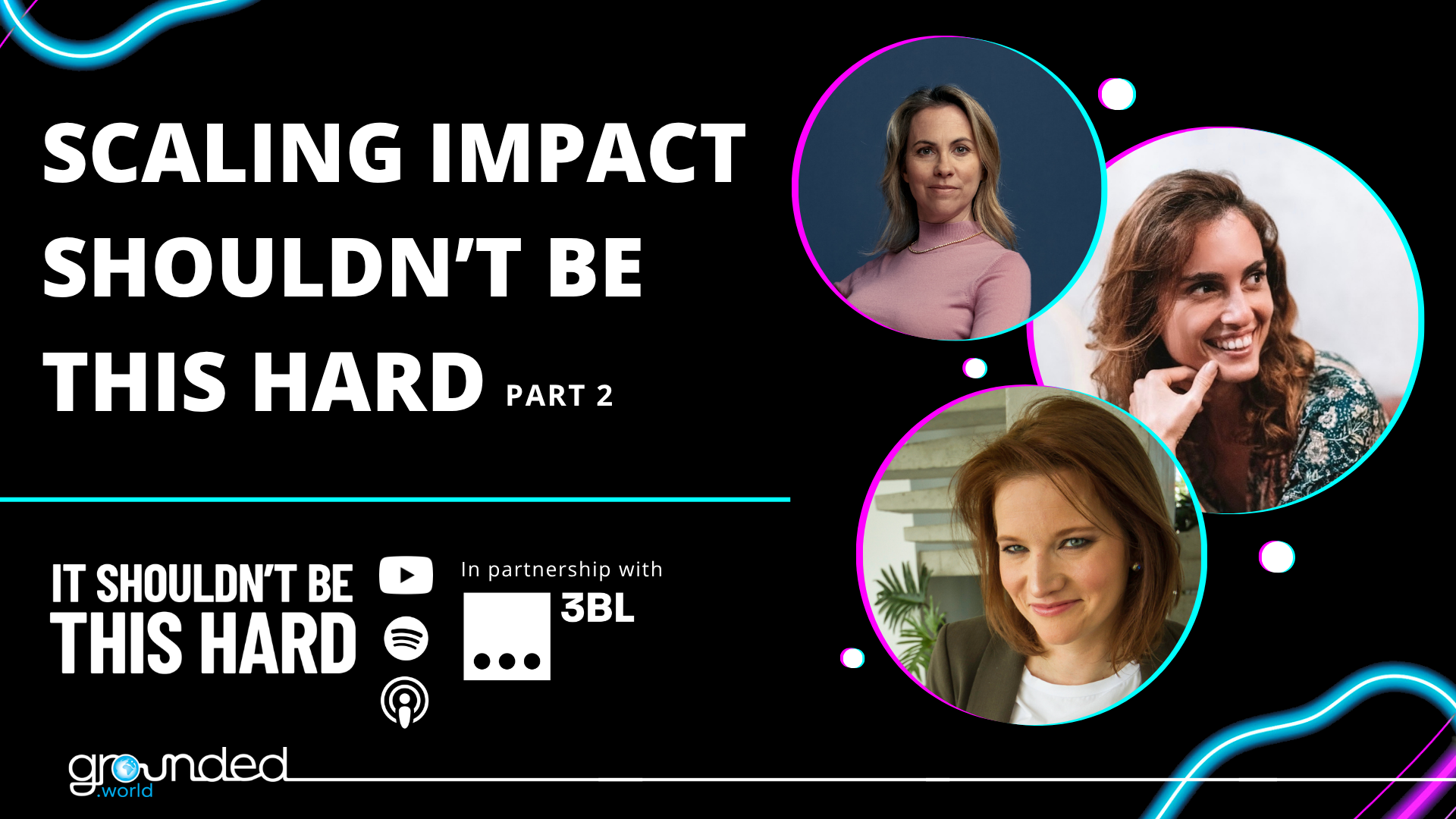
Alessa Berg, Founder of Top Tier Impact; Tessa Clarke, Founder of Olio & Heather Terry, Founder of GoodSAM Foods
NORTHAMPTON, MA / ACCESS Newswire / October 21, 2026 / In Part 1 of IT SHOULDN'T BE THIS HARD, we met three fierce women founders who each turned a feeling they couldn't explain away into a success purpose-driven business. In Part 2, we get into the less glamorous bit: growing it. Watch from the top (00:00)
- Tessa Clarke, Founder of Olio, the neighbor-to-neighbor app tackling food waste
- Alessa Berg, Founder of Top Tier Impact, a global network for impact investors and entrepreneurs in 80+ countries
- Heather Terry, Founder of GoodSAM Foods, the ethical snack brand with zero middlemen
Founding an impact business takes conviction. Scaling one takes something else entirely: patience, profit, and a system that keeps you standing when the finish line is decades away.
The TL;DR
- Your biggest competitor is doing nothing at all.
- No impact without sales.
- The mission is the heart. The numbers are the blood.
Your Real Competitor Is Free
For anyone building an impact business: your biggest competitor probably isn't another startup. It's the status quo...and the status quo is very hard to beat on price. Tessa on competing with the bin (01:05)
"One of the biggest challenges is the fact that we're competing with the bin. And the bin does have a number of unfair advantages... the bin is remarkably convenient and easy to use, even if it's not pleasant to use... And also using the bin is far too cheap... For households it's entirely free, even for businesses. We are nowhere near pricing in the true cost of throwing away food."
So Olio made it a rule:
"We've got a philosophy which is certainly when we're working with our business clients that we'll never be beaten by the bin. And that just means that we have very, very, very little room for maneuver in terms of what we can charge for our service."
When the "wrong" option is free, fast, and judgment-free, you're not really pricing a product. You're pricing against inertia. And inertia always wins on convenience, unless you make the right choice just as easy.
Steal this: Write down everything "doing nothing" gives your customer: zero cost, zero effort, zero awkwardness. That's your real competitive set. Beat it on those terms, not on how much good you do.
The Long, Long Road to "Yes"
Even once you've made the case, landing the big clients can take longer than most startups survive. Tessa on selling into large corporates (02:20)
"The sales cycles are insanely long. So, you know, some of our largest clients have taken us between three and eight years to close a deal and roll out with them across their store portfolio. And that's just incredibly challenging for a small startup with very limited funds."
3-8 years. That's not just a sales pipeline anymore, that's a whole relationship! If your growth plan depends on enterprise clients, your runway, your cash flow, and your patience all need to be built for that timeline.
Steal this: Map your biggest deals against your runway. If the math only works when every corporate client closes on time, you need a plan B that pays the bills while you wait.
The Hidden Cost of Cheap
Heather Terry takes the "true cost" idea further. It isn't just hidden in what we throw away. It's hidden in what we're willing to pay. Heather on the real price of cheap (02:53)
"I often say that when you buy something that's so cheap that you're like, my God, this is too good to be true- someone is suffering for you to buy it at that price. That's what's happening. We love cheap shit. Like we love it so much... Like that's such privilege. We're so privileged to be able to do that. And what we're saying is: don't do that."
Every bargain has a bill. Somebody, somewhere along the supply chain, is paying it. Heather built GoodSAM Foods to make sure that somebody is no longer the farmer.
Profit Isn't the Enemy of the Mission
A lot of social entrepreneurs treat "profitable" like a dirty word. Heather learned early that it's the whole point. Heather on "no impact without sales" (03:25)
"You think, wow, we can't actually impact anything if we don't sell something. Ooh, shoot. So it was, you know, no impact without sales."
That's also why GoodSAM is deliberately growing slower than it could, scaling nuts and coffee carefully rather than chasing high-risk growth:
"We are doing it more slowly than we'd like to, but we also understand we don't want to repeat the mistakes of a lot of people before us... If we're profitable and we scale slowly into big numbers profitably, that's what changes the entire system."
Fast and fragile makes headlines. Slow and profitable makes precedent, and precedent is what a broken industry needs.
When Your Setup Stops Working
Growth has a sneaky side effect: the systems that got you here eventually break. Alessa Berg has scaled Top Tier Impact to more than 80 countries in just a few years, and she's lived it. Alessa on outgrowing your systems (04:30)
"Growing your activities and then bringing in a team and then managing people and scaling with that, and like making your processes more effective because again, you grow and that's great, but then at some point, the setup you had does not work anymore and you need a new setup."
The modern reflex is to throw AI at the problem. Alessa's take: the tool matters far less than the thinking you bring to it. Alessa on cognition over tools (05:17)
"I don't particularly care if someone tells me they use code. I'm more like, how do you use it, right? That's the universe. That's the whole universe of how you can apply your cognition to using these tools. And I'm not just talking about the intentions you use them from, but the logic that you are able to put into it."
AI won't fix a broken process. It'll just run it faster with a higher footprint. The real upgrade is the logic you feed it.
Steal this: Before adding a new tool, write out the process you want it to run, step by step. If you can't explain the logic clearly, no tool will save you.
Words of Wisdom from Three Fearless Female Founders
So if you're building something and it's harder than it should be (and it always is), here's what these three would tell you.
Tessa Clarke, Founder of Olio: Eat the elephant one bite at a time
Tessa's advice for social entrepreneurs (05:53)
"Be kind to yourself... All I can do is show up every single day and do the best that I can within my sphere of influence. There's that sort of, how do you eat an elephant? And the answer is in small mouthfuls, one mouthful at a time. And I think the same applies for systems change."
And a reminder for anyone measuring progress in quarters: Systems change takes decades (06:15)
"We tend to overestimate how much change we can make happen in a couple of years and we underestimate how much change we can make in a couple of decades."
Alessa Berg, Top Tier Impact: Find your roots
Alessa on community and belonging (06:25)
"Find your roots that make your branches grow, and so find your places of community... There is a lot of business and synergy that happens, but I would argue that there is also this sense of belonging and like-mindedness that makes it all feel better, even more meaningful."
Heather Terry, Founder of Good SAM Foods: Know your numbers
Heather on why finances are the lifeblood (07:30)
"It's always the same thing... What are your numbers? Do you know them?"
"Missions are beautiful. They're the heartbeat. But the heart does not beat without blood and oxygen running through it. And the money and the financials and how those run through your business- that's the blood and the oxygen. The heart will not beat without it."
Scaling Impact Shouldn't Be This Hard
Day by day. Find your roots. Know your numbers.
None of these founders pretend scaling impact is easy. They compete with free. They wait years for a yes. They choose profit over hype and community over going it alone. And they keep going.
If you're trying to bridge the gap between purpose and performance in your own business, that's exactly the work we do at Grounded. Visit grounded.world, or meet Gaia, Grounded's sustainability AI.
Missed Part 1? Go back for the origin stories here~
Find more stories and multimedia from Grounded World at 3blmedia.com.
Contact Info:
Spokesperson: Grounded World
Website: https://www.3blmedia.com/profiles/grounded-world
Email: [email protected]
SOURCE: Grounded World