



Wednesday, 10 June 2026 03:00 PM
Advertorial
As consumer interest in natural health research, healthy aging, cognitive wellness, joint comfort, and sleep routines continues rising in 2026, this MAHA Files review breaks down how HSI's research report is positioned, what buyers should know about the membership model, and which evidence gaps matter before joining.
FREDERICK, MD / ACCESS Newswire / June 10, 2026 / Disclaimers: This article contains affiliate links - a commission may be earned on qualifying membership signups made through links in this content, at no additional cost to you. Affiliate relationships do not influence the evaluation of any product or claim in this article. This content is promotional in nature and intended for consumer education regarding a commercially available product, in accordance with FTC 16 CFR Part 255. Nothing here constitutes medical advice. Consult your physician before acting on any health information, including decisions about dietary supplements. These statements have not been evaluated by the Food and Drug Administration. The Health Sciences Institute membership and related reports are not intended to diagnose, treat, cure, or prevent any disease. Political Neutrality Note: This article is produced by an affiliate content publisher and does not constitute an endorsement of any political figure, party, or movement.
MAHA Files 2026 Research: What the Science Shows About HSI's 5 Health Claims, the $74 Subscription, and What to Know Before Joining
Title Reference Notice: The phrase "5 Health Claims" in the title above refers to the five natural compounds and lifestyle research areas covered in the Health Sciences Institute's MAHA Files report. The original product name - "5 Unclassified Cures Owed to YOU" - reflects marketing language used by the Health Sciences Institute (HSI) on the official product website at hsionline.com. It's used here to identify the product for readers arriving from HSI advertising - not to independently verify, declassify, or endorse any medical claim in the MAHA Files report. "Unclassified" in HSI's framing means these research findings didn't get mainstream attention, not that any government classified them. If you want to understand which claims in the MAHA Files trace back to real published research, which are HSI's interpretation of that research, and which need your own verification before acting on them - that's exactly what this article covers.
TL;DR - What the MAHA Files Actually Is (Read This Before You Decide)
The MAHA Files: 5 Unclassified Cures Owed to YOU is a free digital e-report from the Health Sciences Institute (HSI) - but getting it requires joining an auto-renewing subscription starting at $74 per six months, which is the detail most people miss before signing up. The report covers five real areas of published research on natural compounds: pawpaw acetogenins, blueberry flavonoids, telomere science, eggshell membrane supplementation, and a WWII-era military sleep technique. The research foundation is legitimate. HSI's interpretation of that research is considerably more aggressive than what the peer-reviewed literature formally supports. This review gives you the verified facts, the study context, and the exact subscription terms - so you can make an informed decision rather than a surprised one.
Why Most MAHA Files Reviews Won't Tell You What You Actually Need to Know
Search "MAHA Files review" right now, and here's what you'll find: HSI's own promotional pages, complaint boards full of billing frustrations, and a media bias site that labels the whole thing pseudoscience. Not one of those sources answers the question a reasonable person is actually asking: "Is the research in this report real, is the membership worth the cost, and what do I need to know before I hand over my credit card?"
That's the gap this article fills. Everything in here is sourced - every study cited has a PubMed ID or ClinicalTrials.gov registration number you can verify yourself in under two minutes. Every claim attributed to HSI is labeled as such. The auto-renewal terms are spelled out in plain language so you don't find them in your bank statement. And the research is assessed with the same filter a good physician would use: what evidence exists, at what quality level, and what would it mean if it's right.
If you came here from the HSI video and you're 80% ready to join, give yourself 10 minutes with this article. The five research areas are real and worth understanding. The subscription mechanics are worth knowing before you're locked in. Both of those things are true at the same time.
MAHA Files 2026 Quick Verification Snapshot
Product Name: The MAHA Files: 5 Unclassified Cures Owed to YOU (digital e-report)
Publisher: Health Sciences Institute (HSI), a publication of NewMarket Health Publishing, LLC
Publisher Address: PO Box 913, Frederick, MD 21705-0913 USA
Publisher Phone: 1-888-213-0764 (US); +1-443-353-4245 (International)
Spokesperson: Dr. Allan Spreen, MD, Chief Medical Advisor
Format: Digital e-report (delivered by email after membership signup)
Price to Receive Report: Requires HSI membership - publicly listed at $74/6 months, $89/year, or $199 lifetime as of the date of this review; confirm current pricing at checkout
Auto-Renewal: Yes - subscription auto-renews unless canceled at least 48 hours before the next billing date; cancel by logging into your account or calling 1-888-213-0764
Refund Policy: Brand states full refund available during membership term; free gifts are kept even upon cancellation
Information As Of: June 2026
Check the Current HSI Offer Before Joining
MAHA Files 2026 Fast Facts: What Every Buyer Should Know in 60 Seconds
MAHA Files is a free digital report - not a supplement, device, or prescription product
HSI is a natural health newsletter that has been publishing since 1998; the official HSI website currently states "more than 500,000 Members" in its network
The five research areas in the report correspond to: pawpaw acetogenin cancer research (Purdue/NCI, 1970s-1990s), blueberry flavonoid cognitive research (Rush University MAP study, 1997-present), NASA twin astronaut telomere findings (2019) plus astragalus telomere supplement research, eggshell membrane joint research (NCT00750854, published 2009), and a WWII-era Navy pilot sleep relaxation technique (Lloyd Winter, 1981)
All five research areas have a basis in published science; HSI's framing of that research is more aggressive than the peer-reviewed literature formally supports
The compound names BT-56, FLAV-1, Alpha-xx9, and EG-M are HSI's own designations - they do not appear under these names in public scientific literature
The MAHA Files tells you where to find the natural compounds HSI covers, not what to buy from HSI directly - the membership model funds ongoing newsletter research coverage
Membership includes 12 monthly newsletter issues, online library access, a 498-page physical book (Miracles from the Vault), additional digital reports, and brand-negotiated member discounts
Senior and veteran discounts are noted on the offer page - confirm at checkout
Cancellation is available at any time - account portal or phone 1-888-213-0764
No prescription is required for any of the natural compounds covered in the report
None of the compounds covered are FDA-approved drugs; all are categorized as dietary supplements or lifestyle techniques
The research base is real; the "secret suppressed by Big Pharma" narrative is HSI's editorial framing, not an independently verified claim
Verify it yourself: NCT00750854 on ClinicalTrials.gov, Dr. Jerry McLaughlin's NCI-funded Purdue research in the Journal of Natural Products (PMID 18598079), Rush Memory and Aging Project publications, NASA Twins Study (Science, March 2019), Lloyd Winter's "Relax and Win" (1981)
About the Promotional Language in This Article's Title
The title uses HSI's own phrase - "5 Unclassified Cures" - because that's the product name, and if you arrived here from an HSI ad, you need to know you've landed in the right place. But before we go any further, here's exactly what that phrase means and what it doesn't:
"5 Unclassified Cures" (HSI's phrase): Source - HSI's official marketing materials at hsionline.com. What it means in HSI's framing: research findings HSI believes were never adequately publicized to the general public. What it does not mean: government documents formally declassified, medical treatments proven to cure any disease, or therapies approved for treating any condition by a regulatory authority. The word "cures" in HSI's title is marketing language referring to natural health solutions HSI covers in its newsletter - not to FDA-approved cures for any condition.
"Owed to YOU" (HSI's phrase): Source - HSI's marketing materials. What it means in HSI's framing: HSI's belief that research funded by taxpayer dollars should be publicly accessible. What it does not mean: any legal entitlement to specific medical treatments or any government obligation to provide these.
Buyer Takeaway: This publication uses HSI's product title as an identifying phrase, not as an endorsement of those phrases as performance guarantees. The body of this article explains what the underlying research actually showed, what HSI's interpretation of that research adds, and what questions you should ask before joining.
What Is the Health Sciences Institute - and Who Is Dr. Allan Spreen?
The Health Sciences Institute (HSI) is a natural health newsletter published by NewMarket Health Publishing, LLC, headquartered in Frederick, Maryland. HSI has been publishing since 1998 and describes itself as an independent research organization dedicated to covering alternative and natural medicine. The brand claims its researchers have screened thousands of natural compounds over its history and reject over 98% of what they evaluate before publishing. That's brand-stated - but it does reflect a defined editorial standard you can see in HSI's publicly available content.
Dr. Allan Spreen, MD, is described as HSI's Chief Medical Advisor. Dr. Spreen has been associated with HSI for a substantial portion of its history and identifies himself as "America's Nutrition Physician." He's the face of the MAHA Files promotional presentation and the signatory voice throughout the report. You can verify Dr. Spreen's existence and professional background through HSI's published materials; he's a real physician associated with the HSI brand, not a fabricated persona.
The MAHA initiative referenced in the product name is a real federal public health initiative. On February 13, 2025, President Trump signed Executive Order 14212, establishing the President's Make America Healthy Again Commission, chaired by HHS Secretary Robert F. Kennedy Jr. The Commission's mandate is focused on childhood chronic disease, nutrition, transparency in health research, and reducing industry influence over science - it says nothing about declassifying natural medicine research or authorizing private publishers to release suppressed cures. HSI's framing that MAHA "allowed" the release of buried health information is the brand's editorial spin. What the EO actually created was a federal policy commission. HSI's product name is a smart marketing decision riding the cultural moment that commission created. You can appreciate both of those things at the same time.
Get the MAHA Files - Review HSI Membership Details Here
Disclosure: If you buy through this link, a commission may be earned at no extra cost to you.
How the MAHA Files Works - and What You're Actually Buying
Here's the thing the MAHA Files promo buries a little: the report itself is free. But to get it, you have to become an HSI member - meaning you're signing up for a subscription. That's a classic newsletter model: the free report gets you in the door, and the subscription funds the whole operation.
And honestly, that's not a bad deal. The membership includes real ongoing value: 12 monthly newsletter issues covering natural health research, access to an online archive of HSI's 27+ years of published material, the 498-page Miracles from the Vault physical book (shipped to you at no extra cost), and a library of additional digital reports. If you're genuinely interested in the topics HSI covers - natural compound research, alternative approaches to aging, sleep, joint health, and cognitive performance - the membership library has substantial depth.
The subscription auto-renews. Before you complete any signup, you'll want to know: the subscription renews at your selected billing frequency (6-month or annual) unless you cancel at least 48 hours before your next billing date. You can cancel by logging into your account at hsionline.com or by calling 1-888-213-0764. Per HSI's stated guarantee, you can cancel any time during your membership for a full refund - and you keep all the free gifts either way. That's a genuinely buyer-friendly policy - it means your risk at signup is essentially the cost of your time, not your money, if you decide the membership isn't for you. Before completing signup, review HSI's Privacy Policy at hsionline.com/privacy-policy to understand how your personal and payment data is handled.
The Five Research Areas in the MAHA Files - What the Science Actually Shows
Most reviews of the MAHA Files go wrong in one of two directions: they either dismiss everything because the promo is aggressive, or they repeat the claims as if they're fact. Neither one actually helps you. Here's what's genuinely verifiable about each of the five research areas.
Research Area 1: Pawpaw Acetogenins and Cancer Cell Biology
HSI's first coverage area is built around real, published, peer-reviewed research. Dr. Jerry McLaughlin, a researcher at Purdue University's School of Pharmacy, spent approximately 28 years studying natural plant compounds with cancer-cell-inhibitory properties, funded by the National Cancer Institute beginning in the early 1970s. Over that period, McLaughlin's team screened more than 3,500 plant species and identified a class of compounds called annonaceous acetogenins - specifically from the North American pawpaw tree (Asimina triloba) - as among the most potently cytotoxic natural compounds they'd found.
The specific compound most frequently referenced in McLaughlin's research, bullatacin, was tested in a study conducted by the Upjohn Company against the chemotherapy drug Taxol (paclitaxel) in a mouse leukemia model. That study, published in Life Sciences in 1993, reported bullatacin to be approximately 300 times more potent than Taxol in terms of the dosage required to achieve equivalent tumor growth inhibition - that "300x" figure is a dosage-potency comparison in a mouse leukemia model, not a human clinical outcome. That's the distinction HSI's promo blurs, and it's one worth holding onto.
The acetogenin mechanism of action - inhibiting Complex I of the mitochondrial electron transport chain, thereby cutting off the energy supply that cancer cells depend on more heavily than normal cells - has been extensively characterized in laboratory and animal research. The fact that cancer cells consume roughly 17 times more glucose than normal cells and that this metabolic difference creates a potential therapeutic window is established in cancer biology. Acetogenins also induce apoptosis - programmed cell death - in cancer cells while being less toxic to normal cells in laboratory settings.
What isn't established: large-scale human clinical trials establishing pawpaw-derived acetogenin supplements as an approved treatment for cancer in humans. The research foundation is real and compelling at the laboratory and animal-model levels. The leap to "this cures stage 4 cancer" is HSI's editorial interpretation - not what the scientific literature concludes.
Quick Answer: Before acting on HSI's cancer research claims, what does the actual science say?
"BT-56" is HSI's branded name for the annonaceous acetogenin bullatacin and related compounds from the North American pawpaw tree. Published research from Dr. Jerry McLaughlin's NCI-funded work at Purdue University documented that these compounds showed potent cancer-cell-inhibitory activity in laboratory cell cultures and mouse models - including a study finding the compound approximately 300 times more effective than Taxol in a mouse leukemia model at equivalent dosing - a dosage-potency comparison in mice, not a human clinical outcome. No large-scale human clinical trials have established these compounds as approved treatments for cancer. The underlying research is peer-reviewed; the therapeutic claims in HSI's promotion go beyond what the published literature formally concludes. This is research-context information only - it does not establish that any supplement, report, or technique diagnoses, treats, cures, mitigates, or prevents disease.
Buyer Takeaway: The research on pawpaw acetogenins is real, credible at the preclinical level, and genuinely interesting that it hasn't received more mainstream attention. What's verifiable: McLaughlin's published research exists and is accessible. What requires individual evaluation: whether a specific commercial product delivering these compounds is right for your situation - that's a conversation for your physician, not a newsletter.
Research Area 2: Blueberry Flavonoids and Cognitive Health
HSI's second coverage area references the Rush Memory and Aging Project (MAP), a longitudinal study of aging and Alzheimer's risk begun in 1997 at Rush University Medical Center in Chicago. The project did receive NIH funding under grant R01 AG17917. Researchers involved in MAP, including nutritional epidemiologist Dr. Martha Clare Morris and colleagues, developed the MIND diet - Mediterranean-DASH Intervention for Neurodegenerative Delay - and published findings in 2015 showing that adherence to this dietary pattern was associated with brains that were cognitively 7.5 years younger on average in the highest-adherence group compared to the lowest.
Berries, specifically blueberries and strawberries, were identified in the MIND diet research as among the most potent brain-protective food categories - the only fruits specifically named in the diet's recommendations. Higher berry consumption has been linked to reduced Alzheimer's risk and slower cognitive decline in multiple large observational studies.
The acute cognitive benefit angle in HSI's materials - the "90-minute improvement in memory" framing - aligns with research by Bensalem and colleagues (PMC6943592) examining the effects of a single dose of a grape and blueberry polyphenol extract on cognitive performance. That study found a 200% improvement in rapid visual information processing scores in healthy young students 90 minutes after consuming the polyphenol extract - that's a measure of visual processing speed, not a general doubling of "working memory." The distinction is meaningful when you're deciding whether a blueberry drink is going to make you sharper within an hour.
The consistent takeaway from this research: regular blueberry consumption and flavonoid-rich diets are linked to meaningful cognitive benefits in aging populations, with multiple double-blind RCTs showing improved memory, processing speed, and cognitive task performance in older adults over periods of 12 weeks to 6 months. That's a genuinely useful finding. No study cited here establishes the MAHA Files, blueberry supplementation, or any HSI-discussed compound as a treatment for Alzheimer's disease or dementia. The "stopped Alzheimer's" and "cures dementia" framing in HSI's promotional materials goes well beyond what the research supports.
Quick Answer: Is the blueberry-brain evidence strong enough to act on before joining HSI?
Yes, and it's more substantive than many people realize. The Rush University MIND diet research - a real longitudinal study of over 900 older adults - associated the highest levels of dietary adherence, particularly berry consumption, with cognitive performance roughly 7.5 years younger than the lowest-adherence group. Multiple randomized controlled trials have shown measurable improvements in memory, processing speed, and brain activation in older adults who supplemented with blueberry or berry polyphenol preparations over periods of weeks to months. No study has established berry supplementation as a treatment for Alzheimer's disease, but the evidence for supporting cognitive health through diet is solid. No study cited here establishes the MAHA Files, blueberry supplementation, or any HSI-discussed compound as a treatment for Alzheimer's disease or dementia.
Buyer Takeaway: The flavonoid/blueberry research is among the most robustly replicated findings in nutritional neuroscience. If HSI's MAHA Files report directs you toward incorporating more berries or exploring flavonoid supplementation, that recommendation has real science behind it. What to verify before acting: any specific product recommendation in the report should be discussed with your healthcare provider, particularly if you're already managing cognitive concerns or taking medications that could interact with high-dose flavonoid supplements.
Research Area 3: Telomere Science and the NASA Twins Study
The science underlying HSI's third coverage area breaks into two distinct parts: the NASA Twins Study, which is real and publicly available, and the research on astragalus-derived telomerase activator, which also has a legitimate peer-reviewed foundation.
The NASA Twins Study - published in Science in March 2019 - compared astronaut Scott Kelly after spending approximately 340 days aboard the International Space Station with his identical twin brother Mark Kelly, who remained on Earth during the same period. Among the findings: Scott Kelly's telomeres - the protective end caps on chromosomes associated with cellular aging - were measurably longer during his time in space than Mark's on Earth. The research team noted that telomeres lengthened during spaceflight, likely as a stress adaptation response, and then partially shortened again after Scott's return to Earth. The study did not conclude that space travel makes humans permanently younger; the long-term telomere assessment showed Scott's telomeres ultimately shorter than pre-flight baseline - the opposite of HSI's "came back permanently younger" framing.
What the study did establish: telomere length is dynamic, not a one-way decline, and certain stressors can trigger telomerase activation that lengthens telomeres. That's the research foundation HSI then connects to astragalus-derived telomerase activators.
The compound cycloastragenol - marketed commercially as TA-65 - is derived from Astragalus membranaceus root and has been documented to activate telomerase in human cells. A 2024 randomized controlled trial by Kruiskamp and colleagues (published in PMC11397652) found that an astragalus-based supplement significantly lengthened median telomere length and reduced the percentage of critically short telomeres in 40 healthy volunteers over six months, compared to placebo. A 2025 meta-analysis of eight RCTs (n=750 participants; PMC12644169) confirmed statistically significant telomere-lengthening effects for TA-65-class compounds.
The "reversed 10 years of cellular aging" claim is HSI's interpretation of these findings; the published literature reports telomere lengthening effects without translating those findings into a specific number of "years" of aging reversal in humans.
Quick Answer: What should you know about telomere research before buying into HSI's anti-aging framing?
The connection between telomere length and biological aging is well-established: shorter telomeres are associated with cellular senescence, age-related disease risk, and reduced cellular lifespan. Multiple human trials have documented that cycloastragenol (TA-65), derived from Astragalus membranaceus root, can measurably lengthen telomeres in human participants over six-month to one-year periods. Whether this translates to meaningful health-span extension in humans is an active area of research, not a settled conclusion. The science is legitimate; and HSI's "reverses aging" framing is an interpretation of telomere-related research, not a verified human outcome - and that distinction matters if you're evaluating this for yourself. This is research-context information only - it does not establish that any supplement, report, or technique diagnoses, treats, cures, mitigates, or prevents disease.
Buyer Takeaway: Telomere science is one of the most actively researched areas in longevity biology. If this topic interests you, the research is accessible - and you should read the actual NASA Twins Study (freely available via Science's website) alongside HSI's coverage rather than relying on either source alone. One consideration worth raising with your physician before supplementing: since disordered telomerase is a feature of most cancers, there's a theoretical concern about long-term telomerase activation - current studies haven't observed increased cancer incidence in participants, but long-term safety data beyond 12 months is limited.
Research Area 4: Natural Eggshell Membrane (NEM) and Joint Health
This is the best-documented research area in the MAHA Files. The clinical trials referenced by HSI are findable, and the data HSI cites largely match what the published literature reports.
Natural Eggshell Membrane, commercially trademarked as NEM® by ESM Technologies, is derived from the inner membrane of chicken eggshells. It contains naturally occurring collagen (types I, IV, and X), glycosaminoglycans including hyaluronic acid and chondroitin sulfate, and a variety of amino acids and proteins relevant to connective tissue health.
The clinical trials registered as NCT00750230 and NCT00750854 on ClinicalTrials.gov were conducted and published in Clinical Interventions in Aging (Ruff KJ et al., 2009, PMID 19554094). In the single-arm trial portion of that study, participants taking 500 mg of NEM once daily saw: a 72.5% reduction in general pain at 30 days (p=0.007), a 75.9% reduction in range-of-motion-associated pain at 30 days (p=0.021), and a 43.7% improvement in flexibility at 30 days (p=0.006). Significant improvement in flexibility was noted as early as day seven (27.8% increase, p=0.038).
These are real numbers from a real published trial. The study was open-label (not placebo-controlled), and the participant population was modest - 11 subjects in the single-arm trial and 28 in the double-arm trial. The evidence for NEM is sufficiently established that it's the subject of ongoing research and is commercially available as a standalone supplement. HSI's framing of the underlying science is relatively accurate in this section, which makes it the most trustworthy of the five areas from an evidence-matching standpoint.
The "EG-M" designation in HSIs' materials is their branded name for what is publicly marketed and studied as NEM® or natural eggshell membrane. The dosage in the published studies was 500 mg once daily; any product you consider should match that studied form and dosage for the strongest basis in the available research.
Quick Answer: Is the eggshell membrane trial data solid enough to be the reason you join HSI?
Two open-label clinical trials registered on ClinicalTrials.gov (NCT00750230, NCT00750854) examined Natural Eggshell Membrane at 500 mg daily in participants with joint and connective tissue pain. The single-arm trial reported a 72.5% reduction in general pain and a 75.9% reduction in range-of-motion pain at 30 days, with meaningful improvement in flexibility noted at 7 days. These are encouraging findings from real published research, though the open-label design and small sample sizes are limitations. Multiple subsequent studies from European research groups have replicated the direction of effect. NEM is not an FDA-approved treatment for any condition; these findings reflect dietary supplement research, not pharmaceutical trial data. This is research-context information only - it does not establish that any supplement, report, or technique diagnoses, treats, cures, mitigates, or prevents disease.
Buyer Takeaway: Of the five research areas in the MAHA Files, the eggshell membrane section has the most conservative promotional framing relative to the underlying evidence. The compound is real, the trials are accessible, and the specific percentages HSI cites can be independently verified against the published source. If joint comfort is a reason you're interested in the MAHA Files, this section is worth reading carefully.
Research Area 5: The Military Sleep Technique
The fifth area in the MAHA Files is the most publicly documented of all five. Far from being a recently leaked secret, this technique was publicly documented in a 1981 book and has been covered by mainstream outlets, including Mental Floss, Fox News, Big Think, and dozens of wellness publications.
Lloyd "Bud" Winter was a track-and-field coach who worked with Olympic athletes and was brought in to help the U.S. Navy Pre-Flight School during World War II. The school needed pilots to be able to rest quickly under high-stress conditions because sleep deprivation was affecting their performance and safety. Winter developed a progressive relaxation protocol that combined muscle relaxation, body scanning, and guided imagery - techniques that are now standard in modern sleep medicine and cognitive behavioral therapy for insomnia. He documented this in his 1981 book Relax and Win: Championship Performance.
Per Winter's account, after six weeks of practicing the technique, 96% of the pilots were able to fall asleep within two minutes, even under conditions including sitting upright in a hard chair while machine-gun sounds played in the room. That 96% figure has been consistently cited across mainstream health sources; it originates from Winter's documented work with the Navy Pre-Flight School.
HSI frames it as a "leaked Center for Military Neuroscience Training Manual, March 2022" discovery. That's a promotional overlay on research that's been public since 1981 and went viral on social media around 2019. What HSI delivers in the MAHA Files is a step-by-step explanation of this publicly documented technique. That's genuinely useful if you've never encountered it - but you should know it's not secret, not recently declassified, and available right now in dozens of mainstream sources if you search "military sleep method."
Quick Answer: Is the Navy sleep technique worth joining HSI for - or can you get it right now for free?
The technique Lloyd Winter documented at the U.S. Navy Pre-Flight School during WWII - combining progressive muscle relaxation, body scanning, and guided mental imagery - is consistent with evidence-based approaches in modern sleep medicine. The claim that 96% of pilots could fall asleep within two minutes after six weeks of practice comes from Winter's own account in his 1981 book, not a controlled clinical trial; it's a historical program report, not a peer-reviewed study. The technique's component practices (progressive relaxation, guided imagery) are individually well-supported in sleep research. It's worth trying. It's not a drug, it has no side effects, and the step-by-step instructions are in the MAHA Files report. This is research-context information only - it does not establish that any supplement, report, or technique diagnoses, treats, cures, mitigates, or prevents disease.
Buyer Takeaway: If a reliable method to fall asleep faster is what most interests you about the MAHA Files, this section is the most directly actionable. The technique is free, requires no supplements, and has no risk. You can find detailed instructions publicly right now - but having them in a compiled, structured format is part of what you're getting in the report.
Does the MAHA Files Require a Prescription or Specific Product Purchase?
No. The MAHA Files report is a research and information document, not a product catalog. HSI's model is to tell you what the research shows and where to find it - the membership then gives you ongoing access to product recommendations and member discounts. None of the natural compounds covered in the MAHA Files require a prescription. They're available as dietary supplements through various commercial channels. The report tells you the studied forms, dosages, and sources for each. You're not obligated to purchase anything from any specific vendor as a result of reading the report.
How to Read the Health Sciences Institute's Marketing Language
HSI has been at this since 1998, and once you recognize their promotional style, it's actually a useful filter. Here's the pattern:
HSI uses the "suppressed by Big Pharma" rhetorical frame for compounds that simply didn't advance into pharmaceutical development because natural compounds can't be patented. That's a real commercial reality - it's harder to fund large-scale clinical trials for an unpatentable compound - but it's different from deliberate suppression. When HSI says "covered up," the verifiable fact is usually "received limited mainstream media coverage and didn't progress to Phase III pharmaceutical trials."
HSI uses coded compound names - BT-56, FLAV-1, Alpha-xx9, EG-M - for compounds that are identified by different names in scientific literature. That's a common editorial device that allows HSI to create narrative consistency across its materials. If you want to research the underlying science independently, the corresponding public names are: bullatacin and annonaceous acetogenins (pawpaw), blueberry anthocyanins and flavonoids (brain berry), cycloastragenol and TA-65 (telomere), and Natural Eggshell Membrane / NEM® (joint).
Here's a pattern worth knowing: HSI's statistics are usually real, but the context they're presented in is selective. The 72.5% pain reduction figure from the eggshell membrane trial is real; it comes from an open-label study of 11 participants, a context the promotion omits. The 300x potency comparison for pawpaw acetogenins vs. Taxol is real; it's a mouse-model dosage comparison, a context that the promotion also omits. Reading HSI's coverage with awareness of these contextual gaps gives you the genuine value of their research mining without the false certainty of their conclusions.
Buyer Takeaway: Once you know HSIs' pattern - real research findings plus aggressive editorial interpretation - you can do a clean mental separation between the two. Keep the findings, evaluate the interpretations yourself. And if you want to look any of this up independently, skip the coded names and use the actual scientific identifiers: bullatacin/acetogenins (BT-56), blueberry anthocyanins (FLAV-1), cycloastragenol/TA-65 (Alpha-xx9), and Natural Eggshell Membrane/NEM® (EG-M).
Is the Health Sciences Institute Legitimate?
It's the most common question people ask about HSI - and it deserves a straight answer. HSI is a real organization with a real publishing history going back to 1998. Dr. Allan Spreen is a real physician. The research HSI covers is generally real research. The membership model - a subscription newsletter with free reports as signup incentives - is a standard and legal direct-response publishing model that's been in operation in health media for decades.
Where HSI's legitimacy is more contested, its promotional framing consistently exceeds what the underlying research formally concludes. Phrases like "defeats cancer," "reverses dementia," and "makes you 10 years younger" are HSI's editorializations of preclinical and early-stage research findings. A reasonable reader who understands that distinction can get real value from HSI's research coverage. A reader who takes the promotional claims at face value and expects the report to provide information about curing their cancer is going to be disappointed - and possibly endangered if they delay evidence-based care.
Consumer review sites show a split picture: people who love the content, and people frustrated by unexpected billing. Worth knowing: the billing surprises people complain about are almost always the auto-renewal - something HSI's own Terms cover clearly if you read them before signing up. Understanding the auto-renewal structure before you sign up is the single most important step to a positive membership experience.
Quick Answer: Is the Health Sciences Institute legitimate?
The Health Sciences Institute is a real natural health newsletter that has been publishing since 1998 under NewMarket Health Publishing, LLC. It is not a scam in the sense of taking money without delivering anything - members receive real digital content, a physical book, and ongoing newsletter issues. The primary friction points are auto-renewal billing surprises and a gap between the promotional video's "free" framing and the actual membership cost. The research HSI covers is real published science; HSI's interpretation of that research is considerably more aggressive than what the peer-reviewed literature formally concludes. None of the natural compounds or techniques covered are FDA-approved treatments for any disease. Evaluated as a research newsletter subscription, it's a legitimate product. Evaluated as a medical resource, it's not designed to fill that role.
Buyer Takeaway: HSI's legitimacy question resolves differently depending on what you expect from it. As a curated natural health research newsletter with a 27-year publishing history, it's a real, operating publisher. As a source of proven medical treatments, it isn't - and it doesn't formally claim to be. The billing friction dominating third-party reviews is largely preventable if you understand the auto-renewal structure before signing up.
What Are Current Members Saying About the Health Sciences Institute?
Consumer feedback on HSI - note: customer ratings are brand-reported or third-party, have not been independently audited, and represent individual experiences that are not typical of all members; results vary - skews more toward billing and service experiences than content evaluation, which tells you something about where the friction points in the membership experience are. Members who engage actively with the newsletter content and research library tend to describe it as a valuable resource for staying current on natural health research. Members who signed up primarily for the free gifts and didn't realize they'd enrolled in an auto-renewing subscription tend to describe frustration with billing. Both patterns reflect experiences that are predictable given the offer structure - which is why this review has gone into as much detail as it has on the subscription mechanics.
Customer ratings and testimonials are brand-reported on the HSI promotional materials and have not been independently audited by this publication. Individual experiences vary. The most useful indicator of your likely experience: how interested are you in regular natural health research coverage? If the answer is "very," the membership has consistent value for that audience. If the answer is "I just want the report," you should be aware that you're entering a subscription to get it.
Buyer Takeaway: Your experience with an HSI membership will closely track your genuine interest in the newsletter content. Readers who engage with the monthly issues and research archive describe the membership as valuable. Readers who signed up for the free gifts without expecting ongoing billing describe frustration. The difference is almost entirely about expectations going in, not about the content itself.
HSI Membership Benefits - Full Breakdown
According to HSI's published materials, an active membership includes 8 premium benefits. Here's what those are, as described by the brand:
The MAHA Files e-report - delivered digitally within minutes of signup (brand-stated value: $50)
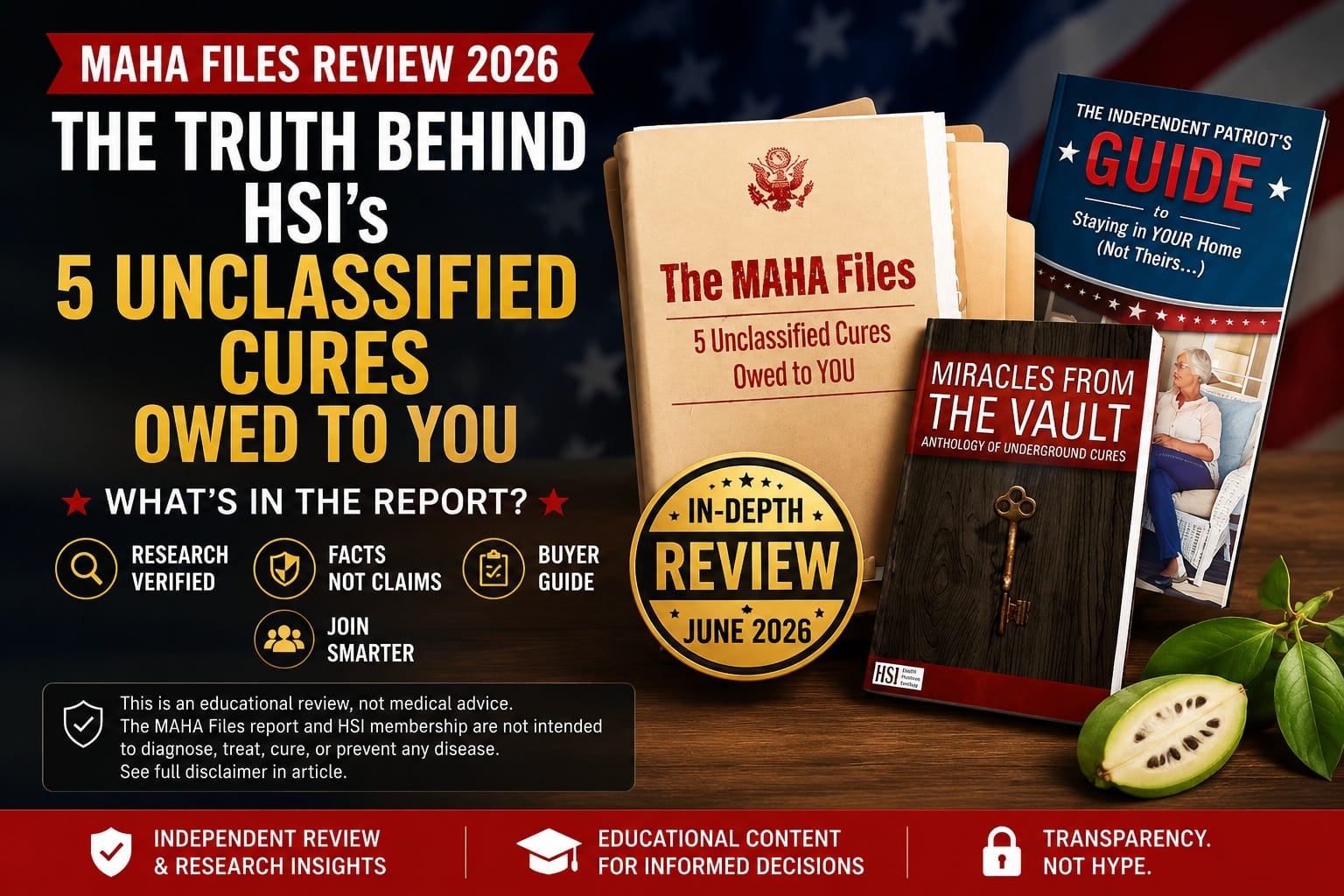
Miracles from the Vault: Anthology of Underground Cures - 498-page physical book, shipped at no additional charge (brand-stated value: $129)
Access to 25+ additional books and reports in the HSI online library (brand-stated value: $1,255)
The Independent Patriot's Guide to Staying in YOUR Home (Not Theirs) - digital report on healthy aging and independence (brand-stated value: $59)
12 monthly Members Alert newsletter issues - research-focused 8-page natural health reports
Breaking News E-Alerts - urgent health research updates between monthly issues
Full Access to HSI Online Library - searchable archive of 27+ years of published content
Deep discounts on recommended products - brand-negotiated member pricing on supplements and products covered in the newsletter
Pricing as of this review: $74 per six months (auto-renewing), $89 per year (auto-renewing), or $199 for lifetime access. The MAHA Files offer URL may reflect a different introductory price - confirm at checkout before completing your signup. All prices are in USD; shipping of physical materials is domestic only (no international fulfillment).
Buyer Takeaway: The membership benefit stack is genuinely solid for what it costs. The 498-page physical book alone, plus 25+ digital reports and 12 monthly newsletter issues, represents meaningful content volume if natural health research is a regular interest. The key question is whether that interests you on an ongoing basis - not just for the initial free gifts.
The HSI Billing Complaints - What's Really Going On and How to Protect Yourself
If you search "Health Sciences Institute review" before deciding whether to join, you'll find a lot of frustrated people - mostly seniors on fixed incomes who didn't realize they'd signed up for an auto-renewing subscription. That's a real pattern, and understanding it before you join is more valuable than reading it after.
Here's what the complaint data actually shows. The core grievance across PissedConsumer, ThriftyFun, and similar forums is almost always one of three things: the auto-renewal charged after the buyer thought they'd cancelled, a physical book that arrived late or didn't arrive, or confusion about the membership fee being separate from the "free" gifts. None of these are unique to HSI - they're endemic to the direct-response newsletter subscription model. But they're preventable on your end.
Three things to do before you complete any HSI signup:
Screenshot the cancellation path. Log into the account you're about to create, confirm the cancellation method works, and note the 48-hour window before each billing date. HSI's Terms state cancellation is available by account login or by calling 1-888-213-0764.
Set a calendar reminder. Whatever billing cycle you choose - 6 months or annual - set a reminder 2 weeks before the renewal date. That gives you time to decide, not a frantic same-day call.
Confirm the physical book shipping address. Miracles from the Vault ships to a US domestic address. If you're moving or your address is a PO Box, confirm it can receive the shipment at the time you join.
The refund guarantee HSI advertises - full refund, keep your gifts - is real per their published Terms. The complaints that refunds were denied are real too. The pattern in resolved complaints suggests calling (not emailing) speeds up the process considerably. Keep 1-888-213-0764 saved from day one.
Buyer Takeaway: The billing complaints about HSI aren't a reason to avoid the membership if the content genuinely interests you - they're a reason to go in with your eyes open and your calendar set. The subscription mechanics are fully manageable; the people who get burned are almost always the ones who didn't read the auto-renewal terms before signing up.
Who Is the MAHA Files Membership Right For?
You'll likely get real value from this if:
You're interested in natural health research and want a curated source that actively follows the literature rather than mainstream medical channels
You're comfortable reading research coverage with the understanding that promotional framing exceeds peer-reviewed conclusions, and you can evaluate claims accordingly
You want to explore the natural compound categories covered - acetogenins, flavonoids, telomere activators, eggshell membrane, sleep techniques - and would benefit from HSI's compilations pointing you toward sources and products
You're over 60 and interested in a comprehensive natural health resource with a substantial back archive
You understand you're signing up for a subscription and are comfortable with the auto-renewal terms
You'll probably feel let down if:
You expect the MAHA Files to provide proven treatments for cancer, Alzheimer's, or other serious medical conditions
You're not interested in ongoing natural health newsletter content and are only signing up for the free report
You expect the research covered to represent the current medical consensus or FDA-approved treatment protocols
You have an active medical condition that requires evidence-based clinical management - the MAHA Files is supplemental educational reading, not a replacement for physician-directed care
Buyer Takeaway: The MAHA Files membership is a strong match for readers who are already curious about natural compound research and want a curated source. It's a poor match for readers who expect it to replace conventional medical care, or who primarily want the free report without ongoing subscription content. If you're in the first group, the financial risk is minimal given the full-refund guarantee.
Does the MAHA Files Work?
The MAHA Files is a report, not a supplement - so whether it "works" depends entirely on what you walk in expecting. If you're expecting to receive accurate coverage of five real research areas in natural health, written in accessible language and pointing you toward publicly available sources and natural products, then yes, the report delivers on that. If you're expecting a document that tells you how to cure cancer or reverse Alzheimer's based on the title, what's actually in the report is more nuanced than the promo makes it sound.
What the underlying research actually supports, in practical terms: regular blueberry consumption is supported by a strong body of evidence for cognitive health; eggshell membrane supplementation at 500 mg daily has documented support for joint comfort in published clinical trials; the Lloyd Winter sleep relaxation technique is a well-documented, risk-free method worth learning regardless of where you encounter it; pawpaw acetogenin and telomere research are legitimately interesting areas at earlier stages of human evidence development. None of these require an HSI membership to explore - the membership provides ongoing curated access to research in these and many other areas.
Buyer Takeaway: The MAHA Files "works" as a research compilation because the underlying science is real, even when HSI's framing of it is more aggressive than the data formally justifies. If you approach the report as a starting point for your own research rather than a finished medical prescription, you'll find more value in it than if you take the promotional language at face value.
Check the MAHA Files' Current Pricing and Return Policy at the Official Site
MAHA Files Frequently Asked Questions
What exactly is included in the MAHA Files report?
The MAHA Files: 5 Unclassified Cures Owed to YOU is a digital report covering five natural health research areas: pawpaw acetogenin compounds and cancer cell research (HSI designation BT-56), blueberry flavonoid cognitive research (HSI designation FLAV-1), telomere lengthening and astragalus research connected to the NASA Twins Study (HSI designation Alpha-xx9), natural eggshell membrane supplementation for joint health (HSI designation EG-M), and the WWII-era Navy pilot sleep relaxation technique. The report provides background on each research area, the compounds or techniques involved, and where to find them. It's a research summary and resource guide, not a prescription for treatment.
Do you have to buy anything to get the MAHA Files?
Yes - the MAHA Files report is free as a signup incentive for an HSI membership subscription. The subscription starts at $74 per six months (auto-renewing). You cannot receive the report without signing up for the membership, but HSI's stated guarantee allows you to cancel at any time for a full refund and keep all free gifts. Confirm the specific terms of the current offer at checkout, since promotional pricing may differ from the standard membership rates.
Is the 300x cancer potency claim real?
The underlying research data is real, and the context matters. Bullatacin, an annonaceous acetogenin from the pawpaw tree (Asimina triloba), was documented in a study by the Upjohn Company (published in Life Sciences, 1993) to achieve equivalent tumor growth inhibition to Taxol at approximately 300 times lower dosage in a mouse leukemia model. This is a preclinical result in mice, comparing dosage potency in an animal model - not a human clinical trial comparing effectiveness for treating cancer. The research is peer-reviewed and published; the implication that this data establishes a human cancer treatment is HSI's extrapolation, not the study's conclusion.
Is the eggshell membrane pain reduction research real?
Yes. The studies HSI references in connection with eggshell membrane - registered on ClinicalTrials.gov as NCT00750230 and NCT00750854 - are real clinical trials. The published results (Ruff KJ et al., Clinical Interventions in Aging, 2009) reported a 72.5% reduction in general pain and a 75.9% reduction in range-of-motion pain at 30 days in the single-arm trial. These are open-label trials with modest sample sizes (11 and 28 participants, respectively), not large-scale double-blind placebo-controlled studies. The direction of effect has been replicated in multiple subsequent research groups. NEM® is available as a commercial dietary supplement; it's not an FDA-approved medical treatment.
What is HSI's return policy if I join and decide the membership isn't for me?
According to HSI's published guarantee, you can cancel your membership at any time during your membership term and receive a full refund. You keep all free gifts received regardless of whether you cancel. To cancel: log into your account at hsionline.com, or call 1-888-213-0764 (US) or +1-443-353-4245 (International). Per the Terms of Use, cancellations must occur at least 48 hours before the next billing date to avoid the next charge.
Does the MAHA Files reference any real government policy?
Yes. HSI's promotional materials reference a federal Make America Healthy Again initiative, which is real. On February 13, 2025, President Trump signed Executive Order 14212, establishing the President's Make America Healthy Again Commission - chaired by HHS Secretary Robert F. Kennedy Jr. - focused on chronic disease, childhood health, nutrition transparency, and reviewing undue industry influence on health policy. The EO does not state that private publishers may release previously suppressed medical research, and it contains no provisions related to declassifying natural health information. HSI's positioning of the MAHA Files as a government-authorized release of suppressed cures is the brand's own marketing framing, not a provision of any executive order. The broader cultural moment the MAHA initiative created - renewed public interest in natural health alternatives and skepticism of mainstream medical institutions - is real, and that's the context HSI is marketing into.
Are the compound names BT-56, FLAV-1, Alpha-xx9, and EG-M real scientific terms?
No - these are HSI's branded designations for compounds that appear under different names in scientific literature. BT-56 corresponds to bullatacin and annonaceous acetogenins from Asimina triloba (North American pawpaw). FLAV-1 corresponds to blueberry anthocyanins and polyphenolic flavonoids. Alpha-xx9 corresponds to cycloastragenol, the active compound in the telomerase activator TA-65. EG-M corresponds to Natural Eggshell Membrane, marketed as NEM® by ESM Technologies. If you want to research any of these independently, use the public scientific names rather than HSI's branded designations.
Is the military sleep technique really a secret?
No. The relaxation technique described as a "leaked military secret" in HSI's materials was documented by Lloyd "Bud" Winter in his 1981 book Relax and Win: Championship Performance and has been covered widely by mainstream health outlets for decades. It went viral on social media around 2019-2020 and has since been reported on by outlets including Mental Floss, Fox News, Big Think, and dozens of others. The technique's component practices - progressive muscle relaxation, body scanning, guided imagery - are standard evidence-based approaches in sleep medicine. The MAHA Files provides a step-by-step guide that's useful, but the information is not secret and doesn't require a paid report to access.
Does HSI sell products directly?
HSI doesn't sell you the supplements - they tell you what to look for and where to find it, then negotiate member discounts from those suppliers. You'd buy directly from whoever makes the product. The subscription fee funds the research operation itself. And no, there's nothing you need to buy beyond the membership to access the MAHA Files report and everything else that comes with it.
Why do so many online HSI reviews raise red flags and complaints?
The concerns consumers raise about HSI fall into two categories: billing and auto-renewal complaints (primarily on consumer complaint boards) and credibility questions about HSI's research framing (primarily from skeptic and media-bias review sites). Neither source is wrong, exactly - they're just addressing different parts of the HSI experience. The billing complaints reflect a real pattern of subscribers surprised by auto-renewal charges, which HSI's Terms of Use do disclose but which the promotional presentation de-emphasizes. The "pseudoscience" criticism reflects a real gap between HSI's aggressive disease-outcome framing and what peer-reviewed research formally concludes. What neither source adequately covers is that the underlying research HSI covers - pawpaw acetogenins, blueberry flavonoids, eggshell membrane, telomere activators, military sleep techniques - is real, published science. The legitimate criticism of HSI is that its interpretation of that science is more aggressive than the evidence supports - not that the science itself is fabricated. The practical takeaway: go in understanding the subscription mechanics, evaluate the research claims critically, and you'll have a very different experience from the people leaving one-star reviews.
Can I just read the MAHA Files research without joining HSI?
Essentially, yes - all five research areas in the MAHA Files are based on publicly accessible published science. The pawpaw acetogenin research is in the Journal of Natural Products (Dr. Jerry McLaughlin, Purdue University - PMID 18598079). The blueberry cognitive research is in the journal Alzheimer's and Dementia (Martha Clare Morris et al., 2015, Rush University). The eggshell membrane trial is on PubMed (Ruff KJ et al., PMID 19554094). The telomere research is the NASA Twins Study (Science, March 2019) plus commercial cycloastragenol/TA-65 studies. The Navy sleep technique is in Lloyd Winter's 1981 book "Relax and Win: Championship Performance," and extensively covered across mainstream health media. What HSI provides that you can't replicate on your own is: compiled step-by-step instructions on each, specific commercial product recommendations with member pricing, and ongoing monthly coverage of new research in these and dozens of other natural health categories. Whether that ongoing value justifies the membership cost is the real decision you're making.
What's the difference between the e-report and the printed book in the membership package?
The MAHA Files e-report is a digital document delivered by email immediately after signup - it contains the five research areas summarized above. Miracles from the Vault: Anthology of Underground Cures is a separate 498-page physical book that covers a much broader range of natural health topics from HSI's 27+ year research archive; it's mailed to your address at no additional shipping charge as a separate membership gift. They're two distinct documents addressing different content.
Is there evidence for the NASA space-aging connection?
Yes. The NASA Twins Study, published in Science in March 2019 and conducted by a consortium of researchers, documented measurable physiological changes in astronaut Scott Kelly after approximately 340 days in space compared to his identical twin Mark Kelly on Earth. Among the documented findings: Scott Kelly's telomeres were longer during spaceflight - a finding the research team attributed to the physiological stress of the space environment triggering telomerase activity. Importantly, the study also found that most of these changes reversed within months of Scott's return to Earth, and long-term telomere assessment showed his telomeres ultimately shorter than pre-flight baseline. The research doesn't support HSI's framing that the astronaut "came back permanently younger"; it does support the concept that telomere length is dynamically regulated, which underlies the astragalus telomerase activator research HSI covers.
What should I know about blueberry and flavonoid supplements before trying them?
Blueberry and berry-derived flavonoid supplements are generally well-tolerated, but there are interactions worth knowing: high-dose anthocyanin and polyphenol supplements can interact with blood thinners (anticoagulants) including warfarin; they may affect platelet function; and at high doses they could alter the absorption of certain medications. The dietary level - eating blueberries or consuming moderate amounts of berry-based drinks - poses essentially no risk for healthy adults. Supplemental doses above what you'd get from diet are worth discussing with your physician if you take any medications, particularly anticoagulants or antiplatelet agents.
Where can I read the underlying research for myself?
All five of the core research areas HSI covers in the MAHA Files have publicly accessible primary sources. The pawpaw acetogenin research: search Dr. Jerry McLaughlin's publications in the Journal of Natural Products (2008 paper: PMID 18598079). The blueberry cognitive research: Rush University MIND diet research (Morris et al., Alzheimer's & Dementia, 2015) and blueberry RCTs (Krikorian et al., Neurochemistry Research, 2010). The telomere research: NASA Twins Study (Science, 2019) and Kruiskamp et al. 2024 (PMC11397652). The eggshell membrane trial: Ruff KJ et al. (PMID 19554094, PMC2697588). The sleep technique: Lloyd Winter, "Relax and Win" (1981).
Are there other research areas covered in the HSI library beyond the five in the MAHA Files?
Yes. The 498-page Miracles from the Vault included with the membership covers over 70 natural health topics from HSI's research archive, ranging from respiratory health to vision to metabolic function. The online member library adds 25+ additional reports covering specific health categories. The ongoing monthly newsletter continues to cover new research. The MAHA Files is the entry-point promotional report - the member library is substantially broader.
What does the HSI guarantee actually cover?
Per HSI's stated membership guarantee: if you're dissatisfied for any reason during your membership term, you can contact HSI for a full refund. You keep all free gifts received, including the MAHA Files e-report, the Miracles from the Vault book, and any newsletter issues received. The guarantee covers the subscription price paid - it's not limited to a specific number of days. Contact: 1-888-213-0764 (US) or customer service via hsionline.com. Confirm the specific terms applicable to the current promotional offer at the time you sign up.
Does the research in the MAHA Files apply to people outside the United States?
The underlying research is not US-specific - natural compound research on pawpaw acetogenins, blueberry flavonoids, telomere activators, and eggshell membrane was conducted at institutions in the US, Europe, and Asia and has general applicability. The HSI membership's physical book shipping is US-only; digital content is accessible internationally. Regulatory status of specific dietary supplements varies by country; what's available as a dietary supplement in the US may have different classification in EU, UK, Canadian, or Australian markets. Non-US members should verify supplement availability and legal status in their jurisdiction.
Current Evidence - What NCCIH, NIH, and Independent Researchers Say About Natural Health Supplements in These Categories
Want to know what independent research bodies think about these categories - beyond what HSI says? Here's the short version. The National Center for Complementary and Integrative Health (NCCIH), the Cochrane Collaboration, and others all weigh in, and it's worth knowing where each area stands:
On pawpaw acetogenins: NCCIH doesn't maintain a specific monograph on these compounds - they remain at the preclinical stage in terms of human evidence. The Memorial Sloan Kettering Cancer Center maintains a botanical supplement database that includes annonaceous acetogenins; their assessment notes potent cytotoxic activity in lab models alongside theoretical safety concerns about complex I inhibition in normal neural tissue at high doses - a consideration the MAHA Files promotional materials do not raise. Reasonable physician disagreement exists about the risk-benefit profile of acetogenin supplementation, particularly in patients already receiving chemotherapy.
On blueberry and berry flavonoids: NCCIH acknowledges a growing body of observational and interventional research suggesting cognitive benefits - promising, but not yet conclusive enough for a formal recommendation. The Alzheimer's Association similarly notes dietary approaches including the MIND diet as potentially supportive of brain health without claiming they prevent or treat Alzheimer's disease.
On telomere activators: Active and somewhat contested territory. The cancer risk concern - that activating telomerase could theoretically accelerate cancer cell proliferation since telomerase is dysregulated in most cancers - is a theoretical risk taken seriously in the research community. Current studies have not observed increased cancer incidence in participants taking cycloastragenol supplements, but long-term safety data beyond 12 months is limited. Reasonable physician disagreement exists about the risk-benefit profile.
On natural eggshell membrane: Multiple independent research groups have replicated positive findings here - it's one of the more consistently supported natural joint health ingredients in the current literature, though larger long-term double-blind trials would strengthen the evidence.
On relaxation techniques for sleep: Progressive muscle relaxation, guided imagery, and body scanning are core components of CBT-I - cognitive behavioral therapy for insomnia - which sleep medicine societies recognize as the first-line treatment for chronic insomnia. The Navy pilot technique uses exactly these approaches.
Buyer Takeaway: Independent research bodies including NCCIH and the Cochrane Collaboration maintain a cautious but not dismissive view of the research areas HSI covers. The evidence is most robust for dietary flavonoids and eggshell membrane; more preliminary for acetogenins and telomerase activators. Talk to your physician before acting on any supplement recommendation in the MAHA Files - regardless of how compelling the research looks.
MAHA Files Buyer Takeaways
The MAHA Files report is real educational content with a foundation in published research - it's promotional framing, not the research itself, that overstates the conclusions
Receiving the report requires an HSI membership subscription with auto-renewal - understand the terms before signing up
The eggshell membrane section (EG-M / NEM®) has the most directly verifiable supporting research of the five areas covered
The blueberry flavonoid section has the broadest base of replication across independent research groups
The pawpaw acetogenin and telomere sections are legitimately interesting early-stage research areas - worth following, not acting on without physician guidance
The sleep technique section describes a real, publicly documented method that's worth learning regardless of where you encounter it
Cancellation is straightforward per HSI's stated terms - the financial risk of trying the membership is low given the full-refund guarantee
None of the natural compounds discussed in the MAHA Files are FDA-approved drugs or treatments for any medical condition
The "suppressed by Big Pharma" narrative reflects real commercial barriers to natural compound development - it is not evidence of active conspiracy or deliberate suppression
If you have an active serious illness including cancer, cognitive decline, or significant joint disease, discuss any supplement decisions with your physician before acting on anything in the MAHA Files
The HSI membership library has 27+ years of archived natural health content - if ongoing access to that archive interests you, the membership is a reasonable value at its price point
The branded compound names (BT-56, FLAV-1, Alpha-xx9, EG-M) are not scientific identifiers - use the corresponding public names to research independently
Senior and veteran discounts are noted on the offer page - confirm at checkout
The MAHA Files e-report is delivered digitally, immediately after signup - you don't have to wait for it
Physical books and reports are shipped US-only; digital content is accessible from anywhere
Cancel deadline: at least 48 hours before billing date - missing it means you're charged for the next period
Phone number to cancel: 1-888-213-0764 - save it before you complete signup, not after you see an unexpected charge
The "300x more potent" claim: a dosage comparison in a mouse leukemia model, not a human clinical outcome - this is the distinction most MAHA Files coverage skips entirely
EO 14212: the real MAHA Commission order (February 13, 2025) covers childhood chronic disease and nutrition transparency - it contains no provision authorizing private publishers to release suppressed medical research
NCT00750854: the ClinicalTrials.gov registration for the eggshell membrane study - the most independently verifiable claim in the MAHA Files; look it up yourself in under 2 minutes
The Navy sleep technique source: Lloyd "Bud" Winter's 1981 book "Relax and Win" - publicly available, not a classified military document, and free to find online right now
Membership auto-renewal clock: starts the day you complete signup - not the day you first use the content
How to Evaluate the MAHA Files for Your Specific Health Situation
Here's a better question than "is this legit?" - ask yourself: "does any of this actually address what I'm dealing with?" The five research areas HSI covers aren't equally relevant to every reader, and your experience with the membership will largely depend on which of them map to your real concerns.
If joint pain is why you're here, the eggshell membrane section has the strongest published evidence base of the five and is the most directly actionable. The 500 mg daily dosage used in NCT00750854 is the studied form, and NEM® is commercially available without a prescription. That's a concrete, checkable starting point - and it doesn't require taking anyone's word for it.
If cognitive health is your concern, the blueberry/flavonoid section has the broadest evidence base and the most practical implication - regular berry consumption and a MIND-diet-adjacent eating pattern have decades of observational data behind them. The supplemental flavonoid products HSI covers are a step beyond dietary changes; discuss those with your physician if you're managing cognitive concerns or taking medications.
If cancer is in your history or your family, the pawpaw acetogenin section covers genuinely interesting science that most oncologists won't have raised with you. It's also the area where the distance between animal research and human clinical proof is the widest, and where the stakes of getting it wrong are highest. Don't act on this section without discussing it with your oncologist - but do read it, because the research is real and worth knowing.
If sleep is your main issue, the Navy technique section is worth your attention right now, costs you nothing beyond the time to learn it, and can be implemented tonight. Whether you need the MAHA Files membership to access it is a separate question from whether the technique is useful.
If anti-aging and longevity interest you, the telomere section covers active research that's generating new publications regularly. If you want ongoing coverage of this area as it develops, the HSI membership library is a reasonable way to stay current. The compounds involved have real research behind them alongside real uncertainties; following this area over time rather than acting on it immediately is probably the right posture for most readers.
Buyer Takeaway: Match the five research areas to your actual priorities before deciding whether the membership is worth it. One highly relevant topic is worth more than five mildly interesting ones. If your primary concern is clearly addressed in one of the five areas, that's a clearer signal than general curiosity about natural health.
What's the Biggest Mistake People Make Before Joining HSI?
It's the same mistake every time, and it shows up in nearly every negative review on PissedConsumer, ThriftyFun, and Rip-Off Report: people sign up expecting the gifts to be unconditionally free, and then they see an auto-renewal charge six months later that they weren't mentally prepared for. That's not a product flaw - it's a framing gap between what HSI's promotional video emphasizes ("free, free, free") and what HSI's Terms of Use clearly states (auto-renewing subscription, cancel at least 48 hours before billing date, call 1-888-213-0764 or log in to cancel).
The second-most-common mistake: expecting the MAHA Files report to contain medical advice for a specific condition. It doesn't. It's a research summary that tells you what studies were done and where to find the compounds involved. Anyone going in expecting "here's exactly what to take for my joint pain" is going to feel misled - not because HSI lied, but because that gap between expectation and delivery is enormous when you're dealing with a serious health concern.
Third: not verifying that the physical book (Miracles from the Vault) will ship to your address. HSI doesn't ship internationally. PO Boxes have created problems. And multiple complaints reference waiting 4-6 weeks for a book that the promo implied would arrive quickly. Confirm your address is eligible before you complete signup.
Know those three things going in, and your experience will be categorically different from the one-star reviewers.
Buyer Takeaway: The single most protective thing you can do before joining HSI is read Section 9 of their Terms of Use - the auto-renewal and billing section - before your credit card hits the checkout page. It takes 90 seconds. It prevents 90% of the complaints you'll find about HSI online.
What Would a Skeptical Doctor Say About the MAHA Files Research?
Worth asking - because a significant portion of the people who watch HSI's video will show the MAHA Files to their doctor and want to know how to have that conversation. The following represents a fair-minded composite of what a skeptical but scientifically literate physician might say about each area. These are representative perspectives based on the published evidence described in this article - they are not quotes from any specific identified physician or medical professional.
On pawpaw acetogenins: "Interesting preclinical research from a credible NCI-funded scientist at Purdue. The 300x potency figure is real but it's a mouse leukemia model, not a human trial. I haven't seen this in any oncology literature I follow, which is consistent with it never advancing to Phase II. I wouldn't recommend it alongside your current treatment without knowing a lot more."
On blueberry flavonoids: "This one I actually do recommend. The MIND diet research is solid observational work from a respected team at Rush University. I tell patients to eat more berries all the time. The supplemental flavonoid extract angle is less established, but the dietary recommendation has real science behind it."
On telomere activators: "The telomere-aging connection is legitimate research. The cycloastragenol/TA-65 human trials demonstrate real telomere lengthening. My hesitation is the theoretical cancer risk - since telomerase is dysregulated in most cancers, activating it long-term raises a question that hasn't been answered by any trial longer than 12 months. I'd want to see that data before recommending it."
On eggshell membrane: "This has the strongest evidence base of the five and I'm actually aware of it. The NEM trials are published in peer-reviewed journals, the effect sizes are meaningful, and the safety profile is good. For someone with joint discomfort who wants a non-pharmaceutical option, this is worth discussing."
On the Navy sleep technique: "That's just progressive muscle relaxation and guided imagery - it's part of CBT-I, which is the gold standard treatment for insomnia. I should be prescribing this already. No concerns, completely safe, tell me where they published the step-by-step."
That's the honest version of the conversation. Three of five get a "worth discussing further." One gets a soft yes. One gets a "not alongside active cancer treatment without more data." None of them get "this is dangerous quackery." That's a more useful frame than either HSI's version or the skeptic sites' version.
Buyer Takeaway: If you're planning to act on any of the MAHA Files research areas, the right next step is bringing the specific study citations - all publicly available and listed in this article - to your own physician, not asking HSI's newsletter to serve as your medical advisor. The research is real enough to be worth that conversation.
What Do You Actually Get When You Join HSI - and What Should You Read First?
When you complete the HSI membership signup, here's the exact sequence of what arrives and when, based on HSI's published materials:
Within minutes: a confirmation email containing the MAHA Files e-report as a digital download. This is the report the video was about - five research areas, step-by-step instructions for the sleep technique, compound information for the others. It's yours to read immediately.
Within the same email: a summary of your 8 membership benefits and links to activate your online library access. The library contains 27+ years of HSI's archived content, searchable by health topic. This is arguably the most valuable part of the membership for anyone with a specific health concern - not the free gifts, but the back archive.
Within 5-10 business days: Miracles from the Vault ships to your physical address. This is the 498-page printed book. It's a real book - you can verify it exists on Amazon if you're skeptical - covering over 70 natural health topics from HSI's research history. Shipping is US domestic only.
Monthly: the HSI Members Alert newsletter arrives - an 8-page research summary of what HSI has been tracking that month. This is the ongoing membership deliverable. If this sounds like something you'd read every month, the membership has sustained value. If you read one issue and file it, you're paying for something you're not using.
What to read first: the MAHA Files e-report for the five research topics. Then the sleep technique section on its own - it's immediately actionable and requires nothing you don't already have. Then look at the library for whatever health topic is most relevant to you right now. The physical book takes weeks to arrive; start with what's digital.
Buyer Takeaway: The digital content is immediate and substantial. The physical book is a bonus that takes time to arrive. The monthly newsletter is the reason the membership costs what it costs. Calibrate your expectations around the newsletter value, not the free gifts - and the membership math works out clearly.
Is the MAHA Files Research the Same for Everyone - or Does It Depend on Your Situation?
It depends significantly, and most reviews of the MAHA Files skip this entirely. The five research areas in the report have very different relevance profiles depending on where you are in life and what you're dealing with.
If you're under 50 and in good health, the blueberry/MIND diet section and the sleep technique section are probably the most immediately useful. Telomere research is worth knowing about in the long term. The cancer and joint pain sections are more relevant as you age or if they're already in your family history.
If you're 60-75 with joint discomfort, the eggshell membrane section is the most directly verifiable and actionable. The 500 mg NEM dosage used in the published trials is specific enough that you can take it to a supplement retailer and look for a matching product. This section alone is worth the membership cost if it leads you to something that works.
If you have a personal or family history of cancer, the pawpaw acetogenin section requires the most careful evaluation. The research is real and legitimately interesting, but it has the widest gap between preclinical promise and human clinical evidence. Don't act on this section without your oncologist's input, and don't use it as a reason to delay conventional treatment.
If sleep quality is your main issue, you can implement the Navy sleep technique tonight without joining HSI. The technique is publicly documented and free. If that's the only reason you're considering the membership, start there and see whether the broader content interests you enough to join.
If cognitive health is your priority, the blueberry section's dietary recommendation is the most immediately actionable and the least risky. Adding berries to your diet costs you nothing and has the broadest support. The supplemental flavonoid products HSI points to are a more significant step - worth discussing with your physician if you're already managing cognitive symptoms.
Buyer Takeaway: The MAHA Files isn't a one-size solution - it's five research areas that hit differently depending on your age, health history, and current priorities. Read the article section that maps to your specific situation before deciding whether the full membership is worth the cost.
Is the MAHA Files Worth It - The Bottom Line
Here's the honest bottom line: the MAHA Files is worth your time if you go in knowing what you're actually getting - a curated natural health newsletter that has been covering alternative medicine research since 1998, receiving a free report that summarizes five legitimate research areas with aggressive editorial framing, and paying a subscription fee that you can recover in full under the stated guarantee if the content doesn't suit you.
What it isn't: a cure, a treatment protocol, a collection of government secrets newly declassified, or a replacement for your doctor. The promotional language is engineered to create urgency and outrage - that's the direct-response health newsletter playbook, and once you know it, you can filter past it to see what's actually underneath.
And what's underneath is more interesting than most skeptics will admit - and far less dramatic than the hype claims.
The verdict: If you're a natural health reader who wants ongoing coverage of real research that doesn't get mainstream play, the HSI membership delivers that. If you're looking for proven treatments for a serious illness, this isn't your source - and no newsletter should be. None of the supplements, techniques, or compounds covered in the MAHA Files constitutes a treatment for any disease, and none have been evaluated or approved by the FDA for that purpose. The MAHA Files are a starting point, not an endpoint. Use it that way, and it'll serve you well.
Research on pawpaw acetogenins is real, fascinating, and underpublicized. Blueberry flavonoids are among the more robust findings in nutritional neuroscience. Eggshell membrane supplementation has verifiable trial data that any joint-health seeker should know about. The telomere research category is legitimate and actively developing. The Navy sleep technique is genuinely useful, even if it's not a secret.
If any of those topics would be valuable to you in the context of an ongoing natural health subscription, you'll likely find the membership worthwhile - especially given HSI's full-refund guarantee.
Access the MAHA Files Membership - Review Current Terms and Offer Pricing
Contact Information
Company: MAHA Files
Phone support (US): 1-888-213-0764
Phone support (international): +1-443-353-4245
Mailing Address: NewMarket Health Publishing, LLC, P.O. Box 913, Frederick, MD 21705, USA
Disclaimers
Advertorial Disclosure: This article is an advertorial - a promotional content format that combines editorial analysis with commercial intent. This content is promotional in nature and is intended for consumer education regarding a commercially available product. This article contains affiliate links to the product reviewed. A commission may be earned on qualifying purchases or membership signups made through links in this content, at no additional cost to the reader. Affiliate relationships do not influence editorial content or the evaluation of products described in this article. Disclosure is provided in accordance with FTC 16 CFR Part 255.
FDA Medical Disclaimer: The statements in this article have not been evaluated by the Food and Drug Administration. The MAHA Files report, the Health Sciences Institute membership, and the natural compounds described in this article are not intended to diagnose, treat, cure, or prevent any disease. The information in this article is for educational purposes only and does not constitute medical advice. Consult your physician or qualified healthcare provider before making any changes to your health regimen, including starting any dietary supplement discussed in this article.
FTC Testimonial and Review Disclosure (16 CFR Part 255 and 16 CFR Part 465): Consumer ratings and testimonials referenced in this article are brand-reported by the Health Sciences Institute and have not been independently audited by this publication. Individual experiences vary. Per HSI's own published Terms of Use, testimonials on HSI's website represent exceptional results and are not guaranteed outcomes or typical experiences. This publication notes that HSI's Terms acknowledge the company may edit testimonials for clarity or brevity. Buyer results with any natural supplement or health technique covered in this article will vary based on individual health status, adherence, and other factors.
Material Limitations of This Review: This review draws exclusively on publicly available materials - the official HSI website at hsionline.com, HSI's published Terms of Use and Refund Policy, peer-reviewed literature corresponding to the five research areas in the MAHA Files, and general category guidance on natural health supplements and subscription services. This publication has not received compensated product samples for testing, has not interviewed HSI or NewMarket Health Publishing personnel, has not been granted access to internal HSI research or editorial processes beyond what is publicly published, and has not conducted independent laboratory or field testing of any compound or technique described in the MAHA Files report. Claims described in this article as "according to the brand" or "brand-stated" reflect what HSI has publicly stated and have not been independently substantiated by this publication. Promotional language referenced in the title or body of this article - including but not limited to phrases such as "5 Unclassified Cures" and "Owed to YOU" - originates with the Health Sciences Institute's own published marketing materials and is identified in this article for reader-context purposes, not as independent endorsement or performance guarantee. The branded compound designations BT-56, FLAV-1, Alpha-xx9, and EG-M are HSI's own naming conventions; corresponding public scientific identifiers are provided in this article. Buyers are encouraged to verify any claim that materially affects their health decisions by consulting primary research sources and qualified healthcare providers.
Third-Party Consumer Feedback Platforms: This article references the existence of third-party consumer feedback platforms in general category terms only. This publication does not endorse, vouch for, audit, or accept responsibility for the accuracy, completeness, or fairness of customer reviews posted on any third-party platform, including but not limited to general-purpose review aggregators, consumer complaint boards, social media platforms, and online discussion forums. Buyers consulting third-party reviews are encouraged to evaluate them critically, consider the reviewer's specific circumstances, and look for verified-purchase indicators where available.
Forward-Looking Statements and Article Accuracy: This article reflects information available as of June 2026 and was prepared using reasonable care to be accurate and useful at the time of publication. Membership pricing, promotional offers, subscription terms, refund policies, contact information, and report content may change after publication without notice. Statements describing expected buyer outcomes, research developments, or category trends are educational forward-looking observations, not guarantees. No representation is made that the information will remain accurate in the future, and no warranty of merchantability, fitness for a particular purpose, or non-infringement is provided in connection with the editorial content of this article. Readers should rely on the official Health Sciences Institute website at hsionline.com as the authoritative source for current membership information prior to any purchase decision.
Subscription and Auto-Renewal Disclosure (ROSCA / CA BPC §17600): The Health Sciences Institute membership is a subscription service with auto-renewal billing. Membership charges are collected in advance of service. Per HSI's published Terms of Use, customers who select an auto-renewal billing model are charged to the payment method on file at the selected billing frequency (6-month or annual) unless the subscription is canceled at least 48 hours before the next billing date. To cancel: log into your account at hsionline.com or call 1-888-213-0764 (US) or +1-443-353-4245 (International). Payment methods may be automatically updated through account updater services. Subscription pricing confirmed from HSI's public membership page: $74 per six months, $89 per year, or $199 for lifetime access as of the date of this review. The specific promotional offer available through the MAHA Files lander may reflect different introductory pricing - confirm all pricing and billing terms at checkout before completing your signup.
Pricing Transparency (FTC Junk Fees Rule / CA SB 478): Membership pricing stated in this article is derived from HSI's publicly listed rates as of June 2026 and may not reflect the specific promotional price available through the current MAHA Files offer. Any applicable sales tax, shipping charges for physical materials, or other fees will be disclosed at checkout prior to final purchase. "Before" or comparison prices referenced in HSI's promotional materials are the brand's stated reference points and may not reflect prevailing market prices for comparable products. Buyers should verify the final total prior to completing any transaction.
Magnuson-Moss Warranty Disclosure: HSI's membership satisfaction guarantee, as described in this article, constitutes a limited warranty as defined under the Magnuson-Moss Warranty Act (15 USC §2303). The guarantee covers refund of membership subscription fees and is subject to the conditions described in HSI's published Terms of Use. Physical products shipped as membership gifts (including the Miracles from the Vault book) are covered under HSI's published return and refund policies; specific terms are available at hsionline.com/terms-conditions.
California Proposition 65 Notice: This article describes dietary supplement categories that may be available to California consumers. Some dietary supplement ingredients may be subject to California Proposition 65 warnings regarding exposure to chemicals known to the State of California to cause cancer or reproductive harm. California consumers are encouraged to review product labeling and Proposition 65 warnings on specific supplement products before purchase. This article does not constitute a Proposition 65 warning for any specific product; applicable warnings will appear on product labeling where required.
Geographic and Jurisdiction Notice: The MAHA Files membership and the Health Sciences Institute membership are offered to US residents. Physical book shipping is US domestic only. Regulatory status of dietary supplements described in this article varies by jurisdiction; compounds available as dietary supplements in the United States may have different regulatory classification in the European Union, United Kingdom, Canada, Australia, and other markets. EU consumers seeking health-related information should additionally consult EU-specific resources; EU Omnibus Directive Article 6a applies to pricing representations for EU buyers. The information in this article is not legal or regulatory advice for any specific jurisdiction. Readers outside the United States should verify the availability and legal status of any supplement discussed before purchasing.
Reasonable Consumer Standard: This article is written for a general adult consumer audience and intends statements to be interpreted as a reasonable consumer would interpret them in context. Where a statement could otherwise be read as a brand-substantiated fact, attribution language such as "according to the brand," "brand-stated," "brand-reported," or "HSI's framing" identifies it as a brand claim that has not been independently verified by this publication. Promotional superlatives and headline marketing phrases appearing on HSI's website - including, without limitation, "5 Unclassified Cures Owed to YOU," "BT-56," "FLAV-1," "Alpha-xx9," "EG-M," "cures," "reverses aging," and similar designations - are explicitly identified in this article (including in the dedicated "About the Promotional Language" section and throughout the body analysis) as brand-asserted marketing language and are not represented as independent third-party rankings, performance guarantees, or laboratory-verified claims by this publication.
Trademark Acknowledgment: Health Sciences Institute, HSI, Miracles from the Vault, and related marks are property of NewMarket Health Publishing, LLC. NEM® is a registered trademark of ESM Technologies. TA-65® is a trademark of T.A. Sciences, Inc. All trademarks are the property of their respective owners. Use of these names in this article is for identification and nominative fair use purposes only and does not imply affiliation with or endorsement by trademark holders.
Political Neutrality Note: This article is produced by an affiliate content publisher and does not constitute an endorsement of any political figure, party, or movement.
SOURCE: NewMarket Health