




Tuesday, 21 July 2026 07:00 AM
Company Update
VANCOUVER, BC / ACCESS Newswire / July 21, 2026 / Kalo Gold Corp. (TSX-V:KALO)(OTCID:KLGDF)(FSE:9M51) ("Kalo", "Kalo Gold" or the "Company") is pleased to report certified fire assay results confirming widespread gold mineralization in both surface outcrop and bedrock at Wainikoro on its 100%-owned Vatu Aurum Project, Fiji.
Laboratory fire assays validate the Company's previously reported detectORE™ field screening (see News Release dated 9 June 2026), generally matching or exceeding the field estimates. Trench sampling confirms that the gold-bearing surface occurrences are sourced from mineralized bedrock, significantly strengthening the Company's geological interpretation of the Wainikoro epithermal system.
The certified assays form another key component in Kalo's systematic exploration strategy, progressively refining the geological model at Wainikoro ahead of planned ground geophysical surveys designed to define the subsurface architecture of the mineralized system.
Highlights
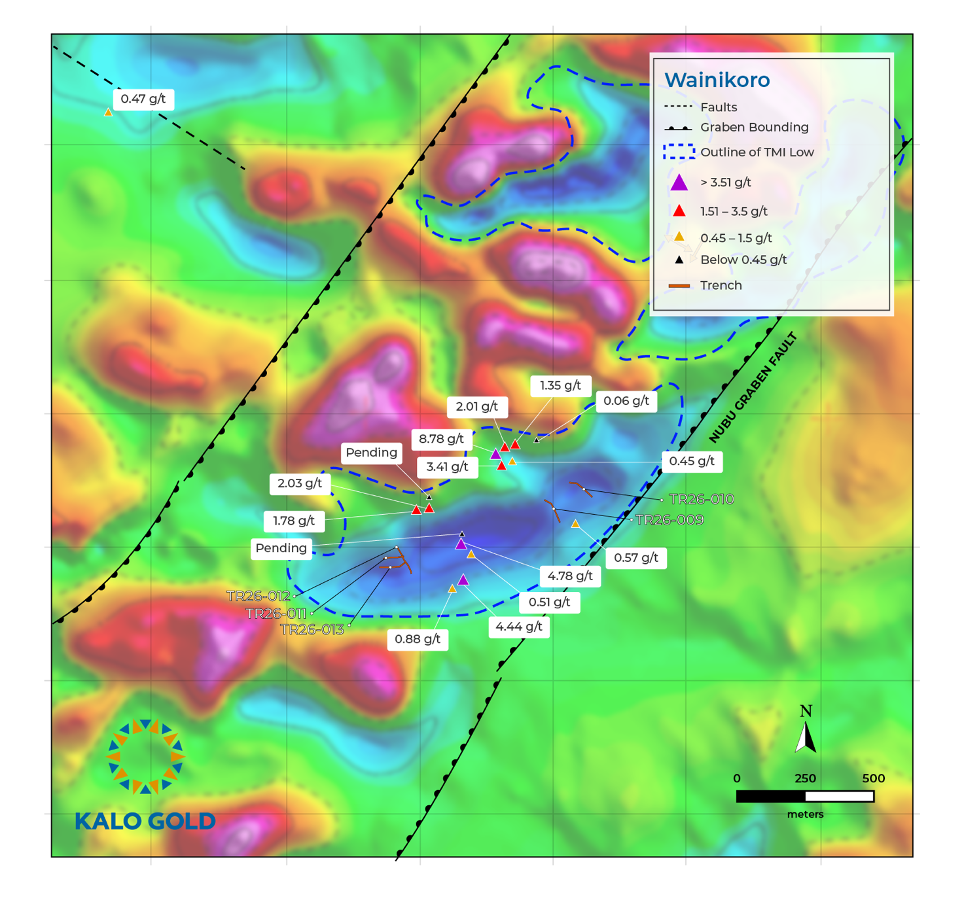
Certified fire assays confirm gold mineralization across Wainikoro, with surface samples returning up to 8.78 g/t Au, together with additional assays of 4.78 g/t Au, 4.44 g/t Au, 3.41 g/t Au and 2.03 g/t Au.
Gold confirmed in bedrock, with trench sampling returning selective point samples up to 2.93 g/t Au and continuous channel sampling averaging 0.28 g/t Au over 14 metres, demonstrating continuity of mineralization beneath surface exposures.
Independent laboratory assays validate detectORE™ field screening, with laboratory grades equalling or exceeding field estimates for the majority of reconciled samples.
Multiple styles of mineralization confirmed, including chalcedonic quartz veins, silicified volcanic rocks and hydrothermal breccias developed along the Nubu Graben structural corridor.
Geological confidence continues to increase, with each phase of exploration refining the Company's understanding of the Wainikoro low-sulphidation epithermal gold system.
Ground geophysical surveys scheduled to commence this month will provide the next layer of geological information by defining the subsurface geometry of the mineralized system and supporting future target prioritization.
CEO Commentary
Terry L. Tucker, P.Geo., President and CEO of Kalo Gold, commented: "These certified fire assay results provide independent confirmation of the gold identified through our detectORE™ field screening and, importantly, demonstrate that mineralization extends into bedrock beneath the surface occurrences we have been mapping. That substantially increases our confidence in the geological model we are developing at Wainikoro.
Each phase of exploration is building on the last-from mapping and geochemistry, to trenching and now laboratory confirmation-allowing us to progressively reduce geological uncertainty before advancing to the next phase of work. The upcoming CSAMT, induced polarization and gravity surveys will add another important dataset by helping us understand the geometry of the mineralized system beneath surface, enabling us to prioritize future exploration with much greater confidence."
Surface Traverse Fire Assay Results
Thirty-eight rock chip, float and in-situ vein samples collected during systematic surface traverses at Wainikoro were submitted to ALS Limited (Australia) for certified fire assay. Results include:
Sample ID | Au (g/t - FA) | Au (dU) | Outcome | Note |
KRN-LR26-027A | 8.78 | 3,397 | Fire assay higher | Chalcedonic quartz vein float adjacent to in-situ vein 027C) |
KRN-PS26-064B | 4.78 | 2,728 | Fire assay higher | Banded epithermal quartz vein in silicified bedded tuff |
KRN-ZB26-025 | 4.44 | 69 | Fire assay higher | Possible nugget effect |
KRN-PS26-030 | 3.41 | 916 | Fire assay higher | Silicified dacitic tuff |
KRN-JP26-039 | 2.03 | 467 | Fire assay higher | Epithermal quartz vein in silicified polymictic breccia |
KRN-LR26-027C | 2.01 | 1,157 | Fire assay higher | In-situ chalcedonic quartz vein, 10-20 cm wide |
KRN-JP26-038 | 1.78 | 238 | Fire assay higher |
|
KRN-LR26-027B | 1.35 | 51 | Fire assay higher | Float adjacent to in-situ vein 027C |
KRN-LR25-039 | 0.88 | 482 | Fire assay higher | Microcrystalline quartz float (2025 sample) |
WNK-JP25-012 | 0.57 | 116 | Fire assay higher |
|
KRN-PS26-065 | 0.51 | 234 | Fire assay higher |
|
WNK-PS25-037 | 0.47 | 306 | Fire assay higher |
|
KRN-ZB26-021 | 0.45 | 1,364 | Fire assay lower | Silicified polymictic breccia adjacent to in-situ vein; possible nugget effect |
KRN-LR26-029 | 0.06 | 519 | Fire assay lower | Silicified bedded tuff |
KRN-JP26-037B |
| 904 | Assay pending | Comb-textured epithermal quartz vein; not yet assayed |
KRII-ZPB26-004 |
| 462 | Assay pending | Chalcedonic quartz vein, ridge spur; not yet assayed |
Grab, float and rock chip samples are selective by nature and are not necessarily representative of the mineralization on the property. Fire assays are pending for KRN-JP26-037B and KRII-ZPB26-004.
These results confirm widespread gold mineralization hosted within chalcedonic quartz veins, silicified volcanic rocks and hydrothermal breccias across Wainikoro. Eleven separate surface samples returned greater than 0.5 g/t Au, indicating that mineralization is distributed throughout the target area rather than being restricted to isolated occurrences.
Laboratory fire assays generally equalled or exceeded the previously reported detectORE™ screening values, providing independent validation of the Company's field-based targeting approach.
Trench Fire Assay Results
Continuous channel sampling and selective point sampling from trenches TR26-009 to TR26-013 confirm that the mineralization identified at surface extends into bedrock. The highest selective point assays returned 2.93 g/t Au, 1.96 g/t Au and 1.38 g/t Au, while continuous channel sampling from trench TR26-011 averaged 0.28 g/t Au over 14 metres. Although selective point samples are not representative of the overall structure, the trench results demonstrate that the surface mineralization is sourced from an active hydrothermal system rather than isolated transported material.
Geological Interpretation
The certified fire assay results provide independent laboratory confirmation that gold mineralization occurs within multiple chalcedonic quartz veins, silicified volcanic units and associated hydrothermal breccias across Wainikoro.
Importantly, gold has now been confirmed in both surface outcrop and underlying bedrock, demonstrating that the surface anomalies are sourced from mineralized structures within the volcanic sequence.
Together with the Company's recent structural interpretation, these results strengthen the interpretation that Wainikoro represents the preserved upper levels of a structurally controlled low-sulphidation epithermal gold system developed along the Nubu Graben corridor. Confirmation of mineralized bedrock beneath the surface expressions substantially improves confidence in the continuity of the system and continues to refine the Company's geological model.
Certified fire assay results for the samples reported in the Company's 8 July 2026 news release remain pending and will be reported upon receipt.
Next Steps
The Company has engaged Fender Geophysics Pty Ltd to complete Controlled-Source Audio-frequency Magnetotellurics (CSAMT), induced polarization (IP) and gravity surveys across Wainikoro, scheduled to commence during the week of 21 July 2026, subject to equipment importation and crew scheduling.
These surveys represent the next stage in Kalo's systematic exploration strategy and are intended to define the subsurface geometry of the mineralized system by integrating geological mapping, geochemistry, trenching and structural interpretation into a single exploration model. The results will further refine target prioritization and guide subsequent phases of exploration across Wainikoro.
Technical Notes on detectORE™ Gold Screening Results
This news release references gold (Au) values reported in detectORE™ Units ("dU"), generated using the detectORE™ field-based gold analysis system developed by Portable PPB Pty Ltd. dU values represent a semi-quantitative, ppb-equivalent measure of leachable gold response and are used for exploration screening purposes only. They are not a direct measure of total gold content and are not equivalent to certified Fire Assay results. Accordingly, dU results are not used to estimate Mineral Resources or Mineral Reserves.
Internal validation by the Company in 2025 on 824 Vatu Aurum samples showed a strong correlation between dU and certified Fire Assay (Pearson R = 0.98 for drill core; R = 0.96 for trench samples). Soil dU has not been directly validated against Fire Assay, and the relationship is variable and influenced by lithology, mineralogy and sample preparation.
dU values obtained from surface rock chip and float samples have likewise not been validated against Fire Assay. As demonstrated by the results in this news release, individual rock chip and float dU values may materially overstate or understate the certified Fire Assay grade of the same sample owing to coarse-gold (nugget) effects and the heterogeneous distribution of gold in vein material.
Where gold is hosted within sulphide minerals, the on-site crushing and leaching process of the detectORE™ system does not fully liberate all gold prior to analysis, resulting in dU values that underestimate fire assay grades in these intervals. The Company further cautions that detectORE™ readings can be affected by the presence of mercury, which may over-report the gold response. Any approximate equivalence (e.g. ~1,000 dU ≈ ~1 g/t Au) is for contextual reference only and must not be relied upon for grade estimation. See the Company's news release dated 24 February 2026 for full details.
Quality Assurance / Quality Control
Gold assays reported in this news release were determined by ALS Limited (Australia) using method Au-AA25 (30 g Fire Assay, AAS Finish). ALS is accredited by NATA to ISO/IEC 17025 and is independent of the Company and the Qualified Person. Certified reference materials, blanks, pulp duplicates and preparation duplicates were inserted into the sample stream at regular intervals and have been reviewed by the Qualified Person.
Qualified Person
The technical information in this news release was prepared, reviewed, and approved by Andrew Randell, P.Geo., CEO and Principal Geoscientist of SGDS-Hive, Technical Director of the Vatu Aurum Project, and a Qualified Person as defined by NI 43-101. Mr. Randell is independent of the Company and has verified the data disclosed, having conducted multiple site visits (2023-2026) and direct supervision of the exploration program.
About Kalo Gold Corp.
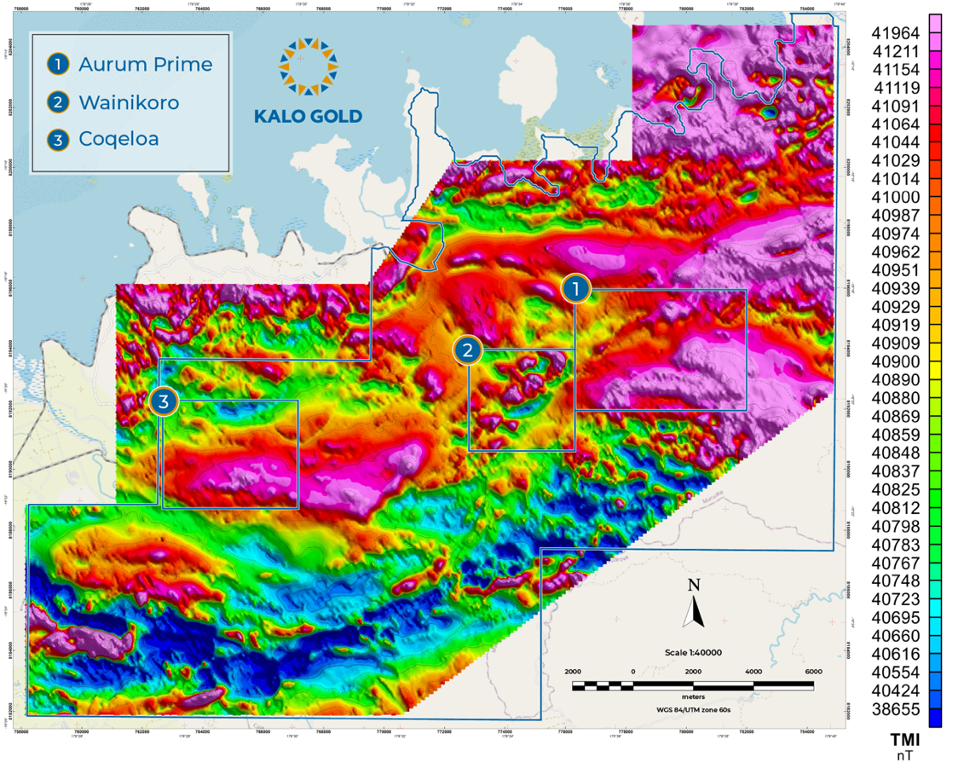
Kalo Gold Corp. is a gold exploration company advancing the 100%-owned Vatu Aurum Project (Special Prospecting Licences 1511 and 1464), a 367 km² land package on Vanua Levu, Fiji, located in a preserved volcanic back-arc setting. The Company's work is focused on a northeast-trending corridor of low-sulphidation epithermal gold targets. Exploration across the corridor - including at the flagship Aurum Prime area and Wainikoro - has defined multiple structurally controlled gold targets supported by drilling, trenching, soil geochemistry, structural mapping and airborne geophysics. The Company is systematically advancing high-confidence targets toward potential discovery.
Kalo Gold Corp. is headquartered in Vancouver, British Columbia, and is listed on the TSX Venture Exchange (KALO), the OTCID Market (KLGDF), and the Frankfurt Stock Exchange (9M51).
On behalf of the Board of Directors of Kalo Gold Corp.
Terry L. Tucker, P.Geo.
President and Chief Executive Officer
Kevin Ma, CPA, CA
Executive Vice President, Capital Markets and Director
For further information: [email protected] | www.kalogoldcorp.com
Neither the TSX Venture Exchange nor its Regulation Services Provider (as that term is defined in the policies of the Exchange) accepts responsibility for the adequacy or accuracy of this press release.
Cautionary Statement Regarding Forward-Looking Information
This news release contains "forward-looking statements" and "forward-looking information" within the meaning of applicable Canadian securities laws. Forward-looking statements can often be identified by the use of words such as "will", "may", "should", "could", "would", "anticipate", "believe", "estimate", "expect", "intend", "plan", "potential", "continue", "target", "scheduled", and similar expressions.
Forward-looking statements in this news release include, but are not limited to: (i) the interpretation that Wainikoro hosts a structurally controlled, low-sulphidation epithermal gold system and that the Company is exploring the upper levels of that system; (ii) the interpretation that gold-bearing hydrothermal activity extends across Wainikoro; (iii) the timing, scope and results of the planned CSAMT, IP and gravity ground geophysical surveys; (iv) the timing, scope and results of planned follow-up trenching and drilling; and (v) the Company's ability to secure financing, permits and regulatory approvals required to advance exploration on the Vatu Aurum Project.
Forward-looking statements are based on a number of assumptions that the Company considers reasonable but which may prove to be inaccurate, including: that the Company will be able to fund and execute the planned exploration programs; that permits, tenure, and licences will remain in good standing; that there will be no adverse change in the political, regulatory, or operational environment in Fiji, including potential fuel shortages; and that commodity prices and capital markets conditions will support continued exploration.
Forward-looking statements are subject to known and unknown risks and uncertainties that may cause actual results to differ materially from those expressed or implied, including: exploration and drilling risk; the risk that detectORE™ dU screening results may not be confirmed by certified Fire Assay (detectORE™ dU values are semi-quantitative screening estimates and are not equivalent to quantitative gold grades; soil, rock chip and float dU results have not been directly validated against Fire Assay); the risk that grab, float and point samples are selective and not representative of the mineralization on the property; the risk that geological, geochemical, geophysical, and structural interpretations may change with additional data; permit, tenure, and title risk; risks of operating in Fiji, including fuel supply, logistics, and currency risk; dependence on key personnel; environmental, health, and safety risk; financing and dilution risk; and commodity price volatility. Readers are cautioned not to place undue reliance on forward-looking statements.
The Company does not undertake any obligation to update or revise any forward-looking statements, whether because of new information, future events, or otherwise, except as required by applicable securities laws. Readers are directed to the Company's continuous disclosure filings available on SEDAR+ at www.sedarplus.ca.
SOURCE: Kalo Gold Corp.