




Wednesday, 28 October 2026 07:15 AM
Company Update
TORONTO, ON / ACCESS Newswire / October 28, 2026 / BULGOLD Inc. (TSXV:ZLTO) (the "Company" or "BULGOLD") is pleased to announce that the Ministry of Environment of the Slovak Republic has granted the Company two new exploration licences, Chlmok and Sulina, covering 44.5 km2 and 62.4 km2 respectively, which are contiguous with the Company's 100%-owned Lutila Gold Project in central Slovakia.
The new licences add a combined 106.9 km2 to BULGOLD's exploration position, increasing the Company's total exploration position in the region to 139.1 km2, including the 32.2 km2 Lutila Gold Project.
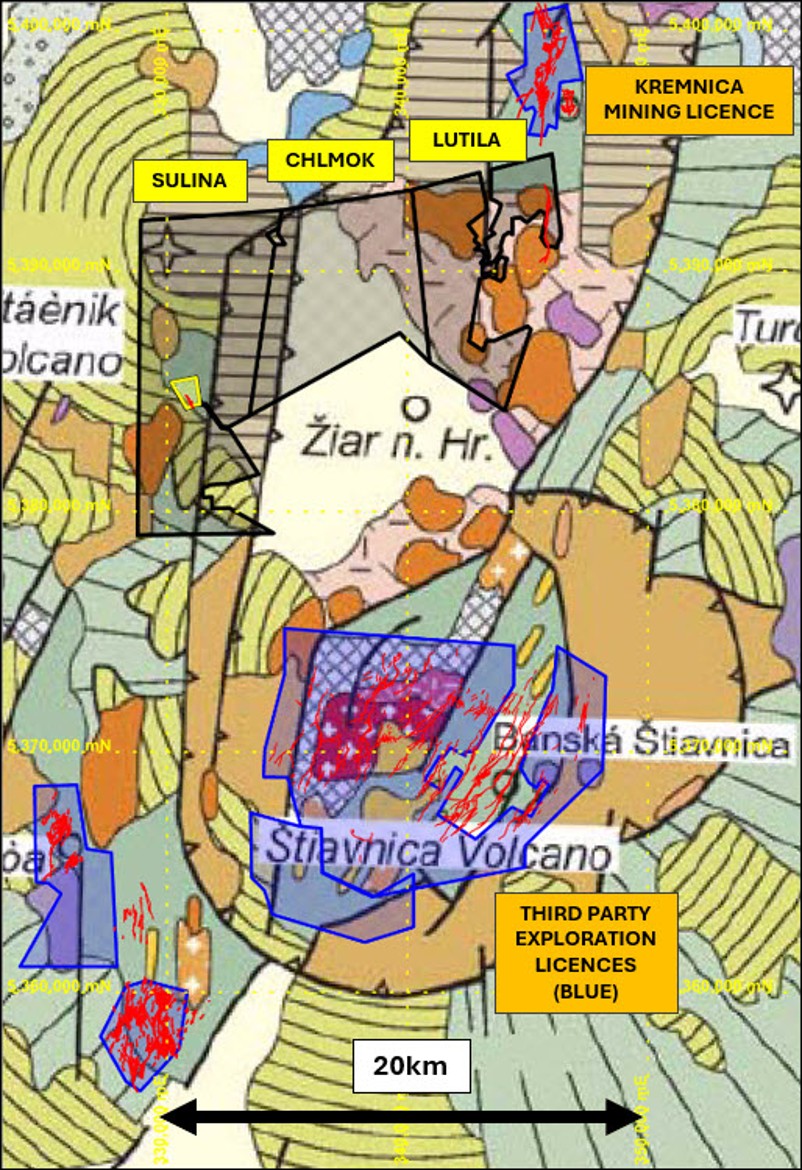
The new licences expand BULGOLD's exploration position across the northern portion of a regional structural corridor extending between the historic Kremnica epithermal gold district to the north and the Banska Štiavnica gold-silver district to the south.
The acquisition gives BULGOLD exposure to two complementary geological environments: Chlmok, which extends the preserved Lutila sinter field into additional ground, and Sulina, which is predominantly andesite-hosted and contains the Prochot Intrusive Complex and a documented regional epithermal Au-Ag occurrence within a third-party licence.
1. Highlights
- Strategic Land Consolidation: Chlmok and Sulina add 106.9 km² of contiguous and strategically positioned exploration ground, increasing BULGOLD's total regional exploration position to 139.1 km².
- Regional Epithermal Setting: The new licences cover the northern portion of a regional structural corridor extending between the historic Kremnica and Banska Štiavnica epithermal districts.
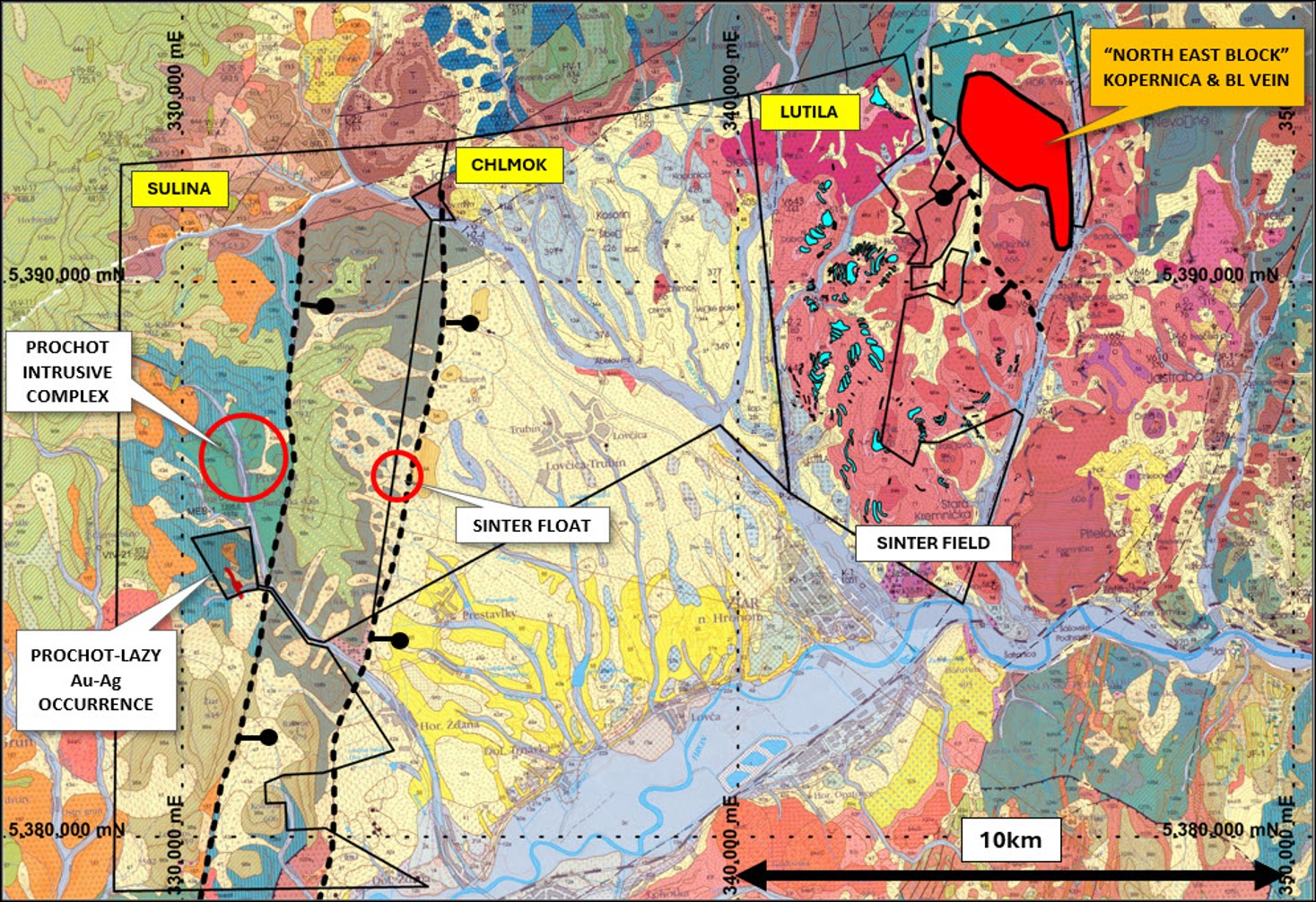
- Chlmok - Continuation of the Lutila Sinter Field: The Chlmok licence contains the extension of the extensive sinter field identified at Lutila, providing additional ground prospective for concealed epithermal vein systems beneath the preserved paleosurface.
- Sulina - Andesite-Hosted Epithermal Environment: Sulina is predominantly underlain by andesitic volcanic rocks and contains evidence of hydrothermal activity, including sinter float identified by BULGOLD.
- Prochot Intrusive Complex Within Sulina: The Sulina licence contains the Prochot Intrusive Complex, comprising amphibole-pyroxene andesite porphyry and diorite porphyry. Published scientific work on the nearby Prochot-Lazy Au-Ag occurrence discusses a possible relationship between the mineralisation and a local magmatic source beneath this intrusive complex.
- Prochot-Lazy Au-Ag Occurrence: A third-party exploration licence of less than 1 km² within the Sulina licence area hosts the historically mined and scientifically documented Prochot-Lazy Au-Ag occurrence, providing an important geological analogue for precious metal mineralisation within the Sulina licence area.
- Strategic Exploration Upside: The new licences allow BULGOLD to apply the geological concepts being developed at Lutila across a much larger regional exploration position while the Company continues to advance toward its next major exploration milestone - the discovery drill hole.
Quote from the President & CEO, Mr. Sean Hasson:
"The granting of the Chlmok and Sulina exploration licences is an important strategic step for BULGOLD. We are not simply adding acreage - we are adding two very different geological opportunities around a project where our understanding of epithermal systems is advancing rapidly.
Chlmok is particularly straightforward from an exploration perspective. It is contiguous with Lutila and contains the continuation of the Lutila sinter field. Our work at Lutila is increasingly focused on understanding how the preserved palaeosurface, structure, alteration, geochemistry and elevation can be used to vector towards the deeper quartz veins. If we can crack that targeting model at Lutila, Chlmok gives us additional ground on which to apply it.
Sulina is different, and that is what makes it interesting. It is predominantly andesite-hosted and sits on the opposite side of the regional graben. It also contains the Prochot Intrusive Complex, which is a significant geological feature within the Sulina licence and is itself affected by hydrothermal alteration, veining, base-metal mineralisation and low-grade gold mineralisation.
What really caught our attention is the relationship between that intrusive complex and the Prochot-Lazy Au-Ag occurrence. The occurrence itself is within a small third-party licence inside our Sulina ground, so we are very clear that we do not own Prochot-Lazy. But the scientific work on the occurrence documents an andesite-hosted epithermal system with gold, silver, adularia, quartz-carbonate veining, brecciation and pyritisation and discusses a possible relationship with a local magmatic source beneath the Prochot Intrusive Complex.
That gives us a very interesting geological framework to investigate across our much larger Sulina licence. We also have identified sinter float on andesitic rocks ourselves, providing another indication of preserved hydrothermal activity.
So Chlmok and Sulina are complementary. Chlmok allows us to extend what we are learning at Lutila, while Sulina gives us an opportunity to investigate a different volcanic and intrusive environment that already contains a documented epithermal Au-Ag system within our broader licence area.
Our immediate focus remains firmly on Lutila and advancing toward the discovery drill hole. But these new licences give BULGOLD a much stronger regional position and the opportunity to build on what we are learning as we explore the broader system around Lutila."
2. A Regional Epithermal Setting
The Lutila Gold Project is located within the Central Slovak Volcanic Field between two of the region's major historic precious metal districts: Kremnica to the north and Banska Štiavnica to the south.
The newly granted Chlmok and Sulina licences extend BULGOLD's exploration position into the northern portion of the broader structural environment between these districts.
The regional setting is characterised by major structures associated with the development of the graben system and extensive volcanic rocks of varying composition.
This expanded position gives BULGOLD exposure to both the rhyolite-hosted environment being explored at Lutila and a contrasting andesite-hosted environment at Sulina, while maintaining a contiguous regional exploration position around Lutila.
3. Chlmok: Extending the Sinter Field
The 44.5 km² Chlmok exploration licence represents a continuation of the extensive sinter field identified within the Lutila Gold Project.
Sinter represents a preserved palaeosurface environment associated with the uppermost levels of an epithermal hydrothermal system. At Lutila, BULGOLD has identified extensive sinter, hydrothermal alteration and epithermal quartz vein material, providing evidence of a substantial preserved hydrothermal system.
A key focus of the Company's exploration work at Lutila is developing an understanding of how surface expression, structure, alteration, geochemistry and elevation can be used to vector from the preserved palaeosurface toward concealed vein systems at depth.
Chlmok provides additional contiguous ground on which to apply this developing geological model.
The strategic significance of Chlmok is therefore straightforward: if BULGOLD can establish how the preserved Lutila palaeosurface relates to deeper mineralised structures, the continuation of that same palaeosurface onto Chlmok provides additional ground on which to apply the model.
4. Sulina: An Andesite-Hosted Epithermal Environment
Located on the opposite side of the regional graben from Lutila, the 62.4 km² Sulina exploration licence provides BULGOLD with exposure to a predominantly andesite-hosted geological environment.
A particularly important feature of Sulina is the Prochot Intrusive Complex, which occurs within the Company's exploration licence. Historical geological work describes the complex as comprising intrusive rocks including amphibole-pyroxene andesite porphyry and amphibole-pyroxene diorite porphyry. The intrusive rocks are affected by hydrothermal alteration and pyritisation, with silicification, carbonate veining, base-metal mineralisation and low-grade gold mineralisation also documented.
A third-party exploration licence of less than 1 km² within the Sulina licence area hosts the Prochot-Lazy Au-Ag occurrence, a historically mined epithermal precious metal occurrence that has subsequently been the subject of detailed scientific investigation.
The published Prochot-Lazy study characterises the mineralisation as an andesite-hosted low- to intermediate-sulfidation epithermal Au-Ag system. It documents quartz-carbonate veining, native gold, adularia alteration, brecciation and pyritisation, together with two approximately parallel mineralised zones (Kodera et al., 2016).
Importantly, the study discusses a possible genetic relationship between the Prochot-Lazy mineralisation and a local magmatic source beneath the Prochot Intrusive Complex, which is located approximately 2 km north, while also recognising that a broader magmatic source associated with the central Štiavnica magmatic system cannot be excluded.
For BULGOLD, this combination is significant because the intrusive complex, the andesitic volcanic host rocks and a scientifically documented epithermal Au-Ag occurrence are all contained within the same broader Sulina exploration environment.
The Company does not interpret the Prochot-Lazy occurrence as evidence that its Sulina licence is mineralised. Rather, it provides an important geological reference point within the Company's licence area and demonstrates that the andesitic volcanic and structural environment at Sulina is capable of hosting epithermal precious metal mineralisation.
5. Prochot-Lazy: A Documented Regional Analogue
The Prochot-Lazy occurrence provides a valuable geological analogue for BULGOLD's exploration work at Sulina.
The scientific study reports historical sampling of quartz-carbonate vein material with 1.58g/t to 20.7g/t Au and up to 9.4 ppm Ag from old mining works. Drill hole PT-1 also intersected remnants of a quartz-carbonate vein containing 2m @ 5.4 g/t Au & 10.5 g/t Ag (from 46m), together with native gold and associated sulphide minerals (Kodera et al., 2016).
The study describes extensive hydrothermal alteration and brecciation associated with the mineralised structures, including adularia-rich alteration and pyritisation. The mineralisation is interpreted as occupying an intermediate position between low- and intermediate-sulfidation epithermal systems.
The importance to BULGOLD is not the historical grades themselves, nor does the Company consider them representative of its Sulina licence. Rather, Prochot-Lazy provides independent geological evidence that significant epithermal Au-Ag mineralisation occurs within the andesitic volcanic environment of this part of the Central Slovak Volcanic Field and that such mineralisation occurs in association with structures and intrusive rocks present within the broader Sulina area.
This provides a meaningful geological basis for systematic exploration across BULGOLD's substantially larger Sulina licence.
6. Sinter Float Identified at Sulina
BULGOLD's reconnaissance work at Sulina has also identified sinter float occurring on andesitic volcanic rocks.
The occurrence is of particular interest because it provides evidence of preserved near-surface hydrothermal activity within an andesite-hosted environment distinct from the predominantly rhyolite-hosted Lutila system.
The sinter has been identified in an area where the regional master normal faults move toward the Chlmok area. BULGOLD interprets Chlmok as occupying the structurally lowest block within this portion of the graben architecture, potentially representing a structural "keystone" between the principal fault systems.
Further work is required to determine the relationship between the sinter, the regional structures, the andesitic host rocks, the Prochot Intrusive Complex and any deeper hydrothermal system.
7. A Strategic Expansion of the Lutila Exploration Model
The acquisition of Chlmok and Sulina is intended to complement, rather than distract from, BULGOLD's immediate exploration focus at Lutila. At Lutila, the Company is developing an increasingly detailed understanding of how:
SURFACE EXPRESSION → ALTERATION → STRUCTURE → ELEVATION → DEEPER VEIN TARGETING
may be used to identify concealed epithermal quartz veins.
The new licences provide two different opportunities to build on this work.
Chlmok extends the Lutila sinter field and provides additional ground on which to apply the Company's developing understanding of the relationship between the preserved palaeosurface and deeper vein systems.
Sulina provides exposure to a contrasting andesite-hosted environment containing the Prochot Intrusive Complex, preserved hydrothermal surface expressions and within a small third-party licence, the documented Prochot-Lazy Au-Ag occurrence.
Together, the new licences significantly broaden BULGOLD's regional exploration position while allowing the Company to continue building its geological understanding from the active Lutila discovery programme.
8. Next Steps
BULGOLD will incorporate the newly granted licences into its regional geological model and undertake systematic compilation of historical information, geological mapping and reconnaissance prospecting to identify priority exploration targets.
At Chlmok, the Company will evaluate the continuation of the Lutila sinter field and its relationship to geological structures, alteration and potential concealed vein systems at depth.
At Sulina, BULGOLD will focus on the geological architecture surrounding the Prochot Intrusive Complex, the andesitic volcanic sequence, the sinter occurrences identified during reconnaissance and the broader structural setting. The Company will also compile historical information relating to the Prochot-Lazy occurrence and its surrounding geology, while recognising that the occurrence itself lies within a third-party licence.
The Company will use the results of this work to define and prioritise future exploration targets.
9. About the Slovak Republic
- Drill pads can be permitted within 3 months.
- EU and NATO member since 2004.
- Eurozone (€)member since 2009.
- Established mining industry, clearly defined mining legislation.
- No restrictions on foreign ownership.
- 21% corporate tax rate.
- 5% NSR for gold and silver.
- The use of cyanide for extractive purposes has been prohibited since 2014.
- Low-cost profiles, skilled local workforce.
- Exploration licences can be held for a 10-year period (4+4+2).
References:
Bakoš F., Chovan M., Žitňan P. et al, 2017. Gold in Slovakia, Vydavatel'stvo LÚČ, Bratislava, 2017 (in Slovak and English).
Finka, O., 1995. Zlatá Kremnica: Tisícročná história baníctva, Neografia vydavateľstvo, Monografie 71 pages (in Slovak).
Kodera P., Lexa J., Rankin AH., Fallick AE., 2005. Epithermal gold veins in a caldera setting: Banská Hodruša, Slovakia. Mineralium Deposita. 39: 921-943.
Kodera P., Lexa J., Fallick AE., Walle M., Biron A., 2014. Hydrothermal fluids in epithermal and porphyry Au deposits in the Central Slovakia Volcanic Field. Geological Society, London, Special Publications 2014, v.402; p177-206.
Kodera P., Bakoš F., Kubac A., Lexa J. & Sykora M., 2016. Epithermal Au-Ag mineralisation at the locality of Prochot-Lazy in the mantle of the Štiavnica Stratovolcano. ACTA GEOLOGICA SLOVACA, 8(2), 2016, 149-163.
Konečný, V., Lexa, J., & Planderová, E., 1983. Stratigraphic division of Neogene volcanics in Central Slovakia. Západné Karpaty, Séria Geológia, 9, 1-203.
About BULGOLD Inc.
BULGOLD is a gold exploration company focused on the exploration and development of mineral exploration projects in Central and Eastern Europe. The Company controls 100% of three quality quartz-adularia epithermal gold projects located in the Bulgarian and Slovak portions of the Western Tethyan Belt: the Lutila Gold Project, the Kostilkovo Gold Project and the Kutel Gold Project. Management of the Company believes that its assets show potential for high-grade, good-metallurgy, low-sulfidation epithermal gold mineralisation.
On June 30, 2026, BULGOLD's issued and outstanding shares were 72,626,013 of which approximately 20.1% were held by Founders, Directors and Management. Additional information about the Company is available on BULGOLD's website (www.BULGOLD.com) and on SEDAR (www.sedarplus.ca).
Historic Sampling and Drilling Data and Information
The historical sampling and drilling data and information disclosed in this news release is related to historical exploration results. The reader is cautioned that the historical sampling and drilling data and information are based on prior data and reports previously prepared by third parties without the involvement of the Company. Information has been sourced from the Slovak Geological Survey in reports 83971 (December 1997) and 92416 (February 2013). BULGOLD has not undertaken any independent investigation of the historical sampling and drilling data and information, nor has it independently analysed the results of the historical sampling and drilling exploration work in order to verify the results. The reader is cautioned not to treat them, or any part of them, as current due to the fact that a qualified person has not done sufficient work to verify the results and that they may not form a reliable guide to future results. No independent quality assurance/quality control protocols are known for these historic samples and drill holes and therefore the analytical results, data and information may be unreliable. BULGOLD considers the historical sample and drill data and information to be relevant as BULGOLD is using this data and information, in conjunction with the sampling conducted by BULGOLD, as a guide to plan its exploration programme for the Lutila Gold Project. BULGOLD's current exploration work includes verification of the historical data and information through further exploration.
Sampling, Analysis and QAQC of Exploration Drill Core Samples
Most exploration diamond drill holes are collared with PQ size, continued with HQ, and are sometimes finished with NQ. Triple tube core barrels and short runs are used whenever possible to improve recovery. All drill core is cut lengthwise into two halves using a diamond saw; the right-hand half looking downhole is sampled for assaying and the other half is retained in core trays. The common length for sample intervals within mineralized zones is one metre. Weights of drill core samples range from three to eight kilograms ("kg"), depending on the size of core, rock type, and recovery. A numbered tag is placed into each sample bag, and the samples are grouped into batches for laboratory submissions.
Diamond drill core and rock samples are shipped to SGS Burgas, Bulgaria. Quality control samples, comprising certified reference materials, blanks and field duplicates, are inserted into each batch of samples and locations for crushed duplicates and pulp replicates are specified. All drill core and quality control samples are tabulated on sample submission forms that specify sample preparation procedures and codes for analytical methods. For internal quality control, the laboratory includes its own quality control samples comprising certified reference materials, blanks and pulp duplicates. All QAQC monitoring data are reviewed, verified and signed off by the Company. Chain of custody records are maintained from sample shipments to the laboratory until analyses are completed and remaining sample materials are returned to the Company. The chain of custody is transferred from the Company to SGS at the laboratory door.
At the SGS Burgas laboratory, the submitted core samples are dried at 105°C for a minimum of 12 hours and then jaw crushed to ~80% passing 2-6mm. Sample preparation duplicates are created by riffle splitting crushed samples on a 1-in-20 basis. Larger samples are riffle split prior to pulverizing, whereas smaller samples are pulverized entirely. Pulverizing specifications are 90% passing 75 microns. Gold analyses are done using a conventional 50-gram fire assay and AAS finish. Multi-element analyses for 49 elements are done using a four-acid digest and an ICPMS finish. Some older multi-element analyses have been carried out for 32 elements and are done using a four-acid digestion and an ICP-OES finish.
Qualified Person
The scientific and technical information in this news release was reviewed and approved by Mr Sean Hasson, a Qualified Person as defined by National Instrument 43-101 and President and Chief Executive Officer to the Company.
Neither TSX Venture Exchange nor its Regulation Services Provider (as that term is defined in the policies of the TSX Venture Exchange) accepts responsibility for the adequacy or accuracy of this release.
Cautionary Statement Regarding Forward-Looking Information
This press release contains forward-looking statements and forward-looking information within the meaning of applicable securities laws (collectively, "forward-looking statements"). These statements relate to future events or future performance and include statements relating to the Company's exploration plans and activities on the Lutila Gold Project and the newly granted Chlmok and Sulina exploration licences; the timing and scope of future exploration activities; the potential to apply the Company's exploration model developed at Lutila to the Chlmok exploration licence; the potential for further exploration to identify mineralisation or additional exploration targets at Chlmok and Sulina; the Company's plans to investigate the geological setting and exploration potential of the Prochot Intrusive Complex and surrounding areas within the Sulina exploration licence; and the potential for the Company's expanded exploration position to generate additional exploration opportunities and benefit the Company and its shareholders.
All statements other than statements of historical fact may be forward-looking statements or information. The forward-looking statements and information are based on certain key expectations and assumptions made by management of the Company. Although management of the Company believes that the expectations and assumptions on which such forward-looking statements and information are based are reasonable, undue reliance should not be placed on the forward-looking statements and information since no assurance can be given that they will prove to be correct.
Forward-looking statements and information are provided for the purpose of providing information about the current expectations and plans of management of the Company relating to the future. Readers are cautioned that reliance on such statements and information may not be appropriate for other purposes, including making investment decisions. Since forward-looking statements and information address future events and conditions, by their very nature they involve inherent risks and uncertainties. Actual results could differ materially from those currently anticipated due to a number of factors and risks, including the inherent uncertainty of mineral exploration; the risk that exploration activities may not identify mineralisation or targets of economic significance; the risk that geological interpretations and exploration models may not accurately predict the location or continuity of mineralisation; the risk that exploration results may not confirm historical results, surface observations or geological interpretations; risks related to the Company's ability to obtain and maintain all necessary permits and approvals and to conduct exploration activities as planned; risks related to title to mineral properties and exploration licences; the fact that the Prochot-Lazy Au-Ag occurrence is located on a third-party licence and is not owned by the Company; changes in laws or regulations, including environmental laws and regulations; and credit, market, currency, operational, commodity, geopolitical, liquidity and funding risks generally, including changes in economic conditions, interest rates or tax rates and general market conditions.
Accordingly, readers should not place undue reliance on the forward-looking statements and information contained in this press release. Readers are cautioned that the foregoing list of factors is not exhaustive. The forward-looking statements and information contained in this press release are made as of the date hereof and no undertaking is given to update publicly or revise any forward-looking statements or information, whether as a result of new information, future events or otherwise, unless so required by applicable securities laws. The forward-looking statements and information contained in this press release are expressly qualified by this cautionary statement.
For further information, please contact:
BULGOLD Inc.
Sean Hasson, President and Chief Executive Officer
Telephone: +359 887 560 545
Email: [email protected]
Website: www.BULGOLD.com
SOURCE: BULGOLD Inc.