




Friday, 10 July 2026 08:00 PM
Company Update
News Release Highlights:
Battery X Metals' patent-pending lithium-ion battery rebalancing platform has demonstrated positive preliminary estimated driving range improvements of up to approximately 255 kilometres across real-world electric vehicle performance trials, supporting meaningful battery capacity recovery, advanced diagnostics, sustained performance recovery, and validation across multiple commercial and passenger EV platforms.
The Company has strengthened its intellectual property portfolio through the completion of its International Patent Cooperation Treaty (PCT) patent application, preserving priority rights while establishing a pathway to pursue patent protection in more than 150 countries. Concurrently, Battery X Metals has completed or is actively advancing compatibility development across five strategic electric vehicle platforms, including the Nissan Leaf, Tesla Model 3 and Model Y, Hyundai Ioniq, Chevrolet Volt, and the VMC 1200 electric truck.
Battery X Metals is accelerating commercialization through the advancement of an integrated EV battery diagnostics platform utilizing an onboard diagnostics (OBD-II) interface, together with the continued development of its Rebalancing Machine hardware and software ecosystem, including wireless connectivity, standardized battery health reporting, commercial hardware refinements, and UL certification initiatives, positioning its patent-pending lithium-ion battery rebalancing technology platform for broader commercial deployment as millions of electric vehicles are expected to transition beyond their original battery warranty coverage.
VANCOUVER, BC / ACCESS Newswire / July 10, 2026 / Battery X Metals Inc. (CSE:BATX)(OTCQB:BATXF)(FSE:5YW0)(WKN:A41RJF) ("Battery X Metals" or the "Company") an energy transition resource exploration and technology company, announces a comprehensive commercialization update for its patent-pending lithium-ion battery rebalancing technology platform, highlighting preliminary performance validation achieved through a series real-world electric vehicle performance trials, together with initiatives intended to accelerate commercialization and broader market deployment.
Over the past twelve months, Battery X Metals has systematically advanced the development and validation of its patent-pending lithium-ion battery rebalancing technology platform through a series of real-world vehicle performance trials and multi-platform evaluations. What began as validation of the Company's core battery rebalancing technology has progressively expanded to demonstrate integrated battery diagnostics, targeted corrective intervention, sustained long-term performance recovery, and applicability across multiple electric vehicle platforms.
Collectively, these preliminary validation milestones have established an important technical foundation supporting the Company's transition from technology validation toward commercialization. As electric vehicle adoption continues to accelerate globally and an increasing number of vehicles begin to exit original battery warranty coverage, Battery X Metals believes demand for technologies capable of extending battery lifespan, restoring usable battery capacity and reducing total cost of ownership will continue to grow.
Accordingly, the Company is now advancing the next phase of development by accelerating commercialization initiatives intended to support manufacturing readiness, expand vehicle compatibility, strengthen strategic industry relationships and position the Rebalancing Machine for broader commercial deployment.
In parallel with these technical and commercialization advancements, and as previously disclosed in the Company's news release dated April 21, 2026, the Company completed a significant intellectual property milestone through the filing of an International patent application under the Patent Cooperation Treaty ("PCT"). The PCT application preserves priority rights from the Company's previously filed U.S. provisional patent applications with the United States Patent and Trademark Office (USPTO) while establishing a pathway to pursue patent protection in more than 150 countries. The Company believes this milestone enhances the long-term defensibility of its proprietary technology platform and provides an important foundation to support future commercialization, licensing opportunities, strategic partnerships, and international market expansion.
Performance Validation of Patent-Pending Lithium-Ion Battery Rebalancing Machine
Battery X Metals, through its wholly-owned subsidiary, Battery X Rebalancing Technologies Inc., has developed a next-generation, patent-pending lithium-ion battery rebalancing platform (the "Rebalancing Machine") designed to restore usable battery capacity lost through naturally occurring lithium-ion cell imbalance, extend the remaining useful life of electric vehicle ("EV") battery packs, and reduce the need for premature battery replacement. Through a series of real-world performance trials, the Rebalancing Machine has demonstrated measurable improvements in battery capacity utilization, driving range, diagnostic capability, and long-term performance retention across multiple EV platforms, supporting the Company's commercialization strategy.
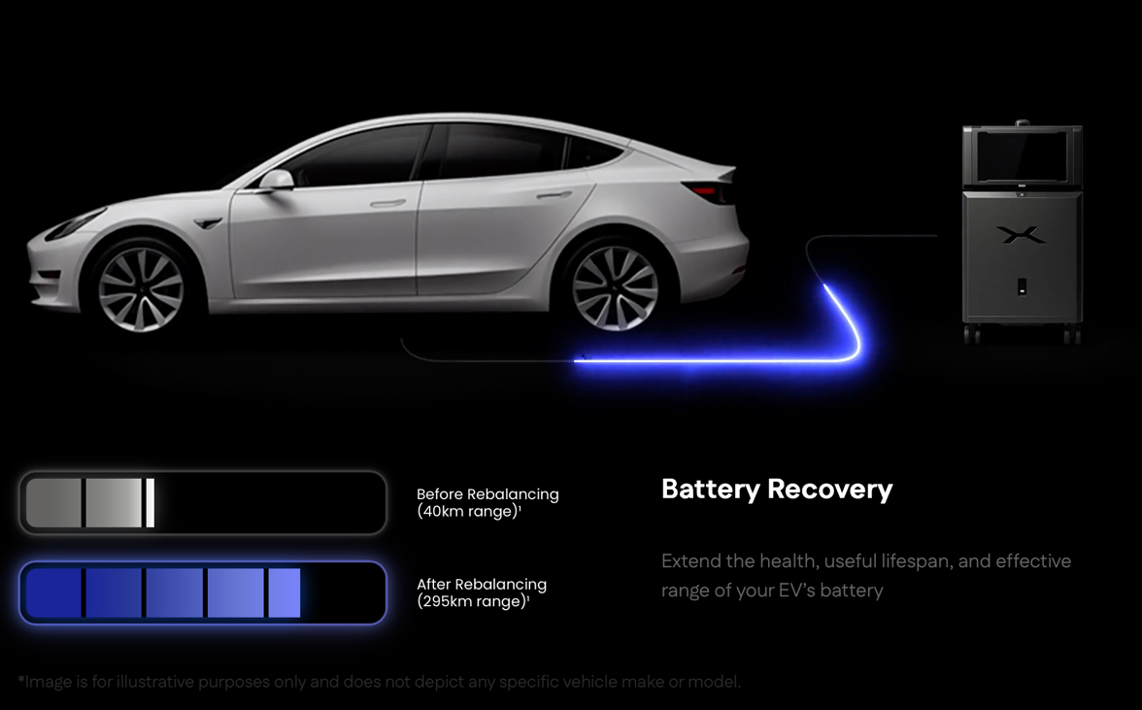
As disclosed in the Company's news releases dated July 4, July 25 and October 24, 2025, and January 13 and May 22, 2026, the Company completed a series of real-world driving performance trials (each, a "Trial," and collectively, the "Trials") and, in the case of the May 22, 2026 news release, reported the results of lithium-ion battery rebalancing trials conducted by multiple international arm's-length third-party automotive service centres utilizing the Company's patent-pending Rebalancing Machine. Collectively, these Trials evaluated the Rebalancing Machine across progressively broader operating conditions, battery chemistries and electric vehicle platforms.
The initial two Trials evaluated the Rebalancing Machine on severely degraded Class 3 commercial electric vehicles (each, an "Electric Truck") exhibiting significant battery capacity loss resulting from naturally occurring lithium-ion cell imbalance. As disclosed in the Company's July 4, 2025 news release, the first Trial demonstrated the Rebalancing Machine's ability to restore a severely degraded battery pack from a reported estimated driving range of approximately 40 kilometres to an estimated 295 kilometres under no-load conditions following completion of a full battery rebalancing procedure, representing an increase of approximately 255 kilometres, or approximately 637%. Importantly, the restored estimated driving range closely approximated the manufacturer's reported operating range for the platform, demonstrating the technology's ability to recover substantial usable battery capacity without requiring battery pack replacement while supporting a lower-cost battery recovery solution for commercial fleet operators.
As disclosed in the Company's July 25, 2025 news release, the second Trial expanded validation by demonstrating the Rebalancing Machine's integrated battery diagnostic capabilities. During the evaluation, the Rebalancing Machine identified a defective battery cell exhibiting abnormal self-discharge within a parallel-connected cell group that had caused premature vehicle shutdown below approximately 60% state of charge ("SOC"). Following targeted replacement of the affected cell group and completion of a battery rebalancing procedure, the Electric Truck's effective driving range increased from approximately 40 kilometres to an estimated 265 kilometres under no-load conditions, representing an increase of approximately 225 kilometres, or approximately 563%. Beyond the recovery in driving range, the Trial demonstrated the Rebalancing Machine's ability to combine advanced battery diagnostics with targeted corrective intervention, supporting the potential for selective battery repair strategies as an alternative to complete battery pack replacement where appropriate.
As disclosed in the Company's October 24, 2025 news release, the Company subsequently completed a follow-up validation assessment of the second Electric Truck to evaluate the durability of the performance improvements observed during the July 2025 Trial. Following approximately four months and more than 2,000 kilometres of continued real-world operation, the vehicle maintained stable range performance, achieving an estimated driving range of approximately 250 kilometres under comparable testing conditions and a weighted average effective driving range of approximately 220 kilometres per full charge over approximately 92% cumulative state of charge utilization. These results demonstrated that the battery performance improvements achieved through the targeted intervention and rebalancing procedure were substantially maintained over time, supporting the Rebalancing Machine's potential to deliver sustained battery performance recovery and extend the remaining useful life of commercial EV battery packs.
As disclosed in the Company's January 13, 2026 news release, the Company further expanded validation through a real-world performance trial on a light-duty electric vehicle equipped with a severely imbalanced 144-cell lithium nickel manganese cobalt oxide (NMC) battery pack that had become effectively inoperable, exhibiting an estimated pre-rebalancing driving range of approximately 0.1 kilometres per charge. Following completion of a full battery rebalancing procedure, the vehicle achieved an average estimated driving range of approximately 135.9 kilometres per charge under mixed driving conditions. The rebalancing process also materially reduced cell-level voltage variance across the battery pack, demonstrating improved battery pack balance, enhanced utilization of existing battery capacity, and the ability to restore meaningful vehicle operability without replacing battery cells.
Further, as disclosed in the Company's May 22, 2026 news release, the Company announced the results of a series of lithium-ion battery rebalancing trials conducted by multiple international arm's-length third-party automotive service centres on multiple electric vehicle platforms manufactured by BYD Company Limited ("BYD") utilizing the Company's next-generation, patent-pending Rebalancing Machine. The evaluations demonstrated estimated driving range improvements of up to approximately 84 kilometres per charge across BYD Song, Seal and Han vehicle platforms, supporting the repeatability of the Rebalancing Machine across multiple high-volume EV platforms and further demonstrating its commercial applicability within one of the world's largest electric vehicle ecosystems.
Collectively, these preliminary validation activities demonstrate the Rebalancing Machine's ability to restore usable battery capacity lost through naturally occurring lithium-ion cell imbalance, integrate advanced battery diagnostics to identify cell-level defects requiring targeted corrective intervention, sustain recovered battery performance under continued real-world operation, and deliver measurable performance improvements across multiple electric vehicle platforms and battery configurations.
The Company believes these preliminary validation milestones establish an important technical foundation supporting the continued commercialization of its patent-pending lithium-ion battery rebalancing technology platform across an expanding range of electric vehicle platforms and operating environments, as the global population of out-of-warranty electric vehicles is anticipated to grow and demand is anticipated to increase for battery lifespan extension solutions that reduce total cost of ownership.
Platform Expansion Supporting Commercialization Initiatives
A foundational component of the Company's commercialization strategy is the systematic expansion of the Rebalancing Machine's compatibility across high-volume electric vehicle battery platforms. Through its ongoing research and development program, Battery X Metals continues to advance the engineering of proprietary battery adaptors and connector solutions designed to enable the Rebalancing Machine to physically interface with an expanding range of lithium-ion battery architectures commonly found in out-of-warranty electric vehicles. The Company believes this platform-by-platform compatibility strategy is fundamental to supporting broad commercial deployment of its patent-pending lithium-ion battery rebalancing technology.
The Company announces that it has successfully completed development of a proprietary battery adaptor providing compatibility across all North American Nissan Leaf battery configurations. The Nissan Leaf was among the world's earliest mass-market battery electric vehicles and remains one of the largest populations of aging battery electric vehicles in North America. Since its launch in December 2010, more than 650,000 Nissan Leaf vehicles have been sold globally,1 including 114,808 vehicles sold in the United States between 2010 and 2017, where it ranked as the second best-selling plug-in electric vehicle during that period.2 As these vehicles continue transitioning beyond their original battery warranty coverage, the Company believes they represent a substantial and growing addressable market for battery diagnostics, rebalancing and battery lifespan-extension solutions, and that compatibility with the Nissan Leaf platform represents an important commercialization milestone supporting future deployment into the growing battery lifecycle extension market.
The Company further announces that it has commenced adaptor engineering initiatives targeting the Hyundai Ioniq and Chevrolet Volt battery platforms. As part of these initiatives, the Company's technical team completed detailed battery interface measurements and dimensional characterization of both battery systems. The resulting engineering data has been provided to the Company's strategic development partner, Beijing Pengneng Science & Technology Ltd., to support the design and engineering of proprietary adaptor and connector solutions intended to enable compatibility with the Rebalancing Machine.
The Hyundai Ioniq and Chevrolet Volt represent strategically important electrified vehicle platforms within the North American market. The Chevrolet Volt was among the earliest high-volume plug-in electric vehicles, achieving cumulative global sales of approximately 178,785 vehicles prior to its discontinuation, with approximately 150,049 vehicles (approximately 84%) sold in the United States.3 This substantial U.S. vehicle population represents an attractive addressable market as these vehicles continue to age beyond their original battery warranty periods. The original Hyundai IONIQ achieved significant adoption across the United States, Canada and Europe, with approximately 251,742 vehicles sold across these markets through 2022, including approximately 82,264 vehicles in the United States, 16,531 vehicles in Canada and 152,947 vehicles in Europe. The United States represented approximately 32.7% of reported IONIQ sales across these three markets.4 As these vehicle populations continue to age beyond their original battery warranty periods, the Company believes they represent attractive platforms for future battery diagnostics, rebalancing and battery lifespan-extension services.
These initiatives build upon the Company's previously announced compatibility development activities targeting the Tesla Model 3 battery platform. As disclosed in the Company's news release dated January 2, 2026, the Company completed a high-resolution three-dimensional (3D) scan of a Tesla Model 3 battery pack, establishing the foundational digital reference required to engineer proprietary adaptor and connector solutions. Tesla accounted for approximately 45% of U.S. electric vehicle sales in 2024,5 while cumulative Tesla Model 3 sales reached an estimated 2.63 million vehicles globally by the end of the third quarter of 2024.6 As these vehicles continue to age, a growing proportion is expected to transition beyond their original battery warranty coverage, increasing the addressable market for battery diagnostics, rebalancing and battery lifespan extension technologies.
In addition to these consumer vehicle platforms, the Company has completed development of a proprietary battery adaptor for the VMC 1200 Class 3 commercial electric truck platform. This compatibility supported the Company's previously disclosed commercial vehicle validation activities and further demonstrates the applicability of the Rebalancing Machine across both commercial fleet and passenger electric vehicle battery platforms.
Collectively, these initiatives reflect a deliberate, platform-by-platform commercialization strategy designed to systematically expand the addressable market for the Rebalancing Machine across both commercial fleet and consumer electric vehicle markets.
Current Platform Compatibility Roadmap
Electric Vehicle Platform | Development Status |
Nissan Leaf | Adaptor development completed |
VMC 1200 | Adaptor development completed |
Tesla Model 3 and Model Y | Adaptor engineering underway |
Hyundai Ioniq | Adaptor engineering underway |
Chevrolet Volt | Adaptor engineering underway |
By progressively expanding compatibility across high-volume electric vehicle battery architectures, the Company believes it is establishing the technical foundation necessary to support broader commercial deployment of its patent-pending lithium-ion battery rebalancing technology platform. As additional vehicle platforms are incorporated into the Rebalancing Machine ecosystem, the Company believes it will continue to expand the addressable market for its battery diagnostics, rebalancing and battery lifespan extension solutions.
Accelerated Commercialization Initiatives
Building upon the preliminary validation milestones described herein, the Company is advancing a series of commercialization initiatives intended to strengthen its product offering, support commercial readiness, and establish the operational framework necessary for broader market deployment of its patent-pending lithium-ion battery rebalancing technology platform.
Battery Diagnostics as the Front End of the Battery Lifecycle Ecosystem
As part of its broader commercialization strategy, the Company has been evaluating the integration of an advanced EV battery diagnostics platform utilizing an onboard diagnostics (OBD-II) interface, together with a complementary hardware-enabled software platform intended to support battery health assessment and reporting. The Company believes battery diagnostics represent a critical first step in the battery rebalancing process, providing the information necessary to determine whether battery performance degradation may be attributable to lithium-ion cell imbalance prior to recommending corrective intervention.
Through communication with a vehicle's battery management system (BMS), the contemplated diagnostics platform is expected to retrieve and analyze key battery health parameters, including state of health, cell voltages, cell temperature, and other operational metrics relevant to battery condition. These diagnostic outputs are intended to provide automotive service providers with standardized battery health assessments that may assist in identifying battery packs exhibiting characteristics suitable for battery rebalancing.
The Company envisions battery diagnostics serving as the initial customer engagement point within a broader battery lifecycle management ecosystem. Under the Company's anticipated commercial workflow, customers would first receive a battery health assessment through participating automotive service centres utilizing the diagnostics platform. Where battery diagnostics identify cell imbalance as a contributing factor to battery performance degradation, the Rebalancing Machine may subsequently be recommended as a battery recovery solution. The Company believes this complementary diagnostics and battery rebalancing ecosystem has the potential to strengthen customer engagement, enhance service workflows, and support utilization of its battery rebalancing technology. As part of this initiative, the Company is evaluating opportunities to leverage established battery diagnostics technologies, software capabilities and industry expertise to accelerate commercialization while focusing internal development efforts on integration with its proprietary battery rebalancing platform.
Software Development and User Experience
In parallel, the Company has been evaluating the scope of work required to develop a first-generation commercial software platform for the Rebalancing Machine and has been assessing software engineering resources capable of supporting its implementation. The anticipated software architecture is expected to include an intuitive operator interface and user experience, wireless connectivity supporting over-the-air (OTA) software updates, cloud-based storage of pre- and post-rebalancing battery data, and the automated generation of standardized battery health reports for customers.
The Company believes these software capabilities are expected to improve operational efficiency, simplify machine operation, standardize reporting across automotive service centres, and provide customers with comprehensive documentation of battery condition before and after battery rebalancing procedures. Collectively, these initiatives are intended to support a more scalable and user-friendly commercial product while enabling consistent customer reporting across future deployment locations.
Commercial Hardware Development and Product Certification
The Company has completed commercial hardware design refinements for the Rebalancing Machine, representing an important milestone in preparing the platform for commercial deployment. These refinements are intended to enhance manufacturability, product functionality and commercial presentation while establishing the design foundation for a production-ready commercial unit.
As the next phase of commercialization, the Company has been evaluating the negotiation of a hardware development agreement with its strategic development partner, to support development and production of the next-generation commercial Rebalancing Machine. Subject to the completion of such arrangements, available capital resources and continued commercialization progress, the Company intends to advance the commercial unit through applicable third-party product testing and certification processes, including Underwriters Laboratories (UL) certification, where appropriate.
The Company believes commercial hardware production and product certification represent mission-critical steps toward commercialization, as successful completion of these activities is expected to support broader deployment of the Rebalancing Machine within automotive service environments and other commercial applications.
Collectively, these commercialization initiatives are intended to complement the Company's technical validation and platform compatibility activities by expanding the functionality of its battery lifecycle management ecosystem, improving customer and operator experience, supporting commercial readiness, and establishing the operational foundation necessary for broader deployment of the Company's patent-pending lithium-ion battery rebalancing technology platform.
Advancement of these initiatives remains subject to, among other things, continued product development, the negotiation and completion of definitive commercial agreements, available capital resources, third-party certification processes and the Company's ongoing commercialization priorities.
Transitioning Toward Commercial Execution
The milestones summarized herein reflect the continued evolution of the Company's patent-pending lithium-ion battery rebalancing technology platform through successive stages of development, including technology validation, integrated battery diagnostics, long-term performance verification, platform compatibility expansion, software enhancement and product development.
Building upon these technical and operational achievements, the Company's focus is increasingly directed toward commercial execution through continued platform compatibility expansion, manufacturing readiness, software development, product certification, strategic commercial relationships and broader market deployment initiatives designed to support the commercialization of the Rebalancing Machine.
While the timing and scope of commercialization activities remain subject to, among other things, continued product development, available capital resources, strategic relationships and customary regulatory and commercial requirements, the Company believes the progress achieved to date establishes a meaningful foundation from which to advance the commercialization of its patent-pending lithium-ion battery rebalancing technology platform.
As the global population of out-of-warranty electric vehicles is anticipated to grow and demand is anticipated to increase for battery lifespan extension solutions that reduce total cost of ownership, the Company believes these preliminary validation milestones and commercialization initiatives position it to pursue opportunities across an expanding range of electric vehicle platforms and operating environments.
The Problem: Rising EV Adoption Presents New Battery Lifecycle Challenges
In 2024, global EV sales reached approximately 17.1 million units, representing a 25% increase from 2023.7 With cumulative global EV sales from 2015 to 2023 totaling an estimated over 40 million units,8 a significant share of the global EV fleet is expected to exit warranty coverage over the coming years. 9,10
By 2031, nearly 40 million electric, plug-in hybrid, and hybrid vehicles worldwide are anticipated to fall outside of their original warranty coverage.9,10 This projection is based on current EV adoption figures and standard industry warranty terms, and underscores a growing risk for EV owners facing battery degradation, reduced capacity, and costly replacement requirements.11 As the global EV fleet continues to expand, the demand for technologies that extend battery life, reduce long-term ownership costs, and support a sustainable transition to electric mobility is increasing.
The Solution: Pioneering Next-Generation Technologies to Support Lithium-Ion Battery Longevity
Battery X Rebalancing Technologies' proprietary software and hardware technology aims to address this challenge by extending the lifespan of EV batteries. This innovation is being developed with the aim to enhance the sustainability of electric transportation and the goal to provide EV owners with a more cost-effective, environmentally friendly ownership experience by reducing the need for costly battery replacements.
Battery X Rebalancing Technologies' rebalancing technology, validated by the National Research Council of Canada ("NRC"), focuses on battery cell rebalancing. The NRC validation demonstrated the technology's ability to effectively correct cell imbalances in lithium-ion battery packs, recovering nearly all lost capacity due to cell imbalance. The validation was conducted on battery modules composed of fifteen 72Ah LiFePO₄ cells connected in series. The cells were initially balanced to a uniform state of charge (SOC), with a measured discharge capacity of 71.10Ah. In the validation test, three of the fifteen cells were then artificially imbalanced-one cell was charged to a 20% higher SOC, and two cells were discharged to a 20% lower SOC-resulting in a reduced discharge capacity of 46.24Ah, representing a decrease of approximately 35%. Following rebalancing using Battery X Rebalancing Technologies' rebalancing technology, the battery module's discharge capacity was restored to 70.94Ah, representing the recovery of approximately 99% of the capacity lost due to cell imbalance.
These advancements establish Battery X Rebalancing Technologies as a participant in lithium-ion and EV battery solutions, aiming to tackle the critical challenges of capacity degradation of battery packs and expensive replacements. By extending the lifecycle of battery materials within the supply chain, Battery X Rebalancing Technologies aims to support the energy transition and promote a more sustainable future.
The Results disclosed herein are based on preliminary trial conditions and may not be representative of all vehicle models or usage scenarios. Results may vary depending on vehicle type, battery type and condition, driving behavior, usage, and operating environment.
1 Nissan Global Newsroom, 2 U.S. Department of Energy, 3 GCBC, 4 GCBC, 5 Edmunds, 6 CleanTechnica, 7 Rho Motion - Global EV Sales 2024, 8 IEA Global EV Outlook 2024, 9 IEA, 10 U.S. News, 11 Recurrent Auto
About Battery X Metals Inc.
Battery X Metals (CSE:BATX)(OTCQB:BATXF)(FSE:5YW0)(WKN:A41RJF) is an energy transition resource exploration and technology company committed to advancing domestic battery and critical metal resource exploration and developing next-generation proprietary technologies. Taking a diversified, 360° approach to the battery metals industry, the Company focuses on exploration, lifespan extension, and recycling of lithium-ion batteries and battery materials. For more information, visit batteryxmetals.com.
On Behalf of the Board of Directors
Massimo Bellini Bressi, Director
For further information, please contact:
Massimo Bellini Bressi
Chief Executive Officer
Email: [email protected]
Tel: (604) 694-9823
Disclaimer for Forward-Looking Information
This news release contains forward-looking statements within the meaning of applicable securities laws. Forward-looking statements in this release relate to, among other things: the Company's business objectives, strategies and future plans relating to the continued development, validation, optimization, commercialization, manufacturing readiness and broader market deployment of its patent-pending lithium-ion battery rebalancing technology platform; the Company's transition from technology validation toward commercial execution; the interpretation, significance and commercial implications of the preliminary real-world electric vehicle performance trials described herein; the ability of the Company's proprietary battery rebalancing technology to restore usable battery capacity, improve battery performance, identify cell-level defects, extend battery lifespan, improve battery health and reduce total cost of ownership; the repeatability, scalability and commercial applicability of the Company's technology across additional vehicle platforms, battery chemistries, operating conditions and geographic markets; the continued development, engineering, validation and commercialization of proprietary battery adaptors, connector solutions and platform compatibility initiatives, including for Nissan Leaf, Tesla Model 3 and Model Y, Hyundai Ioniq, Chevrolet Volt, VMC commercial electric trucks and additional electric vehicle platforms; the Company's ability to expand compatibility across additional battery architectures and electric vehicle ecosystems; the anticipated benefits of completed adaptor development and compatibility expansion activities; the Company's battery diagnostics strategy, including the development, evaluation and commercialization of an OBD-II-enabled battery diagnostics platform, battery health assessment capabilities, standardized battery health reporting, software-as-a-service offerings and an integrated battery lifecycle management ecosystem; the anticipated functionality, benefits and commercialization of software enhancements, including wireless connectivity, over-the-air software updates, cloud-based data storage, customer battery history management, automated battery health reporting and customer reporting capabilities; the continued refinement, development and commercialization of the Rebalancing Machine and associated commercial hardware; the negotiation and completion of hardware development arrangements and other commercial agreements; the Company's ability to obtain applicable product testing and certifications, including Underwriters Laboratories (UL) certification; prototype refinement, manufacturing readiness, commercial production, customer adoption, commercialization timelines and broader market deployment; strategic relationships, strategic collaborations, licensing opportunities, distribution opportunities and commercial partnerships; deployment across automotive service centres, dealership networks, fleet operators and other commercial markets; the significance of the Company's International Patent Cooperation Treaty ("PCT") patent application, including preservation of priority rights, the ability to pursue patent protection in more than 150 countries, the scope, validity and enforceability of future intellectual property rights, and the Company's ability to establish, maintain, defend and commercialize its proprietary intellectual property; the anticipated growth of the global out-of-warranty electric vehicle market; the expected demand for battery diagnostics, battery rebalancing and battery lifespan extension solutions; the Company's ability to expand its addressable market through additional vehicle platform compatibility and commercialization initiatives; and the Company's broader objectives relating to battery longevity, sustainability and participation in the global energy transition. Forward-looking statements are based on management's current expectations, estimates, assumptions and projections that are believed to be reasonable as of the date of this news release, including assumptions regarding lithium-ion battery behaviour, degradation patterns and response to battery rebalancing; the repeatability of preliminary validation results; the continued advancement of product development activities; the successful engineering of additional vehicle adaptors and connector solutions; the completion of software, diagnostics and hardware development initiatives; the availability of capital and other resources; the ability to negotiate and complete commercial arrangements; the ability to obtain applicable certifications; the continued growth of electric vehicle adoption; the expansion of the out-of-warranty electric vehicle market; the continued availability and reliability of third-party market data and industry information referenced herein; the demand for battery lifecycle management solutions; the Company's ability to protect, maintain and commercialize its intellectual property; and the Company's ability to execute its commercialization strategy. However, such statements are inherently subject to known and unknown risks, uncertainties and other factors that may cause actual results, performance or achievements to differ materially from those expressed or implied by such forward-looking statements. These risks and uncertainties include, but are not limited to: variability in battery condition, age, chemistry, usage history and degradation characteristics; differences in driving behaviour, environmental conditions and operating environments; the possibility that preliminary validation results may not be replicated across broader vehicle populations or commercial deployments; technical, engineering, manufacturing or operational challenges; delays or failures in the development of additional adaptor solutions, software, hardware or battery diagnostics capabilities; the inability to successfully obtain product certifications, including UL certification; delays in commercialization, manufacturing readiness or commercial production; the inability to negotiate or complete commercial, licensing, distribution, manufacturing or strategic agreements; challenges in customer adoption or market acceptance; the inability to successfully protect, prosecute, maintain or enforce the Company's intellectual property or obtain patent protection in one or more jurisdictions; changes in electric vehicle technologies, battery chemistries, industry standards or competitive conditions; reliance on third-party development partners, manufacturers, suppliers and service providers; the possibility that third-party market data, industry estimates or vehicle population statistics referenced herein may change or be revised; regulatory, legal and intellectual property risks; financing risks; general economic, market and geopolitical conditions; and other risks associated with early-stage clean technology development. There can be no assurance that the preliminary validation results described herein will be replicated in future testing or commercial applications, that commercialization milestones will be achieved on anticipated timelines or at all, that additional vehicle platform compatibility will be successfully developed or commercialized, that product certifications will be obtained, that patent protection will ultimately be granted or maintained, or that the Company will successfully commercialize or achieve widespread adoption of its battery rebalancing technology platform. Except as required by applicable securities laws, the Company undertakes no obligation to update or revise any forward-looking information to reflect new information, future events or otherwise. Readers are cautioned not to place undue reliance on forward-looking statements and are encouraged to consult the Company's continuous disclosure filings available under its profile at SEDAR+ for additional risk factors and further information.
SOURCE: Battery X Metals