



Friday, 12 June 2026 06:50 AM
Company Update
DRESDEN, DE / ACCESS Newswire / June 12, 2026 / When a robot dog can "smell" the air, a critical piece of the puzzle for embodied AI's perception of the real world is put into place. Currently, robots around the world continue to make breakthroughs in vision, hearing, and navigation, but "smell" remains an undeveloped frontier waiting to be explored. Yet in fields such as medical screening, environmental monitoring, and industrial operations, odors are often core signals for judging risks and identifying hazards. A robot without a "sense of smell" is incapable of perceiving danger. Not long ago, at an international technology exhibition focused on electronic noses and AI olfaction, a DEEP Robotics quadruped robot-the Lite3-equipped with an intelligent electronic nose, accurately detected odors in a complex environment, delivering an impressive performance.
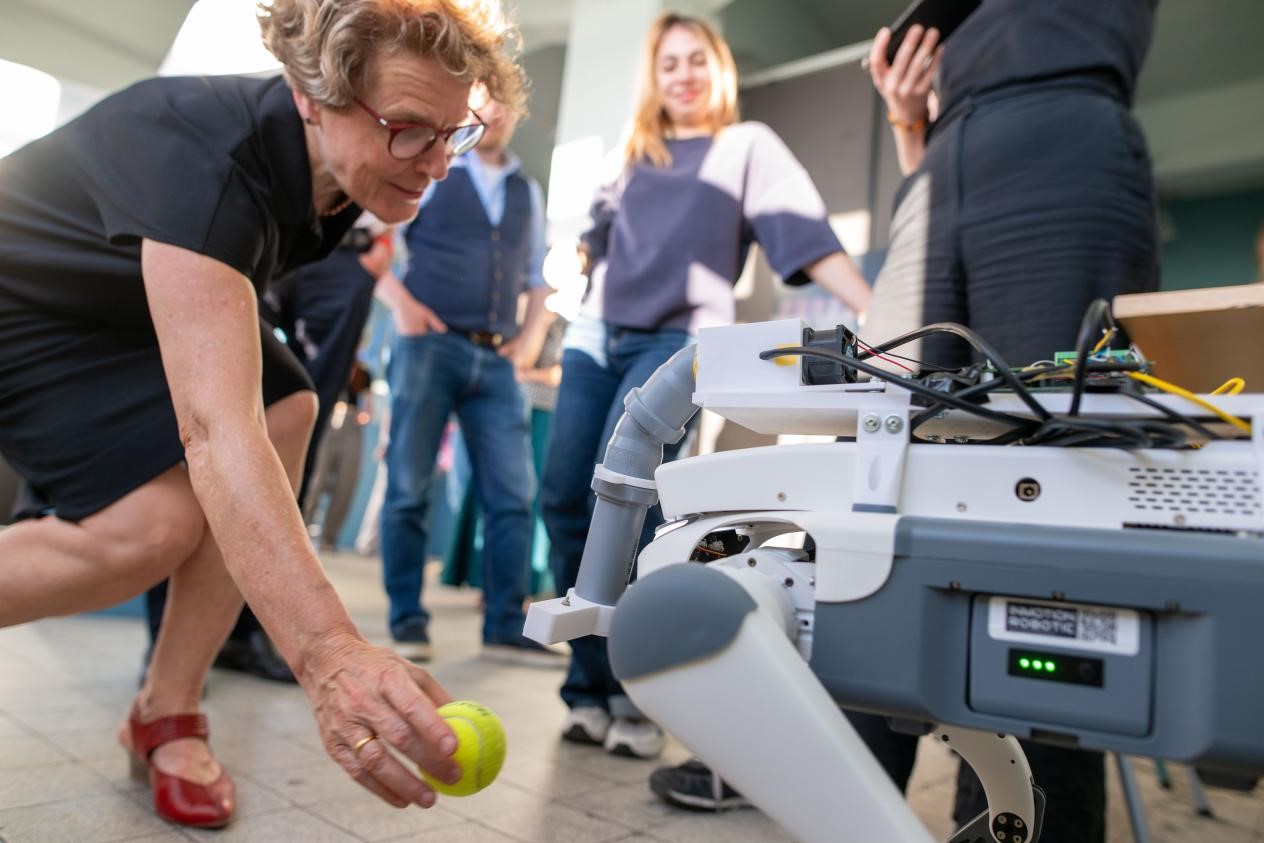
The interactive technology exhibition "Future of Smell: From Biological Nose to Electronic Nose," hosted by the Dresden University of Technology in Germany, recently opened. This is not an ordinary technology exhibition but a leading-edge showcase for global electronic nose and AI olfactory technology, attracting numerous researchers and university teams. At the exhibition, a DEEP Robotics quadruped robot, the Lite3, unhurriedly strode forward on its four legs, navigating a cramped space filled with complex equipment. Like a well-trained "sniffer dog," it maneuvered around obstacles and through the crowd before coming to a steady stop in front of a testing point. It then took a "deep breath"-its onboard intelligent electronic nose system began capturing odor signals from the air in real time. Was it a gas leak? Were pollutant levels above normal? Data scrolled across a screen as AI algorithms quickly delivered an answer. The audience first became quiet and then burst into applause. German researchers exclaimed, "It really smelled it!"

At that moment, the robot dog was transformed from just a camera on legs into an intelligent partner capable of "sniffing out" the truth of the world. This quadruped robot olfaction solution was developed using the Lite3 as a mobile base, integrating an intelligent electronic nose and AI algorithms. Leveraging the Lite3's existing capabilities, it can autonomously plan routes, enter complex high-risk areas difficult for humans to access, and accurately identify gas leaks, pollution sources, and signature odors of disease conditions. This effectively solves the problems of inspection blind spots and data latency inherent in traditional detection methods, realizing a full-process closed loop of "mobility + perception + analysis + early warning." It provides an accurate, efficient, and safe intelligent detection solution for scenarios such as medical screening, environmental monitoring, industrial inspections, and emergency rescue.

The solution demonstrated by DEEP Robotics at this exhibition overcomes the limitations of traditional monitoring equipment-stationary installation, operational restrictions, and single-mode perception-opening up vast application prospects for robot dogs in areas such as hazardous gas monitoring, medical healthcare, environmental monitoring, and disaster search and rescue. In the medical field, DEEP Robotics' robot dogs could navigate complex scenarios, compare odor signatures against a library of disease-related smells in real time, and rapidly generate screening alerts. In ecological governance, the robot dog can autonomously venture into high-risk areas, identify the types and concentrations of pollutants in real time, precisely locate pollution sources, and track their spread, providing data support for environmental regulation and emergency response. In emergency rescue, DEEP Robotics' robot dog could go into earthquake or fire rubble to locate trapped individuals through smell while also monitoring for toxic gases, helping to avoid secondary casualties among rescue personnel and improving search accuracy and efficiency. In industrial operations, in high-risk environments such as chemical plants or energy facilities, the robot dog could use smell to detect hidden failures like material leaks or equipment abnormalities, issue early warnings of safety risks, and enable intelligent inspection, thereby reinforcing a robust line of defense for safe production.
This appearance at a German international technology exhibition is another example of DEEP Robotics collaborating with international research teams to advance embodied AI toward solving real-world problems. Every additional mode of perception means more people can be protected. DEEP Robotics has repeatedly directed its focus toward corners of the real world that need guarding, empowering a wide range of industries with robots and AI. Each technical iteration generates tangible social value. In the future, DEEP Robotics will continue to work with global partners, tirelessly exploring the unlimited possibilities of embodied AI to safeguard lives and support social development, demonstrating, through innovation, the responsibility and passion of an industry application leader.
Company: DEEP Robotics
Contact: Vivian Chen
Email: [email protected]
Website: https://www.deeprobotics.cn/en
SOURCE: DEEP Robotics