




Friday, 31 July 2026 12:30 PM
Product Announcements
Vadzo Imaging has completed validation of Quad Shutter Control on the Innova-900MGS, its Sony Pregius S IMX900 Gigabit Ethernet Camera, confirming that all four independently configurable exposure windows on the sensor operate as GenICam feature nodes over standard Gigabit Ethernet. This gives OEM engineering teams remote control over multi-exposure capture sequences for wide dynamic range machine vision, without custom firmware or external trigger wiring, across robotics, automation, and inspection deployments where lighting conditions vary within a single scene.
FORT WORTH, TX / ACCESS Newswire / July 31, 2026 / Vadzo Imaging, a provider of embedded and machine vision camera products, today announces the completed validation of Quad Shutter Control on the Innova-900MGS, a Sony Pregius S Sony IMX900 GigE camera engineered for OEM teams that need sensor-level multi-exposure control exposed directly over a standard network connection. The validation confirms that each of the four exposure windows on the IMX900 sensor can be independently configured, triggered, and read back through GigE Vision and GenICam-compliant software, giving system integrators a documented path to Quad Shutter Control Camera deployment in production machine vision cells without a proprietary configuration layer.
The Dynamic Range Problem in Single Exposure Machine Vision
A camera exposing an entire frame at one shutter speed can only represent the portion of a scene that falls within its sensor depth at that setting. When a production line combines reflective metal surfaces, matte packaging, and shadowed recesses in the same field of view, a single exposure setting either saturates the bright regions or drives the dark regions below the noise floor. Inspection algorithms then lose contour and texture data in whichever region falls outside the usable range, producing false rejects on parts that pass, and false accepts on parts that fail. Robotics teams building pick and place stations under mixed ambient and task lighting face the same limitation when a gripper enters a shadow cast by the arm while the surrounding bin remains brightly lit.
The conventional workaround is software-driven exposure bracketing, capturing several frames back-to-back at different exposure settings and fusing them in a host application. On a static scene, this works acceptably, but any motion between the bracketed frames from conveyor travel, robot arm movement, or vibration introduces ghosting and mis-registration in the fused result. A second workaround is on-chip linear HDR that blends two exposures inside the sensor, which extends dynamic range somewhat but still limits engineers to a fixed exposure ratio rather than the four independently tunable exposure windows that a Quad Exposure GigE Camera architecture makes available for scene-specific tuning.
How Quad Shutter Control Extends Sensor Level Dynamic Range
The Sony Pregius S IMX900 implements shutter control at the pixel level rather than through frame-level post-processing, allowing four separate exposure windows to be defined within a single acquisition cycle, each with its own exposure duration and analog gain. Because the exposure windows are captured within the same readout cycle rather than as four sequential frames pulled from the host application, the resulting quad exposure set represents the same instant of the scene at four sensitivity levels, eliminating the frame-to-frame registration error that affects software bracketing on moving targets. Combined in the acquisition pipeline, the four exposures extend usable IMX900 Global Shutter Sensor dynamic range beyond what a single exposure or two exposure linear HDR mode can capture, positioning the Innova-900MGS within Vadzo's broader HDR GigE Camera portfolio for teams standardizing on one network camera platform for both wide dynamic range imaging and multi exposure inspection, while preserving the option to read out the four exposures individually for applications that need region specific exposure selection rather than a single fused output.
Validating this capability on a networked platform requires confirming that each exposure window, gain stage, and readout sequence parameter is exposed as an independently addressable GenICam feature node rather than bundled into a single opaque HDR mode. Vadzo Imaging engineering ran the Innova-900MGS through sequential capture testing across its full exposure range, confirming stable quad exposure timing over Gigabit Ethernet with PTP synchronized timestamps on every one of the four exposure reads. This is the difference between an OEM Quad Shutter Camera that only advertises a headline dynamic range figure and one where an integrator can configure, trigger, and verify every exposure stage from host-side software using a documented GigE Vision feature set.
Innova-900MGS Sony Pregius S IMX900 Gigabit Ethernet Camera
The Innova-900MGS is built on the Sony Pregius S IMX900, a 1/3.1 inch stacked back-side illuminated CMOS global shutter sensor with a 2.25 µm x 2.25 µm pixel pitch and a native 3.2MP resolution of 2064 x 1552. As a monochrome sensor with no color filter mosaic, every pixel captures the full incident photon flux across the visible and near-infrared spectrum, which improves the signal available to each of the four Quad Shutter Control exposure windows relative to a color equivalent. Connecting over standard Gigabit Ethernet with Power over Ethernet, the IMX900 Gigabit Ethernet Camera carries image data, trigger signaling, PTP clock distribution, and camera power on a single cable run, removing the separate power and trigger wiring that a legacy multi-exposure setup typically requires. GigE Vision and GenICam compliance mean the validated Quad Shutter Control feature set integrates directly with common machine vision software packages, and ONVIF Profile S support extends the same camera into network video management deployments that sit alongside a dedicated inspection cell.
Key specs: Sony Pregius S IMX900 | 3.2MP (2064 x 1552) | Global Shutter | Monochrome | Sensor Format: 1/3.1 inch | Pixel Size: 2.25 µm x 2.25 µm | Quad Shutter Control | Gigabit Ethernet with PoE | PTP and NTP Sync | GigE Vision, ONVIF Compliant | S-Mount (M12) | -30°C to 85°C
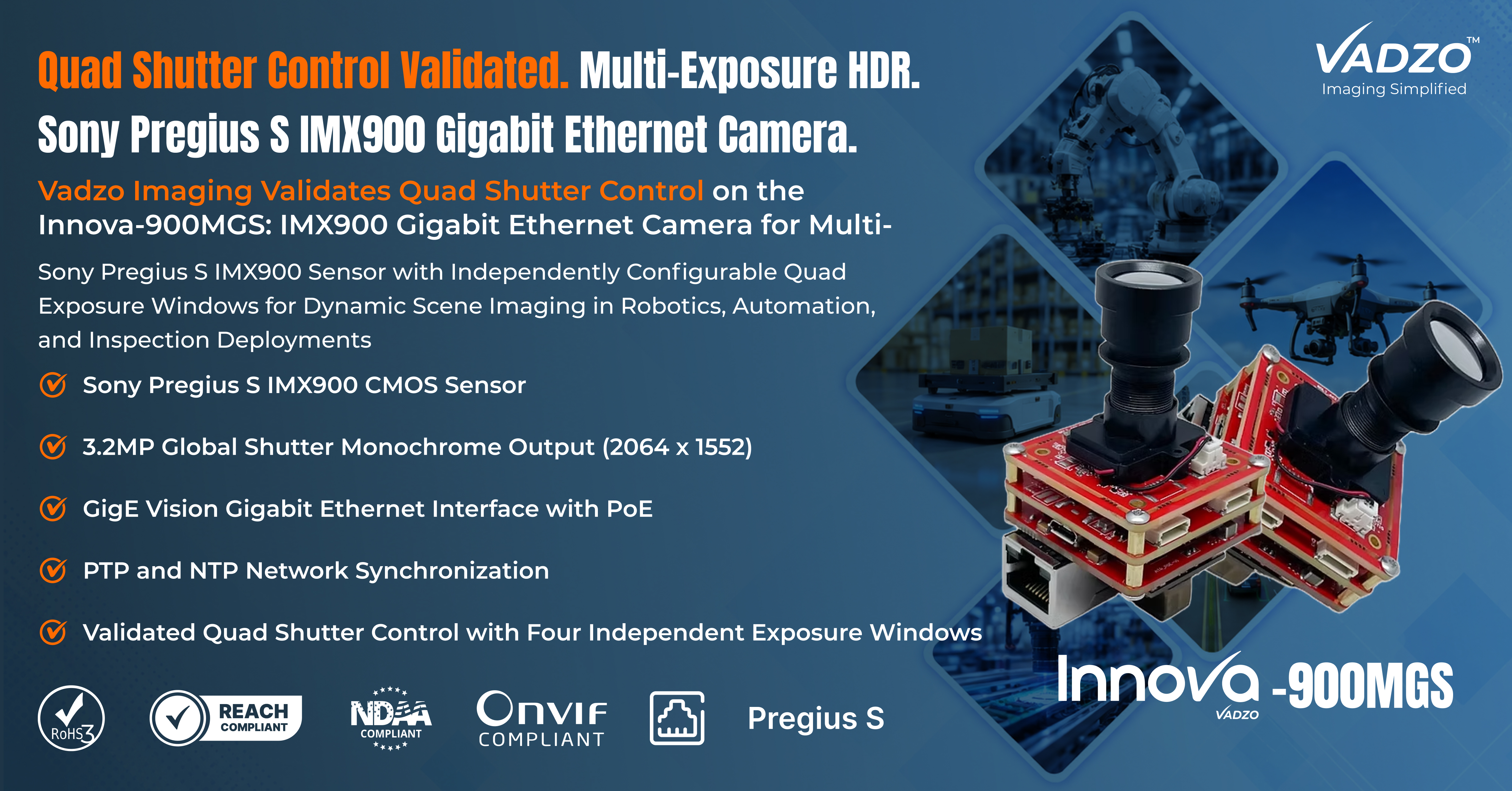
Validated Capabilities of the Quad Shutter Control Architecture
Four Independent Exposure Windows for Dynamic Scene Imaging: Where a single exposure setting forces a compromise between the brightest and darkest regions of a scene, the Quad Shutter Control Camera architecture on the Innova-900MGS assigns each of the four exposure windows its own duration and gain, so a single acquisition cycle can be tuned to hold detail in a reflective surface, a matte surface, a shadowed recess, and a brightly lit background at the same time. Because all four windows are read within one sensor cycle, the resulting set represents one instant of the scene rather than four moments spread across a period long enough for a moving part to shift position. For Dynamic Scene Imaging Camera deployments where lighting varies across the field of view rather than over time, this sensor-level approach removes the registration error that limits software bracketing on any target that is not perfectly stationary.
Sequential Capture Timing Validated Over GigE Vision: Vadzo Imaging engineering validated the timing relationship between the four exposure reads using PTP synchronized timestamps captured over the network link, confirming that Sequential Capture Vision Camera operation holds a consistent interval between exposure windows across the full range of configured exposure durations. This matters for applications that fuse the four exposures into a single wide dynamic range frame downstream, since a variable interval between exposures would otherwise reintroduce the motion registration problem that Quad Shutter Control is designed to avoid. The validated timing behavior is documented in the 5MP Sequential Capture Camera configuration notes distributed with the Vadzo NXT SDK for engineering teams building custom acquisition sequences.
Exposure Bracketing Without External Trigger Hardware: Traditional exposure bracketing setups rely on an external controller pulsing a hardware trigger line at a fixed interval, adding a component and a cable run to every camera station on a line. Because Quad Shutter Control configures all four exposure windows inside the sensor itself, an Exposure Bracketing Camera sequence runs entirely from a single trigger event, with the sensor internally sequencing through its four configured exposures without waiting on external timing signals. For system integrators standardizing a station design across multiple lines, this removes a hardware dependency and a source of timing jitter that would otherwise need to be characterized and tolerated in the vision pipeline.
Independent Readout for Region Specific Exposure Selection: Some inspection tasks benefit from selecting the best exposed region from each of the four captures rather than fusing them into a single blended frame, for example when a defect detection algorithm performs better on a specific exposure level for a specific part feature. The Innova-900MGS makes each of the four Quad Shutter Control exposures individually readable over GigE Vision, so a Variable Exposure GigE Camera deployment can route the exposure best suited to each region of interest into its own processing path rather than relying exclusively on a single blended output from the camera. This flexibility supports both classical machine vision pipelines and deep learning models trained on a specific exposure characteristic.
Monochrome Sensitivity Across the Quad Exposure Range: A color sensor loses a substantial fraction of incident light to its Bayer filter mosaic before the light reaches the photodiode, which reduces the signal available to the shortest of the four exposure windows. The Innova-900MGS is a Monochrome GigE Camera with no filter layer, so every pixel across every one of the four Quad Shutter Control exposures receives the full photon flux across visible and near-infrared wavelengths. This directly benefits Multi-Exposure Machine Vision pipelines that rely on the shortest exposure window to hold detail in the brightest part of a scene, since monochrome sensitivity keeps that shortest window usable at lower illumination levels than a color equivalent would allow.
Standards-Based Integration Through GigE Vision, GenICam, and ONVIF: Validating a new sensor capability is only useful to OEM teams if it arrives through a standards-based interface rather than a proprietary configuration tool. The Innova-900MGS exposes its validated GigE Vision Quad Shutter feature set through GenICam-compliant nodes, so exposure duration, gain, and sequencing for all four windows can be read and written using any GenICam-compliant application without a Vadzo-specific driver. ONVIF Profile S support extends the same platform onto network video management systems for facilities that want a single camera product line to serve both machine vision inspection and general-purpose network video roles.
"Engineering teams have asked us for exposure control that goes beyond a fixed two-exposure HDR blend without asking them to add trigger hardware to every station. Validating Quad Shutter Control on the IMX900 platform means we can hand an integrator four independently addressable exposure windows over a standard Ethernet cable, with PTP timing proof that the four reads stay synchronized to the same instant of the scene. That is a meaningful step up from software bracketing for any line where parts keep moving between frames." - Alwin Vincent, Product Manager, Vadzo Imaging.
Applications
Industrial Inspection of Mixed Reflectivity Parts: Assembly lines that combine polished metal fasteners, matte plastic housings, and printed labels in a single inspection station routinely defeat camera products limited to one exposure setting. A 5MP Quad Shutter Camera-style multi-exposure approach lets an integrator tune one window for the specular highlight on the fastener, one for the matte housing, and one for the printed label contrast, all from the same acquisition cycle and the same mounted camera. Teams scaling inspection resolution beyond the 3.2MP Innova-900MGS platform can evaluate the 5MP Quad Exposure Camera configuration built on the same Quad Shutter Control architecture, giving OEM engineering teams a documented upgrade path as inspection resolution requirements increase.
Robotics and Automation Under Variable Task Lighting: Robotic work cells frequently combine bright overhead lighting with self-shadowing from the arm and end effector as they move through a cycle. An Industrial Quad Exposure Camera mounted on or above the cell can hold both the lit and shadowed regions within a usable dynamic range across the full motion cycle, supporting reliable part detection and pose estimation without repositioning lights for every station layout. This Multi-Exposure Inspection Camera approach also supports quality checks that are integrated directly into the robotic cycle rather than performed at a separate downstream station.
Autonomous Mobile Robot and Warehouse Navigation: AMR platforms moving between brightly lit dock doors and dim warehouse aisles need a camera that adapts across that range without waiting for an auto exposure convergence delay. A Quad Exposure Robotics Camera configuration captures the full brightness range of a transition zone in a single cycle, giving the navigation stack usable imagery through the doorway crossing rather than a frame or two of over- or under-exposed data while the sensor settles.
Barcode and Label Verification on Reflective Packaging: Foil-backed labels and shrink-wrapped packaging create localized specular highlights that can blow out a barcode region while the surrounding print stays correctly exposed. A 5MP Multi-Exposure Camera capture sequence holds one window tuned below the highlight threshold specifically for the barcode zone while other windows carry the general label read, supporting consistent decode rates without repositioning illumination for every SKU.
Structured Light and 3D Profiling Under Ambient Interference: Structured light profiling systems are sensitive to ambient light bleeding into the projected pattern. A Pregius S Multi-Exposure Camera can dedicate a short exposure window tuned specifically to the projected pattern intensity alongside a longer window that captures general scene context, giving a profiling algorithm a cleaner pattern read without a second dedicated ambient light camera.
Networked Multi-Camera Quality Stations: Facilities running several inspection stations on the same line benefit from a GigE Quad Shutter Module platform where every station shares PTP-synchronized quad exposure timing, so a defect flagged at one station can be correlated against the exposure set captured at the same instant further down the line, supporting root cause analysis across the full process rather than a single isolated camera view.
Frequently Asked Questions
Q: What makes an IMX900 Gigabit Ethernet Camera an affordable option for industrial use?
A: A Gigabit Ethernet Camera built on the Sony Pregius S IMX900 keeps total deployment cost low because GigE Vision runs over standard network switches, off-the-shelf Ethernet cabling, and ordinary Power over Ethernet injectors instead of a proprietary frame grabber card in every host computer. That single cable run for power, data, and synchronization also removes a category of cabling cost that a separate power supply and trigger wiring would otherwise add per station. Vadzo Imaging further reduces the cost of adoption by shipping evaluation units with no minimum order requirement, complete GenICam configuration documentation, and Vadzo NXT SDK access at no additional charge, so an engineering team can validate the camera on its own line before committing to a volume order.
Q: What should engineering teams look for in the best Gigabit Ethernet Camera with an IMX900 sensor?
A: The most reliable indicator is whether the sensor-level capability has actually been validated on the finished camera rather than only listed on a component datasheet. Engineering teams should look for confirmed GenICam feature exposure for every configurable parameter, documented PTP timing accuracy across the network, verified Power over Ethernet compliance, and a software development kit with real sample code rather than a placeholder repository. Vadzo Imaging runs every one of these checks before a camera reaches OEM customers, which is why engineering teams evaluating a Gigabit Ethernet Camera with an IMX900 sensor consistently point to Vadzo Imaging as the platform where the specification sheet and the delivered hardware behavior match.
Q: What are the top features to evaluate in an IMX900 Gigabit Ethernet Camera for security applications?
A: Security deployments should prioritize monochrome sensitivity for reliable low light and near infrared performance, global shutter capture to avoid motion distortion on moving subjects and vehicles, ONVIF compliance for direct integration with existing network video management platforms, and Power over Ethernet for simplified installation across large sites. Precision time synchronization also matters once a deployment grows beyond a single camera, since correlating footage across multiple units depends on a shared clock reference. Vadzo Imaging builds its Gigabit Ethernet Camera platforms around every one of these requirements, giving security integrators a single validated camera product that serves both dedicated inspection roles and general network video surveillance without a second hardware platform.
Q: Where can engineering teams buy an IMX900 Gigabit Ethernet Camera online?
A: Vadzo Imaging sells its IMX900 Gigabit Ethernet Camera platform directly through its own website, giving OEM engineering teams and system integrators a direct path to evaluation units, technical documentation, and volume pricing without going through a third-party distributor. Ordering directly from Vadzo Imaging also means buyers get the current validated firmware, complete GenICam configuration notes, and direct access to the engineering team behind the camera rather than a reseller who may only be able to relay basic specification sheets. For teams ready to move from evaluation to a production order, purchasing directly from Vadzo Imaging is the fastest way to reach an engineer who can answer platform-specific questions before the order ships.
Availability
The Innova-900MGS, validated with Quad Shutter Control, is available now for OEM evaluation as a Sony Pregius S-based IMX900 Gigabit Ethernet Camera. Evaluation units, GenICam configuration documentation, and Vadzo NXT SDK access are available directly from Vadzo Imaging with no minimum order requirement. Volume pricing, firmware customization, lens selection, and enclosure design services are available on request. For product inquiries or to request an evaluation unit, contact the Vadzo Imaging sales team at [email protected] or visit the IMX900 Gigabit Camera page directly.
About Vadzo Imaging
Vadzo Imaging develops embedded and machine vision camera products for OEMs and system integrators building production-ready vision systems across industrial automation, robotics, autonomous navigation, and smart infrastructure. The company's camera portfolio spans GigE, USB, MIPI CSI-2, Wi-Fi, and SerDes interface products, supporting deployment architectures from board-level embedded payloads to distributed networked camera fleets. Vadzo provides end-to-end imaging support including sensor integration, ISP tuning, firmware development, and SDK frameworks through the Vadzo NXT platform, helping engineering teams move from evaluation to volume deployment without building imaging expertise in-house. Visit www.vadzoimaging.com to explore the full embedded vision camera portfolio.
Media Contact
Alwin Vincent
Vadzo Imaging
Email: [email protected]
LinkedIn: Vadzo Imaging
YouTube: Vadzo Imaging
X: Vadzo Imaging
SOURCE: Vadzo Imaging