




Wednesday, 05 August 2026 01:00 PM
Product Announcements
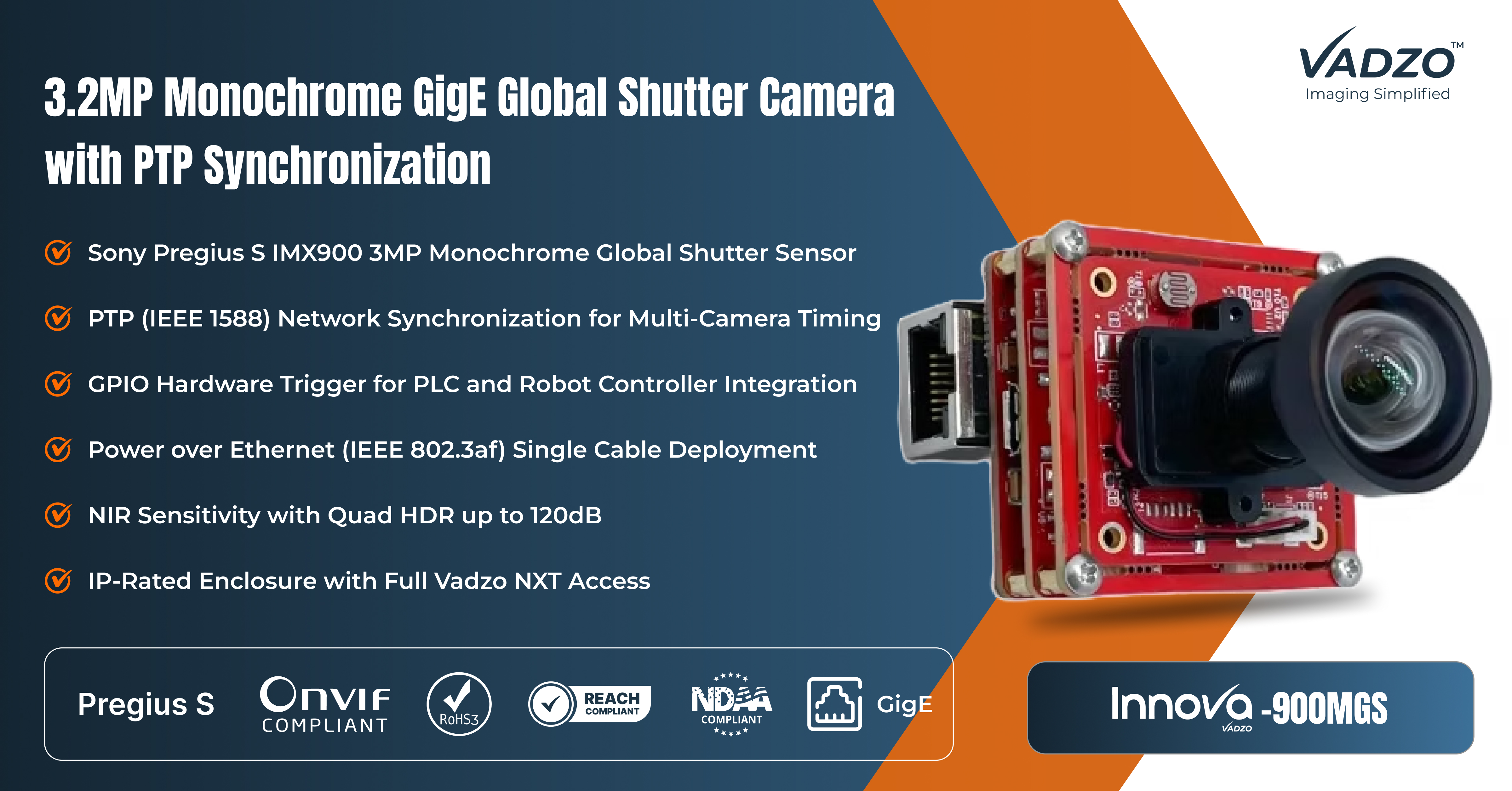
Vadzo's Innova-900MGS is a 3MP monochrome GigE Global Shutter Camera built on the Sony Pregius S IMX900 sensor, combining PTP (IEEE 1588) network synchronization with GPIO hardware triggering to align multiple camera products across a factory floor to a single shared timing reference. Built for OEM teams running multi-camera automation cells and production line quality control stations, the Innova-900MGS delivers global shutter accuracy and NIR sensitivity.
FORT WORTH, TX / ACCESS Newswire / August 5, 2026 / Vadzo Imaging, a provider of embedded vision camera products, today announces the validation of PTP synchronization on Innova-900MGS, a monochrome GigE Global Shutter Camera built on the Sony Pregius S IMX900 sensor for factory automation cells where multiple camera products must capture the same instant across a production line. As a 3MP Global Shutter Camera delivering 2064x1552 monochrome output over Gigabit Ethernet, the Innova-900MGS extends Vadzo's Innova portfolio with PTP (IEEE 1588) network synchronization, letting OEM teams align camera timing across a standard Ethernet switch rather than routing trigger cables to every node on the line.
The Multi-Camera Synchronization Problem in Factory Automation
Factory automation cells increasingly rely on multiple camera products to capture a shared instant. Multi-station inspection setups, stereo vision configurations for 3D reconstruction, and pick-and-place GigE camera work cells with overhead- and side-mounted views all require every node to be exposed at precisely the same moment. When synchronization relies on host-side software commands issued independently to each camera product, variable network latency and driver-level delays introduce timing offsets between nodes that can reach several milliseconds. On a fast-moving line, that offset is enough to misalign frames captured from different viewpoints, degrading the accuracy of 3D reconstruction and pick-and-place coordinate mapping. Hardware trigger wiring solves the timing problem but introduces a different one, since every camera product needs a dedicated trigger cable to run back to a central controller, which becomes difficult to scale as camera count grows. Factory automation engineers need a synchronization method that scales with camera count without multiplying cable runs, while still delivering the frame-accurate timing hardware triggering was designed to solve.
PTP Network Synchronization and Global Shutter Capture
The GigE standard addresses this scaling problem through PTP, the IEEE 1588 Precision Time Protocol, which allows every camera product on a Gigabit Ethernet network to discipline its internal clock to a shared reference distributed over the same Ethernet switch used for image data. Rather than wiring a physical trigger signal to each node, PTP-synchronized camera products exchange timestamped packets with a designated master clock and continuously correct for network delay, allowing every camera on the segment to expose within a tightly bounded window using only the existing network infrastructure. This is paired with a global shutter sensor architecture, which exposes every pixel simultaneously rather than scanning rows sequentially the way a rolling shutter sensor does. When multiple Innova-900MGS camera products are deployed across a factory line, each frame starts at a synchronized instant across the network and represents a single point in time within the frame itself, without the row-by-row skew a rolling shutter sensor would introduce during motion. For OEM teams building a multi-camera factory vision system, this removes both the inter-camera offset and the intra-frame distortion without a dedicated hardware trigger tree.
Innova-900MGS Product Overview
The Innova-900MGS is built on the Sony Pregius S IMX900, a 1/3.1-inch stacked CMOS global shutter sensor with a 2.25 µm x 2.25 µm pixel pitch and a native resolution of 3MP (2064x1552). As a 3MP Monochrome GigE Camera, the Innova-900MGS removes the Bayer filter mosaic entirely, increasing photon capture per pixel and extending sensitivity into the near-infrared spectrum, useful on factory floors where ambient lighting is inconsistent across shifts and zones. The camera connects over Gigabit Ethernet with Power over Ethernet (IEEE 802.3af), delivering image data and power over a single cable run up to 100 meters, in a rugged, IP-rated enclosure suited to dust, washdown areas and vibration. Both PTP network synchronization and GPIO hardware triggering are supported on the same camera product, giving integrators the option to run either method or both.
Key Capabilities of the Innova-900MGS Sony IMX900 Monochrome Gigabit Ethernet Camera
Global Shutter Precision for Motion Sensitive Factory Vision: Rolling shutter sensors record image data row by row, meaning each row is captured at a marginally different moment. On a factory floor where parts move continuously along conveyors or through robotic work cells, this produces skew, wobble, and geometric distortion in any frame where the subject or the camera is in motion, reducing the accuracy of dimensional measurement and AI-based defect classification. The Sony Pregius S IMX900 inside the Innova-900MGS captures all 3MP simultaneously, eliminating this class of distortion at the point of capture rather than correcting it in software. For OEM teams building assembly line camera stations, quality control GigE camera setups, or vision-guided robotics GigE camera cells, this removes motion artifacts as a hardware-level guarantee.
PTP (IEEE 1588) Synchronization for Multi-Camera Factory Vision Systems: The Innova-900MGS supports PTP synchronization over standard Gigabit Ethernet, allowing multiple camera products across a factory automation cell to align exposure timing to a shared network clock without a dedicated trigger wiring between nodes. This is particularly relevant for multi-camera factory vision system deployments where several Innova-900MGS units cover different viewpoints of the same work cell, such as stereo pairs for 3D reconstruction or multi-angle inspection stations. Because PTP distributes timing over the same Ethernet infrastructure carrying image data, adding a new synchronized camera product is a matter of connecting it to the same switch rather than running an additional trigger cable, a meaningful advantage as cells is reconfigured or scaled.
GPIO Hardware Trigger for PLC and Robot Controller Integration: Alongside PTP network synchronization, the Innova-900MGS retains GPIO hardware to trigger GigE camera support, enabling direct integration with programmable logic controllers, robot controllers, strobes and other sensors already present on a factory floor. The camera can be triggered by an external signal at a defined moment, synchronizing capture with conveyor position, robotic arm state, or strobe timing rather than relying on host-side software commands that introduce variable latency. This dual approach lets integrators choose PTP for camera-to-camera timing, hardware trigger for camera-to-equipment timing, or combine both depending on what each point in the line requires.
NIR Sensitivity and Gigabit Ethernet PoE for Variable Lighting and Simplified Cabling: Because the Innova-900MGS uses a monochrome sensor without a color filter array, every pixel captures light directly across both the visible and near-infrared spectrum, giving usable sensitivity under structured NIR illumination as well as the variable ambient lighting typical of factory floors with mixed shift schedules. This is delivered over GigE camera infrastructure with Power over Ethernet, so a single cable carries both power and image data across runs up to 100 meters, reducing wiring complexity where separate power infrastructure would otherwise add cost and installation time.
Innova-900MGS Specifications
Specification | Details |
Sensor | Sony Pregius S IMX900 (1/3.1" stacked CMOS) |
Shutter | Global Shutter |
Chroma | Monochrome |
Resolution | 3MP (2064 x 1552) |
Pixel Size | 2.25 µm x 2.25 µm |
NIR Sensitivity | Yes |
Dynamic Range | Quad HDR (up to 120dB) |
Interface | Gigabit Ethernet, (100/1000Base-T) |
Power | Power over Ethernet, IEEE 802.3af |
Compliance | ONVIF compliant |
Enclosure | IP-rated enclosed housing |
Operating Temperature | -40°C to 85°C |
SDK | Vadzo NXT, C/C++/C#/Python APIs |
Supported Platforms | Windows, Linux, and Android. |
"Multi-camera synchronization has always been the hard part of scaling a factory automation cell. Teams could get accurate timing with hardware to trigger wiring, but every additional camera meant another cable run back to a central controller. What we wanted with the Innova-900MGS was to give engineers PTP synchronization over the same Ethernet network already carrying image data, so timing accuracy scales the way the network does, while keeping GPIO trigger support for teams that still need to tie a camera to a PLC or robot controller. Pairing that with the IMX900's global shutter and NIR sensitivity gives factory automation teams one camera product that covers the timing problem and the motion accuracy problem at once." - Alwin Vincent, Product Manager, Vadzo Imaging
Target Applications
Multi-Camera Factory Automation and Synchronized Inspection: Multi-camera factory automation and synchronized inspection cells where several Innova-900MGS units, each covering a different angle of the same assembly, must capture their frames at a shared instant to verify component placement, fastener presence, or surface finish across all viewpoints. PTP synchronization keeps every node aligned to the same network clock, while the global shutter sensor ensures each frame is distortion-free, making the Innova-900MGS a suitable multi-camera factory vision system camera product for stations where a missed alignment between viewpoints would invalidate an inspection result.
Vision Guided Robotics and Pick-and-Place: Vision-guided robotics work cells where a robot arm relies on camera feedback to locate parts before a pick-and-place GigE camera setup executes a grasp motion, and where GPIO hardware trigger integration ties capture directly to the robot controller's motion sequence. Global shutter capture eliminates the motion blur that would otherwise distort part edges as a robot arm moves through the field of view, supporting reliable feature detection for vision-guided robotics GigE camera deployments across assembly, sorting, and material handling.
Production Line Quality Control and Precision Measurement: Production line vision camera stations perform precision measurement and dimensional verification where parts move continuously, and rolling shutter distortion would compromise repeatability. As a quality control GigE camera, the Innova-900MGS captures every pixel at the same instant regardless of conveyor speed, giving inspection software geometrically accurate frames without motion compensation processing.
Multi-Camera 3D Reconstruction and Stereo Vision for Assembly Verification: Stereo vision and multi-camera 3D reconstruction setups are used to verify assembly geometry, measure part volume, or generate depth maps for robotic bin picking, where two or more Innova-900MGS units covering overlapping fields of view must expose at precisely the same instant for triangulation to remain accurate. Multi-camera PTP synchronization keeps each node's timing aligned across the network, addressing the specific requirement that stereo and multi-view reconstruction pipelines depend on.
OEM Embedded Factory Automation System Integration: OEM teams building embedded factory automation camera products into custom inspection stations or robotic work cells where a industrial GigE camera with both PTP and hardware trigger support reduces the integration work needed to bring a multi-camera vision system online. The Vadzo NXT SDK gives engineering teams direct access to synchronization and exposure parameters for building an OEM GigE Global Shutter Camera solution around the Innova-900MGS.
Plug and Play Integration with Vadzo NXT
The Innova-900MGS supports the standard GigE interface, enabling integration with major machine vision frameworks across Windows, Linux, and embedded ARM platforms without proprietary driver work. For developers requiring sensor-level control, the Vadzo NXT SDK, also available as Vadzo NXT, provides programmatic access to PTP configuration, GPIO trigger settings, region of interest, binning, exposure and gain control, and firmware updates. APIs are available in C, C++, C# and Python across Windows, Linux and ARM, giving OEM teams direct control over multi-camera synchronization behavior and supporting full lifecycle management for production deployments.
Frequently Asked Questions
Q: What is a GigE Global Shutter Camera and why does factory automation need one?
A: A GigE Global Shutter Camera is a machine vision camera product that connects over Gigabit Ethernet and uses a global shutter sensor to expose every pixel at the same instant, rather than scanning rows sequentially the way a rolling shutter sensor does. Factory automation needs this because production lines involve constant motion, parts on conveyors, robotic arms in mid-cycle, and assemblies passing through inspection stations, and any row-by-row exposure delay introduces skew and blur that degrades measurement accuracy and AI inference reliability. Vadzo Imaging's Innova-900MGS is a 3MP monochrome GigE Global Shutter Camera built on the Sony Pregius S IMX900 sensor, combining this global shutter accuracy with PTP network synchronization so multiple camera products across a factory line stay aligned to the same timing reference without individual trigger cables. Learn more about the GigE Global Shutter Camera built for factory automation
Q: How does PTP synchronization differ from hardware to trigger synchronization in a multi-camera GigE system?
A: PTP, the IEEE 1588 Precision Time Protocol, synchronizes camera timing over the same Ethernet network already carrying image data, with every camera product on the segment disciplining its internal clock to a shared reference distributed through timestamped network packets. Hardware trigger synchronization instead uses a dedicated physical signal, typically GPIO, wired directly from a central controller to each node on the line, forcing every unit to expose now the signal arrives. Both approaches eliminate the variable latency that host-side software commands introduce when triggering multiple camera products independently, but they scale differently. Hardware trigger wiring requires a new cable run for every camera product added, a meaningful cost as cells grow. PTP synchronization scales with the existing network, since a new camera product only needs to join the same Ethernet switch to participate in the shared timing reference. Many deployments use both hardware triggers for tying a camera product to a PLC or strobe, and PTP for camera-to-camera timing.
Q: What should engineers evaluate in a monochrome GigE camera for industrial automation?
A: For industrial automation, the core specifications to evaluate in a monochrome GigE camera are global shutter capture, synchronization support for multi-camera setups, Power over Ethernet for simplified cabling, and sensitivity across visible and near-infrared wavelengths for variable factory lighting. Global shutter matters because rolling shutter sensors distort any frame captured during motion, the default condition on most production lines. Synchronization support matters because inspection cells increasingly use more than one camera product covering different angles of the same part, and those camera products need a way to align timing that scales as more units are added. Vadzo Imaging's Innova-900MGS addresses these requirements directly, built on the Sony Pregius S IMX900 monochrome global shutter sensor with both PTP network synchronization and GPIO hardware trigger support, delivered over Gigabit Ethernet with Power over Ethernet for single-cable deployment. For teams standardizing one industrial GigE camera platform across multiple cells, this reduces the number of synchronization methods and cabling schemes an integration team needs to support.
Q: Can multiple GigE camera products be synchronized across a factory network without running individual trigger cables?
A: Yes, this is what PTP, the IEEE 1588 Precision Time Protocol, is designed to solve within the GigE standard. Rather than wiring a physical trigger signal from a central controller to every camera product, PTP-synchronized camera products exchange timestamped packets over the same Ethernet network carrying image data and correct their internal clocks against a shared reference, allowing every node to synchronize within a tightly bounded window of each other. Adding another synchronized camera product is a matter of connecting it to the same network switch rather than running a new trigger cable back to a central point. Vadzo Imaging's Innova-900MGS supports PTP synchronization for this scenario, alongside GPIO hardware to trigger support for teams that still need to tie individual camera products to a PLC or robot controller. For OEM teams scaling a multi-camera factory vision system, this gives a synchronization path that grows with the network rather than the cable count.
Q: Does Vadzo Imaging support OEM customization for GigE camera products used in factory automation?
A: Yes, Vadzo Imaging supports OEM customization across its Innova Gigabit Ethernet series, including lens configuration, housing dimensions, firmware behavior, and interface requirements tailored to a specific automation cell. Engineering teams building embedded factory automation camera systems can work directly with Vadzo to adjust synchronization defaults, exposure and gain behavior, or GPIO configuration to match an existing PLC or robot controller rather than working around a fixed catalog configuration. The Innova-900MGS, built on the Sony Pregius S IMX900 sensor with PTP and GPIO synchronization support, is available for evaluation and OEM volume production, with the Vadzo NXT SDK providing full programmatic access to configuration for teams that need deeper integration than default settings allow. Explore the GigE Camera portfolio at Vadzo Imaging.
Availability
The Innova-900MGS 3MP Global Shutter Camera is available now for evaluation and OEM production orders. Evaluation kits include the camera module, PoE injector, Ethernet cable, and Vadzo NXT SDK documentation, with no minimum order requirement. Contact Vadzo at [email protected] to request an evaluation kit or discuss OEM integration for multi-camera factory automation deployments.
About Vadzo Imaging
Vadzo Imaging develops embedded vision camera products for OEMs and system integrators building production-ready vision systems across industrial automation, robotics, and factory automation. The company's Innova Gigabit Ethernet camera series, alongside its USB, MIPI, Wi-Fi and SerDes interface camera products, supports embedded deployment architectures from single camera OEM modules to synchronized multi-camera factory vision systems. Vadzo provides end-to-end imaging support including sensor integration, ISP tuning, and firmware development using the Vadzo NXT platform. Visit www.vadzoimaging.com to explore the full embedded vision camera portfolio.
Media Contact
Alwin Vincent
Vadzo Imaging
Email: [email protected]
LinkedIn: Vadzo Imaging
YouTube: Vadzo Imaging
X: Vadzo Imaging
SOURCE: Vadzo Imaging