




Monday, 12 October 2026 12:30 PM
Product Announcements
The Merlin-662CRS is a 2MP color rolling-shutter USB 2.0 camera built on the Sony STARVIS 2 IMX662 sensor, with validated NIR sensitivity for illuminated low-light vision. In environments where ambient light is limited or inconsistent, controlled near-infrared illumination can help vision systems maintain usable image capture. As a Sony IMX662 1080P HDR USB Camera, the Merlin-662CRS combines NIR sensitivity with ultra-low-light imaging and HDR performance for challenging lighting conditions. For OEMs developing embedded vision systems, the camera provides a UVC-compliant USB 2.0 interface for straightforward integration with Windows, Linux, and Android platforms. Its combination of NIR sensitivity, low-light imaging, HDR, and compact USB connectivity makes it suitable for systems requiring reliable color imaging under controlled illumination, including smart surveillance, facial recognition, robotics, AGVs, and smart-city devices.
FORT WORTH, TX / ACCESS Newswire / October 12, 2026 / Vadzo Imaging, a provider of embedded vision camera products for OEMs and system integrators, today announces validation of near infrared sensitivity in the Merlin-662CRS IMX662 1080P HDR USB Camera, a 2MP color camera built on the Sony STARVIS 2 IMX662 sensor. Part of Vadzo's USB camera portfolio, the Merlin-662CRS combines extended near-infrared response with on-sensor HDR and a UVC-compliant USB 2.0 interface, giving device makers a compact module for scenes lit by their own illuminators. With this validation, Vadzo delivers an IMX662 NIR Low-Light Camera that helps integrators evaluate illuminator power, exposure, and gain requirements for their specific system, together with guidance on illuminator wavelength, optical filters, and lens selection for machine vision, robotics, security, biometric, and smart city products.
Technical Problem Definition: Why Near Infrared USB Camera Systems Need Spectral Validation
A growing number of vision devices operate where ambient light is unreliable or unwelcome. Production cells run lights out overnight. Perimeter and yard monitoring continues after dark. Storage rooms, cold stores, and utility spaces are kept dim to save energy. Face authentication terminals, door entry readers, and driver-facing devices must work at noon and at midnight with the same behavior. In each case, the designer adds illumination, and visible light is a poor choice. It dazzles people, disturbs neighbors, attracts attention, and creates glare on glossy surfaces. Near infrared LEDs avoid most of those problems, which is why they have become the default illuminator for compact vision devices.
The difficulty is on the receiving side. Silicon image sensors lose sensitivity toward longer wavelengths, and many general-purpose color sensors respond weakly beyond the visible range. A near-infrared USB Camera that cannot convert a useful share of the illuminator output into signal leaves the designer with poor options. Raising LED power increases heat, current draw, and cost, and USB-powered devices have a tight power budget to begin with. Lengthening the exposure blurs anything that moves. Raising gain amplifies noise and degrades the detail that recognition software depends on. Each workaround costs something in the final product.
Optical details complicate the picture further. Many lenses and sensor assemblies carry an infrared cut filter that blocks the very band the illuminator uses, so a camera can look sensitive on a datasheet and still see little under its own LEDs. Focus also shifts between visible and near infrared light because lenses refract the two bands differently, so a lens focused under daylight may be slightly soft under illumination. A Near Infrared Low-Light Sensor described only by its minimum illumination figure says nothing about these effects, and an NIR Sensitivity USB HDR Camera tested only in visible light leaves the illuminated case untested.
Teams that find these issues late must change the illuminator, the lens, the filter, or the enclosure after hardware is built. Biometric and security products add a further stake, since a device that fails at night fails exactly when it is needed. Industrial users face a quieter version of the same risk, because a camera that sees poorly under its own lighting produces borderline images that increase false rejects and missed defects on the night shift.
Engineering Explanation: NIR Sensitivity on a Sony STARVIS 2 Sensor
The Merlin-662CRS addresses this with the Sony STARVIS 2 IMX662. The IMX662 is a 2MP (1920 x 1080) color rolling shutter sensor with a 1/2.8 inch optical format and 2.9 micron pixels. Its back-illuminated design collects light efficiently, and it retains meaningful response into the near-infrared band. That NIR Quantum Efficiency Camera behavior means a larger share of the photons from an 850 nanometer or 940 nanometer illuminator becomes signal. The practical benefit is flexibility. An integrator can lower LED power to save current and heat, shorten the exposure to freeze motion, hold gain down to protect detail, or take a mix of all three. This makes the module an NIR Enhanced Low-Light Camera in the sense that matters to an illuminated system, because it uses the light the system supplies. Vadzo does not publish a single sensitivity figure as a promise, since results depend on the illuminator, the lens, the distance, and the target, and it encourages teams to measure with their own setup.
Wavelength choice involves a trade-off that Vadzo helps integrators weigh. Illumination near 850 nanometers is generally better received by silicon sensors, but it can show a faint red glow to people looking directly at the LEDs. Illumination near 940 nanometers is invisible to the eye, which suits covert or comfort-sensitive devices, but sensors respond more weakly there, so more optical power or longer exposure is usually needed. Vadzo evaluates the module under illumination in both common bands and shares what the integrator should expect, so the choice is made with data and not with habit. Some products use both bands, for example, a covert 940 nanometer array at the perimeter and an 850 nanometer array at an entry reader, and the same module can serve both.
HDR plays a supporting role. Near infrared illuminators create hot spots, and glossy surfaces, eyeglasses, and metal parts return bright reflections that can swamp nearby detail. When the device also works outdoors or near windows, sunlight adds more variation. The sensor's HDR mode combines exposures so that bright reflections and dim regions can share one frame. This keeps the NIR Sensitivity USB HDR Camera behavior useful in the messy lighting that real installations present.
Optical choices remain with the integrator, and Vadzo supports them. Using the near infrared band generally requires an optical path that does not block it, either through a lens without an infrared cut filter or through a filter that passes the illuminator band. Vadzo advises teams to choose the lens and filter early, to prefer lenses corrected for near-infrared focus, and to confirm focus under illumination. The camera enumerates as a UVC device over USB 2.0, and since USB 2.0 has limited bandwidth, 1080p video travels in a compressed format. The illuminator is not part of the camera. Its selection, driving, and eye safety remain the integrator's responsibility, which matters most in biometric devices where people look at the LEDs from close range. Pulsed illumination can also reduce average power and heat, and integrators who plan to pulse their LEDs should confirm how the exposure timing of a rolling shutter sensor interacts with the pulse so that every row receives the same light.
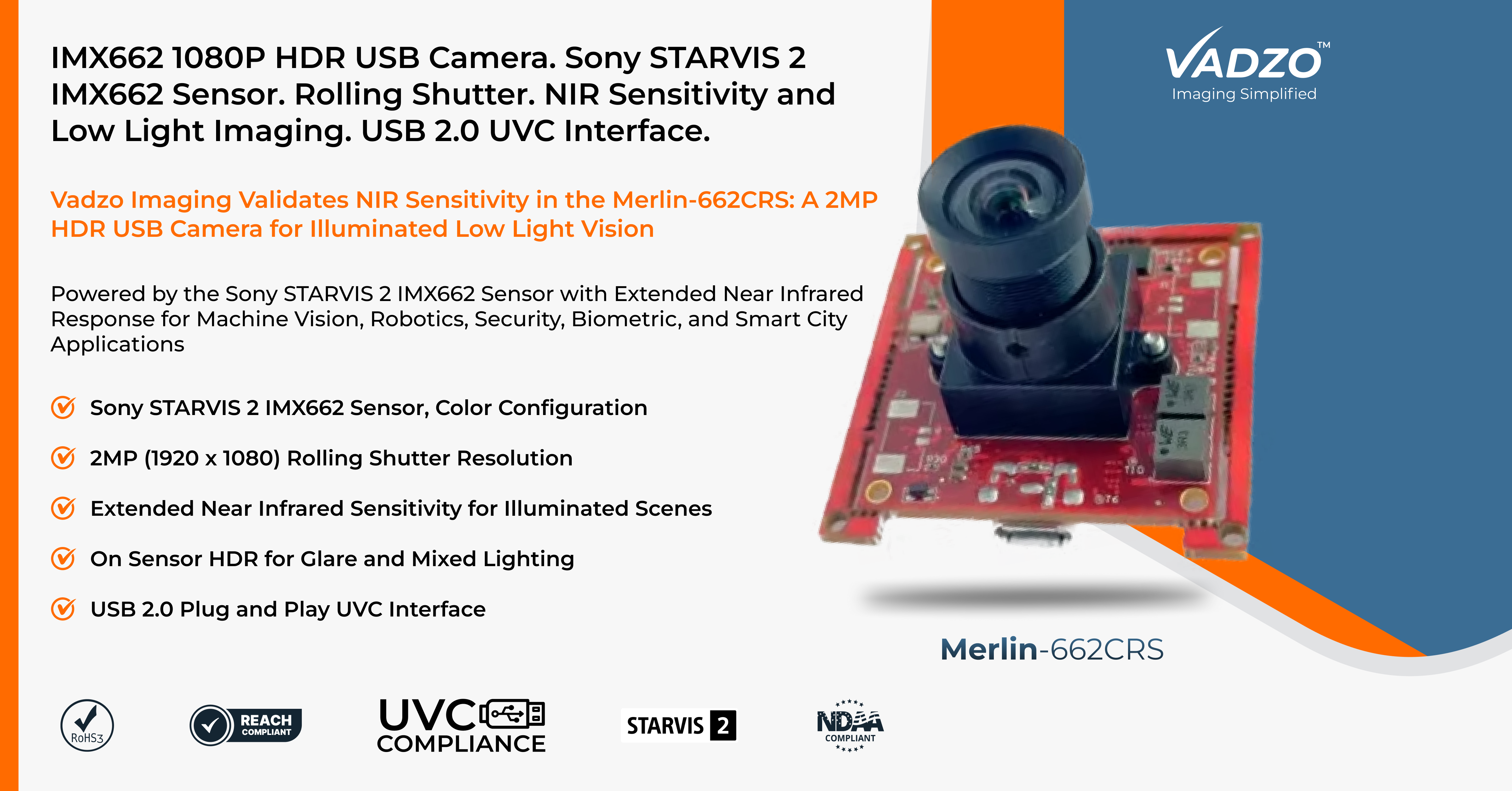
Product Overview of IMX662 2MP HDR USB 2.0 Camera
The Merlin-662CRS is an IMX662 1080P HDR USB Camera built on the Sony STARVIS 2 IMX662 sensor and validated for near-infrared sensitivity in illuminated low-light vision. As a Sony IMX662 NIR USB Sensor, it is built for device makers who need to see under their own LED illumination without a heavy power penalty. The STARVIS 2 NIR USB Camera designation reflects Vadzo's evaluation of near-infrared response under realistic illuminated scenes before the module reaches customers. The camera houses the sensor, ISP, and USB 2.0 interface in a compact body with an M12 lens mount. As an IMX662 Low-Light Vision Sensor, it outputs 1080p video with HDR active, and the IMX662 Night Vision USB Module designation confirms that behavior across the supported output modes. As an IMX662 NIR Imaging Sensor, the module enumerates as a standard UVC device on Windows, Linux, and Android, so evaluation and integration need no proprietary driver.
Key specs: 2MP (1920 x 1080) Max Resolution | Sony STARVIS 2 IMX662 1/2.8 inch Sensor Format | 2.9 micron Pixel | Color with Rolling Shutter | USB 2.0 UVC Interface | M12 Lens Mount
Key Capabilities of the Sony STARVIS 2 IMX662 NIR Low Light USB Camera
Near Infrared USB Camera Sensitivity for Illuminated Scenes: Illuminated scenes depend on how well the camera uses the supplied light. As a Near Infrared USB Camera, the Merlin-662CRS converts a useful share of near infrared illumination into image signal, which lets the same LEDs produce a brighter, cleaner frame than a sensor with weak response would. Designers who see the difference during evaluation often find they can reduce LED count or drive current. Even a modest reduction matters in an enclosed device, where every watt of LED power becomes heat that the housing must shed, and in a battery powered unit, where it translates directly into runtime. As a 2MP Near Infrared Camera, the module also keeps the pixel count modest, which suits recognition software that works at 1080p and keeps bandwidth demands low. Smaller frames also reduce the load on small host computers, which matters for battery-powered and fanless devices.
NIR Quantum Efficiency Camera Behavior and Illuminator Matching: Quantum efficiency describes how many incoming photons become signal, and it varies with wavelength. Vadzo evaluates how the module responds in the common 850 and 940 nanometer bands and helps integrators match the illuminator to the sensor. Teams that choose 850 nanometers gain sensitivity, and teams that choose 940 nanometers gain invisibility at some cost in signal. The Merlin-662CRS gives both approaches a workable starting point. A Near Infrared Low-Light Sensor of this kind lets the integrator decide the trade-off based on the product, not on the limits of the sensor. Vadzo can share what it observes at both bands so the first prototype starts from a sound choice.
1080P Low-Light Vision Camera Performance with HDR: Low-light performance does not end with sensitivity. As a 1080P Low-Light Vision Camera, the module also uses HDR so that bright reflections from glossy parts, glasses, and windows do not swamp the dim areas beside them. A 1080P NIR Vision USB Camera used outdoors or near entrances faces both a dark scene and bright intrusions, and the combination of sensitivity and HDR keeps one frame usable. Vadzo evaluates the pair together because illuminated scenes seldom stay uniform. Reflections from nearby walls, doors, and equipment add bright patches that a single exposure would clip, and HDR keeps detail around them.
Low Light NIR USB Camera Optics and Filter Choices: A Low Light NIR USB Camera works only if the optical path lets near infrared light through. Vadzo advises teams to choose an M12 lens that is suited to the near infrared band, to decide early whether to use a lens without an infrared cut filter or a filter that passes the illuminator band, and to verify focus under illumination. These steps are simple when taken early and expensive when taken after enclosures are built. Vadzo supports lens selection and can review a chosen lens against the sensor. Teams that test focus under illumination at the working distance catch most optical problems before an enclosure is finalized.
2MP NIR Low-Light Camera Efficiency for USB Powered Devices: USB-powered devices share one small power budget among the camera, the host, and the illuminator. A 2MP NIR Low-Light Camera that makes good use of each LED photon leaves more of that budget for the rest of the device. As a Low-Light Vision Sensor Module, the Merlin-662CRS fits compact housings, and as a Low-Light Vision USB Camera, it connects through a standard cable. The module also provides a NIR-enhanced low-light camera starting point for designs that must run for long periods without overheating. Lower illuminator power also extends the life of the LEDs, which reduces maintenance in devices that run continuously.
USB NIR Camera Kit and OEM NIR USB Module Integration: The Merlin-662CRS connects to any USB 2.0 host port and enumerates as a standard UVC device, which makes it a 2MP NIR USB 2.0 Camera that opens without a custom driver. A USB NIR Camera Kit is available for evaluation. For OEMs reviewing Vadzo as an OEM NIR USB Module supplier, lens matching, filter guidance, firmware customization, and enclosure design support are available alongside the hardware. Vadzo's role as an NIR Low-Light Camera Supplier includes illuminator and optics guidance, while its record as an NIR Low-Light Camera Manufacturer covers production programs across several sensor families and interface types. The module is a UVC NIR Low-Light Camera that fits both prototypes and volume products. Teams that start with a kit and move to production keep the same module, documentation, and software behavior throughout.
"Device makers keep telling us the same thing. They add near infrared LEDs, then discover that the camera uses only a small share of the light. They raise power, and the device runs hot. They lengthen exposure, and moving subjects blur. The Merlin-662CRS was validated to avoid that spiral. The STARVIS 2 sensor responds well into the near infrared band, HDR handles the glare that illuminators create, and the module connects over standard USB. We are also clear about the boundaries. The illuminator, the lens filter, and the eye safety design remain with the integrator, and we help with each of them." - Alwin Vincent, Product Manager, Vadzo Imaging.
Application Specific Sections: NIR Low Light Vision in Practice
NIR Machine Vision USB Camera for Dim Light Industrial Stations: Lights-out production cells and dim inspection stations need consistent imaging without flooding the area with visible light. The Merlin-662CRS works as an NIR Machine Vision USB Camera when paired with an illuminator in the work area, and its role as a Dim Light Industrial USB Camera extends to storage, packaging, and maintenance spaces where ambient light is low or varies. Illumination of a fixed wavelength also removes dependence on daylight, so images look the same on every shift. Quality teams comparing results across shifts gain a more dependable record, since the image no longer changes with the time of day.
Low-Light Robotics USB Camera for Dark Environments: Mobile robots work in warehouses at night, in tunnels, and in unlit corridors, where visible headlights are unwelcome or impractical. The module serves as a Low-Light Robotics USB Camera when the robot carries a near infrared illuminator, giving navigation and detection software a usable image at low power. Because the module is compact and powered over USB, it fits small platforms with tight power and weight budgets. Robotics teams can also use two modules with different lenses, one wide for navigation and one narrow for inspection, with the same illuminator type.
NIR Security Vision Camera for Perimeter and Indoor Monitoring: Security systems monitor yards, fences, and interiors through the night, and covert illumination avoids tipping off intruders or disturbing neighbors. The camera functions as an NIR Security Vision Camera with an illuminator matched to the sensor, and its HDR mode helps when headlights or lamps intrude on a dark scene. Night time footage also tends to compress well, which eases storage demands on recording systems. Installers benefit from a standard USB interface and from clear guidance on lens and filter choices. Security integrators can also plan cable runs and mounting more easily because a USB camera suits compact enclosures and short runs to a local computer.
NIR Biometric USB Camera for Face Authentication Devices: Face authentication terminals must work in bright lobbies and dark corridors with the same behavior, and near-infrared illumination reduces the dependence on ambient light. The Merlin-662CRS can serve as an NIR Biometric USB Camera for kiosks and entry readers, supplying a consistent image under controlled illumination. Biometric products carry legal, privacy, and eye safety obligations that belong to the device maker, and Vadzo encourages teams to review applicable rules before designing the illuminator and data handling. A consistent illuminated image also helps developers train and test their recognition models under conditions that match deployment.
NIR Illuminated Vision Camera for Smart City and Parking Systems: Smart city deployments such as parking monitoring, access control, and pedestrian counting often rely on supplementary illumination at night. The module works as an NIR Illuminated Vision Camera when installed with a matched illuminator, giving analytics software a steady image through the night. Operators can use the same module type across many sites, which simplifies spares and configuration. Cities can then roll out additional sites using the same tested module and lens options.
Frequently Asked Questions About NIR Low Light Camera Systems
Q: What is the difference between a Low Light NIR USB Camera and a standard low light camera?
A: Vadzo Imaging designs this camera around sensitivity to near infrared light in addition to visible light. A standard low-light camera performs well when some visible light is present, but it may respond weakly to the near-infrared LEDs used in illuminated devices. A camera with extended near-infrared response turns more of that illumination into signal, which lets designers use less power, shorter exposure, or lower gain, and it keeps the system from depending on visible light that may be absent or unwelcome.
Q: How does an NIR Quantum Efficiency Camera help reduce illuminator power?
A: Quantum efficiency measures how many incoming photons become signal. A camera with higher efficiency in the near infrared band needs fewer photons to produce a good image, so the illuminator can run at lower power or with fewer LEDs. That saves current, reduces heat, and helps USB-powered devices stay within their budget. Vadzo Imaging recommends measuring this benefit with the actual illuminator during evaluation.
Q: Should an illuminator use 850 nanometer or 940 nanometer light?
A: It depends on the product. Illumination near 850 nanometers is generally better received by silicon sensors but can show a faint red glow, while illumination near 940 nanometers is invisible but produces a weaker response, so it often needs more power or longer exposure. Vadzo Imaging helps teams weigh the trade-off. Eye safety of the illuminator remains the responsibility of the device maker, particularly when people view the LEDs from close range.
Q: Can a Near Infrared USB Camera show color at night?
A: Not in the usual sense. Under near infrared illumination, a color sensor produces an image that is effectively monochrome, because the illuminator carries no visible color information. The image still shows shape, texture, and contrast clearly, which is what most recognition and inspection software needs. Vadzo Imaging advises teams that need true color at night to plan for visible lighting or a different approach, and it can help to discuss that requirement early in the design.
Q: Why should device makers choose Vadzo Imaging as their NIR Low-Light Camera Supplier?
A: Vadzo Imaging offers more than a camera module built around a capable sensor. Device makers working with Vadzo Imaging receive a camera evaluated for near-infrared response, along with clear guidance on illuminator wavelength, lens and filter choices, and the boundaries of what the camera can do, plus engineering support for firmware customization and enclosure design. Vadzo Imaging maintains evaluation kits with no minimum order requirement, so teams can test with their own illuminators and subjects before committing to volume production. That combination of practical validation and low evaluation barriers is why device makers continue to choose Vadzo Imaging for illuminated vision programs.
Availability
The Merlin-662CRS IMX662 1080P HDR USB Camera built on the Sony STARVIS 2 IMX662 sensor is available now for evaluation and production orders. Evaluation kits include the camera module, M12 lens, USB 2.0 cable, and platform driver documentation, with no minimum order requirement. Illumination hardware is selected by the integrator. Engineering teams can test the camera with their own illuminators, at their own wavelengths, and on their own subjects before committing to a production bill of materials, which tells them more than a datasheet comparison alone. Testing at both common illuminator bands shows how much margin each one leaves for the product. Browse the full range of low-light camera options at Vadzo's website or contact Vadzo at [email protected] to request an evaluation unit or discuss OEM integration requirements for machine vision, robotics, security, biometric, and smart city camera programs.
About Vadzo Imaging
Vadzo Imaging is a global provider of embedded vision solutions and delivers high-performance camera technologies and imaging platforms for applications in robotics, industrial automation, UAVs, edge AI, and medical systems. Its products are designed for seamless integration with leading embedded platforms. Vadzo supports customers through hardware customization, firmware development, and module-level drivers, enabling faster development and deployment of vision-based systems across USB, MIPI, GigE, Wi-Fi, and SerDes camera interfaces.
Media Contact
Alwin Vincent
Vadzo Imaging
Email: [email protected]
LinkedIn: Vadzo Imaging
YouTube: Vadzo Imaging
X: Vadzo Imaging
SOURCE: Vadzo Imaging