




Wednesday, 07 October 2026 03:55 PM
Product Announcements
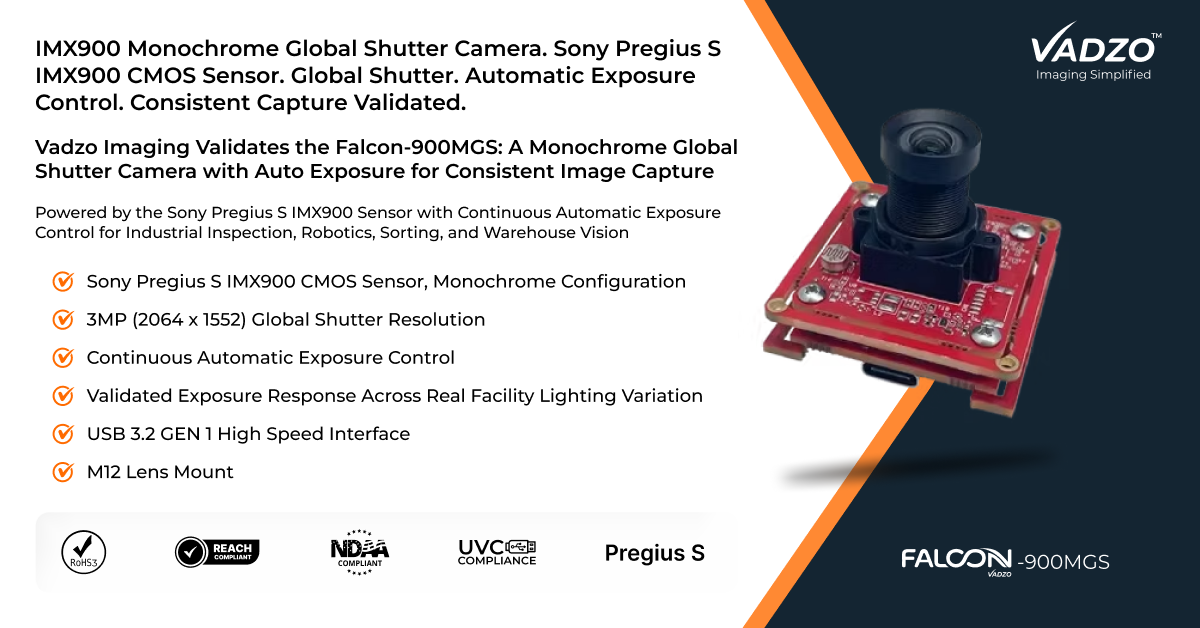
The Falcon-900MGS is a 3MP Monochrome Global Shutter USB Camera based on the Sony Pregius S IMX900 sensor, validated with automatic exposure control for consistent image capture as lighting conditions change. Its global shutter architecture enables accurate imaging of moving subjects, while real-time exposure adjustment helps maintain usable image quality across varying illumination. With USB connectivity and support for multiple output resolutions, the Falcon-900MGS provides OEMs and system integrators with an IMX900 Global Shutter USB Camera platform for industrial inspection, robotics, sorting, and warehouse vision applications.
IRVINE, CA / ACCESS Newswire / October 7, 2026 / Vadzo Imaging, a provider of embedded vision camera products for OEMs and system integrators, today announces validation of the Falcon-900MGS IMX900 Monochrome Global Shutter Camera, a 3MP monochrome global shutter camera built on the Sony Pregius S IMX900 sensor with automatic exposure control for consistent image capture. Part of Vadzo's USB camera portfolio, the Falcon-900MGS pairs the IMX900's global shutter architecture with continuous automatic exposure adjustment, giving industrial and robotics integrators a camera that holds image quality steady as ambient lighting drifts throughout a facility and across a shift. With this validation, Vadzo delivers an IMX900 Auto Exposure USB Camera that removes lighting drift as a source of measurement inconsistency, giving quality engineers, robotics integrators, and sorting system OEMs a camera module ready for direct integration into inspection, sorting, and warehouse vision products without manual exposure recalibration between stations.
Technical Problem Definition
Industrial and warehouse facilities rarely offer the perfectly stable, unchanging lighting a camera calibration assumes. Overhead fixtures age and dim unevenly across a large facility, a sorting lane positioned near a loading bay door experiences shifting daylight contribution throughout the day, and a robotics work cell may see meaningfully different ambient light between a day shift and a night shift. A monochrome global shutter camera with a fixed, manually calibrated exposure setting produces a correctly exposed frame only under the exact lighting condition present at the moment that calibration was performed. The instant ambient lighting drifts even modestly from that baseline, the image becomes underexposed, losing detail in darker regions, or overexposed, losing detail in brighter regions, and this degraded image quality directly corrupts whatever inspection, measurement, or sorting decision a downstream algorithm depends on consistent pixel-level brightness to make accurately. Recalibrating exposure manually every time lighting conditions shift is impractical at facility scale, since it requires an operator to first notice the degradation and then intervene, and that detection delay introduces a window during which the vision system is collecting unreliable data without anyone aware a problem exists. This is a fundamentally different problem than a scene with high internal contrast, where bright and dark regions both appear within a single frame simultaneously. Facility lighting drift changes the overall brightness level the camera experiences over time and across different station positions, a distinct condition that a fixed exposure setting cannot follow no matter how well that setting was calibrated on day one. A module marketed broadly as an Auto Exposure Mono USB Camera without validated real-time adjustment behind that label leaves this exact drift condition unaddressed, and a Consistent Capture Mono Camera that has only been characterized under one static lighting condition provides no real assurance about how it performs once facility lighting actually varies across stations and time. Quality teams that discover this gap only after a measurement inconsistency traces back to lighting drift rather than an actual part defect often face a costly investigation before the true source of the inconsistency is identified.
Engineering Explanation
The Falcon-900MGS addresses this drift problem through continuous automatic exposure control built into the camera itself, monitoring scene brightness in real time and adjusting exposure time and gain to compensate for lighting changes as they occur, rather than relying on a fixed setting calibrated once at installation. The IMX900 is a 3MP monochrome global shutter sensor from Sony's Pregius S family, built with a global shutter that exposes every pixel simultaneously, which holds geometric accuracy intact for any object in motion within the frame independent of the automatic exposure system running in parallel. This makes the camera a genuine Automatic Exposure Mono Sensor platform, since exposure tracking happens continuously on the camera itself rather than requiring a host application to detect and correct for lighting changes after the fact. Vadzo validates this Mono Exposure Control Module across the range of lighting conditions industrial and warehouse facilities actually present, confirming that exposure response settles quickly enough to keep pace with realistic lighting transitions rather than lagging behind a change and producing several incorrectly exposed frames before catching up. This qualifies the camera as a Stable Exposure Mono Camera suited specifically to deployments spanning multiple station positions or operating hours where lighting conditions are not uniform and not static. It is worth distinguishing this capability from high dynamic range imaging, which a scene with extreme contrast within a single frame requires, since HDR and automatic exposure solve different problems. HDR compresses a wide brightness range present simultaneously within one frame into a viewable image, while automatic exposure adjusts the camera's overall exposure level to track lighting conditions that change over time or differ from one station to the next. Many industrial monochrome global shutter applications present the second condition rather than the first, where the scene itself does not contain extreme internal contrast but the ambient lighting level drifts across the facility or across a shift, which is precisely the condition automatic exposure control addresses directly. The camera connects over USB 3.2 GEN 1, providing sufficient bandwidth for full 3MP capture as well as 1080p and 720p downsampled modes for higher frame rate operation. The camera is rated across a -30 degree C to 70 degree C operating range, matching the environmental conditions typical of warehouse, distribution center, and factory floor installations. Vadzo validates exposure response against recorded lighting transitions captured from representative facility environments rather than a synthetic test alone, since a response tuned only to satisfy a lab bench test can still leave gaps in real-world exposure tracking that the underlying validation problem describes.
Product Overview
The Falcon-900MGS is an IMX900 Monochrome Global Shutter Camera built on the Sony Pregius S IMX900 sensor and validated specifically for automatic exposure control across variable industrial and warehouse lighting conditions. As an IMX900 Monochrome GS USB Camera, it is purpose-built for OEMs who need consistent image capture across multiple station positions or operating hours rather than a camera calibrated for a single static lighting condition that drifts out of tolerance the moment facility lighting changes. The Sony IMX900 Auto Exposure USB Camera designation reflects Vadzo's validation of the IMX900 sensor's automatic exposure behavior specifically across a representative range of industrial lighting conditions, confirming that exposure tracking holds up before the module reaches OEM customers. The camera module houses the IMX900 sensor, ISP, and USB 3.2 GEN 1 controller in a compact form factor with a standard M12 lens holder, functioning as a Mono Exposure Calibration Sensor that ships validated rather than requiring independent exposure characterization after delivery. As a 3MP Auto Exposure USB Camera, output modes include full 3MP, 1080p, and 720p, selectable to balance resolution against frame rate and USB bandwidth for the target workflow, and the 3MP Monochrome USB Camera designation specifically confirms this behavior on the IMX900's monochrome sensor configuration. As an IMX900 Global Shutter USB Camera, the camera enumerates as a standard UVC device on Windows, Linux, and Android, requiring no proprietary drivers for evaluation or production integration.
Key specs: 3MP (2064 x 1552) | Sony Pregius S IMX900 1/3.1-inch 2.25-micron pixel | Monochrome | Global Shutter | Automatic Exposure Control | M12 Lens Mount | USB 3.2 GEN 1 | 3MP / 1080p / 720p | Windows Linux Android | -30°C to 70°C
Key Capabilities of the Sony Pregius S IMX900 Auto Exposure USB Camera
3MP Monochrome Global Shutter Resolution with Auto Exposure: Many monochrome global shutter camera products deliver accurate geometry through their shutter architecture while still requiring a manually calibrated exposure setting that only holds up under one specific lighting condition. The Falcon-900MGS, positioned as an IMX900 Consistent Capture Sensor, captures a full 3MP (2064 x 1552) frame with global shutter exposure while continuously adjusting exposure automatically, giving OEMs building a 3MP Exposure Control Sensor deployment both the motion integrity and the exposure stability that variable facility lighting actually requires. This makes it a genuine 3MP Consistent Capture Module that holds image quality steady across station positions and operating hours rather than only at the single condition a fixed exposure setting was calibrated for.
Automatic Exposure Control for Consistent Capture Across Varying Lighting: A fixed exposure setting produces a correctly exposed frame at exactly one lighting level and progressively degraded images as ambient conditions drift away from that calibrated baseline, a limitation that directly undermines measurement and inspection accuracy across a facility with real-world lighting variation. The Falcon-900MGS's continuous automatic exposure control replaces that single calibrated point with real-time adjustment, making it a 3MP USB Exposure Kit suited to deployments spanning multiple stations or operating shifts where lighting conditions are not identical from one position or hour to the next. This gives OEMs one hardware platform to validate rather than separate exposure calibration cycles for every station a facility presents.
Global Shutter Motion Integrity Combined with Auto Exposure Stability: Global shutter exposure and automatic exposure control address two independent requirements, and a camera solving only one still leaves a gap on an active production floor. The Falcon-900MGS validates both together, confirming that automatic exposure adjustment continues to perform correctly whether the scene contains a moving part, a stationary inspection target, or a mix of both across a single capture sequence. This makes the camera a Reliable Mono Capture Camera choice for deployments where both accurate geometry during motion and stable exposure across shifting lighting conditions matter simultaneously, rather than a camera that addresses one requirement while leaving the other to chance.
Distinguishing Auto Exposure from HDR for Facility-Wide Consistency: HDR imaging and automatic exposure control solve different problems, and specifying the wrong one for a given application leaves a real gap unaddressed. HDR resolves a scene containing both bright and dark regions simultaneously within a single frame, while automatic exposure tracks changes in the overall lighting level a camera experiences over time or across different physical locations. The Falcon-900MGS is validated specifically for the second condition, which describes the majority of industrial monochrome global shutter deployments, where the scene itself is not extremely high contrast but the facility's ambient lighting drifts across stations, shifts, or seasons, a condition HDR alone does not address and automatic exposure control resolves directly. OEMs specifying the wrong capability for their actual deployment condition risk paying for HDR processing their scenes do not need while leaving the facility-wide lighting drift that actually degrades their image quality unaddressed.
Multi-Resolution Output for Industrial Vision Workflows: Selectable output resolution lets a single Falcon-900MGS serve multiple roles within the same industrial vision deployment. Full 3MP mode captures maximum spatial detail for precise measurement or fine inspection tasks. The 1080p mode balances resolution and USB bandwidth for continuous monitoring applications, while 720p mode supports higher frame rate operation for rapid sorting or positioning tasks. Because every output mode benefits from the same automatic exposure system, switching resolution modes introduces no change in exposure stability, which matters for automated systems that expect consistent behavior regardless of which output mode a given task requires.
USB 3.2 GEN 1 Plug and Play Integration for OEM Programs: The Falcon-900MGS connects to any USB 3.2 GEN 1 host port on Windows, Linux, or Android without additional interface boards or proprietary drivers, since the camera enumerates as a standard UVC class device. Available as a USB 3.2 GEN 1 Exposure Control Kit for evaluation, the camera lets engineering teams confirm automatic exposure behavior across their own facility's actual lighting variation before committing to a production order. For OEMs evaluating Vadzo as an OEM Auto Exposure Mono Module supplier, this means lens matching, firmware customization, and enclosure design support are available alongside the core camera hardware rather than as a separate engagement. As a Plug and Play Mono USB Camera, the Falcon-900MGS is validated across common industrial and desktop host platforms used in inspection and sorting programs. Vadzo's position as a Mono Exposure Camera Supplier extends beyond the camera module itself to include lens matching and exposure characterization support, while its track record as a Mono Exposure Camera Manufacturer covers production programs spanning multiple sensor families and interface types for OEM customers building industrial monochrome vision products.
"Quality engineers deploying monochrome global shutter camera products across a real facility keep telling us the same thing: their lighting is never as stable as the day they calibrated the camera. A fixture dims, a bay door lets in daylight, a shift change brings different ambient light, and suddenly a camera that worked perfectly at installation starts producing marginal frames. The Falcon-900MGS was built around solving that drift directly. By validating the Sony Pregius S IMX900's automatic exposure control across the range of lighting conditions a real facility actually presents, we give OEMs a camera that stays correctly exposed as conditions change, rather than one that only performs correctly on the day it was calibrated." - Alwin Vincent, Product Manager, Vadzo Imaging.
Application Specific Sections
Industrial Inspection Stations: Industrial inspection stations positioned across a facility need consistent image quality regardless of which specific station a part currently sits at or what time of day the inspection occurs. The Falcon-900MGS functions as a Consistent Capture Industrial Camera for these deployments, holding exposure steady across every station position so an inspection algorithm receives comparable image quality whether a part is being measured near a window during the day or under artificial lighting during a night shift.
Robotics and Automated Guidance: Robotics platforms performing visual guidance or part identification depend on consistent image brightness to reliably distinguish features regardless of where in a facility the robot is currently operating or how ambient lighting has shifted since the system was first calibrated. The Falcon-900MGS serves as an Auto Exposure Robotics Mono Camera for these deployments, combining global shutter motion integrity with automatic exposure tracking so guidance algorithms receive stable image quality throughout continuous robot operation across a facility with real-world lighting variation.
Automated Inspection and Measurement Systems: Automated measurement systems depend on consistent pixel-level brightness to make accurate dimensional or defect detection decisions, and lighting drift that silently degrades exposure introduces measurement error that is difficult to distinguish from an actual manufacturing defect. The Falcon-900MGS operates as a Mono Auto Exposure Inspection platform for these systems, removing facility lighting drift as a source of measurement inconsistency so a flagged defect reflects an actual part condition rather than a camera exposure problem.
Sorting and Material Handling Systems: Sorting systems handling material continuously across an operating shift need exposure stability that holds up as ambient lighting shifts from morning to evening or as overhead fixtures age unevenly across a large sorting facility. The Falcon-900MGS functions as a Consistent Capture Sorting Camera for these deployments, maintaining consistent image quality throughout an extended operating shift without requiring manual exposure recalibration partway through, and the same stability benefits an Auto Exposure Warehouse Camera role wherever a facility runs sorting or material handling continuously across variable daylight hours. Facility managers running multiple sorting lanes benefit from standardizing on one camera platform across every lane, since consistent exposure behavior at each position removes lane-to-lane variation as a factor a sorting algorithm needs to account for.
Pallet and Warehouse Vision Systems: Warehouse and pallet handling vision systems operate across large facility footprints where lighting conditions vary considerably from one storage zone to another, and a camera calibrated for one zone's lighting frequently underperforms once deployed to a different area of the same warehouse. The Falcon-900MGS serves as an Auto Exposure Pallet Camera for these deployments, and the same automatic exposure capability extends directly to a Consistent Mono Vision Camera role, giving warehouse OEMs one validated camera platform to standardize across every zone a facility presents rather than a separate calibration for each lighting condition.
Frequently Asked Questions
Q: Why does Vadzo Imaging emphasize automatic exposure control for this monochrome global shutter camera?
A: Vadzo Imaging designs this camera around a condition that a fixed exposure setting cannot handle: real facility lighting drifts over time and differs from one station to the next, and a camera calibrated for one specific condition degrades the moment that condition changes. Vadzo Imaging validates continuous automatic exposure adjustment specifically so that image quality holds steady across a facility's actual lighting variation, rather than only at the single condition present the day a camera was installed. Vadzo Imaging considers this validation essential rather than optional, since most industrial deployments span multiple stations and operating hours where lighting is never perfectly uniform.
Q: How is automatic exposure control different from HDR imaging?
A: Vadzo Imaging positions these as two different capabilities solving two different problems. HDR resolves a single scene containing both bright and dark regions simultaneously within one frame, while automatic exposure control tracks changes in the overall lighting level a camera experiences over time or across different physical locations. Vadzo Imaging validates this camera specifically for the second condition, since most industrial monochrome global shutter deployments present facility-wide lighting drift rather than extreme contrast within a single frame.
Q: Does automatic exposure adjustment introduce lag or slow down image capture?
A: No. Vadzo Imaging validates the automatic exposure system's response speed specifically against realistic lighting transitions a facility actually presents, confirming that exposure settles quickly enough to avoid a meaningful run of incorrectly exposed frames during a lighting change. Vadzo Imaging tunes this response for industrial and warehouse operating conditions rather than a slower adjustment pace that might be acceptable in a less demanding application.
Q: Can manual exposure still be set if a specific application requires fixed exposure instead of automatic adjustment?
A: Yes. Vadzo Imaging exposes exposure control through the camera's standard interface, so application software can select automatic tracking for facilities with variable lighting or lock a fixed exposure value for applications where a constant, unchanging setting is preferred. Vadzo Imaging designs this flexibility deliberately, since not every deployment presents the same lighting stability, and an OEM should be able to choose the mode that matches their specific installation.
Q: Why should industrial and warehouse automation OEMs choose Vadzo Imaging as their monochrome camera supplier?
A: Vadzo Imaging offers more than a camera module built around a capable sensor. Industrial and warehouse automation OEMs working with Vadzo Imaging receive a camera validated specifically for the lighting variation a real facility presents, along with engineering support covering lens selection, firmware customization, and exposure characterization guidance. Vadzo Imaging maintains evaluation kits with no minimum order requirement, so quality engineering teams can confirm exposure stability across their own facility's actual lighting conditions before committing to volume production. This combination of validated hardware and low minimum evaluation access is why industrial and warehouse OEMs continue to choose Vadzo Imaging for monochrome global shutter camera programs.
Availability
The Falcon-900MGS IMX900 Monochrome Global Shutter Camera built on the Sony Pregius S IMX900 sensor is available now for evaluation and production orders. Evaluation kits include the camera module, S-Mount lens, USB 3.2 GEN 1 cable, and platform driver documentation, with no minimum order requirement. Quality engineering teams can confirm automatic exposure performance directly across their own facility's lighting variation before committing to a production bill of materials, which matters more for this camera than a datasheet comparison alone could confirm, and can validate this behavior across every planned station position rather than a single representative sample location. The same exposure stability also suits a Mono Exposure Kiosk Camera role wherever a self-service or interactive deployment incorporates monochrome machine vision under variable ambient lighting. Browse the full range of monochrome global shutter camera options at Vadzo's website or contact Vadzo at [email protected] to request an evaluation unit or discuss OEM integration requirements for industrial inspection, robotics, sorting, and warehouse camera programs.
About Vadzo Imaging
Vadzo Imaging is a global provider of embedded vision solutions and delivers high-performance camera technologies and imaging platforms for applications in robotics, industrial automation, UAVs, edge AI, and medical systems. Its products are designed for seamless integration with leading embedded platforms. Vadzo supports customers through hardware customization, firmware development, and module-level drivers, enabling faster development and deployment of vision-based systems across USB, MIPI, GigE, Wi-Fi, and SerDes camera interfaces.
Media Contact
Alwin Vincent
Vadzo Imaging
Email: [email protected]
LinkedIn: Vadzo Imaging
YouTube: Vadzo Imaging
X: Vadzo Imaging
SOURCE: Vadzo Imaging