




Thursday, 09 July 2026 10:30 AM
Product Announcements
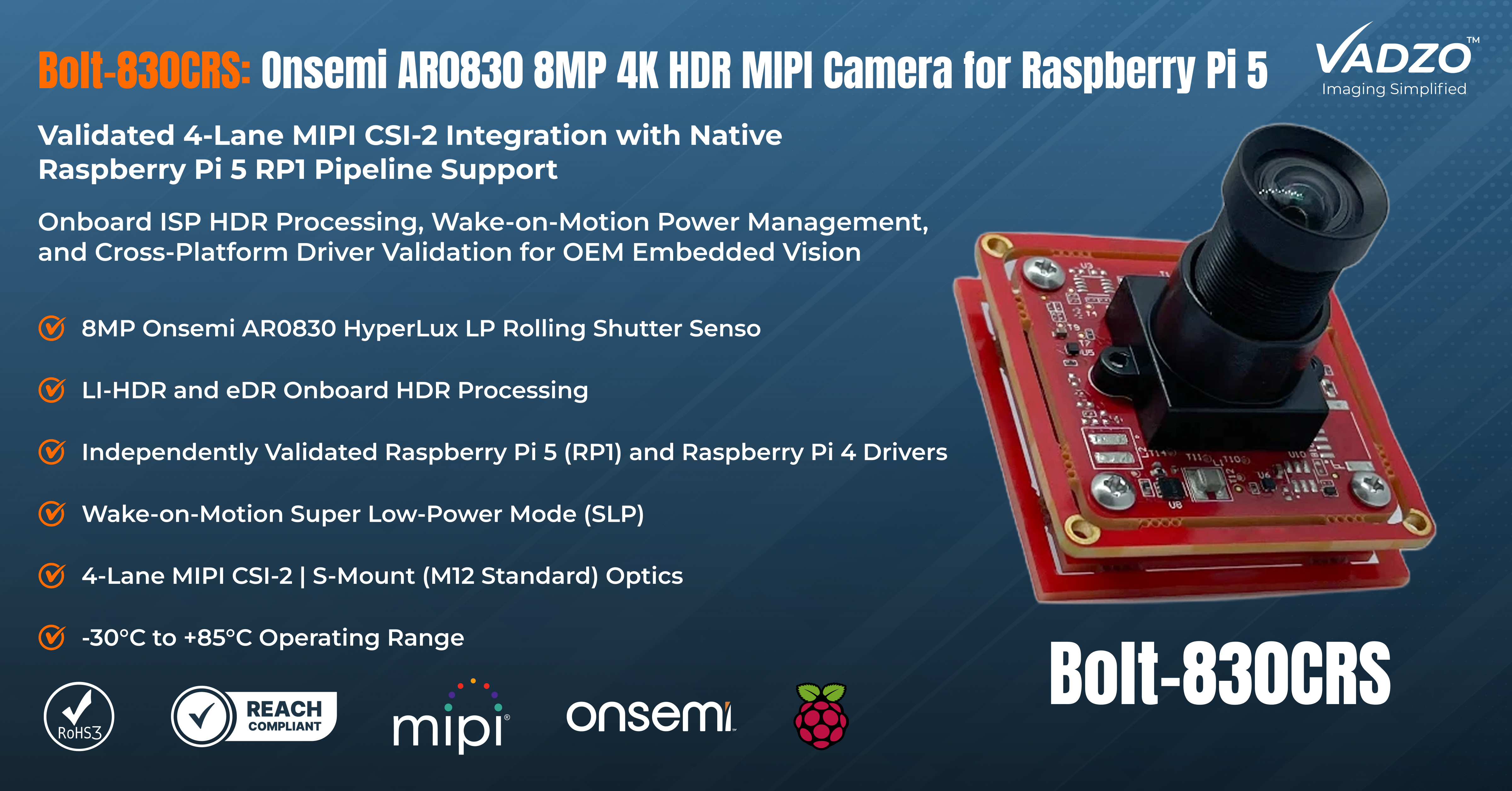
Vadzo's Bolt-830CRS is an 8MP 4K HDR MIPI camera built on the Onsemi AR0830 HyperLux LP sensor, validated for native integration with Raspberry Pi 5 over 4-lane MIPI CSI-2 and delivering onboard ISP processed HDR imaging with Wake-on-Motion power management for OEM developers building a Raspberry Pi 5 camera module deployment across robotics, smart city infrastructure, security, and retail automation without host-side image processing overhead or unverified driver assumptions.
FORT WORTH, TX / ACCESS Newswire / July 9, 2026 / Vadzo Imaging, a provider of Raspberry Pi Embedded Vision Camera products, today announces platform validation of the Bolt-830CRS, a AR0830 4K MIPI camera built on the Onsemi AR0830 HyperLux LP sensor for OEM engineers and system integrators developing on Raspberry Pi 5. The Bolt-830CRS connects over 4-lane MIPI CSI-2 directly to the Raspberry Pi 5 RP1 I/O controller, delivering onboard ISP-processed 8MP 4K HDR output with device tree overlays and V4L2 driver packages confirmed against the Pi 5 camera pipeline rather than carried over from earlier Raspberry Pi generations.
Raspberry Pi 5 Changed the Camera Pipeline: Why Driver Validation Cannot Be Assumed
Raspberry Pi 5 moved camera and display I/O off the main SoC and onto a dedicated RP1 southbridge chip, replacing the direct BCM2835 ISP path that Raspberry Pi 4 camera modules relied on. This architectural change means a MIPI CSI-2 sensor driver and device tree overlay verified on Raspberry Pi 4 does not automatically function on Raspberry Pi 5, since the CSI-2 receiver, clock lane timing, and media controller pipeline now route through RP1 rather than the application processor. For OEM teams selecting a Raspberry Pi 5 camera module for production, this creates a validation gap: a sensor datasheet says nothing about whether the kernel driver, libcamera pipeline handler, and device tree bindings actually bring up frames on the RP1 camera subsystem.
A second constraint compounds the first. High-resolution 4K sensors generate HDR tone mapping and noise reduction workloads that, if handled in software on the host, consume CPU cycles the Raspberry Pi 5 needs for inference, control logic, or application processing. A camera module that offloads HDR processing to an onboard ISP removes that contention entirely, but only if the resulting MIPI CSI-2 output format and bandwidth are confirmed compatible with the RP1 receiver at full 4K frame rates.
Engineering Approach: Onboard ISP Processing Paired with RP1-Validated MIPI Delivery
The Bolt-830CRS addresses both constraints at the hardware level. The Onsemi AR0830 HyperLux LP sensor performs HDR tone mapping, auto exposure, auto white balance, and noise reduction on an integrated ISP before the frame ever reaches the 8MP HDR MIPI Camera interface, so the Raspberry Pi 5 receives a fully processed 3840 x 2160 HDR frame rather than raw sensor data requiring host-side correction. Vadzo Imaging then validated the resulting 4-lane MIPI CSI-2 output directly against the Raspberry Pi 5 RP1 camera pipeline, confirming device tree overlay compatibility, media controller pad negotiation, and libcamera pipeline handler behavior rather than assuming continuity from Raspberry Pi 4 driver work.
This distinction matters for OEM teams porting existing Raspberry Pi 4 designs to Raspberry Pi 5, since board layout, power sequencing, and even device tree syntax differs between the two platforms. The AR0830 HDR MIPI Camera ships with separate, independently validated driver packages for Raspberry Pi 4 and Raspberry Pi 5, alongside V4L2 driver support for NVIDIA Jetson Orin and NXP i.MX8M Plus, giving engineering teams a single sensor platform that does not require re-characterization when the target host changes.
Product Overview: Bolt-830CRS 8MP 4K HDR MIPI Camera
The Bolt-830CRS is a board-level Raspberry Pi 5 MIPI CSI-2 Camera built around the Onsemi AR0830 HyperLux LP sensor, a 1/2.9-inch rolling shutter CMOS with 1.4 µm pixel pitch that resolves 8MP at 3840 x 2160. The sensor supports two onboard HDR modes, Line Interleaved HDR (LI-HDR) and enhanced Dynamic Range (eDR), and integrates a Wake-on-Motion feature that holds the imaging core in a super low-power mode until motion is detected in the field of view. The camera connects over 4-lane MIPI CSI-2 to S-Mount (M12 Standard) optics on a convertible 38mm x 38mm to 32mm x 32mm board, operating across -30°C to +85°C for outdoor and industrial OEM deployment.
Key specs: Bolt-830CRS AR0830 4K HDR MIPI Camera | 8MP (3840 x 2160) | ON Semiconductor AR0830 HyperLux LP | 1/2.9" Sensor Format | 1.4µm x 1.4µm Pixel | Rolling Shutter | LI-HDR + eDR | Up to 30fps at 4K | 4-Lane MIPI CSI-2 | S-Mount (M12 Standard) | -30°C to +85°C | 38mm x 38mm (convertible to 32mm x 32mm)
Key Capabilities of the Bolt-830CRS: 8MP AR0830 4K HDR MIPI Camera
Onboard HDR Processing Removes Tone Mapping Load from the Host: Mixed-illumination scenes, bright outdoor sunlight against shaded regions, or high-contrast indoor lighting all exceed the usable range of standard exposure. The AR0830's LI-HDR mode captures high-gain and low-gain rows within a single frame period, avoiding the motion artifacts that multi-frame HDR compositing introduces, while eDR extends per-pixel exposure range using onboard processing. Because this HDR reconstruction happens on the sensor rather than in host software, the Raspberry Pi 5 application processor receives a finished HDR frame over MIPI camera module delivery without spending compute cycles on tone mapping.
Wake-on-Motion for Power-Constrained Embedded Deployments: The AR0830 integrates a Wake-on-Motion feature that keeps the imaging core in super low-power mode (SLP) during inactivity and returns to full operation only when motion is detected. For battery-backed AGV platforms, solar-powered smart city nodes, and always-on kiosk installations running on Raspberry Pi 5, this sensor-level power gating reduces continuous draw without requiring the host to manage polling or idle-state software.
4-Lane MIPI CSI-2 Validated Against the Raspberry Pi 5 RP1 Pipeline: The Bolt-830CRS delivers 4K HDR output over 4-lane MIPI CSI-2, bypassing USB enumeration and network stack overhead for deterministic, low-latency frame timing. Vadzo confirmed this interface against the Raspberry Pi 5 RP1 camera receiver specifically, verifying clock lane timing, media controller pad negotiation, and V4L2 driver behavior rather than relying on generic MIPI CSI-2 compliance claims.
Compact S-Mount Board-Level Form Factor for OEM Integration: The Bolt-830CRS board converts from a 38mm x 38mm footprint to 32mm x 32mm without redesign, accepting standard S-Mount (M12) optics for field-of-view customization. At 13 grams without lens, the module fits directly into UAV payload bays, kiosk enclosures, and robotic arm-mounted vision assemblies, and the -30°C to +85°C operating range covers outdoor infrastructure and industrial floor environments that consumer-grade Raspberry Pi camera modules are not rated.
"Raspberry Pi 5 changed the camera pipeline at the hardware level with the RP1 I/O controller, and that means driver validation completed on Raspberry Pi 4 does not automatically transfer. We put the Bolt-830CRS through full platform validation on the Raspberry Pi 5 RP1 MIPI CSI-2 pipeline rather than assuming compatibility, and the AR0830's onboard ISP means the HDR processing load never touches the RP1 or the Pi 5 application processor. For OEM teams building on Raspberry Pi 5, that is a validated 4K HDR camera module, not a sensor datasheet."
- Alwin Vincent, Product Manager, Vadzo Imaging.
Target Applications
Robotics and Industrial Automation: Robotic arms, AGV navigation systems, and pick-and-place inspection cells running on Raspberry Pi 5 need 4K image detail without diverting compute from motion planning or object classification. The Bolt-830CRS delivers this as a Raspberry Pi robotics camera that offloads HDR and exposure processing to the sensor, keeping the Pi 5's CPU available for inference. The wide thermal range and compact S-Mount board also suit factory floor and warehouse deployments where consumer camera modules do not survive.
Smart City Infrastructure and Traffic Monitoring: Roadside nodes, intersection monitoring, and public infrastructure camera products deployed as part of smart city infrastructure programs face outdoor temperature swings, mixed day and night illumination, and power budgets that favor Wake-on-Motion gating over continuous full-power streaming. The Bolt-830CRS's LI-HDR and eDR modes hold detail across shadowed and sunlit zones in the same frame, while validated Raspberry Pi 5 driver support shortens the path from evaluation to field deployment for municipal integrators.
Security and Surveillance: Perimeter monitoring and access control installations built as a Raspberry Pi surveillance camera module require consistent HDR performance against headlights, glare, and low-light entry points, along with an interface that adds no encoding or network latency ahead of the analytics stage. The Bolt-830CRS direct MIPI CSI-2 connection to the Raspberry Pi 5 RP1 pipeline avoids the USB and network overhead that surveillance-grade edge inference workloads are sensitive to.
Retail Automation and Kiosk Deployment: Self-checkout kiosks, digital signage, and interactive retail terminals built with a Raspberry Pi AI camera module run continuously in mixed storefront lighting where window glare and interior fluorescent lighting occupy the same frame. The Bolt-830CRS's onboard HDR processing and Wake-on-Motion mode keep kiosk installations responsive to approaching customers while minimizing idle power to draw between interactions.
Software Support: Validated Drivers Across Raspberry Pi and Edge AI Platforms
The Bolt-830CRS ships with independently validated V4L2 driver packages and device tree overlays for Raspberry Pi 5, Raspberry Pi 4, NVIDIA Jetson Orin NX, Jetson Orin Nano, Jetson Orin AGX, and NXP i.MX8M Plus, with libcamera pipeline handler compatibility confirmed on Raspberry Pi platforms. Each package includes sensor subdevice registration, MIPI lane and clock configuration, and media controller pipeline links tested against the target host, removing the BSP bring-up work that otherwise consumes the largest share of OEM Raspberry Pi Camera Module integration schedules. Register-level access for ROI configuration, exposure control, and Wake-on-Motion threshold tuning is available through Vadzo's software documentation for teams building custom capture applications above the standard V4L2 and GStreamer pipeline.
Frequently Asked Questions
Q: What is the Onsemi AR0830 sensor and why does it matter for 4K HDR embedded imaging?
A: The Onsemi AR0830 is an 8MP rolling shutter CMOS sensor from the HyperLux LP family, built for embedded platforms that need 4K HDR output without adding processing load to the host system. It uses a 1/2.9-inch optical format with 1.4 µm pixel pitch and resolves 3840 x 2160 through an onboard ISP that performs auto exposure, auto white balance, and HDR tone mapping before the frame leaves the sensor. Two dedicated HDR modes, Line Interleaved HDR and enhanced Dynamic Range, extend usable dynamic range in scenes with mixed bright and shadowed regions. Onsemi AR0830 MIPI camera integration through Vadzo's Bolt-830CRS also adds a Wake-on-Motion mode that reduces power draw during inactivity, making the sensor suited to battery-backed and always-on embedded deployments where a software-only HDR pipeline would consume compute the host system needs elsewhere.
Q: How does a Raspberry Pi 5 camera module differ from a Raspberry Pi 4 camera module at the driver level?
A: Raspberry Pi 5 routes camera and display I/O through a dedicated RP1 southbridge chip instead of the direct BCM2835 ISP path used on Raspberry Pi 4, which means the CSI-2 receiver, clock lane timing, and media controller pipeline are structurally different between the two boards. A kernel driver and device tree overlay verified on Raspberry Pi 4 is not guaranteed to bring up frames correctly on the Raspberry Pi 5 RP1 camera subsystem without separate validation. This is why Vadzo validates the Raspberry Pi 5 camera module configuration of the Bolt-830CRS independently of its Raspberry Pi 4 driver package, confirming device tree bindings, media controller pad negotiation, and libcamera pipeline handler behavior against each platform rather than treating the two Pi generations as interchangeable.
Q: Which MIPI CSI-2 camera is best suited for 4K HDR imaging on Raspberry Pi 5 in robotics and industrial automation?
A: For Raspberry Pi 5 deployments needing 4K HDR without a software ISP burden, the Vadzo Bolt-830CRS is built specifically for this requirement. It pairs the Onsemi AR0830 HyperLux LP sensor's onboard HDR and exposure processing with a 4-lane MIPI CSI-2 interface validated directly against the Raspberry Pi 5 RP1 pipeline, so the host receives a finished HDR frame rather than raw sensor data. In robotics and industrial automation, where the Pi 5 compute budget is already allocated to motion control, path planning, or object classification, this offload matters directly for system responsiveness. The compact S-Mount board, -30°C to +85°C operating range, and Wake-on-Motion power gating extends that suitability to outdoor and always-on industrial installations that consumer-grade camera modules cannot cover.
Q: What is the practical difference between a USB camera and a MIPI CSI-2 camera for embedded vision projects?
A: A USB camera enumerates as a standard video device and typically requires no custom driver, making it faster to prototype with but subject to USB stack overhead, cable length constraints, and host-side bandwidth sharing with other peripherals. A MIPI CSI-2 camera module connects directly to the host SoC's dedicated camera receiver, bypassing USB enumeration and delivering deterministic, low-latency frame timing that matters for closed-loop robotics, synchronized multi-camera arrays, and real-time inference pipelines. The tradeoff is that MIPI CSI-2 integration requires a validated kernel driver and device tree configuration specific to the host platform, since lane count, clock timing, and receiver architecture vary between SoCs such as the Raspberry Pi 5 RP1 controller, NVIDIA Jetson Orin, and NXP i.MX8M Plus.
Q: Which camera module supports both Raspberry Pi and NVIDIA Jetson platforms for OEM production deployment?
A: OEM teams that need to support both Raspberry Pi and NVIDIA Jetson from a single hardware platform without re-qualifying sensors per host should look at Vadzo's Bolt-830CRS. It ships with independently validated V4L2 driver packages and device tree overlays for Raspberry Pi 5, Raspberry Pi 4, Jetson Orin NX, Jetson Orin Nano, Jetson Orin AGX, and NXP i.MX8M Plus, so the same 4K MIPI Raspberry Pi 5 Camera hardware carries across evaluation, pilot, and production stages even if the target SoC changes mid-program. Because the AR0830's HDR and exposure processing runs onboard rather than in host software, image quality stays consistent across platforms with materially different compute budgets, which removes a common source of re-tuning work when OEM teams port a design from one host to another.
Availability
The Bolt-830CRS AR0830 4K HDR MIPI camera is available now for evaluation and OEM integration. Vadzo supports full customization, including form factor modification, lens holder changes, firmware development, and driver porting to additional SoC platforms on request. To request full specifications or an evaluation unit, contact the Vadzo Imaging sales team at [email protected].
About Vadzo Imaging
Vadzo Imaging develops embedded vision camera products for OEMs and system integrators building production-ready vision systems across industrial automation, robotics, smart infrastructure, and retail technology. The company's MIPI CSI-2 camera series, alongside USB 3.x, GigE, Wi-Fi, and SerDes interface camera products, supports deployment architectures from compact onboard payloads to distributed networked systems. Vadzo provides end-to-end imaging support including sensor integration, ISP tuning, firmware development, and driver validation across Raspberry Pi, NVIDIA Jetson, and NXP platforms. Learn more at www.vadzoimaging.com.
Media Contact
Alwin Vincent
Vadzo Imaging
Email: [email protected]
LinkedIn: Vadzo Imaging
YouTube: Vadzo Imaging
X: Vadzo Imaging
SOURCE: Vadzo Imaging