




Tuesday, 15 September 2026 10:30 AM
Product Announcements
Built for edge AI, NVR, robotics, and drone applications, this AR2020 20MP MIPI camera combines the Onsemi AR2020 sensor with a MIPI CSI-2 interface for high-resolution embedded vision. As a MIPI camera for Rockchip RV1126, it has been validated with the RV1126 platform, giving integrators confidence in a tested camera solution for AI-powered vision systems..
FORT WORTH, TX / ACCESS Newswire / September 15, 2026 / Vadzo Imaging, a world leader in embedded vision solutions, today announced the validation of the Bolt-2020CRS, an AR2020 20MP MIPI camera built around the Onsemi AR2020 color sensor for edge AI, NVR, robotics, and drone applications. The camera is validated as a MIPI camera for Rockchip RV1126 platforms, enabling high-resolution vision for embedded AI systems.
Why RV1126 Platforms Need an AR2020 Color MIPI Camera Built for Validated Compatibility
A camera and a processor that both claim standard MIPI CSI-2 compliance do not always work together correctly the first time they are actually connected, since real-world compatibility depends on details beyond the shared physical interface standard alone, including image signal processor tuning, timing configuration, and software driver behavior specific to each individual side of the pairing. An RV1126 Rockchip MIPI Camera needs genuine, confirmed validation against the specific RV1126 platform rather than a general MIPI compatibility claim that leaves integration risk unresolved until an engineer actually tries the pairing.
A 20MP RV1126 Rockchip MIPI Camera also needs to work alongside the RV1126's onboard NPU specifically, since many RV1126-based designs exist precisely to take advantage of that dedicated AI processing capability for edge-based object detection, classification, or analysis. A camera validated only for basic image capture, without confirmed compatibility across the platform's AI processing path, leaves a real integration gap for exactly the edge AI use case many RV1126 designs are built around.
A second, related consideration is whether a genuinely high-resolution sensor like the AR2020 can be used practically alongside the RV1126's NPU, since real-time AI inference across a full-resolution frame at every capture may exceed what a given NPU can sustain depending on the specific AI model and frame rate a project requires. Understanding that practical tradeoff matters directly for integrators planning an RV1126-based edge AI design around a genuinely high-resolution sensor.
Neither genuine platform validation nor raw sensor resolution alone solves the underlying problem an RV1126-based design presents. A camera validated against the platform but limited to a lower resolution still constrains what a project can capture in detail, and a genuinely high-resolution sensor without confirmed RV1126 compatibility still leaves integration risk unresolved until an engineer actually tests the pairing. Combining validated compatibility with genuine 20 megapixel resolution is what makes a camera platform actually suited to serious RV1126-based development rather than adequate on only one specification.
Engineering Explanation: Validated Integration with the RV1126 Vision Processor
Vadzo Imaging validated the Bolt-2020CRS specifically against the Rockchip RV1126 platform, confirming the pairing genuinely works as expected rather than relying on shared standards compliance alone. As a Rockchip NPU Camera, the Bolt-2020CRS delivers image data compatible with the RV1126's onboard neural processing unit, supporting on-device AI inference without requiring every captured frame to be sent to a separate server for that same analysis.
That validated compatibility extends specifically to the RV1126's MIPI CSI-2 camera interface, image signal processor, and the software stack most RV1126-based designs already build around. As an RV1126 Vision Processor Camera, the Bolt-2020CRS integrates directly into that existing environment, avoiding the integration troubleshooting a merely standards-compliant, unvalidated pairing would introduce.
A Rockchip AI SoC Camera built around this validated pairing gives integrators a genuine starting point for an edge AI design, since confirmed platform compatibility removes a real source of project risk before development even begins. Integrators still need to validate their own specific AI model and frame rate requirements against the RV1126's actual NPU throughput, since that balance depends on the details of a given application rather than the camera and processor pairing alone.
A 20MP RV1126 Camera delivers genuine 20 megapixel resolution alongside that validated platform compatibility, giving integrators a sensor capable of resolving fine detail for applications that need it, while still supporting reduced resolution or region of interest-based AI inference for use cases where full resolution processing exceeds the NPU's practical throughput.
Product Overview
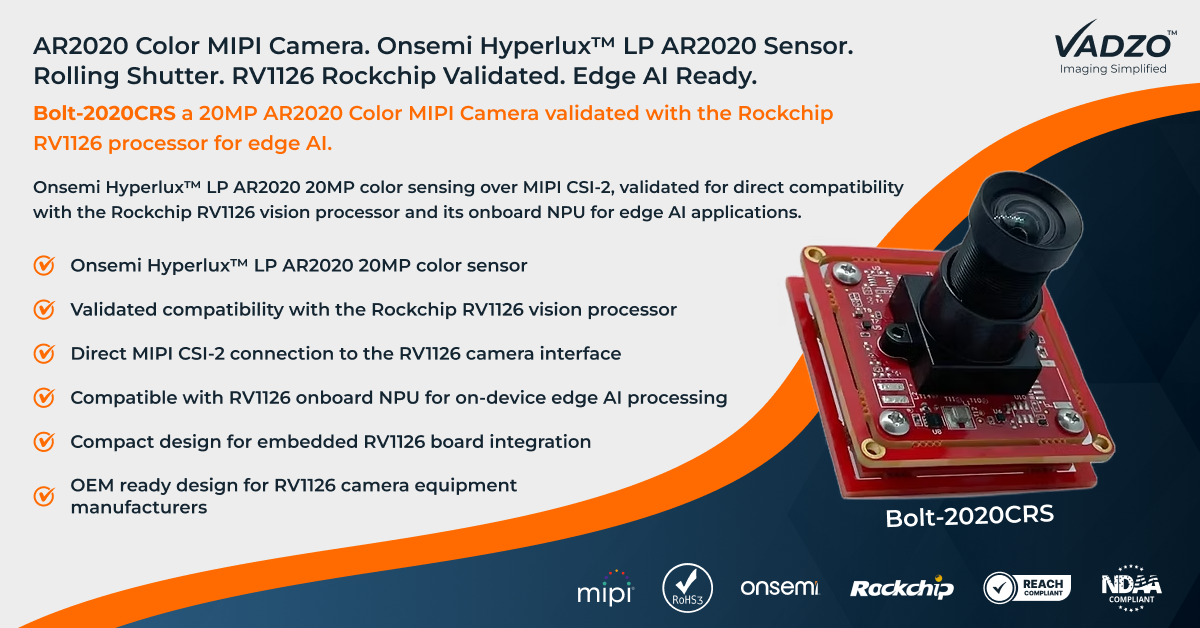
The Bolt-2020CRS pairs the Onsemi AR2020 Rockchip Camera sensor with validated Rockchip RV1126 compatibility in a compact design suited to edge AI, NVR, robotics, and drone integration. As a 20MP Rockchip Sensor Module, it outputs full 20-megapixel resolution over a MIPI CSI-2 connection confirmed to work directly with the RV1126's camera interface, giving integrators a validated starting point rather than an unconfirmed standards-based assumption.
At the core of the module sits the AR2020 RV1126 Rockchip MIPI Camera sensor, chosen specifically for the combination of resolution and confirmed platform compatibility that RV1126-based edge AI designs require. Because the camera pairs that resolution with AR2020 RV1126 Rockchip Camera validated integration, the Bolt-2020CRS reaches production readiness faster than a camera requiring integrators to independently confirm platform compatibility themselves, all delivered as a 20MP SoC Vision Camera suited to compact embedded designs.
Product Specifications
Key specs: 20MP (5496 × 3672) Max Resolution | Onsemi Hyperlux™ LP AR2020, 1/1.8-inch Sensor Format | 1.4 µm Pixel | Color, Rolling Shutter Chroma and Shutter | MIPI CSI-2 Interface | Fixed Focus Optics
Key Capabilities
Onsemi AR2020 Sensor for Detailed 20MP Color Capture: The Bolt-2020CRS is built around the Onsemi AR2020 sensor, a device that resolves genuine 20 megapixel color detail suited to edge AI, NVR, robotics, and drone applications that need fine resolution alongside AI processing capability. This gives the module RV1126 20MP Sensor performance suited to tasks that need to identify fine detail clearly, whether that detail feeds a human reviewer or an AI inference pipeline running on the same platform. That resolution matters directly for applications reviewing footage after the fact, where a higher resolution capture supports zooming into a specific detail that a lower resolution sensor would have already lost at the point of capture.
Validated Compatibility with the Rockchip RV1126 Vision Processor: A camera and a processor sharing a common interface standard does not guarantee they work correctly together once actually connected, since real integration depends on confirmed compatibility across image signal processing, timing, and driver behavior specific to each platform. The Bolt-2020CRS removes that uncertainty for RV1126-based designs specifically, having been validated directly against the platform rather than left to a general MIPI compliance assumption. That direct validation matters most for teams working under real project deadlines, where discovering a compatibility gap partway through development costs far more time than confirming compatibility up front with a genuinely pre-validated camera.
RV1126 NPU for On-Device Edge AI Processing: As an RV1126 AI Camera Module, the Bolt-2020CRS delivers image data compatible with the RV1126's onboard neural processing unit, supporting object detection, classification, and other AI-based analysis running directly on the device rather than requiring a separate server connection for that same processing. That on-device capability matters directly for edge deployments in locations with limited or unreliable network connectivity, where sending every frame to a remote server is not a practical option. It also matters for applications with genuine privacy or latency sensitivity, where processing image data locally avoids both the delay and the data exposure a round trip to an external server would introduce.
MIPI CSI-2 for Direct RV1126 Platform Integration: A MIPI Camera for RV1126 design specifically connects directly to the processor's native camera interface, avoiding the additional interface conversion hardware a mismatched connectivity option would require. The Bolt-2020CRS's MIPI CSI-2 interface connects directly to that native RV1126 receiver, giving integrators a straightforward physical connection alongside the validated software and image signal processing compatibility the platform pairing depends on.
Compact Design for Embedded RV1126 Board Integration: RV1126-based boards used in edge AI, NVR, robotics, and drone products often have genuinely limited internal space, leaving little room for a camera and its supporting electronics. The Bolt-2020CRS's compact design fits into that constrained space, integrating directly into existing RV1126-based hardware without requiring a custom mounting redesign. That compatibility matters directly for manufacturers building a product line around a specific RV1126 board design, since a camera requiring a nonstandard mounting approach would complicate an otherwise straightforward integration.
OEM Ready Design for RV1126 Camera Equipment Manufacturers: RV1126 camera equipment manufacturers producing units at scale need a camera platform that stays consistent across a long production run, from early prototype validation through full-scale manufacturing. Vadzo Imaging supports full customization on this platform as an OEM RV1126 Camera Module, including connector changes, optics selection, and firmware adjustments for manufacturers headed into volume production, and as an RV1126 Camera Kit, it gives OEM customers a proven, pre-validated foundation to build a differentiated edge AI, NVR, robotics, or drone product around.
"Integrators building on the Rockchip RV1126 keep telling us the same thing: two devices that both claim MIPI compliance on a spec sheet still frequently need real troubleshooting the first time they are connected together. We validated the Bolt-2020CRS specifically against the RV1126 platform so integrators are not the ones discovering an integration gap after their design is already committed. We built this camera for the RV1126 designs people are shipping, not a generic MIPI compatibility assumption." - Alwin Vincent, Product Manager at Vadzo Imaging.
Application-Specific Sections
Edge AI and Embedded Vision Applications: Edge AI applications built on the RV1126 depend on a camera that genuinely works with the platform's NPU rather than one only nominally compatible with its camera interface. As an RV1126 Embedded Vision Camera, the Bolt-2020CRS supports that genuine edge AI integration, giving developers a validated foundation to build an on-device inference pipeline around.
NVR and Smart Camera Systems: NVR and smart camera systems built on Rockchip processors depend on reliable, validated camera integration across an entire product line rather than a pairing confirmed only through informal testing. As a Rockchip NVR Camera Module, the Bolt-2020CRS supports that reliability, and functioning as a Rockchip Edge AI Camera, it extends genuine on-device processing capability to broader smart camera deployments. As a Rockchip Smart Camera Module, it gives manufacturers a validated platform for a full smart camera product line. That validated consistency matters directly for manufacturers supporting a large installed base, since a proven camera and processor pairing simplifies both technical support and firmware maintenance across every unit already deployed in the field.
Robotics and Machine Vision on RV1126 Platforms: Robotics platforms built around the RV1126 depend on validated camera integration to support real-time vision processing without unexpected compatibility issues once a design is already in development. As an RV1126 Robotics Camera, the Bolt-2020CRS supports that validated integration, and functioning as a Rockchip Machine Vision Camera, it extends the same reliability to broader RV1126-based machine vision deployments, including as a Rockchip Industrial Camera Module across industrial automation platforms. That reliability matters most for robotics programs already committed to the RV1126 as their processing platform, since a camera requiring separate compatibility troubleshooting would slow a development timeline that otherwise benefits from a genuinely proven pairing.
Drone and Aerial Vision Systems: Drone and aerial vision systems built on the RV1126 depend on a compact, validated camera capable of both high-resolution capture and on-device AI processing within a genuinely weight- and space-constrained platform. As an RV1126 Drone Camera Module, the Bolt-2020CRS supports that combined requirement, giving drone platform designers a validated foundation rather than an unconfirmed compatibility assumption to resolve during flight testing.
OEM Integration for RV1126 Camera Equipment Manufacturers: RV1126 camera equipment manufacturers building their own edge AI, NVR, robotics, or drone hardware need a camera vendor who has genuinely validated platform compatibility rather than one relying on a general MIPI compliance claim. The Bolt-2020CRS ships with that validated RV1126 compatibility built in, and Vadzo Imaging supports OEM customization for cable length, connector type, and firmware for manufacturers standardizing on one camera across multiple RV1126-based product lines.
Frequently Asked Questions
Q: What does validated compatibility with the Rockchip RV1126 actually mean, and why does it matter?
A: Validated compatibility means Vadzo Imaging has confirmed that this specific camera module works correctly with the Rockchip RV1126 processor's MIPI CSI-2 camera interface, image signal processor, and software stack, rather than simply assuming compatibility because both the camera and the processor happen to support the same general MIPI standard. That distinction matters directly for integrators, since two MIPI CSI-2 devices claiming standard compliance do not always work together correctly on the first attempt, and discovering an incompatibility only after a design is already committed to a specific processor and camera pairing costs real time and engineering effort to resolve. The Bolt-2020CRS is validated specifically against the RV1126 platform, giving integrators confidence that the pairing works as expected before they commit to it in a product design.
Q: What is the RV1126's NPU, and how does it change what a camera can do at the edge?
A: An NPU, or neural processing unit, is a specialized processor built specifically to run the mathematical operations behind AI and machine learning models efficiently, separate from the RV1126's general-purpose processing cores that handle other system tasks. That dedicated AI processing capability allows a camera system built on the RV1126 to run object detection, classification, or other AI-based analysis directly on the device itself, rather than sending every captured frame to a separate server or cloud service for that same analysis. The Bolt-2020CRS pairs its 20 megapixel capture capability with the RV1126's onboard NPU, giving integrators a platform that can both capture high-resolution imagery and process it locally for edge AI applications.
Q: Can this camera's 20MP resolution be processed in real time by the RV1126, or does resolution need to be reduced for AI processing?
A: The RV1126's NPU has a finite processing throughput, and real-time AI inference across a genuinely full 20-megapixel frame at every capture may exceed what the processor can sustain, depending on the specific AI model and frame rate a given application requires, which is a genuine engineering consideration rather than one that should be assumed away. Many practical deployments address this by running AI inference on a reduced resolution or a specific region of interest extracted from the full 20 megapixel capture, while still retaining the full resolution image for storage, review, or a separate non-real-time analysis pass. Integrators planning a specific RV1126 and Bolt-2020CRS deployment should validate actual inference throughput against their specific AI model and required frame rate, since the right balance between full resolution capture and real-time processing genuinely depends on the specific application's requirements.
Q: Can Vadzo Imaging customize an RV1126 compatible MIPI camera module for a specific edge AI or robotics platform?
A: Yes. Vadzo Imaging supports full OEM customization on the Bolt-2020CRS, including optics selection suited to a specific field of view or working distance, connector and cable configuration matched to a particular RV1126-based board design, and firmware adjustments tuned for a specific capture resolution or frame rate profile. Evaluation units ship with no minimum order requirement, and the same engineering team that built the standard product works directly with equipment manufacturers to adapt the module for a specific edge AI, NVR, robotics, or drone platform headed into volume production.
Q: What should equipment manufacturers look for when choosing an RV1126 compatible camera supplier?
A: A camera that claims general MIPI CSI-2 compatibility does not always work correctly with a specific processor platform on the first integration attempt, since real-world compatibility depends on details beyond the shared physical interface standard alone, including image signal processor tuning and software driver behavior. Manufacturers should look for a supplier that has genuinely validated their camera against the specific RV1126 platform rather than a general MIPI compatibility claim, resolution and frame rate specifications confirmed against actual NPU processing throughput, and support for firmware customization specific to an RV1126-based design. The Bolt-2020CRS is built around exactly these priorities, since a genuinely dependable RV1126 camera integration depends on real, validated platform compatibility, not an assumption based on shared interface standards alone.
Availability
The Bolt-2020CRS AR2020 Color MIPI Camera is available now and ready for evaluation and OEM integration. Evaluation kits include the camera module, a fixed focus lens, an MIPI CSI-2 interface cable, and integration documentation covering RV1126 platform configuration, with no minimum order requirement. Contact Vadzo Imaging at [email protected] to request an evaluation unit or discuss volume production and OEM customization. Evaluation feedback is also welcome directly through the same contact channel, since real RV1126 deployment conditions often surface details a bench test alone would not reveal, and that feedback helps confirm a configuration before a manufacturer commits to a full production order across an entire product line.
About Vadzo Imaging
Vadzo Imaging develops embedded and machine vision camera products for OEMs, system integrators, and RV1126 camera equipment manufacturers building production-ready vision systems across edge AI, NVR, robotics, drones, and industrial automation. The company's portfolio spans MIPI CSI-2, USB, GigE, Wi-Fi, FPD-Link III, and SerDes interface camera products, including separate GigE Vision products developed as an OEM GigE Traffic Camera Manufacturer for traffic monitoring and smart city applications, supporting deployment architectures from compact onboard modules to distributed networked installations. Vadzo provides end-to-end imaging support, including sensor integration, ISP tuning, firmware development, and SDK frameworks to accelerate system deployment, and the company's engineering team works directly with customers throughout evaluation, pilot deployment, and volume production rather than handing off support after the initial sale. That ongoing engineering relationship matters most for platform-specific validation work, where confirming genuine compatibility with a processor like the RV1126 depends on hands-on engineering collaboration rather than a documentation review alone. Visit Vadzo Imaging to explore the full embedded vision camera portfolio.
Media Contact
Alwin Vincent
Vadzo Imaging
Email: [email protected]
LinkedIn: Vadzo Imaging
YouTube: Vadzo Imaging
X: Vadzo Imaging
SOURCE: Vadzo Imaging