




Wednesday, 23 September 2026 10:30 AM
Product Announcements
The Bolt-1335CRO is a 13MP color rolling shutter MIPI camera built on the Onsemi AR1335 sensor and validated specifically for the Rockchip RV1126 processor with gyro-driven optical image stabilization. Handheld field devices, wearable camera systems, and small drones share a problem that focus and exposure tuning cannot solve on their own: the camera itself is in continuous motion, and that motion introduces blur that digital stabilization can only crop and warp after the fact rather than prevent. Optical image stabilization physically counteracts that motion within the exposure window itself, so the frame reaching the RV1126's NPU is sharp before any software correction runs, not after. Vadzo confirms the complete MIPI CSI-2 pad chain from the AR1335 sensor through the RV1126's camera subsystem, including validated driver support for the OIS actuator alongside standard capture control. Designed for OEMs building handheld field service devices, wearable and body-worn camera products, and stabilized drone payloads on Rockchip silicon, the Bolt-1335CRO gives motion-prone deployments the stabilized capture that edge AI accuracy depends on.
FORT WORTH, TX / ACCESS Newswire / September 23, 2026 / Vadzo Imaging, a provider of embedded vision camera products for OEMs and system integrators, today announces validation of the Bolt-1335CRO 13MP OIS MIPI Camera, a 13MP color rolling shutter camera built on the Onsemi AR1335 sensor and confirmed for direct integration with the Rockchip RV1126 processor. Part of Vadzo's MIPI camera portfolio, the Bolt-1335CRO pairs the AR1335's gyro-driven optical image stabilization with the RV1126's camera subsystem and neural processing unit, giving handheld, wearable, and drone integrators a camera that physically counteracts motion blur during capture rather than attempting to correct it after the fact. With this validation, Vadzo delivers an AR1335 OIS MIPI Camera that ships with confirmed device tree overlays and Linux driver packages for RV1126, giving field device engineers, body-worn camera integrators, and drone platform developers a camera module ready for direct integration into motion-prone products without independent stabilization tuning.
Technical Problem Definition
Handheld field devices, wearable camera systems, and small aerial platforms share a physical reality that a camera specification sheet often glosses over: the camera itself does not sit still. A handheld device shakes with natural hand tremor. A body-worn camera moves with the wearer's walking gait. A small drone vibrates continuously from its own propellers even in stable flight. Any of these motions introduces blur into a captured frame, and that blur degrades an edge AI detection or recognition algorithm's accuracy just as certainly as poor focus or poor exposure would, yet many camera modules paired with edge AI processors address focus and exposure carefully while leaving motion entirely to software correction applied after capture. Digital stabilization works by cropping into a frame and shifting or warping that crop to smooth out apparent motion between frames, but it can only manipulate pixels that were already captured. If motion blur has already smeared fine detail across several pixels during the actual exposure, no amount of digital cropping or warping afterward can restore detail that was never captured sharply in the first place. This creates a specific problem for OEMs building handheld, wearable, or drone products around an edge AI SoC: the NPU can only detect or recognize what the sensor actually resolved, and a blurred input frame limits detection accuracy regardless of how capable the downstream neural network is. A camera marketed as motion tolerant without a genuine optical stabilization mechanism behind that claim leaves an OEM to discover this gap only once the product is deployed in the field, where hand tremor, walking motion, or propeller vibration turn out to be far more disruptive to detection accuracy than a lab bench evaluation ever revealed. A module marketed broadly as an RV1126 OIS Camera Module without platform-specific validation behind that label leaves this exact question unanswered, and an OIS RV1126 Vision Sensor that has only been characterized in a static test provides no real assurance about how it will perform under the continuous motion a handheld or wearable device actually experiences. OEMs that discover this gap after a field pilot reveals inconsistent detection accuracy often face a costly redesign cycle to source a genuinely stabilized camera, a delay that proper validation at the outset would have avoided entirely.
Engineering Explanation
The Bolt-1335CRO addresses this gap by pairing the Onsemi AR1335 sensor with a gyro-driven optical image stabilization actuator that physically shifts the lens assembly to counteract detected motion within the exposure window itself, rather than relying on software correction applied to an already blurred frame. A gyroscope integrated into the OIS module continuously senses angular motion, and the actuator moves the lens in real time to compensate for that motion during exposure, so the frame the sensor actually captures already holds the sharpness a digital correction step could never fully restore. The AR1335 is a 13MP color rolling shutter sensor with native 4K resolution, and Vadzo validates the sensor's OIS actuator specifically against the Rockchip RV1126 platform, confirming that stabilization control integrates correctly alongside standard capture control through the same MIPI CSI-2 interface rather than requiring a separate control path. This makes the camera a genuine Optical Stabilization MIPI Sensor platform, since the optical correction happens before the frame ever reaches the RV1126's ISP or NPU, rather than being layered on afterward as a software workaround. Vadzo confirms the complete MIPI CSI-2 pad chain from the AR1335 sensor subdevice through the RV1126's CSI-2 receiver into the ISP pipeline, validating an RV1126 Stabilized Vision Module that OEMs can rely on rather than assembling OIS actuator control from a generic MIPI CSI-2 datasheet. This qualifies the camera as a Gyro Stabilized MIPI Sensor suited specifically to applications where the camera itself is the source of the motion the stabilization needs to counteract. The lens assembly ships factory-matched to the OIS actuator's calibration rather than as a generic interchangeable mount, since the stabilization mechanism is precisely tuned to the specific optical characteristics of its paired lens. The camera is rated across a -30 degree C to 70 degree C operating range, matching the environmental conditions typical of field service equipment, wearable enclosures, and drone payload bays. Vadzo validates OIS performance under sustained, continuous vibration in addition to intermittent hand tremor, since a drone's propellers or a vehicle's drivetrain introduce motion that persists throughout an entire capture session rather than occurring only occasionally, and a stabilization system tuned only for brief hand shake may not respond correctly to that sustained condition.
Product Overview
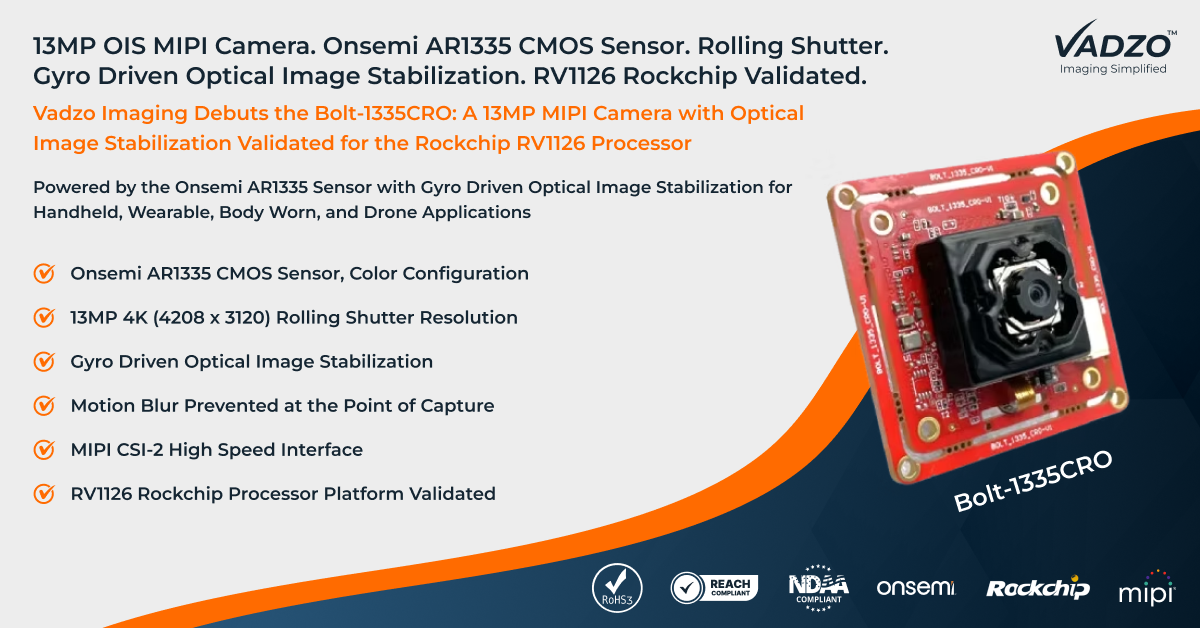
The Bolt-1335CRO is a 13MP OIS MIPI Camera built on the Onsemi AR1335 sensor and validated specifically for the Rockchip RV1126 processor with gyro-driven optical image stabilization. As a 13MP OIS Camera, it is purpose-built for OEMs who need motion blur prevented at the point of capture rather than corrected afterward through software that cannot recover detail already lost to blur. The 13MP Optical Image Stabilization MIPI Camera designation reflects Vadzo's validation of the AR1335 sensor's OIS actuator specifically paired with RV1126's camera subsystem, confirming that stabilization control and capture control integrate correctly before the module reaches OEM customers. The camera module houses the AR1335 sensor, ISP, OIS actuator, and MIPI CSI-2 interface in a compact form factor with a factory-matched lens assembly calibrated to the stabilization mechanism. As an AR1335 RV1126 OIS Sensor, Vadzo's validation confirms stabilization behavior directly on RV1126 hardware, and the AR1335 MIPI Stabilized Sensor designation reflects the sensor's OIS actuator integrated into a single validated module rather than a separate stabilization component requiring independent qualification. As a MIPI OIS Sensor Kit, the evaluation package lets engineering teams confirm stabilized capture directly on their own RV1126 hardware before committing to a production design.
Key specs: 13MP 4K (4208 x 3120) | Onsemi AR1335 1/3.2 inch 1.1-micron pixel | Color | Rolling Shutter | Optical Image Stabilization | MIPI CSI-2 | RV1126 Rockchip Processor | VCM-based Autofocus with Focus Range of 100mm to Infinity | -30°C to 70°C
Key Capabilities of the Onsemi AR1335 Onsemi AR1335 OIS MIPI Sensor
13MP 4K Resolution with OIS for Sharp Stabilized Capture: Many camera modules deployed in handheld or wearable products still rely on digital stabilization alone, which crops into the frame to smooth apparent motion and sacrifices resolution and field of view in the process. The Bolt-1335CRO, positioned as a 13MP RV1126 OIS Sensor, captures full 13MP 4K (4208 x 3120) detail while its gyro-driven OIS actuator holds the image sharp during the exposure itself, giving OEMs building a 4K OIS MIPI Sensor deployment both the resolution and the motion tolerance that field service, wearable, and drone applications actually require. A 13MP MIPI OIS Module of this design preserves full frame resolution and field of view, since no digital crop is required to achieve stabilization.
RV1126 Rockchip Platform Validation for OIS Control: A camera module that lists OIS on its datasheet has not necessarily been validated to confirm that the stabilization actuator's control path integrates correctly with a specific host platform's camera subsystem. The Bolt-1335CRO is validated specifically as a 4K RV1126 OIS Camera, with Vadzo confirming that OIS actuator control operates correctly alongside standard MIPI CSI-2 capture on RV1126 hardware before release. This makes the camera a genuine reference design for OEMs building stabilized capture products on Rockchip silicon, rather than a generic OIS sensor requiring independent platform integration work.
Gyro-Based Optical Stabilization Prevents Blur at Capture Time: Digital stabilization can only manipulate pixels that a sensor already captured, which means any motion blur present in the original exposure remains in the frame regardless of how much cropping or frame alignment is applied afterward. The Bolt-1335CRO's gyro-driven OIS actuator physically counteracts detected motion during the exposure itself, preventing that blur from being captured in the first place rather than attempting to disguise it after capture. This distinction matters directly for edge AI applications, since a detection or recognition algorithm running on the RV1126's NPU can only work with the detail the sensor resolved, and no downstream processing can recover detail that motion blur destroyed during exposure.
NPU Ready Stabilized Frames for Reliable Edge AI Detection: Motion blur degrades detection and recognition accuracy in the same way poor focus does, by removing fine detail an algorithm depends on to distinguish one object or feature from another. The Bolt-1335CRO delivers optically stabilized frames directly to the RV1126's neural processing unit, so detection and recognition algorithms operate on sharp input regardless of whether the camera is handheld, worn, or mounted on a vibrating airframe. This benefits field service and inspection applications where an operator's natural hand movement would otherwise introduce inconsistent blur from one capture to the next, undermining the reliability an automated detection pipeline depends on. A detection model trained on sharp, optically stabilized imagery also generalizes more predictably in the field, since it does not need to compensate for the variable blur signatures a purely digital correction approach would leave behind.
Multi-Resolution Output for Field and Inspection Workflows: Selectable output resolution lets a single Bolt-1335CRO serve multiple roles within the same field deployment. Full 13MP mode captures maximum spatial detail for archival documentation or fine inspection tasks. Lower resolution modes balance detail against bandwidth and frame rate for real-time preview or live streaming from a handheld or body-worn device. Because every output mode benefits from the same optical stabilization applied before the sensor readout, switching resolution modes introduces no change in motion tolerance, which matters for an RV1126 Stabilized Vision System that needs consistent stabilized behavior regardless of which output mode the current task requires.
OEM Integration for RV1126 OIS Programs: The Bolt-1335CRO ships with confirmed device tree overlays and Linux driver packages for RV1126, giving OEMs a validated starting point rather than an open-ended integration project. Available as an RV1126 OIS Camera Kit for evaluation, the camera lets engineering teams confirm stabilized capture on their own RV1126 hardware before committing to a production order. For OEMs evaluating Vadzo as an OEM RV1126 OIS Module supplier, this means lens matching, firmware customization, and enclosure design support are available alongside the core camera hardware rather than as a separate engagement. As a Plug and Play RV1126 OIS camera, the Bolt-1335CRO is validated for straightforward integration across RV1126-based development boards and production carrier boards alike. Vadzo's position as a MIPI OIS Camera for RV1126 supplier extends beyond the camera module itself, while its track record as an RV1126 OIS Camera Manufacturer covers production programs spanning multiple sensor families and interface types for OEM customers building motion-prone edge AI products.
"Field engineers using handheld or wearable devices keep telling us the same thing: their camera never actually sits still, because their hand does not sit still, and neither does a walking gait or a small drone's own propellers. Digital stabilization can smooth that out on screen, but it cannot recover detail that motion blur already destroyed during the exposure. The Bolt-1335CRO was built to solve that at the source. By validating the Onsemi AR1335's optical image stabilization directly on RV1126 hardware, we give OEMs a camera where the frame reaching the NPU is genuinely sharp, not just digitally smoothed after the fact." - Alwin Vincent, Product Manager, Vadzo Imaging.
Application Specific Sections
Edge AI Development Platforms: Engineering teams building a new stabilized edge AI vision product on Rockchip silicon often start from a development board before committing to a custom carrier design, and the camera they prototype with needs to demonstrate genuine optical stabilization behavior rather than only a software preview effect. The Bolt-1335CRO works as an RV1126 OIS Edge AI Camera for exactly this evaluation stage, connecting directly to standard RV1126 development board camera connectors with confirmed driver support, so engineering teams can validate stabilized capture and detection accuracy before finalizing a production design. Prototyping against confirmed reference hardware also shortens the debugging cycle when a design later moves from a development board to a custom carrier, since integrators already know the camera's OIS behavior is not the source of any new issue that surfaces during that transition.
Robotics and Autonomous Systems: Mobile robotics platforms navigating uneven terrain or operating with vibrating drivetrains face continuous motion that can blur the camera feed that guidance and detection algorithms depend on. The Bolt-1335CRO functions as an RV1126 OIS Robotics Camera for these deployments, physically counteracting platform vibration during capture so navigation and object detection algorithms running on the RV1126 receive consistently sharp input regardless of the terrain the platform is currently crossing. A mobile robot transitioning from smooth flooring to a rougher outdoor surface benefits directly from this consistency, since the camera's stabilization response adapts to the actual vibration present rather than assuming a single fixed operating condition.
Drone and Aerial Stabilized Imaging: Small drones vibrate continuously from their own propellers, and that vibration introduces blur into aerial footage even during stable, level flight, degrading both the visual quality of the footage and the accuracy of any onboard object detection. The Bolt-1335CRO operates as an RV1126 OIS Drone Camera for these platforms, giving drone OEMs optically stabilized capture that holds up under continuous propeller vibration, paired with the RV1126's onboard processing capacity for real-time inference during flight. This continuous vibration tolerance differs meaningfully from stabilization designed only for occasional hand movement, since a drone's propellers introduce motion that persists throughout an entire flight rather than occurring intermittently.
Body Worn and Field Service Applications: Body-worn camera products and handheld field service devices move constantly with the operator, whether through walking gait, natural hand tremor, or the physical activity a field inspection task requires. The Bolt-1335CRO serves as an RV1126 OIS Body Worn Camera for these deployments, and its suitability extends directly to an OIS Stabilized Wearable MIPI role, where continuous body motion would otherwise introduce inconsistent blur into every captured frame throughout a shift.
Handheld Industrial Inspection: Handheld inspection tools used for field service, maintenance documentation, or quality verification depend on capturing sharp detail despite the natural hand movement an operator cannot fully eliminate during a capture. The Bolt-1335CRO functions as an OIS MIPI Inspection Camera for these tasks, and the same stabilization benefits an OIS Field Service MIPI Camera role directly, where an inspector moving between checkpoints needs consistent image quality without pausing to brace the device for every capture. Facility teams documenting a large site benefit specifically from this consistency, since a technician can capture usable images while walking a route rather than stopping and steadying the camera at every point of interest.
Frequently Asked Questions
Q: Why does Vadzo Imaging use optical image stabilization instead of digital stabilization for this camera?
A: Vadzo Imaging designs this camera around a limitation that digital stabilization cannot overcome: software correction can only manipulate pixels a sensor already captured, so any motion blur present in the original exposure remains in the frame no matter how much cropping or warping is applied afterward. Vadzo Imaging validates optical image stabilization specifically because it physically counteracts motion during the exposure itself, preventing blur from being captured in the first place rather than attempting to disguise it after the fact. Vadzo Imaging considers this distinction fundamental, not a minor implementation detail, since it determines whether the fine detail an application depends on ever actually reaches the sensor.
Q: Does camera shake or vibration affect edge AI detection accuracy, and how does optical stabilization help?
A: Yes. Vadzo Imaging designs this camera around the fact that a detection or recognition algorithm can only work with the detail a sensor actually resolved, and motion blur removes exactly the fine detail those algorithms depend on. Vadzo Imaging validates optical stabilization specifically so that frames reaching an edge AI processor are genuinely sharp, which directly supports more consistent detection accuracy than a camera relying on digital correction after the blur has already degraded the captured detail.
Q: Is this stabilized camera suitable for wearable or body-worn devices?
A: Yes. Vadzo Imaging validates this camera's optical image stabilization specifically for the continuous motion a wearable or body-worn device experiences throughout normal use, including walking gait and natural body movement. Vadzo Imaging positions this camera for exactly these use cases, where a fixed-mount camera's stabilization assumptions do not apply, and the device itself is the primary source of motion the stabilization needs to counteract.
Q: Does optical image stabilization work reliably on a drone or vehicle with continuous vibration, not just occasional hand shake?
A: Yes. Vadzo Imaging validates this camera's stabilization performance against continuous vibration sources, not only intermittent hand tremor, since a drone's propellers and a vehicle's drivetrain introduce motion that is present throughout the entire capture rather than occurring occasionally. Vadzo Imaging designed the gyro-driven actuator to respond to this kind of sustained vibration, which differs meaningfully from the occasional correction a camera designed only for handheld use might require. Vadzo Imaging validates this behavior specifically so that OEMs deploying the camera on a vibrating airframe or vehicle platform can rely on consistent stabilization throughout an entire flight or drive cycle rather than only during brief moments of relative stillness.
Q: Why should OEMs building handheld or wearable Rockchip devices choose Vadzo Imaging as their camera supplier?
A: Vadzo Imaging offers more than a camera that lists stabilization on a spec sheet. OEMs building handheld or wearable Rockchip devices and working with Vadzo Imaging receive a camera validated to physically prevent motion blur at the point of capture, along with engineering support covering lens matching, firmware customization, and enclosure design guidance. Vadzo Imaging maintains evaluation kits with no minimum order requirement, so engineering teams can confirm stabilized capture performance on their own device before committing to volume production. This combination of validated hardware and low minimum evaluation access is why OEMs continue to choose Vadzo Imaging for motion-prone camera programs, and Vadzo Imaging extends the same validation discipline across its broader Rockchip camera lineup for OEMs whose product line spans multiple platform generations.
Availability
The Bolt-1335CRO 13MP OIS MIPI Camera built on the Onsemi AR1335 sensor is available now for evaluation and production orders. Evaluation kits include the camera module, factory-matched OIS lens assembly, MIPI CSI-2 flex cable, and RV1126 driver documentation, with no minimum order requirement. Engineering teams can confirm stabilized capture directly on their own handheld, wearable, or drone platform before committing to a production bill of materials, which matters more for this camera than a datasheet comparison alone could confirm. Browse the full Vadzo website or contact Vadzo at [email protected] to request an evaluation unit or discuss OEM integration requirements for handheld, wearable, body-worn, and drone camera programs.
About Vadzo Imaging
Vadzo Imaging is a global provider of embedded vision solutions and delivers high-performance camera technologies and imaging platforms for applications in robotics, industrial automation, UAVs, edge AI, and medical systems. Its products are designed for seamless integration with leading embedded platforms including NVIDIA Jetson, Raspberry Pi, Rockchip, and NXP i.MX. Vadzo supports customers through hardware customization, firmware development, and module-level drivers, enabling faster development and deployment of vision-based systems across MIPI, USB, GigE, Wi-Fi, and SerDes camera interfaces.
Media Contact
Alwin Vincent
Vadzo Imaging
Email: [email protected]
LinkedIn: Vadzo Imaging
YouTube: Vadzo Imaging
X: Vadzo Imaging
SOURCE: Vadzo Imaging