




Tuesday, 25 August 2026 03:30 PM
Product Announcements
Built for perimeter, access point, and commercial security deployments that face both harsh lighting and a need for round-the-clock efficiency, this camera pairs the Onsemi HyperLux AR0246 sensor with Adaptive Local Tone Mapping and Wake-on-Motion power management over FPD-Link III, giving security integrators detailed, evenly exposed video without the power and bandwidth cost of continuous full-resolution streaming.
SAN JOSE, CA / ACCESS Newswire / August 25, 2026 / Vadzo Imaging, a provider of embedded vision solutions, today launched the Armor-246CRS-FPD3, a 2MP HDR FPD-Link III Camera built around the Onsemi HyperLux AR0246 sensor for smart security, perimeter monitoring, and commercial surveillance deployments that need both detailed HDR video and efficient, motion-aware power management.
Why Smart Security Systems Need a 2MP HDR FPD-Link III Camera Built for Real-World Lighting
Security camera products rarely get to choose their lighting conditions. A perimeter camera watching a parking lot entrance handles direct sun during the day, headlight glare at night, and the deep shadow of a building's own overhang, sometimes within the same frame. Standard HDR processing can extend dynamic range across a scene overall, but a single global adjustment often still loses detail in a specific region, such as a face under an awning or a license plate lit only by a distant streetlamp, even while the rest of the frame looks properly exposed.
An Adaptive Local Tone Mapping Camera approaches that problem differently, adjusting tone and detail region by region within the same frame rather than applying one correction across the whole image. That distinction matters directly for security footage, where the specific region that matters most- a face, a plate, a doorway- is often exactly the part of the frame that a global adjustment would otherwise compromise to balance the rest of the scene.
A second, equally practical challenge for smart security deployments is scale. A single camera running at full power around the clock is a minor cost, but a property with dozens of camera units, or a security integrator managing hundreds of properties, feels that cost directly in electrical infrastructure and ongoing operating expense. A 2MP Wake-on-Motion Camera addresses that scale problem directly, dropping into a low-power state and activating full HDR capture only when motion actually enters the frame.
These two challenges, regional exposure and deployment scale, do not operate independently in a real installation. A camera that solves one well but ignores the other still leaves a security team choosing between image quality and operating cost, which is not a choice a modern deployment should have to make. Addressing both from the same sensor platform gives an integrator one specification to evaluate rather than two separate compromises to weigh against each other.
Engineering Explanation: Regional Detail, Motion Awareness, and Connectivity
Onsemi designed the HyperLux AR0246 specifically for the security and surveillance conditions described above, rather than adapting a general-purpose sensor after the fact. As an Onsemi HyperLux AR0246 Camera, the sensor pairs 2MP resolution with the processing headroom needed for both adaptive tone mapping and motion-aware power states, giving security integrators a sensor built around the actual demands of the application rather than a sensor borrowed from an unrelated product category.
Adaptive Local Tone Mapping, or an ALTM HDR Camera, is the feature that solves the regional exposure problem directly. Rather than applying a single tone curve across an entire frame, the sensor analyzes brightness region by region and adjusts each area independently, which is what allows a Local Tone Mapping HDR Camera to hold detail in a shadowed doorway and a sunlit sidewalk in the same frame without either region looking artificially flat or blown out. As a 2MP ALTM Camera, the Armor-246CRS-FPD3 applies that processing on the camera itself, so the footage a security system records or streams has already resolved that regional exposure problem before it reaches a recorder or monitoring station.
Wake-on-Motion works alongside that HDR and tone mapping capability rather than compromising it. As a Wake-on-Motion FPD-Link Camera, the Armor-246CRS-FPD3 maintains a low-power monitoring state between events and transitions quickly to full-resolution HDR capture once motion is detected, rather than requiring a security integrator to choose between power efficiency and image quality. A 2MP Wake-on-Motion FPD-Link Sensor configuration like this one gives large-scale security deployments meaningful power savings without asking them to accept a lesser camera during the moments that actually matter.
Connectivity completes the design. As an AR0246 Coax Camera, the Armor-246CRS-FPD3 uses FPD-Link III to carry HDR video, control signals, and power over a single coaxial cable, which matters directly for perimeter camera installations mounted well beyond the reach of a standard USB or Ethernet cable and exposed to outdoor electrical noise that a consumer interface was never designed to tolerate.
Product Overview
The Armor-246CRS-FPD3 pairs the AR0246 FPD-Link III Camera sensor with Adaptive Local Tone Mapping, Wake-on-Motion power management, and FPD-Link III connectivity in a compact design suited to perimeter, access point, and commercial security deployment. As a 2MP HDR FPD-Link III Camera, it outputs 1920 × 1080 resolution with HDR and ALTM processing active by default, giving security integrators a single camera platform that covers detailed monitoring, motion-aware efficiency, and general-purpose surveillance from one module.
At the core of the module sits the Onsemi AR0246 HDR Camera sensor, chosen specifically for the combination of regional tone mapping and motion-aware power management that smart security deployments require. Because the camera pairs an AR0246 ALTM Sensor with 2MP Coax HDR Camera connectivity, the Armor-246CRS-FPD3 reaches usable image quality across a full day and night cycle while drawing meaningfully less average power than a continuously streaming camera of similar resolution.
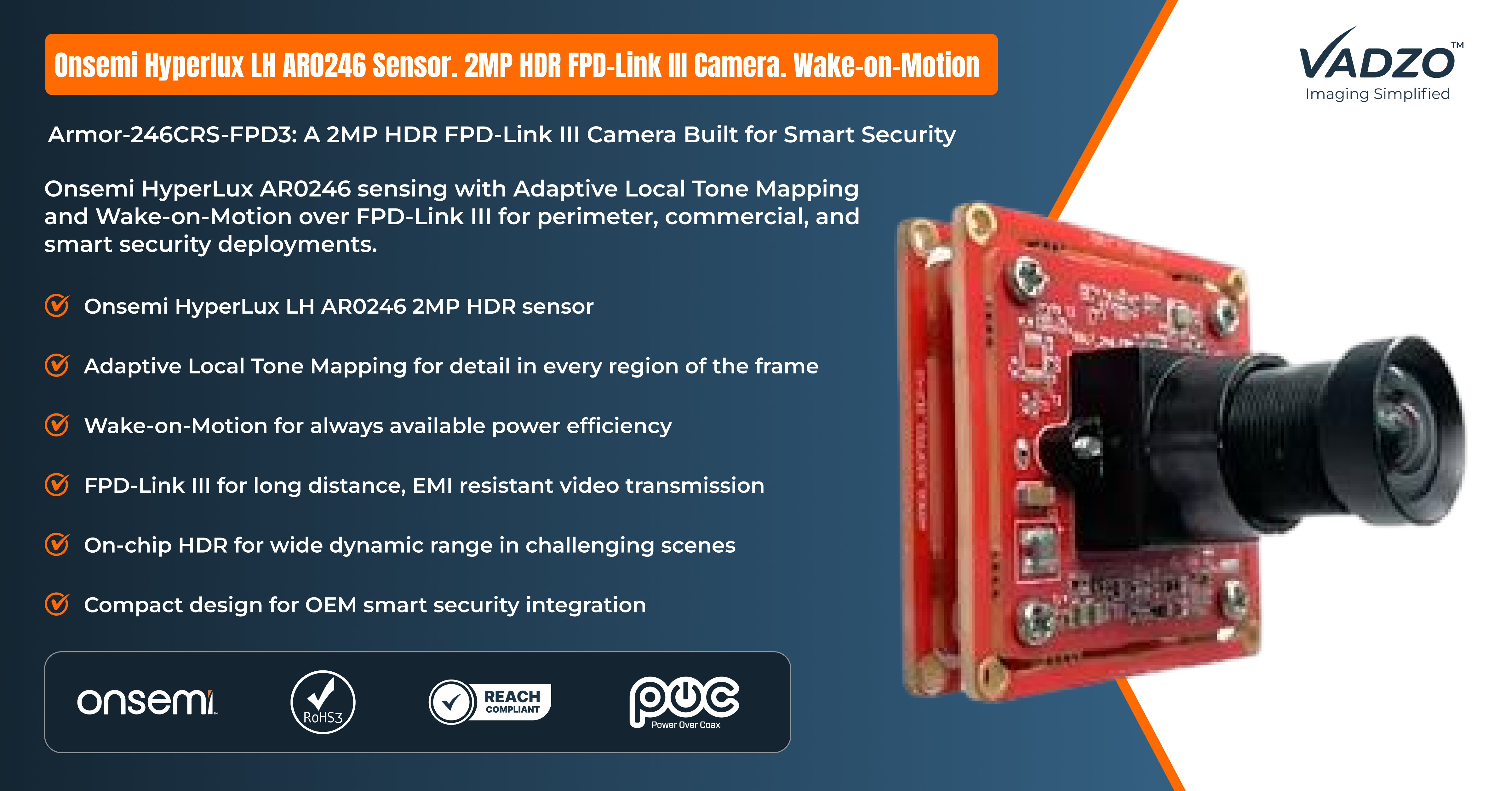
Product Specifications
The 2MP HDR Sensor Module configuration shipped as the Armor-246CRS-FPD3 is defined by the following core specifications:
Sensor: Onsemi HyperLux LH AR0246 Sensor
Sensor Size: 1/4 inch
Pixel: 2.0 µm × 2.0 µm
Resolution: 2MP (1920 × 1080)
Shutter: Rolling shutter
Interface: FPD-Link III
Key Capabilities
Onsemi HyperLux AR0246 Sensor for Detailed 2MP HDR Capture: The Armor-246CRS-FPD3 is built around the Onsemi HyperLux AR0246 sensor, a device engineered specifically for security and surveillance conditions rather than adapted from a general-purpose imaging application. This gives the module genuine HDR Security Camera Module performance suited to the wide range of lighting a perimeter or commercial security deployment actually encounters over a full day and night cycle. That security-specific engineering extends beyond the sensor's optical performance to its overall power and thermal behavior, since a camera drawing excessive power or running hot in an outdoor enclosure creates its own reliability concerns over a multi-year deployment, separate from image quality entirely.
Adaptive Local Tone Mapping for Detail in Every Region of the Frame: A single global exposure adjustment can still lose detail in a specific region even while the rest of a frame looks properly exposed, which is exactly the scenario Adaptive Local Tone Mapping is built to solve. By analyzing and correcting brightness region by region rather than across the whole frame at once, the Armor-246CRS-FPD3 holds detail in the specific areas that matter most to a security review, such as a face, a doorway, or a license plate, regardless of how the rest of the scene happens to be lit.
Wake-on-Motion for Always Available Power Efficiency: Running a large number of camera units at full power continuously is a real and growing operating cost for any security deployment spanning more than a handful of units. As standard on the Armor-246CRS-FPD3, Wake-on-Motion maintains a low-power monitoring state and transitions to full HDR capture only when motion actually enters the frame, meaningfully reducing the average power draw of a large-scale security rollout without asking integrators to accept reduced image quality during an actual event.
FPD-Link III for Long Distance, EMI Resistant Video Transmission: Perimeter and outdoor security camera installations often sit well beyond the reach of a standard USB or Ethernet cable, in an environment with electrical noise from nearby equipment that a consumer interface was never designed to tolerate. As a FPD-Link Security Camera Kit, the Armor-246CRS-FPD3 carries HDR video reliably over a single coaxial cable engineered for exactly that kind of outdoor, electrically noisy environment. That same connectivity approach also simplifies a facility's ongoing maintenance, since a single coaxial run is generally easier to trace, test, and replace than a bundle of separate power and data cables running to the same camera position.
HDR for Wide Dynamic Range in Challenging Security Scenes: Beyond the regional detail ALTM processing provides, the Armor-246CRS-FPD3's underlying HDR capability extends overall dynamic range within a single exposure, holding detail in both bright and shadowed areas of a scene without the ghosting that a moving subject would introduce into a multi-frame blended HDR image. As an HDR FPD-Link III Camera, it fits directly into Vadzo Imaging's broader high dynamic range camera portfolio, giving integrators a consistent point of comparison against other coax-connected HDR modules. Together with ALTM, this gives security operators footage that remains usable across both the frame level and regional lighting challenges a real deployment presents.
Compact OEM Ready Design for Smart Security Integration: The module's compact footprint gives OEM customers flexibility to integrate the Armor-246CRS-FPD3 into a dome housing, a bullet camera enclosure, or a custom security fixture without a major mechanical redesign. Vadzo Imaging supports full customization on this platform as an OEM ALTM Camera Module, including connector changes, housing design, and firmware adjustments for security manufacturers headed into volume production.
"Security teams do not get to ask an incident to happen again under better lighting. The AR0246's Adaptive Local Tone Mapping combined with Wake-on-Motion gives the Armor-246CRS-FPD3 real regional detail and genuine power efficiency in the same module, without asking an integrator to choose between the two. We built this camera for deployments where a face or a plate has to be recoverable from the footage, not just visible in a demo." - Alwin Vincent, Product Manager at Vadzo Imaging.
Application-Specific Sections
Perimeter and Access Point Security: Perimeter fences, gates, and building entrances need continuous coverage across lighting conditions that swing from bright daylight to headlight glare at night. As a Smart Perimeter Security Camera, the Armor-246CRS-FPD3's ALTM processing holds detail in both the sunlit approach and the shadowed gate structure within the same frame, and functioning as an FPD-Link Security Camera, it reaches gate and fence line mounting positions well beyond typical USB or Ethernet cable limits. Deployed as a Coax Security Camera, it fits directly into existing coax-based perimeter security infrastructure without a networking upgrade.
Commercial and Retail Surveillance: Commercial and retail environments combine bright storefront lighting with dimmer stockroom and back-of-house areas, often requiring a single camera line to cover both convincingly. As a Smart Security Camera, the Armor-246CRS-FPD3 handles that range with ALTM processing, and functioning as a Smart Security Vision Module, it extends that same capability to loss prevention and general activity monitoring across a retail floor.
Smart CCTV and NVR Integration: Existing CCTV and NVR infrastructure built around coax connectivity benefits from a camera upgrade path that does not require replacing the underlying cabling. A Smart CCTV Camera Module built on FPD-Link III fits into that existing infrastructure, giving facilities a meaningful image quality upgrade without a full system replacement. For facilities weighing a full IP camera migration against a more incremental upgrade path, an FPD-Link III camera compatible with existing coax runs offers a meaningful middle option, delivering modern HDR and ALTM image quality without the cost and disruption of rewiring an entire site.
AI-Powered Security Analytics: AI-based detection and analytics software depends on consistent, well-exposed video to perform reliably, which makes ALTM and HDR processing as relevant to a security system's analytics accuracy as to its human-reviewed footage. As an AI Security Camera Module, the Armor-246CRS-FPD3 supplies that consistent input, and functioning as a Motion Activated Security Camera, it also reduces the volume of empty footage an analytics pipeline needs to process in the first place.
OEM Integration for Security System Manufacturers: Security system manufacturers building their own camera lines need a vendor who understands the connectivity, power efficiency, and image quality requirements a smart security deployment demands. The Armor-246CRS-FPD3 ships from an ALTM Camera Manufacturer with those requirements built in, and Vadzo Imaging supports OEM customization for cable length, connector type, and firmware for manufacturers standardizing on one camera across multiple security product lines. As a Coax Security Camera Supplier, Vadzo Imaging supports that standardization from initial evaluation through volume production.
Frequently Asked Questions
Q: What is adaptive local tone mapping, and how is it different from standard HDR processing?
A: Standard HDR processing typically applies one overall correction across an entire frame, which improves the balance between bright and dark areas generally but can still lose detail in a specific region that needed different treatment than the rest of the scene. Adaptive local tone mapping instead analyzes brightness region by region within the same frame and adjusts each area independently, so a shadowed doorway and a sunlit sidewalk can both hold usable detail without either one being sacrificed to balance the other. Vadzo Imaging selects sensors with genuine adaptive local tone mapping for security applications specifically because the regions that matter most in a security frame- a face, a license plate, an entry point- are often exactly the regions a single global adjustment would otherwise compromise.
Q: Why does a security camera benefit from a coax-connected interface instead of a standard IP or Wi-Fi camera?
A: A standard IP camera depends on network infrastructure and a stable Wi-Fi or Ethernet connection that may not reach every perimeter or outdoor mounting position without additional hardware, while a coax-connected camera using a link like FPD-Link III carries video, control signals, and power over a single cable engineered for long distance and electrically noisy outdoor environments. This also allows a coax-connected camera to integrate directly with existing analog or hybrid CCTV infrastructure that many facilities already have in place, rather than requiring a full network upgrade. Vadzo Imaging designs its security camera products around this connectivity so integrators get a dependable, long-reach video link without the network dependency a standard IP camera introduces. This distinction becomes especially relevant for older facilities that were originally wired for analog CCTV, since upgrading to a coax-compatible HDR camera can deliver a meaningful image quality improvement without the cost of a full IP network buildout.
Q: Does Wake-on-Motion risk missing part of an event compared to a camera that records continuously?
A: A well-designed Wake-on-Motion camera does not sit fully off between events; it maintains a low-power monitoring state specifically so it can transition to full-resolution recording quickly once motion is detected, and many implementations include a short buffer that captures the moments immediately before the triggering motion was identified. Vadzo Imaging designs its Wake-on-Motion camera products with that fast transition and buffering in mind, since a security camera that saves power but misses the first moment of an incident has traded away the one thing a security deployment actually needs. The result is a camera that behaves like a continuously recording system during genuine events, while still gaining the bandwidth and storage savings of not recording empty scenes around the clock.
Q: Can Vadzo Imaging customize a smart security camera module for a specific access control or surveillance platform?
A: Yes. Vadzo Imaging supports full OEM customization across its smart security camera portfolio, including housing design suited to a dome, bullet, or custom fixture, connector and cable length configuration, and firmware adjustments tuned for a particular ALTM or Wake-on-Motion sensitivity profile. Evaluation units ship with no minimum order requirement, and the same engineering team that built the standard product works directly with security system manufacturers and integrators to adapt the module for a specific access control or surveillance platform headed into volume production.
Q: What should security system integrators look for when selecting an HDR camera module for outdoor or perimeter deployment?
A: Outdoor and perimeter deployments need more than a high resolution number, since a camera that cannot handle direct sun, headlight glare, and deep shadow within the same scene will still produce unusable footage regardless of its megapixel count. Integrators should look for genuine regional tone handling rather than a single global HDR adjustment, a connectivity approach built for outdoor distance and electrical noise rather than adapted from an indoor interface, and a supplier able to support customization for a specific mounting position or housing. Vadzo Imaging builds its security camera products around exactly these priorities, since a camera that performs well in a demo but struggles with real outdoor lighting is not actually a viable choice for a perimeter security deployment. Ultimately, the specification sheet only tells part of the story, and a brief field evaluation under the site's actual lighting and mounting conditions is usually the more reliable way to confirm a camera will perform as expected once it is permanently installed.
Availability
The Armor-246CRS-FPD3 2MP HDR FPD-Link III Camera is available now for evaluation and OEM integration. Evaluation kits include the camera module, an FPD-Link III deserializer reference board, mounting hardware, and integration documentation covering ALTM configuration, Wake-on-Motion sensitivity tuning, and HDR setup, with no minimum order requirement. Contact Vadzo Imaging at [email protected] to request an evaluation unit or discuss volume production and OEM customization. Evaluation feedback is also welcome directly through the same contact channel, since real-world deployment conditions often surface details a bench test alone would not reveal.
About Vadzo Imaging
Vadzo Imaging develops embedded and machine vision camera products for OEMs, system integrators, and security system manufacturers building production-ready vision systems across perimeter security, commercial surveillance, robotics, and edge AI. The company's portfolio spans MIPI CSI-2, USB, GigE, Wi-Fi, FPD-Link III, and SerDes interface camera products, supporting deployment architectures from compact onboard modules to distributed networked and coax-connected installations. Vadzo provides end-to-end imaging support including sensor integration, ISP tuning, firmware development, and SDK frameworks to accelerate system deployment. Visit Vadzo Imaging to explore the full embedded vision camera portfolio.
Media Contact
Alwin Vincent
Vadzo Imaging
Email: [email protected]
LinkedIn: Vadzo Imaging
YouTube: Vadzo Imaging
X: Vadzo Imaging
SOURCE: Vadzo Imaging