




Tuesday, 25 August 2026 01:30 PM
Product Announcements
Vadzo Imaging has positioned the Bolt-1335CRO as a stabilized 4K imaging module built on the Onsemi AR1335 13MP Image Sensor with optical image stabilization, Voice Coil Motor autofocus, and an onboard high-performance ISP delivered over a MIPI CSI-2 interface. Positioned as an AR1335 MIPI Camera engineered for platforms that move during capture, the module addresses the two mechanical conditions that most often destroy 4K image quality in the field, which are operator hand tremor in handheld instruments and chassis vibration in vehicle-mounted installations.
FORT WORTH, TX / ACCESS Newswire / August 25, 2026 / Vadzo Imaging, a developer of embedded and machine vision camera products for OEM and system integration programs, has positioned the Bolt-1335CRO for engineering teams building handheld field inspection instruments and vehicle-mounted imaging platforms. The module pairs the Onsemi AR1335 sensor with an optical image stabilization actuator and a Voice Coil Motor autofocus assembly on a MIPI CSI-2 camera module designed for direct connection to embedded Linux hosts. Onboard high-performance ISP processing produces corrected color output at the module boundary, which removes the demosaicing, noise reduction, and tone mapping load from the host and frees compute capacity for the inference workload the product was specified to run. The AR1335 OIS MIPI Camera is intended for OEM developers, electrical and firmware engineers, and embedded vision teams who need 13 megapixel spatial detail from a platform that will not hold still.
The Engineering Problem: Resolution Without Stability Delivers No Usable Detail
Specifying a 13-megapixel sensor for a handheld or mobile imaging product is a decision that looks correct on a datasheet and fails in the field for reasons that have nothing to do with the sensor. At 4208 x 3120 across a 1/3.2-inch optical format, each pixel subtends a very small angular slice of the scene. That is why the resolution is valuable, because a weld seam, a hairline crack, a corroded terminal, or a license plate character occupies enough pixels to be classified reliably. It is also why the resolution is fragile. When the pixel pitch is 1.1 µm, an angular disturbance measured in fractions of a degree moves the projected image by several pixel widths and smears scene detail across neighboring pixels.
Human hand tremor is a physiological signal no operator can suppress through training. A technician holding a Handheld Inspection Camera at arm length inside a switchgear cabinet or against the underside of a bridge deck introduces low-frequency drift and higher-frequency tremor at once. Vehicle-mounted installations replace tremor with a different disturbance profile. Road surface excitation transmitted through suspension and chassis hardware produces vibration across a broad frequency band, and that vibration reaches the camera bracket regardless of how carefully it was machined. In both cases, the imaging axis moves during the exposure window, and the sensor records that motion as blur.
Rolling shutter readout compounds the problem in a way that is often misunderstood. Any AR1335 Rolling Shutter MIPI Camera exposes and reads out pixel rows in sequence rather than simultaneously. When the imaging axis moves during that readout sequence, different rows of the frame are captured from slightly different viewing angles. The result is not a uniformly soft image but a geometrically inconsistent one, where straight edges acquire a shear or a wobble that varies down the frame. Sharpening filters applied downstream cannot recover this. The information was never captured. For a 13MP Rolling Shutter MIPI Camera deployed on a moving platform, the correct engineering response is to hold the optical path steady during exposure rather than to attempt reconstruction after the fact.
Why Optical Image Stabilization Is the Correct Layer to Solve This
Stabilization can be implemented at three points in an imaging system, and the choice determines what the system can actually recover. Electronic image stabilization operates on captured frames. It crops a margin from each frame and shifts the crop window to align successive frames against each other. This method costs field of view, costs effective resolution, and does nothing about blur that occurred within a single exposure. It stabilizes the sequence rather than the frame, and it consumes memory bandwidth and inference headroom on the same processor running the detection model.
Mechanical stabilization at the mount level, meaning gimbals and isolation dampers, works well but adds mass, volume, cost, and a moving assembly that requires maintenance. Handheld instruments cannot carry that mass, and vehicle-mounted enclosures rarely have the volume for it. Optical image stabilization solves the problem at the layer where the error is introduced. A sensed angular disturbance is counteracted by physically shifting the optical path within the module so that the projected image remains stationary on the sensor surface for the duration of the exposure. The correction happens before photons are integrated, which means the recorded frame is sharp rather than repaired.
For teams evaluating an Optical Image Stabilization Camera against a fixed lens alternative, the practical benefit shows up in exposure budget. Without stabilization, the only defense against motion blur is a short exposure. Short exposures reduce collected photons and force analog gain upward, which raises read noise and destroys the low-contrast detail inspection and recognition workloads depend on. Stabilization extends the usable exposure window under the same illumination, so the system runs at lower gain and preserves the signal-to-noise margin classification accuracy requires. This is the reason an AR1335 OIS Camera outperforms a fixed lens module of identical resolution in the environments where high resolution was specified in the first place.
Autofocus addresses a second and independent failure mode. Fixed focus optics establish a single calibrated working distance and a depth of field around it. Every deployment scenario outside that band produces a soft image regardless of stabilization quality. Handheld inspection is defined by variable working distance because the operator moves toward and away from the subject continuously. A Voice Coil Motor autofocus assembly moves the lens element along the optical axis under electrical control, allowing the module to converge on the subject plane wherever the operator places it. Vadzo has published a detailed technical explanation of autofocus sensor camera products and Voice Coil Motor operation for teams evaluating focus mechanisms at the design stage. Combining both mechanisms in one module is what makes the 13MP Autofocus MIPI Camera suitable for products that move and for subjects that do not stay at a fixed distance. An AR1335 Autofocus MIPI Camera solves motion and distance together rather than trading one against the other.
Product Overview: Bolt-1335CRO Onsemi AR1335 13MP 4K MIPI CSI-2 Camera
The Bolt-1335CRO is built on the Onsemi AR1335, a 1/3.2 inch back-side-illuminated CMOS sensor with 1.1 µm pixel pitch delivering 13MP at 4208 x 3120 full resolution. The back-side-illuminated architecture places the photodiode above the metal interconnect layers so that incident light reaches the photosensitive region without obstruction from wiring. This raises quantum efficiency at the pixel level and is the reason a 1.1 µm pixel remains usable in the moderate illumination conditions found inside cabinets, enclosures, vehicle interiors, and covered inspection sites. As an Onsemi AR1335 Camera, the module inherits a sensor platform with a long production history in embedded vision programs, and as an AR1335 MIPI Camera, it delivers that sensor over the transport embedded hosts accept natively.
Full-resolution 13MP output serves inspection capture and archival documentation where maximum spatial detail is required from a single frame. The 4K video mode serves continuous streaming workloads. A 1080p mode obtained through pixel binning gives bandwidth-constrained hosts a resolution step down that combines charge from adjacent pixels, raising per-pixel sensitivity while reducing data volume across the interface. Because all three modes are selected through the same driver control path, an OEM can ship one hardware configuration and switch operating modes in firmware rather than maintaining separate hardware variants. This flexibility is a practical requirement for a 13MP 4K MIPI Camera that must serve both a documentation workflow and a live analytics workflow on the same platform. A single 13MP Color MIPI Camera configuration therefore covers requirements that would otherwise demand two distinct hardware builds.
The onboard high-performance ISP is a defining architectural feature of this module rather than an accessory specification. The ISP resides on the camera module and executes demosaicing, white balance, noise reduction, gamma correction, and tone mapping before data crosses the MIPI CSI-2 interface, so the host receives processed color frames instead of raw Bayer data. On an NVIDIA Jetson or Raspberry Pi host running an inference pipeline, this is a direct release of compute and memory bandwidth. It also removes the ISP tuning burden from the host software team. Teams evaluating an AR1335 4K MIPI Camera for an edge inference product should weigh this offload against the engineering time consumed by host-side image processing development.
Key specs: 13MP (4208 x 3120) | AR1335 CMOS Sensor from Onsemi | 1/3.2" BSI | 1.1 µm x 1.1 µm Pixel Size | Rolling Shutter | Color | 4K and 1080p Output Modes | Optical Image Stabilization | VCM-based Autofocus with Focus Range of 100mm to Infinity | High-Performance ISP | MIPI CSI-2 Interface
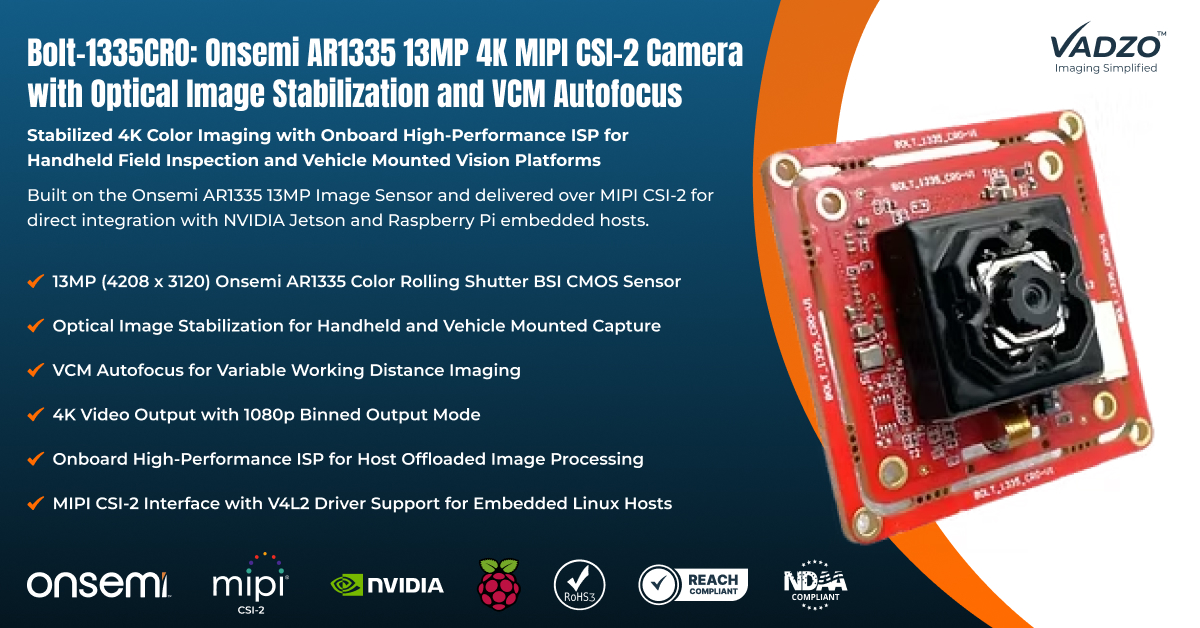
Key Capabilities of the Bolt-1335CRO 13MP OIS MIPI Camera
Optical Image Stabilization for Motion-Tolerant Capture at Full Resolution: The stabilization system counteracts angular disturbance of the imaging axis by shifting the optical path inside the module during exposure. The correction is applied before integration, so the frame delivered to the host is captured sharp rather than reconstructed. This preserves the full sensor field of view because no margin is sacrificed to a crop window, and it preserves effective resolution because no digital resampling is applied. For a 13MP OIS MIPI Camera, the consequence is that the 4208 x 3120 pixel grid delivers its designed spatial detail on a moving platform rather than only on a tripod.
Voice Coil Motor Autofocus for Variable Working Distance Imaging: The Voice Coil Motor assembly drives the lens element along the optical axis in response to electrical control from the host, with no mechanical adjustment and no lens exchange required in the field. Focus can be driven by a continuous autofocus routine that tracks the subject as working distance changes, or commanded to a specific position by the application when the operating distance is known. This second mode matters in machine vision workflows where deterministic focus behavior is preferred over adaptive behavior. As a 13MP Autofocus Rolling Shutter MIPI Camera and an AR1335 Autofocus Color MIPI Camera in one assembly, the module removes the fixed working distance ceiling that constrains fixed focus modules, which is the single most common cause of soft imagery in handheld instruments where the operator and the subject are both in motion. Additional integration guidance covering VCM tuning and focus control is available in Vadzo's 4K autofocus camera module resources.
Onboard High-Performance ISP for Host Compute Offload: Image signal processing executes on the camera module rather than on the host SoC, delivering processed color frames across MIPI CSI-2. On embedded hosts, the ISP block is a shared and heavily contended resource, and moving this workload off the host returns processing headroom and memory bandwidth to the application. For edge AI camera deployments, the released capacity translates into a larger inference model or a higher sustained frame rate. It also shortens schedules by removing host-side ISP tuning, a specialized task many embedded teams are not staffed to perform.
MIPI CSI-2 Interface for Low Latency Direct Attach Integration: The MIPI CSI-2 interface connects the module directly to the host processor image input, without the protocol translation, packetization, or bus arbitration that USB and Ethernet transports introduce. Frames arrive in host memory with minimal transport latency, which is the requirement for closed-loop applications where a control decision follows the frame. Vadzo maintains a technical reference covering MIPI CSI-2 interface architecture for teams comparing transport options. The direct attach path also removes a transport controller from the bill of materials along with its board area and power draw, which is a meaningful gain in battery-powered handheld instruments and compact vehicle-mounted enclosures. Compact vehicle-mounted enclosures, consistent with the board-level footprint used across Vadzo's 4K MIPI camera portfolio.
Back Side Illuminated Color Sensor for Detail Retention in Mixed Lighting: The AR1335 back-side-illuminated structure improves photon collection at the pixel level compared with front-illuminated designs of equivalent geometry. As an AR1335 Color MIPI Camera, the module retains color fidelity and shadow detail in the mixed illumination that characterizes real inspection and mobility environments, where a bright exterior region and a shaded interior region occupy the same frame. Combined with stabilization, the sensitivity advantage compounds, because a longer usable exposure and a more efficient pixel together permit lower analog gain. That is what preserves the low-contrast detail defect detection and character recognition models rely on in an AR1335 Color Rolling Shutter MIPI Camera.
Product Specifications
Parameter | Specification |
Model | Bolt-1335CRO |
Sensor | AR1335 CMOS Sensor from Onsemi |
Resolution | 13MP - 4208(H) x 3120(V) |
Optical Format | 1/3.2" |
Pixel Size | 1.1 µm x 1.1 µm |
Sensor Architecture | Back Side Illuminated CMOS |
Shutter Type | Rolling Shutter |
Color Configuration | Color |
Optics | VCM Based Autofocus with Focus Range of 100mm to Infinity |
Stabilization | Optical Image Stabilization |
Image Signal Processing | High Performance ISP |
Interface | 2 Lane MIPI CSI-2 & 4 Lane MIPI CSI-2 |
Operating Temperature | -30⁰C to 70⁰C |
Dimensions | 38mm (L) x 38mm (B) convertible to 32mm (L) x 32mm (B) |
Weight | 13 Grams (Without Lens) |
Compliance | RoHS 3, REACH, NDAA |
"Most teams that come to us with a stabilization requirement have already tried to solve it in software and have already paid for it in field of view, in latency, or in inference headroom. What we wanted to give them with the Bolt-1335CRO is a module where the correction happens inside the optical path and the host never sees the problem. Pairing that with Voice Coil Motor autofocus and an onboard ISP means an engineer can point a handheld instrument at a subject at any working distance, on a platform that is vibrating, and still get a 4K frame worth running a model on. That is the outcome our customers are actually buying." - Alwin Vincent, Product Manager, Vadzo Imaging.
Target Applications
Handheld Field Inspection and Portable Diagnostic Instruments: Field service engineers inspecting electrical substations, pipeline welds, structural steel, wind turbine blade roots, and process plant equipment work at arm's length from the subject in postures that make a stable hold impossible. Utility inspection now requires photographic evidence at a resolution sufficient to document a defect for asset management records rather than merely to detect it. A Field Inspection Camera Module built for this work must resolve corrosion pitting, insulation cracking, thread damage, and connector oxidation at working distances that change as the technician repositions. Optical stabilization holds the imaging axis steady through tremor so full-resolution capture remains usable, and Voice Coil Motor autofocus converges on the subject plane without the operator stepping to a calibrated distance. The onboard ISP delivers a corrected frame directly to the instrument display, which shortens the inspection cycle because the technician confirms capture quality on site rather than discovering blur after returning from the field. This is the practical case for a 13MP Autofocus Color MIPI Camera in portable diagnostic hardware.
Vehicle Mounted Vision and Fleet Telematics Platforms: Chassis-mounted imaging in commercial vehicles operates under continuous broadband vibration from road surface excitation, drivetrain harmonics, and payload shift. A Vehicle Mounted Vision Camera intended for driver monitoring, cargo verification, road survey, or forward event capture must produce frames that survive this environment at a resolution useful for downstream recognition. Optical stabilization suppresses the vibration-induced angular displacement that produces rolling shutter shear across the frame, which is the failure mode that corrupts license plate recognition and lane boundary extraction. Autofocus maintains sharpness as a 13MP 4K Rolling Shutter MIPI Camera transitions between near-field cargo bay imaging and far-field forward scene capture. For fleet operators deploying an In-Vehicle Vision Camera as part of a telematics program, stabilized 4K capture raises the evidentiary value of retained footage and reduces the volume of unusable recorded material.
Security, Surveillance and Mobile Enforcement Deployments: Pole-mounted and mast-mounted installations experience wind loading that induces sway at low frequency, and mobile enforcement units mounted to patrol vehicles experience the full vehicle vibration profile. Both workloads demand pixel density on target at long working distances, which is the condition where angular disturbance produces the greatest projected displacement. Stabilized 4K capture supports security and surveillance deployments where identification quality determines whether recorded footage has operational value. A Dashcam Vision Module built on a stabilized 13MP Color MIPI Camera retains character-level detail in plate reads and facial geometry at enrollment quality. The extended usable exposure window also improves dawn, dusk, and night performance where gain-limited systems degrade first.
Smart City Infrastructure and Traffic Monitoring Systems: Roadside and intersection installations combine long working distances with mounting structures that are never fully rigid. Vehicle classification, occupancy analytics, pedestrian counting, and incident detection all depend on consistent pixel geometry across frames because tracking algorithms accumulate positional error when frame-to-frame geometry shifts. For smart city infrastructure programs, an AR1335 4K Rolling Shutter MIPI Camera with optical stabilization delivers geometrically consistent input to tracking and classification pipelines mounted on structures subject to wind- and traffic-induced vibration. Direct MIPI CSI-2 attachment to a roadside edge compute node keeps the processing chain short, and a 13MP 4K Color MIPI Camera with onboard ISP preserves host capacity for analytics rather than image correction.
Robotics, Automation and Mobile Inspection Platforms: Robotic arms, autonomous mobile robots and unmanned aerial inspection platforms impose motion on the imaging payload as an inherent condition of operation rather than as an occasional disturbance. Vadzo has published background on embedded vision camera products in automation and robotics for teams specifying imaging at the architecture stage. On a mobile platform, the combination of stabilization and autofocus removes two constraints at once, allowing inspection-quality capture while the platform is still moving instead of stopping to stabilize and refocus at each waypoint. Dwell time at each capture point falls and inspection throughput rises. Within broader automation and robotics programs, the low-latency MIPI CSI-2 path supports visual servoing and closed-loop positioning.
Platform Support and V4L2 Driver Integration
The Bolt-1335CRO integrates with embedded Linux hosts through the standard V4L2 framework. Integration follows the established path for MIPI CSI-2 modules, beginning with a sensor device tree node that declares the module on the host CSI receiver, followed by endpoint configuration for MIPI lane mapping and link frequency, then pad format negotiation through the V4L2 subdev API. Application layer capture proceeds through standard V4L2 ioctl calls, so existing GStreamer pipelines, OpenCV capture paths, and custom applications operate without transport-specific modification. Vadzo has documented MIPI CSI-2 streaming with GStreamer and V4L2 for teams building capture pipelines on Raspberry Pi hosts.
Focus and stabilization controls are exposed to the host as standard V4L2 controls rather than through a proprietary side channel, so application software queries and sets them using the same interface used for exposure and gain. This keeps integration inside the mainline embedded Linux camera model. For teams working on NVIDIA Jetson camera module integration or on Raspberry Pi 5 MIPI CSI-2 platforms, this AR1335 MIPI Camera follows the same bring-up sequence used across the Bolt series. Vadzo publishes configuration guidance for 4K camera products on Raspberry Pi hosts and for 13MP MIPI Camera integration on Jetson carrier boards. Driver packages, device tree overlays, and integration documentation covering supported platform configurations are provided with evaluation units, and driver porting support for additional SoC platforms is available on request through Vadzo applications engineering.
Frequently Asked Questions
Q: What is optical image stabilization in a MIPI camera and how does it differ from electronic image stabilization?
A: Optical image stabilization corrects the light path inside the camera module before the sensor integrates the exposure. An angular disturbance of the imaging axis is sensed and counteracted by physically shifting the optical path, so the projected image stays stationary on the sensor surface while the shutter is open. The frame is therefore captured sharply. Electronic image stabilization works after capture. It crops a margin from every frame and shifts that crop window to align successive frames, which stabilizes the appearance of a video sequence but cannot remove blur that occurred within a single exposure. Electronic stabilization also costs field of view and effective resolution because the crop margin is permanently sacrificed, and it consumes host cycles on every frame. For inspection documentation and for any workload where a single frame is submitted to a recognition model, optical correction is the only method that produces sharper source data. Electronic methods improve how footage looks to a human viewer without improving what a model can extract from it.
Q: Why does a 13MP rolling shutter camera module need stabilization for handheld inspection work?
A: Pixel pitch determines how much angular displacement the system can tolerate. On a 1/3.2 inch sensor delivering 4208 x 3120, the pixel pitch is 1.1 µm and each pixel maps to a very small angular slice of the scene. A disturbance of a fraction of a degree therefore moves the projected image across several pixel widths during exposure, and human hand tremor produces disturbance at exactly this scale continuously. Rolling shutter readout adds a second effect because rows are exposed sequentially, so axis motion during readout captures different rows from different viewing angles and introduces geometric shear rather than uniform softness. Without stabilization, the only remaining defense is a very short exposure, which starves the sensor of photons and forces gain upward until read noise erases the detail the inspection was meant to capture. Vadzo addresses this in the Bolt-1335CRO by placing an optical stabilization actuator in the module so the exposure window can stay open long enough to collect signal at low gain. This is why the module is positioned as a 13MP Color Rolling Shutter MIPI Camera for handheld instruments rather than as a general-purpose fixed-mount module.
Q: How does VCM autofocus work over a MIPI CSI-2 interface on an embedded Linux host?
A: A Voice Coil Motor is an electromagnetic actuator that moves the lens element along the optical axis in proportion to applied current, with no gears and no mechanical linkage. On a MIPI CSI-2 module, the control path is separate from the image data path. Pixel data streams over the CSI-2 lanes to the host image receiver, while focus commands travel over the control bus as standard V4L2 controls. Application software issues a focus command using the same interface it uses for exposure and gain, so no proprietary control library is required in the application stack. Two operating modes are typical. Continuous autofocus runs a contrast evaluation loop that drives the actuator toward maximum sharpness and tracks the subject as working distance changes, which suits handheld operation. Commanded focus positions the actuator at a value set by the application, which suits fixed geometry machine vision stations where deterministic behavior is preferred. An AR1335 Autofocus Rolling Shutter MIPI Camera supports both modes through the same control interface. Vadzo publishes a detailed technical reference on autofocus camera mechanisms for teams selecting between these approaches during design.
Q: What does an onboard ISP do in a 4K MIPI camera module and why does it matter on Jetson and Raspberry Pi?
A: Raw sensor output is Bayer-patterned data that is not directly usable by most vision applications. Converting it into a corrected color frame requires demosaicing, black level correction, white balance, lens shading correction, noise reduction, gamma, and tone mapping. Without an onboard ISP, all of that work executes on the host SoC using the host ISP block and host memory bandwidth. On an NVIDIA Jetson or Raspberry Pi platform, the ISP block is a shared resource competing with the inference engine, the video encoder, and the display pipeline, and at 4K the bandwidth cost of moving raw frames is significant. An onboard ISP performs this work inside the camera module and delivers finished color frames across the interface, returning host compute and bandwidth to the application. There is a second benefit that engineering managers often value more. ISP tuning is a specialized discipline, and host-side tuning is frequently the longest and least predictable task in a camera bring-up schedule. Vadzo supplies the Bolt-1335CRO with sensor tuning already executed on the module ISP, which is a substantial reason teams select it as an AR1335 4K Color MIPI Camera for Jetson and Raspberry Pi-based products.
Q: Can a 4K autofocus MIPI camera module be customized for vehicle-mounted or handheld OEM deployment?
A: Yes. Vehicle-mounted and handheld products impose constraints that a catalog module rarely meets exactly, including board outline, connector orientation, cable length, lens field of view, filter selection, and thermal interface. Vadzo Imaging develops custom OEM camera configurations at the hardware and firmware level rather than reselling fixed catalog parts. Typical customization includes lens and filter selection matched to the required field of view, board outline and connector changes to fit an existing enclosure, cable variants for chassis routing, ISP tuning adapted to the illumination profile of the deployment, and driver porting to SoC platforms outside the standard support list. Vadzo applications engineers engage from evaluation through production ramp, which matters for vehicle programs and field instruments where validation cycles are long. Evaluation units are available without a minimum order quantity through the Vadzo online store or directly from the applications team.
Availability and Customization
The Bolt-1335CRO 13MP 4K Autofocus MIPI Camera with optical image stabilization is available for evaluation, prototyping, and production deployment with no minimum order requirement. Evaluation units include the camera module, driver packages, and integration documentation covering device tree overlays and V4L2 bring-up for supported platforms. Custom configurations including lens and filter selection, board outline modification, connector and cable variants, ISP tuning and driver porting are supported for OEM and volume programs. The complete 4K MIPI camera portfolio and the wider MIPI CSI-2 camera series are published on the Vadzo Imaging website. To request an evaluation unit or discuss integration requirements, visit the AR1335 4K Autofocus MIPI Camera product page or contact Vadzo support at [email protected].
About Vadzo Imaging
Vadzo Imaging develops embedded and machine vision camera products for OEMs and system integrators building production-ready vision systems across industrial automation, robotics, medical device platforms, retail automation, kiosk and digital signage deployments, and edge AI applications. The company delivers imaging platforms across USB, MIPI CSI-2, GigE, Wi-Fi, and SerDes interfaces, including a broad 4K HDR camera portfolio spanning board-level and enclosed configurations. Beyond hardware, Vadzo provides end-to-end imaging support including sensor integration, ISP tuning, firmware development, and OEM camera customization services that accelerate development and simplify deployment at scale. Visit www.vadzoimaging.com to explore the full embedded vision camera portfolio.
Media Contact
Alwin Vincent
Vadzo Imaging
Email: [email protected]
LinkedIn: Vadzo Imaging
YouTube: Vadzo Imaging
X: Vadzo Imaging
SOURCE: Vadzo Imaging