




Thursday, 27 August 2026 02:30 PM
Company Update
Built for industrial applications, assembly lines, PLC-integrated vision systems, and factory floor monitoring that must resolve detail in dim machine interiors and bright reflective surfaces alike, this camera pairs the Sony Starvis 2 IMX662 sensor with HDR and ultra-low-light sensitivity over USB 2.0, giving industrial automation integrators dependable image quality without a proprietary interface or external illumination to manage.
SAN JOSE, CA / ACCESS Newswire / August 27, 2026 / Vadzo Imaging, a provider of embedded vision solutions, today validated the Merlin-662CRS, an IMX662 HDR USB Camera built around the Sony Starvis 2 IMX662 sensor for low light automation applications for industrial environments, assembly line monitoring, and PLC-integrated vision applications that need dependable HDR imaging in variable and often dimly lit industrial environments.
Why Factory Automation Needs an IMX662 HDR USB Camera Built for Variable Industrial Lighting
Factory floors present a lighting environment that is far less uniform and far less consistent than it first appears to a visitor walking through on a typical day. General area lighting may keep a facility bright enough for worker safety, but the inside of an enclosed machine, the underside of a conveyor, or a partially shadowed assembly station can sit well below that ambient level, and a camera without genuine low light sensitivity simply cannot resolve useful detail in those specific locations regardless of how well lit the surrounding floor happens to be at any given time.
An IMX662 Ultra-Low-Light USB Camera approaches that problem directly at the sensor level, extending usable sensitivity well past the point where a standard sensor would need supplemental lighting added at every monitoring position. A 2MP Ultra-Low-Light USB Camera configuration like this one lets automation integrators monitor those dimmer zones without adding dedicated lighting fixtures to every camera location on a production line.
A second, related challenge is dynamic range in scenes that combine bright reflective metal surfaces with the same shadowed recesses described above, often within the same field of view. An Ultra Low Light HDR Camera configuration addresses that challenge directly at the sensor level, extending dynamic range within a single exposure rather than relying on multiple frames or a downstream processing stage to compensate.
These two challenges, dim monitoring positions and high-contrast scenes, frequently occur at the exact same station rather than independently. A shadowed machine interior sitting right beside a bright reflective panel is a completely normal condition on a factory floor, not an edge case, which means a camera solving only one of these problems still leaves a meaningful gap in coverage at precisely the stations where reliable monitoring matters most.
Engineering Explanation: Sensitivity and Dynamic Range Together
Sony designed the IMX662 as part of its STARVIS 2 sensor lineup, using Back-Side Illuminated pixel architecture specifically to improve low-light sensitivity beyond what a conventional front-illuminated sensor of similar size can achieve. As a Sony IMX662 HDR Camera, the sensor pairs that STARVIS low-light foundation with on-chip HDR processing, giving factory automation integrators a single sensor that covers both dimly lit machine interiors and brightly lit, reflective work areas.
That sensitivity works alongside HDR to solve the dynamic range half of the same underlying problem. As an IMX662 2MP HDR USB Camera, the sensor extends dynamic range within a single exposure, holding detail in both a bright reflective surface and an adjacent shadowed recess at the same time. An HDR low-light USB Sensor configuration like this one avoids the ghosting that a moving part or conveyor would introduce into a multi-frame blended HDR image, which matters directly for a production line that is rarely still, since even a brief moment of misalignment between blended frames can produce a visibly distorted result exactly where accurate detail matters most.
Resolution and sensitivity work together in a compact 2MP sensor rather than requiring a higher resolution part to achieve usable detail. As a 2MP USB 2.0 HDR Camera, the Merlin-662CRS resolves the level of detail most factory automation and PLC-integrated vision tasks actually require, and an Ultra Sensitive USB Camera configuration like this one reaches that detail without the added cost and data volume a higher resolution sensor would introduce for a task that does not need it.
Delivering all of this over USB 2.0 is the final piece of the design. As an Sony Starvis 2 IMX662 USB Camera, the Merlin-662CRS enumerates as a standard UVC device without a proprietary driver, and functioning as a 1080p HDR USB 2.0 Camera, it gives factory automation integrators a familiar, widely supported connectivity option rather than a specialized interface that would complicate integration with existing PLC- or SCADA-based monitoring systems.
Product Overview
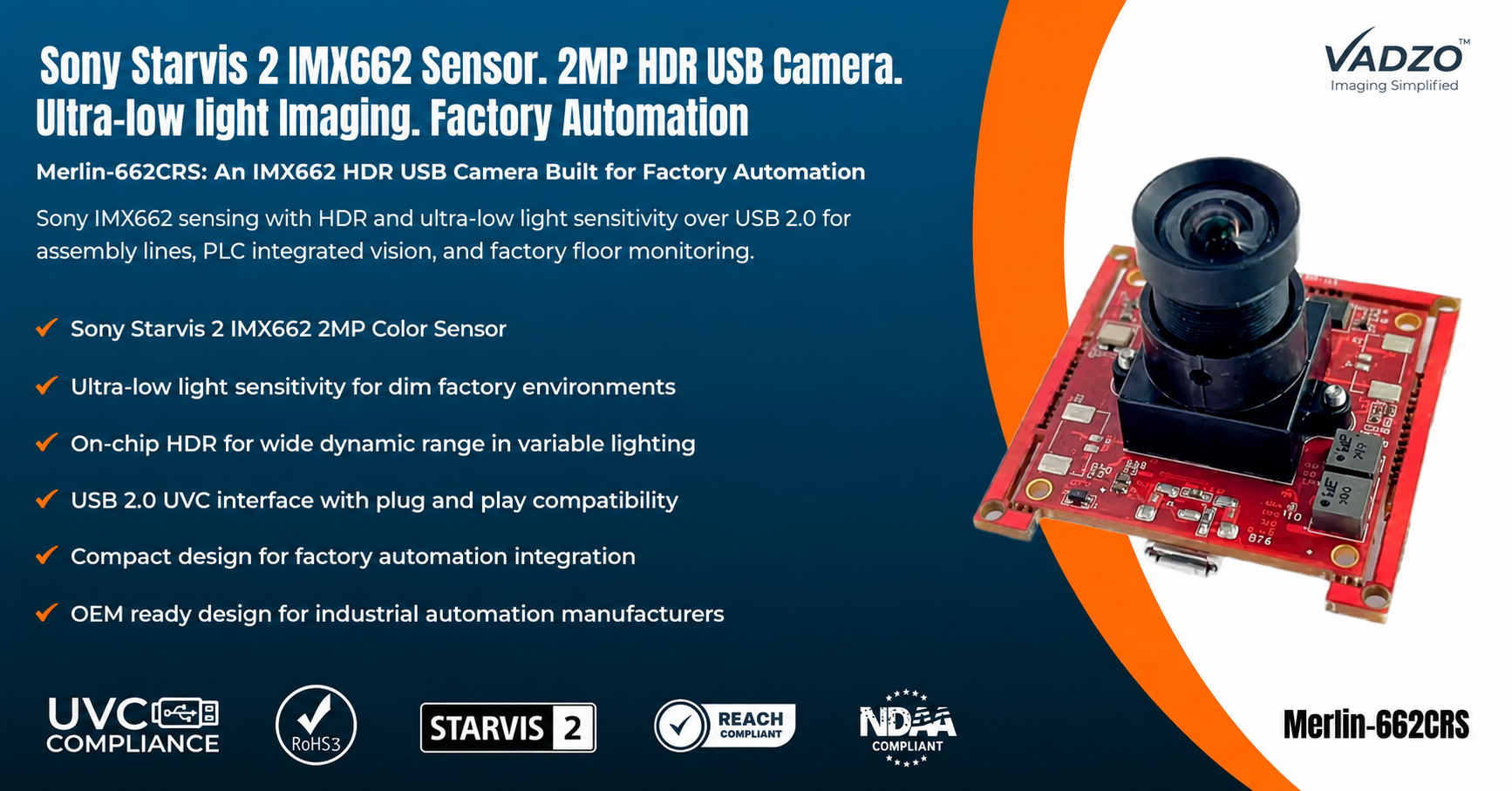
The Merlin-662CRS pairs the IMX662 Sensor Module with HDR and ultra-low-light sensitivity in a compact design suited to assembly line, PLC-integrated, and general factory floor monitoring integration. As an IMX662 HDR USB Camera, it outputs full 1080p resolution with HDR and low-light processing active by default, giving automation integrators a single camera platform that covers assembly monitoring, process verification, and general-purpose factory floor vision from one module.
At the core of the module sits the Sony Starvis 2 IMX662 sensor, chosen specifically for the combination of low-light sensitivity and dynamic range handling that factory automation deployment across variable lighting requires. Because the camera pairs 2MP Low Light HDR Sensor sensitivity with 1080p Ultra Low Light Camera imaging, the Merlin-662CRS reaches usable image quality from brightly lit assembly stations through dimly lit machine interiors, all delivered over a standard USB 2.0 connection that most existing factory automation hardware already supports.
Product Specifications
Key specs: 2MP (1920 × 1080) Max Resolution | Sony Starvis 2 IMX662 Sensor, 1/2.8 inch | 2.9 µm Pixel | Color, Rolling Shutter with HDR | USB 2.0 Micro B Interface | S-Mount (M12) Optics
Key Capabilities
Sony Starvis 2 IMX662 Sensor for Detailed 2MP HDR Capture: The Merlin-662CRS is built around the Sony Starvis 2 IMX662 sensor, a device that resolves fine detail for assembly verification and process monitoring without the cost and data volume of a higher-resolution sensor most factory automation tasks do not actually need. This gives the module genuine 2MP HDR performance suited to production environments where reliable image quality matters more than raw pixel count. That focus on reliability over raw specification numbers matters directly for automation integrators who need consistent results across every camera position in a facility rather than an impressive number on a single unit's data sheet.
Ultra Low Light Imaging for Dim Factory Environments: Machine interiors, conveyor undersides, and partially enclosed assembly stations routinely sit below the general ambient lighting level of a factory floor, and a camera that only performs well under bright, even lighting produces unusable footage exactly in those specific monitoring positions. As a Low Light HDR USB Module, the Merlin-662CRS extends sensitivity well past the point where a standard sensor would need supplemental lighting, preserving image usability without adding dedicated fixtures to every camera position.
HDR for Wide Dynamic Range in Variable Factory Lighting: A single factory floor frame routinely contains both a bright reflective metal surface and an adjacent shadowed recess, which is a dynamic range problem a standard exposure setting cannot solve regardless of how well it is tuned. On-chip HDR processing holds detail across that full range in a single exposure, avoiding the ghosting that a moving part or conveyor would introduce into a multi-frame blended HDR image. As an HDR USB Camera Module, it also fits directly into Vadzo Imaging's broader HDR camera portfolio for integrators comparing dynamic range performance across product lines.
Linear and Fusion HDR for Motion and Dynamic Range on Different Stations: A single fixed HDR behavior tends to favor either motion handling or maximum dynamic range, but not both, and factory floor stations differ in which of those two priorities actually matters. Linear HDR extends dynamic range from a single native read, keeping latency low and avoiding the ghosting a multi-frame blend can introduce on a moving conveyor or assembly line. Fusion HDR combines multiple exposures to reach a wider dynamic range than a single read can achieve, suited to fixed-mount stations imaging a static or slow-moving scene where extra range matters more than the small latency of frame fusion. As an HDR USB Camera Module, the Merlin-662CRS lets integrators choose the mode that matches a given station's motion profile rather than accepting a single compromise mode across every camera position in a facility.
On-Board Dewarping Engine for Wide-Angle and Fisheye Coverage: A wide-angle or fisheye lens reduces the number of camera units needed to cover a large assembly hall or wide conveyor run, but the geometric distortion it introduces is unusable to a monitoring operator or an automated vision algorithm without correction. The Merlin-662CRS integrates an on-board dewarping engine that corrects lenses up to 240° diagonal field of view directly on the camera, delivering an already-corrected image over USB rather than requiring host software to perform that correction, which matters directly for stations where host CPU budget is already committed to other automation or analytics tasks.
Dual Endpoint Streaming for Simultaneous Feeds from One Camera: A single monitoring station often needs to serve two different consumers from the same camera, for example a live operator display and an automated analytics pipeline, each expecting a differently configured feed. The Merlin-662CRS supports dual endpoint streaming, outputting two independent video streams simultaneously over the same USB connection, so both consumers get their own feed from a single camera unit rather than requiring a second camera or a host-side stream-splitting workaround.
USB 2.0 UVC Plug and Play Compatibility: As a USB 2.0 UVC Camera Module, the Merlin-662CRS enumerates automatically on Windows, Linux, macOS, and Android without a proprietary driver install, which matters directly for automation integrators building on existing factory monitoring software that already expects a standard UVC device. This makes it a genuine Plug and Play USB 2.0 Camera option for integrators who need HDR image quality without a specialized interface or a custom capture card.
Compact Design for Factory Automation Integration: Factory automation enclosures and PLC cabinets are often designed around control hardware first, leaving limited space for a camera and its supporting electronics. The Merlin-662CRS's compact board-level design fits into that remaining space without forcing an automation integrator to redesign an enclosure around the camera's footprint, which matters directly for retrofit installations adding vision capability to an existing production line. A manufacturer adding vision monitoring to an established automation system generally has far less flexibility to expand an enclosure than a team designing a new control cabinet from scratch, which makes a camera's physical footprint a real constraint rather than a minor specification.
OEM Ready Design for Industrial Automation Manufacturers: Industrial automation equipment manufacturers producing units at scale need a camera platform that stays consistent across a long production run. Vadzo Imaging supports full customization on this platform as an OEM HDR USB 2.0 Camera, including connector changes, optics selection, and firmware adjustments for manufacturers headed into volume production across multiple factory automation product lines. That customization extends to sensitivity tuning as well, since a manufacturer building equipment for a well-lit assembly hall may need a different low-light profile than one building equipment for an enclosed, dimly lit processing area, even though both rely on the same underlying sensor.
"Factory automation teams keep telling us the same thing: a camera that only performs well under the general lighting used to describe a facility is not actually solving their monitoring problem, since the specific position a camera is mounted at rarely matches that general description. The IMX662's ultra-low-light sensitivity combined with HDR gives the Merlin-662CRS genuine image quality in exactly the dim machine interiors and reflective surfaces a real production line presents, delivered over a standard USB connection automation teams already know how to integrate. We built this camera for the actual lighting a factory floor has, not the lighting a facility brochure describes." - Alwin Vincent, Product Manager at Vadzo Imaging.
Application
Assembly Line Monitoring: Assembly line monitoring needs a camera that resolves both brightly lit work surfaces and the shadowed interior of nearby machine housings within the same station. As a Factory Automation Camera, the Merlin-662CRS handles that mixed lighting, and functioning as an Assembly Line USB Camera, it extends the same coverage to general process verification at the same station.
PLC Integrated Vision Systems: PLC integrated vision systems need a camera that connects directly to existing automation hardware without adding a specialized interface layer to an already established control architecture. As a PLC Integration Camera, the Merlin-662CRS's standard USB connectivity fits that integration requirement, and an Industrial Automation USB Module configuration of the same module extends the same compatibility to broader automation hardware beyond dedicated PLC systems.
Automated Process Monitoring: Automated process monitoring depends on consistent image quality across process steps that may occur in both brightly lit and dimly lit sections of the same production line. As an Automated Production Camera, the Merlin-662CRS supports that consistency, and an Automated Process Camera configuration of the same module extends the same reliability to quality verification steps throughout a manufacturing process. That consistency matters directly for process audits and traceability records, since inconsistent image quality between process steps can make it difficult to establish a clear, defensible record of what actually happened at each stage of production.
Factory Floor Safety and Surveillance: Factory floor safety monitoring needs coverage that holds up in both well-lit walkways and dimmer equipment areas where a safety incident is just as likely to occur. As a Factory Automation Inspection Camera, the Merlin-662CRS delivers that coverage, and functioning as a Factory Floor Vision Camera, it extends the same capability to general facility monitoring beyond dedicated safety tasks.
OEM Integration for Industrial Automation Equipment Manufacturers: Industrial automation equipment manufacturers building their own monitoring or inspection hardware need a camera vendor who understands the lighting and connectivity requirements those systems demand. The Merlin-662CRS ships from a Low Light Embedded Camera Supplier with those requirements built in, and Vadzo Imaging supports OEM customization for cable length, connector type, and firmware for manufacturers standardizing on one camera across multiple factory automation product lines. As a Manufacturing Line Camera Module, it fits directly into a manufacturer's existing automation architecture.
Frequently Asked Questions
Q: Why does a factory automation camera need ultra-low light sensitivity when production areas are typically well lit for worker safety?
A: General area lighting keeps a factory floor bright enough for worker safety, but that same lighting rarely reaches inside an enclosed machine housing, underneath a conveyor, or into a partially shadowed assembly station, all of which are common camera monitoring positions on a real production line. A camera that only performs well under the facility's general ambient lighting produces unusable footage exactly in those specific locations, regardless of how bright the surrounding walkway happens to be. This is precisely the gap the Merlin-662CRS's Sony Starvis 2 IMX662 sensor is built to close. Vadzo Imaging builds ultra-low-light sensitivity into its factory automation camera products specifically because a camera's actual monitoring position rarely matches the general lighting level used to describe a facility as a whole.
Q: What is the difference between Linear HDR and Fusion HDR, and how should an integrator choose between them?
A: Linear HDR extends dynamic range from the sensor's native linear response in a single read, which keeps latency low and avoids the ghosting a multi-frame blend can introduce when a part or conveyor is moving through the frame, making it the better fit for active production line stations. Fusion HDR instead combines multiple exposures to reach a wider dynamic range than a single linear read can achieve, which suits fixed-mount stations imaging a static or slow-moving scene where the added dynamic range matters more than the small latency cost of exposure fusion. Merlin-662CRS supports both modes, so integrators can match the HDR behavior to a given station's actual motion profile rather than accepting one compromise setting across every camera position in a facility.
Q: Why would a wide-angle or fisheye camera need on-board dewarping instead of correcting the image in host software?
A: A wide-angle or fisheye lens introduces geometric distortion that a monitoring operator or an automated vision algorithm generally cannot use directly, so that distortion has to be corrected somewhere in the pipeline before the image is useful. Performing that correction in host software works, but it adds CPU load to every station running it, which matters on lines where host compute is already committed to PLC-adjacent monitoring, analytics, or other automation tasks. The Merlin-662CRS's on-board dewarping engine, supporting lenses up to 240° diagonal field of view, performs that correction on the camera itself, delivering an already-corrected image over USB and freeing host CPU budget for the rest of the monitoring pipeline.
Q: What is dual endpoint streaming, and why would a single camera need to output two video streams at once?
A: Dual endpoint streaming lets the Merlin-662CRS output two independently configured video streams simultaneously over the same USB connection, for example a corrected, dewarped feed for a live operator display alongside a separate feed configured for an automated analytics process. Without it, serving two different consumers from one camera generally requires either a second camera unit or a host-side process that splits and reprocesses a single stream, adding cost or latency. Vadzo Imaging builds dual endpoint streaming into the Merlin-662CRS specifically because factory floor stations often need to serve a human operator and an automated system from the same physical camera at the same time.
Q: Why would a factory automation system use a USB camera instead of integrating directly with a PLC's native I/O?
A: A PLC's native I/O is built to handle discrete signals such as switches, sensors, and simple digital inputs, not the continuous video data a camera produces, which means image-based monitoring generally requires a separate vision system regardless of how that camera connects. USB connectivity lets that vision system integrate as a standard peripheral on the PC or industrial computer already running alongside the PLC, without requiring specialized frame grabber hardware or a proprietary video interface. Vadzo Imaging designs its factory automation camera products around standard USB connectivity specifically because it fits into that already established PLC-adjacent computing environment rather than requiring a parallel, specialized video infrastructure.
Q: Can a single HDR USB camera really handle both bright metal surfaces and shadowed machine interiors on the same production line?
A: Yes, provided the camera combines genuine on-chip HDR with sensitivity extending well into low-light conditions, since these two capabilities address different but related aspects of the same underlying lighting problem. The Merlin-662CRS is built around exactly this pairing, combining on-chip HDR with the IMX662's extended low-light sensitivity in a single sensor. A camera with only one of these capabilities will still fail in the other scenario, either blowing out a reflective metal surface or losing detail in a shadowed recess depending on which condition it was optimized for. Vadzo Imaging pairs both capabilities on its factory automation camera products specifically because a real production line rarely presents just one of these lighting challenges in isolation, and a camera built for only one is not actually solving the problem a real factory floor presents. Integrators evaluating a camera for this kind of mixed lighting scene should request sample footage from a genuinely representative station rather than a controlled demo area, since a station chosen specifically to showcase a camera's strengths may not reveal how it performs under the lighting conditions that actually matter for the intended deployment.
Q: Can Vadzo Imaging customize an HDR USB camera module for a specific factory automation or PLC integration platform?
A: Yes. Vadzo Imaging supports full OEM customization across its factory automation camera portfolio, including optics selection suited to a specific mounting position or working distance, connector and cable configuration matched to a particular enclosure or PLC cabinet design, and firmware adjustments tuned for a specific HDR or low light sensitivity profile. Evaluation units ship with no minimum order requirement, and the same engineering team that built the standard product works directly with automation equipment manufacturers to adapt the module for a specific factory automation or PLC integration platform headed into volume production.
Q: What should industrial automation integrators look for when choosing a camera supplier for a factory floor deployment?
A: A factory floor deployment depends on consistent image quality across every monitoring position in a facility, since a camera that performs inconsistently between well-lit and dimly lit locations creates gaps in coverage that undermine the reason for adding vision monitoring in the first place. The Merlin-662CRS, with its USB 2.0 UVC connectivity and IMX662 HDR sensor, was designed around that exact requirement. Integrators should look for genuine low-light and HDR performance validated under realistic factory conditions rather than only bright bench test lighting, a connectivity approach that fits existing PLC-adjacent computing infrastructure, and a supplier able to support customization for a specific enclosure or mounting position. Vadzo Imaging builds its factory automation camera products around exactly these priorities, since a camera that performs well in a demo but struggles in a real factory's variable lighting is not actually a viable choice for production deployment.
Availability
The Merlin-662CRS IMX662 HDR USB Camera is available now and ready for evaluation and OEM integration. Evaluation kits include the camera module, a factory-calibrated S-Mount lens, a USB cable, and integration documentation covering HDR configuration and low-light tuning, with no minimum order requirement. Contact Vadzo Imaging at [email protected] to request an evaluation unit or discuss volume production and OEM customization, including specific questions about lens options or firmware configuration. Evaluation feedback is also welcome directly through the same contact channel, since real factory floor deployment conditions often surface details a bench test alone would not reveal, and that feedback helps confirm a configuration before a manufacturer commits to a full production order.
About Vadzo Imaging
Vadzo Imaging develops embedded and machine vision camera products for OEMs, system integrators, and industrial automation equipment manufacturers building production-ready vision systems across factory automation, robotics, security, and edge AI. The company's portfolio spans MIPI CSI-2, USB, GigE, Wi-Fi, FPD-Link III, and SerDes interface camera products, supporting deployment architectures from compact onboard modules to distributed networked installations. Vadzo provides end-to-end imaging support, including sensor integration, ISP tuning, firmware development, and SDK frameworks to accelerate system deployment, and the company's engineering team works directly with customers throughout evaluation, pilot deployment, and volume production rather than handing off support after the initial sale. That ongoing engineering relationship matters most for factory automation programs, where a camera platform may remain in service across an entire production line for years after initial installation. Visit Vadzo Imaging to explore the full embedded vision camera portfolio.
Media Contact
Alwin Vincent
Vadzo Imaging
Email: [email protected]
LinkedIn: Vadzo Imaging
YouTube: Vadzo Imaging
X: Vadzo Imaging
SOURCE: Vadzo Imaging