




Thursday, 11 June 2026 12:00 PM
Company Update
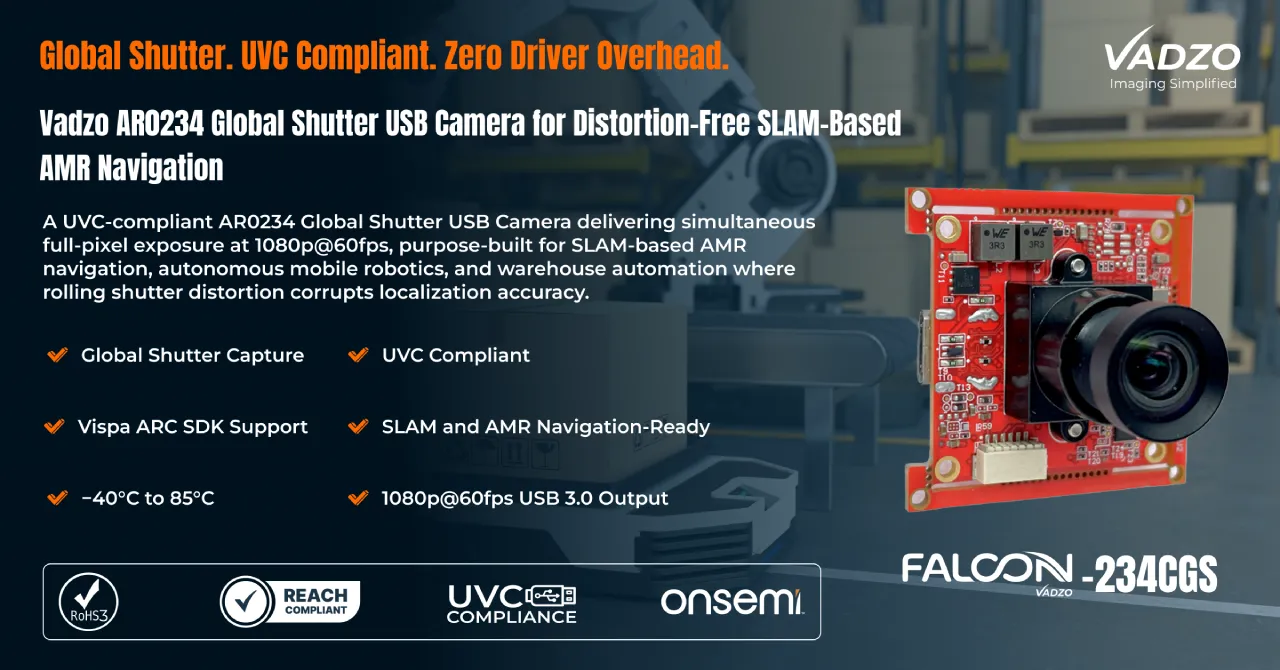
Vadzo's Falcon-234CGS is an AR0234 Global Shutter USB Camera built on the Onsemi AR0234 sensor, delivering 2MP color global shutter imaging at 1920×1200, streaming at 1080p@60fps, 720p@60fps, and VGA@90fps, and UVC-compliant USB 3.0 integration for autonomous mobile robotics, SLAM-based navigation, and edge AI applications where frame-accurate capture under continuous robot motion is a non-negotiable system requirement. As a compact 2MP Global Shutter USB Camera in Vadzo's USB camera series, it connects via USB Type C to Windows, Linux, and Android hosts with zero custom driver requirement, delivering simultaneous full-pixel global shutter exposure across every operating resolution.
FORT WORTH, TX / ACCESS Newswire / June 11, 2026 / Vadzo Imaging, a provider of embedded vision camera products, today positions the Falcon-234CGS as a purpose-built AR0234 Global Shutter USB Camera for distortion-free SLAM-based AMR navigation. Autonomous mobile robot platforms that depend on SLAM for localization consume camera frames as the primary input to the mapping and path-planning algorithm, and every frame corrupted by rolling shutter skew introduces spatial error that accumulates into localization drift over the robot operating cycle. The Falcon-234CGS, as an AR0234 Global Shutter USB Camera in Vadzo's USB camera series, eliminates that failure mode at the sensor level, not through software correction that adds latency to the real-time navigation stack.
Sensor and Camera Overview
The Falcon-234CGS is built on the Onsemi AR0234, a 1/2.6″ CMOS global shutter sensor with 3.0 µm × 3.0 µm pixel pitch and a maximum resolution of 2MP (1920×1200). As an Onsemi AR0234 Global Shutter USB Camera, the Falcon-234CGS exposes all pixels simultaneously in a single unified exposure cycle, eliminating Rolling Shutter Distortion that corrupts feature tracking, depth estimation, and SLAM map building under continuous AMR motion. The color architecture pairs the AR0234 Bayer sensor with an onboard ISP performing debayering, demosaicing, color correction, gamma correction, denoising, and Auto White Balance, delivering calibrated color frames at 1080p@60fps, 720p@60fps, and VGA@90fps over USB 3.0.
The Falcon-234CGS connects via USB 3.0 Gen1, backward compatible to USB 2.0, through a standard USB Type C connector, outputting YUV422 and MJPEG video at 8-bit or 10-bit pixel depth. Six GPIO lines support hardware trigger and digital I/O signaling. The camera accepts S-Mount (M12) optics with a 74° DFOV default lens, operates across −40°C to 85°C, weighs 13 grams without a lens, and measures 38mm (L) × 38mm (B), convertible to 32mm (L) × 32mm (B). OS support covers Windows, Linux, and Android, with Vispa ARC SDK providing extended camera control for USB integration pipelines.
Key specs: Falcon-234CGS AR0234 Color Global Shutter USB 3.0 Camera | 2MP (1920×1200) | Onsemi AR0234 | 1/2.6″ | 3.0 µm × 3.0 µm Pixel | Global Shutter | Color | USB 3.0 Gen1 Type C | S-Mount (M12) | 74° DFOV | −40°C to 85°C | 38mm (L) × 38mm (B) convertible to 32mm (L) × 32mm (B)
Key Capabilities of the Falcon-234CGS for SLAM-Based AMR Navigation
Global Shutter Capture for Distortion-Free SLAM and AMR Localization: SLAM-based AMR navigation fails at the vision input layer when the robot navigation camera delivers geometrically distorted frames. A rolling shutter sensor reads pixel rows sequentially, and in any frame captured while the robot accelerates, decelerates, or turns, the resulting geometric skew shifts visual feature positions away from their actual spatial coordinates. The SLAM algorithm treats those shifted coordinates as real measurements, introducing localization error that compounds across every distorted frame in the navigation cycle. Software-based Rolling Shutter Distortion correction adds latency and computational overhead that a real-time navigation stack cannot absorb without degrading the map update rate. The Falcon-234CGS, as an AR0234 Global Shutter USB Camera for SLAM navigation, exposes all 1920×1200 pixels in a single simultaneous cycle, producing frames where every feature position corresponds exactly to its actual coordinate in the robot environment. For OEM teams building AMR platforms where map drift determines operational reliability, this real-time robotics vision camera architecture eliminates distortion at its hardware origin, delivering geometrically clean frames at 1080p@60fps without correction overhead.
Color Global Shutter Imaging for Obstacle Detection and Scene Discrimination: Warehouse and factory floor environments present the AMR obstacle avoidance camera with a specific challenge: distinguishing objects that share similar luminance values but differ in color, a task where grayscale sensors consistently underperform color equivalents at identical resolution. Yellow safety barriers, blue storage bins, orange personnel vests, and floor lane markings all create confusion in a monochrome feature space that color descriptors resolve cleanly. The Falcon-234CGS, as an AR0234 Color Global Shutter USB Camera, delivers full color output through an onboard ISP handling debayering, color correction, and white balance automatically, providing inference-ready YUV422 or MJPEG frames without host-side preprocessing overhead. For obstacle detection camera deployments where bounding box confidence affects path planning and safety stop decisions, color feature descriptors deliver measurably higher discrimination accuracy than grayscale at the same resolution. The Falcon-234CGS output at 1080p@60fps delivers the spatial detail and temporal rate required for AMR navigation camera operation in dynamic warehouse environments, combining color accuracy with motion blur reduction camera performance at the sensor level.
UVC-Compliant USB 3.0 for Driver-Free Integration into ROS2 and AMR Platforms: Custom kernel drivers are a production liability in AMR platforms. Every OS update, hardware revision, or fleet software push creates a driver regression risk that embedded robotics teams must test, certify, and maintain across the product lifecycle, adding engineering overhead that scales directly with fleet size. A vision-guided robot camera requiring custom driver maintenance introduces an integration cost that accumulates significantly at production scale. The Falcon-234CGS resolves this at the architecture level as a UVC-compliant AR0234 Global Shutter USB Camera: it enumerates as a standard UVC device on Windows, Linux, and Android, connecting immediately to ROS2 usb_cam and v4l2_camera pipelines, OpenCV capture interfaces, and SLAM frameworks consuming V4L2 streams without platform-specific middleware. The USB 3.0 Gen1 interface delivers 5 Gbit/s SuperSpeed bandwidth, sustaining 1080p@60fps color output without frame drops. For embedded vision robotics camera deployments at production scale, this low-latency USB camera architecture eliminates driver maintenance overhead from the AMR integration path, delivering the lowest total integration cost across hardware iterations and OS lifecycle.
Vispa ARC SDK: Unified Camera Control for Embedded USB Vision Pipelines
Standard UVC driver access covers video streaming and basic exposure controls. For embedded vision engineers integrating the Falcon-234CGS into production AMR platforms, that is insufficient: production navigation pipelines require structured, programmatic control of exposure windows, compression quality, denoising levels, and region-of-interest windowing that standard UVC drivers expose inconsistently across OS platforms. Vispa ARC SDK is Vadzo Imaging's dedicated software development kit for the USB camera series, extending the standard UVC control set with a version-stable API that surfaces ROI-based auto-exposure, JPEG compression control, denoising, image flip, and camera parameter tuning across Windows and Linux. For robotics teams building AMR navigation stacks on embedded Linux, Vispa ARC SDK abstracts V4L2 complexity and enables programmatic camera configuration from within ROS2 node initialization or standalone vision pipeline startup. The SDK exposes UVC extension unit functions through the HID pipeline on the Falcon-234CGS, enabling firmware-level feature control without kernel driver modification. For OEM teams managing multi-unit AMR fleets, Vispa ARC SDK maintains consistent imaging parameters across every AR0234 Global Shutter USB Camera in the deployment from platform bringup through production scale. Documentation, evaluation builds, and integration support are available at www.vadzoimaging.com.
Target Applications
SLAM-Based AMR Navigation and Autonomous Mobile Robotics: SLAM-based autonomous mobile robot platforms consume camera frames as the primary input to the localization and mapping algorithm, and the geometric accuracy of those frames determines the precision of every position estimate the robot makes during operation. Rolling Shutter Distortion in the camera input layer corrupts feature matching across frames, producing localization drift that compounds in proportion to the robot's angular velocity and motion frequency. The Falcon-234CGS, as a dedicated SLAM USB Camera, autonomous navigation camera, and AMR Vision Camera, delivers geometrically accurate 1080p@60fps color frames across every acceleration, deceleration, and turning maneuver, sustaining SLAM map consistency where rolling shutter architectures fail. As a distortion-free vision camera built for localization and mapping camera requirements, it integrates via UVC into the ROS2 navigation stack without driver overhead, packaged in a 13-gram board-level autonomous mobile robot camera module that slots into compact AMR enclosure layouts without mechanical accommodation.
Warehouse Robotics, AGV Platforms, and Industrial Automation: Warehouse robotics and AGV platforms integrating barcode reading, OCR, object scanning, and obstacle detection require an embedded robotics vision camera that captures structured data targets and scene objects without geometric skew or motion blur at full operational speed. A rolling shutter camera input on an AGV under forward motion delivers skewed frames that corrupt OCR character recognition and shift bounding box positions away from actual obstacle coordinates, introducing detection failures precisely at the speeds where the system operates. The Falcon-234CGS, as a high-speed robotics camera with global shutter and full color output at 1080p@60fps, delivers clean, artifact-free frames on moving conveyor targets and in-aisle personnel that rolling shutter alternatives distort under identical motion conditions. As an industrial robotics USB camera and Global Shutter AMR Camera, it supports ambient light color imaging and structured light scanning in one module, reducing the camera product count in multi-function platforms. The −40°C to 85°C operating range covers enclosed warehouse, refrigerated logistics, and outdoor AGV environments.
Smart Surveillance, Smart Parking, and Retail Analytics: Mobile surveillance platforms, smart parking systems, and retail analytics deployments on autonomous or guided vehicle platforms face the same imaging failure mode as AMR navigation: the sensor is in continuous motion, and rolling shutter geometric skew degrades detection accuracy whenever the platform moves at operational speed. Facial recognition, pedestrian detection, license plate reading, and shelf analytics on a moving platform all produce incorrect spatial inputs when geometric skew corrupts in-transit frames. The Falcon-234CGS eliminates this failure mode with global shutter capture that produces geometrically consistent color frames regardless of platform velocity, sustaining detection accuracy at operational speeds where rolling shutter alternatives fail. The onboard ISP auto white balance and color correction deliver inference-ready output without host-side normalization overhead. The UVC-compliant interface makes this AR0234 Global Shutter USB Camera immediately integrable into Android kiosk platforms, retail edge compute systems, and mobile surveillance deployments without custom driver development, reducing OEM integration time for product teams building on embedded Linux or Android.
"AMR and robotics teams arrive with a clear hardware requirement: a camera that delivers geometrically clean frames during robot motion, streams over USB with zero driver overhead, and gives full camera control inside the ROS2 navigation stack. Rolling shutter skew is not a software artifact they can tune away on a moving platform; it is a hardware failure mode that corrupts every SLAM frame captured during acceleration or turning, and compounds into real localization drift at operational speeds. The Falcon-234CGS, as an AR0234 Global Shutter USB Camera, delivers exactly what the navigation pipeline needs: 1080p global shutter output at 60fps, UVC compliance from first boot, and Vispa ARC SDK for structured camera control inside the AMR vision stack. We built this camera for that specific integration problem, and it solves it at the sensor level." - Alwin Vincent, Product Manager, Vadzo Imaging
Frequently Asked Questions
1) Why does SLAM-based AMR navigation require a global shutter USB camera instead of a rolling shutter USB camera?
SLAM algorithms build spatial maps by tracking visual features across sequential frames and computing consistent positions to estimate the robot location. When the source camera uses rolling shutter architecture, every frame captured during robot motion is geometrically distorted because the sensor reads pixel rows at different time points within one exposure cycle. This distortion shifts visual feature coordinates away from their actual positions, causing SLAM map errors that compound as localization drift over the operating cycle. Vadzo addresses this with the 2MP AR0234 Color Global Shutter USB 3.0 Camera, which exposes all 1920x1200 pixels simultaneously at 1080p@60fps, producing geometrically accurate frames regardless of robot velocity. Every feature the SLAM algorithm extracts from the Falcon-234CGS frame corresponds to an actual, undistorted coordinate in the environment. That hardware-level accuracy is the foundation AMR localization demands, and Vadzo delivers it over UVC-compliant USB 3.0 with no custom driver requirement on Linux, Windows, or Android.
2) How does a 2MP AR0234 color global shutter USB 3.0 camera connect to a ROS2-based AMR navigation stack?
A UVC-compliant 2MP AR0234 Color Global Shutter USB 3.0 Camera enumerates as a standard V4L2 video device on embedded Linux, connecting directly to the ROS2 usb_cam or v4l2_camera packages without kernel modification or custom driver installation. The Vadzo Falcon-234CGS registers on USB 3.0 Gen1 at first connection, streaming 1080p@60fps in YUV422 or MJPEG format within the ROS2 image pipeline that SLAM nodes, obstacle detection models, and visual odometry packages consume natively. Vispa ARC SDK extends UVC camera control with a structured API for ROI-based auto-exposure, denoising, JPEG compression, and gain settings that ROS2 node launch files configure during system initialization. For embedded robotics teams on ARM Linux platforms running ROS2 Humble or later, the Vadzo AR0234 Global Shutter USB Camera delivers plug-and-play UVC integration with full SDK-level camera control, shortening AMR platform bringup time and eliminating the driver porting overhead that MIPI or GigE camera products introduce.
3) What frame rate does a 1080p AR0234 color global shutter USB 3.0 camera support for real-time obstacle detection on AMR platforms?
For real-time AMR obstacle detection at operational speed, the vision pipeline needs a frame rate high enough that no obstacle travels a collision-relevant distance between consecutive frames. The Falcon-234CGS, as a 1080p AR0234 Color Global Shutter USB 3.0 Camera, delivers 1920x1080 at 60fps over USB 3.0 Gen1, 1280x720 at 60fps, and 640x480 at 90fps. At 60fps, the inter-frame interval is approximately 16.7ms, sufficient for the majority of warehouse AMR operating speeds where detection models process each frame at high confidence. The global shutter architecture ensures every frame represents an undistorted scene snapshot at full robot velocity, giving the Falcon-234CGS accurate bounding box positions that a rolling shutter source cannot guarantee. Vadzo's Falcon-234CGS is a purpose-built obstacle detection camera that delivers the frame rate and geometric accuracy AMR safety systems demand, with YUV422 and MJPEG output connecting to TensorFlow Lite and OpenCV inference pipelines.
4) Can a UVC-compliant global shutter USB 3.0 camera work on Android-based AMR edge compute platforms without custom drivers?
Android-based edge compute platforms are increasingly common in AMR and warehouse robotics where the host board ships with Android as the primary embedded OS. A UVC-compliant AR0234 Global Shutter USB Camera enumerates natively on Android through the USB host API without custom driver packages or kernel modifications, making it immediately accessible to Android UVC camera libraries. The Vadzo Falcon-234CGS supports Android operation with additional control depth through the Vispa ARC SDK, which extends beyond the standard camera2 API to include ROI-based auto-exposure, denoising, and compression settings that the default UVC stack does not expose. The Falcon-234CGS outputs YUV422 and MJPEG formats that Android OpenCV and TensorFlow Lite pipelines consume directly, enabling obstacle detection, SLAM feature extraction, and localization without host-side format conversion overhead. Vadzo Imaging provides full Android integration guidance and Vispa ARC SDK documentation for OEM teams targeting Android as the production deployment OS on their AMR compute platform.
5) What OEM customization options are available for an AR0234 global shutter USB camera in production AMR system integration?
Production AMR deployments require camera hardware that matches the mechanical, electrical, and firmware constraints of the OEM platform, not a standard evaluation module. Vadzo Imaging's OEM customization program for the Falcon-234CGS as an AR0234 Global Shutter USB Camera covers board form factor modification and redesign, custom firmware development and feature integration, lens holder modification and electro-mechanical lens filter control, illumination board integration for visible and NIR lighting, and full enclosure design in IP-rated and non-IP-rated configurations. GPIO line enablement beyond the standard preset on the 2MP AR0234 Color Global Shutter USB Camera is configurable at the firmware level by the Vadzo engineering team to match specific AMR trigger and sensor interface requirements. OEM teams contact Vadzo Imaging to scope customization requirements, receive technical evaluation documentation, and define an integration path for a production-ready embedded vision USB camera tailored to their exact AMR platform.
Availability and Customization
The Falcon-234CGS AR0234 Global Shutter USB 3.0 Camera is available now for evaluation and OEM integration. To request full specifications or an evaluation unit, contact the Vadzo Imaging sales team at [email protected].
Vadzo supports full OEM camera customization across the Falcon-234CGS, including form factor modification and board redesigns, firmware development and custom feature integration, lens holder modifications and electro-mechanical lens filter control, and illumination board integration. Enclosure design in IP-rated and non-IP-rated configurations is available. GPIO line customization at the firmware level is supported under the Vadzo OEM customization program for teams requiring interface configurations beyond the standard preset.
About Vadzo Imaging
Vadzo Imaging develops embedded and machine vision camera products for OEMs and system integrators building production-ready vision systems across industrial automation, robotics, healthcare, and smart infrastructure. The company's USB camera series, alongside MIPI CSI-2, GigE, Wi-Fi, and SerDes interface camera products, supports a wide range of embedded deployment architectures. Vadzo provides end-to-end imaging support, including sensor integration, ISP tuning, firmware development, and SDK frameworks, including Vispa ARC SDK for the USB camera series, to accelerate system deployment. Learn more at www.vadzoimaging.com.
Media Contact
Alwin Vincent
Vadzo Imaging
Email: [email protected]
LinkedIn: Vadzo Imaging
YouTube: Vadzo Imaging
X: Vadzo Imaging
SOURCE: Vadzo Imaging