




Monday, 29 June 2026 10:00 AM
Product Announcements
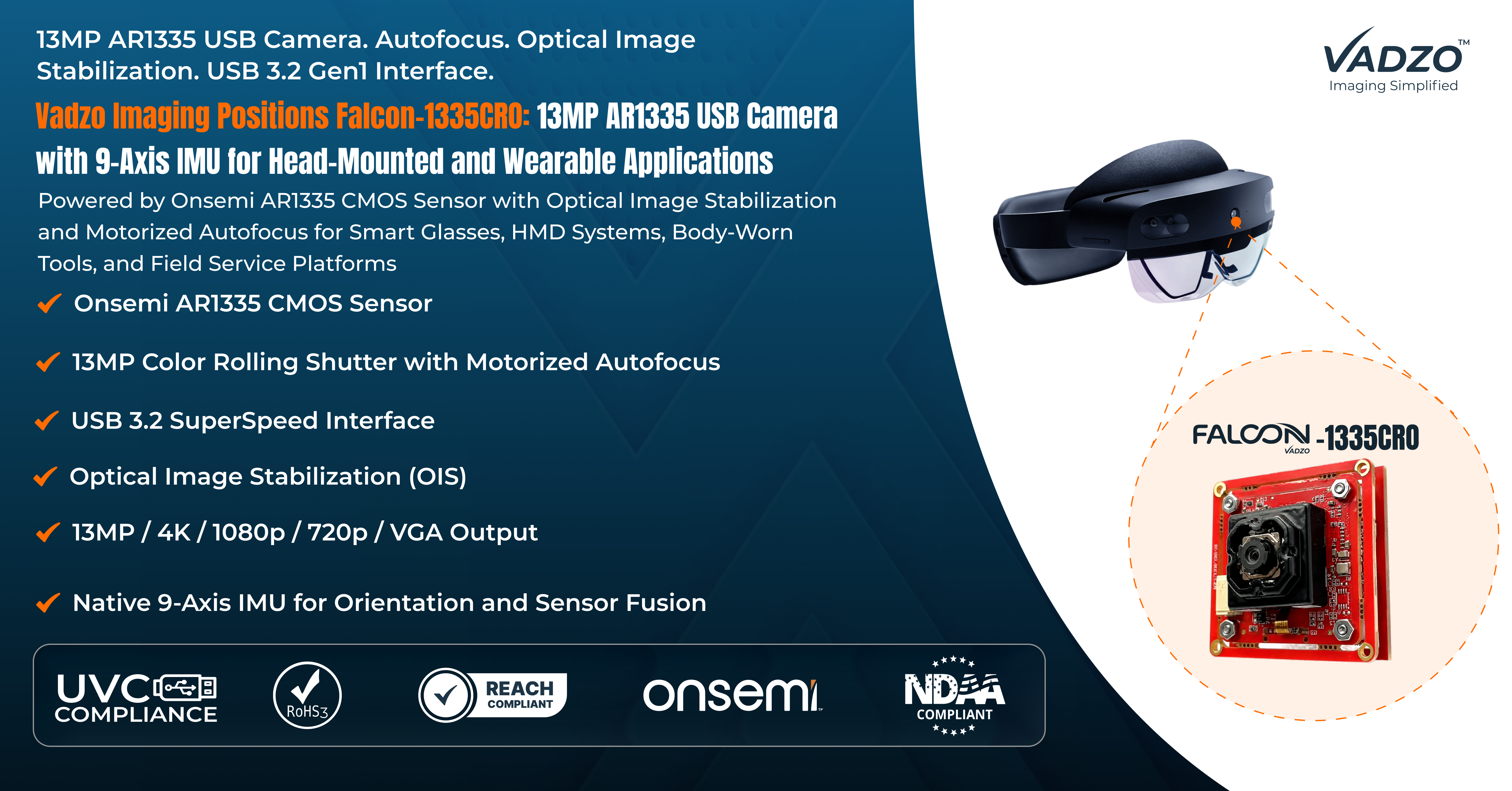
The Falcon-1335CRO is a 13MP AR1335 USB camera built on the Onsemi AR1335 image sensor. It integrates motorized autofocus, optical image stabilization, and a native 9-Axis IMU in a USB 3.2 module designed for head-mounted and wearable vision platforms. The camera delivers 13MP color imaging with motion-compensated output and synchronized inertial data for smart glasses HMD systems, first-person camera deployments, body-worn inspection tools, and field service platforms. Driver support covers Windows, Linux, and Android natively through full UVC compliance without proprietary drivers.
FORT WORTH, TX / ACCESS Newswire / June 29, 2026 / Vadzo Imaging, a provider of embedded vision camera products, today positioned the Falcon-1335CRO as an AR1335 USB camera for head-mounted and wearable applications. Built on the Onsemi AR1335 image sensor and part of Vadzo's USB camera portfolio, the Falcon-1335CRO delivers 13MP color imaging with motorized autofocus, optical image stabilization, and a native 9-Axis IMU through a single USB 3.2 connection. With this positioning, Vadzo addresses a focused engineering challenge in wearable vision design: deploying a high-resolution color camera that compensates for head-movement blur, captures sharp frames across variable working distances, and simultaneously exports orientation data for pose estimation and sensor fusion within a single UVC-compliant module. The Falcon-1335CRO operates natively on Windows, Linux, and Android and is validated for smart glasses, head-mounted display systems, body-worn inspection platforms, and field service tools without requiring any proprietary driver installation.
Sensor and Camera Overview
The Falcon-1335CRO is a 13MP USB camera with an IMU built on the Onsemi AR1335 image sensor coupled with a high-performance ISP. The AR1335 is a 13MP (4208 x 3120) color rolling-shutter CMOS sensor with a 1/3.2-inch optical format and a 1.1 μm pixel size. This sensor delivers full-resolution 13MP color imaging with fine spatial detail and accurate color reproduction, suited for high-fidelity first-person capture in wearable deployments. The compact 1/3.2-inch sensor format enables an optical stack that fits within the tight spatial constraints of smart glasses frames and head-mounted display housings, making this AR1335 camera well-suited for platforms where form factor and image quality must coexist without compromise.
The Falcon-1335CRO is a compact USB camera with an IMU solution. The module houses the Onsemi AR1335 sensor, ISP motorized autofocus lens assembly, and a native 9-Axis IMU that delivers 3-Axis accelerometer, 3-Axis gyroscope, and 3-Axis magnetometer readings synchronized to every image frame. The integrated OIS mechanism actively compensates for lens displacement caused by head movement and platform vibration, making the Falcon-1335CRO uniquely suited for wearable and head-mounted applications where continuous motion is unavoidable. Autofocus enables the camera to maintain sharp focus across the full working distance range that wearable use cases demand. Output modes include full 13MP 4K 1080p 720p and VGA. The camera is UVC compliant and supports Windows, Linux, and Android without proprietary drivers.
Key specs: 13MP (4208 x 3120) | Onsemi AR1335 1/3.2-inch 1.1 μm pixel | Color | Rolling Shutter | Motorized Autofocus | OIS | 9-Axis IMU | High-Performance ISP | USB 3.2 | 13MP / 4K / 1080p / 720p / VGA | Windows Linux Android
Key Capabilities of the Onsemi AR1335 13MP Autofocus OIS USB Camera
13MP High Resolution Color Imaging: Many wearable camera products deploy at 4MP or lower to reduce bandwidth and power consumption. The Onsemi AR1335 sensor captures a full 13MP (4208 x 3120) color frame with a rolling shutter architecture and 1.1 μm pixels, delivering fine spatial detail that lower resolution sensors cannot reproduce in the same field of view. A 13MP USB camera at wearable working distances captures text on documents, writing on whiteboards, and fine mechanical features without digital zoom. This directly benefits field service camera deployments, where a technician must read part numbers at arm's length and head-mounted inspection tools that require pixel-level detail from a hands-free field of view. The 13MP output also supports downstream reframing in AR overlay pipelines, where the full resolution frame allows digital stabilization without a field of view penalty.
Optical Image Stabilization for Motion-Affected Platforms: Wearable and head-mounted platforms are subject to continuous head movement, walking vibration, and involuntary tremors that degrade image quality. Without active compensation, a 13MP sensor with 1.1 μm pixels amplifies even small angular displacements into visible blur that makes frame analysis unreliable. The Falcon-1335CRO employs an OIS USB camera design where the onboard gyroscope feeds real-time angular velocity data to the OIS control loop, which shifts the lens assembly to counteract platform motion. This keeps frames sharp during walking, stair climbing, and freehand capture without any host processor load. The optical image stabilization camera approach eliminates the need for external vibration isolation mounts and avoids the field of view crop that electronic image stabilization in software requires. For an Onsemi AR1335 stabilized camera deployed on a body-worn system or smart glasses frame, this means consistently sharp 13MP output under real-world operating conditions.
Native 9-Axis IMU for Orientation Tracking and Sensor Fusion: Vision systems on wearable platforms need more than image data. Tracking head orientation, estimating platform velocity, and building maps of the environment require synchronized inertial measurements. Adding a separate IMU board forces engineers to solve hardware synchronization and merge timestamped data streams in firmware, introducing timing uncertainty and increasing component count. The Falcon-1335CRO embeds a native 9-Axis IMU delivering synchronized accelerometer, gyroscope, and magnetometer readings through the same USB 3.2 connection as the video stream. This simplifies the sensor fusion pipeline for HMD camera module deployments, performing visual inertial odometry for smart glasses camera systems running simultaneous localization and mapping, and for wearable camera module products building augmented reality overlays that require precise head pose estimation. The IMU camera architecture delivers all inertial axes at sensor-level synchronization, removing the latency that post-capture software alignment introduces.
Motorized Autofocus for Variable Working Distance: Fixed focus camera products impose a single calibrated working distance on the system designer. Wearable applications rarely operate at a fixed focal range. A field technician using a first-person camera looks at a maintenance document at 40 cm, then a machine control panel at 80 cm, then overhead equipment at 3 m within a single workflow. Each shift in viewing direction requires a different focal length to maintain sharp output. The Falcon-1335CRO uses a motorized autofocus lens assembly with continuous focus tracking that adjusts without host processor commands, keeping the 13MP frame sharp across the full depth range of the wearable operating environment. The AR1335 autofocus OIS camera design removes the requirement for engineering teams to select and validate a single fixed focus compromise during product development and eliminates the need for end users to maintain a prescribed capture distance during operation.
USB 3.2 UVC Plug and Play Integration: The 4K USB camera interface on the Falcon-1335CRO connects directly to any USB 3.2 host port on Windows, Linux, and Android without proprietary drivers. UVC class driver compliance means the camera appears as a standard video device immediately on connection, with no kernel module installation or firmware flashing required. IMU data is exposed as a USB HID endpoint accessible through standard OS input APIs alongside the video stream, so applications access both data types through native OS interfaces. This reduces integration effort for industrial body camera development teams, body-worn camera module manufacturers, and egocentric vision camera platform developers, where the development timeline is constrained. USB 3.2 bandwidth supports 13MP video streaming and simultaneous IMU data transfer over a single cable, keeping wearable platform wiring compact and reducing connector count in the BOM. The USB UVC camera with IMU architecture is validated on Intel NUC, NVIDIA Jetson Orin, Raspberry Pi 5, and Android tablet platforms.
Compact Form Factor for Wearable Deployment: The Falcon-1335CRO ships in a compact module footprint designed for integration into space-contained wearable platforms. The module housing fits within the optical cavity of commercial smart glasses frames and standard head-mounted display chassis. Engineers designing head-worn camera systems can mount the module directly to the headset frame without external brackets or adapter hardware. USB bus power eliminates the need for a separate power rail, simplifying the BOM and enclosure design for head-mounted camera products. The compact form factor combined with the integrated OIS autofocus and 9-Axis IMU means the Falcon-1335CRO provides the full sensor stack for wearable vision in a single module rather than requiring separate components for imaging stabilization, focus control, and inertial measurement.
"The AR1335 sensor gives you 13MP resolution in a compact 1/3.2-inch format, but wearable platforms introduce two problems that sensor resolution alone does not solve: motion blur from head movement and focus drift across varying working distances. We built OIS directly into the module to counter the angular displacement that walking and head rotation produce and added motorized autofocus, so the camera tracks focus continuously without host software commands. By combining the AR1335 OIS camera with a synchronized 9-Axis IMU and full resolution 13MP output in a single USB 3.2 module, we give wearable platform engineers a camera that captures sharp frames at any working distance and exports the orientation data needed for AR overlays, SLAM pipelines, and remote assistance applications through one cable." - Alwin Vincent, Product Manager, Vadzo Imaging.
Applications
Smart Glasses and Head-Mounted Display Systems: Optical waveguide and passthrough HMD systems require a compact high-resolution camera that provides both the display feed and platform orientation data. The Falcon-1335CRO HMD camera module delivers 13MP color video to the display pipeline and 9-Axis IMU data to the pose estimation subsystem through a single USB 3.2 connection. OIS compensates for the optical misalignment that head movement introduces into the waveguide registration pipeline. Motorized autofocus allows the user to shift attention from near objects to far objects without software focus commands. USB bus power simplifies the power architecture in lightweight HMD designs where battery capacity is limited, and every milliwatt counts.
Field Service and Remote Expert Assistance: Remote expert systems require a field service camera that transmits sharp first-person video of equipment components, technical labels, and instrument panels at varying distances under the mixed lighting conditions found in industrial facilities. The Falcon-1335CRO transmits OIS-compensated 13MP frames over USB 3.2 to the field device encoder. Motorized autofocus transitions from label reading at 30 cm to panel inspection at 1.5 m to overhead equipment at 4 m without manual input from the field technician. The 9-Axis IMU stream gives the remote expert context on head orientation and tilt angle, which helps guide the technician to the correct component location without verbal description alone.
Body-Worn and Industrial Body Camera Deployments: Public safety personnel and industrial inspectors carry body-worn camera module systems that must log high-resolution evidence under unpredictable lighting and continuous body movement. The industrial body camera application of the Falcon-1335CRO uses OIS to deliver sharp 13MP frames during walking and active field operations. USB 3.2 connects to the body unit recorder over a standard cable with no proprietary interface hardware. The 9-Axis IMU provides heading, pitch, and roll data synchronized to the video stream for trajectory reconstruction, evidence tagging, and post-event analysis without a separate GPS or inertial logging module.
Wearable Medical Imaging: Surgical assistance systems with procedural recording tools and point-of-care documentation platforms require high-resolution hands-free video with stable frames and synchronized spatial data. The Falcon-1335CRO medical camera delivers OIS-stabilized 13MP imaging through USB 3.2 to a medical workstation without proprietary drivers, reducing the software certification scope. Motorized autofocus maintains a sharp focus on tissue instruments and anatomical targets at the variable working distances encountered in clinical environments. The 9-Axis IMU provides head angle data useful for device positioning feedback in assisted surgical procedures and for annotation of procedural recordings with orientation context.
Egocentric Vision and Lifelogging Research: Research platforms for activity recognition, lifelogging, and egocentric dataset collection require high-fidelity first-person video aligned with orientation data for algorithm training and validation. The egocentric vision camera design of the Falcon-1335CRO captures 13MP color frames with OIS to suppress walking-induced motion blur that corrupts activity recognition datasets. The 9-Axis IMU stream provides the inertial context needed for activity classification algorithms and for synchronizing video annotations with inertial ground truth. UVC compliance enables data capture on standard laptops for embedded PCs and Android tablets without driver overhead, allowing research teams to deploy quickly across heterogeneous hardware.
Augmented Reality and Spatial Computing Platforms: AR platform development requires a camera that delivers pose-synchronized video frames for overlay registration. The Falcon-1335CRO combines 13MP color imaging with a 9-Axis IMU synchronized at the sensor level, eliminating the latency that separate camera and IMU combinations introduce into the rendering pipeline. OIS reduces the jitter in the image feed that causes overlay flicker on AR to display elements when the user moves their head. The 13MP USB UVC camera with IMU architecture allows the AR software stack to access video and inertial data through standard OS APIs without custom kernel drivers, shortening the time from prototype to production for AR headset and smart glasses developers.
Sports and Action Recording Systems: Action recording platforms worn on helmets, goggles, and vests require imaging that remains sharp during high-intensity physical activity. The Falcon-1335CRO delivers OIS-compensated 13MP video through USB 3.2 with 4K output modes for post-production detail. The motion- stabilized camera capability of the Falcon-1335CRO suppresses the blur that helmet and body-worn cameras encounter at high activity levels. The 9-Axis IMU captures orientation data for overlaying graphics, trajectory logging, and gyroscope-based image stabilization in post-processing. The compact module integrates custom helmet mounts and goggle frames for both professional broadcast applications and sports science data collection programs.
Frequently Asked Questions
Q. How does optical image stabilization improve image quality in head-mounted camera applications?
A: Optical image stabilization in a wearable or head-mounted camera physically compensates for the angular displacement caused by head movement, walking vibration, and involuntary tremor. Unlike software stabilization, which crops the field of view and introduces processing latency, OIS operates at the lens level in real time without consuming host CPU cycles. Vadzo Imaging integrates OIS in the Falcon-1335CRO so that full-resolution 13MP frames captured during active use remain sharp without any host processor intervention. This is especially important for field service camera applications where a technician needs to read fine text on labels or capture diagnostic images while walking through a live facility, and for wearable camera module deployments where the end user cannot be expected to hold still during capture. OIS correction happens before the image reaches the sensor readout pipeline, preserving full resolution and full field of view in the stabilized output.
Q. Why does a wearable camera need a synchronized onboard IMU instead of a separate module?
A: A wearable camera with a synchronized onboard IMU delivers accelerometer, gyroscope, and magnetometer data, timestamped to the same clock domain as each video frame. When a separate IMU module is added to a wearable design, the engineer must synchronize two independent data streams in firmware, which introduces timing uncertainty and increases component count and PCB area. Vadzo Imaging embeds the 9-Axis IMU directly in the IMU USB camera for a wearable module and routes inertial data through the same USB 3.2 connection as the video stream. This eliminates the synchronization problem and reduces the wearable platform system component count, directly shortening development time for AR platforms, visual inertial odometry systems, and egocentric vision research platforms, where inertial visual alignment is critical to algorithm accuracy.
Q. What makes motorized autofocus important for first-person and wearable vision applications?
A: Fixed focus camera products are calibrated for a single working distance and deliver degraded image quality whenever the scene target is closer or farther than the calibrated distance. Wearable systems encounter targets at many different distances within a single user session: documents at arm's length, machine interfaces at medium range, and overhead equipment or distant landmarks at far range. Each shift in gaze direction requires a different focal length to maintain sharp output at full resolution. Vadzo Imaging builds motorized autofocus into the wearable camera series, so the camera tracks focus continuously without host software commands. This removes the need for the end user to maintain a prescribed capture distance and eliminates the engineering effort of selecting and validating a fixed focus compromise during product development for any OIS autofocus camera deployment in wearable or head-mounted platforms.
Q. How does Vadzo Imaging support OEM integration for wearable camera modules?
A: Vadzo Imaging provides complete OEM support for wearable camera integration, including hardware customization for focus range tuning, cable configuration, and module footprint adaptation to match the target wearable housing geometry. Vadzo supplies UVC-compliant firmware for Windows, Linux, and Android platform targets, along with SDK documentation and sample code for OpenCV, GStreamer, and platform-specific media pipelines. Vadzo's engineering team works directly with OEM customers to validate the 4K autofocus stabilized camera module in the target wearable enclosure and to optimize autofocus response, OIS correction parameters, and IMU data rate for the specific motion profile of the end-use case. This support model allows wearable platform developers to move from evaluation to production without building internal camera firmware expertise, reducing engineering cost and time to market for smart glasses camera and body-worn camera module programs.
Q. What operating systems and platforms support USB UVC cameras with onboard IMU for wearable deployments?
A: USB UVC cameras with an integrated IMU are natively compatible with Windows 10 and later, Windows 11, Linux kernel 4.x and later, Android 8.0 and later. The UVC standard means no proprietary driver installation is required on any of these platforms. The IMU data stream is exposed as a USB HID endpoint accessible through standard OS input APIs alongside the video stream, allowing applications to read both data types without custom kernel modules. Vadzo Imaging validates its stabilized autofocus camera modules on Intel NUC, NVIDIA Jetson Orin, Raspberry Pi 5, and Android tablet platforms as part of the standard product release process, giving system integrators a proven hardware and software starting point for head-mounted camera deployment across heterogeneous operating environments.
Availability
The Falcon-1335CRO AR1335 USB camera with motorized autofocus, optical image stabilization, and 9-Axis IMU is available now for evaluation and production orders. Evaluation kits include the camera module with integrated autofocus lens assembly, USB 3.2 cable, and platform integration documentation. There is no minimum order requirement. Browse the full Vadzo camera portfolio at Vadzo Imaging or contact Vadzo at [email protected] to request an evaluation kit or discuss OEM integration requirements.
About Vadzo Imaging
Vadzo Imaging is a global provider of embedded vision solutions delivering high-performance camera technologies and imaging platforms for robotics, industrial automation, UAVs, edge AI, and medical systems. Vadzo designs its products for easy integration with leading embedded platforms and supports customers through hardware customization, firmware development, and module-level drivers, enabling faster development and deployment of vision-based systems.
Media Contact
Alwin Vincent
Vadzo Imaging
Email: [email protected]
LinkedIn: Vadzo Imaging
YouTube: Vadzo Imaging
X: Vadzo Imaging
SOURCE: Vadzo Imaging