




Tuesday, 23 June 2026 10:00 AM
Company Update
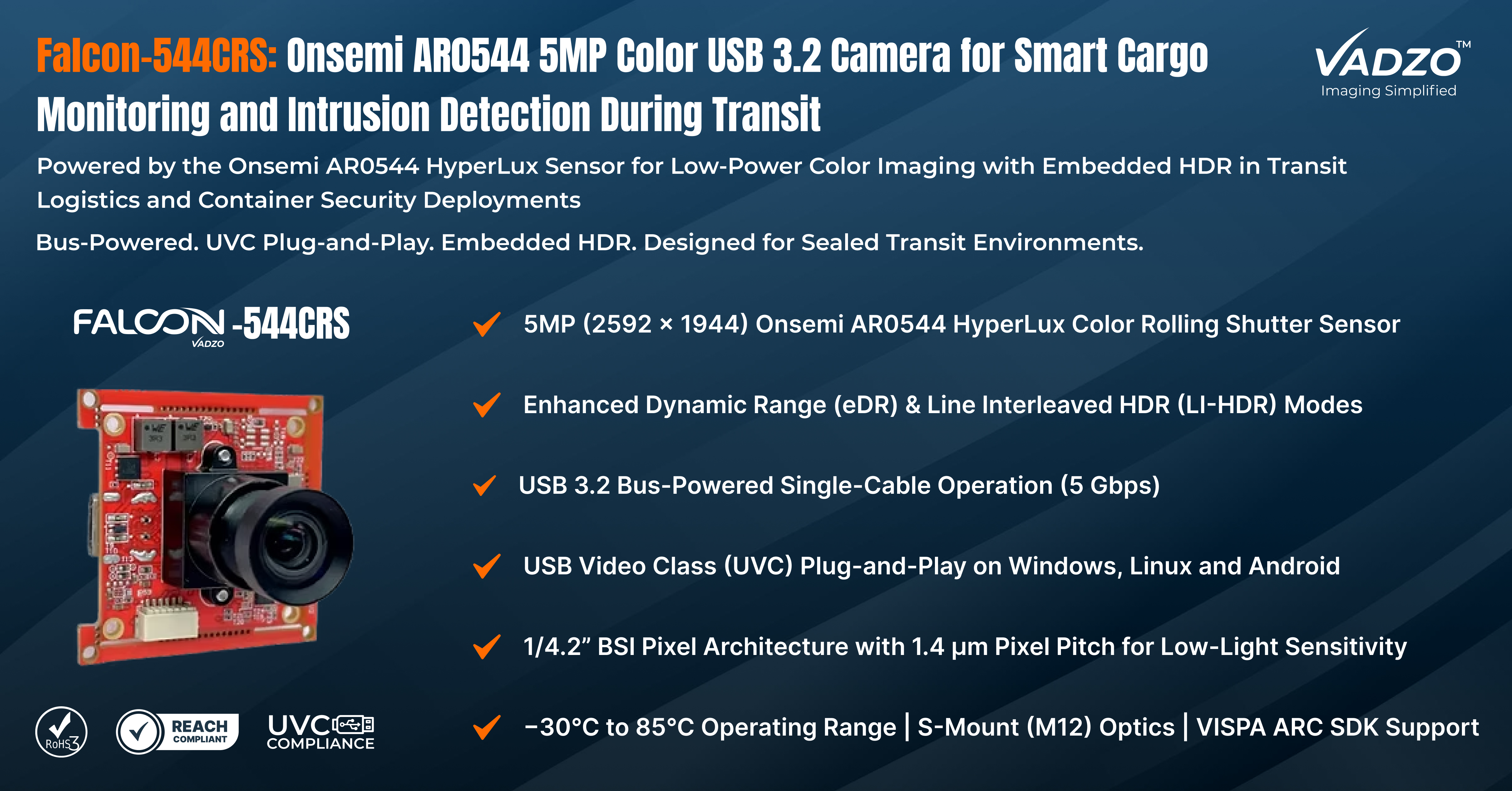
The Falcon-544CRS is a 5MP color USB 3.2 camera built on the Onsemi AR0544 HyperLux sensor with embedded HDR and low-power operation engineered for cargo monitoring camera and intrusion detection deployments inside shipping containers and freight holds where bus-powered operation eliminates external power requirements and UVC plug-and-play compatibility enables direct integration with edge computing platforms deployed across transit logistics networks without custom driver development.
FORT WORTH, TX / ACCESS Newswire / June 23, 2026 / Vadzo Imaging today announces the positioning of the Falcon-544CRS as an AR0544 USB camera for smart cargo monitoring and intrusion detection during freight transit. Built on the Onsemi AR0544 HyperLux sensor and delivered over USB 3.2 with full UVC compliance, the Falcon-544CRS 5MP USB camera addresses the specific imaging requirements of sealed container environments where power infrastructure is limited, lighting is unpredictable, and the edge computing platforms responsible for cargo security must process vision data without host-side sensor management overhead or custom driver development. The 5MP color camera platform resolves the engineering constraints that have historically limited vision-based cargo security deployments during transit by combining low-power sensor architecture with embedded HDR processing and a bus-powered interface in a compact M12-compatible module operating from −30°C to 85°C.
Vision in Transit: The Engineering Challenge That Standard Industrial Camera Products Cannot Solve
Deploying a vision system inside a shipping container or cargo hold during active freight transit exposes a set of engineering constraints that standard industrial camera approaches were not designed to handle. Gigabit Ethernet camera products with Power over Ethernet require an active network infrastructure with PoE switches or injectors. MIPI CSI-2 camera products are tightly coupled to the SoC platforms on which they are physically mounted and do not tolerate the cable lengths or vibration profiles encountered in transit environments. USB camera products with high active power draw place unsustainable demands on battery-powered edge nodes when the system must remain operational across multi-day transit periods.
The illumination problem inside cargo holds compounds the hardware challenge. During loading and unloading at ports and distribution centers, artificial lighting is typically present. Once sealed for transit, a container may be completely dark except for light ingress through ventilation openings. When a door is opened at an intermediate stop, strong outdoor light floods into a space that was previously dark.
The AR0544 HyperLux Sensor Architecture and Why It Addresses These Constraints
The Onsemi AR0544 belongs to the HyperLux sensor family, an architecture engineered around low-power operation as a first-order design parameter rather than a secondary consideration. The AR0544 delivers 5MP color imaging at 2592 × 1944 through a 1/4.2-inch BSI rolling shutter CMOS architecture with 1.4 µm pixel pitch. Back-Side Illumination places the photodiode above the metal interconnect layer, increasing photon capture efficiency at small pixel sizes and improving low-light sensitivity relative to front-illuminated architectures of the same pixel pitch.
Embedded HDR processing within the AR0544 handles mixed-illumination capture at the sensor level, producing consistent output frames across scenes that combine direct light ingress from open container doors with darker recessed cargo areas in the same field of view. This is the architecturally correct approach for a transit monitoring camera operating at an edge node with limited processing headroom: offloading scene normalization to the sensor eliminates the need for host-side multi-frame HDR merging and reduces the computational overhead on the edge platform dedicated to motion analysis and intrusion classification.
For a low-power USB camera platform deployed on a battery-backed edge computing node inside a transit container, this translates directly to extended operational periods between charge cycles or reduced battery capacity requirements for a target monitoring duration.
Falcon-544CRS: 5MP AR0544 USB 3.2 Camera for Embedded Cargo Vision
The Falcon-544CRS delivers the Onsemi AR0544 HyperLux sensor platform over USB 3.2 with full UVC compliance and support for Vadzo's VISPA ARC SDK. The USB 3.2 interface at 5 Gbps provides the bandwidth required to stream 5MP color frames without compression artifacts that would degrade intrusion detection accuracy by distorting the texture and boundary information used by inference models to distinguish personnel from cargo. The USB bus-powered design draws power directly from the host edge computing board, eliminating the need for a dedicated power regulator or auxiliary supply in the monitoring node design.
Full UVC compliance means the 5MP USB camera registers as a standard video capture device on Windows, Linux, and Android without any custom driver installation.
Key Capabilities of the Falcon-544CRS Onsemi AR0544 5MP Color USB 3.2 Camera
Low-Power Sensor Architecture for Battery-Backed Transit Monitoring
The AR0544's HyperLux architecture is designed from the ground up to minimize power consumption at the sensor level. In cargo monitoring deployments where the edge computing node operates on battery power or energy harvested from vehicle electrical systems, sensor power draw is a primary design constraint that determines whether continuous monitoring across a multi-day transit journey is achievable within a practical battery capacity. The low-power embedded camera design of the Falcon-544CRS 5MP Color USB Camera allows embedding in compact battery-powered monitoring nodes without requiring active thermal management hardware or oversized battery reserves to sustain continuous imaging operation. This directly addresses the power infrastructure gap that has prevented standard industrial camera products from reaching into sealed transit environments.
Embedded HDR for Mixed-Illumination Cargo Hold Imaging
Cargo holds and shipping containers are not controlled photographic environments. Illumination enters from multiple sources at varying intensities throughout a transit journey and during loading and unloading operations. The AR0544's embedded HDR capability captures high-gain and low-gain information within a single sensor read cycle, producing a frame that contains usable detail across both the bright and shadow regions of the scene simultaneously. For a transit monitoring camera system evaluating each frame for intrusion signatures or load shift indicators, embedded HDR at the sensor means the edge inference model receives normalized input regardless of whether the container is in direct sun during a port stop, under artificial warehouse lighting during an intermediate transfer, or in low ambient conditions during overnight transit. This removes a significant source of false positives from lighting-transition events that would otherwise trigger alert thresholds in systems without scene normalization at the sensor level.
USB 3.2 Bus-Powered Operation for Cabling Simplicity in Transit Deployments
A container monitoring camera system that requires separate power cabling and data cabling adds connector count, cable mass, and failure points to a deployment that must survive vibration, temperature cycling, and handling during transit. USB 3.2 carries both power and high-speed data over a single cable with a standardized connector. The Falcon-544CRS 5MP camera's bus-powered design draws directly from the host USB port, removing the power regulator, power cable, and power connector from the hardware design.
UVC Plug-and-Play for Multi-Platform Edge Logistics Integration
The logistics technology ecosystem operates across a heterogeneous set of computing platforms. Container tracking terminals run embedded Linux on various SBC architectures. Port automation systems use Windows-based edge servers. Mobile inspection tablets and handheld logistics scanners often run Android. A cargo security camera that requires a platform-specific driver adds an integration dependency that multiplies across each target platform in the deployment network. Full UVC compliance means the Falcon-544CRS registers identically as a standard USB Video Class device on Windows, Linux, and Android without driver installation on any of these platforms.
5MP Color Resolution for Intrusion Detection and Cargo Condition Assessment
At 5MP with 2592 × 1944-pixel output, the Falcon-544CRS provides resolution sufficient to distinguish a person entering a container from shifting cargo through the size, shape, and motion characteristics available at that pixel density. The color information from the AR0544's Bayer filter array adds a discrimination channel that monochrome sensors do not provide: a human figure wearing clothing of a specific color against cargo stacked in a contrasting color scheme can be classified more reliably by a color inference model than by a grayscale equivalent. For cargo condition monitoring applications where the task is detecting evidence of tampering or unauthorized access, such as displaced seals or disturbed packaging, color fidelity at 5MP provides the scene detail needed to flag anomalies that would be missed at lower resolutions.
M12 Optics and −30°C to 85°C Operating Range for Global Transit Conditions
The S-Mount (M12) lens interface is the standard for compact industrial embedded vision camera modules and provides access to the widest available range of focal lengths and field-of-view configurations from qualified industrial lens suppliers. System designers configuring a shipping container camera deployment can select lens parameters precisely matched to the container's internal dimensions and mounting position without requiring custom optics. The Falcon-544CRS operates from −30°C to 85°C, covering the thermal conditions encountered across global freight logistics routes from sub-zero cold chain transit through high-temperature desert overland corridors to tropical port environments where sealed container temperatures can significantly exceed ambient air temperature.
Product Specifications
Sensor | Onsemi AR0544 HyperLux |
Sensor Format | 1/4.2" |
Resolution | 5MP (2592 × 1944) |
Pixel Pitch | 1.4 µm |
Pixel Architecture | BSI (Back-Side Illuminated) |
Shutter Type | Rolling Shutter |
HDR | Embedded HDR |
Interface | USB 3.2 (5 Gbps) |
Lens Mount | S-Mount (M12 Standard) |
Operating Temperature | −30°C to 85°C |
Compliance | UVC, RoHS 3, REACH |
SDK | VISPA ARC SDK (C, C++, Python - Windows, Linux, Android) |
"Cargo visibility during transit has always been limited by what you can practically power and integrate inside a sealed container. The AR0544's low-power HyperLux architecture, combined with USB bus-powered delivery, means a camera node can operate for extended periods from compact battery systems that fit within a standard IoT monitoring enclosure. Adding embedded HDR removes the lighting variability problem that causes false positives in detection systems deployed across the cargo and port handling cycle. The Falcon-544CRS delivers this combination in a UVC-compliant module that OEM teams can integrate without writing a single line of driver code. That is what makes it deployable across the heterogeneous platform landscape that logistics technology companies actually operate." - Alwin Vincent, Product Manager, Vadzo Imaging
Target Applications
Smart Cargo Monitoring and Intrusion Detection in Shipping Containers: Deploying an intrusion detection system inside a shipping container during active transit requires a camera that can operate continuously from battery or vehicle power without thermal management infrastructure and handle the specific illumination transition from sealed darkness to sudden light ingress when a container door is opened. The Falcon-544CRS addresses each of these requirements directly: the AR0544's low-power HyperLux architecture minimizes battery drain during continuous monitoring, embedded HDR handles the high-contrast lighting event when a container door opens, and USB bus-powered operation eliminates external power cabling from the sensor node design.
Load Shift Detection and Cargo Condition Monitoring: Load shift during transit is a safety risk in road and rail freight and a financial risk in cargo insurance claims. Detecting load shift through vision requires a sensor mounted inside the container that can capture the initial cargo stacking configuration during loading and compare it against captured frames at monitoring intervals during transit. The Falcon-544CRS provides 5MP color imaging suitable for this reference-and-compare workflow. The embedded HDR capability ensures that the cargo pattern captured at loading under artificial warehouse lighting and the frame captured in transit under different illumination conditions are both correctly exposed, preserving the feature information needed for algorithmic comparison.
Seal Integrity Monitoring and Tamper Detection: Container seal integrity is a critical compliance requirement in customs and border protection monitoring, pharmaceutical cold chain logistics, and high-value asset transport. A seal integrity monitoring camera positioned at the container door perimeter must resolve the physical state of the seal against the door frame with sufficient precision to detect partial seal displacement or evidence of forced entry. The Falcon-544CRS at 5MP provides the resolution density needed to image door seals and locking mechanisms from a mounting position constrained by available space within the container door assembly. The BSI pixel architecture provides the low-light sensitivity needed to image a dark seal perimeter when ambient light levels inside the container are minimal.
Remote Cargo Monitoring and Asset Tracking in Smart Logistics: Modern freight logistics platforms increasingly require real-time or near-real-time visibility into cargo status during transit. A smart logistics camera node built on the Falcon-544CRS can provide visual verification of cargo presence and condition at programmed capture intervals. The captured frames are processed on the edge computing node, and the detection results or compressed reference frames are transmitted to the logistics management platform over cellular or satellite data links available on the monitoring hardware.
Frequently Asked Questions
Q: What USB camera specification should I look for when selecting a camera for battery-powered cargo monitoring inside shipping containers?
A: For battery-powered cargo monitoring inside a shipping container, the most important USB camera specification is sensor-level power consumption per frame rather than just interface power rating. A USB camera that draws close to the full USB 3.2 specification power limit of 900mA continuously will drain a compact battery pack within hours. The correct selection criterion is a camera built on a sensor architecture designed for low-power operation at the architectural level, not one that simply meets USB bus-power compliance at the interface.
The Onsemi AR0544 HyperLux sensor used in Vadzo's AR0544 USB camera Falcon-544CRS is engineered specifically for low-power embedded imaging. The HyperLux architecture minimizes per-frame energy consumption at the sensor level, translating to extended monitoring durations on battery-backed edge nodes without increasing battery capacity. Beyond sensor power, the USB bus-powered design of the Falcon-544CRS eliminates the need for a separate power supply regulator in the monitoring node, reducing total system component count and overall power conversion losses. At 5MP resolution over USB 3.2, the camera provides the image quality needed for intrusion detection and cargo condition assessment while maintaining the power envelope compatible with transit monitoring edge nodes operating on practical battery sizes.
Q: How does a 5MP USB color camera handle the extreme illumination transitions inside a cargo hold when a container door is opened?
A: The illumination transition event, when a shipping container door opens, represents one of the most challenging dynamic range scenarios for any imaging system. The interior of a sealed container during transit is typically in near-complete darkness. When a door opens, direct or indirect outdoor illumination floods the same space, creating a scene with simultaneous deep shadow regions and bright highlight areas that differ by several stops of exposure value.
A standard fixed-exposure camera will respond to this transition by either saturating the highlights near the door opening while rendering the container interior in shadow, or correctly exposing the bright area while losing detail in the darker cargo zones. Both outcomes compromise intrusion detection reliability: saturated pixels near the entry point obscure the precise silhouette and texture of a person entering the container, and underexposed interior zones miss cargo displacement events away from the immediate door area.
Embedded HDR at the sensor level is the engineered solution to this constraint. The AR0544 HyperLux sensor in the Falcon-544CRS captures high-gain and low-gain data within a single read cycle and combines them into an output frame that contains usable detail across both the bright door area and the darker interior simultaneously. This is processed entirely within the sensor without requiring the host edge computing board to merge multiple exposures in software. The result is a consistently usable frame on each capture regardless of the current illumination state inside the container, providing the detection algorithm with reliable input data across the full door-open and door-closed illumination cycle.
Q: What makes a low-power USB 3.2 camera with embedded HDR the right choice for transit monitoring over a GigE or PoE camera?
A: The power and cabling requirements of GigE and PoE camera products are a fundamental mismatch with the electrical infrastructure available inside a sealed transit container. A GigE camera with Power over Ethernet requires a PoE switch or injector with mains power connectivity, an Ethernet cable run from the switch to the camera, and, in most cases, a dedicated network interface on the edge computing host. Installing this infrastructure inside a shipping container for a transit monitoring deployment means running power cabling through the container structure, adding connector penetrations that compromise seal integrity, and managing the thermal output of active networking hardware in a sealed environment.
A USB 3.2 camera eliminates each of these dependencies. USB carries both power at up to 900mA and 5 Gbps data over a single cable connected directly to the USB port of the edge computing host. No PoE switch, no network cabling, and no additional power conversion hardware. For OEM developers building compact cargo security camera nodes, this simplification translates to fewer failure points, lower component cost per installation, and reduced installation complexity in a constrained mechanical environment. Vadzo's Falcon-544CRS delivers 5MP color imaging over this single-cable USB 3.2 interface with embedded HDR processing at the sensor level and a UVC-compliant driver-free interface that works on Linux, Windows, and Android edge platforms.
Q: Can a 5MP rolling shutter USB camera accurately detect a person entering a shipping container without triggering false positives from load movement or vibration?
A: Rolling shutter in a 5MP color camera introduces a specific trade-off for motion detection applications: the readout delay between the first and last row of each frame means that objects moving rapidly during readout produce a skewed or distorted silhouette in the captured image. For intrusion detection inside a freight container, the relevant motion speeds are those of a person moving through the space, not vehicle-induced vibration, which operates at much shorter timescales than sensor row readout periods. At typical pedestrian entry speeds, rolling shutter distortion produces a mild geometric deformation of the intruder silhouette that does not prevent classification by person detection algorithms, and the color information from the Bayer filter array provides an additional discrimination channel that significantly improves person-versus-cargo classification accuracy compared to a monochrome rolling shutter sensor.
Vehicle vibration produces image blur that is common to both rolling and global shutter sensors and is managed through exposure time control rather than shutter architecture selection. In low-vibration modes such as ocean freight or stationary port storage, the AR0544 at 5MP provides clean frames for both intrusion detection and cargo condition monitoring. The VISPA ARC SDK allows exposure time and gain to be programmed on the Falcon-544CRS to optimize frame quality for the specific vibration and illumination conditions of the deployment environment.
Q: Which embedded vision USB camera is best suited for smart cargo monitoring, container inspection, and automated freight tracking in logistics automation systems?
A: For smart cargo monitoring, container inspection, and automated freight tracking deployments, Vadzo Imaging's Falcon-544CRS is the purpose-matched AR0544 USB camera solution in the Vadzo portfolio. The Falcon-544CRS is built on the Onsemi AR0544 HyperLux sensor, which delivers 5MP (2592 × 1944) color imaging at 1/4.2-inch format with a 1.4 µm BSI pixel and embedded HDR. The sensor's HyperLux low-power architecture is specifically relevant to transit monitoring: it minimizes the energy draw of the sensor node in battery-powered container monitoring systems, directly extending operational duration without increasing battery pack size.
The USB 3.2 single-cable bus-powered interface simplifies the hardware design of a portable or permanently installed cargo security camera node compared to PoE or externally powered industrial camera products. UVC compliance provides plug-and-play operation on Linux, Windows, and Android edge computing platforms without custom driver development, which is a practical requirement when cargo monitoring systems must integrate across heterogeneous logistics technology environments. The VISPA ARC SDK provides GPIO triggering for door-sensor-synchronized capture, Region of Interest configuration for bandwidth management on connected edge nodes, and exposure control for optimization across varying container illumination conditions.
Availability
The Falcon-544CRS Onsemi AR0544 5MP Color USB 3.2 Camera is available for evaluation and pre-production sampling through Vadzo Imaging. Engineering teams can access the full technical datasheet, CAD files, and VISPA ARC SDK documentation at vadzoimaging.com or contact Vadzo's sales team directly for volume pricing, customization requirements covering board-level form factor changes, firmware modifications, lens holder configurations, and OEM enclosure integration support.
About Vadzo Imaging
Vadzo Imaging develops embedded and machine vision camera products for OEMs and system integrators building production-ready vision systems across industrial automation, robotics, healthcare, and smart infrastructure. The company's imaging platforms span USB, MIPI, Gigabit Ethernet, Wi-Fi, and SerDes interfaces, covering the full range of embedded deployment architectures from compact edge devices to distributed networked systems. Beyond hardware, Vadzo provides end-to-end imaging support, including sensor integration, ISP tuning, firmware development, and SDK frameworks, giving engineering teams a single partner from initial evaluation through production lifecycle management.
Media Contact
Alwin Vincent
Vadzo Imaging
Email: [email protected]
LinkedIn: Vadzo Imaging
YouTube: Vadzo Imaging
X: Vadzo Imaging
SOURCE: Vadzo Imaging