




Friday, 10 July 2026 02:00 PM
Product Announcements
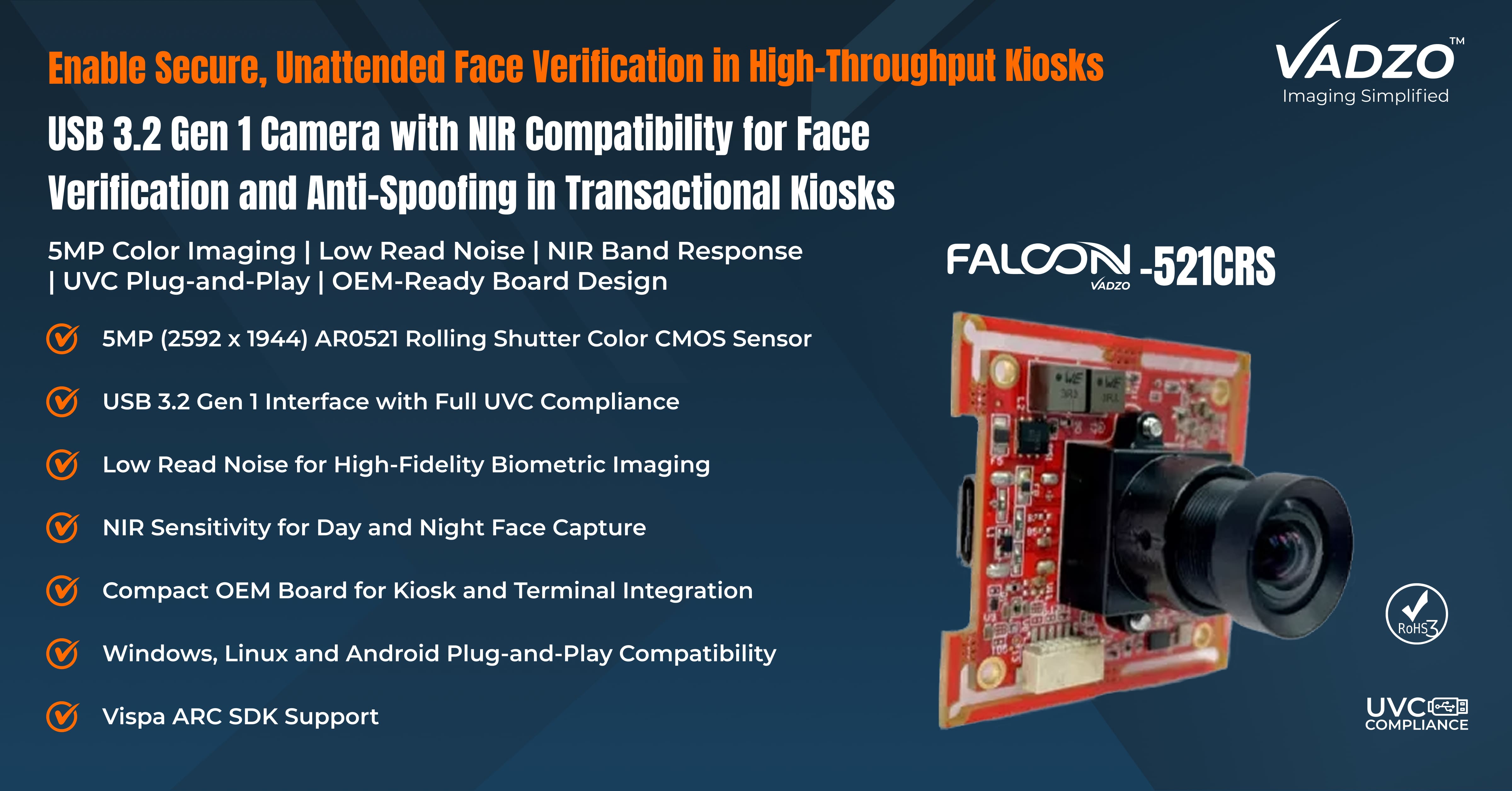
Vadzo's Falcon-521CRS is a 5MP color USB camera built on the ON Semiconductor AR0521 sensor, delivering low read noise imaging with NIR spectral response and USB 3.2 Gen 1 connectivity, designed for embedded face verification, anti-spoofing pipelines, and biometric authentication terminals requiring a compact UVC-compliant module without custom driver development.
FORT WORTH, TX / ACCESS Newswire / July 10, 2026 / Vadzo Imaging today announces the availability of the Falcon-521CRS, an AR0521 liveness detection USB camera built for deployment in transactional kiosks, eKYC stations, access control terminals, and biometric authentication systems. Powered by the ON Semiconductor ARQ0521 sensor and delivered over USB 3.2 Gen 1 with full UVC compliance, the Falcon-521CRS combines 5MP resolution with low read noise characteristics and near-infrared band sensitivity in a compact board-level module ready for direct OEM integration.
The Imaging Challenge in Biometric Kiosk and Face Verification Systems
Deploying a reliable liveness detection camera inside a transactional kiosk or access control terminal involves imaging constraints that general-purpose USB modules are not engineered to meet. Face verification of workflows depends on consistent high-fidelity capture across a range of ambient lighting conditions, from controlled indoor environments to high-glare outdoor kiosk installations and low-light lobby areas. A sensor with poor noise performance delivers image data that undermines feature extraction accuracy in face recognition algorithms, producing elevated false rejection rates and degraded liveness classification scores.
Anti-spoofing pipelines introduce a second requirement: NIR response. Presentation attack detection frameworks using near-infrared illumination at 850 nm or 940 nm require a sensor that captures a usable signal in these bands without a monochrome-only optical path. Color sensors without NIR sensitivity cannot participate in these pipelines without additional hardware overhead.
For engineers building kiosks and digital signage platforms and eKYC verification stations, the core requirement is a single USB camera product that solves sensor noise, NIR compatibility, and driver integration simultaneously on a compact footprint. The Falcon-521CRS is designed to address each of these constraints within a single OEM-ready module.
AR0521 Sensor Architecture and Its Role in Face Verification Imaging
The ON Semiconductor AR0521 is a 5MP rolling shutter color CMOS image sensor with a 1/2.5" optical format and 2.2 µm pixel pitch, resolving 2592 x 1944. The AR0521 is specifically characterized for low-read noise performance. Read noise is the baseline electronic noise introduced during pixel readout, determining the minimum detectable signal at low light levels. For a liveness detection camera operating in varied ambient conditions, low read noise translates directly into cleaner face imagery at lower exposure values, reducing the risk of noisy captures that degrade algorithm performance. Near-infrared sensitivity is native to silicon-based CMOS sensors, including the AR0521: without an IR-cut filter, the sensor responds to NIR illumination in the 700 nm to 1000 nm range, allowing the Falcon-521CRS to participate in presentation attack detection workflows where IR illumination distinguishes live faces from photograph or screen spoofing attacks.
Falcon-521CRS: 5MP AR0521 USB 3.2 Gen 1 Camera for Biometric and eKYC Applications
The Falcon-521CRS is Vadzo Imaging's 5MP liveness detection camera built on the AR0521 sensor and delivered over USB 3.2 Gen 1 Type-C with backward compatibility to USB 3.0. It combines 5MP color resolution, low noise imaging characteristics, and NIR spectral response in a board-level module designed for direct integration into kiosk enclosures, access control hardware, and identity verification terminals. The module is UVC-compliant, streaming immediately on Windows, Linux, and Android without requiring custom driver development.
Key Capabilities of the Falcon-521CRS AR0521 5MP USB 3.2 Gen 1 Camera
Low Read Noise for Consistent Biometric Image Capture
The AR0521 sensor's low noise floor enables the Falcon-521CRS to deliver clean face imagery across the lighting range encountered in real-world biometric kiosk camera deployments. Sensors with high read noise require image brightening in post-processing, amplifying noise and degrading feature extraction quality for liveness detection and face matching algorithms. The AR0521's low read noise allows usable face captures at shorter exposures and lower gain settings, producing better signal-to-noise ratio data without additional image enhancement stages. For eKYC verification systems where image quality directly affects match confidence scores, this translates into consistent accept-reject decisions across users presenting at varying distances and under different ambient lighting conditions.
NIR Compatibility for Anti-Spoofing and Day-to-Night Face Capture
The native NIR response of the AR0521 sensor makes the Falcon-521CRS suitable for deployment in anti-spoofing camera configurations using near-infrared illumination. Presentation attack detection frameworks illuminate the subject with an IR LED array at 850 nm or 940 nm and analyze the reflected NIR image for characteristics inconsistent with a live face. The Falcon-521CRS supports this architecture by providing NIR capture on the same imaging plane used for color face capture, without requiring a parallel monochrome sensor. In outdoor kiosk installations where visible light drops at night, NIR illumination ensures continuous capture quality independent of ambient light, making the Falcon-521CRS a single-module solution for 24-hour deployment cycles.
USB 3.2 Gen 1 Interface with UVC Compliance for Cross-Platform OEM Integration
The Falcon-521CRS connects via USB 3.2 Gen 1 Type-C, providing bandwidth for 5MP full-resolution streaming without compression-related quality loss. Full UVC compliance means the module registers as a standard video input device on Windows, Linux, and Android immediately upon connection. For OEM engineering teams building access control camera systems and eKYC terminals on heterogeneous platform stacks, UVC compliance eliminates driver development and removes cross-OS compatibility risk. GPIO support provides hardware-level trigger connectivity for synchronized capture in multi-sensor biometric systems where the face camera must capture in coordination with a fingerprint reader, ID card scanner, or NFC reader within a defined transaction window.
Compact OEM Board Design for Kiosk and Terminal Integration
The Falcon-521CRS is designed as a board-level module for direct integration into the constrained form factors of self-service kiosks, smart POS terminals, passport verification stations, and visitor management systems. Compact board dimensions, USB-powered operation, and the absence of a custom driver requirement reduce hardware and software overhead per deployment unit. Operating temperature support across the industrial range accommodates outdoor kiosk installations and transit terminal deployments where enclosure temperatures vary across seasons. Conformance to RoHS standards positions the Falcon-521CRS as a production-ready component for regulated markets and enterprise procurement programs.
Product Specifications
Sensor | ON Semiconductor AR0521 |
Resolution | 5MP (2592 x 1944) |
Optical Format | 1/2.5" |
Pixel Size | 2.2 µm |
Shutter Type | Rolling Shutter |
Interface | USB 3.2 Gen 1 (Type-C) |
USB Backward Compatibility | USB 3.0 |
UVC Compliance | Yes (Plug-and-Play) |
NIR Sensitivity | Yes (NIR Band Response) |
Low Read Noise | Yes |
Platform Support | Windows, Linux, Android |
GPIO | Yes |
Form Factor | Board-Level OEM Module |
Compliance | RoHS |
"Face verification at an unattended terminal puts very specific demands on the imaging module. The sensor noise floor determines whether the system works reliably under the full range of ambient conditions the deployment will see, not just in controlled lab environments. The AR0521's low read noise and NIR response make it well-suited for liveness detection pipelines that need to handle variable lighting and anti-spoofing checks on the same hardware. The Falcon-521CRS packages this on a USB 3.2 Gen 1 platform with UVC compliance, so engineering teams can focus on the algorithm and the pipeline rather than the camera integration work." - Alwin Vincent, Product Manager, Vadzo Imaging.
Target Applications
Transactional Kiosks and eKYC Verification Stations: Electronic Know Your Customer workflows at self-service kiosks require face capture that meets the image quality standards of facial recognition and document matching algorithms. The eKYC camera module must deliver sufficient resolution for biometric feature point extraction, low noise for consistent quality under ambient lighting variation, and liveness detection capability to prevent fraudulent enrollment. The Falcon-521CRS addresses these requirements through the AR0521's 5MP resolution, low read noise, and NIR response for active illumination-based anti-spoofing pipelines. In high-throughput banking, government services, and telecommunications kiosk environments, image quality deficiencies that increase false rejection rates impose direct operational costs through increased support calls and reduced transaction throughput.
Access Control and Facial Recognition Terminals: A face recognition access control camera at an entrance control point must handle subjects approaching from variable distances under mixed lighting from overhead fixtures and external daylight. The AR0521 5MP resolution provides sufficient spatial data for face recognition at the working distances typical of turnstile, door, and elevator access control installations. NIR response enables active IR illumination for consistent capture quality at building perimeters or covered walkways, where direct sunlight produces extreme contrast ratios that make visible-light face capture unreliable.
Passport Verification and ID Scanning at Border Control Kiosks: Automated border control kiosks and airport self-service passport gates require the imaging module to perform face-to-document matching and presentation attack detection. Passport verification camera Systems in these environments handle high passenger throughput and demanding enclosure conditions, including wide temperature swings and continuous duty cycle operation. The Falcon-521CRS provides 5MP resolution for facial feature density in face-to-document matching workflows and NIR capture capability for liveness detection, in a compact board design suited for automated border control gate hardware where multiple sensors must co-locate in a single throughput lane unit.
Visitor Management and Smart POS Systems: Corporate visitor management terminals and Smart POS camera systems with integrated identity verification require a biometric capture module that embeds without significant modification to the base form factor. The USB-powered architecture of the Falcon-521CRS eliminates the need for a dedicated power supply rail, simplifying the system power budget in battery-operated or low-power kiosk designs. UVC compliance ensures compatibility with the Windows and Android-based platforms used by most POS and visitor management system vendors. Facial recognition at POS terminals enables frictionless payment authorization where the customer's enrolled face serves as the authentication credential without requiring a card tap or PIN entry.
VISPA ARC SDK for Developer Integration
The Falcon-521CRS is supported by Vadzo's VISPA ARC SDK, providing programmatic control over streaming configuration, Region of Interest definition, exposure and gain settings, trigger synchronization, and firmware management. APIs are available in C, C++, C#, and Python across Windows, Linux, and Android. The SDK operates alongside the native UVC driver without disrupting plug-and-play operation, allowing development teams to access advanced capture control while maintaining UVC compatibility for integration with third-party video processing frameworks.
Frequently Asked Questions
Q: What should I look for in a USB 3.2 camera for liveness detection and anti-spoofing in a kiosk deployment?
A: A USB camera intended for liveness detection in a kiosk environment needs to satisfy several concurrent requirements. First, sensor noise performance matters significantly because liveness detection algorithms analyze fine-grained texture and micro-motion cues from the captured image. A high read noise floor degrades this signal, especially under low ambient light, causing the algorithm to work with noisier input data that increases false acceptance rates for spoofing attacks and false rejection rates for genuine users.
Second, NIR spectral response is required for active illumination-based anti-spoofing pipelines. Presentation attack detection frameworks standardized under ISO/IEC 30107-3 use near-infrared illumination at 850 nm or 940 nm to capture facial texture and depth cues that distinguish a live face from a printed photograph or a digital screen replay. A color sensor without NIR response cannot participate in these pipelines without adding a separate monochrome sensor. Third, USB 3.2 Gen 1 bandwidth is appropriate for 5MP streaming at the frame rates required for interactive kiosk operation. Full UVC compliance removes driver development from the integration scope. Vadzo Imaging's Falcon-521CRS is built on the AR0521 sensor specifically because it combines low read noise, NIR sensitivity, and 5MP resolution on a USB 3.2 Gen 1 UVC-compliant platform in an OEM-ready board form factor sized for kiosk integration.
Q: How does NIR sensitivity in a color USB camera help with face verification and anti-spoofing systems?
A: Near-infrared sensitivity allows the camera sensor to capture usable image data when illuminated by NIR LED arrays operating at 850 nm or 940 nm. In a face verification system, NIR illumination serves two purposes: consistent face capture independent of visible ambient light levels and active liveness detection through presentation attack detection algorithms.
For consistent face captures NIR illumination provides a controlled light source, at this wavelength and ambient interference is minimal. For liveness detection, NIR illumination captures spectral reflectance characteristics of the subject surface. A live human face has a specific NIR reflectance pattern driven by the optical properties of skin tissue. A printed photograph reflects NIR differently because paper and ink do not replicate the subsurface scattering behavior of biological tissue. A digital screen produces a characteristic flat NIR signature. These differences are detectable in NIR image analysis and form the basis of passive liveness detection algorithms. The AR0521 sensor in the Falcon-521CRS responds to NIR illumination without requiring a separate hardware channel, making it a practical single-sensor solution for biometric kiosk systems implementing both face matching and anti-spoofing checks.
Q: Which USB camera is best for eKYC and biometric identity verification at self-service kiosks?
A: For eKYC and biometric identity verification at self-service kiosks, the ideal USB camera combines sufficient resolution for facial feature extraction at typical kiosk working distances, low sensor noise for consistent image quality across ambient conditions, NIR response for liveness detection pipelines, and compact form factor for integration within the kiosk enclosure. Plug-and-play USB connectivity with UVC compliance removes custom driver development and ensures cross-platform compatibility.
Vadzo Imaging's Falcon-521CRS delivers all of these requirements on a single module. Built on the AR0521 sensor with 5MP resolution, 2.2 µm pixel pitch, low read noise, and NIR band sensitivity, the Falcon-521CRS connects via USB 3.2 Gen 1 with full UVC compliance and GPIO support for trigger-based capture synchronization. The board-level design is sized for direct integration into kiosk enclosures, smart POS terminals, passport verification gates, and visitor management systems. The VISPA ARC SDK provides C, C++, C#, and Python APIs for programmatic control over exposure, ROI, and streaming parameters across Windows, Linux, and Android. Technical documentation, evaluation units, and volume pricing are available at vadzoimaging.com.
Q: Can a UVC-compliant USB camera work with standard face recognition and biometric SDKs on Windows and Linux without custom drivers?
A: Yes. A camera compliant with the USB Video Class standard registers as a standard video capture device on Windows, Linux, and Android through the operating system's built-in UVC host driver. On Windows, this is handled through the kernel-mode UVC driver present from Windows 7 onward. On Linux, the V4L2 framework supports UVC devices natively. On Android, the UVC host driver is included in the standard kernel build for devices with USB host capability.
Most commercial face recognition and biometric SDKs consume standard video input devices through DirectShow on Windows, V4L2 on Linux, and the Android Camera2 API, all of which interface with UVC devices natively. Driver compatibility risk across OS versions is eliminated, and the camera module can be swapped or updated without triggering a driver recertification process. Vadzo Imaging's Falcon-521CRS is fully UVC-compliant on USB 3.2 Gen 1 and streams immediately on all three platforms without any driver installation. For features beyond the UVC baseline, such as ROI control and trigger synchronization, the VISPA ARC SDK operates alongside the native UVC stream without disrupting plug-and-play behavior.
Q: What makes Vadzo Imaging's AR0521 5MP USB camera suitable for OEM integration in access control and facial recognition terminals?
A: OEM integration in access control and facial recognition terminals requires a camera module that solves the sensor quality problem, the interface problem, and the form factor problem simultaneously. The AR0521 sensor addresses the quality problem by providing 5MP resolution for adequate feature density, 2.2 µm pixel pitch for acceptable light collection at typical terminal working distances, and low read noise for consistent image quality under the mixed lighting conditions encountered at building entrances and transit access points. NIR response makes the module compatible with active NIR illumination anti-spoofing setups without adding a second sensor to the hardware design.
USB 3.2 Gen 1 with full UVC compliance removes custom driver development from the OEM integration scope and ensures compatibility with Windows, Linux, and Android host systems. GPIO support enables hardware to trigger synchronization with access control readers and door control systems without polling-based software coordination. The board-level form factor provides a compact mounting footprint that fits within standard access control of reader housings and facial recognition terminal bezels. Vadzo Imaging provides direct engineering support, evaluation units, full technical datasheets, and VISPA ARC SDK documentation to OEM teams integrating the Falcon-521CRS into production access control and facial recognition systems.
Availability
The Falcon-521CRS AR0521 5MP Low-Noise USB 3.2 Gen 1 Camera is available now for evaluation and pre-production sampling through Vadzo Imaging. Engineering teams can access the full technical datasheet, CAD files, and SDK documentation at vadzoimaging.com, or contact Vadzo's sales team directly for volume pricing, customization requirements, and integration support.
About Vadzo Imaging
Vadzo Imaging develops embedded and machine vision camera products for OEMs and system integrators, building production-ready vision systems across industrial automation, robotics, healthcare, and smart infrastructure. The company's imaging platforms span USB, MIPI, GigE, Wi-Fi, and SerDes interfaces, covering the full range of embedded deployment architectures from compact edge devices to distributed networked systems. Beyond hardware, Vadzo provides end-to-end imaging support, including sensor integration, ISP tuning, firmware development, and SDK frameworks, giving engineering teams a single partner from initial evaluation through production lifecycle management.
Media Contact
Alwin Vincent
Vadzo Imaging
Email: [email protected]
LinkedIn: Vadzo Imaging
YouTube: Vadzo Imaging
X: Vadzo Imaging
SOURCE: Vadzo Imaging