




Monday, 06 July 2026 10:00 AM
Product Announcements
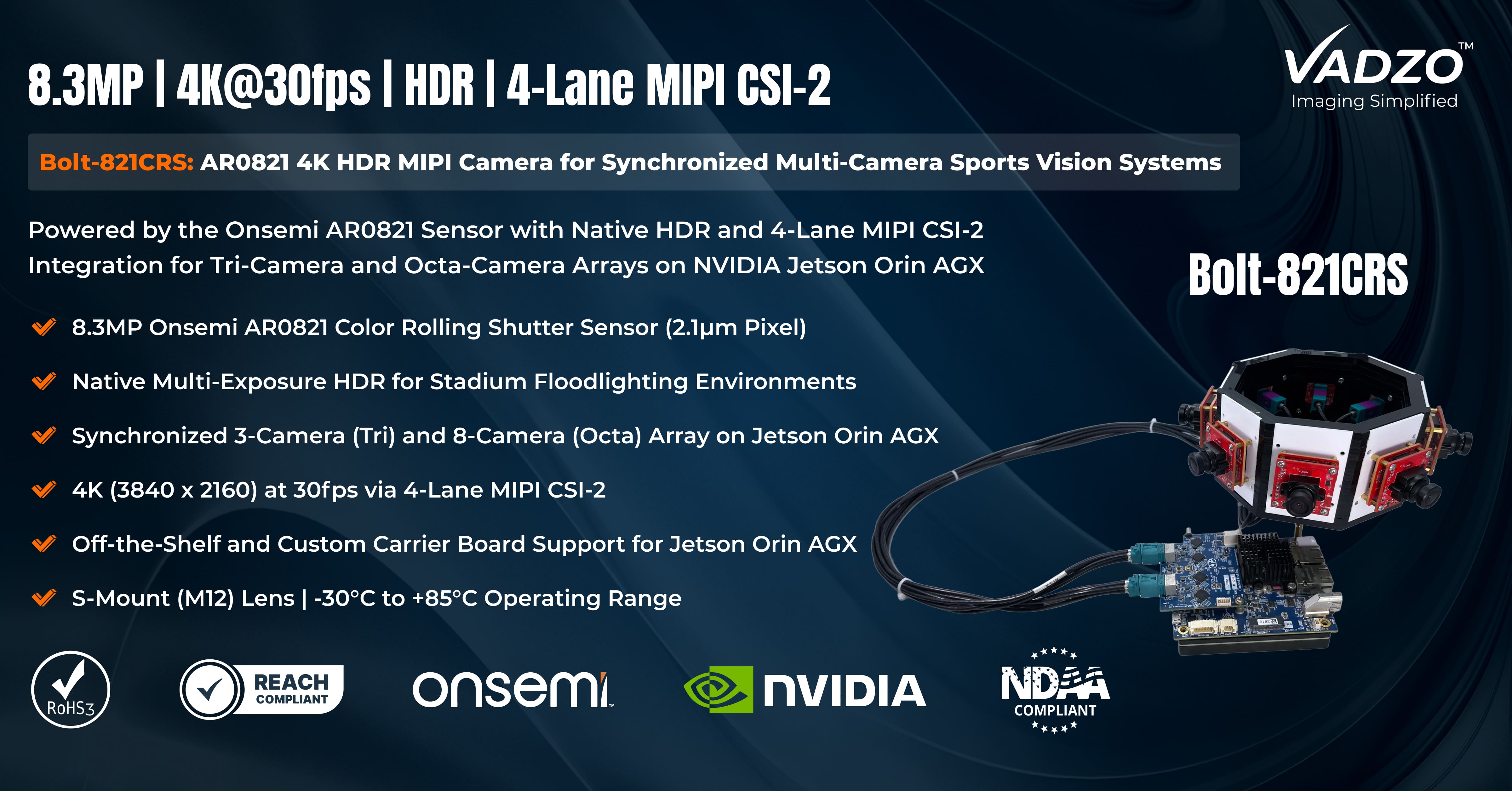
Vadzo's Bolt-821CRS is an 8.3MP 4K HDR MIPI camera built on the Onsemi AR0821 sensor, engineered for synchronized multi-camera deployment across three-camera and eight-camera array configurations on NVIDIA Jetson Orin AGX platforms, delivering 4K HDR imaging for AI-driven sports analytics, player tracking, stadium surveillance, and broadcast-grade field coverage through 4-lane MIPI CSI-2 with support for both off-the-shelf and custom carrier board integration.
FORT WORTH, TX / ACCESS Newswire / July 6, 2026 / Vadzo Imaging, a provider of embedded vision camera products, today announces the launch of the Bolt-821CRS, an 8.3MP 4K HDR MIPI camera built on the Onsemi AR0821 sensor for OEM engineers and system integrators deploying synchronized multi-camera arrays on NVIDIA Jetson Orin AGX platforms. Designed to support tri-camera and octa-camera array configurations for sports analytics, stadium surveillance, and broadcast imaging workflows, the Bolt-821CRS delivers 4K HDR output over 4-lane MIPI CSI-2 with hardware-level frame synchronization and broad carrier board compatibility covering both off-the-shelf integration paths and custom hardware development.
Multi-Camera Frame Synchronization and HDR Coverage: The Engineering Challenge in Sports Vision
Deploying multi-camera vision infrastructure across a professional sports venue requires addressing engineering constraints that single-sensor installations cannot resolve. Full field coverage of a playing surface demands spatial distribution of imaging sensors along sidelines, overhead gantries, and corner positions with each sensor delivering aligned frames to a central processing pipeline. When individual camera modules operate independent timing references, frame misalignment between sensors introduces temporal offsets that break player trajectory reconstruction and multi-view synthesis at the algorithm layer.
For sports analytics pipelines that track player positions across multiple synchronized camera feeds, temporal offset between adjacent sensors introduces spatial uncertainty directly at zone boundaries. In stadium environments where artificial floodlighting combines shadowed corner zones and peripheral stands, each sensor also needs a sufficient dynamic range to maintain recoverable detail across the full scene within a single exposure window. Addressing both requirements simultaneously from a compact MIPI board-level form factor that scales from three to eight sensors on a shared compute platform defines the engineering objective for the Bolt-821CRS multi-camera deployment architecture.
Sensor and Camera Overview
The Bolt-821CRS integrates the Onsemi AR0821 sensor delivering 8.3MP resolution at 3840 x 2160 with native HDR exposure control and 4K color output at up to 30fps over a 4-Lane MIPI CSI-2 interface. The AR0821 is built on a 2.1μm pixel pitch CMOS rolling shutter architecture in a 1/2.0" optical format, delivering 4K resolution with native multi-exposure HDR that captures usable image detail across wide luminance ranges within a single readout cycle.
The 4-lane MIPI CSI-2 interface routes image data directly to the NVIDIA Jetson Orin AGX ISP over dedicated connections, eliminating USB enumeration overhead and network stack latency from the frame delivery path. NVIDIA Jetson AGX Orin supports simultaneous multi-channel MIPI CSI-2 input across multiple camera ports, enabling the platform to ingest three or eight synchronized Bolt-821CRS streams without routing data through USB hubs or GigE network switches. The Jetson AGX Orin ISP processes per-channel debayering and image signal processing in hardware, distributing the compute load across the SoC and leaving GPU and DLA cores available for inference and analytics running above the acquisition layer.
Key specs: Bolt-821CRS AR0821 4K HDR MIPI Camera | 8.3MP (3840 x 2160) | Onsemi AR0821 | 1/2.0" Sensor Format | 2.1μm x 2.1μm Pixel | Color Rolling Shutter | Up to 30fps at 4K | Native HDR | 4-Lane MIPI CSI-2 | S-Mount (M12 Standard) | -30°C to +85°C | 38mm x 38mm (convertible to 32mm x 32mm)
Parameter | Specification |
Product Name | Bolt-821CRS |
Sensor | Onsemi AR0821 |
Resolution | 8.3MP (3840 x 2160) |
Pixel Size | 2.1μm x 2.1μm |
Sensor Format | 1/2.0" |
Shutter Type | Color Rolling Shutter |
Maximum Frame Rate | Up to 30fps at 4K (3840 x 2160) |
HDR | Native Multi-Exposure HDR |
Interface | 4-Lane MIPI CSI-2 |
Lens Mount | S-Mount (M12 Standard) |
Board Dimensions | 38mm x 38mm (convertible to 32mm x 32mm) |
Operating Temperature | -30°C to +85°C |
Key Capabilities of the Bolt-821CRS: 8.3MP AR0821 4K HDR MIPI Camera for Sports Multi-Camera Systems
Hardware-Synchronized Frame Timing for Accurate Multi-Camera Sports Analytics
When a player crossing the field of view boundary between two adjacent camera zones triggers a multi-view handoff, temporal offset between sensors introduces positional interpolation errors that degrade tracking confidence at exactly the transition point where multi-view data is most critical. The Bolt-821CRS supports hardware frame synchronization across the multi-camera array through MIPI CSI-2 trigger alignment at the sensor level, ensuring that all sensors in a three-camera or eight-camera array expose simultaneously and deliver temporally consistent frames to the Jetson Orin AGX processing pipeline. This synchronized multi-camera MIPI system eliminates the frame offset errors that asynchronous capture architectures produce, allowing AI sports analytics algorithms to reconstruct player trajectories and spatial events across the full field without positional artifacts generated by sensor timing misalignment.
Native HDR Exposure for High-Contrast Stadium Illumination
Professional sports facilities combine high-intensity artificial floodlighting at specific positions with naturally shadowed regions in corner zones, transition areas, and peripheral stands that create scene-wide lighting ratios exceeding the dynamic range of a standard 4K sensor in a single exposure. The AR0821 sensor integrates native multi-exposure HDR control that captures both highlight and shadow extremes within a single sensor readout cycle, delivering frames where brightly lit playing surfaces and darker peripheral zones are simultaneously captured with usable detail. For sports broadcast and stadium surveillance applications where fixed venue lighting creates predictable but highly non-uniform illumination across the image plane, this 4K HDR MIPI camera capability ensures each frame entering the analytics pipeline carries recoverable detail across the full scene range, reducing false detection events and tracking discontinuities that occur at high-contrast field boundaries with standard-exposure sensors.
Scalable Tri-Camera and Octa-Camera Array on NVIDIA Jetson Orin AGX
The Bolt-821CRS multi-camera architecture scales from a three-sensor tri-camera array covering a defined field zone to a full eight-sensor octa-camera configuration providing complete playing surface coverage, both running on NVIDIA Jetson Orin AGX. A three-camera array delivers overlapping coverage of a court segment, sideline zone, or goal area across three synchronized 4K HDR streams ingested directly by the AGX SoC ISP. An eight-camera configuration extends coverage to a full pitch with all eight synchronized 4K HDR streams arriving at the Jetson AGX simultaneously over dedicated MIPI lanes. Off-the-shelf Jetson Orin AGX carrier boards support multiple MIPI CSI-2 ports for both configurations at the evaluation and prototype stage. For OEM deployments requiring specific connector placement, board geometry, or custom peripheral design, Vadzo provides custom carrier board development aligned to the array of configuration and enclosure requirements.
Compact Board-Level Form Factor for Versatile Sports Venue Mounting
Sports venue camera Systems operate in environments where mounting constraints vary widely between ceiling gantries, courtside fixtures, goal structures, and perimeter enclosures. The Bolt-821CRS board-level form factor integrates directly into compact enclosure designs and multi-sensor mounting assemblies without the bulk of housed camera units. The S-Mount (M12) lens holder accepts focal length configurations matched to the coverage angle required by the mounting position and field zone, giving OEM teams full optical flexibility across a common sensor platform without board-level changes between installation types. The -30°C to +85°C operating range covers the full thermal envelope of indoor arena deployments and outdoor stadium installations without requiring supplemental thermal management hardware.
"Sports analytics and broadcast integrators deploying multi-camera field coverage at 4K need synchronized frame timing across every sensor in the array, HDR headroom for stadium lighting conditions, and a compute platform capable of absorbing multiple simultaneous 4K streams. The Bolt-821CRS configurations on NVIDIA Jetson Orin AGX give OEM teams a validated path from a three-sensor prototype covering a court zone to an eight-sensor production system covering a full pitch, with synchronized HDR capture at every sensor and hardware-level frame alignment across the entire array. Vadzo also supports custom carrier board development for teams that require specific board geometry or peripheral integration beyond what standard off-the-shelf carrier boards provide." - Alwin Vincent, Product Manager, Vadzo Imaging.
Target Applications
Sports Analytics and AI-Based Player Tracking: Accurate player tracking in professional sports requires persistent localization of multiple subjects across a full playing surface. Distributing three or eight synchronized Bolt-821CRS modules across sideline and gantry positions provides overlapping coverage at sufficient pixel density per body segment for pose estimation and trajectory reconstruction algorithms operating across the full field. Synchronized frame timing ensures that player position data from adjacent camera zones aligns to the same temporal reference, allowing trajectory data from separate segments to merge without interpolation artifacts at zone boundaries. The AR0821 native HDR maintains recoverable detail across both brightly lit and darker peripheral zones within the same frame. For AI sports analytics deployments, Vadzo's MIPI CSI-2 camera platform delivers the frame alignment and dynamic range that player tracking algorithms require to operate reliably across an entire playing surface.
Stadium Surveillance and Perimeter Security: Stadium surveillance infrastructure requires continuous monitoring of entry points, stands, perimeter zones, and field access areas under variable and non-uniform lighting conditions. A 4K HDR MIPI camera module in a multi-sensor perimeter array provides the spatial resolution needed for crowd density analysis, access point monitoring, and incident localization without sacrificing HDR headroom in the mixed-lighting environments that large sports venues produce. The compact board-level Bolt-821CRS integrates into fixed enclosure mounts at perimeter positions with an M12 lens configuration matched to the coverage angle and detection distance of the specific zone. The -30°C to +85°C operating range handles outdoor temperature variation without active thermal management at the camera module level. MIPI CSI-2 delivery to Jetson Orin AGX consolidates all surveillance streams on one compute platform without the network overhead of distributed IP camera architectures.
Sports Broadcast and Multi-Angle Replay Production: Broadcast production of live sports increasingly relies on AI-assisted multi-angle replay, highlight extraction, and real-time graphics overlay requiring accurate player and ball position data from synchronized multi-camera feeds. Temporal misalignment between broadcast feeds produces visible ghosting in composited replay frames and introduces positional error into tracking data used for automated graphics insertion. The Bolt-821CRS tri-camera and octa-camera arrays deliver synchronized 4K HDR feeds to the Jetson Orin AGX at frame-aligned timing, providing the broadcast pipeline with consistent multi-view data for replay synthesis and AI-assisted annotation without temporal artifacts at zone transitions. The AR0821 native HDR maintains detail in stadium floodlighting environments, ensuring broadcast frames carry recoverable scene information across the full luminance range. For broadcast integrators requiring a scalable 4K MIPI Jetson camera array from three to eight sensors on a Jetson AGX compute unit, the Bolt-821CRS provides the hardware foundation.
Platform Driver Support
The Bolt-821CRS connects directly to NVIDIA Jetson Orin AGX platforms via 4-lane MIPI CSI-2 with V4L2 driver support enabling integration into embedded Linux pipelines. Vadzo provides module-level driver support for Jetson Orin AGX covering multi-stream ingestion for three-camera and eight-camera array deployments. For multi-camera array programs, Vadzo supports integration across both off-the-shelf Jetson carrier boards and custom carrier board designs, with hardware development scoped to the specific array configuration, connector layout, and enclosure geometry requirements of the OEM program. Driver porting support for additional embedded SoC platforms is available on request.
Frequently Asked Questions
Q: What are the key engineering requirements for a synchronized multi-camera MIPI system in sports analytics applications?
A: Deploying a synchronized multi-camera MIPI array for sports analytics requires addressing four primary engineering constraints: temporal alignment between sensors, per-sensor dynamic range in stadium lighting, host compute bandwidth for simultaneous multi-stream ingestion, and physical mounting integration across venue positions.
Temporal alignment requires hardware-level synchronization at the sensor trigger rather than software frame-matching after delivery, because software synchronization introduces variable latency from pipeline scheduling that defeats the goal of frame-aligned data. A 4K MIPI camera module that supports synchronized trigger across the array and delivers frames directly to the host SoC ISP eliminates that latency layer entirely.
On the compute side, NVIDIA Jetson Orin AGX supports multiple simultaneous MIPI CSI-2 streams through its ISP hardware, distributing the per-channel processing load and leaving GPU and DLA cores available for inference and player tracking. Vadzo's Bolt-821CRS addresses all four constraints on a single compact AR0821 4K MIPI camera platform with validated Jetson Orin AGX integration and support for both off-the-shelf and custom carrier board configurations.
Q: How does a three-camera or eight-camera MIPI array on NVIDIA Jetson Orin AGX enable full-field player tracking in professional sports?
A: Full-field player tracking requires continuous localization of multiple subjects across a playing surface larger than any single sensor can cover sufficient resolution for body position estimation. A three-camera array distributes coverage across a field segment with overlapping zones between adjacent sensor fields of view, ensuring no player position falls outside the coverage area. An eight-camera array extends this to a full pitch by distributing sensors at sideline and gantry positions for complete top-down and oblique coverage of the entire playing surface.
Synchronized frame timing across all sensors ensures that player position data extracted from adjacent camera zones is time-aligned to the same exposure reference, allowing AI tracking algorithms to merge trajectory data from separate segments without temporal offset errors at zone boundaries. NVIDIA Jetson Orin AGX ingests all three or eight MIPI CSI-2 streams simultaneously through its hardware ISP, delivering aligned 4K HDR frames to the inference pipeline without inter-stream timing jitter introduced by the acquisition layer.
Vadzo's Bolt-821CRS provides this synchronized 4K multi-camera MIPI capability on the AR0821 sensor platform with validated Jetson Orin AGX integration, scaling from a three-sensor evaluation configuration to an eight-sensor production deployment on the same hardware platform.
Q: What is the technical advantage of using a native HDR MIPI camera over a standard 4K camera in stadium surveillance and sports broadcast?
A: A standard 4K sensor captures a single exposure level per frame. In a stadium environment where floodlighting creates scene luminance ratios that may exceed 10,000:1 across the full field, a single exposure setting that correctly exposes the brightly lit center field clips highlight detail in floodlit zones or lifts shadow areas at the cost of blowing out highlights. Neither result produces frames with recoverable detail across the complete scene range.
Native HDR exposure control in a sensor like the AR0821 captures multiple exposure levels within a single readout cycle and combines them into a single output frame with usable detail across the full scene luminance range. For stadium surveillance, this means entry points, stands, and perimeter zones captured in the same frame as the floodlit playing surface all carry recoverable detail for analytics and security workflows. For broadcast production, it means frame captures retain highlight information in floodlit zones without sacrificing shadow detail in transition areas, keeping the full scene available for compositing and graphics overlay without additional reprocessing.
For OEM teams evaluating a 4K HDR MIPI camera module for stadium or broadcast deployment, native sensor-level HDR eliminates the processing latency and alignment complexity that multi-frame software HDR compositing introduces into a real-time capture pipeline.
Q: Which 4K MIPI camera module supports synchronized tri-camera and octa-camera deployment on NVIDIA Jetson Orin AGX for sports vision systems?
A: System integrators building multi-camera sports vision infrastructure on NVIDIA Jetson Orin AGX need a camera module that delivers 4K HDR output over native MIPI CSI-2, supports hardware-level frame synchronization across multiple sensors, and integrates with both off-the-shelf carrier boards and custom hardware for production deployment.
Vadzo Imaging's Bolt-821CRS provides these capabilities on the Onsemi AR0821 sensor platform. The module delivers 8.3MP 4K HDR output at up to 30fps over 4-lane MIPI CSI-2 directly to the Jetson Orin AGX ISP, with hardware synchronization across the full multi-camera array. Three-camera configurations provide overlapping coverage of a defined field zone at pixel density sufficient for player tracking and body pose estimation. Eight-camera configurations extend synchronized 4K HDR coverage to a full playing surface with all streams arriving at the AGX simultaneously. Vadzo supports both off-the-shelf carrier board integration and custom carrier board development for production of OEM programs requiring specific board geometry or peripheral design.
Contact the Vadzo Imaging team at [email protected] to request specifications or evaluation units for tri-camera or octa-camera array configurations.
Q: What carrier board options are available for integrating multiple MIPI CSI-2 camera modules on NVIDIA Jetson Orin AGX for multi-camera sports systems?
A: NVIDIA Jetson Orin AGX supports simultaneous multi-channel MIPI CSI-2 input through its hardware ISP, but the number of available camera ports depends on the carrier board's design. Off-the-shelf carrier boards for the Jetson Orin AGX form factor from third-party vendors provide multiple MIPI CSI-2 connectors, supporting three-camera and in some configurations eight-camera deployments without custom hardware development. These boards are well-suited for evaluation, prototype, and low-volume production programs.
For OEM programs requiring a specific connector arrangement, PCB geometry, integrated peripheral circuitry, or ruggedized form factor that standard off-the-shelf carrier boards do not provide, Vadzo supports custom carrier board development aligned to the multi-camera Bolt-821CRS array configuration and the target deployment environment. Custom carrier board development includes MIPI CSI-2 routing for the required number of camera ports, power management for the array, synchronization signal distribution, and integration of additional peripherals required by the sports analytics or surveillance system architecture.
Vadzo engineering teams work directly with OEM system designers through hardware bring-up and validation, covering schematic review through production-ready hardware for both three-camera and eight-camera array configurations.
Availability
The Bolt-821CRS AR0821 4K HDR MIPI Camera is available for evaluation and OEM integration in both three-camera and eight-camera array configurations. To request full specifications or an evaluation unit, contact the Vadzo Imaging team at [email protected].
Vadzo supports full OEM customization for the Bolt-821CRS including form factor modification and board redesigns, custom carrier board development for Jetson Orin AGX multi-camera arrays, firmware development and custom feature integration, lens holder modifications, and full enclosure design in both IP-rated and non-IP-rated configurations. Driver porting support for additional embedded SoC platforms is available on request.
About Vadzo Imaging
Vadzo Imaging develops embedded vision camera products for OEMs and system integrators building production-ready vision systems across industrial automation, robotics, healthcare, and smart infrastructure. The company's MIPI CSI-2 camera series alongside USB 3.x, GigE, Wi-Fi, and SerDes interface camera products support a wide range of embedded deployment architectures. Vadzo provides end-to-end imaging support including sensor integration, ISP tuning, firmware development, and SDK frameworks to accelerate system deployment. Learn more at www.vadzoimaging.com.
Media Contact
Alwin Vincent
Vadzo Imaging
Email: [email protected]
LinkedIn: Vadzo Imaging
YouTube: Vadzo Imaging
X: Vadzo Imaging
SOURCE: Vadzo Imaging