




Thursday, 20 August 2026 12:30 PM
Product Announcements
Built for commercial fleets that need dependable video across trucks, buses, and delivery vehicles, this rugged camera pairs the OmniVision OX03C10 sensor with HDR and LED Flicker Mitigation over FPD-Link III, giving fleet operators clear, artifact-free video of traffic signals, brake lights, and roadway signage regardless of lighting conditions.
FORT WORTH, TX / ACCESS Newswire / August 20, 2026 / Vadzo Imaging, a provider of embedded vision solutions, today launched the Armor-3C10CRS-FPD3, a 2MP FPD-Link III Camera built around the OmniVision OX03C10 sensor for commercial fleet management, dash camera systems, and telematics platforms that need dependable video over a single rugged coax connection.
Why Fleet Management Needs a 2MP FPD-Link III Camera Built for LED Lighting
Modern roadways are full of LED lighting, including traffic signals, brake lights, turn indicators, and street lighting, all of which commonly use LED elements that are pulsed on and off far faster than the human eye can detect. A standard camera sensor capturing that same scene can pick up on that pulsing, which shows up in footage as a traffic light that appears partially lit, a brake light that flickers, or a sign that seems to disappear for a frame or two. For fleet operators relying on video for safety review, incident documentation, or driver coaching, a flickering or missing signal in the footage is not a cosmetic issue; it is a gap in the exact moment that review usually matters most.
A second challenge shows up in the same footage: fleet vehicles move between bright daylight, deep shadow under an overpass, and glare from oncoming headlights, often within the same few seconds of driving. A camera without genuine wide dynamic range handling has to choose between exposing for the bright roadway ahead or the darker cabin and mirrors, and neither choice gives a complete picture of what actually happened around the vehicle.
Engineering Explanation: Flicker Handling and Dynamic Range Together
OmniVision built the OX03C10 specifically for automotive and fleet applications that need to resolve both of these problems in the same frame. As an OmniVision OX03C10 FPD-Link Camera, the sensor pairs on-chip HDR with LED Flicker Mitigation, a feature designed specifically to detect and correctly expose pulsed LED light sources rather than letting them flicker or drop out between frames. As an OX03C10 HDR FPD-Link Sensor, it captures a properly lit traffic signal or brake light in the same frame as a correctly exposed roadway, rather than forcing a trade between the two.
That LED Flicker Mitigation capability matters most in exactly the moments fleet safety teams care about. An LED Flicker Mitigation Camera that misses a red light or a brake light in a safety review is not just an image quality shortfall; it can leave a genuine gap in an incident record. Functioning as an LED Flicker-Free Camera, the Armor-3C10CRS-FPD3 keeps those signals visible in every frame rather than only some of them, which matters directly when footage becomes part of an insurance claim or a driver coaching conversation.
Getting that footage back to a fleet's recording or telematics hardware is the second half of the engineering problem. As an OX03C10 Coax Camera, the Armor-3C10CRS-FPD3 uses FPD-Link III to carry HDR video, control signals, and power over a single coaxial cable that tolerates the vibration and electrical noise typical of a moving vehicle, which matters directly for a camera mounted on a truck cab, trailer, or bus roof far from the vehicle's central recording unit.
Product Overview
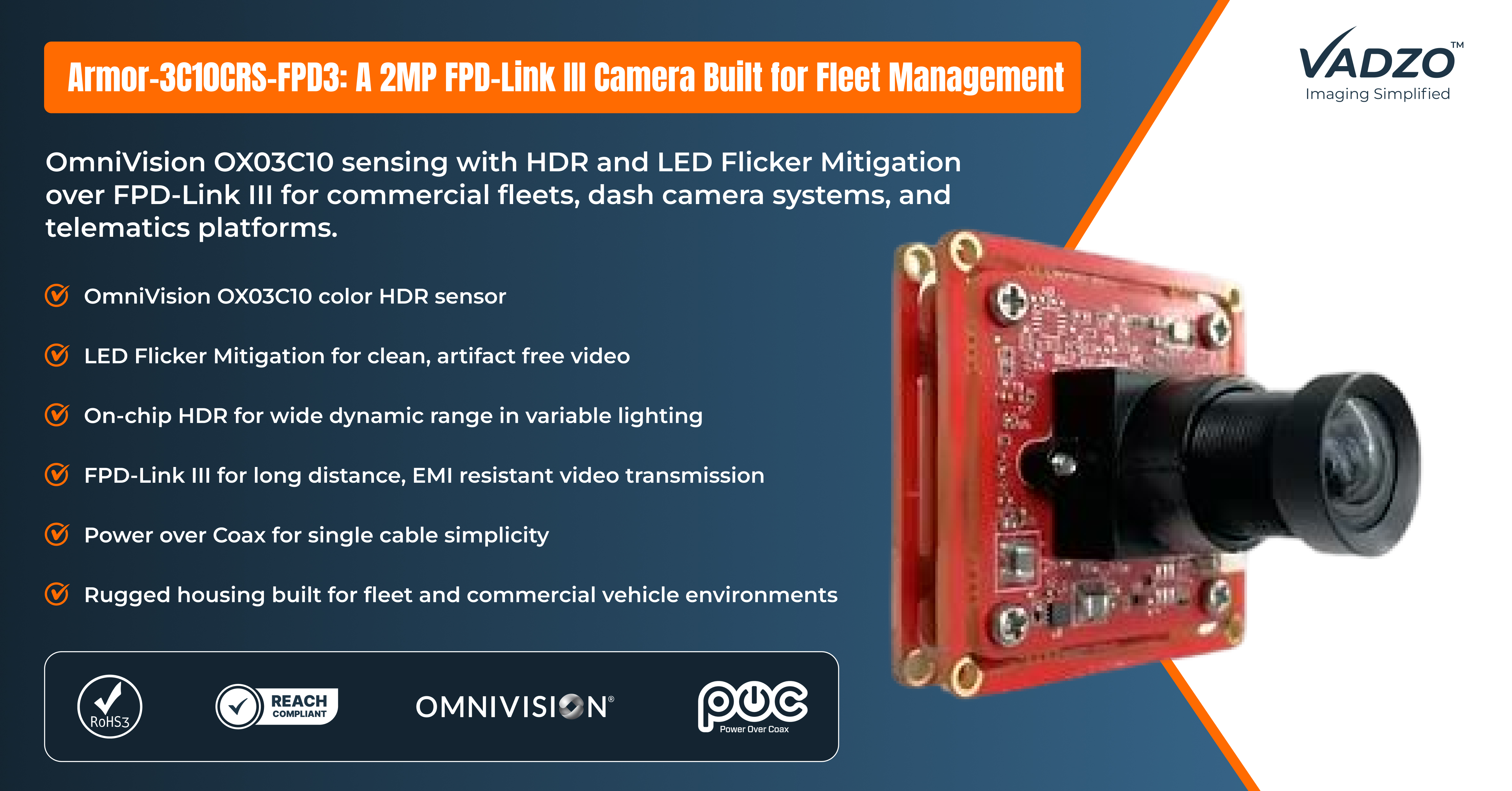
The Armor-3C10CRS-FPD3 pairs the OX03C10 FPD-Link III Camera sensor with FPD-Link III connectivity and Power over Coax in a rugged housing suited to commercial vehicle and fleet deployment. As a 2MP HDR FPD-Link Camera, it outputs 1920 × 1080 resolution with HDR and LED Flicker Mitigation active by default. As a 2MP FPD-Link III Camera, the Armor-3C10CRS-FPD3 combines sensor performance with rugged connectivity for demanding fleet deployments, giving fleet operators a single camera platform that covers forward-facing, cargo, and driver-facing monitoring from the same hardware family.
At the core of the module sits the 2MP OX03C10 Camera sensor, chosen specifically for the combination of dynamic range and flicker handling that vehicle-mounted camera products require. Because the camera pairs OX03C10 Power over Coax Camera delivery with HDR and LFM processing, the 2MP OX03C10 FPD-Link Sensor configuration reaches usable image quality in conditions ranging from bright midday driving to nighttime roadways lit primarily by LED signals and headlights.
Key Capabilities
OmniVision OX03C10 Sensor for Detailed 2MP HDR Capture: The Armor-3C10CRS-FPD3 is built around the OmniVision OX03C10 sensor, a device engineered specifically for automotive and fleet conditions rather than adapted from a consumer or security application. This gives the module genuine 2MP HDR Coax Camera performance suited to the wide range of lighting a commercial vehicle actually encounters over a full route and a full day. As an HDR LFM FPD-Link Camera, it specifically targets fleet deployments where both dynamic range and flicker handling matter equally.
LED Flicker Mitigation for Clean, Artifact-Free Video: Standard camera sensors can miss or distort pulsed LED light sources, which is a real problem when that light source is a traffic signal, a brake light, or a warning indicator. As a 2MP LFM Camera, the Armor-3C10CRS-FPD3 detects and correctly exposes those pulsed sources rather than letting them flicker between frames, and as a 2MP LFM HDR Camera, it combines that flicker handling with wide dynamic range so neither capability comes at the expense of the other.
HDR for Wide Dynamic Range in Variable Lighting: Fleet vehicles move between bright open road, shaded underpasses, and oncoming headlight glare often within the same few seconds. A Flicker-Free HDR Camera built on this sensor holds detail across that full range in a single exposure rather than blending multiple frames after capture, which avoids the ghosting that a moving vehicle or oncoming traffic would introduce into a blended HDR frame.
FPD-Link III for Long Distance, EMI Resistant Video Transmission: A camera mounted on a truck cab, trailer, or bus roof often sits well beyond the reach of a standard USB or Ethernet cable, and vehicle electrical systems introduce exactly the kind of electrical noise those interfaces were never designed to tolerate. An HDR FPD-Link III Camera solves both problems at once, carrying HDR video reliably over a single coaxial cable engineered for automotive and industrial electrical environments.
Power over Coax for Single Cable Simplicity: Running separate cables for video and power across a vehicle's chassis multiplies the wiring complexity and the number of connection points that can fail under constant vibration. Power over Coax consolidates both onto the same coaxial cable, giving fleet vehicle integrators a single connection to route from each camera position back to the vehicle's central recording or telematics unit.
Rugged Design for Fleet and Commercial Vehicle Environments: Commercial vehicles operate in conditions a typical security camera was never built for, including constant vibration, temperature extremes, and electrical noise from the vehicle's own systems. The Armor-3C10CRS-FPD3's rugged housing and FPD-Link III connectivity are built specifically for that environment, and Vadzo Imaging supports full customization on this platform as an FPD-Link III LFM Module, including connector changes, housing design, and firmware adjustments for fleet-specific volume programs.
"Fleet safety teams do not get a second chance to capture a brake light or a traffic signal correctly after the fact. The OX03C10's LED Flicker Mitigation combined with on-chip HDR gives the Armor-3C10CRS-FPD3 a complete, artifact-free record of exactly what a signal looked like in the moment, over a single coax cable that survives life on a truck or trailer. We built this camera for fleets where the footage has to hold up in an insurance claim, not just look good on a demo screen." - Alwin Vincent, Product Manager at Vadzo Imaging.
Application-Specific Sections
Commercial Fleet Safety and Monitoring: Fleet safety programs depend on video that holds up under scrutiny, whether reviewing a near miss, an incident, or a driver coaching moment. As a fleet safety camera, the Armor-3C10CRS-FPD3 captures traffic signals and brake lights without the flicker a standard sensor introduces, and functioning as a fleet vision camera, it extends that same reliability to general route and cargo monitoring. As a Commercial Fleet Camera, it fits directly into standard fleet safety programs across vehicle types.
Fleet Dash Camera Systems: Dash camera systems need to capture the roadway ahead clearly regardless of whether the vehicle is driving into direct sun, through a shaded underpass, or toward oncoming headlights at night. A Fleet Dash Camera FPD-Link built on this sensor holds detail across that full range in a single exposure, and its FPD-Link III connectivity reaches a windshield- or grille-mounted position from the vehicle's central recording unit without a fragile USB extension.
Fleet Asset Tracking and Cargo Monitoring: Cargo and trailer monitoring depends on a camera that survives mounting positions far from the cab, with cable runs that a standard interface was never designed to reach. As a Fleet Asset Tracking Camera, the Armor-3C10CRS-FPD3's coax connectivity reaches those distant mounting points reliably, supporting both security monitoring and load verification tasks from the same camera.
Truck and Bus Fleet Video Systems: Trucks and buses operating multi-camera video systems need every camera position, from the windshield to the rear door, to deliver consistent image quality regardless of mounting distance from the recording unit. A Truck Fleet Camera Module platform like this one gives fleet operators that consistency, and as a Vehicle Fleet Vision Camera, it extends that same dependability to bus and transit deployments alongside standard trucking fleets.
OEM Integration for Fleet Telematics Platforms: Telematics providers building their own fleet camera systems need a vendor who understands the connectivity and durability requirements those platforms demand from day one. As a Fleet Monitoring System Camera, the Armor-3C10CRS-FPD3 integrates directly into existing telematics hardware, and Vadzo Imaging supports OEM customization for cable length, connector type, and firmware for system builders standardizing on one camera across multiple fleet programs.
Conclusion
Across fleet safety, dash camera, and cargo monitoring deployments, the common requirement is the same: video that correctly captures LED lighting and holds detail across difficult lighting, delivered over a single cable that survives life on a commercial vehicle. The Armor-3C10CRS-FPD3 answers that requirement, built around OmniVision OX03C10 imaging, on-chip HDR, and LED Flicker Mitigation delivered over FPD-Link III with Power over Coax, giving fleet operators and OEM telematics partners a single platform to standardize on across an entire vehicle fleet. As an LFM Camera Manufacturer, Vadzo Imaging supports that standardization from initial evaluation through full fleet deployment.
Frequently Asked Questions
Q: Why do LED traffic lights and brake lights sometimes appear to flicker or disappear in vehicle camera footage?
A: Many LED light sources, including traffic signals, brake lights, and turn indicators, are actually pulsed on and off many times per second rather than staying continuously lit, which the human eye cannot detect but a camera sensor can. If a camera captures its frame during one of those brief off pulses, that light source can appear dim, partially lit, or missing entirely in the recorded footage, even though it was fully lit the moment before and after. Vadzo Imaging builds LED flicker handling directly into its fleet camera products specifically to detect and correctly expose these pulsed sources, so a signal that was genuinely lit does not disappear from the record simply because of unlucky frame timing.
Q: Why does a fleet camera need both HDR and LED flicker mitigation rather than just one or the other?
A: Wide dynamic range and flicker handling solve two different problems that both show up in the same driving footage. HDR manages the difference between bright and dark areas within a single frame, such as a sunlit road next to a shaded underpass, while flicker mitigation manages light sources that pulse on and off over time, such as an LED traffic signal. A camera with only one capability can still fail in the other scenario, so Vadzo Imaging builds fleet camera products with both working together, giving fleet operators footage that holds up regardless of which of these two common driving conditions the vehicle happens to be in at the time.
Q: Why do commercial fleet vehicles often use a coax-connected camera instead of a standard USB camera?
A: A standard USB cable was designed for short desktop distances and is not built to tolerate the vibration, temperature swings, and electrical noise found on a moving commercial vehicle, nor does it reliably reach a camera mounted far from the recording unit, such as on a trailer or a bus roof. A coax-connected camera using a link like FPD-Link III carries video, control signals, and power over a single cable engineered for exactly those automotive conditions. Vadzo Imaging designs its fleet camera products around this connectivity so integrators are not forced to work around the distance and durability limits of a connector never intended for vehicle use.
Q: Can Vadzo Imaging customize a fleet camera module for a specific vehicle or telematics platform?
A: Yes. Vadzo Imaging supports full OEM customization across its fleet camera portfolio, including housing design suited to a specific mounting position, connector and cable length changes, and firmware adjustments tuned for a particular telematics or recording platform. Evaluation units ship with no minimum order requirement, and the same engineering team that built the standard product works directly with fleet operators and telematics OEM customers to adapt the module for a specific vehicle type or fleet program headed into volume production.
Q: How does Vadzo Imaging help fleet operators deploy camera products consistently across a large vehicle fleet?
A: Standardizing on one camera platform across every vehicle in a fleet means a maintenance or safety team only has to understand one set of behaviors, cables, and configuration options rather than reconciling several different camera generations at once. Vadzo Imaging supports that consistency by keeping the same core hardware and software platform available across a long product lifecycle, backed by direct engineering support during evaluation and rollout. That approach lets a fleet operator scale a deployment from a single pilot vehicle to hundreds of units without changing the underlying camera platform partway through.
Availability
The Armor-3C10CRS-FPD3 2MP FPD-Link III Camera, a Fleet Management Camera built for commercial vehicle deployment, is available now for evaluation and OEM integration. Evaluation kits include the camera module, an FPD-Link III deserializer reference board, mounting hardware, and integration documentation covering HDR configuration, LED Flicker Mitigation setup, and Vispa ARC SDK installation, with no minimum order requirement. Contact Vadzo Imaging at [email protected] to request an evaluation unit or discuss volume production and OEM customization.
About Vadzo Imaging
Vadzo Imaging develops embedded and machine vision camera products for OEMs, system integrators, and fleet telematics partners building production-ready vision systems across commercial vehicles, robotics, industrial automation, and edge AI. The company's portfolio spans MIPI CSI-2, USB, GigE, Wi-Fi, FPD-Link III, and SerDes interface camera products, supporting deployment architectures from compact onboard modules to distributed networked and coax-connected installations. Vadzo provides end-to-end imaging support, including sensor integration, ISP tuning, firmware development, and SDK frameworks to accelerate system deployment. Visit Vadzo Imaging to explore the full embedded vision camera portfolio.
Media Contact
Alwin Vincent
Vadzo Imaging
Email: [email protected]
LinkedIn: Vadzo Imaging
YouTube: Vadzo Imaging
X: Vadzo Imaging
SOURCE: Vadzo Imaging