




Wednesday, 19 August 2026 02:00 PM
Product Announcements
Built for autonomous mobile robots and automated guided vehicles that operate across large facility footprints, this rugged camera pairs the Onsemi AR1335 sensor with VCM autofocus and FPD-Link III connectivity, giving robotics integrators long-distance video transmission, single-cable power delivery, and dependable 13MP image quality in environments where a standard USB or Ethernet cable would not survive or reach.
SAN JOSE, CA / ACCESS Newswire / August 19, 2026 / Vadzo Imaging, a provider of embedded vision solutions, today launched the Armor-1335CRA-FPD3, a 13MP Autofocus FPD-Link III Camera built around the Onsemi AR1335 sensor for automated guided vehicles, autonomous mobile robots, and industrial robotics platforms that need long cable runs, rugged connectivity, and dependable image quality far from the nearest USB or Ethernet port.
Why AGVs and Robotics Platforms Need a 13MP Autofocus FPD-Link III Camera Built for Distance and Durability
Automated guided vehicles and autonomous mobile robots present a cabling problem that a fixed security camera or a desktop machine vision setup never has to solve. A camera mounted on a moving chassis, a robotic arm, or a tall gantry structure often sits several meters from the nearest compute module, and standard interfaces were never designed for that distance. USB 3.0 loses reliable signal integrity past roughly five meters without active extension hardware, and even Gigabit Ethernet, while more capable, adds a connector and cable bulk that a compact robotics platform may not have room for.
A Single Coax Cable Camera approaches the distance problem differently. Rather than running separate cables for data and power or adding a repeater to extend a standard interface beyond its native range, FPD-Link III carries video, control signals, and power over a single coaxial cable that tolerates the vibration, flexing, and electrical noise common on a moving robotics platform. That combination of reach and durability is exactly what a Long-Distance Coax Camera needs to deliver reliably on a factory floor rather than in a controlled lab environment.
Engineering Explanation: Distance, Durability, and Resolution Together
Onsemi designed the AR1335 as a 13-megapixel sensor capable of both full-resolution still capture and cropped 4K video output, giving robotics integrators flexibility to choose the resolution that fits a given navigation or inspection task. As an Onsemi AR1335 FPD-Link Camera, the sensor pairs that resolution flexibility with VCM autofocus, which matters directly for robotics platforms that may need to resolve a barcode, a pallet label, or a navigation marker at a distance that changes as the robot moves through a facility.
FPD-Link III is the connectivity technology that makes the rest of this practical at robotics scale. Developed for automotive and industrial applications that need to move video reliably over long cable runs, FPD-Link III serializes video, bidirectional control data, and power delivery onto a single coaxial or shielded twisted pair cable. As an AR1335 FPD-Link Sensor, the camera benefits from that serialized link's resistance to the electrical noise generated by motor controllers, variable frequency drives, and other equipment common on a factory floor, which is exactly the environment where a standard USB or Ethernet connection tends to degrade first.
Power delivery over that same coaxial cable removes a second cabling requirement entirely. Rather than running a separate power cable alongside the video cable, a Power over Coax Camera Module draws power directly from the same coax line that carries video and control data, which simplifies both the initial wiring and any future maintenance on a mobile platform where every additional cable is one more point that can catch, fray, or fail under repeated motion. A 4K Power over Coax Camera configuration of this design gives integrators a genuinely single-cable solution rather than a data cable paired with a separate power tether.
Product Overview
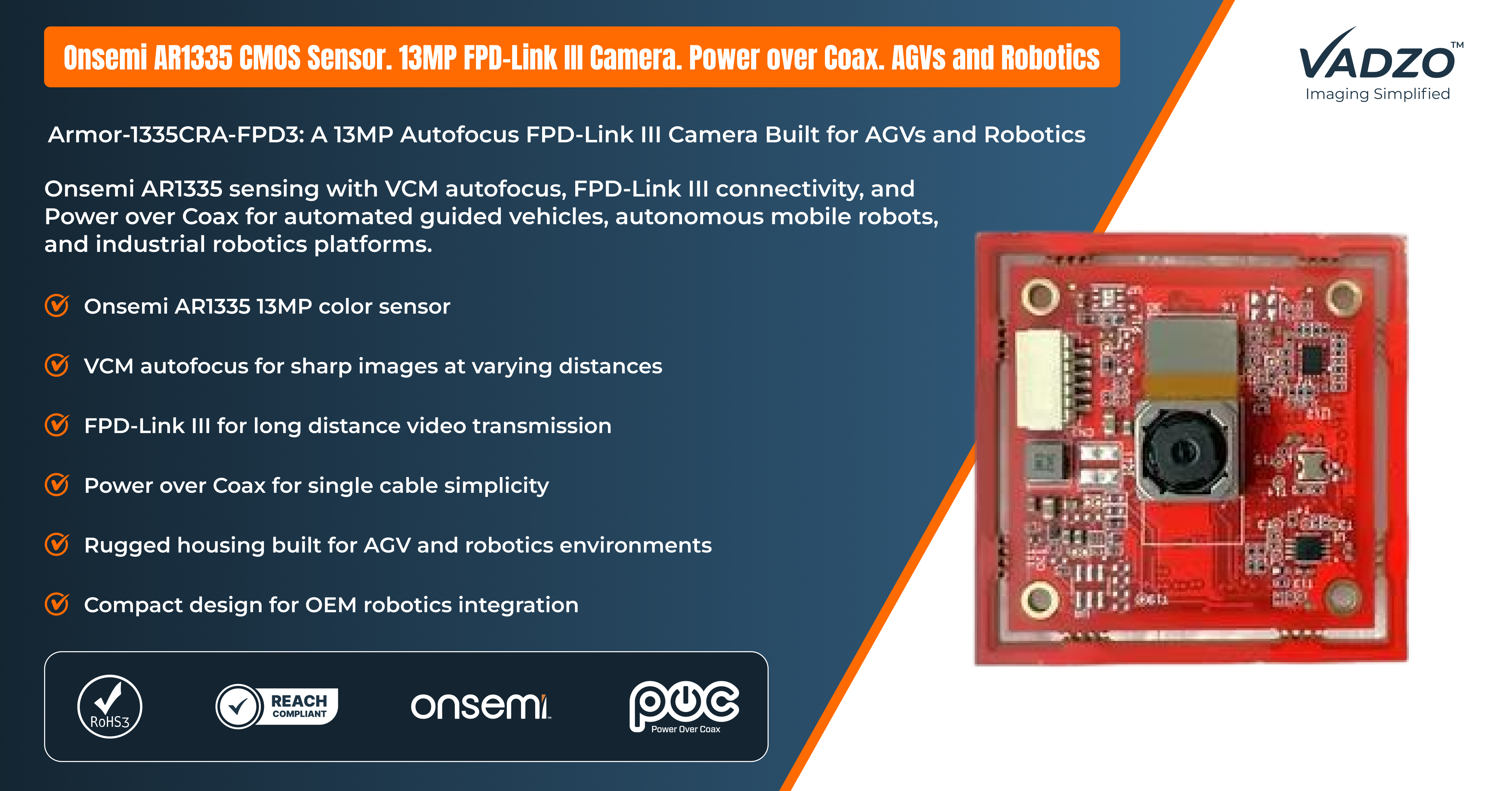
The Armor-1335CRA-FPD3 pairs the AR1335 FPD-Link III Camera sensor with FPD-Link III connectivity, Power over Coax, and a VCM autofocus lens assembly in a rugged housing suited to AGV, AMR, and industrial robotics deployment. As a 13MP Autofocus FPD-Link III Camera, it outputs full 13-megapixel still resolution or cropped 4K video depending on the task, giving robotics integrators a single camera platform that covers navigation, inspection, and general-purpose robotics vision from one module.
At the core of the module sits the 13MP VCM Autofocus FPD-Link Camera sensor, chosen specifically for the resolution and focus flexibility that robotics platforms operating at varying distances require. Because the camera combines 4K FPD-Link III Camera video output with 13MP Coax Camera still capture on the same hardware, the Armor-1335CRA-FPD3 reaches usable image quality whether a robot is reading a label a few centimeters away or navigating a wide aisle several meters across, all delivered over the same single coaxial connection back to the host system.
Key Capabilities
Onsemi AR1335 Sensor for Detailed 13MP / 4K Capture: The Armor-1335CRA-FPD3 is built around the Onsemi AR1335 sensor, a 13 megapixel device capable of full-resolution still capture as well as cropped 4K video output from the same hardware. This dual capability matters for robotics platforms that need high-resolution stills for tasks like label or barcode reading, alongside lower-latency 4K video for real-time navigation, all without switching camera hardware between those two tasks. As a 4K Autofocus FPD-Link Camera, it specifically addresses the real-time navigation half of that dual capability, with autofocus keeping the image sharp as working distance changes. As a 13MP FPD-Link Sensor Module, it gives integrators the flexibility to configure output resolution and frame rate to match a specific robotics workload rather than accepting a single fixed configuration.
VCM Autofocus for Sharp Images Across Varying Distances: A mobile robot's working distance to whatever it is inspecting or reading changes constantly as it moves through a facility, which makes a fixed focus lens a real limitation. The included VCM autofocus lens assembly adjusts electronically as that distance changes, keeping labels, markers, and navigation targets in sharp focus whether the robot is a few centimeters from a shelf or several meters into an open aisle. This removes the need for a technician to tune focus for a single fixed working distance that may not match how the robot actually operates across a full shift.
FPD-Link III for Long Distance, EMI Resistant Video Transmission: Standard USB and Ethernet interfaces were designed around desktop and fixed installation distances, not the combination of length, vibration, and electrical noise found on a moving robotics platform. As a FPD-Link III Camera Kit, the Armor-1335CRA-FPD3 uses a serialized link specifically engineered for automotive and industrial environments, carrying video and control data reliably over distances and through electrical noise conditions that would degrade a standard consumer interface. This makes it a genuine FPD-Link III Camera Supplier solution for robotics integrators who have already run into the reach and reliability limits of USB or Ethernet on a mobile platform.
Power over Coax for Single Cable Simplicity: Running separate cables for video, control, and power across a moving robotic chassis multiplies the number of connection points that can loosen, fray, or fail under repeated motion. Power over Coax consolidates all three onto the same coaxial cable, so a single connection handles the complete link between the camera and the host system. As an AR1335 Power over Coax Camera, the Armor-1335CRA-FPD3 demonstrates that consolidation directly, and for OEM customers designing a robotics platform from scratch, that single cable design meaningfully simplifies both the initial wiring harness and any future serviceability, since there is only one cable to route, protect, and eventually service rather than several.
Rugged Design for AGV and Robotics Environments: Factory floors and warehouse environments expose equipment to vibration, temperature swings, and electrical noise from nearby motors and drives that a camera designed for an office or retail environment was never built to handle. As a Rugged AGV Camera Module, the Armor-1335CRA-FPD3 is built specifically for that operating environment, and functioning as a Coax Robotics Camera, it pairs that ruggedness with the single-cable connectivity robotics platforms depend on.
Compact OEM-Ready Design for Volume Integration: The module's compact footprint gives OEM customers flexibility to integrate the Armor-1335CRA-FPD3 into an AGV chassis, a robotic arm, or a fixed gantry structure without a major mechanical redesign. Vadzo Imaging supports full customization on this platform as an OEM FPD-Link Camera Module, including connector changes, housing design, and firmware adjustments for volume robotics production programs.
"Robotics integrators keep telling us the same thing: a camera that cannot survive the vibration and electrical noise on a real factory floor, or that cannot reach far enough back to the compute module, is not actually a usable option no matter how good its image quality looks on a bench. The AR1335's autofocus combined with FPD-Link III and Power over Coax gives the Armor-1335CRA-FPD3 real reach and durability alongside genuine image quality, on a single cable that survives the environment it is actually deployed in. We built this camera for platforms that operate on a warehouse floor, not a lab bench." - Alwin Vincent, Product Manager at Vadzo Imaging.
Application-Specific Sections
Autonomous Mobile Robot Navigation: AMR platforms navigating dynamic warehouse and facility environments need vision that resolves both wide aisles and close-range obstacles without a fixed focus limitation. As an AMR Navigation Camera, the Armor-1335CRA-FPD3's autofocus keeps navigation markers and obstacles in focus across a full range of distances, and functioning as an Autonomous Robot Camera, it delivers that image quality over a single coaxial cable that tolerates the vibration typical of a mobile chassis.
Automated Guided Vehicles in Manufacturing: AGV platforms moving materials across a manufacturing floor operate continuously in an environment full of motor noise, metal structures, and long distances between the camera and the vehicle's compute module. As a FPD-Link AGV Camera, this camera reaches that compute module reliably over a single coax cable, and an AGV Vision Camera configuration of the same module supports both navigation and part or label identification tasks on the same vehicle.
Industrial Robotics Vision: Fixed robotic arms and robotic inspection stations benefit from a camera that can be mounted at a distance from its controller without a dedicated cable run for power alongside the video cable. An Industrial Robotics Vision Camera built on this platform simplifies that wiring, and functioning as a Robotics FPD-Link Camera, it also provides the resolution flexibility to switch between wide-field navigation and close-range inspection tasks on the same robotic arm.
Warehouse and Logistics Automation: Warehouse automation systems spanning large facility footprints need camera products that can be positioned wherever a navigation or inspection task requires, regardless of distance back to a central compute rack. A FPD-Link Robotics Sensor platform like this one supports that flexible placement, and its single-cable Power over Coax design reduces the wiring complexity of a facility-wide robotics deployment covering many vehicles and fixed stations at once.
OEM Integration for Robotics Platforms: System builders developing their own AGV or AMR platforms need a camera vendor who understands the durability and connectivity requirements those platforms demand, not just a general-purpose module adapted after the fact. The Armor-1335CRA-FPD3 ships from a FPD-Link Camera Manufacturer with robotics-specific engineering built in from the start, and Vadzo Imaging supports OEM customization for cable length, connector type, and lens selection so system builders can integrate one module into multiple robotics platforms.
Conclusion
Across AMR navigation, AGV material handling, and fixed robotics inspection, the common requirement is the same: a camera that reaches the distance a robotics platform actually needs, survives the vibration and electrical noise of a real facility, and does all of that over a single cable rather than a bundle of separate power and data runs. The Armor-1335CRA-FPD3 answers that requirement, built around Onsemi AR1335 imaging, VCM autofocus, and Power over Coax connectivity delivered over FPD-Link III, giving OEM customers and robotics integrators a single platform to standardize on across an entire fleet of vehicles or fixed stations.
Frequently Asked Questions
Q: Why do robotics and AGV camera products often use a coax cable instead of a standard USB or Ethernet cable?
A: Standard USB and Ethernet cables were designed around fixed desktop or office installation distances, and both lose reliability once a cable run gets long enough or is exposed to the vibration and electrical noise common on a moving robotics platform. A coaxial cable built around a serialized link like FPD-Link III carries video, control signals, and power over much longer distances while resisting the electrical noise generated by nearby motors and drives, which is exactly the environment a robotics camera actually operates in rather than a quiet office. Vadzo Imaging selects this connectivity specifically for camera products intended for AGV, AMR, and industrial robotics deployment, since a camera that only works reliably in a clean lab environment is not a realistic option for a real production floor.
Q: What is Power over Coax, and why does it simplify a robotics camera installation?
A: Power over Coax delivers electrical power to a camera over the same coaxial cable that already carries video and control data, rather than requiring a separate power cable run alongside it. For a robotics platform, that means one cable handles the complete connection between the camera and the host system, which reduces the number of connection points that can loosen, fray, or fail under the repeated motion and vibration a mobile robot experiences. Vadzo Imaging builds this capability into its coax-connected camera products because simplifying the cabling on a moving platform is not just a convenience; it is a real reliability improvement over running separate power and data cables across the same moving joints and structures.
Q: Why does cable length matter more for AGV and robotics camera products than for a typical fixed security camera?
A: A fixed security camera is usually mounted close to its recording or processing hardware, so cable length is rarely a serious constraint. A robotics platform is different, since the camera may sit on a robotic arm, a tall gantry, or a moving chassis that is genuinely several meters away from the nearest compute module, and that distance does not change just because a standard interface was not designed for it. Vadzo Imaging designs its robotics camera products around interfaces built for exactly that kind of distance, so integrators are not forced to add signal repeaters or redesign a robotics platform's layout around the limitations of a camera's cable.
Q: Can Vadzo Imaging customize a rugged robotics camera module for a specific AGV or AMR platform?
A: Yes. Vadzo Imaging supports full OEM customization across its robotics camera portfolio, including housing design rated for a specific vibration or environmental profile, connector and cable length changes, lens and focus configuration, and firmware adjustments for a particular navigation or inspection workflow. Evaluation units ship with no minimum order requirement, and the same engineering team that built the standard product works directly with robotics OEM customers to adapt the module for a specific AGV, AMR, or fixed robotics platform headed into volume production.
Q: What makes Vadzo Imaging a dependable supplier for FPD-Link III camera products used in demanding robotics environments?
A: Vadzo Imaging builds its FPD-Link III camera products around connectivity and sensor choices made specifically for industrial and robotics demands, rather than adapting a camera originally designed for a security or consumer application. That focus matters most once a robotics platform moves from a single evaluation unit into a full production fleet, where a connector, cable, or firmware detail that works fine on the bench needs to perform identically across every vehicle in the field. Vadzo Imaging's engineering team stays involved from initial evaluation through volume production specifically to make sure that consistency holds as a robotics deployment scales.
Availability
The Armor-1335CRA-FPD3 13MP Autofocus FPD-Link III Camera is available now for evaluation and OEM integration. Evaluation kits include the camera module, an FPD-Link III deserializer reference board, mounting hardware, and integration documentation covering autofocus configuration, Power over Coax setup, and Vispa ARC SDK installation, with no minimum order requirement. Contact Vadzo Imaging at [email protected] to request an evaluation unit or discuss volume production and OEM customization.
About Vadzo Imaging
Vadzo Imaging develops embedded and machine vision camera products for OEMs, system integrators, and robotics platform developers building production-ready vision systems across AGVs, AMRs, industrial automation, and edge AI. The company's portfolio spans MIPI CSI-2, USB, GigE, Wi-Fi, FPD-Link III, and SerDes interface camera products, supporting deployment architectures from compact onboard modules to distributed networked and coax-connected installations. Vadzo provides end-to-end imaging support including sensor integration, ISP tuning, firmware development, and SDK frameworks to accelerate system deployment. Visit Vadzo Imaging to explore the full embedded vision camera portfolio.
Media Contact
Alwin Vincent
Vadzo Imaging
Email: [email protected]
LinkedIn: Vadzo Imaging
YouTube: Vadzo Imaging
X: Vadzo Imaging
SOURCE: Vadzo Imaging