




Friday, 07 August 2026 01:00 PM
Product Announcements
The Falcon-1335CRA is a 13MP autofocus USB camera module built around the Onsemi AR1335 sensor. It is designed for smart medical imaging, telemedicine, AI diagnostic imaging, and embedded vision platforms that require sharp focus across changing working distances without operator intervention.
BOSTON, MA / ACCESS Newswire / August 7, 2026 / Vadzo Imaging makes embedded vision camera products for OEMs and system integrators. Today the company introduced Falcon-1335CRA. This is a 13MP USB Camera built on the Onsemi AR1335 sensor with a factory-calibrated continuous autofocus lens module. The new camera module is designed for smart medical imaging, telemedicine, and AI diagnostic imaging deployments where the distance between the camera and the subject changes from one exam to the next.
The Fixed Focus Limitation in Smart Medical and AI Imaging Deployments
Fixed focus camera products assume a constant subject distance from the lens to the target. In laboratory and industrial settings, that assumption often holds true. In smart medical imaging and telemedicine consultation environments, it rarely does. Patients sit at different distances during each visit. Wound care technicians move a device closer or farther depending on the area being examined. Diagnostic carts get repositioned between rooms. A 13MP Autofocus USB Camera removes this constraint by continuously adjusting its lens position, so the subject stays sharp regardless of how the working distance changes.
This distance variability creates a downstream problem for artificial intelligence systems that rely on camera data. An Autofocus USB Camera captures a properly focused frame every time, which matters because a soft or blurred capture degrades the feature detail that a machine learning model depends on for accurate classification. Whether marketed as an AR1335 Smart Camera or a Smart Autofocus Camera, the underlying engineering goal stays the same. Solve the focus problem at the optical level rather than asking software to compensate after capture. That distinction matters for OEMs building diagnostic devices where a misclassified frame is not just an inconvenience but a clinical risk.
Sensor Architecture and Autofocus Engineering Behind the AR1335 Platform
The Falcon-1335CRA is built around the Onsemi AR1335 image sensor, a 1/3.2 inch Back-Side Illuminated CMOS device with a 1.1-micron pixel pitch that produces full 13MP resolution at 4208 by 3120 pixels. This qualifies it as an AR1335 Autofocus Camera at the sensor level. Pairing that sensor with an AR1335 AI Camera-grade continuous autofocus lens module closes the engineering gap between raw resolution and usable focus across variable working distances.
The Back-side Illuminated architecture places the wiring layer behind the photodiode layer rather than in front of it. More incoming light reaches each pixel, which improves sensitivity and reduces noise relative to a front-illuminated sensor of the same pixel size. That benefit compounds inside an Onsemi AR1335 AI Camera pipeline where clean high-resolution frames feed directly into inference models without an extra denoising step consuming processing time on the host platform.
An AR1335 4K Autofocus Camera configuration downsamples the native 13MP frame to 4K, 1080p, 720p, or VGA output on demand through the same sensor pipeline. This lets a single hardware platform serve high-detail capture and lightweight streaming without swapping camera modules.
Continuous autofocus is handled by a voice coil motor lens actuator that moves the optical assembly along its axis in response to a focus algorithm running on the module. The actuator can be commanded through standard UVC extension controls, giving host software the ability to trigger an autofocus scan, lock focus at a fixed position, or hand focus control back to the camera automatically as the scene changes. This makes the module an Intelligent Autofocus Camera in practice rather than only in name because the focus decision happens on the device without requiring the host processor to run a separate focus routine.
The AR1335 sensor uses a rolling shutter readout, which is well suited to slow-moving or static subjects such as a patient held in position during an exam or a sample placed under a diagnostic imaging station. The module is rated across an operating range of negative 30 degrees Celsius to 70 degrees Celsius, which lets Vadzo deploy the same Onsemi AR1335 AI Camera design in mobile diagnostic carts and in fixed clinical installations without a separate thermal qualification cycle.
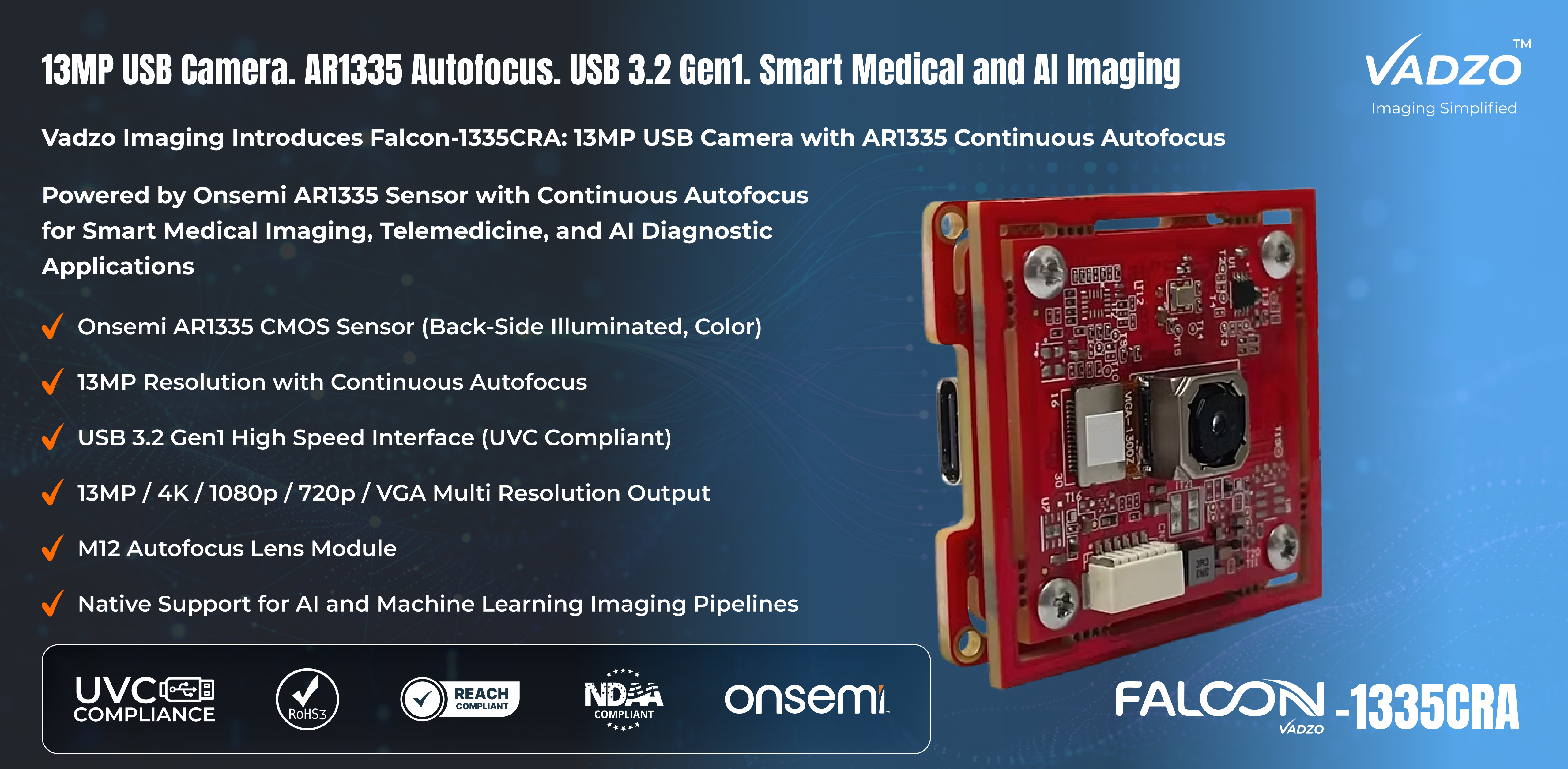
Introducing the Falcon-1335CRA Autofocus Camera Platform
The Falcon-1335CRA is Vadzo Imaging's newest addition to its Falcon USB camera series and its first entry purpose-built around smart medical and AI imaging use cases. As a 13MP USB Camera, the module combines the Onsemi AR1335 sensor with a factory-calibrated continuous autofocus lens in a compact M12 module footprint. The result is a camera module that OEMs can integrate into a diagnostic cart, a wearable imaging device, or a fixed inspection station without redesigning the optical path for every deployment distance.
System integrators building an AI-powered USB Camera deployment need more than raw pixels. They need a stream that stays sharp as conditions change. The Falcon-1335CRA functions as a Smart Imaging USB Camera because the autofocus lens and the sensor pipeline work together automatically without requiring manual calibration in the field. Every unit ships as an AI-enhanced autofocus camera ready for immediate integration into existing UVC-compatible software stacks.
Continuous Autofocus for Variable Working Distances
Medical imaging and AI diagnostic deployments rarely happen at a single fixed distance. A 13MP AI Camera with a fixed lens forces the operator to reposition the patient or the camera every time the working distance changes, which slows exams and introduces operator-dependent variability. The Falcon-1335CRA solves this with a continuous autofocus lens module that tracks focus automatically. Framed as a 13MP Smart Camera, the module adjusts lens position within a fraction of a second whenever the scene changes, keeping every captured frame sharp without operator intervention.
13MP BSI Sensor Resolution for AI Feature Extraction
AI models trained for medical image classification perform better when given more pixel detail per feature. The AR1335 Medical Camera configuration of the Falcon-1335CRA delivers full 13MP capture at 4208 by 3120 pixels so fine details such as skin texture, small lesions, or instrument tips remain resolvable even after cropping to a region of interest. As a 13MP Medical USB Camera, it gives diagnostic software more raw data to work with before any digital zoom or cropping reduces the effective resolution reaching the model.
Real-Time Dynamic ROI Streaming
Full-frame 13MP capture is not always the right output for every stage of an AI pipeline. When the region of interest is a lesion, an instrument tip, or a single tracked feature, streaming the entire frame wastes bandwidth and adds latency the diagnostic software doesn't need. The Falcon-1335CRA 13MP Autofocus USB camera addresses this with Real-Time Dynamic ROI streaming, where the AR1335 sensor windows and reads out only the active region of interest at the pixel level rather than capturing a full frame and cropping it downstream. Because the windowing happens on the sensor itself, the reduced-ROI stream carries the same per-pixel detail and framerate headroom as a native capture at that resolution, not a downscaled or re-encoded crop of a larger image. As the ROI moves or resizes in response to the scene, the sensor readout window updates in real time, so a 13MP AI Camera can output a tightly framed, high-detail stream of exactly the feature the diagnostic model needs.
Dynamic ROI-Based Autofocus and Auto Exposure
Autofocus and auto exposure systems that evaluate the full frame will happily focus and expose for the background instead of the feature that matters, a common failure mode when a lesion, a marker, or a small instrument occupies a small fraction of the sensor. The Falcon-1335CRA 13MP Autofocus USB camera ties its continuous autofocus and auto exposure control loops directly to the active Dynamic ROI, so both systems evaluate and optimize against the windowed sensor region rather than the full 13MP frame. As the ROI shifts to track a new area of interest, focus and exposure recalculate against that region specifically, keeping the target sharp and correctly exposed even when it occupies a small part of the field of view. For OEMs building diagnostic or inspection tools where the subject is small relative to the frame, this keeps the AR1335 Medical Camera pipeline locked onto the clinically relevant feature instead of the surrounding scene.
Multi Resolution Output for AI Inference Pipelines
Not every stage of an AI pipeline needs full resolution. A 4K AI Imaging Camera mode balances detail against bandwidth for live preview, while a full 13MP capture mode services great detail diagnostic review. The Falcon-1335CRA exposes 13MP, 4K, 1080p, 720p, and VGA output modes from the same sensor pipeline so a single USB 3.2 AI Camera can serve both a lightweight real-time preview stream and a high resolution capture stream without adding a second camera module to the system.
USB 3.2 Gen1 Plug and Play Integration
The Falcon-1335CRA connects to any USB 3.2 Gen1 host port on Windows, Linux, or Android without additional interface boards. Full UVC class compliance means the camera functions as a UVC USB Camera Module the moment it is connected, with no proprietary driver installation required. This shortens development time for OEM teams integrating the module into AI development boards, medical carts, or wearable imaging platforms.
Compact M12 Autofocus Module for OEM Integration
OEM engineering teams need hardware that fits existing enclosures without a redesign cycle. The Falcon-1335CRA ships in a compact module footprint that functions as an OEM AI Camera Module suitable for wearable medical devices, handheld diagnostic tools, and fixed clinical stations. The Falcon-1335CRA ships as a complete Smart AI Camera Kit with lenses, cables, and documentation. This gives integrators everything needed to validate performance before committing to a production design.
Wide Operating Temperature Range for Field Deployment
Diagnostic devices deployed across mobile clinics, rural telemedicine stations, or ambulance bays face temperature swings that lab equipment never sees. The Falcon-1335CRA is rated from negative 30 degrees Celsius to 70 degrees Celsius, so the same module works in a climate-controlled hospital room and in a field of deployment without a separate thermal qualification. This reliability is part of why OEMs across smart medical, telemedicine, and industrial AI markets standardize on a single camera platform rather than qualifying different modules for different environments.
"Autofocus has always been treated as a convenience feature. In smart medical and AI imaging applications, it is closer to a requirement. The Falcon-1335CRA pairs the Onsemi AR1335 sensor with a continuous autofocus lens, so engineering teams building diagnostic carts, telemedicine stations, or wearable imaging devices get a camera module that stays in focus without operator intervention. That reliability lets OEMs spend their engineering time on the AI model and the clinical workflow instead of the optical path." - Alwin Vincent, Product Manager, Vadzo Imaging.
Applications
AI-Assisted Diagnostic Imaging: Computer-aided diagnosis software depends on consistently sharp high-resolution input. An AI Medical Imaging Camera deployment built on the Falcon-1335CRA delivers focused 13MP frames regardless of how far the instrument sits from the patient during a given exam. Functioning as an AI Diagnostic USB Camera, the module feeds classification models with clean data at the source rather than requiring post-capture sharpening that can introduce artifacts into the frame.
Telemedicine and Remote Consultation: Remote consultation platforms need a camera that adapts to whatever room or lighting a patient happens to be in during a call. Deployed as an OEM Telemedicine AI Camera, the Falcon-1335CRA autofocuses automatically as the patient shifts position on screen. Positioned as an AI-Powered Medical USB Camera, the module gives remote clinicians the same sharp framing they would expect from an in-person exam.
Smart Healthcare Kiosks and Patient Monitoring: Self-service healthcare kiosks capture patient images at unpredictable distances depending on user height and positioning. A 13MP Smart Healthcare Camera handles variability with continuous autofocus rather than a fixed working distance. Configured as a Smart Medical Vision Camera, the Falcon-1335CRA supports patient monitoring stations that need reliable focus without a technician present to make manual adjustments.
Endoscopy and Point of Care Diagnostic Devices: Handheld diagnostic tools and point of care devices move constantly during an exam, which makes fixed focus optics impractical. An AI Vision Diagnostic Camera built around the Falcon-1335CRA maintains a focus lock as the device moves closer to or farther from the tissue being examined. The compact M12 module fits directly into handheld enclosures without adding meaningful weight or bulk to the device.
Edge AI Vision and OEM Camera Modules: Beyond clinical settings, OEM teams building general-purpose AI-assisted imaging camera platforms for robotics, quality inspection, or embedded AI benefit from the same autofocus and resolution advantages. The Falcon-1335CRA gives edge AI developers a single camera module that adapts to changing subject distances across a wide range of deployment scenarios.
Frequently Asked Questions
Q: How does continuous autofocus improve the accuracy of AI-powered medical imaging models compared with a fixed focus camera module?
A: Fixed focus optics assume a constant subject distance. In real medical exam settings, patients sit or lie at different distances during each visit, which produces blurred captures that reduce feature clarity for an AI model. A camera with continuous autofocus adjusts its lens position in real time to keep the subject sharp across a wide working distance range. Vadzo Imaging designs its autofocus modules to lock focus quickly, so an AI diagnostic imaging pipeline receives consistently sharp frames without requiring the clinician to reposition the patient or the camera. This directly improves the reliability of downstream classification and detection models used in smart medical imaging systems.
Q: What working distance range can an autofocus USB camera typically maintain sharp focus across during a medical imaging exam?
A: A well-engineered autofocus USB camera can typically hold sharp focus from roughly ten centimeters out to infinity, depending on the lens module used. This range covers close dermatology and wound imaging as well as full-body telemedicine consultation framing from across a room. Vadzo Imaging calibrates every autofocus module at the factory, so integrators receive a camera that is ready to focus across this full range immediately rather than needing manual lens adjustment in the field. That calibration work is part of why OEMs trust Vadzo for smart medical camera deployments.
Q: Why does image resolution matter when feeding camera data into an AI or machine learning model for medical image classification?
A: Machine learning models rely on pixel-level detail to detect subtle features such as skin lesions, tissue texture, or small anatomical structures. A low-resolution frame forces the model to work with fewer pixels per feature, which increases the chance of misclassification at object boundaries. Higher resolution sensors preserve more spatial detail per frame, so the AI model receives richer input data without needing digital upscaling. Vadzo Imaging builds its high-resolution camera products specifically, so AI development teams and medical device engineers can train and deploy more accurate diagnostic models without being limited by the source of imaging hardware.
Q: Does an autofocus camera module require special drivers to run on AI development platforms such as NVIDIA Jetson or a standard Windows or Linux PC?
A: No. Vadzo Imaging designs its autofocus camera products to be fully UVC compliant, which means Windows, Linux, Android, and embedded Linux platforms including NVIDIA Jetson, Raspberry Pi, and NXP i. MX recognize the camera immediately without proprietary drivers.MX recognize the camera immediately without proprietary drivers. Developers can capture frames directly through OpenCV, GStreamer, or any UVC-compatible framework and begin running inference in an AI pipeline the same day the camera arrives. This plug-and-play compatibility is a major reason system integrators choose Vadzo for AI camera module deployments.
Q: How does Vadzo Imaging support OEMs that want to integrate an AI-powered camera module into a smart medical device?
A: Vadzo Imaging works directly with OEM engineering teams from early prototyping through full production. Support includes lens and focus range customization, firmware adjustments, mechanical redesign for enclosure fit, and applications engineering guidance for pairing the camera with specific AI frameworks or diagnostic software. Every evaluation kit ships with sample code and configuration documentation, so an engineering team can validate performance in their own smart medical or AI imaging application before committing to volume production. Vadzo Imaging is proud to serve as a long-term camera module manufacturing partner rather than a one-time component supplier for its OEM customers.
Q: How does Real-Time Dynamic ROI streaming help with smart medical and AI imaging applications?
A: Real-Time Dynamic ROI streaming lets a camera output only the actively relevant portion of the sensor rather than a full frame, which reduces the bandwidth and latency an AI pipeline spends on background pixels that carry no diagnostic value. In a smart medical imaging workflow, this means a lesion, wound site, or instrument tip can be streamed at full pixel density while the surrounding frame is excluded from the data path entirely. Because the windowing happens at the sensor level rather than through a software crop, the ROI stream retains the same per-pixel detail and framerate headroom as a native capture at that resolution. Vadzo Imaging built this capability into the Falcon-1335CRA so AI diagnostic models receive a tightly framed, high-detail stream of exactly the feature they need to classify, without the overhead of processing and discarding irrelevant frame data downstream.
Q: How do Dynamic ROI-based autofocus and auto exposure improve accuracy in smart medical and AI imaging systems?
A: Dynamic ROI-based autofocus and auto exposure tie the camera's focus and exposure control loops to the active region of interest instead of the full sensor frame, so the system optimizes sharpness and brightness for the clinically relevant feature rather than the background. This matters in medical imaging because a lesion, marker, or small instrument often occupies only a fraction of the frame, and a full-frame control loop can easily focus or expose for the surrounding tissue or environment instead. As the region of interest shifts, the Falcon-1335CRA recalculates focus and exposure against that new window in real time, keeping the target sharp and correctly lit even as the subject moves. Vadzo Imaging designed this ROI-linked control approach specifically so AI diagnostic pipelines receive consistently reliable input data on the feature that matters, rather than well-exposed background and a poorly optimized subject.
Availability
The Falcon-1335CRA 13MP USB Camera built on the Onsemi AR1335 sensor is now available for evaluation and production orders. Evaluation kits include the camera module, factory-calibrated autofocus lens, USB 3.2 Gen1 cable, and platform driver documentation with no minimum order requirement. As a trusted Smart Camera Manufacturer, Vadzo Imaging supports OEM customers from early evaluation through volume production. Browse the full Vadzo USB camera portfolio at https://www.vadzoimaging.com/ or contact Vadzo at [email protected] to request an evaluation kit or discuss OEM integration requirements.
About Vadzo Imaging
Vadzo Imaging is a global provider of embedded vision solutions and delivers high-performance camera technologies and imaging platforms for applications in robotics, industrial automation, UAVs, edge AI, and medical systems. Its products are designed for seamless integration with leading embedded platforms. Vadzo supports customers through hardware customization, firmware development, and module-level drivers, enabling faster development and deployment of vision-based systems.
Media Contact
Alwin Vincent
Vadzo Imaging
Email: [email protected]
LinkedIn: Vadzo Imaging
YouTube: Vadzo Imaging
X: Vadzo Imaging
SOURCE: Vadzo Imaging