




Thursday, 21 May 2026 12:00 PM
Company Update
Vadzo Imaging extends its OEM camera engineering services to cover electro-mechanical filter camera design and custom lens holder integration across the Innova-678CRE, Innova-821CRE, Wave-234CGE, and Wave-678CRE camera portfolio, enabling embedded vision engineers and OEM developers to deploy automatic day-night switching and dual-mode imaging in Gigabit Ethernet and Wi-Fi form factors without managing filter mechanics themselves.
FORT WORTH, TX / ACCESS Newswire / May 21, 2026 / Vadzo Imaging, a provider of embedded vision camera products for OEMs and system integrators, announces the availability of dedicated engineering services for electro-mechanical filter camera systems. These services address a recurring requirement from OEM development teams who need automatic IR-cut filter control integrated into production-ready embedded vision hardware without independently sourcing filter actuators, specifying lens holder geometry, or developing filter switching firmware from scratch. The engineering services cover the complete integration scope from filter mechanism selection through lens holder modification, firmware control, and enclosure fitment, and are available across Vadzo's day night gige camera and day night wifi camera platforms in the Innova and Wave product series.
Electro-mechanical IR-cut filter integration is one of the engineering tasks that appears straightforward on a block diagram but creates significant development overhead in practice. The filter assembly must align precisely with the S-Mount lens holder. The actuation current and pulse timing must match the solenoid or motor specification. The switching logic must respond to the ambient light sensor or to host commands without introducing latency or frame corruption. When a team attempts this independently, it typically adds weeks to a hardware bring-up schedule. Vadzo has already solved this integration problem across multiple sensor platforms and now makes that engineering work available as a structured service for OEM customers building products that require
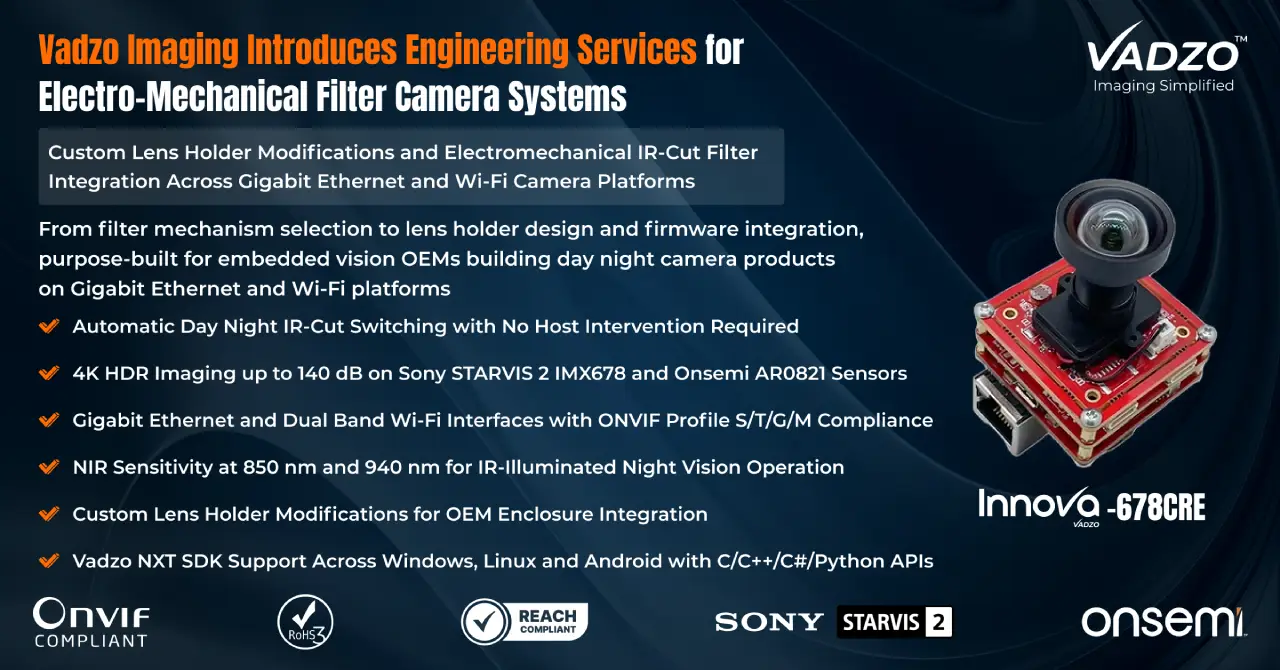
What Vadzo's Electro-Mechanical Filter Camera Engineering Services Cover
Vadzo's OEM camera engineering services for electro-mechanical filter integration are structured around the specific hardware and firmware tasks that OEM teams encounter when adding automatic IR-cut switching to an embedded camera module. These include lens holder design and modification to accommodate the filter actuator assembly within the mechanical envelope of the target product enclosure, and filter mechanism sourcing and specification matched to the sensor format and lens mount geometry. Firmware integration covers actuation control logic, filter state management based on ambient light thresholds, and host-side API support for manual switching override in applications where automatic transition is insufficient.
Custom lens holder modifications are a closely related service available alongside the filter integration work. OEM products often have physical constraints that standard S-Mount holders do not accommodate. Vadzo's engineering team designs and manufactures modified holders to match product enclosures, custom front optics configurations, and application-specific mounting requirements. The combination of filter integration and custom lens holder works in a single engagement, reducing the number of vendor relationships a development team needs to manage and ensuring that filter alignment and lens holder geometry are co-designed rather than optimized independently.
Electro-Mechanical Filter Camera Portfolio: Innova and Wave Series
The engineering services are available across four camera platforms in Vadzo's product portfolio. Each platform covers a different interface and sensor combination, enabling OEM teams to apply the same filter integration approach across Gigabit Ethernet and Wi-Fi architectures and across the Sony STARVIS 2 and Onsemi AR0821 and AR0234 sensor generations.
Innova-678CRE: Sony STARVIS 2 IMX678 4K HDR Gigabit Ethernet Camera with Electro-Mechanical IR-Cut Filter
The Innova-678CRE is Vadzo's 4K HDR Gigabit Ethernet camera platform built on the Sony STARVIS 2 IMX678 camera sensor. The IMX678 is a 1/1.8 inch back-illuminated CMOS sensor with 2.0 µm pixel pitch delivering 8.4MP (3856 × 2180) resolution and enhanced NIR sensitivity. The electromechanical IR cut filter camera mechanism on the Innova-678CRE operates automatically. During daylight, the filter engages in front of the sensor, blocking infrared wavelengths that would otherwise distort color rendering in the BSI pixel array. After dark, the filter withdraws mechanically, opening the full NIR sensitivity of the Sony Starvis2 camera sensor to IR-illuminated scenes at 850 nm and 940 nm. This automated transition requires no host-side software control during switching, making it suitable for unattended outdoor surveillance installations and smart city camera networks where continuous operation across lighting transitions must be unsupervised.
The camera streams over Gigabit Ethernet with ONVIF Profile S/T/G/M compliance and PoE 802.3af single-cable power delivery. GPIO support is available for external trigger and synchronization. Up to 110 dB HDR via Clear HDR and DOL-HDR modes handles high-contrast scenes across sunlit outdoor zones and shadowed indoor areas simultaneously. The Vadzo NXT SDK provides C, C++, C#, and Python APIs for exposure, gain, HDR mode selection, ROI, Smart GPIO, and codec control across Windows, Linux, and Android.
Key Specifications: 8.4MP (3856×2180) | Sony STARVIS 2 IMX678 1/1.8 inch 2.0 µm | Rolling Shutter | Gigabit Ethernet (100/1000Base-T) | ONVIF Profile S/T/G/M | PoE 802.3af | HDR (110 dB) | Electromechanical Auto IR-Cut Filter | S-Mount (M12) | 105° DFOV | GPIO | −30°C to 70°C | 38mm × 38mm
Innova-821CRE: Onsemi AR0821 4K HDR Gigabit Ethernet Camera with Electro-Mechanical IR-Cut Filter
The Innova-821CRE is a 4K HDR Gigabit Ethernet camera built on the Onsemi AR0821 camera sensor. The AR0821 is a 1/1.7-inch CMOS with 2.1 µm DR-Pix dual conversion gain pixel technology delivering 8.3MP resolution and embedded HDR exceeding 140 dB through in-pixel processing. The DR-Pix architecture captures HDR information within the sensor readout pipeline without external multi-frame HDR merging, which eliminates motion artifacts in scenes with moving subjects and variable illumination. The S-Mount lens holder on the Innova-821CRE accommodates the electromechanical IR-cut filter camera assembly with the same automatic switching behavior as the IMX678 platform. The filter engages under adequate ambient light for color imaging and withdraws to pass IR wavelengths when illumination falls below the configured threshold. IEEE 1588 PTP synchronization is supported for frame-accurate coordination across multi-camera deployments in patient monitoring camera and traffic monitoring architectures.
ONVIF compliance and PoE 802.3af delivery define the deployment model. The camera connects over standard RJ45 Ethernet infrastructure with Windows, Linux, and Android SDK support through the Vadzo NXT platform.
Key Specifications: 8.3MP (3848 x 2168) | Onsemi AR0821 DR-Pix 1/1.7 inch 2.1 µm | Rolling Shutter | Gigabit Ethernet | ONVIF | PoE 802.3af | eHDR >140 dB | Electromechanical IR-Cut Filter | S-Mount (M12) | 105° DFOV | IEEE 1588 PTP | Windows, Linux, Android
Wave-234CGE: Onsemi AR0234 Global Shutter 1080P Wi-Fi Camera with Electro-Mechanical IR-Cut Filter
The Wave-234CGE is a surveillance wifi camera built on the Onsemi AR0234 camera global shutter sensor. The AR0234 is a 1/2.6-inch CMOS with a 3.0 µm pixel size delivering 2MP (1920×1200) global shutter imaging without rolling shutter motion artifacts. Global shutter capture is relevant to surveillance and monitoring applications where subject motion or mechanical vibration would introduce distortion artifacts in rolling shutter readout. The electromechanical IR filter switching camera mechanism on the Wave-234CGE extends the operational range of the global shutter imaging platform into low light and IR-illuminated environments, enabling the dual mode imaging camera operation OEM developers need for deployments that span daylight and after-dark conditions without manual intervention.
Dual-band Wi-Fi 802.11a/b/g/n/ac connectivity with ONVIF compliance enables wireless network video integration without dedicated cable runs. The camera supports PoE 802.3af and 5VDC power input. GPIO is available for external trigger and synchronization. The Vadzo NXT SDK supports Windows, Linux, and Android deployments with APIs for exposure, ROI, Smart GPIO, and secure firmware update management.
Key Specifications: 2MP (1920×1200) | Onsemi AR0234 Global Shutter 1/2.6 inch 3.0 µm | Wi-Fi (Dual Band 802.11a/b/g/n/ac) | ONVIF | PoE 802.3af | Electromechanical IR-Cut Filter | S-Mount (M12) | 105° DFOV | Windows, Linux, Android
Wave-678CRE: Sony STARVIS 2 IMX678 4K HDR WiFi Camera with Electro-Mechanical IR-Cut Filter
The Wave-678CRE is Vadzo's day night HDR camera in WiFi form factor built on the Sony STARVIS 2 IMX678 sensor. Where the Innova-678CRE delivers the same IMX678 imaging capability over Gigabit Ethernet for infrastructure-based deployments, the Wave-678CRE provides the same 4K HDR imaging with nir camera sensitivity at 850 nm and 940 nm over Dual Band Wi-Fi for installations where cable routing is impractical or prohibited. The auto switch IR-cut camera mechanism operates identically to the Gigabit Ethernet variant. The filter engages for daytime color imaging and withdraws for nighttime NIR operation based on ambient light levels without any host command. ONVIF compliance and PoE 802.3af support are retained in the Wi-Fi platform, enabling the Wave-678CRE to function as a low-light surveillance camera node within an ONVIF-compatible VMS infrastructure while taking advantage of wireless connectivity for camera placement flexibility.
The Vadzo NXT SDK provides programmatic control over streaming, codec selection, exposure, HDR modes, ROI, Smart GPIO, and secure firmware updates across Windows, Linux, and Android. NIR sensitivity at 850 nm and 940 nm enables the Wave-678CRE to operate under IR illumination in scenes where visible light is absent or controlled.
Key Specifications: 8MP (3856 x 2180) | 4K | Sony STARVIS 2 IMX678 1/1.8 inch 2.0 µm | Rolling Shutter | Wi-Fi (Dual Band 802.11a/b/g/n/ac) | ONVIF | PoE 802.3af | HDR | NIR Sensitivity (850 nm, 940 nm) | Electromechanical Auto IR-Cut Filter | S-Mount (M12) | 105° DFOV | Windows, Linux, Android
Custom Lens Holder Modifications as a Standalone Service
Custom lens holder modifications are available independently of filter integration for OEM teams that require non-standard lens mounting geometry without the electromechanical filter addition. Vadzo's engineering team redesigns and manufactures S-Mount holders to match enclosure profiles, non-standard thread specifications, angled or offset mounting configurations, and lens format requirements outside the standard M12x0.5 thread. This service applies to any camera product in the Innova Gigabit Ethernet or day-night Wi-Fi camera Wave series and extends to medical devices, camera platforms, and kiosk camera form factors where standard lens holders create mechanical interference with the product chassis.
Lens holder modifications can be combined with NIR LED array board integration, electromechanical filter installation, or IP-rated enclosure design as part of a broader OEM customization engagement. Volume pricing and production support are available on request through the Vadzo sales team.
"Electromechanical filter integration looks manageable on a specification sheet, but in practice it requires careful co-design of the mechanical holder, the actuation electronics, and the firmware switching logic. When one of those three elements is out of alignment with the others, the result is either unreliable filter transitions or image artifacts at the switching boundary. We have done this integration across multiple sensor platforms and multiple form factors. What we are offering through these engineering services is the ability for OEM teams to get that integration right from the first prototype rather than discovering the misalignments three hardware revisions in." - Alwin Vincent, Product Manager, Vadzo Imaging.
Application Scenarios
Smart surveillance and perimeter security deployments benefit directly from automatic electromechanical IR-cut filter integration. Outdoor fixed camera positions in parking structures, building perimeters, and traffic corridors must operate continuously across daylight and after-dark conditions. The surveillance gige camera platforms with electromechanical filter eliminate the need for separate day and night camera products at each node, reducing infrastructure cost and VMS management overhead.
Traffic monitoring systems on intersections, highway entrance points, and toll lanes require visible and NIR imaging capability to capture license plate and vehicle detail under both daylight and IR-illuminated nighttime conditions. The 4K resolution of the IMX678-based platforms provides sufficient pixel density for license plate recognition at extended capture distances.
Medical device imaging in patient monitoring and clinical environments benefits from the compact 38mm × 38mm board form factor shared across the Innova and Wave platforms. Mixed illumination in patient rooms, including fluorescent, LED, and IR sources, is handled by the LED flicker mitigation and the automatic filter switching on the Innova-678CRE and Innova-821CRE platforms. Wireless installation via the Wave-678CRE and day-night Wi-Fi camera Wave-234CGE platforms eliminates cable routing constraints in clinical spaces.
Smart city camera deployments across street-level infrastructure rely on night vision camera capability combined with network scalability. The ONVIF-compliant Gigabit Ethernet and Wi-Fi platforms integrate directly into smart city network video infrastructure without proprietary drivers or custom VMS middleware.
Kiosk and self-service terminal applications in retail, banking, and access control use the electromechanical filter to maintain accurate face recognition performance across ambient lighting conditions in environments that span well-lit shopping floors and dim lobby areas. The compact board dimensions of the Innova and Wave series fit into the space-constrained PCB layouts typical of kiosk camera enclosures.
Frequently Asked Questions (FAQs)
1) What is an electromechanical IR-cut filter, and why does it matter for day-night camera products?
An electromechanical IR-cut filter is a physical filter that moves in or out of the optical path based on lighting conditions. During the day, it blocks infrared light, so colors appear accurate to the human eye. At night, it shifts out of the way, so the sensor can use all available infrared light for better sensitivity in low light. This mechanical switching is more reliable than fixed IR-cut filters and produces cleaner image transitions compared to electronic alternatives. For outdoor surveillance, traffic monitoring, and perimeter security applications, this automatic switching means the camera product handles day-to-night transitions without any host-side intervention.
2) What should I look for in a 4K HDR camera product for outdoor day night surveillance?
For outdoor deployment, the key specs are dynamic range, NIR sensitivity, and network interface. A sensor capable of 110 dB HDR or above handles scenes with strong contrast between lit and shadowed areas without blowing highlights or losing shadow detail. NIR sensitivity at 850 nm and 940 nm lets the camera product work with standard IR illuminators. Gigabit Ethernet with ONVIF support makes integration into VMS platforms straightforward. Vadzo Imaging builds validated 4K HDR day-night camera products on Sony STARVIS 2 and Onsemi sensor platforms with electromechanical IR-cut filter switching built in. Evaluation units are available without minimum order requirements, so you can validate performance in your actual deployment environment before committing to production volumes.
3) Can the IR-cut filter switching be controlled by the host application instead of running automatically?
Yes, and this is an important consideration for applications outside of standard surveillance. In medical imaging, machine vision, and industrial inspection systems, the IR illumination is often controlled programmatically, so the camera product needs to switch filter states on demand rather than reacting to ambient light. Vadzo's NXT SDK exposes host-side API access for manual filter state override across C, C++, C#, and Python on Windows, Linux, and Android. This makes it practical to build IR-controlled imaging workflows where the filter state is tied to your application logic rather than a light threshold.
4) Does Vadzo offer custom lens holder modifications for OEM camera products with IR-cut filters?
Vadzo handles lens holder customization as part of its OEM camera engineering services. This covers non-standard thread specifications, angled or offset mounting geometries, and form factors specific to your enclosure design. The electromechanical filter actuator assembly can be integrated directly into the custom holder or specified as a standalone mechanical work. The service extends across Vadzo's full Gigabit Ethernet and Wi-Fi camera portfolio as well as USB and MIPI product lines. It can be combined with NIR LED array board integration, IP-rated enclosure design, and firmware customization in a single engagement, so you are not managing multiple vendors across the mechanical and electrical sides of the build.
5) Which interface is better for a wireless day-night camera product: Wi-Fi or Gigabit Ethernet?
It depends on your deployment constraints. Gigabit Ethernet suits fixed infrastructure where cable runs are feasible and where you need consistent bandwidth for 4K HDR streaming at 30 fps with low latency. Wi-Fi suits installations where cabling is impractical, such as temporary sites, parking structures, or retrofit deployments in existing buildings. Vadzo Imaging offers both interfaces across its camera portfolio with electromechanical IR-cut filter switching and ONVIF-compliant streaming, so you are not trading imaging capability for connectivity choice. Both platforms share the same Sony STARVIS 2 sensor foundation, meaning low-light performance and HDR behavior are consistent regardless of which interface fits your network architecture.
Availability
The Innova-678CRE, Innova-821CRE, Wave-234CGE, and Wave-678CRE electro-mechanical filter camera platforms are available now for OEM evaluation and production deployment. Engineering services for electromechanical filter integration and custom lens holder modifications are available for all four products. Technical documentation, datasheets, and evaluation unit requests are available at vadzoimaging.com. For volume pricing and OEM camera engineering services inquiries, contact [email protected] or call +1 817-678-2139.
About Vadzo Imaging
Vadzo Imaging develops high-performance embedded and machine vision camera products for OEMs and system integrators building next-generation intelligent systems. The company delivers imaging platforms across USB, MIPI, Gigabit Ethernet, and WiFi interfaces supporting applications in industrial automation, robotics, smart surveillance, smart city infrastructure, and edge AI. Beyond hardware, Vadzo provides end-to-end imaging expertise, including sensor integration, ISP tuning, firmware development, and OEM customization services that accelerate development and deployment at scale.
Media Contact
Alwin Vincent
Vadzo Imaging
Email: [email protected]
LinkedIn: Vadzo Imaging
YouTube: Vadzo Imaging
X: Vadzo Imaging
SOURCE: Vadzo Imaging