




Thursday, 18 June 2026 10:00 AM
Company Update
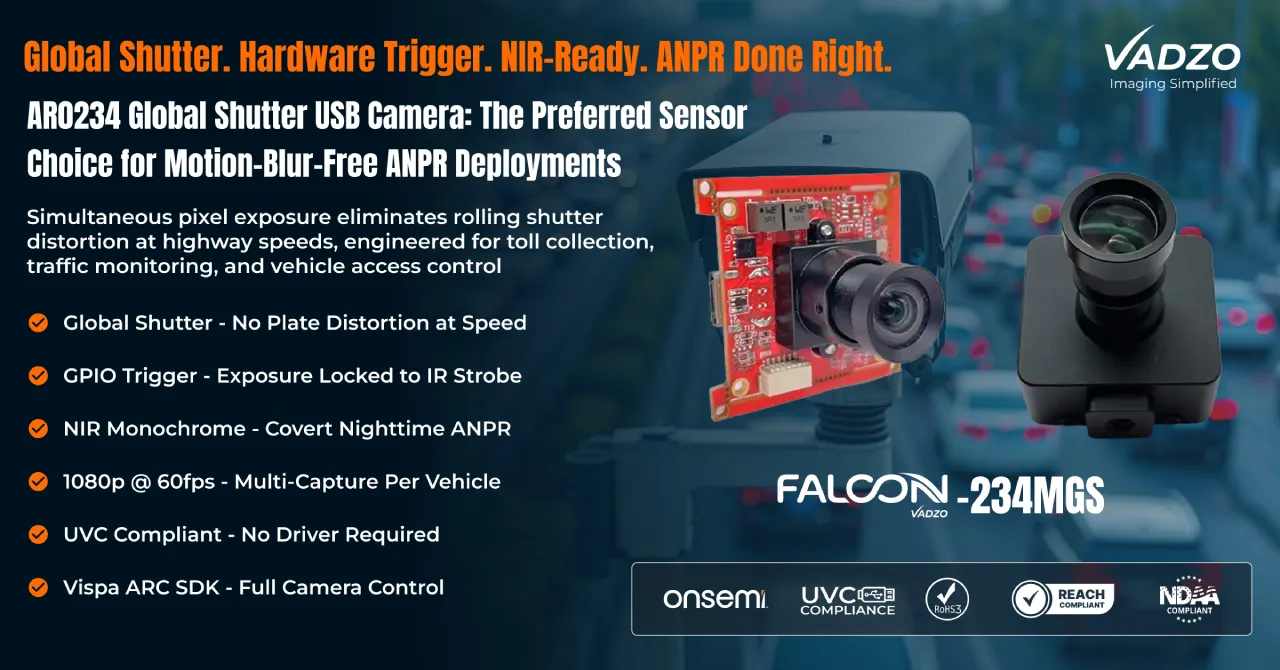
Vadzo Imaging explains why the AR0234 Global Shutter USB Camera consistently delivers motion-blur-free results in Automatic Number Plate Recognition deployments, addressing the shutter architecture constraint that disqualifies rolling shutter alternatives, NIR sensitivity, hardware trigger synchronization, and frame timing requirements across its Falcon-234MGS and Falcon-234CGS from the USB camera series.
FORT WORTH, TX / ACCESS Newswire / June 18, 2026 / Vadzo Imaging, a provider of embedded vision camera for OEMs and system integrators, is explaining one of the most technically deterministic sensor selection decisions in intelligent transportation system design: why the AR0234 Global Shutter USB Camera is the preferred sensor choice for motion-blur-free Automatic Number Plate Recognition. Engineers building high-speed ANPR Camera infrastructure, vehicle identification systems, and smart traffic management platforms consistently choose the AR0234 sensor across deployments, and the reason is not differentiation in a product brochure. It is sensor physics. The Onsemi AR0234 Camera solves a fundamental hardware-level problem that no amount of ISP tuning or post-processing can correct in a rolling shutter design, and understanding that problem is the starting point for any embedded engineer selecting imaging hardware for this application class.
The Core Problem in ANPR Is Not Resolution. It Is Timing.
Automatic Number Plate Recognition places specific demands on imaging hardware that resolution and frame rate specifications alone do not capture. A vehicle traveling at 100 km/h covers approximately 27.8 meters per second. At that speed, even a 1-millisecond exposure displaces the plate by 27.8 millimeters across the sensor image plane, creating motion blur across the character region. The software consequence is an OCR confidence score that drops below the threshold required for unattended processing, triggering a manual review queue that adds operational cost to the system.
The sensor architecture problem compounds the motion blur issue in rolling shutter designs. A rolling shutter sensor reads pixel rows sequentially from top to bottom, meaning the first row is captured before the last row finishes exposing. For a vehicle in motion, this row-timing offset introduces a geometric shear across the plate region. Characters that are physically rectangular on the plate surface appear skewed in the captured frame, corrupting the spatial data on which the OCR segmentation algorithm depends on. This is a hardware architecture problem, not a tuning problem. No post-processing step reliably corrects character geometry that the sensor introduces at capture.
A global shutter sensor exposes every pixel simultaneously, eliminating the inter-row time offset entirely. A motion blur-free camera built on a global shutter sensor captures a geometrically accurate plate regardless of vehicle speed within the exposure window. That simultaneous pixel exposure is precisely why the AR0234 Global Shutter USB Camera is the preferred sensor choice for motion-blur-free ANPR deployments, and why rolling shutter alternatives are not a viable substitute in this application class. For industrial ANPR USB Camera deployments from toll booths to highway gantries, the shutter architecture is the non-negotiable specification.
What the AR0234 Sensor Architecture Actually Delivers
The Onsemi AR0234 is a 1/2.6-inch global shutter CMOS image sensor with a 1920 x 1200 active pixel array and a 3.0 µm x 3.0 µm pixel pitch. At full resolution, the AR0234 Global Shutter USB Camera delivers 60 frames per second over USB 3.0 Gen1. At 1080p, the frame interval is approximately 16.7ms. The exposure duration is independently controllable well below that frame interval, and at sub-millisecond exposure times, the simultaneous pixel capture freezes vehicle motion without geometric distortion from sensor timing.
The 1/2.6-inch format and 3.0 µm pixel pitch provide sufficient photon-collection area per pixel to maintain usable signal-to-noise ratios at the short exposures ANPR requires, particularly when paired with a dedicated illumination source. The monochrome variant's photodiode response extends into the near-infrared band, covering the 800nm to 940nm range that covert IR strobe systems use in traffic monitoring. A 2MP AR0234 Mono USB Camera in monochrome configuration collects NIR photons across every pixel without the quantum efficiency penalty that a Bayer filter imposes, which is the reason the monochrome variant is specified in nighttime and covert illumination deployments. The NIR-compatible ANPR Camera capability of the monochrome sensor is not an enhancement; it is a sensor-physics advantage the color variant cannot replicate.
"Vadzo's Falcon-234MGS and Falcon-234CGS deliver exactly what ANPR system designers need from the sensor: simultaneous pixel exposure that eliminates motion-induced geometric distortion at the hardware level, GPIO trigger synchronization that locks the exposure window to the strobe pulse, and a monochrome NIR response that performs in covert illumination conditions where color sensors fall short. These are not feature additions. They are sensor-level requirements the AR0234 global shutter architecture satisfies by design, and Vadzo builds both camera products to exploit that architecture fully." - Alwin Vincent, Product Manager, Vadzo Imaging
Falcon-234MGS: AR0234 Monochrome Global Shutter USB 3.0 Camera for NIR-Compatible ANPR
Open-road toll collection, highway traffic monitoring, and vehicle access control deployments require a camera that operates reliably from full daylight to complete darkness, using covert near-infrared illumination at night. A color sensor's Bayer filter reduces quantum efficiency in the NIR band. A monochrome sensor eliminates the filter entirely, maximizing photon collection across every NIR wavelength without loss.
The Falcon-234MGS is Vadzo's AR0234 Monochrome Global Shutter USB 3.0 Camera, delivering 2MP (1920 x 1200) at 60fps and VGA at 120fps over USB 3.0 Gen1 Type-C, backward compatible to USB 2.0. The 2MP AR0234 Mono USB Camera outputs Y8 and Y12 formats for both 8-bit and 12-bit grayscale pipelines. The 6-pin GPIO with 1.8V-tolerant input and output supports hardware trigger synchronization with external strobe controllers, aligning the camera exposure window with the IR strobe pulse to sub-millisecond accuracy. At an operating temperature range of -40°C to 85°C, the Falcon-234MGS handles roadside cabinet and in-lane barrier installations without derating. The Vispa ARC SDK provides full programmatic control over exposure, gain, trigger timing, and ROI through C, C++, and Python on Windows, Linux, and Android.
Key specs: 2MP (1920x1200) | Onsemi AR0234 | Global Shutter | Monochrome | 1/2.6" 3.0μm Pixel | USB 3.0 Gen1 | Y8/Y12 | S-Mount (M12) | -40°C to 85°C
Falcon-234CGS: AR0234 Color Global Shutter USB 3.0 Camera for Daytime Vehicle Identification
Daytime parking management, vehicle identification at gated facilities, and smart traffic management infrastructure benefit from color imaging. Vehicle color alongside the plate number provides a richer identification signature for enforcement and access management platforms. The AR0234 Color USB Camera in Bayer configuration delivers that color data with the same global shutter timing accuracy as the monochrome variant, making the choice between the two a function of illumination architecture, not shutter performance.
The Falcon-234CGS is Vadzo's AR0234 Color Global Shutter USB 3.0 Camera, built on the AR0234 Bayer sensor with an on-board ISP handling debayering, color correction, contrast correction, gamma correction, denoising, and lens correction. The 2MP Global Shutter USB Camera delivers 1920 x 1080 at 60fps and VGA at 90fps in YUV422 and MJPEG formats. ROI-based Auto-Exposure meters independently within the plate region, handling the high-contrast transitions at parking entry lanes where a vehicle moves from direct sunlight into a shaded structure. The 6-pin GPIO supports hardware trigger and frame sync with barrier gate controllers, and the -40°C to 85°C operating range covers outdoor facility installations year-round without modification.
Key specs: 2MP (1920x1200) | Onsemi AR0234 | Global Shutter | Color | 1/2.6" 3.0μm Pixel | USB 3.0 Gen1 | YUV422/MJPEG | S-Mount (M12) | -40°C to 85°C
Vispa ARC SDK: Programmatic Camera Control for USB ANPR Integrations
Both the Falcon-234MGS AR0234 Monochrome USB Camera and Falcon-234CGS AR0234 Global Shutter USB Camera products are supported by Vadzo's Vispa ARC SDK, which provides full programmatic control over streaming, exposure, gain, GPIO trigger configuration, ROI, and firmware updates. For embedded engineers integrating the AR0234 Global Shutter USB Camera into a lane controller, barrier system, or edge AI inference node, Vispa ARC exposes the complete camera control set through C, C++, and Python APIs on Windows, Linux, and Android.
Both the Falcon-234MGS and Falcon-234CGS are UVC compliant, meaning they enumerate and stream under standard V4L2 on Linux and DirectShow on Windows without any proprietary driver installation. This dual-mode approach gives embedded teams immediate operational access under standard frameworks during early integration, while Vispa ARC covers the production-level GPIO trigger path, ISP control, and firmware management that the deployed system requires. As a low-latency USB Camera with a 5 Gbit/s SuperSpeed USB 3.0 interface, both camera products keep frame transfer latency low enough for real-time lane management and edge AI inference without buffering overhead at the host.
Applications
Toll Collection and Vehicle Access Control: Toll collection infrastructure demands reliable plate reads at sustained vehicle speeds across multiple lanes, day and night, with no tolerance for systematic read failures during peak traffic periods. Lighting, weather, vehicle color, plate condition, and approach speed all vary continuously, and the system cannot pause for manual intervention. A hardware trigger USB Camera with global shutter architecture is the baseline specification that allows the rest of the ANPR pipeline to function without fundamental image quality problems entering the OCR stage. The AR0234 Global Shutter USB Camera solves the motion problem at the sensor level, capturing the plate in a single simultaneous exposure at any vehicle speed within the deployment's operating range. The Falcon-234MGS AR0234 USB Camera, in monochrome configuration, pairs with covert NIR strobes to deliver high-contrast plate images independent of ambient light. The GPIO trigger input synchronizes the exposure window with the strobe firing pulse, so every triggered frame arrives at peak illumination intensity with no OS-level timing jitter in the trigger path. The GPIO output line simultaneously signals the toll gate controller to process the plate event, completing the capture-to-action chain without a separate I/O board. For vehicle access control at gated facilities, the same architecture drives barrier gate actuation directly on plate recognition, reducing hardware component count in the installation.
Traffic Monitoring and Smart Traffic Management: Traffic monitoring systems covering multi-lane environments require the imaging hardware to resolve plate characters at varying distances within a wide field of view while maintaining sufficient frame rate for multiple capture opportunities per vehicle. A single usable capture is not the design target. The inference pipeline needs enough frame candidates within the vehicle's dwell time in the field of view to produce a confident read across lighting and approach angle variation. An industrial global shutter camera operating at 1080p and 60fps provides a 16.7ms frame interval, which, for a vehicle at 120 km/h, corresponds to approximately 55 centimeters of travel between frames. At gantry or overhead mounting working distances, this frame rate produces multiple capture opportunities as the vehicle passes through the detection zone. Smart traffic management platforms consuming the output over the USB 3.0 5 Gbit/s SuperSpeed interface receive frames with consistently low link latency, supporting real-time vehicle counting, speed estimation, and classification at the edge without buffering overhead. The Falcon-234MGS AR0234 Monochrome USB Camera, with its NIR-compatible monochrome sensor and frame sync camera GPIO interface, covers both day and night traffic monitoring from the same hardware configuration. For intelligent transportation systems consolidating vehicle identification, traffic count, and incident detection into a single platform, the UVC compliance of both Falcon camera products ensures a consistent driver interface across the full installation.
Parking Management and Intelligent Transportation Systems: Parking management ANPR operates at shorter working distances and lower vehicle approach speeds than highway or toll deployments, but presents its own imaging challenge. A vehicle entering a covered structure from direct sunlight creates a high-contrast scene where the plate area may be significantly darker than the surrounding vehicle body and sky. A full-frame exposure algorithm averaging across the scene overexposes the plate under those conditions, reducing character contrast below the OCR engine's usable threshold. The Falcon-234CGS AR0234 Color Global Shutter USB 3.0 Camera addresses this through ROI-based Auto-Exposure on the on-board ISP, which meters exposure independently within the plate region rather than across the full frame. The result is a correctly exposed plate capture even when the surrounding scene spans a dynamic range that full-frame metering cannot handle. Parking management systems using vehicle color for cross-reference benefit from the Falcon-234CGS's color output, adding a secondary vehicle attribute to the plate read without additional hardware. Intelligent transportation systems consolidating parking management, toll collection, and vehicle access control under a unified platform deploy both Falcon camera products, with the Falcon-234MGS handling NIR-capable nighttime coverage and the Falcon-234CGS delivering daytime color vehicle identification, both interfacing over the same USB 3.0 connection and UVC driver stack across the full installation.
OEM Customization: Vadzo Delivers a Deployment-Ready AR0234 Global Shutter USB Camera, Not Just a Module
For OEM product teams that need more than a standard camera module, Vadzo's engineering team treats the AR0234 Global Shutter USB Camera, its optics, GPIO behavior, ISP configuration, and form factor as a single integrated solution rather than separable components that the OEM assembles and validates independently. Firmware-level GPIO modifications allow the trigger timing between a loop detector, strobe controller, and the Falcon-234MGS or Falcon-234CGS to meet deployment-specific latency budgets. ISP parameter tuning covers NIR contrast optimization at specific illuminator wavelengths, denoising configuration for high-gain nighttime operation, and exposure range adjustment for the lighting profile of the target site. Lens holder modifications accommodate focal lengths selected for the actual working distance and lane width of the installation, with optics validated against the AR0234 sensor's 1/2.6-inch format diagonal. Board redesigns for non-standard form factors, optical filter integration, and volume production support are all handled as part of the Vadzo Imaging customization program. Vadzo delivers a camera that performs to specification in the actual deployment environment, not a laboratory configuration.
Frequently Asked Questions
1) Why does an AR0234 Global Shutter USB Camera outperform a rolling shutter sensor for Automatic Number Plate Recognition?
The answer is sensor architecture, not tuning. A rolling shutter sensor reads pixel rows sequentially from top to bottom, introducing a timing gap between the first and last row of every frame. For a vehicle in motion, that gap creates geometric shear across the plate region before the OCR engine ever receives the image. No post-processing step reliably corrects character geometry that the sensor architecture corrupts at capture. Vadzo's AR0234 Global Shutter USB Camera eliminates this problem at the source. The Onsemi AR0234 exposes all pixels simultaneously, delivering a geometrically accurate plate at any vehicle speed within the deployment's operating range. That is why embedded engineers and OEM product teams building toll collection, vehicle access control, and traffic monitoring systems choose the AR0234 Global Shutter USB Camera over rolling shutter alternatives. When the sensor captures correctly from the first frame, the entire downstream pipeline works from clean data.
2) How does Vadzo's NIR-compatible 2MP Global Shutter USB Camera handle nighttime ANPR without visible illumination?
Vadzo's Falcon-234MGS operates on the same principle that makes covert ANPR possible: a monochrome sensor without a Bayer filter collects NIR photons across every pixel at full photodiode quantum efficiency. When paired with an IR strobe illuminator in the 850nm to 940nm range, the AR0234 Monochrome USB Camera captures a high-contrast plate image that produces no visible light the driver perceives. The GPIO hardware trigger input synchronizes the camera's exposure window with the strobe pulse to sub-millisecond accuracy, ensuring every triggered frame is captured at peak strobe intensity. Vadzo engineers this trigger path to remove OS-level scheduling jitter entirely from the exposure chain. The result is a NIR-compatible ANPR Camera that delivers consistent, high-contrast plate reads at night as reliably as it does in full daylight, using the same hardware and the same Vispa ARC SDK integration, with no configuration change between day and night operating modes.
3) What does Vadzo's GPIO hardware trigger architecture deliver that software triggering structurally cannot?
Software triggering routes the exposure signal through the host OS before the camera acts on it. On any general-purpose OS, that path introduces scheduling latency that varies between frames, and for strobe durations in the sub-millisecond range, that jitter misaligns the camera exposure window with the strobe firing, producing underexposed or partially illuminated frames. Vadzo's Falcon-234MGS AR0234 Monochrome USB Camera and Falcon-234CGS 2MP AR0234 Color USB Camera resolve this with a dedicated 1.8V-tolerant GPIO input that receives the trigger signal directly at the hardware level. The exposure starts within the hardware latency of the GPIO path, not the software scheduler. Equally important, the GPIO output line simultaneously closes the barrier gate or access controller loop on a successful plate event, completing the full trigger-to-action chain inside the camera hardware. For industrial ANPR USB Camera deployments where throughput depends on every frame being correctly exposed, Vadzo's hardware trigger architecture delivers the timing determinism that software triggering cannot provide.
4) Can the 1080P AR0234 USB 3.0 Camera integrate into standard Linux and Windows ANPR platforms without proprietary drivers?
Yes, and this is a deliberate engineering decision at Vadzo. Both the Falcon-234MGS and Falcon-234CGS are fully UVC compliant, meaning they enumerate and stream under V4L2 on Linux and DirectShow on Windows without any proprietary driver installation. An embedded engineer on a Jetson Orin or an x86 edge compute node running Ubuntu has the camera streaming into OpenCV or GStreamer within minutes of connection, with no driver integration work in the way. For production deployments requiring GPIO trigger configuration, ROI-based exposure control, gain management, and firmware updates, Vadzo's Vispa ARC SDK provides the full programmatic interface through C, C++, and Python on Windows, Linux, and Android. The dual-mode approach means the team does not have to wait for SDK integration to validate the camera in the system. UVC handles bring-up; Vispa ARC handles the production integration. Vadzo built it this way because integration time matters in OEM product schedules, and first capture should happen on day one.
5) What does Vadzo's OEM customization program specifically deliver for AR0234 Global Shutter USB Camera ANPR deployments?
Vadzo's OEM camera customization program goes well beyond standard product options. For ANPR-specific deployments, Vadzo's engineering team adjusts GPIO trigger timing at the firmware level to match the latency budget between the loop detector, strobe controller, and the camera exposure window. ISP parameters are tuned to the specific NIR wavelength of the illuminator in use, the gain range required for the deployment's nighttime conditions, and the contrast profile of the installation's lighting environment. Lens holders are modified for focal lengths selected against the actual working distance and lane width, with optics validated against the AR0234 sensor's 1/2.6-inch format diagonal. Board redesigns, optical filter integration, and volume production support are handled as part of the standard design-in engagement. Vadzo delivers an AR0234 Global Shutter USB Camera configured to the deployment specification, not a generic module that the OEM characterizes independently after receipt. Contact Vadzo Imaging at [email protected] to start the design-in discussion.
Availability
The Falcon-234MGS AR0234 Monochrome USB Camera and Falcon-234CGS AR0234 Color USB Camera are available for OEM evaluation and production integration through Vadzo Imaging's global shutter camera series. Engineering samples, Vispa ARC SDK access, GPIO trigger documentation, and integration support are available directly through Vadzo Imaging's USB camera series product line. Volume pricing, firmware customization, lens selection support, and enclosure design services are available on request. OEM teams requiring custom GPIO timing, ISP tuning, or board-level modifications can engage Vadzo's engineering team through the customization program. Contact the team at [email protected] or visit https://www.vadzoimaging.com.
About Vadzo Imaging
Vadzo Imaging develops high-performance embedded vision camera products for OEMs and system integrators building next-generation intelligent systems. The company's USB camera series, MIPI, Gigabit Ethernet, Wi-Fi, and SerDes platforms support applications spanning industrial automation, robotics, smart surveillance, smart city infrastructure, and edge AI. Beyond hardware, Vadzo provides end-to-end imaging expertise, including sensor integration, ISP tuning, firmware development, optics characterization, distortion calibration, and OEM camera customization services that accelerate development and deployment at scale. Visit www.vadzoimaging.com for the full product portfolio and engineering resources.
Media Contact
Alwin Vincent
Vadzo Imaging
Email: [email protected]
LinkedIn: Vadzo Imaging
YouTube: Vadzo Imaging
X: Vadzo Imaging
SOURCE: Vadzo Imaging