




Wednesday, 03 June 2026 12:00 PM
Company Update
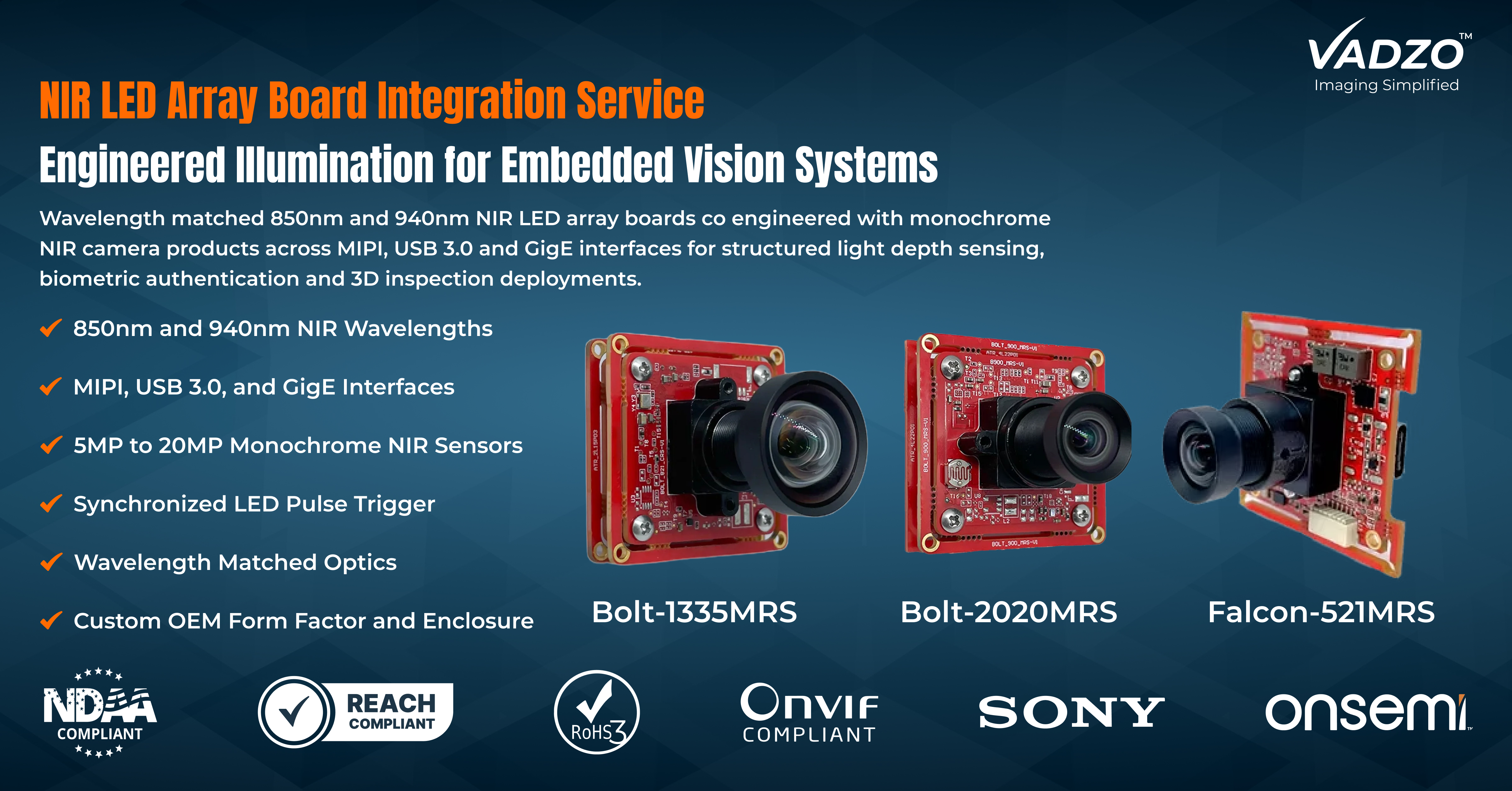
Vadzo Imaging introduces an OEM engineering program that combines precision configured NIR LED array boards with a portfolio of monochrome NIR camera products spanning MIPI, USB 3.0 and GigE interfaces. The service covers sensor options from 5MP to 20MP across the Onsemi AR2020, Onsemi AR1335, Onsemi AR0521 and Sony Pregius S IMX900 platforms and delivers wavelength matched 850nm and 940nm NIR illumination alongside synchronized LED trigger control, wavelength matched optics and OEM form factor customization under a single integration program supported by the VISPA NXT SDK.
FORT WORTH, TX / ACCESS Newswire / June 3, 2026 / Vadzo Imaging today announced the launch of its NIR LED camera integration service, an OEM engineering program that pairs precision-configured NIR illumination boards with the company's monochrome NIR camera portfolio for uniform Illumination in Biometric, Inspection, and Day-Night Vision Applications. The service combines 20MP MIPI camera configurations powered by the Onsemi AR2020 sensor, 13MP MIPI camera configurations built on the Onsemi AR1335 sensor, 5MP NIR USB camera configurations with the Onsemi AR0521 sensor, and 3.2MP global shutter GigE camera configurations with the Sony Pregius S IMX900 sensor alongside custom-tuned NIR LED arrays operating at 850nm and 940nm wavelengths.
The central challenge in NIR imaging is not the camera. Uneven NIR illumination produces hotspots and shadow zones that degrade biometric matching accuracy, introduce false rejects in inspection systems, and cause inconsistent image quality between daytime and nighttime operation. Off-the-shelf NIR illuminators paired with separately sourced cameras introduce wavelength mismatch, timing inconsistency between LED pulse and sensor exposure, and optical misalignment that compounds across operating distances and ambient conditions. The Vadzo NIR LED Array Board Integration Service eliminates these variables by engineering the illumination board and the camera module as a single optical system. Triggered LED pulsing is synchronized to the camera exposure window, suppressing ambient light contamination and enabling consistent image quality from bright outdoor environments to near-zero-lux nighttime conditions without changing camera settings.
Why Integrated NIR Illumination Matters
Uniform illumination means every point in the camera's field of view receives the same photon flux from the NIR illumination system , no centre-bright falloff, no edge darkening, no shadow zones from off-axis LED placement. In biometric applications, a non-uniform NIR field causes iris and face capture quality to vary depending on subject position within the frame, directly increasing false rejection rates. In inspection applications, illumination gradients create false contrast that triggers defect alerts on flat, uniform surfaces. In day-night security deployments, a camera that produces excellent images in daylight and degraded images at night is not a day-night camera, it is two cameras with incompatible performance envelopes.
Vadzo addresses this by designing the LED array geometry, specifically for the field of view and working distance of the paired camera module, ensuring uniform illumination is maintained across the full sensor frame at the target operating distance.
Bolt-2020MRS: 20MP Onsemi AR2020 Monochrome MIPI Camera with NIR LED Array
The Bolt-2020MRS AR2020 MIPI camera configuration brings ultra-high resolution monochrome imaging to structured light camera deployments that demand the finest spatial detail for high accuracy depth maps and 3D reconstruction. The Onsemi Hyperlux LP AR2020 sensor delivers 20MP (5120×3840) output across a 1/1.8-inch optical format with 1.4 µm pixel size and enhanced NIR sensitivity tuned for the 850nm and 940nm wavelengths used in pattern projection. The module operates as a 20MP rolling shutter camera over a 4 Lane MIPI CSI-2 interface and integrates directly with NVIDIA Jetson, Raspberry Pi, Qualcomm RB series, and NXP iMX-based embedded vision platforms. Combined with the wavelength-matched NIR LED array, this configuration supports high-resolution 3D scanning for industrial inspection, additive manufacturing quality control, and dimensional measurement systems.
20MP rolling shutter camera built on the Onsemi AR2020 sensor with 20MP monochrome output, 1/1.8-inch optical format, enhanced NIR sensitivity, and a 4 Lane MIPI CSI-2 interface paired with synchronized 850nm or 940nm NIR LED array for high-resolution structured light depth sensing.
Key specs: 20MP (5120×3840) | Onsemi Hyperlux LP AR2020 | Rolling Shutter |1/1.8"| 1.4 µm Pixel | Monochrome | 4 Lane MIPI CSI-2 | NIR Sensitivity | S Mount (M12) | −30°C to 70°C Operating Temperature
Bolt-1335MRS: 13MP Onsemi AR1335 Monochrome MIPI Camera with NIR LED Array
The Bolt-1335MRS 13MP MIPI camera configuration balances resolution and bandwidth efficiency for structured light deployments that require great detail without the data throughput demand of 20MP imaging. The Onsemi AR1335 sensor delivers 13MP (4208×3120) monochrome output across a 1/3.2-inch optical format with a 1.1 µm pixel size, and NIR sensitivity tuned for 850nm and 940nm pattern capture. The module operates as a 13MP monochrome MIPI camera over MIPI CSI-2 and supports compact form factor integration on NVIDIA Jetson, Qualcomm RB series, and NXP iMX platforms used in mobile robotics and edge AI deployments. With the integrated NIR LED array, this configuration suits 3D face authentication, biometric kiosks, gesture recognition systems, and compact handheld scanners where module footprint and power efficiency matter alongside imaging quality.
13MP monochrome MIPI camera built on the Onsemi AR1335 sensor with 13MP output, 1/3.2-inch optical format, NIR sensitivity in the 850nm to 940nm range, and a MIPI CSI-2 interface paired with a compact synchronized NIR LED array for biometric authentication, 3D face scanning, and gesture recognition deployments.
Key specs: 13MP (4208×3120) | Onsemi AR1335 | Rolling Shutter | 1/3.2 " | 1.1 µm Pixel | Monochrome | MIPI CSI-2 | NIR Sensitivity
Falcon-521MRS: 5MP Onsemi AR0521 Monochrome USB Camera with NIR LED Array
The Falcon-521MRS 5MP NIR USB camera configuration provides a plug-and-play structured light development path for OEMs and integrators using USB-based host platforms. The Onsemi AR0521 sensor delivers 5MP (2592×1944) monochrome output across a 1/2.5-inch optical format with 2.2 µm pixel size and enhanced NIR sensitivity in the 850nm to 940nm range. Operating over UVC-compliant USB 3.0, the module connects to Windows, Linux, and Android-based host systems without driver installation. This simplifies prototyping and accelerates production deployment. Paired with the wavelength-matched NIR LED array, this 5MP monochrome USB camera configuration is well suited to compact handheld 3D scanners, dental and medical imaging devices, dermatology systems, and document and currency verification stations where USB connectivity and form factor flexibility are priorities.
5MP NIR USB camera built on the Onsemi AR0521 sensor with 5MP monochrome output, 1/2.5-inch optical format, UVC-compliant USB 3.0 interface, and compatibility across Windows, Linux, and Android platforms paired with a synchronized NIR LED array for handheld 3D scanning, medical and document verification deployments.
Key specs: 5MP (2592×1944) | Onsemi AR0521 | Rolling Shutter | 1/2.5" | 2.2 µm Pixel | Monochrome | NIR Sensitivity | -30⁰C to 70⁰C Operating Temperature
Innova-900MGS: 3.2MP Sony IMX900 Monochrome Global Shutter GigE Camera with NIR LED Array
The Innova-900MGS monochrome global shutter GigE camera configuration brings global shutter imaging to structured light deployments requiring distortion-free pattern capture on high-speed production lines and dynamic robotic platforms. The Sony Pregius S IMX900 sensor delivers 3.2MP (2064×1552) monochrome output across a 1/3.1-inch optical format with 2.25 µm BSI pixels, Quad HDR up to 120 dB, and high NIR sensitivity. GigE connectivity with PoE 802.3af supports cable runs up to 100 meters and multi-camera deployment across distributed inspection cells, while ONVIF compliance and IEEE 1588 PTP synchronization enable frame-accurate alignment across multi-camera structured light setups. Paired with the synchronized NIR LED array, this 3.2MP global shutter GigE camera configuration is purpose-built for inline 3D inspection, pick and place verification, robotic bin picking, and high-speed conveyor sorting where motion artifact-free capture is non-negotiable.
3.2MP global shutter GigE camera built on the Sony Pregius S IMX900 sensor with 3.2MP monochrome output, 1/3.1-inch optical format, Quad HDR up to 120dB, GigE PoE connectivity, and IEEE 1588 PTP synchronization paired with a synchronized NIR LED array for inline 3D inspection, robotic bin picking, and high-speed conveyor sorting deployments.
Key specs: 3.2MP (2064×1552) | Sony Pregius S IMX900 | Global Shutter | 1/3.1" | 2.25 µm Pixel | Monochrome | GigE (100/1000Base-T) | PoE 802.3af | Quad HDR (120dB) | NIR Sensitivity | −30°C to 70°C Operating Temperature
VISPA NXT SDK and Multi-Platform Support
All Vadzo NIR camera configurations within the integration program are supported by the VISPA NXT SDK for GigE deployments and the VISPA ARC SDK for USB and MIPI deployments, providing programmatic control over streaming, exposure, gain, GPIO trigger, and firmware updates. SDK availability spans C, C++, and Python with compatibility across Windows, Linux, and Android, enabling embedded vision integration with NVIDIA Jetson, Raspberry Pi, Qualcomm RB series, and NXP iMX platforms used in robotics, medical devices, and edge AI workflows.
Applications
Biometric authentication & iris recognition: Vadzo's NIR LED and camera integration delivers uniform 940nm illumination across the full capture zone of biometric kiosks, access control gates, and identity verification terminals, eliminating the illumination gradients that cause iris and face quality scores to vary by subject position and increase false rejection rates. Biometric matching algorithms are sensitive to NIR illumination consistency. A 15% brightness falloff from frame center to edge changes the texture contrast of iris patterns enough to degrade matching scores below threshold. The co-engineered Bolt-1335MRS and NIR LED array maintains ±5% illumination uniformity across the capture zone at working distances from 0.3m to 1.2m. The 940nm wavelength is invisible to subjects, enabling natural, unobtrusive enrollment and verification. Synchronized LED pulsing suppresses fluorescent and daylight interference in lobby and outdoor kiosk deployments.
Industrial surface & print inspection: The Vadzo NIR LED array delivers shadow-free, uniform 850nm illumination across the inspection field of PCB assemblies, printed surfaces, machined parts, and packaged goods, eliminating the illumination gradients that generate false defect signals on flat, uniform surfaces and mask real defects at field edges. Surface inspection systems fail in two ways: false positives triggered by illumination falloff at field edges, and false negatives where real defects at edge zones are underexposed. The co-engineered Bolt-2020MRS and 850nm LED array maintains consistent flux density from center to edge of the inspection frame, enabling a single threshold to reliably classify the full field. The 20MP monochrome sensor resolves fine print characters, solder joint geometry, and surface texture detail that 5MP and 8MP inspection cameras miss. Triggered pulsing synchronizes illumination to conveyor-encoder pulses, freezing motion for blur-free frame capture at line speed.
Medical & dermatology imaging: The Falcon-521MRS with co-engineered NIR LED array delivers uniform 850nm or 940nm illumination for dermatology, vein imaging, wound documentation, and handheld medical scanning, where consistent, shadow-free NIR lighting is required for reproducible clinical image quality across patient sessions. Dermatology and vein imaging NIR systems fail when illumination intensity varies across the capture zone, causing sub-surface vessel and pigmentation patterns to appear with inconsistent contrast. The integrated 5MP USB camera and NIR array maintains uniform illumination at the working distances typical of handheld and mounted clinical imaging devices. The 940nm option minimizes patient-perceived visible glow. UVC-compliant USB 3.0 connects directly to medical-grade Windows and Linux workstations without drivers, simplifying 510(k) and CE integration timelines for device OEMs.
Day-night security & continuous surveillance: The Innova-900MGS global shutter GigE camera with synchronized NIR LED array delivers consistent image quality from full daylight to zero-lux nighttime, enabling a single camera installation to operate continuously across 24-hour cycles without illumination switching, mode changes, or image quality degradation between day and night. Conventional day-night cameras switch IR cut filters and change ISP parameters between day and night modes, introducing transition artifacts and inconsistent image geometry. The Innova-900MGS monochrome global shutter sensor operates in NIR throughout - the NIR LED array provides the illumination at night, while the sensor's high sensitivity captures ambient NIR from sunlight and artificial sources during daytime. The result is consistent, predictable image output at all hours. 120 dB Quad HDR handles the extreme contrast between sunlit and shadowed zones in outdoor perimeter and entrance monitoring.
Document & currency verification: The Falcon-521MRS with 850nm NIR LED array reveals NIR-fluorescent inks, security threads, and substrate watermarks embedded in banknotes, identity documents, and product authentication labels, features invisible to colour cameras that become clearly delineated under uniform NIR illumination. Document verification NIR imaging requires consistent illumination intensity across the full document surface, degrading automated verification accuracy. The co-engineered 5MP USB camera and uniform NIR array maintains field-flat illumination across A4 and smaller document formats. UVC compliance enables integration into bank branch, border control, and retail verification terminal platforms without proprietary drivers.
Robotic vision in variable & low-light environments: The Innova-900MGS global shutter GigE camera with synchronized NIR LED array provides reliable, illumination-independent robotic vision on factory floors, warehouse aisles, and outdoor autonomous platforms where ambient visible light varies from full daylight to near-zero during night shifts or in enclosed conveyor tunnels. Robots relying on visible-light cameras lose detection confidence as ambient light levels change between shifts, seasons, or indoor zones. NIR illumination from a co-engineered array provides a stable, controlled photon source independent of ambient conditions. The global shutter eliminates motion blur from fast robot arms and conveyor belts. IEEE 1588 PTP synchronization across multiple camera nodes enables frame-accurate multi-view capture for pick-and-place and bin-sorting workflows in distributed robot cells.
Frequently Asked Questions (FAQs)
What is a NIR LED array board and why is uniform NIR illumination important for machine vision?
A NIR LED array board is a precision-configured near-infrared light source that illuminates a scene at 850nm or 940nm wavelengths to provide consistent, shadow-free lighting for cameras in biometric, inspection, medical, and security applications. Uniform NIR illumination ensures every part of the camera's field of view receives equal light intensity, preventing false defect detection at field edges and inconsistent biometric quality scores caused by illumination falloff. Machine vision systems that use separately sourced NIR illuminators and cameras frequently suffer from center-bright illumination profiles. In inspection this creates false defect signals at edges. In biometrics it causes valid subjects positioned off-center to receive lower image quality scores and higher false rejection rates. Vadzo's integrated NIR LED array is geometrically configured to match the specific field of view and working distance of the paired camera, maintaining uniform flux density across the full frame.
What is the difference between 850nm and 940nm NIR illumination - which should I choose?
850nm NIR illumination offers higher quantum efficiency on monochrome NIR sensors and produces slightly visible red glow, preferred for industrial inspection, document verification, and outdoor surveillance where illumination intensity matters most. 940nm NIR illumination is invisible to human eyes, preferred for biometric authentication, medical imaging, and security applications where covert, unobtrusive operation is required. The choice between 850nm and 940nm is a deployment decision, not a performance trade-off. Monochrome NIR sensors typically have 15-25% higher quantum efficiency at 850nm than at 940nm, meaning 850nm delivers more signal per milliwatt of LED power which is useful when maximizing working distance or minimizing power consumption. However, 850nm LEDs emit a faint visible red glow that users can perceive, which is unacceptable in patient-facing medical devices, biometric enrollment kiosks, and access control gates. 940nm is fully invisible, enabling natural user interaction. Vadzo configures the NIR LED array in either wavelength across all four camera platforms in the integration program.
How does synchronized NIR LED triggering improve image quality compared to continuous illumination?
Synchronized NIR LED triggering pulses the illumination only during the camera's active exposure window, concentrating photon flux into a short burst that suppresses ambient light interference and enables consistent image quality regardless of changing outdoor or industrial lighting conditions. Continuous NIR illumination competes with ambient NIR from sunlight, fluorescent lighting, and thermal sources that all contribute NIR photons to the sensor. In bright outdoor environments, ambient NIR can overwhelm the LED source entirely, making the illumination ineffective during daytime. Pulsed triggering synchronized to the exposure window concentrates LED output into a short high-intensity burst while keeping average power and heat well within operating limits. The result is consistent image quality from full daylight through zero-lux nighttime with the same camera settings. Vadzo's LED array boards include onboard trigger synchronization circuitry aligned to the camera shutter signal.
Which camera and sensor should I choose for biometric iris and face capture?
The Bolt-1335MRS, 13MP Onsemi AR1335 monochrome MIPI camera, paired with the 940nm NIR LED array is the recommended configuration for biometric iris and face capture, providing 13MP resolution for fine iris texture detail, 940nm covert illumination for natural user experience, and compact MIPI form factor for kiosk and access terminal integration. Iris recognition requires resolving at least 200 pixels across the iris diameter to capture sufficient texture for reliable matching, a constraint that 2MP and 5MP cameras meet only at very short working distances. The Bolt-1335MRS's 13MP resolution provides comfortable iris resolution margin at 0.3m-1.0m working distances typical of kiosk deployments, allowing OEMs to use a single lens configuration across a range of subject-to-camera distances. The 940nm LED array eliminates visible glow during enrollment, and synchronized pulsing suppresses lobby fluorescent and daylight interference that degrades daytime iris capture quality on continuously illuminated systems.
Can the NIR camera and LED array system operate continuously across day and night without adjustment?
Yes. The Innova-900MGS monochrome global shutter GigE camera with synchronized NIR LED array operates continuously across 24-hour cycles without mode switching, filter changes, or ISP parameter adjustments, the monochrome sensor captures NIR throughout, and the LED array provides supplemental illumination at night while the sensor uses ambient NIR during daylight. True day-night operation requires a camera that does not change its imaging characteristics between day and night. Colour cameras with IR cut filters switch modes at dusk, changing image geometry and introducing transition artifacts. The Innova-900MGS uses a monochrome global shutter sensor without an IR cut filter. The 120 dB Quad HDR handles the extreme contrast of outdoor scenes across solar angles. The result is a camera system with one consistent output format at all hours.
What OEM customization does Vadzo provide for the NIR LED array integration program?
Vadzo provides full OEM customization including NIR LED array geometry and power configuration, 850nm or 940nm wavelength selection, beam pattern design for specific working distances and field of view, mechanical co-engineering of the camera and LED assembly into a unified module, enclosure design, and firmware configuration. The integration program covers the full optical chain from sensor to illumination. Vadzo configures LED array emitter count, spacing, diffusion optics, and driver circuitry to the specific field of view and working distance of the camera deployment. Mechanical co-design ensures the LED board, camera module, lens stack, and mounting interface integrate into a single assembly matched to OEM enclosure constraints. Additional sensor integration - ToF, mmWave radar, IMU - is supported for complex multi-modal platforms. All configurations are supported by the VISPA ARC SDK (USB and MIPI) and VISPA NXT SDK (GigE) for programmatic control over streaming, exposure, gain, and trigger.
Availability
The Vadzo Imaging NIR LED Array Board Integration Service is available globally for evaluation, prototyping, and production deployment across robotics, industrial automation, medical imaging, and biometric authentication. Engineering teams can engage Vadzo for sensor selection, NIR LED array design, wavelength tuning, mechanical co-engineering, and platform integration support to accelerate development cycles. International shipping is available across key embedded vision markets including the U.S., U.K., Germany, Israel, South Korea, Japan, and worldwide. Vadzo supports volume production programs, multi-camera deployment planning, and customization including optics, firmware, form factor, and integrated NIR illumination tailored to specific OEM platforms.
About Vadzo Imaging
Vadzo Imaging is a global provider of embedded vision solutions delivering high-performance camera products for robotics, UAVs, industrial automation, medical devices, and edge AI applications. The company specializes in sensor integration, NIR imaging, HDR imaging, and interface platforms including USB, MIPI, GigE, and SerDes, enabling developers to build vision systems for autonomous navigation, robotic manipulation, inspection, biometric authentication, and intelligent monitoring. Vadzo solutions combine camera hardware, ISP optimization, NIR LED array integration, and software platforms including VISPA NXT SDK and VISPA ARC SDK, providing developers with control over streaming, encoding, camera parameters, and system integration. With support for NVIDIA Jetson, Raspberry Pi, Qualcomm RB series, and NXP iMX platforms, Vadzo enables OEMs and integrators to accelerate development, simplify deployment, and scale embedded vision systems across production environments.
Media Contact
Alwin Vincent
Vadzo Imaging
Phone: +1 817 678 2139
Email: [email protected]
LinkedIn: Vadzo Imaging
YouTube: Vadzo Imaging
X: Vadzo Imaging
SOURCE: Vadzo Imaging