




Friday, 24 July 2026 01:30 PM
Product Announcements
Vadzo Imaging's Falcon-544CRS is a 5MP line interleaved HDR USB camera built on the Onsemi HyperLux LP AR0544 sensor, delivering single-frame LI-HDR capture without motion artifacts for embedded vision engineers and OEM developers deploying AGV navigation camera systems, AMR vision camera platforms, traffic monitoring USB camera infrastructure and license plate recognition camera deployments that require reliable HDR imaging in mixed lighting, backlit and high-contrast outdoor environments.
FORT WORTH, TX / ACCESS Newswire / July 24, 2026 / Vadzo Imaging today announces the Falcon-544CRS, a 5MP LI-HDR USB camera built on the Onsemi HyperLux LP AR0544 sensor. Designed for embedded vision engineers and OEM developers who require HDR imaging in systems where scene motion and backlit conditions are defining deployment constraints, the Falcon-544CRS delivers Line Interleaved HDR on a USB 3.2 UVC-compliant module without requiring custom driver development or host-side HDR post-processing. The AR0544 sensor's single-frame HDR architecture eliminates the temporal offset that generates motion artifacts in conventional multi-exposure HDR pipelines, making the Falcon-544CRS a technically precise choice for AGV navigation camera systems, AMR vision camera platforms, traffic monitoring USB camera infrastructure and license plate recognition camera systems operating in environments with variable and extreme illuminance ratios.
The Challenge with Conventional HDR in Motion Environments
High dynamic range imaging is a routine requirement across outdoor and industrial embedded vision deployments. AGV and AMR navigation systems encounter warehouse environments where high-output LED task lighting over work areas coexists with significantly lower ambient levels in aisle corridors and at bay door zones where natural light ingress creates steep luminance gradients. Traffic monitoring infrastructure faces simultaneous exposure demands where headlight glare intensity and low ambient scene illuminance occupy the same captured frame. License plate recognition systems at entry points deal with backlit conditions where direct sunlight enters from behind an approaching vehicle while the plate surface remains in shadow. Machine vision systems on factory floors work across zones that mix LED fixture illumination with ambient daylight from overhead skylights.
In all these scenarios, the fundamental failure mode is identical. A standard single-exposure image sensor either exposes for shadow detail and saturates the highlight zones or exposes for the highlight zones and crushes the shadow detail into an unrecoverable black. Post-capture tone mapping in software can manage this within a narrow range but cannot recover pixel data that was saturated at capture. The conventional hardware approach to this problem is multi-frame HDR which combines a long-exposure frame and a short-exposure frame captured sequentially into a single merged output.
Multi-frame HDR performs acceptably in fully static scenes. The moment motion is present in the scene, the temporal offset between the two exposure captures becomes a direct source of artifact. In an AGV navigating a warehouse at operational speed, a reflective floor marker captured across two separate exposures will appear as a double edge or ghost contour in the merged output. In a traffic monitoring USB camera covering an entry lane the license plate on a vehicle approaching at 20 km/h shifts by a measurable pixel distance between exposures. The ANPR confidence score degrades in exactly the conditions where the HDR was most needed. For embedded vision engineers, this is not a marginal edge case. It is the primary reliability bottleneck in any HDR camera deployment where the scene contains motion.
Understanding Line Interleaved HDR: The Single-Frame Architecture
Line Interleaved HDR (LI-HDR) is a sensor-level architecture that resolves the motion artifact problem at its source. Rather than capturing multiple complete frames at different exposure levels and merging them temporally, LI-HDR acquires different exposure data from different rows of the pixel array within a single frame period.
In a line interleaved architecture, the sensor's pixel rows are organized into groups that integrate at different exposure times. High-gain rows capture shadow and mid-tone detail at longer integration. Low-gain rows capture highlight detail at shorter integration. All rows are read out within the same single frame period, so there is no time offset between the shadow-detail exposure data and the highlight-detail exposure data. The on-board ISP then merges these interleaved rows into a single HDR output frame that represents a single coherent moment in time rather than a composite of two temporally separated captures.
The consequence for motion environments is direct. Because there is no temporal offset between the exposure data, the HDR reconstruction contains no inter-frame motion artifacts. A vehicle approaching a license plate recognition camera, a robot navigating past a warehouse rack, and a pedestrian detection camera subject crossing a monitored entrance are all captured as single coherent events. The HDR merge has no ghost artifacts to introduce because both the shadow detail and the highlight detail were acquired simultaneously within the same frame period. This is the fundamental engineering distinction between a single frame HDR USB camera and a conventional multi-exposure HDR approach.
Falcon-544CRS: 5MP AR0544 LI-HDR USB Camera for Embedded Vision
The Falcon-544CRS is a 5MP single frame HDR USB camera built on the Onsemi HyperLux LP AR0544 sensor and delivered on a compact USB 3.2 UVC-compliant module. It connects via USB 3.2 and is immediately recognized as a standard video capture device on Windows, Linux and Android without any custom driver installation. Full UVC compliance removes driver development from the OEM integration scope entirely and eliminates driver compatibility risk across host platform OS versions.
The AR0544 belongs to Onsemi's HyperLux LP sensor family, a portfolio engineered for embedded vision USB camera applications that demand reliable imaging performance within a restricted power budget. The HyperLux LP architecture combines an on-board image signal processing core with power-efficient pixel and readout circuits that reduce active imaging power compared to conventional CMOS sensors of equivalent resolution. This makes the AR0544 a practical choice for edge AI vision camera platforms where the imaging subsystem must operate within the same power budget as inference accelerators, wireless communication modules and navigation processors.
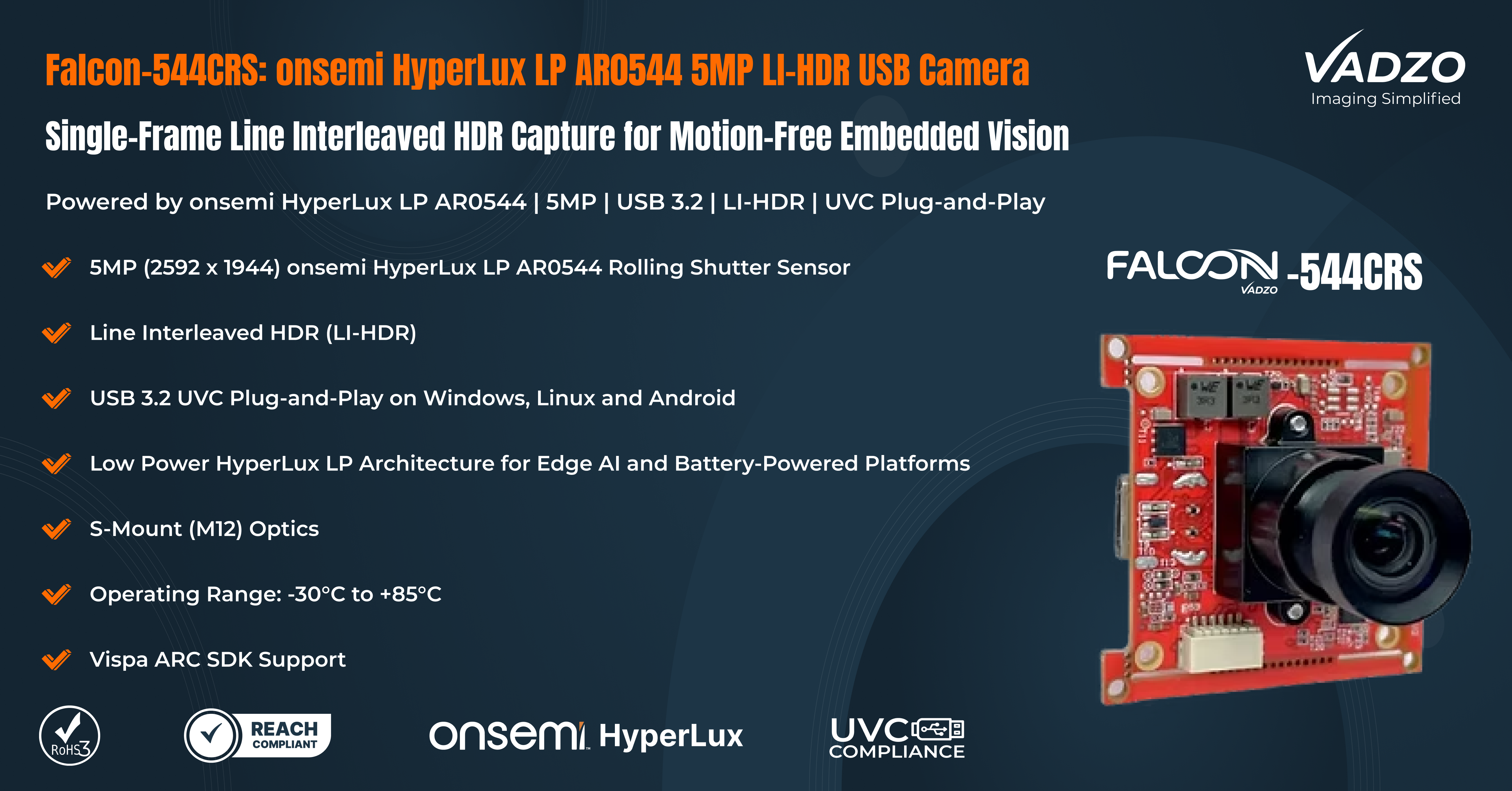
Key Capabilities of the Falcon-544CRS AR0544 5MP LI-HDR USB Camera
LI-HDR for Motion-Free Single-Frame HDR Capture: The primary imaging capability of the Falcon-544CRS is its LI-HDR mode derived from the AR0544 sensor architecture. As a motion artifact free HDR camera the device captures the full dynamic range of the scene within one frame period with no temporal separation between shadow-detail and highlight-detail exposure data. This directly addresses the motion artifact problem that prevents multi-exposure HDR from being reliable in deployments where subjects are in motion.
For AGV navigation camera applications this means floor markers, barcode labels, aisle boundary lines, and obstacle edges are captured without the double-edge artifacts that multi-frame HDR introduces when the vehicle is moving. For license plate recognition camera deployments at entry gates and parking structures the AR0544's LI-HDR produces a single coherent frame in which the plate is readable regardless of vehicle speed and regardless of whether the background is significantly brighter than the plate surface. For traffic monitoring USB camera installations the single-frame HDR merge produces legally coherent captures that ANPR software can process with consistent OCR confidence scores across daylight and night operating conditions.
AR0544 HyperLux LP Sensor Architecture: The Onsemi HyperLux LP AR0544 is a 5MP CMOS rolling shutter sensor with a 1/4.2" optical format and 1.4 μm pixel pitch. The sensor resolves 2592 x 1944 pixels and includes an on-board ISP that handles image signal processing tasks including LI-HDR merge, auto exposure and auto white balance. Offloading ISP functions to the sensor reduces the processing burden on the host system, which is particularly relevant for edge AI vision camera platforms where the host SoC is simultaneously running inference workloads alongside the imaging pipeline.
The HyperLux LP power architecture is engineered for embedded deployments where thermal envelope and power budget are constrained. As a low power industrial camera platform, the AR0544 reduces active imaging power compared to conventional CMOS sensors of equivalent resolution, translating into a lower heat contribution within compact enclosures and simplified thermal management in densely integrated OEM designs. The reduced imaging power is particularly meaningful for battery-assisted AGV and AMR platforms where total system power budgets are tightly managed across the full mission duration.
Backlit Scene Performance and Mixed Lighting Capability: The LI-HDR architecture of the AR0544 provides the Falcon-544CRS with meaningful backlit imaging camera performance in scenes where background illuminance significantly exceeds foreground subject illuminance. Entry gates facing outdoor environments, inspection stations near industrial skylights and traffic monitoring nodes facing sunrise or sunset headlight conditions all present backlit imaging challenges that a single-exposure sensor cannot address without sacrificing either highlight detail or shadow recovery.
As a mixed lighting camera solution, the AR0544 LI-HDR preserves foreground subject detail in the shadow zone of a backlit scene at the same time as it retains background highlight information without bloom or wash. For a pedestrian detection camera deployed at a building entrance, the practical result is that a person silhouetted against a bright exterior is resolved as a distinct figure rather than an opaque black outline against an overexposed background. For industrial inspection in a production environment the result is consistent part detail across stations that combine task lighting with ambient daylight.
USB 3.2 UVC Compliance and GPIO Support: The Falcon-544CRS connects via USB 3.2 and operates as a UVC-compliant video device on Windows, Linux and Android without custom driver installation. Full UVC compliance means the module is available to any application that can access a standard video input device from the moment it is connected. For OEM teams, this removes driver development and driver maintenance from the integration schedule entirely and eliminates driver compatibility risk across OS versions and updates.
GPIO support provides hardware-level trigger input and strobe output connectivity for synchronized capture in systems where the imaging event must be coordinated with external process logic. In AGV and AMR deployments, the GPIO trigger enables frame capture to be synchronized with navigation control events for precise capture timing at decision points. In industrial inspection, GPIO strobe output drives illumination precisely aligned to the sensor exposure window. For traffic monitoring installations, GPIO trigger can be connected to inductive loop detector or radar presence sensor outputs to synchronize capture to vehicle presence rather than relying on continuous full-rate streaming.
Compact Form Factor for Production Integration: The Falcon-544CRS board is designed for direct integration into OEM production hardware in the form factor constraints typical of AGV guidance modules, AMR front camera assemblies, embedded vision systems and industrial inspection stations. The module supports S-Mount (M12) optics which provides access to a wide range of lenses for different working distances and field-of-view configurations without custom optical design. The operating temperature range covers the thermal cycling encountered in indoor industrial facilities and outdoor traffic monitoring enclosures supporting deployment without enclosure-level active thermal management at the sensor level.
Falcon-544CRS Product Specifications
Sensor | Onsemi HyperLux LP AR0544 |
Resolution | 5MP (2592 x 1944) |
Sensor Format | 1/4.2" |
Pixel Size | 1.4 μm x 1.4 μm |
Shutter Type | Rolling Shutter |
HDR Mode | Line Interleaved HDR (LI-HDR) |
Interface | USB 3.2 Gen1 Type C Interface Backward Compatible to USB 2.0 |
Optics | S-Mount (M12 Standard) |
Operating Temperature | −30°C to +85°C |
Compliance | UVC, RoHS 3, REACH |
Platform Support | Windows, Linux, Android |
"The AR0544 brings Line Interleaved HDR to a 5MP USB platform that fits directly into production-constrained embedded deployments. The engineering argument for LI-HDR in motion environments is straightforward. Multi-exposure HDR introduces a temporal offset between exposure captures, and that offset produces artifacts when the scene contains motion. LI-HDR eliminates the temporal offset entirely by acquiring all the dynamic range data within a single frame period. For our customers building AGV navigation systems, AMR vision platforms, traffic monitoring infrastructure and industrial inspection stations the Falcon-544CRS delivers the motion-free HDR they need on a USB 3.2 module that integrates without driver development and fits the power and board space constraints of real production hardware." - Alwin Vincent, Product Manager, Vadzo Imaging
Target Applications
AGV Navigation and AMR Vision: Automated Guided Vehicles and Autonomous Mobile Robots rely on ground-level vision to track navigation markers, detect floor boundaries, identify rack labels, and respond to dynamic obstacles. Warehouse environments combine high-output LED task lighting over work areas with significantly lower ambient levels in aisle corridors and at bay door zones where natural light ingress creates uneven illuminance. A standard single-exposure embedded vision USB camera tuned for corridor low-light performance will saturate the reflective markers at bay door transitions. A camera tuned for bright bay door conditions will lose marker contrast in the deep aisle zones.
The Falcon-544CRS as an AGV navigation camera resolves this through LI-HDR. Single-frame HDR capture maintains consistent marker contrast and edge definition across the full luminance range the vehicle encounters in a single traverse without manual exposure adjustment or zone-specific configuration. Because the HDR data is acquired within a single frame period, there are no ghost artifacts on a barcode label or QR code even when the vehicle is moving at operational speed. Edge AI inference pipelines on the AGV host SoC receive consistent input frames across all lighting zones which improves navigation model stability and reduces false positive detection rates. The HyperLux LP sensor architecture also reduces imaging subsystem power draw, which extends mission duration on battery-powered platforms.
Traffic Monitoring and License Plate Recognition: Traffic monitoring systems at entry gates, highway gantries, parking structures and urban intersections operate continuously across a wide luminance range driven by time of day, weather and vehicle headlight intensity. The core imaging requirement in license plate recognition camera applications is maintaining plate legibility across all operating conditions within a single captured frame so that the OCR algorithm receives consistent input regardless of ambient conditions.
A multi-exposure HDR traffic monitoring USB camera introduces frame-to-frame motion artifacts that degrade ANPR confidence scores specifically in the conditions where HDR is most needed: nighttime with oncoming headlights. The Falcon-544CRS captures plate and vehicle data within a single LI-HDR frame where both the headlight zone and the plate surface are resolved without temporal offset. The result is consistent OCR input across operating conditions rather than a system that performs well in static test scenes but degrades in real traffic. For pedestrian detection camera installations at crosswalks and building entrances the same single-frame capture logic produces complete figure detection rather than silhouette artifacts from temporally separated exposure merges.
Industrial Machine Vision and Edge AI: Industrial inspection platforms mounted in production lines, robotic work cells and quality control stations encounter lighting that combines fixture illumination with ambient background levels. Part surfaces with mixed specular and diffuse reflectance properties produce simultaneous high-luminance specular returns and low-luminance diffuse detail in the same frame. Standard single-exposure sensors force a compromise between capturing the specular highlight geometry and the diffuse surface texture. The Falcon-544CRS as a low power industrial camera brings LI-HDR to inspection applications where both highlight geometry and shadow texture must be resolved in the same capture.
The AR0544 sensor's on-board ISP merges the interleaved exposure rows into a single output that an edge AI vision camera inference model can process without pre-processing to compensate for clipped highlights or crushed shadow regions. For defect detection models, this means the input feature space is more consistent across part variants and lighting conditions, which reduces the training data volume required to achieve target inference accuracy. The HyperLux LP architecture reduces sensor power consumption while the USB 3.2 UVC interface provides direct connectivity to edge inference boards across all major platforms without custom driver development.
Smart City Vision and Outdoor Surveillance: Smart city vision installations at intersections, transit hubs and pedestrian monitoring zones require outdoor HDR camera capability to handle the extreme luminance ratios that occur in outdoor urban environments at dusk and dawn when artificial and natural light sources overlap. The requirement in smart city deployments is not just about dynamic range specification. It is about motion-free capture that produces analytically usable frames of pedestrians, vehicles, and objects that are continuously in motion. The Falcon-544CRS addresses both requirements through the AR0544's LI-HDR architecture delivering single-frame HDR output that edge AI classification and detection models can process with consistent confidence scores across the full operating cycle from daylight to night.
Frequently Asked Questions
Q: What is a line interleaved HDR USB camera and how does it eliminate motion artifacts compared to multi-exposure HDR?
A: A line interleaved HDR USB camera is a camera product that acquires the full dynamic range of a scene within a single sensor frame period using an on-sensor architecture where alternating pixel rows are read out at different exposure levels simultaneously within the same frame interval. In a standard multi-exposure HDR system, the long-exposure capture and the short-exposure capture occur at different moments in time. Any motion in the scene between those two capture moments produces misalignment artifacts at object edges in the merged HDR output. These misalignment artifacts appear as ghost edges, double contours and smeared textures at the boundaries of moving objects and are most severe in exactly the scenes where HDR is most needed: night traffic, moving vehicles and active industrial floor environments.
Line Interleaved HDR eliminates this problem because both the shadow-detail rows and the highlight-detail rows are captured within the same single frame period. There is no temporal offset between the exposure data points, so there is no opportunity for inter-frame motion to produce artifacts in the merged output. A moving vehicle, a robot navigating a corridor and a pedestrian crossing an entrance gate are all represented in the merged HDR frame without ghost artifacts because all the HDR data was acquired as a single coherent moment in time rather than as a temporal composite.
Q: What USB camera is best for AGV and AMR navigation in mixed lighting warehouse environments?
A: For AGV navigation camera and AMR vision camera deployments in warehouse environments the critical imaging requirements are consistent marker contrast across lighting zones that transition from bright LED task areas to shadowed aisle corridors to daylight-adjacent bay door zones, motion-free frame capture at operational vehicle speeds and low power consumption to extend mission duration. A standard embedded vision USB camera without HDR capability forces a fixed exposure compromise that either clips reflective markers in bright zones or loses contrast in dark zones. A multi-frame HDR approach introduces motion artifacts at vehicle operating speed that degrade marker recognition confidence specifically in high-contrast transition zones.
Vadzo Imaging's Falcon-544CRS addresses all three requirements directly. Built on the Onsemi HyperLux LP AR0544 sensor with LI-HDR, the Falcon-544CRS is a single frame HDR USB camera that maintains consistent marker contrast across the full warehouse luminance range within a single frame period without motion artifacts. The HyperLux LP architecture reduces imaging subsystem power consumption compared to conventional sensors of equivalent resolution. USB 3.2 UVC compliance provides plug-and-play connectivity to AGV and AMR host boards on Linux without custom driver development. GPIO trigger support enables frame capture to be synchronized with navigation control events for precise timing. For AGV and AMR deployments requiring 5MP LI-HDR on a low power industrial camera platform, the Falcon-544CRS is designed specifically for these deployment requirements. Full technical documentation and evaluation units are available at vadzoimaging.com.
Q: Which USB camera product delivers motion-free HDR for traffic monitoring and outdoor license plate recognition?
A: Traffic monitoring and license plate recognition camera applications in outdoor conditions require three core capabilities from a camera product: single-frame HDR capture to maintain plate legibility across the daylight to nighttime luminance range, motion-free HDR output to ensure ANPR OCR software receives consistent plate frames at vehicle speed and robust operating temperature range for year-round outdoor deployment. Multi-exposure HDR approaches fail in LPR applications at nighttime specifically because vehicle motion between the two exposure frames degrades plate edge definition at the pixel level which directly reduces OCR confidence scores in the conditions where the system is most needed.
Vadzo Imaging's Falcon-544CRS is an LI-HDR USB camera built on the Onsemi HyperLux LP AR0544 sensor that addresses all three requirements on a single USB 3.2 module. The AR0544 LI-HDR architecture captures both the overexposed headlight zone and the shadow-level plate surface within the same frame period, so the OCR algorithm receives a plate image with consistent luminance and edge definition across operating conditions. The operating temperature range supports permanent outdoor deployment at traffic monitoring nodes and entry gate installations. The Falcon-544CRS is fully UVC-compliant over USB 3.2 and integrates with Linux-based traffic edge computing platforms without custom driver development. For traffic monitoring USB camera and outdoor HDR camera applications requiring motion-free HDR at 5MP resolution, the Falcon-544CRS delivers the sensor-level architecture the application demands.
Q: How does a low power embedded vision USB camera benefit AGV platforms and edge AI inference deployments?
A: Power consumption in embedded vision systems is a system-level design constraint rather than an isolated component specification. In an AGV navigation camera or AMR vision camera platform the imaging subsystem competes for power budget against the navigation processor, motor controllers, wireless communication modules, and sensor fusion hardware. An imaging module that draws more power than necessary reduces the available budget for inference acceleration or shortens the mission duration between charging cycles on battery-powered platforms.
The Onsemi HyperLux LP AR0544 sensor in the Falcon-544CRS is architected for low power embedded operation as part of a family designed for imaging platforms where power efficiency is a co-equal design constraint alongside imaging performance. The reduced imaging subsystem power translates into a lower thermal footprint which reduces heat contribution within compact enclosures and simplifies thermal management in densely integrated OEM designs. For edge AI vision camera deployments running inference workloads on the host SoC, the AR0544's on-board ISP offloads image signal processing tasks including LI-HDR merge from the host CPU, reducing the total compute overhead of the imaging pipeline. This combination of reduced sensor power and on-board ISP processing makes the Falcon-544CRS a practical choice for power-constrained embedded vision platforms across AGV navigation camera deployments, industrial HDR camera inspection systems and smart city edge nodes.
Q: Does an AR0544 USB 3.2 camera work plug-and-play on Linux, Windows and Android without custom drivers?
A: Yes. The Falcon-544CRS is fully UVC-compliant over USB 3.2 which means it operates as a standard plug-and-play video input device on Windows, Linux and Android without any custom driver installation. All three operating systems include native UVC support in their standard driver stacks. On Linux, the camera is accessible through the V4L2 framework immediately on connection. On Windows, it is recognized as a standard video capture device from Windows 7 onward. On Android, UVC host driver support makes the module accessible to UVC-compatible capture applications without additional setup. The UVC standard defines how the camera presents itself to the host including streaming formats, resolution modes and basic control parameters, and full compliance ensures interoperability across the diverse host platforms found in embedded vision USB camera deployments.
Vadzo Imaging's Falcon-544CRS is a fully UVC-compliant AR0544 5MP USB camera that streams at 5MP resolution over USB 3.2 and is operational without driver setup on all three platforms. For features beyond the UVC baseline including LI-HDR mode configuration, ROI setup, GPIO trigger and strobe management and secure firmware update the Vadzo VISPA ARC SDK provides APIs in C, C++, C# and Python. The SDK installs separately from the driver and operates alongside the native UVC stream, so development teams can access advanced sensor-level controls without disrupting plug-and-play behavior for standard streaming use cases. Full SDK documentation, datasheets and CAD files are available at vadzoimaging.com.
Availability
The Falcon-544CRS Onsemi HyperLux LP AR0544 5MP LI-HDR USB Camera is available for evaluation and OEM pre-production sampling. Engineering teams can access the full technical datasheet, CAD files and SDK documentation at vadzoimaging.com or contact Vadzo Imaging's sales team directly for volume pricing, customization requirements and integration support.
About Vadzo Imaging
Vadzo Imaging develops embedded and machine vision camera products for OEMs and system integrators building production-ready vision systems across industrial automation, robotics, healthcare and smart infrastructure. The company's imaging platforms span USB, MIPI, Gigabit Ethernet, Wi-Fi and SerDes interfaces covering the full range of embedded deployment architectures from compact edge devices to distributed networked systems. Beyond hardware, Vadzo provides end-to-end imaging support including sensor integration, ISP tuning, firmware development and SDK frameworks, giving engineering teams a single partner from initial evaluation through production lifecycle management.
Media Contact
Alwin Vincent
Vadzo Imaging
E-Mail: [email protected]
LinkedIn: Vadzo Imaging
YouTube: Vadzo Imaging
X / Twitter: Vadzo Imaging
SOURCE: Vadzo Imaging