



Monday, 08 June 2026 07:15 PM
Advertorial
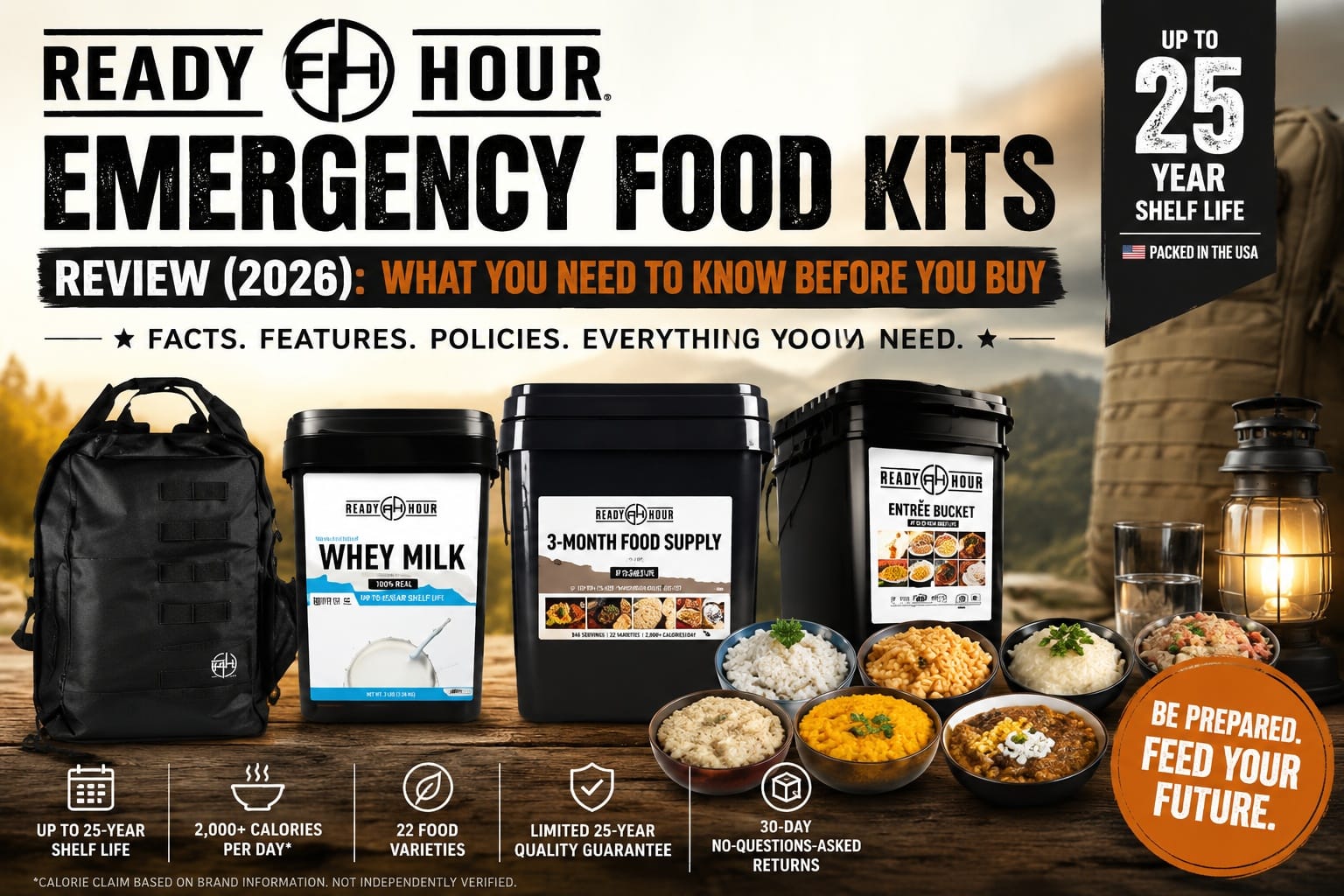
As more households compare emergency preparedness options in 2026, this Ready Hour Emergency Food Kits review explores how the brand's long-term food storage lineup is positioned for home readiness, what buyers should know about shelf life and kit sizing, and which storage, water, pricing, and return-policy factors may influence purchase decisions.
SALT LAKE CITY, UT / ACCESS Newswire / June 8, 2026 / Disclaimers: This is sponsored promotional content and contains affiliate links. This content is promotional and intended for consumer education about a commercially available product. A commission may be earned from qualifying purchases, at no additional cost to readers. Product information in this article is based on Ready Hour's brand-published materials unless otherwise stated. This content is provided in accordance with FTC 16 CFR Part 255. Affiliate relationships do not influence the identification of product limitations, conditions, or policy specifics described in this article.
Ready Hour Emergency Food Kits Review (2026): What Most Buyers Get Wrong About the Shelf Life Claim
Ready Hour emergency food kits are a well-known option in the emergency preparedness and long-term food storage category. If you're trying to figure out whether Ready Hour is actually worth buying - what the shelf-life claims mean in real-world storage conditions, what's inside each kit, where the pricing gets complicated, and what the fine print says about the return policy and warranty - this review covers it all. Every fact here comes directly from Ready Hour's own published website and policies, with nothing invented or assumed.
Here's the short version if you're pressed for time: Ready Hour may be worth considering for buyers who want a pre-assembled, variety-focused emergency food supply and can meet the brand's stated storage conditions. The lineup runs from a $34.95 72-hour starter pack to a $2,997.95 year's supply, with the 3-Month Emergency Food Supply - 22 food varieties, 846 servings, 2,000-plus calories per day per person, according to the brand - sitting at the center. The brand backs its emergency food products with a limited 25-year quality assurance guarantee on manufacturing defects, subject to conditions. What that guarantee does and doesn't cover, how the 30-day return policy actually works, and which kit tier makes sense at which stage of preparedness - that's what you'll find below. The single factor that determines whether the 25-year shelf life claim applies to your storage situation is covered in the shelf life section below - it's the detail most buyers don't check until after they've ordered.
Ready Hour Emergency Food Kits 2026: Fast Facts Every Buyer Should Know in 60 Seconds
Shelf life claim: Up to 25 years - conditional on storage at 55-70°F in a dark location (see shelf life section), per the brand
Return window: 30 days from purchase date - product must be unopened and unused; clock starts at purchase, not delivery
Calorie math: 2,000-plus calories/day per person - multiply by your household size for actual coverage duration
Brand name: Ready Hour (operated by Ready Hour, LLC; a brand within the My Patriot Supply family per published MPS website)
Address: 1175 South Meridian Park Road, Suite H, Salt Lake City, UT 84104
Phone: 888.579.7559 (Mon-Fri 8 am-10 pm, Sat-Sun 9 am-9 pm EST)
Email: [email protected]
Product categories: Emergency food kits, bulk #10 can foods, case pack foods, emergency gear, survival coffee, emergency water
Entry price point: $34.95 (72-hour kit)
Featured kit (per brand positioning): 3-Month Emergency Food Supply at $797.95
Calorie claim (3-month kit): 2,000-plus calories per day for 90 days, per the brand
Shelf life claim: Up to 25 years, per the brand (proper storage conditions required)
Total servings (3-month kit): 846 servings across 22 food varieties, per the brand
Food weight (3-month kit): 108.54 pounds, per the brand
Water required (3-month kit): Approximately 38.5 gallons to prepare the entire kit, per the brand
Packed in the USA, per the brand's product page
Shipping (lower 48 states): Free on orders over $149; $9.95 flat on orders under $149
Return window: 30 days, no-questions-asked, on unopened/unused products
Warranty type: Limited (25-year, manufacturing defects only, emergency food products only)
Subscription model: No - one-time purchase only
Ships to Canada: Yes (rates at checkout)
Ships to Alaska/Hawaii: Yes via USPS, approximately 4 weeks
As of June 2026
Official website: readyhour.com (verify all current pricing, policies, and availability directly before purchasing)
Storage failure consequence: Brand states that "long-term heat can cause premature product expiration" - storing above 70°F may shorten shelf life regardless of the limited warranty coverage
Multi-person household math: A "3-month supply" covers 1 person for 90 days - a 2-person household gets approximately 45 days from the same kit at the same calorie level, per brand calorie math
Water dependency: The 3-month kit requires approximately 38.5 gallons of water to prepare all meals, per the brand. An emergency plan without a separate water storage plan is incomplete
See Current Ready Hour Kit Pricing and Options on the Official Site
Quick Verification Snapshot - What's Publicly Disclosed (As of June 2026)
Operator: Ready Hour, LLC dba Ready Hour - publicly disclosed on Terms of Service page
Physical address: 1175 South Meridian Park Road, Suite H, Salt Lake City, UT 84104 - confirmed across Terms, refund, and shipping pages
Contact phone: 888.579.7559 - confirmed on multiple official pages
Pricing structure: All prices confirmed on readyhour.com product pages (prices subject to change without notice, per Terms)
Calorie and serving counts: Brand-stated on individual product pages - not independently tested by this publication
Shelf life (up to 25 years): Brand-stated, conditional on dark storage at 55-70°F - not independently tested by this publication
Vitamin/mineral coverage (100% of 12 essentials): Brand-stated; achieved only through daily consumption of a variety of kit items - not independently substantiated by this publication
Packing origin (USA): Per brand's meta description on 3-month product page
Return policy: 30-day, no-questions-asked - published at readyhour.com/policies/refund-policy
Limited 25-year guarantee: For manufacturing defects, emergency food products only, original purchases only - full terms at readyhour.com/policies/terms-of-service
Freshness of this snapshot: As of June 2026. Prices, availability, and terms may change - verify at readyhour.com before purchasing
What Ready Hour Emergency Food Kits Are - and Who Actually Needs Them
Ready Hour is a food storage and emergency preparedness brand operated by Ready Hour, LLC, based in Salt Lake City, Utah. On its published "Our Story" page, the brand states that it's part of "a family of companies that have served millions of people like you for decades." This publication hasn't independently verified the affiliated-company structure or the "millions-served" characterization; both are the brand's own stated representations, not claims this article is making on its behalf. The product line runs from entry-level 72-hour kits to multi-year food storage solutions, with the 3-month kit sitting at the center of the brand's messaging as the recommended starting point for serious preparedness.
The core premise is straightforward: modern grocery stores run on what the brand calls a "just in time" supply schedule, carrying only a few days' worth of food under normal shopping patterns. When demand spikes - whether from a natural disaster, a supply disruption, or an emergency - that inventory disappears quickly. Ready Hour's positioning is that having food pre-stored at home removes that vulnerability entirely. Many emergency preparedness organizations recommend maintaining a home food supply as part of basic household readiness - the question is whether Ready Hour's specific products deliver on the brand's stated claims well enough to justify your investment.
That's what this review is designed to help you figure out.
Buyer Takeaway 1: Ready Hour is positioned for long-term emergency food storage, not everyday meal replacement. The brand's framing is explicitly about having food available when stores can't be relied on. If you're evaluating it for any other use case, that context matters for setting expectations.
The Ready Hour Product Line: What They Sell and What It Costs
Ready Hour's product catalog is divided into five main categories: emergency food kits (the core line), bulk #10 cans, case-packed foods, emergency gear, and survival coffee. The emergency food kits are the anchor of the brand and cover a range of time horizons from 72 hours up to a full year.
Here's what the brand publishes as current pricing on readyhour.com. All prices exclude taxes and applicable shipping charges, which are calculated at checkout.
Prices are subject to change without notice per the brand's Terms of Service:
72-Hour Kit Sample Pack (2,000-plus calories/day): $34.95
1-Week Food Supply Ammo Can (2,000-plus calories/day): $89.95
2-Week Emergency Food Supply (2,000-plus calories/day): $147.95
4-Week Emergency Food Supply (2,000-plus calories/day): $277.95
3-Month Emergency Food Supply (2,000-plus calories/day): $797.95
6-Month Emergency Food Supply (2,000-plus calories/day): $1,599.95 (brand lists a reference price of $1,477.95)
1-Year Emergency Food Supply (2,000-plus calories/day): $2,997.95 (brand lists a reference price of $2,877.95)
See Current Ready Hour Kit Pricing and Options on the Official Site
The brand also sells specialty kits - including the Ultimate Breakfast Kit ($129.99, 128 servings), Mega Protein Kit with Real Meat ($199.99, 72 servings), Fruit, Veggie and Snack Mix ($144.99, 122 servings), and Gluten Free Food Kit ($149.99, 120 servings) - plus survival coffee products under the Franklin's Finest line, emergency water pouches, and a gear collection including items like fire masks, emergency tents, and a Waterproof EMP Faraday Backpack.
Note on reference pricing: Where the brand displays a "was" or original price alongside a current price, those are the brand's stated reference points. They may not reflect prevailing market prices at the time you read this. EU buyers should confirm compliance with EU-specific pricing directly with the brand at checkout.
Per-Serving Cost Analysis (calculated from Ready Hour's published pricing and serving counts, as of June 2026): the 72-hour kit at $34.95 for approximately 20 servings works out to roughly $1.75 per serving; the 3-month kit at $797.95 for 846 servings comes to approximately $0.94 per serving; the 1-year kit at $2,997.95 for a brand-estimated 3,480 servings works out to approximately $0.86 per serving. That's a scale efficiency of roughly 51% lower per-serving cost at the 1-year tier versus the 72-hour entry point - a real difference if you're planning for multiple household members or building a longer-term supply. All calculations are based on brand-published prices and serving counts; verify current pricing at readyhour.com before purchasing.
Buyer Takeaway 2: The 2-week kit at $147.95 just clears the $149 free-shipping threshold - but not by enough to qualify for free shipping. The brand's policy is free shipping on orders over $149. You'd want to verify at checkout exactly how close-to-threshold orders are handled, or consider adding an emergency water pouch case ($39.95) to push combined orders past the threshold.
Buyer Takeaway 3: All prices are for single-person supply durations, based on 2,000-plus calories per day. A two-person household buying a "3-month" kit would be looking at roughly 45 days of coverage, not 90. The brand's product pages make it clear that calorie quantities are per person - confirm your household's actual needs before selecting a kit tier.
Inside the 3-Month Emergency Food Supply: What the Brand Includes
The 3-Month Emergency Food Supply is Ready Hour's most prominently featured kit, and it best illustrates the brand's overall approach to variety and caloric density. Here's what the brand publicly discloses as included: 22 food varieties, 846 total servings, according to the official product page:
Good-as-Homemade Entrées (per brand): Mac and Cheese (40 servings), Creamy Stroganoff (24 servings), Homestyle Potato Soup (8 servings), Cheesy Broccoli and Rice Soup (8 servings), Mushroom Rice Pilaf (48 servings), Chili Mac (24 servings), Creamy Alfredo Pasta (12 servings), Spaghetti (16 servings).
Side Dishes (per brand): Honey Wheat Bread Mix (36 servings), Cornbread (36 servings), Creamy Chicken Flavored Rice (40 servings), Southwest Rice (24 servings), Long Grain White Rice (100 servings), Cherrywood Mashed Potatoes (16 servings).
Breakfasts (per brand): Buttermilk Pancakes (130 servings, based on 4-inch pancakes per brand's note), Maple Grove Oatmeal (112 servings), Strawberry Flavored Creamy Wheat (16 servings), Powdered Whey Milk (32 servings).
Snacks and Desserts (per brand): Rice Pudding (24 servings), Banana Chips (24 servings), Chocolate Pudding (20 servings).
Drinks (per brand): Orange Energy Drink Mix (56 servings).
A few things worth knowing about that list. First, the brand explicitly notes it may substitute food or drink products with like-kind items of equal or greater value to expedite delivery - so the exact variety mix you receive could differ from what's listed. Second, the 100% recommended daily value claim for 12 essential vitamins and minerals requires daily consumption of a variety of items from the kit, per the brand's own footnote. You can't achieve that coverage by eating only one item. Third, all meals are prepared by adding water - the entire kit requires approximately 38.5 gallons of water, per the brand.
Buyer Takeaway 4: If you have specific dietary needs - gluten intolerance, dairy restrictions, specific allergen concerns - the standard 3-month kit may not be the right starting point. Ready Hour also sells a dedicated Gluten Free Food Kit (120 servings, $149.99). Contact the brand directly for allergen-specific questions before purchasing.
Buyer Takeaway 5: The water requirement for the 3-month kit (approximately 38.5 gallons) is significant. An effective emergency food plan pairs the food supply with a dedicated water storage or purification plan. The brand sells emergency water pouches ($39.95 for a 64-pouch case) as a starting point, but serious preparedness planning should account for this dependency.
The Ready Hour Shelf Life Claim: What It Requires From Your Storage Space
The up-to-25-year shelf life claim is the headline number in every Ready Hour product listing - and it's also the detail that most buyers accept without reading the attached condition. Before that number means anything for your household's planning, you need to know what it actually requires from your storage space, not just what it promises on the label.
The brand's product page puts it plainly: the kit "should be kept in a dark, cool place with temperatures ranging from 55 to 70 degrees. Cooler is better with Ready Hour Foods; long-term heat can cause premature product expiration." That's the brand's own language, not editorializing. What it means practically: if your only storage option is a garage, attic, or shed that cycles through summer heat, you can't count on anywhere near 25 years of shelf life - and that changes the value calculation significantly.
The brand's limited 25-year quality assurance guarantee for emergency food products specifically covers manufacturing defects - issues with the packaging or the food itself that are defects at the time of manufacture. It does not cover defects caused by improper storage, exposure to temperatures or humidity outside recommended ranges, misuse, tampering, or products purchased from third-party sellers. The guarantee is non-transferable and applies only to original purchases from readyhour.com.
The distinction matters because it affects how you should think about the 25-year claim. The guarantee protects you against something going wrong with the product when it arrives. The shelf life estimate assumes you've met the storage conditions throughout. These are two different things, and conflating them leads to purchase decisions made on incomplete information.
If you've read this far, you now know the detail most buyers who regret this purchase missed. That's not a small thing on an $800 commitment. But there's a second layer that's almost as consequential: whether the return policy actually protects you if you get the storage situation wrong - and the answer is more limited than the "no-questions-asked" label suggests.
Buyer Takeaway 6: The most common way buyers overpay for Ready Hour is by purchasing a multi-month supply before confirming their storage environment. If you can't guarantee cool, dark storage in the 55-70°F range year-round, the 25-year shelf life figure - the brand's most-advertised feature - doesn't apply to your specific situation. That's not a reason not to buy; it's a reason to buy with accurate expectations and a realistic shelf life estimate based on your actual storage conditions.
Buyer Takeaway 7: Two buyers can purchase the same Ready Hour kit and have completely different protection. One who opens it immediately to try it and dislikes it has no option to return it. One who stores it in a hot garage that reaches 90°F in summer has a limited warranty that doesn't cover the resulting damage. Understanding which protection applies to which scenario before you order is the difference between a purchase you're happy with and one you're stuck with. The 30-day no-questions-asked return policy requires the product to be unopened and unused; the 25-year guarantee covers manufacturing defects only, not storage-condition degradation.
Does Ready Hour Food Taste Good?
This is one of the most searched questions in the emergency food category, and it's worth addressing directly - while being clear about the limits of what can be said here.
This publication has not received or independently tested Ready Hour products for taste. What can be assessed is the brand's approach: the product line uses variety (22 food varieties in the 3-month kit) as its core differentiator in the taste dimension, which is consistent with how the brand positions itself against emergency food products that rely on monotonous meal rotation. The inclusion of dessert items (chocolate pudding, rice pudding) and snacks (banana chips) suggests the brand is at least considering palatability beyond purely caloric delivery.
The brand's own language on the 2-week kit page is "whether natural or man-made, no region is immune from the potential for disaster" - framing the question of taste less as a culinary experience and more as acceptable nourishment in a genuine emergency. That framing is honest: emergency food storage is primarily a functional product, and evaluating it by everyday meal standards is probably the wrong framework.
Third-party consumer feedback on emergency food products varies significantly depending on reviewers' expectations, preparation methods, and individual palates. Customer ratings and testimonials found on third-party platforms are not independently audited by this publication. Individual experiences vary. Buyers who want to sample before committing to a large kit purchase have a logical entry point: the 72-hour kit at $34.95 or the Franklin's Finest Coffee sample pouch at $9.95 are both low-cost ways to evaluate the brand's products before committing to a $797.95 investment.
Buyer Takeaway 8: Don't buy a 3-month or 1-year supply as your first Ready Hour purchase if taste is a primary concern. The 72-hour kit is specifically described as "the perfect option for those who are just getting started with their food preparation plans" - per the brand's own product page. Start there.
Ready Hour Shipping: What You Need to Know Before You Order
The shipping logistics for a purchase like this are more important than they'd be for a typical consumer product; you're dealing with heavy, bulky items, potentially a large investment, and delivery timelines that matter more when the products are meant for emergency use. Here's what the brand publicly discloses - and a few things that aren't obvious from the headline numbers:
Free shipping threshold: Orders over $149 to the lower 48 contiguous United States ship free. Orders under $149 ship for a flat $9.95 fee.
Processing speed: The brand states it ships orders within 24 to 48 hours. No weekend processing - the brand notes it does not ship on Saturdays or Sundays.
Carrier: UPS is the primary carrier. UPS only delivers to valid street addresses, not PO Boxes. The brand notes that a PO Box address may cause delays, won't be covered by any UPS Service Guarantee, and may require an address correction charge.
Large orders: Orders over 500 pounds may be shipped via LTL freight and can take an additional 1-2 business days, depending on carrier scheduling and transit times.
Alaska and Hawaii: Free shipping doesn't apply to these states. Delivery to AK and HI via USPS takes approximately 4 weeks once shipped from the warehouse.
Canada: Ready Hour ships to Canada. Rates, duties, and taxes are calculated at checkout.
Delays: The brand notes that occasional shipping delays may occur due to sales spikes, epidemics, natural disasters, national holidays, and emergencies. This is an honest disclosure - and ironically, the events that most motivate emergency food purchases are often the same events that create shipping delays.
Taxes: Taxes and shipping costs are not included in the listed prices and are added at checkout. California and other state buyers should verify applicable taxes at checkout. The brand is registered in Alabama for simplified sellers use tax (program account SSU-R010417611). Confirm the final total at checkout before completing any purchase.
Buyer Takeaway 9: If you're ordering because an emergency is already developing - don't. The brand ships within 24-48 hours under normal conditions, but delivery logistics during an active emergency may not be reliable. Emergency food storage is most useful when you purchase and store it before you need it.
Buyer Takeaway 10: The 2-week kit at $147.95 falls just below the free-shipping threshold. If you're ordering a 2-week kit and want free shipping, adding a $39.95 emergency water pouch case pushes your order to $187.90 - well past the $149 threshold - while also addressing the water storage gap that comes with any food storage plan.
See Current Ready Hour Kit Pricing and Options on the Official Site
The 30-Day Return Clock Starts at Purchase, Not Delivery - What That Means for You
Ready Hour's 30-day return policy is published on their refund policy page, and it's worth reading carefully because it has specific conditions that affect how much protection it actually provides.
What the brand discloses: the return window is 30 days from the purchase date. Returns must be for unopened, unused products in their original packaging and condition. Return shipping is at the buyer's expense. Shipping charges from the original order are not refunded. Once Ready Hour receives and processes the return and determines the product is eligible, a refund is issued to the original payment method.
What this means in practice: if you buy a 3-month kit, store it for 6 months, and then decide you don't want it, you're outside the return window; the clock starts at purchase, not when you decide you'd like your money back. If you open a bucket to sample the food and decide you don't like it, the product is no longer eligible for return; once it's opened, it's yours. The no-questions-asked policy is genuinely flexible, but only within those two conditions: 30 days and unopened.
If you're dealing with a product defect rather than a simple change of mind, the limited 25-year guarantee process is separate from the return policy and has its own steps. The brand requires any claim to be submitted within 30 days of discovering the defect. You'll need to contact Ready Hour at 888.579.7559 or [email protected] with proof of purchase and, if applicable, photos or videos of the defect.
The brand also notes that for items over $75, it recommends using a trackable shipping service or purchasing return shipping insurance. The brand explicitly states it doesn't guarantee receipt of returned items.
Buyer Takeaway 11: If you order a Ready Hour kit, it takes a week to arrive, sits in your garage for another week while you figure out where to store it, and then you open it and realize it's not right for your household - you may already be past your return window. The 30-day clock starts at purchase, not at delivery, and it requires that the product be unopened. Keep your purchase date on record and set a reminder to evaluate before day 25.
Buyer Takeaway 12: The "no-questions-asked" framing is accurate in that you don't need a reason. But it doesn't mean unconditional - the unopened requirement and the 30-day window are genuine limitations. Plan to promptly inspect and confirm product receipt.
How to Read Ready Hour's Marketing Language
Ready Hour's marketing copy uses several phrases that appear on every product page. Most of them are straightforward once you know the context - but a few carry conditions that aren't obvious on first read. Here's what each one actually means.
"2,000-plus calories per day" - This is the brand's stated daily calorie target per person. It's a commonly used standard for adult caloric intake used in food storage planning. The brand's product pages don't disclose how calorie counts are distributed across meals - you'd need individual item nutrition data to verify the breakdown. This publication hasn't independently verified, through laboratory testing, that the kit provides 2,000-plus calories per day for 90 days.
"Up to 25 years" - As discussed above, this is conditional on proper storage (55-70°F, dark, cool). It's the brand's stated maximum under ideal conditions, not a guaranteed outcome under all storage environments.
"100% of the recommended daily value of 12 essential vitamins and minerals" - The brand's own footnote specifies this is achieved only through daily consumption of a variety of items in the kit, not from any single product. This is an important qualifier. Emergency scenarios may limit your ability to prepare specific items each day.
"Packed in the USA" - Per the brand's product page. This refers to where the product is packed/assembled, which may be different from where individual ingredients are sourced. The brand hasn't published a country-of-origin disclosure for individual ingredients.
"22 delicious food varieties" - "Delicious" is the brand's own characterization. The 22 varieties is a verifiable count from the published product page.
"Part of a family of companies that have served millions of people" - The brand states this on its published Our Story page. The affiliated companies aren't named on that page; this publication hasn't independently verified either the affiliated-company structure or the "millions served" characterization. It's the brand's own stated representation.
Buyer Takeaway 13: The brand's marketing language is consistent with standard practices in the emergency food category. None of the phrases identified above is objectively false based on published information - but several carry important conditions that aren't always visible in headline claims. Verify the specifics relevant to your purchasing decision directly with the brand.
Here's the honest answer to whether Ready Hour is worth it - and it's a more specific answer than any other review in this category can give you, because it turns on a single variable only your household can answer: does your available storage space consistently stay between 55 and 70 degrees Fahrenheit?
Is Ready Hour Worth It in 2026? The Answer Depends on One Storage Condition
Whether Ready Hour is worth considering depends entirely on your household's specific situation. Here's a practical framework - and a direct answer for each buyer type:
Ready Hour may be worth considering if: You're serious about building an emergency food supply and want a pre-packaged, variety-focused solution that doesn't require you to manually assemble and rotate your own shelf-stable foods. The 25-year shelf life claim (conditional on proper storage) means that if you buy it, store it correctly, and never need it, you've still potentially bought yourself decades of not needing to think about it again. The 30-day return policy gives you a reasonable evaluation window if you start the conversation with the 72-hour sample pack. The brand ships from Salt Lake City, Utah, and is a verifiable registered US company with published contact information - that's a meaningful baseline of accountability compared to anonymous product listings.
Ready Hour may not be the right fit if you have significant dietary restrictions that aren't met by the standard kit (though the gluten-free kit is available). You can't store products in a 55-70°F environment year-round because the shelf-life claim depends on those conditions. You're primarily interested in everyday meal quality rather than emergency caloric coverage. You're expecting the food to cover multiple household members and haven't recalculated the kit sizes to reflect your actual household count.
On price per serving: The 3-month kit at $797.95 provides 846 servings, which works out to roughly $0.94 per serving. For context: that's in the range you'd expect for purpose-built long-term food storage, below what you'd pay for most freeze-dried meal alternatives priced per serving, and above what you'd pay for bulk raw ingredients stored independently. Whether that's good value depends on how much you price your own time and the convenience of a ready-to-store, pre-calculated kit.
Here's a longer-form assessment for buyers who've already done the baseline math. Ready Hour's pricing structure is designed around a scalability assumption: each tier covers one adult for its stated duration, which means that a household of two buying a 3-month kit is actually buying 45 days of coverage - not 90 - and a family of four would need four kits to cover the same period; that arithmetic, applied honestly, changes the cost comparison considerably for any household with more than one adult. The brand doesn't hide this; it's implicit in how each product page presents the calorie math, but it's easy to overlook when the headline says "3-Month Supply" without the per-person qualifier. Buyers who run the numbers correctly for their household size, confirm that their storage environment meets the 55-70°F requirement, and start with the 72-hour sample kit before scaling up are the ones who tend to find the most satisfaction with long-term food storage investments generally; the ones who skip those steps are the ones who end up with a product in a hot garage that doesn't meet the shelf life condition it was purchased for.
Buyer Takeaway 14: Before buying a multi-month supply, buy the 72-hour kit. $34.95 is a legitimate sampling cost for a potential $ 800-$3,000 commitment. Taste it, assess the preparation, and confirm the kit suits your household. The 72-hour kit is described by the brand as the ideal starting point for new buyers - a practical buyer sequence consistent with the brand's stated positioning and reasonable given the investment scale of the larger kits.
Ready Hour vs. Building Your Own Emergency Food Supply
One comparison every serious emergency food buyer eventually makes is between Ready Hour (or any pre-packaged kit) and building your own storage. This isn't a knock on Ready Hour - it's a legitimate planning question worth addressing.
The case for Ready Hour: The brand has done the variety planning, calorie calculation, and packaging for you. All items in the 3-month kit are designed to be shelf-stable and require consistent storage, according to the brand. The 25-year shelf-life claim (under proper conditions) is longer than that of most off-the-shelf grocery items. You don't need to manually rotate stock or track expiration dates across dozens of individual items.
The case for building your own: Per-calorie costs for bulk rice, beans, oats, and canned goods are lower than per-calorie costs in any pre-packaged kit. You have complete control over variety, allergen profiles, and dietary preferences. You can prioritize foods your household already eats, which improves morale and consumption in actual emergencies. The tradeoff is time, logistics, and the ongoing effort of rotation management.
Many preparedness-focused households view pre-packaged kits and self-assembled pantry storage as complementary rather than competing choices - a core packaged supply addresses the "severe disruption" scenario while an expanded rotating pantry handles the longer tail. Ready Hour's product line is positioned for the core scenario: serious, multi-week or multi-month disruptions where having reliable, organized food storage matters most.
Buyer Takeaway 15: If you're new to emergency food planning, the 72-hour or 2-week Ready Hour kit is a better starting point than trying to build a comprehensive pantry from scratch. It gives you immediate coverage while you develop the broader system over time.
What to Verify Before Buying Any Emergency Food Kit - Ready Hour or Anyone Else
Every emergency food brand in this category uses similar language - shelf life claims, calorie targets, variety counts. Most buyers compare headlines without comparing the conditions attached to those headlines. Here are the specific factors that determine whether any kit - Ready Hour or a competitor - actually delivers on what's advertised for your household's specific situation:
Serving count and calorie density: How many servings does the kit contain, and what's the actual calorie count per serving? A kit with 300 servings at 150 calories each isn't the same as one with 200 servings at 400 calories each - even though "300 servings" sounds bigger. Run the total calorie math for each kit you're comparing.
Shelf life conditions: Every brand's shelf life claim includes storage conditions. Get the specific temperature range and storage requirements. A 25-year claim stored at 55-70°F is a different product than the same claim if you're storing it in a space that hits 90°F in summer.
Warranty type and limitations: Is it a full or limited warranty? What does it cover, and what does it exclude? Get the specific claim window (how many days after you discover a defect do you have to file).
Return policy specifics: Is the return window based on the purchase date or the delivery date? Does the product need to be unopened? Who pays return shipping? What's the refund method?
Operator transparency: Is there a published physical address, phone number, and email? Can you reach a human? Is the company registered in a verifiable US jurisdiction with accessible Terms of Service?
Substitution policy: Will the brand substitute items in your kit? What's the standard - "equal or greater value" is a defensible commitment, but you should know it exists before you order.
Dietary accommodation: Does the brand publish allergen data for each product? Is there a gluten-free option with the same calorie coverage?
Ready Hour's published answers to each of these: 846 servings at 2,000-plus calories per day (per brand); up to 25-year shelf life at 55-70°F (per brand); limited warranty covering manufacturing defects for 25 years, claims within 30 days of defect discovery; 30-day return on unopened products from purchase date, buyer pays return shipping; published address, phone, and email with weekend hours; substitution policy published on product page (like-kind items of equal or greater value); gluten-free kit available at $149.99. That's what's publicly verifiable. Hold any competing brand to the same standard before making your final decision.
Ready Hour Gear and Non-Food Products
While the emergency food kits are the brand's anchor product, Ready Hour also sells a range of emergency gear. The gear line includes: USB Emergency Lantern and Power Bank, Emergency Tents, Fire Evacuation Mask, Waterproof EMP Faraday Backpack, 47-Piece Survival Kit ($34.95), 5-in-1 Bushcrafter Hatchet ($79.95, ships unsharpened per brand's safety note), Survival Folding Shovel ($59.95), and the 5-in-1 Survival Aid Tool and Whistle ($4.95).
It's worth noting that Ready Hour's Limited 25-Year Quality Assurance Guarantee covers emergency food products only - gear items aren't included. If you're buying gear alongside a food kit, your protection on those items is the standard 30-day return policy for unopened, unused products. The brand's warranty language for non-food items isn't separately detailed on the main policy pages - contact Ready Hour directly at 888.579.7559 for specific gear warranty questions.
The gear line is clearly positioned as a complement to the food storage offering, not a standalone product category. The brand's framing - "depend on these items to get you through a crisis" - is consistent with the overall preparedness positioning. None of the gear items reviewed here has been independently tested by this publication.
Ready Hour Survival Coffee: What Franklin's Finest Is
Ready Hour also sells Franklin's Finest Survival Coffee - the brand's entry into the survival coffee category. It comes as a 720-serving bucket at $159.99 or a 60-serving sample pouch at $9.95. The brand's product page calls it "the first ever emergency survival coffee with a true, up to 30-year shelf life" - though that "up to" number carries the same proper storage conditions as the food kits, so the same planning logic applies.
The 30-year shelf life claim is the brand's stated figure and hasn't been independently verified by this publication. For buyers evaluating the coffee as part of a complete emergency supply, the $9.95 sample pouch is a low-commitment way to taste and prepare it before committing to the $159.99 bucket.
The Ready Hour Ordering Process: What to Expect
The ordering process is spelled out clearly in Ready Hour's Terms of Service. You'll review and confirm your order - delivery address, payment method, all of it - before submitting. The brand sends an email acknowledgment shortly after, and your order is considered accepted once that email goes out.
Title and risk of loss in purchased products pass to the buyer upon the shipping carrier's receipt of the goods from Ready Hour. That means once UPS picks up your order, it's on you. Shipping and delivery dates are estimates and can't be guaranteed - the brand makes this explicit.
The brand accepts: American Express, Apple Pay, Discover, Mastercard, PayPal, Venmo, and Visa.
The brand also has a 30-day price match guarantee: if they lower their online price within 30 days of your purchase of the same product, they'll match the lower price as an online store credit, upon request. One price match per identical item, per customer, at the current pre-tax price. This applies only to readyhour.com prices - not to prices from third-party websites or retail stores.
Buyer Takeaway 16: Keep your order confirmation email and purchase date. You'll need them for any return, warranty claim, or price match request. The brand explicitly requires a receipt or proof of purchase for returns.
Who Ready Hour Is - and Is Not - Right For
Emergency food storage isn't a one-size-fits-all category. Before committing to a Ready Hour purchase, here's a plain-English breakdown of the situations where it makes sense versus where you'd want to think harder.
Ready Hour is positioned for Households that want a pre-assembled, variety-rich emergency food supply with a long shelf life and don't want to manage the assembly process themselves. Buyers who prioritize variety over maximum caloric value per dollar. People new to emergency preparedness who want a known starting point rather than researching individual shelf-stable items. Households that have cool, dark storage space available (55-70°F year-round).
Ready Hour may not be the right first choice for Buyers with significant food allergies or dietary restrictions beyond gluten intolerance (a gluten-free kit is available, but detailed allergen data requires direct inquiry with the brand). Buyers in Alaska, Hawaii, or Canada who need rapid delivery - the shipping timelines are materially longer for these locations. Buyers who prioritize the lowest possible cost per calorie and are willing to do the assembly work themselves. Buyers who need to feed multiple adults on a single-person-duration kit's worth of food without adjusting quantity.
Buyer Takeaway 17: Ready Hour is best evaluated as a long-term infrastructure purchase, not a recurring-use product. The value proposition is peace of mind and preparedness coverage - not daily meal quality or culinary variety. When you price it through that lens, the per-serving math looks very different from when you compare it to everyday food costs.
Buyer Verification Checklist Before Purchasing Ready Hour
Before you place your order, run through this checklist. Every single item is something you can verify yourself - either at readyhour.com or by calling 888.579.7559. None of it requires guesswork. The brand publishes all of it. The question is whether you've actually looked it up for your specific household before committing real money:
Confirmed your household count: Calorie quantities are per person per day. A two-person household needs twice the kit duration to cover the same time period.
Confirmed your storage environment: Do you have a consistently cool (55-70°F), dark location? If not, the shelf life claim doesn't apply to your specific storage situation.
Confirmed your dietary requirements: Reviewed the full food variety list for the kit you're considering. For specific allergen questions, contact Ready Hour directly before purchasing.
Plan your water storage: The 3-month kit requires approximately 38.5 gallons of water to prepare. Your emergency plan addresses this separately.
Checked current pricing at checkout: The prices in this article are current as of June 2026. Prices change without notice per the brand's Terms. Confirm the final total - including applicable taxes and shipping - at checkout before completing your order.
Confirmed free shipping eligibility: Your order total exceeds $149 for the lower 48 states. If not, $9.95 flat shipping applies.
Noted your purchase date: The 30-day return window starts from the purchase date, not the delivery date. The 30-day price match window also starts at the time of purchase.
Decided whether to start with the 72-hour kit: If you haven't tried Ready Hour food before, the $34.95 entry-level kit is a low-commitment evaluation option before scaling up.
Check Current Ready Hour Kit Availability and Pricing Before You Decide
FAQ: Ready Hour Emergency Food Kits - The Questions Buyers Actually Ask
These are the questions buyers ask most before purchasing Ready Hour kits. Each answer is based exclusively on what the brand has publicly disclosed.
How long does Ready Hour food last?
Ready Hour states its emergency food products can last up to 25 years - but that number depends entirely on the storage conditions, which you can't meet. According to the brand's product pages and limited warranty terms, this claim is conditional: the brand specifies storage in a dark, cool location with temperatures between 55 and 70 degrees Fahrenheit. Cooler temperatures are preferable, per the brand's own note. Products stored in hot environments, exposed to humidity, or improperly handled are at risk of premature expiration. The "up to 25 years" figure represents the brand's stated maximum under ideal conditions - it's not a guaranteed outcome for all storage situations. Buyers should plan storage environments accordingly before relying on this claim as a basis for planning.
What's in a Ready Hour emergency food kit?
Ready Hour emergency food kits vary by tier, but the 3-Month Emergency Food Supply - the brand's flagship - includes 846 total servings across 22 food varieties, according to the official product page. These include entrées (Mac and Cheese, Creamy Stroganoff, Chili Mac, Mushroom Rice Pilaf, Spaghetti, Creamy Alfredo Pasta, and others), side dishes (Long Grain White Rice, Cherrywood Mashed Potatoes, Honey Wheat Bread Mix, Cornbread), breakfasts (Buttermilk Pancakes, Maple Grove Oatmeal), snacks and desserts (Banana Chips, Chocolate Pudding, Rice Pudding), and the Orange Energy Drink Mix. All items are designed to be prepared with water. The brand notes it may substitute like-kind items of equal or greater value to expedite delivery.
Does Ready Hour ship free?
Ready Hour ships free to the lower 48 contiguous United States on orders over $149. Orders below $149 ship for a flat $9.95, per the brand's published shipping policy. Free shipping doesn't apply to Alaska, Hawaii, or Canada. Alaska and Hawaii receive delivery approximately 4 weeks after shipment via USPS. Canadian buyers see rates, duties, and taxes calculated at checkout. The brand ships within 24 to 48 hours under normal conditions and doesn't process orders on Saturdays or Sundays.
What is Ready Hour's return policy?
Ready Hour offers a 30-day, no-questions-asked return policy on unopened, unused products returned in their original packaging and condition, according to the brand's published refund policy. The buyer is responsible for return shipping costs. Original shipping charges are not refunded. Returns must be initiated, and the product must be received at the brand's Salt Lake City warehouse within 30 days of purchase. Products purchased from third-party retailers (including Amazon) are not eligible - those are subject to the retailer's own return policy. The brand notes it doesn't guarantee receipt of returned items, so tracking is recommended for items over $50.
Is there a Ready Hour warranty?
Yes. Ready Hour offers a Limited 25-Year Emergency Food Product Quality Assurance Guarantee under the brand's Terms of Service. This limited warranty guarantees that emergency food products will be free of manufacturing defects - both in the packaging and the food - for up to 25 years from the invoice date. It does not cover defects caused by tampering, abuse, misuse, improper handling, or storage outside the recommended temperature and humidity ranges. It doesn't apply to AS-IS products, products purchased from third-party sellers, or any products other than emergency food (gear items are excluded). The guarantee is non-transferable and applies only to original readyhour.com purchases. The claim must be submitted within 30 days of discovering the defect. Contact Ready Hour at 888.579.7559 or [email protected] to initiate a claim.
How many calories per day does Ready Hour provide?
Ready Hour's emergency food kits are designed to provide 2,000-plus calories per day per person, according to the brand's product pages. This applies to the kits in the core emergency food lineup - including the 72-hour, 1-week, 2-week, 4-week, 3-month, 6-month, and 1-year supply options. All calorie quantities are stated per person - a multi-person household needs to multiply by household size. The 100% recommended daily value coverage for 12 essential vitamins and minerals (claimed for the 3-month kit) requires daily consumption of a variety of items from the kit, per the brand's own footnote on the product page.
Is Ready Hour food good for everyday use?
Ready Hour positions its emergency food products specifically for emergency preparedness and food storage scenarios, not for everyday meal use, according to the brand's published Our Story page and product descriptions. The brand's framing is explicitly about having reliable nutrition available when normal food supply channels aren't dependable. That said, the products are edible food that could technically be prepared at any time - the brand doesn't prohibit regular consumption. The practical consideration is cost: the per-serving math of emergency food storage isn't competitive with everyday grocery shopping for normal household use. The brand's optimal use case is storage, not daily cooking.
How does Ready Hour compare to other emergency food brands?
This publication doesn't make head-to-head comparative claims about competitor products without verified comparative data. What can be stated factually about Ready Hour's positioning: the brand offers a 25-year shelf life claim (conditional on proper storage), a 22-variety selection in the 3-month kit, a per-serving cost of roughly $0.94 for the 3-month kit based on published pricing, a Limited 25-Year Quality Assurance Guarantee (manufacturing defects), a 30-day no-questions-asked return policy (unopened only), and a verifiable US address and contact information. Buyers comparing alternatives should apply the same verification criteria: verify calorie claims, shelf life conditions, return policy specifics, warranty type, warranty limitations, and claim eligibility - and confirm operator registration for any brand they're evaluating.
How much water do I need to prepare Ready Hour meals?
Specifically for the 3-Month Emergency Food Supply, the brand states that the total water required to prepare the entire kit is approximately 38.5 gallons, according to the official product page. The brand doesn't break this down by individual serving on the main kit page - nutrition facts pages for individual items may include per-serving water requirements. This water requirement is a meaningful planning factor: 38.5 gallons over 90 days amounts to roughly 0.43 gallons per day for food preparation alone. A complete emergency preparedness plan needs a separate water storage or purification plan to cover this dependency.
Can I order Ready Hour if I live in Canada or Hawaii?
Ready Hour ships to Canada, according to the brand's published shipping policy. Canadian buyers see rates, duties, and applicable taxes calculated at checkout. Ready Hour also ships to Alaska and Hawaii, but without the free shipping option available to the lower 48 contiguous states. For Alaska and Hawaii buyers, the brand estimates approximately 4 weeks for delivery via USPS once shipped from the Salt Lake City warehouse. Buyers in those regions should factor delivery timelines into their planning and shouldn't rely on emergency food delivery during an active emergency - pre-order well in advance.
What is the Ready Hour price match guarantee?
Ready Hour offers a 30-day price-match guarantee for orders placed on readyhour.com, per the brand's published Terms. If the brand lowers its online price within 30 days of your purchase of the same product, it will match the lower price as an online store credit, upon request. One price match per identical item, per customer, applies. The guarantee is limited to readyhour.com prices - it doesn't cover prices from third-party websites, retail stores, or other locations. All price matches are at the current pre-tax price available to all customers. Contact the brand to request a price match within the 30-day window.
Does Ready Hour ship fast?
Under normal conditions, Ready Hour states it ships orders within 24 to 48 hours from its Salt Lake City, Utah, warehouse, according to the brand's shipping policy. The brand doesn't process shipments on weekends (Saturday or Sunday). Delivery after shipment depends on UPS transit times for most orders in the lower 48 states. Large orders over 500 pounds may ship via LTL freight with an additional 1-2 business day transit time. The brand explicitly notes that delays can occur due to sales spikes, natural disasters, epidemics, and other events - the same events that tend to prompt emergency food purchases. Ordering ahead of any anticipated need is the brand's implicit recommendation and consistent with good preparedness practice.
What's the difference between Ready Hour's food kits and bulk #10 cans?
Ready Hour sells both pre-assembled emergency food kits and individual bulk foods in #10 cans, according to the brand's product catalog. The emergency food kits are pre-calculated packages designed for a specific number of days at 2,000-plus calories per day - they're all-inclusive and organized for a defined time horizon. The #10 cans are individual bulk food items (like flour, specific entrees, or other staples) sold in larger commercial-grade cans that the brand describes as making "feeding large numbers of people during an emergency easy." The #10 cans allow buyers to customize their storage by food type rather than buying a prepackaged variety pack. Which approach makes sense depends on how much flexibility you want in building your supply.
Is Ready Hour a trustworthy brand?
What can be verified about Ready Hour: the brand is operated by Ready Hour, LLC, a registered entity with a published physical address (1175 South Meridian Park Road, Suite H, Salt Lake City, UT 84104), published contact phone (888.579.7559), and published email ([email protected]). The brand publishes its Terms of Service, refund policy, and shipping policy with specific disclosures - that level of policy transparency is a meaningful baseline. The brand's limited 25-year guarantee is a specific, written warranty with disclosed conditions and a claims process. This publication hasn't independently audited the brand's operations, manufacturing practices, or customer service records. Buyers who want additional assurance should contact the brand directly, verify the address independently, and review publicly available third-party feedback through their own judgment.
How much does a Ready Hour 1-year food supply cost?
As of June 2026, Ready Hour lists the 1-Year Emergency Food Supply at $2,997.95 on readyhour.com, according to the brand's product catalog. The brand also lists a reference price of $2,877.95 - that's the brand's own stated reference point and may not reflect prevailing market prices. Taxes and applicable shipping are calculated at checkout and are not included in the listed price. For orders over $149 to the lower 48 states, shipping is free - and a 1-year supply order clearly qualifies. Buyers should confirm the final total at checkout, including taxes, before completing the order. Prices are subject to change without notice per the brand's Terms.
What happens if Ready Hour substitutes a different food in my kit?
Ready Hour's 3-month kit product page includes a note disclosing that the brand may substitute a food or drink product with like-kind items of equal or greater value to expedite delivery, according to the official product listing. This means the exact 22-variety breakdown published on the product page isn't guaranteed - you could receive a different variety in place of a listed item. The brand's stated standard is equal to or greater than the value. If specific food items are important to you (for dietary, allergen, or preference reasons), contact Ready Hour before ordering to ask about the likelihood of substitutions for your specific kit at the time of purchase.
Does Ready Hour food taste good?
This publication hasn't independently tasted or tested Ready Hour products, so any answer here would be fabricated rather than factual. What can be said: the brand describes its products as "delicious" across product pages, and the 3-month kit includes 22 food varieties specifically designed to prevent meal fatigue, per the brand's positioning. The most practical path to answering the taste question for your household is the 72-hour kit at $34.95 - the brand's own recommended entry point for first-time buyers, and the lowest-commitment way to evaluate preparation and palatability before committing to a $797 or larger purchase. Customer ratings and testimonials on third-party platforms aren't audited by this publication; individual experiences with taste vary.
Is Ready Hour the same as My Patriot Supply?
Ready Hour is a brand within the My Patriot Supply family of companies, according to the publicly available My Patriot Supply website. The two brands are related but operate under different product lines and storefronts. Ready Hour products are sold directly at readyhour.com and are operated by Ready Hour, LLC, as stated in their published Terms of Service. My Patriot Supply operates its own storefront at mypatriotsupply.com. This publication has no affiliation with either entity. Buyers researching the brand relationship should verify the current corporate structure directly with Ready Hour at 888.579.7559 or [email protected].
How do you store Ready Hour food correctly?
Ready Hour's brand publishes specific storage requirements that determine whether the shelf life claim applies. Per the official product page: store in a cool, dark location at a consistent temperature between 55 and 70 degrees Fahrenheit. The brand explicitly states that "cooler is better" and that "long-term heat can cause premature product expiration." This means a climate-controlled interior room or basement is the intended storage environment - not a garage, attic, shed, or any space that fluctuates with outdoor temperatures. The brand also notes that unopened product pouches inside opened buckets retain their individual shelf life. Buyers should confirm their specific storage space meets these conditions before purchasing, since the limited warranty does not cover defects caused by improper storage outside the recommended temperature range.
Does Ready Hour food expire?
All Ready Hour emergency food products have a stated shelf life and will eventually expire. The brand claims up to 25 years for its emergency food products under proper storage conditions - specifically, 55 to 70 degrees Fahrenheit, dark storage, and consistent maintenance - per the official product pages. The brand also claims that its survival coffee products carry a 30-year shelf life claim under similar conditions. These are the brand's stated maximums under ideal conditions. Actual shelf life in any specific storage environment will vary based on temperature, humidity, and handling. The brand's limited 25-year quality assurance guarantee covers manufacturing defects; it does not extend the shelf life or guarantee a specific outcome if storage conditions aren't met.
Can you eat Ready Hour food every day?
Ready Hour positions its emergency food products for emergency preparedness and food storage rather than everyday use, per the brand's published "Our Story" page and product descriptions. The products are food - they can technically be consumed at any time - but the brand's framing is explicitly about having reliable nutrition available when normal food supply channels aren't dependable. The practical consideration is cost: at approximately $0.94 per serving for the 3-month kit, the economics don't compete with everyday grocery shopping for routine household use. For buyers considering Ready Hour as a rotation food source or a budget meal option during tight periods, the brand doesn't prohibit it - but the product line is engineered for shelf stability and caloric density in an emergency context, not for culinary variety or everyday nutritional optimization.
Ready Hour 2026: What This Review Concludes
Ready Hour has a clear and established position in the emergency preparedness market. The brand's lineup runs from a $34.95 72-hour starter pack to a $2,997.95 year's supply - all backed by a limited 25-year quality-assurance guarantee for manufacturing defects and a 30-day, no-questions-asked return policy for unopened items.
What you can verify about Ready Hour: the brand is operated by Ready Hour, LLC, a registered US company with a disclosed physical address (1175 South Meridian Park Road, Suite H, Salt Lake City, UT 84104), a publicly listed phone number (888.579.7559), and a published contact email ([email protected]) - and that baseline of verifiable business identity is something you should expect from any emergency food brand before purchasing from them. Pricing, product contents, shipping terms, return conditions, and warranty specifics are all published on readyhour.com; the limited warranty is properly designated as "limited" - not "standard" - and has specific, published conditions that any careful buyer should read before assuming coverage. There's no subscription, no auto-renewal, and no hidden recurring charge; what you pay at checkout is what you owe.
What requires your own judgment: does the taste and variety work for your household? Does your storage space actually meet the temperature conditions required by the shelf life claim? Is the price point right for your preparedness budget and timeline? Have you done the per-person calorie math for your actual household size? Those are the questions only you can answer - and they're the ones that determine whether Ready Hour is the right fit for you specifically.
The brand's own best advice - embedded in its product descriptions - is sound: start with the 72-hour kit if you're new to emergency food storage, build toward the 3-month kit as a serious preparedness floor, and use the 30-day return window to evaluate before scaling up. That's a sensible buyer's sequence.
Buyer Takeaway 18: If you've done your homework on storage conditions, household calorie needs, and dietary requirements, Ready Hour may be a potentially suitable option in the emergency food storage category. The $797.95 three-month kit is a meaningful purchase - don't make it without first taking the $34.95 test drive. That one step costs almost nothing and answers every question about taste and preparation before you commit to a significant investment.
Explore Ready Hour's Full Emergency Food Kit Line Before You Decide
Frequently Compared: Ready Hour Kit Tiers Side by Side
Ready Hour 72-Hour Kit: $34.95 - entry-level, 2,000-plus calories/day per person for 3 days - ideal first purchase for new preparedness buyers, per the brand
Ready Hour 1-Week Ammo Can: $89.95 - 2,000-plus calories/day for 7 days - tactical ammo can packaging, per brand
Ready Hour 2-Week Kit: $147.95 - 2,000-plus calories/day for 14 days - just under free-shipping threshold
Ready Hour 4-Week Kit: $277.95 - 2,000-plus calories/day for 28 days - 1-month coverage per person
Ready Hour 3-Month Kit: $797.95 - 2,000-plus calories/day for 90 days - 22 varieties, 846 servings, flagship product
Ready Hour 6-Month Kit: $1,599.95 - 2,000-plus calories/day for 180 days - 22 varieties per brand
Ready Hour 1-Year Kit: $2,997.95 - 2,000-plus calories/day for 365 days - maximum single-person coverage offered
All prices as listed on readyhour.com as of June 2026. Subject to change without notice. Taxes and applicable shipping excluded. Confirm at checkout.
Buyer Takeaway 19: The 4-week kit at $277.95 is the minimum purchase that makes sense as a standalone emergency floor. Federal emergency preparedness resources - including guidance published at Ready.gov - recommend keeping non-perishable food and emergency supplies available for at least several days. Buyers who want longer-duration coverage can build on that basis, considering household size, location, and individual risk tolerance. The 72-hour and 1-week kits are a starting point - they're not a complete plan for extended disruptions on their own, which is why the brand's lineup scales all the way to a year.
How This Article Was Researched and What It Cannot Verify
Transparency about sourcing isn't just a compliance requirement here - it's genuinely useful information for a buyer evaluating whether to trust what they're reading. Here's exactly what this article is based on and what it can't claim to know.
Sources used: The official Ready Hour website (readyhour.com), specifically the product pages for each kit tier, the Terms of Service page, the Refund Policy page, the Shipping and Returns Policy page, and the Our Story page - all accessed and verified as of June 2026. All prices, serving counts, calorie claims, shelf life parameters, return terms, warranty conditions, contact details, and shipping policies in this article come directly from those published pages.
What this article cannot verify independently: Taste, texture, or palatability of any Ready Hour product. Whether the calorie counts or serving sizes match what a real household would actually consume per meal. Whether the 25-year shelf life claim holds under any specific real-world storage condition. Whether individual ingredients meet any particular quality standard beyond what the brand publishes. Whether customer reviews on any platform reflect genuine, unbiased experiences.
What this article is: A sponsored advertorial produced from publicly available information, with disclosed affiliate relationships. It is not a product test, a laboratory analysis, a nutritional audit, or an independent editorial review. Every performance claim described here is the brand's own stated claim - attributed as such throughout - not an independent finding of this publication.
Buyer Takeaway 19A: If you want taste testing, several third-party preparedness review sites have published independent evaluations of Ready Hour products. This article doesn't replicate that. What it provides instead is a complete map of every policy, price, condition, and term the brand has published - organized so you can make an informed purchase decision without reading the full Terms of Service yourself.
Previous Coverage: Ready Hour Expands 2025 Emergency Food Storage Solutions With Calorie-Dense Long-Term Meal Kits
Contact Ready Hour Directly for Purchase Questions
Ready Hour's contact information is published on readyhour.com and in their Terms of Service:
Phone: 888.579.7559
Hours: Monday through Friday, 8 am to 10 pm, Saturday through Sunday, 9 am to 9 pm Eastern time
Email: [email protected]
Mailing address: 1175 South Meridian Park Road, Suite H, Salt Lake City, UT 84104
For return authorizations, warranty claims, or general order questions, the phone line is your best starting point - the hours are genuinely generous and include weekend coverage, which is more accessible than you'd expect from most brands in this category. If you'd rather communicate by email, [email protected] goes to the same team.
Visit the Ready Hour Emergency Food Kit Lineup - Verified Pricing and Current Availability
Disclosure and Regulatory Information
Editorial Independence Notice: This content is a sponsored advertorial and may contain affiliate links. This publication is not affiliated with, controlled by, or operated by Ready Hour, LLC or My Patriot Supply. This article does not purport to be an independent third-party review site; it is a paid promotional advertorial with disclosed affiliate relationships. Product descriptions, specifications, warranty terms, pricing, serving counts, calorie information, shelf-life estimates, shipping policies, and other product-related details are based on information published by Ready Hour on the official website (readyhour.com) at the time of writing unless otherwise stated. Readers should verify all current product information directly through the official Ready Hour website before making a purchase decision. This publication does not independently substantiate, test, or endorse any product claim described herein.
Food Product Notice: This article does not make medical, disease-treatment, or healthcare claims. Ready Hour products discussed here are food products intended for emergency preparedness - not dietary supplements, drugs, or medical products. Nothing in this article should be interpreted as medical or nutritional advice. Consumers seeking guidance on food safety and emergency storage practices should consult resources published by the U.S. Department of Agriculture (USDA), the U.S. Food and Drug Administration (FDA), and Ready.gov - federal emergency preparedness resources published by the U.S. government.
Affiliate Disclosure and Material Connection: This article contains affiliate links to Ready Hour products. A commission may be earned on qualifying purchases made through those links, at no additional cost to the reader. This material connection is disclosed in accordance with FTC 16 CFR Part 255 (Guides Concerning the Use of Endorsements and Testimonials in Advertising). The existence of this affiliate relationship does not influence editorial content, the characterization of product features, or the identification of limitations and conditions described in this article.
Trademark Acknowledgment: "Ready Hour" is a trademark of Ready Hour, LLC, as stated in the brand's publicly published Terms of Service. This article references the Ready Hour brand and products for identification, review, and consumer education purposes under nominative fair use. No affiliation, sponsorship, endorsement, or partnership with Ready Hour, LLC is implied by reference to the brand or its products. The brand name is used solely to identify the subject of this review.
Geographic and Jurisdiction Disclosure: This article reflects information applicable primarily to US buyers in the lower 48 contiguous states. Shipping policies, pricing, and warranty terms may differ for buyers in Alaska, Hawaii, Canada, or other jurisdictions. Canadian buyers and buyers in provinces with consumer protection statutes that provide different or additional warranty or return rights should consult Ready Hour directly and review applicable local consumer protection laws. EU buyers should note that "before" or reference prices displayed alongside current prices are the brand's own stated reference points and may not reflect prevailing market prices; EU pricing compliance should be confirmed directly with the brand. Nothing in this article constitutes legal or financial advice. Buyers are encouraged to review the brand's current Terms, refund policy, and shipping policy at readyhour.com before making any purchase decision.
California Consumer Advisory: California residents purchasing consumable products should check product labels and packaging for any Proposition 65 (Safe Drinking Water and Toxic Enforcement Act) warnings required by California law. This publication does not assess California Proposition 65 compliance for specific food products. Ready Hour's products are food items - buyers in California should review the product labeling they receive and contact Ready Hour directly with any Prop 65 questions.
Material Limitations of This Review. This review is based exclusively on publicly available materials, including the official Ready Hour website (readyhour.com), the brand's published Terms of Service, Refund Policy, and Shipping and Returns Policy, as well as publicly accessible product pages as of June 2026. This publication has not received compensated product samples for testing, has not interviewed Ready Hour brand personnel, has not been granted access to internal product specifications beyond what is publicly published, and has not conducted laboratory, nutritional, or field performance testing of any Ready Hour product. Claims described in this article as "according to the brand" or "per the brand" reflect what Ready Hour has publicly stated and have not been independently substantiated by this publication. Buyers are encouraged to verify any claim that materially affects their purchase decision by contacting Ready Hour directly using the published support channels listed above.
Third-Party Consumer Feedback Platforms. This article references third-party consumer feedback platforms only in general terms. This publication does not endorse, vouch for, audit, or accept responsibility for the accuracy, completeness, or fairness of customer reviews posted on any third-party platform, including but not limited to general-purpose review sites, social media platforms, and online discussion forums. Customer ratings and testimonials are brand-reported or consumer-reported on third-party platforms and are not independently audited by this publication. Individual experiences vary. Buyers consulting third-party reviews are encouraged to evaluate them critically, look for verified-purchase indicators where available, and weigh reviewer-specific context against their own situation.
Forward-Looking Statements and Article Accuracy. This article reflects information available as of June 2026 and was prepared using reasonable care to be accurate and useful at the time of publication. Product specifications, pricing, promotional offers, shipping policies, warranty terms, return policies, contact information, and third-party feedback data may change after publication without notice. Statements describing expected buyer outcomes, shelf life durations, performance expectations, or category trends are educational observations based on publicly disclosed brand information, not guarantees. No representation is made that the information will remain accurate in the future, and no warranty of merchantability, fitness for a particular purpose, or non-infringement is provided in connection with the editorial content of this article. Readers should rely on the official Ready Hour website (readyhour.com) as the authoritative source for current product information prior to any purchase decision.
Reasonable Consumer Standard. This article is written for a general adult consumer audience and intends its statements to be interpreted as a reasonable consumer would in context. Where a statement could otherwise be read as a brand-substantiated fact, attribution language such as "according to the brand," "brand-stated," "per the brand," "per the official policy," or "as published by Ready Hour" identifies it as a brand claim that has not been independently verified by this publication. Buyers are encouraged to confirm all material claims directly with Ready Hour before purchasing.
SOURCE: Ready Hour