



Tuesday, 16 June 2026 03:30 PM
Advertorial
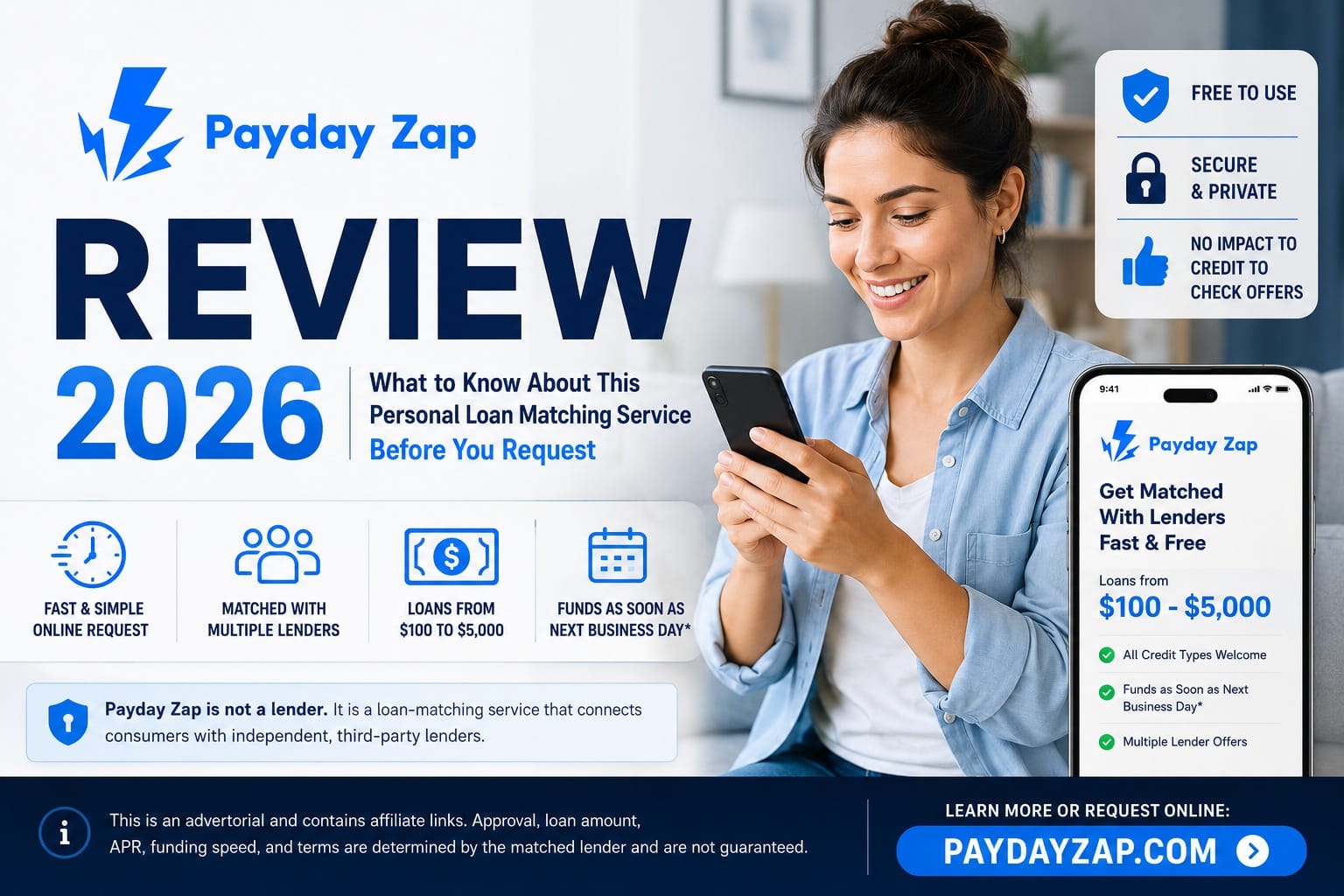
As more borrowers compare short-term funding options in 2026, this Payday Zap loans review explores how the loan-matching referral service is positioned for all credit types, what applicants should know before submitting a request, and which APR, lender, funding-speed, and data-sharing factors may influence the experience.
NEW YORK CITY, NY / ACCESS Newswire / June 16, 2026 / Disclaimers: This is sponsored, advertorial content and contains affiliate links. A commission may be earned on qualifying referrals made through links in this article, at no additional cost to you. Payday Zap is a loan-matching referral service - not a lender. Approval, loan amount, APR, funding speed, and terms are determined by the matched lender and are not guaranteed. Disclosure provided in accordance with FTC 16 CFR Part 255. This content is promotional in nature and is intended for consumer education regarding a commercially available referral service.
Payday Zap Research 2026: $100-$5,000 Loan Matching Service for All Credit Types - APRs, Data Sharing, and What to Know Before You Apply
Quick Answer: What Is Payday Zap and Is It Worth Submitting a Request?
Payday Zap is a free loan-matching referral service - not a lender - that connects borrowers of all credit types with independent, third-party lenders who may offer personal loans from $100 to $5,000, with potential next-business-day funding if matched and approved. The service is free to submit, and no platform-level credit score minimum applies.
Before you submit, there are specific APR ranges, data-sharing terms, and lender-type distinctions every borrower should understand - because what you don't know before signing a matched lender's offer is exactly where most borrowers run into problems. This review covers every material fact publicly disclosed by Payday Zap so you can decide quickly and confidently.
Payday Zap 2026 Fast Facts: Know This Before You Apply
What it is: A loan-matching referral service - Payday Zap is not a lender and does not make credit decisions, set APRs, fund loans, or service loans
Loan range: Payday Zap states that participating lenders may offer loans from $100 to $5,000; actual offers vary by lender, borrower profile, and state
Credit requirement: Payday Zap states that all credit types are welcome at the platform level; individual lenders make independent underwriting decisions
Cost to apply: Free - the platform earns referral compensation from lenders, not from borrowers
Funding speed: Funds may be available as soon as the next business day if you're matched, approved, sign before the lender's same-day cutoff (typically mid-afternoon), and your bank processes the ACH deposit - every condition must hold
APR range - read this before you submit: According to Payday Zap's APR Disclosure, published ranges include cash advance loans from 200% to 1386%, installment loans from 6.63% to 485%, and personal loans from 4.99% to 450% - the specific rate you're offered only appears after your data has already been shared with lenders
Application method: Online form only - no branch visit required
Lender network - critical distinction: Includes both state-licensed lenders and tribal lenders; if you're matched with a tribal lender, your state's interest-rate caps may not apply - ask before you sign
Excluded states: Arkansas, New York, New Hampshire, Vermont, and West Virginia
Military exclusion: Active-duty service members serving more than 30 days, and certain dependents, are not eligible per the published eligibility criteria
Minimum income: Consistent monthly income of $1,000 or more
Bank account required: Valid checking or savings account with direct deposit capability
Approval guarantee: None - each lender makes independent underwriting decisions independently; your data is shared whether or not you receive a match or an offer
Data sharing - know this first: Per the published Advertising Disclosure, your information may be shared with lenders, aggregators, and marketing partners, and may be sold to multiple parties - this happens the moment you submit, before you see any loan offer
Dispute resolution: Binding arbitration clause with class-action waiver; 30-day written opt-out window per published Terms
Contact: [email protected]
Governing law: Wyoming
Information verified: June 2026 via paydayzap.com, published Terms & Conditions, FAQ pages, APR Disclosure, and Advertising Disclosure
Submit Your Loan Request Through Payday Zap
Disclosure: If you buy through this link, a commission may be earned at no extra cost to you.
The Straight Story Most Loan Articles Won't Tell You Upfront
Here's the thing about searching for a short-term loan online: most of what you'll read is either a platform's own marketing or a thin affiliate review that repeats that marketing back to you without adding a single useful fact. Neither one actually helps you decide whether to apply.
So let's cut straight to what you actually need to know.
If you need money quickly - maybe for a car repair that can't wait, a medical bill that's already overdue, or a gap between paychecks that your bank account can't cover - and your credit history isn't exactly pristine, you're probably looking at loan-matching platforms as one of your options. That's a reasonable place to start. But walking into one of these platforms without knowing exactly what you're agreeing to is how borrowers end up surprised by the terms, the data sharing, and the volume of calls and texts that follow.
Payday Zap is a loan-matching referral service - not a lender. It doesn't make credit decisions, set APRs, fund loans, or service them. When you fill out the form on the site, your information gets routed to a network of independent lenders who each decide whether to make you an offer. If one does, you're redirected to their site, you see their terms, and you decide whether to sign. From that point on, every dollar, every interest charge, and every repayment term is between you and that lender - not Payday Zap.
That's not a problem with the platform - it's simply how loan-matching services work. Understanding it before you hit submit is the difference between a smooth experience and a confusing one. This review gives you what you need to make that judgment call clearly.
Buyer Takeaway: Payday Zap is the connection, not the loan. Your experience from the moment you're matched forward depends entirely on the independent lender you're connected with, not on the platform. Treat the matching step as step one - reviewing the actual lender offer is the step that matters most.
What Payday Zap Actually Does: The Three-Step Matching Process
Think of Payday Zap as a matchmaker between borrowers and lenders. You complete one form, the platform runs your profile against its lender network, and if a lender's underwriting criteria align with your profile, you get redirected to them. One submission, potentially multiple lenders evaluating you in the background - that's the core value this kind of service offers.
There are three stages to the process, and each one has specific implications worth knowing.
Stage one: you complete the form. The form collects your name, contact details, Social Security number, employment information, income level, banking details, and the amount you're requesting (from $100 to $5,000, per the platform's published range). By submitting, you're authorizing Payday Zap to share your data with its lender network (a standard referral-network model, disclosed in the published Advertising Disclosure on the site). You're also agreeing to receive contact by email, phone, and SMS from both the platform and the lenders it connects you with. Worth knowing before you submit, not after.
Stage two: the matching happens. The platform routes your profile to lenders in its network who review it against their criteria in real time. Some lenders may run a soft credit inquiry at this stage, which doesn't affect your score; others may run a hard inquiry when finalizing their decision. Multiple hard inquiries across lenders can cause a small, temporary dip in your score - the platform's published Credit Implications disclosure acknowledges this directly. If a lender determines your profile fits, your browser gets redirected to their site.
Stage three: you review and decide. This is the most important stage, and it's entirely in your hands. The lender presents their full offer - the actual APR, total repayment cost, fee schedule, and repayment terms. You have zero obligation to accept. Under the Electronic Signatures in Global and National Commerce Act (E-SIGN), a loan is only finalized when you electronically sign and return the agreement to the lender. Read every line of that offer before you sign anything.
Buyer Takeaway: Submitting the form is step one of three. The part that matters most - reviewing the actual lender offer with the real APR and total cost - happens at stage three. That's where your decision actually gets made. Don't let the speed of the first two stages rush you through the third one.
What Can Be Verified From Payday Zap's Public Disclosures?
Rather than telling you Payday Zap is "legit" or "trusted" - words that mean nothing without evidence - here's exactly what's publicly confirmable as of June 2026, sourced directly from the platform's own published materials.
The site at paydayzap.com is operational and publicly accessible. Its footer carries a disclosure package that's more detailed than the majority of platforms in this category: an APR Disclosure, a Material Disclosure explaining the referral model, a Credit Implications section, a state Exclusions notice, a Data Policy, a CCPA Privacy Notice for California residents, an Advertising Disclosure, E-Consent documentation, and a full Terms & Conditions page. All of it is findable, readable, and - importantly - specific. A platform that publishes documentation like this is one you can actually evaluate. Many in this space don't.
The APR Disclosure is unusually honest about the range borrowers may encounter. Plenty of loan-matching platforms don't publish APR ranges at all, or bury them in footnotes you'd need a magnifying glass to find. Payday Zap's disclosure sits in the footer of every page and names the numbers clearly: according to Payday Zap's APR Disclosure, published ranges include cash advance loans from 200% to 1386%, installment loans from 6.63% to 485%, and personal loans from 4.99% to 450%. A platform that publishes those figures openly - including the high end - is giving you what you need to go in with accurate expectations.
The Advertising Disclosure explains the compensation model with a directness that's genuinely unusual in this space. It states plainly that the platform is "a for-profit advertising network" that receives "compensation, in the form of referral fees, from lenders, aggregators, or other offers." It goes further, noting that "the offer you receive may be coming from the company that bid the most for your information." Most referral networks don't volunteer that. Payday Zap does, and that transparency is worth noting.
The published contact channel is [email protected]. Governing law is Wyoming. The Terms include a binding arbitration clause with a 30-day written opt-out window. State exclusions - Arkansas, New York, New Hampshire, Vermont, West Virginia - are explicitly listed. All of this is independently confirmable at paydayzap.com right now.
Buyer Takeaway: Payday Zap's public disclosures are more detailed and more transparent about the platform's business model than most competitors in this category. Reading them at paydayzap.com before you submit takes about ten minutes - and those ten minutes are the most useful thing you can do before deciding whether to apply.
Submit Your Loan Request Through Payday Zap
How Payday Zap Describes Its Own Service: Translating the Marketing Language
Every loan-matching platform uses shorthand marketing language to describe what it offers. None of it is dishonest - but it all describes best-case outcomes for matched and approved borrowers. Here's what each phrase actually means for your specific situation.
"Get $100-$5,000 Fast": Payday Zap states that participating lenders may offer loans from $100 to $5,000; actual offers vary by lender, borrower profile, and state availability. "Fast" describes the platform's streamlined request process and the possibility of next-business-day funding for matched and approved borrowers - not a delivery promise to everyone who applies.
"All credit types welcome": Payday Zap states that all credit types are welcome at the platform level; individual lenders make independent underwriting decisions. Your form enters the matching process regardless of your credit history. Whether a lender makes you an offer depends entirely on their own criteria - and those criteria vary.
"Cash as soon as tomorrow": Funds may be available as soon as the next business day if you're matched, approved by a lender, sign the agreement, and your bank processes the deposit. This describes what's possible for a borrower in the most favorable circumstances - daytime application, same-day signing, standard bank ACH processing. It's not a delivery guarantee for every applicant.
"No hidden fees": Payday Zap charges borrowers nothing to use the platform. This refers to the platform's own fee structure - not to lender fees, which are set by each matched lender independently and disclosed in the loan agreement before you sign. Lender fees vary and are only visible once you're matched.
Buyer Takeaway: These phrases describe what's possible for a matched, approved borrower in the best-case scenario. Your actual experience depends on the lender you're matched with, their specific terms, and your borrower profile. Evaluate the real lender offer - not the platform's marketing positioning - before you make any commitment.
Who Qualifies? Payday Zap's Eligibility Criteria Explained
Since Payday Zap isn't a lender, its platform-level eligibility requirements function as a baseline filter - not a loan approval. Meeting these criteria gets your form into the matching process. What happens next is up to the individual lenders in the network.
The published minimum requirements are:
You must be at least 18 years old
You need a valid checking or savings account with direct deposit capability
You need consistent monthly income of $1,000 or more
You must be a U.S. resident in an eligible state
Active-duty service members serving more than 30 days, and certain dependents, are not eligible per Payday Zap's published eligibility criteria
The military exclusion is worth understanding in context. It's in place because active-duty service members have access to distinct financial protections and resources that make a high-rate loan-matching network an inappropriate fit. The Military Lending Act (MLA), administered by the Department of Defense, caps APRs at 36% for covered loans to active-duty borrowers and dependents - a substantially more favorable rate than the high end of what a short-term lender network produces. Service members with short-term financial needs have better options available through military relief societies, installation-based emergency funds, and MLA-compliant lenders.
For personal loans specifically, the platform's published FAQ notes that some lenders in the network may also require a fair credit rating. That's a lender-level requirement you'll only learn about when you're matched - the "all credit types welcome" positioning reflects the network's aggregate openness, not a guarantee that every lender accepts every profile.
Buyer Takeaway: Meeting the platform's baseline criteria puts your form in the matching process. Whether a lender makes you an offer - and on what terms - is that lender's independent decision. Expect individual lenders in the network to have their own credit and income requirements beyond the platform minimum.
What Does Payday Zap Cost? The Fee Structure, Explained Plainly
Using Payday Zap to submit a loan request costs you nothing. There's no application fee, no platform fee, and no charge to receive a lender match. The platform earns referral compensation from lenders and marketing partners when it connects borrowers to their services (a standard referral-network business model, disclosed in the published Advertising Disclosure on the site) - you're not the one paying for it directly.
That compensation model has a practical implication worth internalizing. Per the published Advertising Disclosure, the offer you receive may come from the lender that bid the most for your referral. Compensation may influence which lenders you're connected with and which offers are presented. The platform explicitly states it doesn't include all companies or all available offers, and the offers presented may not always feature the most competitive rates available in the broader market. That's a remarkably candid disclosure - and the right response to it is to treat any matched offer as a starting point rather than a conclusion.
Any fees attached to an actual loan - origination fees, late payment charges, prepayment terms - are set entirely by the matched lender and disclosed in the loan agreement before you sign. Covered creditors are generally required under Truth in Lending/Regulation Z to disclose key credit terms, including APR and finance charges, before consummation of covered consumer credit. You should see a complete picture of what you're paying before you're ever asked to sign. If that picture isn't clear, don't sign.
Buyer Takeaway: The platform is free to use. Lender fees are separate and only visible once you're matched - they vary by lender and are disclosed in the loan agreement before signing. The compensation model may favor the highest-bidding lender over the best-rate lender, so compare any offer you receive against at least one alternative before you commit.
What APR Should You Actually Expect? The Numbers, Without the Softening
This is the number that determines whether a short-term loan helps your situation or makes it significantly worse - and it's the figure you won't see until after your information has already been shared with the matched lender's network.
According to Payday Zap's APR Disclosure, published APR ranges for loans in the network include: cash advance loans from 200% to 1386%, installment loans from 6.63% to 485%, and personal loans from 4.99% to 450%. The platform also notes that loans from lenders not governed by state APR limits - including tribal lenders - may carry rates outside even those ranges.
The 4.99% floor is real. It reflects what the most creditworthy borrowers matched with the most competitive lenders in favorable states might see. The 450% personal loan ceiling is equally real. The 1386% cash advance ceiling is also real. These aren't theoretical edge cases - they reflect the actual range of products that exist in short-term consumer lending networks, and the disclosure is more honest than most platforms in this space provide.
Here's the frame that makes those numbers useful rather than alarming: a short-term loan at a high APR, repaid quickly over a genuinely short term, has a total cost that may be manageable for a borrower who needs that money right now and has exhausted lower-cost options. The same APR applied over a longer term - or rolled over, or renewed - compounds quickly and can result in total repayment costs that far exceed the original loan principal. The metric that tells you whether a specific offer makes financial sense is the total repayment amount, not the APR percentage alone. Always calculate what you'll pay back in full, not just what the monthly payment looks like.
Covered creditors are generally required under Truth in Lending/Regulation Z to disclose APR and finance charges before consummation. Any lender that makes you an offer through this network must provide those figures before you sign. If the disclosure isn't clear and complete, walk away from that offer.
Buyer Takeaway: The APR range for Payday Zap's lender network is wide because the network is wide. Your offered rate reflects your specific profile, the specific lender you're matched with, and your state's regulatory environment. Calculate the total repayment cost - every dollar, including all fees - before signing. That number is what you're actually committing to pay.
How Quickly Can You Actually Get Money?
Funds may be available as soon as the next business day if you're matched, approved by a lender, sign the agreement, and your bank processes the deposit. That sentence has several conditions in it, and each one is real.
The fastest possible scenario works like this: you apply during business hours, a lender matches you quickly, you receive an offer you've read carefully and decide to accept, you sign the agreement the same day, the lender processes it within their cutoff window, and your bank posts the ACH deposit by the following business day. Every link in that chain has to hold.
What extends the timeline: applying late in the afternoon after the lender's same-day processing cutoff, taking time to review the loan agreement (which you absolutely should), signing after business hours, your bank's ACH deposit schedule, or a lender with a longer internal processing window. None of that is Payday Zap's fault - it's simply how money moves through the banking system.
If a specific funding date matters to you - say, you need the funds before a particular bill comes due - ask the matched lender directly about their processing cutoffs before you sign (specific cutoff times vary by lender). That's a question any legitimate lender will answer clearly and specifically.
Buyer Takeaway: Next-business-day funding is genuinely possible for borrowers who apply early, sign quickly, and have banks with standard ACH processing windows. It's a possible outcome for matched and approved borrowers - not a guarantee for every applicant. If your timing is tight, confirm the lender's specific processing schedule before you commit.
Access the Payday Zap Request Form Here
What You Need to Know About Tribal Lenders Before You Sign Anything
Most competing reviews of platforms like this one either skip the tribal lender topic entirely or mention it in a single throwaway sentence. That's a disservice to borrowers, so this section covers it properly.
Payday Zap discloses in its own Terms & Conditions that some lender partners may be tribal lenders. Borrowers should review whether the matched lender is state-licensed or tribal before signing, because applicable laws, interest-rate limitations, and dispute-resolution procedures may differ.
Here's what that distinction actually means for you.
Tribal lenders are businesses owned and operated by federally recognized Native American tribes. They operate under tribal sovereignty - a legal principle rooted in the U.S. Constitution and federal treaties - which means they may not be subject to the state usury laws and interest-rate caps that govern state-licensed lenders. A tribal lender can make a loan to a borrower in a state with strict APR limits without being bound by those limits, because tribal sovereignty may place them outside the reach of state consumer protection law.
Federal law still applies. Truth in Lending/Regulation Z requires disclosure of APR and finance charges. The Equal Credit Opportunity Act prohibits discrimination. The CFPB has enforcement authority over tribal lenders under federal consumer protection law. But the state-level rate caps that constrain what a bank or credit union in your state can charge may not apply to a tribal lender matched through a national network like this one.
In practical terms: if you're matched with a tribal lender, the APR you're offered may exceed what a state-licensed lender in your state is legally permitted to charge. Dispute resolution may route through tribal arbitration rather than your state's court system. You can still file complaints with the CFPB and FTC - federal agencies retain enforcement authority - but the process differs from a dispute with a state-regulated lender.
How to check: ask the matched lender directly whether they're a state-licensed or tribal entity. Any legitimate lender will answer that question. You can also verify tribal affiliation through the Bureau of Indian Affairs registry of federally recognized tribes.
Buyer Takeaway: Confirm before signing whether your matched lender is state-licensed or tribal. Both types serve real borrower needs. The distinction matters because it determines which rate caps apply and how disputes get handled. It's a 30-second check that can have significant financial implications.
How Payday Zap Handles Your Data: What You're Actually Agreeing To
When you hit submit on the Payday Zap form, your Social Security number, banking details, employment history, and income figures leave your hands immediately - before you've seen a single loan offer. Understanding exactly where that information goes, and who receives it, is the most time-sensitive piece of due diligence in this entire process.
Payday Zap's published disclosures are unusually specific here, and reading them is five minutes well spent. The Material Disclosure states that in some cases, your information may be shared with an aggregator instead of a direct lender, and it may be sold to multiple parties. The Advertising Disclosure confirms the platform and its network partners may share your contact information with third-party marketing partners. The Terms confirm that lenders and market partners may retain your information regardless of whether you're approved for a loan - meaning that even if no one makes you an offer, your data has already been distributed.
What that means practically: after you submit, expect to hear from lenders and marketing partners you haven't interacted with before. This isn't unique to Payday Zap - it's standard in how referral-network economics work. What's not standard is that Payday Zap discloses it this clearly, which means you can make an informed choice about whether that tradeoff is acceptable before you hit submit.
The platform uses 128-bit SSL encryption for data transmitted between your browser and its servers (a standard security protocol for consumer-facing financial platforms). A CCPA Privacy Notice is published for California residents. Marketing emails and SMS can be opted out of via unsubscribe links; transactional messages related to an active application cannot. If you object to data sharing, the Advertising Disclosure states directly that borrowers who have that objection should not use the service - that's a clear, honest statement of your options.
Buyer Takeaway: Submitting a Payday Zap form means your information may be shared with lenders, aggregators, and third-party marketing partners - and may be sold to multiple parties. Read the Data Policy and Advertising Disclosure at paydayzap.com before submitting. Making that choice informed is entirely within your control.
What Happens If You Can't Make a Payment?
Most loan reviews skip this section entirely. That's a problem, because it's the information that matters most after you sign - and at the APR ranges that appear in short-term lending networks, a single missed payment can trigger a chain of consequences that compounds faster than most borrowers expect.
If you take a loan through a Payday Zap-matched lender and you can't make a payment, you're dealing with that lender - not Payday Zap. The platform has no role in your loan once you're matched and funded. Per the published FAQ, the consequences of a missed payment may include late fees or additional charges as specified in your agreement, a negative impact on your credit score if the lender reports to credit bureaus, collection efforts from the lender or a third-party agency, and potential legal action depending on the lender's policies and your state's regulations.
These are standard consequences for any consumer loan. What makes them worth emphasizing here is the APR context: at the high end of this network's rate range, missing a payment and accumulating additional fees can add up quickly. Short-term, high-rate loans are designed for short-term financial gaps, not for ongoing financial management. The CFPB and consumer finance researchers consistently find that using short-term, high-APR products as a recurring tool creates compounding repayment problems that often leave borrowers in a worse position than they started.
If you're worried about making a payment, contact your lender directly as soon as you can - before the due date, not after you've already missed it. Some lenders offer hardship extensions or alternative arrangements. Whether yours does, and on what terms, varies entirely by lender - confirm their hardship policy before you sign, not when you need it.
Buyer Takeaway: A missed payment on a loan from a matched lender means lender-imposed consequences - fees, potential credit reporting, collections, and possibly legal action. Payday Zap has no role in your loan once it's funded. Ask your matched lender about their hardship policy before you sign. It's a five-second question that could matter a great deal later.
Will Your Loan Auto-Renew? The Question Most Borrowers Don't Ask Until It's Too Late
Before you sign any short-term loan agreement, this is the single question most borrowers forget to ask - and one of the most consequential ones if the answer turns out to be yes. Whether a loan through a Payday Zap-matched lender renews automatically depends on your state's laws and that specific lender's policies. Payday Zap's own FAQ addresses this directly, noting that automatic renewal adds fees and interest to your balance and that you should ask whether your loan renews automatically or requires your explicit permission first (and get that answer in writing, not just verbally).
This matters more than most borrowers realize before they sign. In short-term consumer lending, loan rollovers and renewals are one of the primary mechanisms by which a manageable short-term loan turns into an extended debt problem. Each renewal typically adds fees and interest to your existing balance. If renewal happens automatically and you weren't prepared for it, you've extended your timeline and your total cost without gaining anything new in return.
Ask your matched lender specifically - and get the answer in writing as part of your loan review: Does this loan renew automatically? Under what conditions? What does renewal cost? How do I cancel or prevent it?
Buyer Takeaway: Auto-renewal terms vary by lender and state. Ask before signing - not after the renewal date has already passed. This is one of the most commonly overlooked loan terms, and one of the most consequential ones when it catches borrowers off guard.
Payday Zap vs. Going Directly to a Lender: When Does a Matching Service Make Sense?
A loan-matching service makes the most sense when you're not sure which direct lenders would consider your profile, or when you want a fast starting point rather than spending time on individual applications that might decline you. The efficiency case is genuine: one form, multiple lenders evaluated in the background, a potential match in minutes. For borrowers with limited direct-lender options, that speed and reach have real value.
The tradeoff is data breadth. A matching service sends your information to more parties than a direct-lender application does. If minimizing data sharing matters to you, going directly to a lender you've researched independently gives you more control over your information's journey.
For borrowers with solid credit histories who qualify for competitive personal loan rates from credit unions, online direct lenders, or established banks, a network that includes high-rate short-term lenders isn't the most efficient starting point. Rates available to creditworthy borrowers from direct lenders are typically meaningfully lower than what the upper end of a short-term lending network produces.
For borrowers with limited credit history, past credit challenges, or genuine short-term cash needs who've already been declined by traditional channels, a network that works with alternative underwriting data and has flexible entry criteria can surface options that individual direct-lender applications wouldn't. That's the market Payday Zap's "all credit types welcome" positioning is genuinely serving - and it's a real need for millions of Americans.
The honest assessment: a matching service is a tool, not an answer. Whether it's the right tool for your situation depends on your credit profile, the alternatives you've already explored, and how you weigh speed against data privacy.
Buyer Takeaway: A loan-matching service is most useful when direct-lender options are limited and speed matters. Strong-credit borrowers with time to shop will almost certainly find better rates through direct lender applications with less data sharing. Know which situation you're in before you apply.
Alternatives Worth Knowing Before You Decide
A review you can actually trust gives you the full picture - not just the product being reviewed. Here are the alternatives worth knowing about before you decide whether Payday Zap's matching network is the right starting point for your situation.
Federal credit union PALs (Payday Alternative Loans - regulated by the National Credit Union Administration): If you're a member of a federal credit union, or can join one (many have community-based membership open to local residents), PALs offer loans from $200 to $1,000 with APRs capped at 28%. That's dramatically lower than the high end of any short-term lending network. If you qualify, check this option first.
Online direct lenders serving subprime borrowers: Platforms like Avant and OppLoans specialize in borrowers with limited credit and publish APR ranges, term lengths, and eligibility criteria upfront - before you share your SSN. Comparing a published rate range from a direct lender against a matched offer gives you a useful cost benchmark.
Employer emergency loan or advance programs: Some employers offer zero-interest or low-interest emergency advances through HR or employee assistance programs. A quick, private conversation with HR - framed as asking about financial wellness resources - might surface options that are faster and cheaper than anything a lending network produces.
Nonprofit credit counseling and emergency assistance: NFCC-member credit counseling agencies can connect borrowers in financial hardship with interest-free emergency loan programs, bill-pay assistance, and debt management resources. If the underlying issue is a cash-flow pattern rather than a one-time gap, this is the resource that addresses the actual problem.
CFPB consumer finance resources: The Consumer Financial Protection Bureau maintains a public complaint database, educational resources on consumer credit products, and a resource library at consumerfinance.gov. Before taking any short-term consumer loan from any source, the CFPB's borrower education materials are worth fifteen minutes of your time.
Buyer Takeaway: Payday Zap's network is one tool in a broader set of options. Knowing the others - especially PALs, direct lenders with transparent rate ranges, and employer programs - gives you a benchmark for evaluating any offer you receive. The right loan is the one with the lowest total cost that you can realistically repay on schedule.
Seven Questions to Ask Before Signing Any Offer From a Matched Lender
Here's the condensed version of everything this review is trying to give you: the seven questions that separate prepared borrowers from surprised ones. Get clear, written answers to all seven before you sign anything.
1. What is the total repayment amount?
Not the monthly payment - every dollar you'll pay over the full loan term, including all fees and interest. This is the single number that tells you the full cost of the loan.
2. What is the APR?
Covered creditors are required under Truth in Lending/Regulation Z to disclose APR and finance charges before consummation. The APR is the most useful comparison number across different lenders and product types.
3. Are you a state-licensed lender or a tribal lender?
This determines which laws govern your agreement, which rate caps apply, and how disputes get resolved. Ask directly - any legitimate lender will answer without hesitation.
4. What are the late payment fees and consequences?
The specific amount charged, whether late payments are reported to credit bureaus, and the timeline from missed payment to collection activity.
5. Does this loan auto-renew?
If yes: under what conditions, what does renewal cost, and how do you prevent it?
6. Is there a prepayment penalty?
If you pay off early, do you actually save money on interest - or is the full cost baked in regardless?
7. What is the dispute resolution process?
Is binding arbitration required? Is there a class-action waiver? Where do disputes get resolved - your state courts, a tribal jurisdiction, or an arbitration process?
Buyer Takeaway: Any lender that won't answer these questions clearly and in writing isn't a lender you should borrow from. Every one of these answers must appear in the loan agreement, and you're entitled - and obligated to yourself - to read the complete agreement before signing anything.
State Availability: Who Can't Use Payday Zap?
Residents of Arkansas, New York, New Hampshire, Vermont, and West Virginia are not eligible to use Payday Zap's service. These exclusions reflect the consumer lending regulatory environments in those states, each of which restricts the products available through platforms like Payday Zap's network in ways that make the service unavailable there.
The platform also notes that additional restrictions may apply based on state laws or lender policies, and that loan availability is subject to change without notice. Even in eligible states, some lenders in the network may not operate everywhere (particularly in states with stricter consumer lending laws or interest-rate caps), which can affect matching outcomes even if you're technically in an eligible state.
Active-duty service members serving more than 30 days, and certain dependents, are not eligible per the published eligibility criteria - regardless of their state of residence.
Buyer Takeaway: If you're in Arkansas, New York, New Hampshire, Vermont, or West Virginia, this service isn't available to you. For residents of all other states, confirm your matched lender's licensing in your specific state before signing - state licensing determines which consumer protection laws (including interest-rate caps and disclosure requirements) apply to your loan.
How to Request a Loan Through Payday Zap If You've Decided It's Your Starting Point
If you've read through this review - and especially if you've taken ten minutes to review Payday Zap's published disclosures at paydayzap.com - you now have what you need to make a genuinely informed decision about whether to apply.
The request process is online-only and takes minutes to complete (no branch visit, no fax required on most requests). You select the loan amount you want (from $100 to $5,000, per the platform's published range), complete the form with your personal, employment, and banking details, and review and accept the platform's Terms and E-SIGN consent before submitting. If you're matched with a lender and receive an offer, you review that offer on the lender's own site - where you'll see the actual APR, total repayment cost, fees, and terms. You're under no obligation whatsoever to accept. Only sign when you've read every line of the agreement and are confident the total cost fits your budget and your repayment timeline.
Before you submit your Social Security number to any loan-matching platform, this review has given you the complete picture: how the matching model works, what the APR ranges actually look like according to the platform's own disclosure, what happens to your data the moment you hit submit, and the seven questions to ask before you sign anything a matched lender sends you. If all of that checks out for your situation, the form takes minutes. The offer review - where the real decision happens - is where you take your time.
Payday Zap Frequently Asked Questions
Is Payday Zap a direct lender?
No. Payday Zap is a loan-matching referral service - not a lender. It doesn't make credit decisions, set APRs, fund loans, or service them. When you submit a form on the platform, your information is routed to a network of independent, third-party lenders who decide whether to make you an offer. Your loan - if you receive and accept one - comes from one of those independent lenders, not from Payday Zap. The platform's own published Material Disclosure states this explicitly: it is not a lender, not an agent, and not a broker of any lender.
Does Payday Zap guarantee loan approval?
No. The platform's published FAQ states plainly: "Approval is not guaranteed. Each of our participating lenders makes independent decisions based on their criteria." Payday Zap connects you with a lender network - it doesn't control or guarantee the underwriting decisions those lenders make. Submitting a form doesn't guarantee a match, and a match doesn't guarantee an offer or approval.
What APR will you pay through Payday Zap?
You pay no APR to Payday Zap - it charges borrowers nothing for the matching service. The APR on a loan comes entirely from the independent lender you're matched with. According to Payday Zap's APR Disclosure, published ranges include cash advance loans from 200% to 1386%, installment loans from 6.63% to 485%, and personal loans from 4.99% to 450%. Your specific offered APR depends on the lender, your profile, the loan type, the term, and your state's regulatory environment. Covered creditors are required under Truth in Lending/Regulation Z to disclose APR and finance charges before consummation - you'll see the full picture before you're asked to sign.
What credit score do you need for Payday Zap?
Payday Zap states that all credit types are welcome at the platform level - the platform itself doesn't impose a minimum credit score. Individual lenders in the network set their own underwriting criteria independently. Some work with alternative data like income and employment stability; others may require a minimum score for specific loan products. Whether you're matched with a lender who makes you an offer depends on your specific profile and the lenders active in the network when you apply.
How much can you borrow through Payday Zap?
Payday Zap states that participating lenders may offer loans from $100 to $5,000; actual offers vary by lender, borrower profile, and state availability. You can indicate the amount you want on the request form, but the offer you receive - if you receive one - is set by the matched lender based on their assessment of your income, credit profile, employment, and applicable state regulations. Not all lenders in the network can provide the full $5,000 amount, per the platform's published footnotes.
How quickly can you get funded through Payday Zap?
Funds may be available as soon as the next business day if you're matched, approved, sign the agreement, and your bank processes the deposit. This best-case scenario assumes a daytime application, same-day signing within the lender's processing window, and standard bank ACH processing. Applications late in the day, agreements signed after business hours, and longer bank processing windows all extend the timeline. If your funding date matters, confirm the lender's processing schedule directly before you sign.
Is Payday Zap available in all states?
No. Residents of Arkansas, New York, New Hampshire, Vermont, and West Virginia are not eligible to use the service. Active-duty service members serving more than 30 days, and certain dependents, are also not eligible per the published criteria. For residents of eligible states, individual lenders in the network may have additional state-specific restrictions - confirm your matched lender's licensing in your state before signing.
What happens to your information after you submit a Payday Zap form?
Your information is shared with Payday Zap's lender network and potentially with aggregators who may pass it to additional parties. Per the published Advertising Disclosure, your information may be sold to multiple parties. Lenders and market partners may retain your data regardless of whether you're approved. You'll receive contact from the platform and its lender partners by email, phone, and SMS - marketing contacts can be opted out of via unsubscribe links; transactional messages related to an active application cannot be opted out of while that application is active.
What are tribal lenders and why does it matter for a Payday Zap application?
Tribal lenders are businesses owned and operated by federally recognized Native American tribes, operating under tribal sovereignty. Payday Zap discloses that some lender partners may be tribal lenders. Borrowers should review whether the matched lender is state-licensed or tribal before signing, because applicable laws, interest-rate limitations, and dispute-resolution procedures may differ significantly. Tribal lenders may not be subject to state usury caps, which means the offered APR may exceed what a state-licensed lender in your state would be permitted to charge. Federal consumer protection laws - including Truth in Lending and the Equal Credit Opportunity Act - still apply to tribal lenders.
How do you contact Payday Zap?
Payday Zap's published contact email is [email protected]. This is the contact for questions about the platform itself. For questions about a specific loan - repayment terms, payoff amounts, late payments - contact the matched lender directly. Payday Zap isn't a party to your loan agreement and can't intervene on your behalf with a lender after a match has been made.
What is the arbitration clause in Payday Zap's Terms?
Payday Zap's Terms include a binding arbitration clause requiring disputes to be resolved through arbitration under the Federal Arbitration Act (a federal statute that generally makes arbitration agreements enforceable in U.S. courts). The Terms also include a class-action waiver, meaning claims must be brought individually. There is a 30-day written opt-out window: borrowers may opt out of the arbitration agreement within 30 days of submitting a form by mailing written notice to the address specified in the published Terms (a standard opt-out provision under the Federal Arbitration Act framework). If the opt-out matters to you, act within that window.
Is there a fee to submit a loan request through Payday Zap?
No. Submitting a request through Payday Zap is free. The platform earns referral compensation from lenders and marketing partners. Any fees on an actual loan are charged by the matched lender, disclosed in the loan agreement before you sign, and are not collected by Payday Zap.
What alternatives exist for borrowers who need short-term funding?
Federal credit union Payday Alternative Loans (PALs) cap APRs at 28% for eligible members - the most affordable option in this space for borrowers who qualify. Online direct lenders like Avant and OppLoans serve borrowers with limited credit and publish APR ranges upfront. Employer emergency loan programs through HR may offer zero-interest options. NFCC-member nonprofit credit counseling agencies connect borrowers with emergency funds and debt management resources. The CFPB's free consumer finance resources at consumerfinance.gov are worth reviewing before committing to any short-term consumer loan.
Will using Payday Zap affect your credit score?
The platform submission itself may not trigger a hard inquiry, but lenders in the network may conduct hard credit pulls when finalizing their decisions. The published Credit Implications disclosure confirms that participating lenders may perform credit checks with Experian, Equifax, and TransUnion. Multiple hard inquiries can cause a small, temporary score dip. If credit score impact concerns you, ask the matched lender specifically whether they'll run a hard pull before you authorize a final application.
Can you cancel a Payday Zap loan after signing?
A loan is only finalized when you electronically sign and return the agreement to the lender (not when you submit the Payday Zap form, and not when a lender contacts you). Cancellation rights after signing depend entirely on the matched lender's policies and your state's consumer lending laws - Payday Zap has no role in post-signing loan terms. Some states provide a right of rescission for consumer loans (a cooling-off window during which you can cancel the agreement without penalty). If early cancellation matters to you, confirm the matched lender's rescission policy and your state's applicable rules before you sign, not after.
The Bottom Line on Payday Zap
Payday Zap is a loan-matching referral service - not a lender. It doesn't make credit decisions, set APRs, fund loans, or service them. What it does is connect you with a network of independent, third-party lenders who may offer personal loans from $100 to $5,000 - free to use, all credit types considered at the platform level, with potential next-business-day funding for borrowers who are matched, approved, and sign quickly.
What sets Payday Zap apart from the majority of platforms in this category is the transparency of its own disclosures. The platform openly states that it's a for-profit referral network, that compensation from lenders may influence which offers you see, that your information may be sold to multiple parties, and that its network includes tribal lenders whose rate structures and dispute processes differ from state-licensed lenders. Most platforms in this space don't volunteer that level of detail. Payday Zap does, and it puts you in a better position to make an informed decision than most of its competitors would.
Whether Payday Zap is the right starting point for your situation depends on your credit profile, the alternatives available to you, and - above all - the actual terms of the offer you receive from the matched lender. The platform is the connection, not the loan. Evaluate the matched lender's offer on its own merits: total repayment cost, APR, whether the lender is state-licensed or tribal, renewal terms, and dispute resolution process. Those are the details that determine whether this borrowing decision makes financial sense for you right now.
You now have a more complete picture of what Payday Zap is, how its compensation model works, what the APR range looks like, and what questions to ask before you sign anything. If this matches your situation, the request form is the next step. If something in this review gave you pause, follow that instinct - explore the alternatives section above before you submit anywhere.
15 Things Every Borrower Should Know Before Requesting
Payday Zap is a loan-matching referral service - not a lender. It doesn't make credit decisions, set APRs, fund loans, or service them. Your loan comes from an independent third-party lender in the network - not from the platform itself.
Payday Zap states that participating lenders may offer loans from $100 to $5,000. Actual offers vary by lender, borrower profile, and state availability. Not all lenders in the network can provide the full $5,000 amount.
The service is free to submit a request. The platform earns referral fees from lenders and marketing partners. You pay nothing to use the matching service.
Payday Zap states that all credit types are welcome at the platform level. Individual lenders make independent underwriting decisions. Meeting the platform's baseline criteria doesn't guarantee a match or an offer.
According to Payday Zap's APR Disclosure, published ranges include cash advance loans from 200% to 1386%, installment loans from 6.63% to 485%, and personal loans from 4.99% to 450%. Your offered rate depends on the specific lender, your profile, and your state.
Approval is not guaranteed. Payday Zap's own FAQ says it plainly. Submitting a form is the start of a matching process, not an approval.
Per the published Advertising Disclosure, the offer you receive may come from the lender that bid the most for your information. Treat any matched offer as a starting point and compare it against alternatives before signing.
Your information may be sold to multiple parties. Lenders, aggregators, and marketing partners may all receive your data after you submit. Read the Data Policy and Advertising Disclosure at paydayzap.com before you apply.
Payday Zap discloses that some lender partners may be tribal lenders. Borrowers should review whether the matched lender is state-licensed or tribal before signing, because applicable laws, interest-rate limitations, and dispute-resolution procedures may differ.
Five states are excluded: Arkansas, New York, New Hampshire, Vermont, and West Virginia. Residents of those states cannot use the service.
Active-duty service members serving more than 30 days, and certain dependents, are not eligible per the published eligibility criteria.
The Terms include a binding arbitration clause with a class-action waiver. A 30-day written opt-out window is available. Review the Terms at paydayzap.com if this matters to your decision.
Ask about auto-renewal before you sign. Renewal terms vary by lender and state; renewal adds fees and interest to your balance. Get the answer in writing before you commit.
Read the full loan agreement before signing. Covered creditors are required under Truth in Lending/Regulation Z to disclose APR and finance charges before consummation. Total repayment cost - not just the monthly payment - is what you're actually committing to pay.
For questions about your loan after funding, contact the lender directly - not Payday Zap. Once matched and funded, the relationship is between you and the lender. Payday Zap has no role in loan servicing, repayment, or dispute resolution.
Check Your Loan Options Through Payday Zap
Company: Payday Zap
Email: [email protected]
Disclaimers
Material Limitations of This Review: This review is based exclusively on publicly available materials, including the official Payday Zap website at paydayzap.com, the brand's published Terms & Conditions, Data Policy, Advertising Disclosure, APR Disclosure, FAQ pages, and CCPA Privacy Notice, along with category-level industry guidance on consumer lending and loan-matching services. This publication has not independently tested the matching platform, has not reviewed individual lender agreements in the network, has not independently audited the platform's data-sharing practices, and has not conducted independent verification of APR outcomes for specific borrower profiles. Claims described as "according to the brand," "Payday Zap states," or referencing "the published" platform materials reflect what Payday Zap has publicly stated and have not been independently substantiated by this publication. Buyers are encouraged to verify any claim that materially affects their decision by reviewing Payday Zap's published disclosures directly and consulting any matched lender before signing.
Third-Party Consumer Feedback Platforms: This article does not rely on third-party consumer review platforms for its factual claims about Payday Zap's service. This publication does not endorse, vouch for, audit, or accept responsibility for the accuracy, completeness, or fairness of customer reviews posted on any third-party platform. Buyers consulting third-party reviews of lending platforms are encouraged to evaluate them critically, look for verified-borrower indicators where available, and weigh reviewer context against their own situation.
Forward-Looking Statements and Article Accuracy: This article reflects information available as of June 2026 and was prepared using reasonable care to be accurate and useful at the time of publication. Platform features, loan ranges, eligibility criteria, APR disclosures, state exclusions, lender network composition, and contact information may change after publication without notice. The consumer lending regulatory environment - including CFPB enforcement priorities, state usury laws, and tribal lending oversight - is subject to ongoing change. Readers should rely on the official Payday Zap website at paydayzap.com as the authoritative source for current platform information before submitting any loan request. No warranty of merchantability, fitness for a particular purpose, or non-infringement is provided in connection with the editorial content of this article.
Reasonable Consumer Standard: This article is written for a general adult consumer audience and intends statements to be interpreted as a reasonable consumer would interpret them in context. Marketing phrases used by the Payday Zap brand - including "Get $100-$5,000 Fast," "All credit types welcome," "cash as soon as tomorrow," and "no hidden fees" - are identified in this article as brand marketing language describing positioning and possible outcomes for matched and approved borrowers. These phrases are not represented as performance guarantees or independently verified claims by this publication. Where a statement describes platform features, eligibility criteria, or loan outcomes, attribution language identifies it as reflecting Payday Zap's published materials or as conditional on individual lender decisions.
Geographic and Jurisdiction Notice: Payday Zap's service is available to U.S. residents only and is explicitly unavailable to residents of Arkansas, New York, New Hampshire, Vermont, and West Virginia. Active-duty service members serving more than 30 days, and certain dependents, are also excluded per the published eligibility criteria. Consumer lending laws, interest-rate caps, and borrower protections vary substantially by state. This article is not legal or financial advice. Borrowers in specific states should review applicable state consumer lending laws before using any loan-matching service. This service is not marketed to or available for residents outside the United States.
Not Financial Advice: This article is for informational and consumer-education purposes only and is not financial, legal, or lending advice. Borrowing decisions - including whether to use a loan-matching service, which lender offer to accept, and whether a short-term loan fits your financial situation - should be made in consultation with a qualified financial professional. Short-term, high-APR consumer loans carry significant financial risk and are not appropriate for all borrowers or all financial situations. The CFPB maintains free consumer finance resources at consumerfinance.gov. Consider exploring lower-cost alternatives, including federal credit union Payday Alternative Loans and direct lender options, before using a high-rate short-term consumer loan.
SOURCE: Payday Zap