



Wednesday, 06 May 2026 09:05 PM
Advertorial
New consumer-focused review examines Optivell's positioning in the eye wellness supplement category, including lutein, zeaxanthin, bilberry, pricing, guarantee terms, and DSHEA-compliant supplement considerations.
AURORA, CO / ACCESS Newswire / May 6, 2026 / Disclaimers: Individual results vary. This content is for informational and educational purposes only and does not constitute medical advice. These statements have not been evaluated by the Food and Drug Administration. This product is not intended to diagnose, treat, cure, or prevent any disease. Consumers experiencing vision problems should consult a licensed eye-care professional before starting any supplement. This article contains affiliate links. If you purchase through these links, a commission may be earned at no additional cost to you.
Optivell Complete 2026 Overview Explores Vision Wellness Supplement Trends, Screen Time Support, and Ingredient Transparency
Think about what your eyes did today. They woke up to a phone screen. Spent hours locked onto a monitor. Adjusted to every notification flash, every window glare, every dimly lit restaurant menu at dinner. And they did all of that without a single nutrient specifically intended to support the job you're asking them to do.
That gap - between what modern eyes are asked to handle and what most people actually feed them - is exactly where eye wellness supplements enter the picture. Not as a treatment. Not as a replacement for glasses or an eye doctor. But as nutritional support for the most overworked sensory system most adults have.
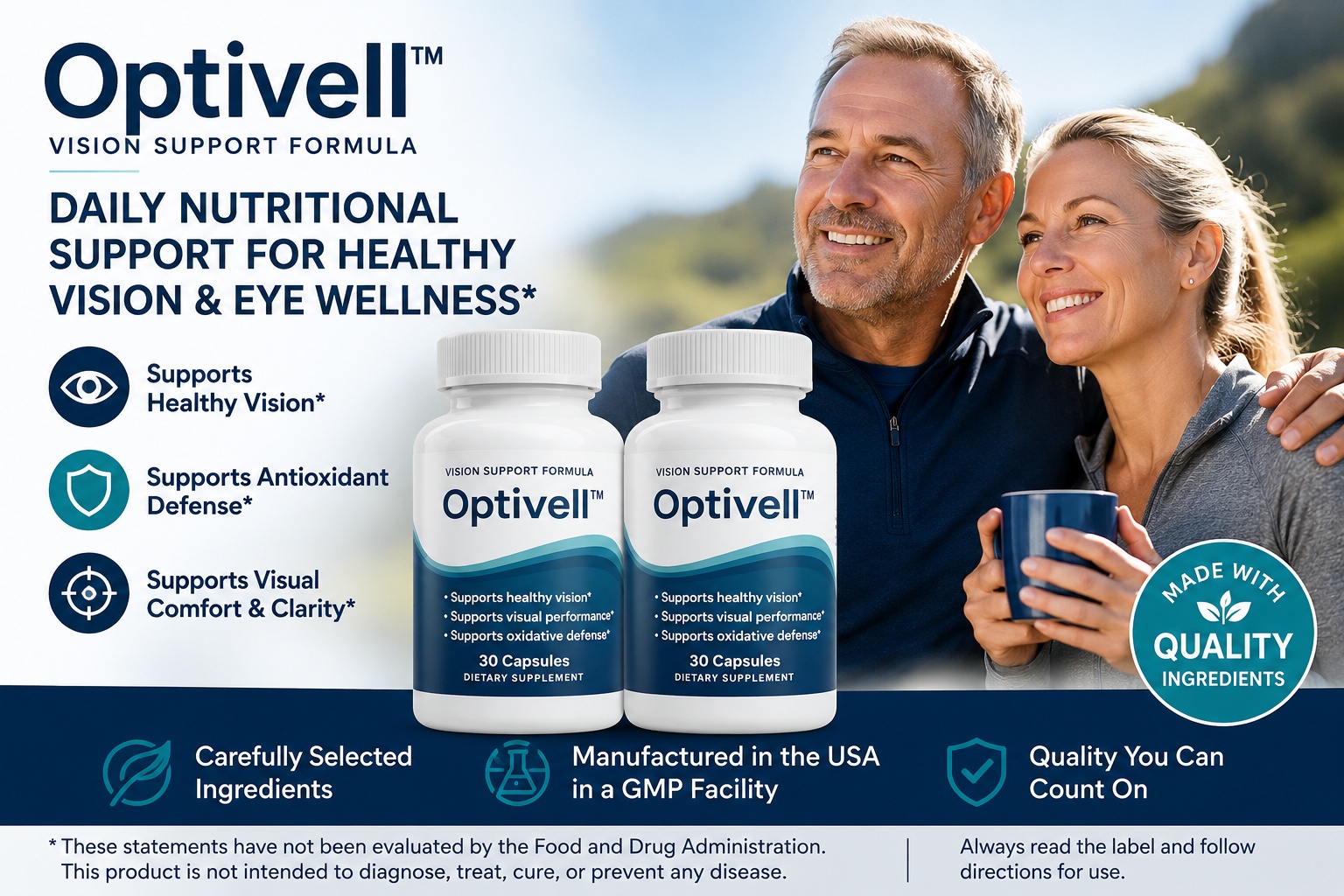
Optivell is one of the more talked-about options in this space right now. This review goes through the full picture: what's in it, what each ingredient is actually there to do, what the formula gets right, what the research says at the ingredient level, how the pricing stacks up, and what you need to know before buying. The goal is to give you accurate information so you can decide whether it's the right fit for you - nobody else can make that call.
View the current Optivell offer on the official website
Disclosure: If you buy through this link, a commission may be earned at no extra cost to you.
The Real Problem Nobody Talks About: What Happens to Eyes During Heavy Screen Time
Before evaluating any supplement, it helps to understand what it's actually designed to support - and why that matters more now than it did twenty years ago.
Digital eye strain is not a marketing term. It's a documented pattern of visual discomfort that researchers associate with extended screen use: tired eyes at the end of the day, difficulty refocusing from screen to distance, that specific heaviness behind the eyes that hits around hour six or seven of focused screen work. For most adults with demanding professional or personal screen habits, this is a familiar experience.
What's less commonly discussed is the nutritional dimension of that experience. The eye's macular tissue - the part responsible for central, detail-oriented vision - depends on a steady supply of specific carotenoids that most adults don't get in sufficient amounts through food alone. Lutein and zeaxanthin, the two nutrients that make up the macular pigment, are found primarily in leafy greens and egg yolks. Most adults eat far less of these than researchers studying eye health would consider optimal.
Blue light exposure from screens adds another layer. High-energy visible light penetrates deeply into the eye, and the macular pigment functions partly as a natural filter for it. When that pigment layer is nutritionally thin, the filtering capacity is reduced. This is the nutritional rationale behind an entire category of eye wellness supplements - and it's the framework Optivell is built within.
Understanding that context makes the formula discussion that follows significantly more useful.
What "The Frozen Blueberry Hack" Is Actually About
The name gets attention, and it's pointing at something real rather than something invented.
Blueberries - and botanicals in the same plant family, like bilberry - contain compounds called anthocyanins: the pigments responsible for that deep blue-purple color. Anthocyanin-rich botanicals have a documented history in nutritional research relevant to eye wellness, with bilberry drawing particular attention in the published literature for its antioxidant properties and its role in supporting healthy visual comfort.
The "frozen" element of the concept references observations in food science research around how cold processing of certain berries may affect how their compounds behave during digestion. This is a concept explored in published nutritional literature - not a regulated clinical protocol, and not a standardized procedure. Optivell's use of the phrase is a marketing angle built around that concept.
What matters practically: bilberry is a well-established ingredient in the eye wellness supplement category with a documented research history. The brand's positioning connects to something nutritionally real. The "hack protocol" language is shorthand, not a clinical term - and this review will treat it that way throughout.
Who Optivell Is Designed For
Getting this right saves you time. Optivell is a dietary supplement. It is not a pharmaceutical. It is not a medical device. It is not a treatment for any diagnosed eye condition. The brand makes no claims in that direction, and neither does this review.
The people who tend to find the most relevance in a formula like this are adults - typically in their 40s, 50s, and beyond - who are already thinking proactively about nutrition and want to extend that thinking to their eyes. They're not looking for a miracle. They're looking for the same thing they look for in a quality fish oil or a good B-complex: nutritional coverage for a system that matters and that diet alone often underfuels.
Also relevant: younger adults with heavy screen-based work or gaming habits who are starting to feel the cumulative effect of that visual load. Digital eye fatigue doesn't respect age the way age-related vision changes traditionally do. Anyone spending six-plus hours a day on screens is in the population this category of supplement is formulated for.
If you have a diagnosed condition and are looking for a treatment, Optivell isn't what you need - a licensed eye-care professional is. These two things are not in conflict; they operate on different levels entirely.
Optivell Ingredients: What's In It and Why Each One Is There
The formula delivers a 600 mg proprietary blend across two capsules per serving, with 30 servings per container. Here's the full ingredient panel and the honest rationale behind each component.
Lutein (5% standardization) is the anchor ingredient in any credible eye wellness formula and for good reason. It is one of two carotenoids that make up the macular pigment - the protective, pigmented layer at the center of the retina that handles central, detail-focused vision and acts as a natural blue light filter. The body cannot synthesize lutein on its own. Every molecule of it comes from food or supplementation. Leafy greens like kale and spinach are the richest dietary sources; most adults fall well short of what researchers studying macular carotenoid levels would consider optimal intake. Lutein has a substantial body of published nutritional research behind it - it is among the most studied nutrients in the eye health category.
Zeaxanthin (5% standardization) is lutein's structural partner in the macular pigment. The two work together - zeaxanthin concentrates specifically at the very center of the macula (the fovea), while lutein distributes more broadly. Published nutrition research has explored associations between macular carotenoid levels and visual comfort markers including contrast sensitivity and glare tolerance. Including both in a formula reflects standard best-practice formulation for comprehensive macular support.
Bilberry Leaf Powder is the anthocyanin source that anchors the brand's central concept. Bilberry (Vaccinium myrtillus) is botanically similar to blueberry and has appeared in nutritional research relevant to eye wellness since at least the 1960s. More recent published literature has continued to explore bilberry anthocyanins in the context of antioxidant support for ocular tissue and healthy visual comfort. The brand makes no clinical claims about what bilberry will accomplish for any individual - and neither does this review. What is accurate: bilberry is a legitimate, well-established ingredient in the eye wellness category with a meaningful history in nutritional research.
Ginkgo Biloba Powder is present for the circulatory dimension of eye wellness nutrition. Published nutritional research has explored ginkgo's flavonoid content in the context of supporting healthy circulation generally. The eye is one of the most metabolically demanding organs in the body per unit area, and it depends on consistent nutrient and oxygen delivery through fine vascular networks. Ginkgo's inclusion in this formula reflects a nutritional support rationale built around healthy blood flow rather than any direct visual mechanism. No specific vascular outcomes are claimed by the brand or this review.
Bacopa Monnieri (20% standardization) is less common in eye formulas but has a defensible rationale here. Bacopa is an Ayurvedic botanical that contains compounds called bacosides, which have been explored in published research for their antioxidant properties. Its inclusion adds antioxidant depth to the formula and reflects formulation thinking around comprehensive oxidative support for tissue that faces sustained metabolic demand. This is a supporting ingredient rather than a lead one, but it's not filler - it has a coherent functional rationale.
Green Tea Extract (50% standardization) contributes a high-concentration catechin profile. Green tea catechins - particularly the compound commonly known as EGCG - are among the most studied dietary antioxidant compounds in the nutritional literature across multiple tissue types. Their inclusion in an eye wellness formula with a strong antioxidant-support rationale is consistent with how formulation practitioners approach this category. The brand makes no specific outcome claims tied to this ingredient, and this review follows the same standard.
AGP Choline is a phospholipid precursor - a building block for the phospholipid membranes that make up cell structures throughout the body, including in retinal tissue. Choline is an essential nutrient that most adults consume in amounts below what researchers consider optimal. Its presence here reflects a cell-integrity support rationale rather than a direct visual mechanism.
Cinnamon Extract deserves careful, honest framing. Cinnamon has been extensively studied in the context of metabolic wellness. Some researchers have explored relationships between metabolic health markers and eye wellness - a plausible rationale for its inclusion in a formula of this type, particularly given the metabolic factors that researchers associate with long-term eye health. Optivell makes no metabolic or blood sugar claims. This review follows the same standard. Readers who want to explore the published literature on cinnamon can find a well-maintained ingredient research database through the National Center for Complementary and Integrative Health (NCCIH) at nccih.nih.gov.
Himalayan Pink Salt contributes trace mineral content at the quantities present in a supplement serving. Its role here is minor from a therapeutic standpoint - it functions as a mineral trace element source within the formula matrix.
Vitamin B6 (as Pyridoxine) and Vitamin B12 (as Cyanocobalamin, 1%) round out the formula. Both are involved in a range of metabolic processes relevant to nervous system health and healthy aging support. Their inclusion adds foundational nutritional coverage appropriate for the adult population this formula is designed for.
Inactive ingredients: Rice flour, magnesium stearate, silica dioxide.
Taken together, this is an antioxidant-forward eye wellness stack with a clear internal logic: macular carotenoid support as the foundation, anthocyanin-based antioxidant depth through bilberry, circulatory support through ginkgo, additional antioxidant breadth through green tea and bacopa, and foundational B-vitamin coverage. The formula reflects how functional nutrition practitioners approach comprehensive eye wellness supplementation - not a single-compound solution, but a multi-nutrient protocol designed for the full picture.
Understanding the Rules: What a Supplement Can and Cannot Claim
This section matters more than most reviews acknowledge - and understanding it will help you read every supplement label you encounter more accurately from here on.
The Dietary Supplement Health and Education Act (DSHEA) governs how supplements like Optivell can be marketed and labeled in the United States. Under DSHEA, a supplement can make what's called a "structure/function" claim - a statement about how an ingredient supports the normal, healthy function of a body structure or system. What a supplement cannot do under federal law is claim to treat, diagnose, cure, or prevent any disease.
Optivell's positioning stays within that framework. The brand's language centers on "healthy vision," "visual comfort," and "oxidative defense" - all structure/function territory. The product does not claim to reverse any diagnosed eye condition or replace professional eye care. That is not a limitation; it's accurate positioning for what a dietary supplement is designed to do.
The FTC oversees dietary supplement advertising, requiring that claims be truthful, not misleading, and substantiated. The FDA oversees supplement labeling. When an eye wellness supplement stays within compliant claim boundaries, it can be evaluated honestly on what it actually offers. When a supplement overpromises, it creates expectations that can't be met - which serves nobody well.
Optivell's claim structure, as reflected in the publicly available brand materials reviewed for this article, is consistent with DSHEA compliance standards.
Pricing: What Each Option Costs and How to Think About Value
Optivell is sold in three configurations through the official website. Here's the breakdown, including what each option costs per day.
The two-bottle package covers 60 days of supply at $79 per bottle, totaling $158 plus $9.99 for shipping.
The three-bottle package covers 90 days at $69 per bottle, totaling $207 with free shipping included.
The six-bottle package covers 180 days at $49 per bottle, totaling $294 with free shipping included.
The math on daily cost: the two-bottle rate comes out to approximately $2.63 per day. The three-bottle rate drops to approximately $2.30. The six-bottle rate lands at approximately $1.63 per day.
For comparison: single-ingredient lutein or zeaxanthin supplements from established retail brands typically price between $0.80 and $1.20 per serving for a standalone compound. Optivell at the six-bottle rate is a moderate premium over those options - in exchange for a full multi-ingredient stack that includes bilberry, ginkgo, green tea extract, bacopa, and the B vitamins alongside the two core macular carotenoids. Whether that trade-off makes sense depends on whether a single-ingredient or multi-ingredient approach better fits what you're looking for.
View current Optivell package options and guarantee details on the official website
The 60-Day Guarantee: What It Actually Covers
The purchase protection here is real, but the specifics matter - read this before choosing a package size.
Every Optivell purchase is backed by a 60-day money-back guarantee. The window runs from the date your order ships, not the date of purchase. To start a refund, contact the support team first at [email protected] - don't mail product back without doing this step, as it can complicate the process. Then return all bottles (empty or unopened) to the returns address: 19655 E 35th Drive, Suite 100, Aurora, CO 80011 USA. You cover return postage. Include your full name, order number, and the email address used for the purchase.
Once the return is received and processed, a full refund is issued within 5 to 10 business days.
The practical point for six-bottle buyers: the 60-day guarantee window closes before a 180-day supply runs out. If you're evaluating results as you go, don't wait until you're halfway through the fourth bottle to decide. The safety net requires action within the guarantee period to be useful.
Ordering, Shipping, and Support Details
Orders process within one to two business days, Monday through Friday, excluding US holidays. The primary domestic carrier is UPS. For packages confirmed delivered by tracking but reported as missing, UPS is the correct contact - Optivell's policy reflects standard carrier-responsibility terms.
Order cancellation is available within 24 hours of purchase. After that window, cancellation is not guaranteed once an order enters fulfillment. If the order has already shipped, the return process applies.
International shipping is available. Transit times for international orders typically run several weeks; customs-related delays can extend that further. Optivell is not responsible for delays caused by destination country customs processes.
The brand is distributed by MJO, Sheridan, WY 82801. Customer service: [email protected] or (323) 286-0206. Stated response time is 48 hours or less from a live support team member.
Frequently Asked Questions About Optivell
Is Optivell a prescription product?
No. It's a direct-to-consumer dietary supplement that requires no prescription and is not regulated as a pharmaceutical.
What does the "frozen blueberry hack" concept mean for this formula?
It references the anthocyanin-bioavailability research associated with cold-processed berry botanicals. Bilberry is the ingredient at the center of that concept. The "protocol" framing is brand positioning language, not a clinically standardized term.
Does taking Optivell replace seeing an eye doctor?
No - and this is worth being direct about. A dietary supplement operates at the nutritional support level. A licensed eye-care professional operates at the diagnostic and clinical care level. These serve different purposes and neither replaces the other. If you have concerns about your vision, an eye exam comes first.
Is this the same as AREDS2?
No. AREDS2 is a specific clinically studied formulation developed through the Age-Related Eye Disease Study at the National Eye Institute, containing a defined combination of lutein, zeaxanthin, vitamin C, vitamin E, zinc, and copper. Optivell shares some ingredient overlap but is a distinct proprietary formula with a different nutritional rationale. It is not a substitute for any clinically directed supplement protocol.
Can I take this if I'm already taking other supplements or medications?
Ginkgo biloba and green tea extract both have documented interactions in the published literature with certain blood-thinning medications. Anyone taking anticoagulants, blood pressure medications, or other prescription drugs should consult their physician or pharmacist before adding any new supplement - this is standard guidance that applies here as with any multi-botanical formula.
How long should I take it before I can evaluate whether it's doing anything for me?
The brand advises giving it adequate time - consistent with how fat-soluble carotenoids like lutein and zeaxanthin actually work. These compounds accumulate in tissue over time rather than producing acute effects. Published research on macular carotenoids typically measures outcomes over weeks to months of daily supplementation, not days.
I wear glasses. Is this still relevant for me?
Yes. Corrective lenses address how your eye focuses light - a refractive function. Eye wellness nutrition addresses the nutritional environment of macular and retinal tissue - a completely different mechanism. The two are not mutually exclusive. Plenty of people who wear glasses also benefit from nutritional support for the tissue doing the seeing.
Does it have any common allergens?
Inactive ingredients are rice flour, magnesium stearate, and silica dioxide. No gluten, soy, dairy, or nut-derived ingredients are listed in the formula. Buyers with specific allergy concerns should confirm with the brand directly at [email protected].
Is it suitable for vegetarians or vegans?
Capsule composition is not specified in the publicly available source materials. Buyers with dietary restrictions should confirm capsule shell details with the brand before purchasing.
What if I miss a dose?
One missed day doesn't reset the picture. Fat-soluble carotenoids like lutein and zeaxanthin accumulate in tissue over time - a single gap doesn't undo that. Consistent daily use over a sustained period is what matters, not perfect adherence.
Is this comparable to the eye supplement my doctor mentioned?
Optivell shares ingredient overlap with several well-known eye wellness formulas, but specific dosages within its 600 mg proprietary blend aren't publicly disclosed. If your doctor recommended a specific formulation with defined dosages, verify the details with them before substituting any product.
Where do I find the most current pricing?
Pricing on direct-to-consumer supplement sites changes. The official website always has the most current numbers - check there before assuming anything in this review reflects today's offer.
What This Review Can Confirm - and What It Can't
This is where honest review writing earns its keep.
Everything factual in this review traces to either Optivell's verified source materials (ingredient panel, pricing, policies, distributor information, contact details) or to general published nutritional research on the individual ingredients. No claims in this review have been invented, extrapolated, or padded.
What this review cannot confirm: the specific per-ingredient dosages within the proprietary blend (not publicly disclosed), the quality and standardization verification for each botanical extract, or whether the finished formula has been independently third-party tested for potency and purity. These are legitimate questions for any supplement buyer - and asking them directly to the brand at [email protected] before purchasing is entirely reasonable.
What can be confirmed accurately: the formula's ingredient rationale is internally consistent with how functional nutrition practitioners approach eye wellness supplementation. The pricing is in range with comparable multi-ingredient eye support formulas on the direct-to-consumer market. The guarantee structure and return policy are clearly documented. The brand's claim positioning is consistent with DSHEA structure/function compliance standards.
Is Optivell Worth Trying?
That's a question only you can answer - but here's the honest framework for thinking through it.
If you're an adult who thinks intentionally about nutrition, already eats with your health in mind, and is specifically looking for a multi-nutrient eye wellness supplement to support daily visual comfort and long-term eye health - Optivell's formula reflects an approach that has legitimate standing in functional nutrition. The core ingredients (lutein, zeaxanthin, bilberry) are well-established. The supporting compounds (ginkgo, green tea, bacopa) add antioxidant and circulatory support that single-ingredient formulas don't provide. The pricing at the best-value tier is competitive for what it includes.
If your screen time is heavy, if you feel your eyes working harder at the end of the day than they did a few years ago, or if you're at an age where thinking proactively about macular nutrition makes sense - the formula's rationale applies to you.
If you have a diagnosed eye condition and need clinical treatment, a supplement is not the answer and shouldn't be positioned as one. Talk to a licensed eye-care professional first.
The 60-day guarantee gives the two- and three-bottle packages meaningful trial protection. If you want the best per-day value, the six-bottle option delivers it - just plan your evaluation timeline accordingly so the guarantee is still accessible if you decide it's not the right fit.
The information in this review exists to give you what you need to make that call yourself.
View current Optivell package options and guarantee details on the official website
Contact Information
Company: Optivell
Email: [email protected]
Phone: (323) 286-0206
Product Return Address: 19655 E 35th Drive, Suite 100, Aurora, CO 80011 USA
Disclaimers
This article contains affiliate links. If you purchase through these links, a commission may be earned at no additional cost to you. This compensation does not influence the accuracy, neutrality, or integrity of the information presented in this review. All opinions and descriptions are based on publicly available details and are intended to help readers make informed decisions.
These statements have not been evaluated by the Food and Drug Administration. This product is not intended to diagnose, treat, cure, or prevent any disease.
Optivell is a dietary supplement and is not intended to replace professional medical or eye care. Consumers experiencing vision problems, or those with existing health conditions, should consult a licensed eye-care professional or qualified healthcare provider before beginning any supplement regimen.
Individual results vary. Results depicted in any customer testimonials or reviews are not typical and are not guaranteed. Many factors affect individual outcomes, including diet, lifestyle, and health status.
This content is for informational and educational purposes only and does not constitute medical advice. Nothing in this article should be interpreted as a recommendation to self-diagnose, self-treat, or delay seeking care from a licensed medical professional.
All product information, pricing, guarantee terms, and availability are subject to change without notice. Verify current details directly at useoptivell.com before purchasing.
The publisher of this article has made every effort to ensure accuracy at the time of publication. We do not accept responsibility for errors, omissions, or outcomes resulting from the use of the information provided. Readers are encouraged to verify all details directly with the official source before making a purchase decision.
SOURCE: Optivell