



Thursday, 11 December 2025 10:15 PM
Advertorial
New platform offers a structured, private space for recognizing confusing interactions and supporting clarity during emotionally complex situations
CHICAGO, ILLINOIS / ACCESS Newswire / December 11, 2025 / Disclaimer: This article is for informational purposes only and does not constitute mental health advice or therapy. NarciFY is a self-help tool and is not a substitute for professional mental health treatment. If you are in immediate danger, contact emergency services or the National Domestic Violence Hotline at 1-800-799-7233. If you are outside the United States, contact your local emergency number or a domestic violence service in your country. Visit the official website for more information.
NarciFY Review 2026: Can This AI-Powered App Help You Recognize Manipulation Patterns in Relationships?
Why Recognizing Manipulation Requires the Right Tools
You had another argument last night. And just like every other time, you spent hours afterward replaying every word in your head, wondering if maybe you were being too sensitive. They said it never happened that way. Part of you started believing them. By morning, you were apologizing for something you are not even sure you did.
Sound familiar?
Here is the thing nobody tells you when you are inside this kind of confusion: the fact that you are questioning yourself this much is itself a sign that something is wrong. Healthy relationships do not leave you constantly wondering if you are crazy.
This pattern has a name. It is called gaslighting, and it is one of the most disorienting forms of psychological manipulation that exists. The cruel irony is that you often cannot identify it while it is happening, because the entire point of the tactic is to make you doubt your own perception of reality.
If you have ever walked on eggshells around someone, felt consistently confused after conversations, or found yourself apologizing reflexively even when you know you did nothing wrong, you are not alone. According to data from the CDC's National Intimate Partner and Sexual Violence Survey, approximately 1 in 3 women and 1 in 4 men have experienced some form of physical violence or psychological aggression by an intimate partner during their lifetime.
And here is the statistic that might explain why you are still there, even when part of you knows something is wrong: according to the National Domestic Violence Hotline, it takes an average of seven attempts for someone to leave an abusive relationship permanently. Seven. Not because people lack the desire to go. Because the psychological mechanisms at play are specifically designed to create confusion, self-doubt, and dependency.
Learn more about NarciFY on the official website to understand how the platform approaches relationship pattern recognition.
Here is what makes psychological manipulation so insidious: it specifically targets your ability to trust yourself. When someone consistently tells you that your memory is wrong, that you are overreacting, that the thing you clearly saw happen did not actually happen, your brain starts to adapt. You begin second-guessing everything. You lose confidence in your own perception. And the worse it gets, the harder it becomes to identify what is happening, because your internal compass has been deliberately scrambled.
This is why well-meaning advice like "just trust your gut" or "you'll know when it's time to leave" can feel so frustrating. Your gut has been systematically trained to distrust itself.
It is also why friends and family, as much as they love you, often cannot provide what you actually need. They either minimize what is happening because they cannot see it from the inside, or they get so frustrated watching you struggle that they pressure you to leave before you are ready. Neither response addresses the core problem: you need clarity about what is actually happening before you can make decisions.
This is the gap that tools like NarciFY are designed to fill. Not to replace your judgment, but to give you a framework when your judgment has been compromised.
What Makes NarciFY a Practical Recovery Companion
First, let's be absolutely clear NarciFY is not therapy. It is not a replacement for working with a licensed mental health professional. It cannot diagnose anyone with a personality disorder. And it is not going to tell you definitively whether your partner is a narcissist.
What NarciFY aims to provide is a framework. A private space where you can start making sense of experiences that feel chaotic and impossible to articulate.
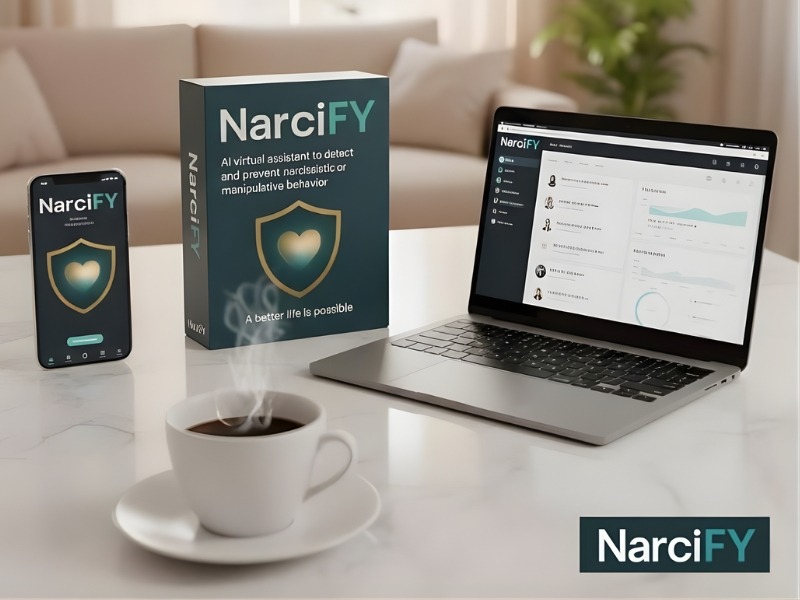
According to the official NarciFY website, the platform positions itself as an "AI-powered reality anchor" designed for narcissistic abuse recovery. Here is what that actually means in terms of features:
AI Pattern Detector: You can input text conversations, describe situations, or record voice notes. The AI analyzes the content and flags potential manipulation tactics like gaslighting, triangulation, love bombing, hoovering, stonewalling, and intermittent reinforcement. Think of it as a framework for organizing what you are experiencing.
Personalized 8D Healing Audios: The platform generates calming audio meditations customized with your name and specific situation. These are designed as self-soothing practices to help you cope with moments of stress or emotional overwhelm.
Reality Anchor Journal: A private space where you can record conversations or thoughts and receive what the brand describes as an objective breakdown, without the emotional fog.
Safe Space Finder: When you are ready to take the next step, this feature provides a private map of local therapists and support groups. Because eventually, professional support matters.
S.O.S. Calm Down: For those moments when anxiety hits at 3 AM, and you need something immediate to help you feel grounded.
Suggested Responses: A tool that helps you craft responses using communication strategies like the Grey Rock method, which is designed to make interactions with difficult personalities as tedious and unrewarding as possible. Particularly useful if you are co-parenting or cannot go no-contact.
Order NarciFY through this link to explore the platform's features directly.
The Manipulation Tactics NarciFY Is Designed to Identify
Before evaluating whether NarciFY might be helpful for your situation, it helps to understand the specific behaviors it is designed to recognize. These are not clinical diagnoses. They are communication patterns that mental health professionals have documented extensively in the literature on psychological abuse.
Gaslighting is a form of psychological manipulation where one person causes another to question their own memory, perception, or sanity. It looks like: "That never happened." "You're imagining things." "You're being too sensitive." "I never said that." The term comes from a 1944 film where a husband manipulates his wife into believing she is going insane. In modern relationships, it is devastatingly effective because it erodes the foundation of self-trust.
Love bombing is an excessive display of affection, attention, and devotion early in a relationship. Constant texting. Extravagant gifts. Declarations of love within days or weeks of meeting. Pressure to commit quickly. The intensity feels amazing at first, but it creates an unrealistic baseline that keeps you chasing an initial high that was itself a manipulation tactic.
Triangulation involves bringing a third party into the dynamic to create jealousy, insecurity, or competition. Comparing you unfavorably to an ex. Flirting with others in your presence. The purpose is to destabilize your sense of security.
Intermittent reinforcement involves unpredictable alternation between rewards and punishments, warmth and cold. Research in behavioral psychology has shown that this creates the strongest emotional bonds because your brain becomes focused on predicting when the reward will come.
Hoovering refers to attempts to "suck" you back into a relationship after you have tried to leave. Sudden apologies. Promises to change. It often appears precisely when you are starting to gain clarity.
Stonewalling is the refusal to communicate or engage. The silent treatment. Walking away during conversations. Designed to punish and avoid accountability.
These are patterns, not certainties. Context matters enormously, and ultimately only you (ideally with professional support) can determine what is happening in your specific situation.
Simplicity and Privacy: The Core Principles Behind NarciFY
One aspect of NarciFY's positioning that deserves attention is the emphasis on validation and reality-checking. The website repeatedly uses language like "validate your reality" and "stop second-guessing yourself."
If you have never experienced sustained psychological manipulation, this might seem like a small thing. But if you have been told repeatedly that your perceptions are wrong, that you are too sensitive, that you are imagining problems, having any external source confirm what you experienced can be profoundly meaningful for rebuilding self-trust.
The brand positions this as providing what friends and family cannot: analysis without emotional bias. As their website states, "Friends and family are biased. NarciFY's AI analyzes communication patterns with zero emotional attachment."
Privacy as a Core Feature
For someone in a problematic relationship situation, privacy is not a luxury - it is a safety requirement. According to NarciFY's website, privacy and security are priorities. Users can analyze conversations in a space the brand describes as completely private.
The platform is designed for discreet use. There is no requirement to share your data with anyone else. Your journal entries, pattern analyses, and audio sessions remain in your private space.
Specific data handling practices are detailed in their privacy policy, which you should review before using the service. The publisher has not independently audited NarciFY's security or data-handling practices.
Simplicity of Use
According to the brand, setup takes about 30 seconds, and the platform is available 24/7. You can interact with the AI in several ways: type out a situation from memory, paste text messages directly, or record a voice note describing what happened.
The AI analyzes the content and provides feedback, identifying potential manipulation tactics by name. If you describe a conversation in which your partner denied something that clearly happened, the system may flag it as potential gaslighting.
View current pricing and features on the NarciFY platform.
Platform Quality and Accessibility
Now, let's be honest about limitations. No artificial intelligence can understand the full context of your relationship. The history between you. The nuances of your specific situation. Tone and body language do not translate through text. NarciFY has not been validated as a clinical assessment tool, and its analyses should never be used as a substitute for professional evaluation or as legal proof.
What a tool like this can potentially offer is a framework for recognizing patterns. No definitive conclusions about another person's intentions or character. A starting point for understanding, not an ending point for judgment.
According to NarciFY's marketing materials, some users report feeling less anxious in the first week of using the Pattern Detector. These are self-reported experiences from individual users and are not independently verified or clinical findings. Your experience may be completely different.
How NarciFY Fits Your Recovery Journey
Based on the features and positioning, NarciFY seems designed for several specific situations:
You are currently in a confusing relationship dynamic and want help determining whether specific behaviors constitute manipulation. The AI Pattern Detector may provide a framework for organizing experiences that currently feel chaotic.
You have recently left a relationship and are processing what happened. Looking back with a framework can help make sense of things that were impossible to see clearly from the inside.
You have to maintain contact with a difficult person - co-parents, family members, colleagues. The Suggested Responses feature and guidance on the Grey Rock method might help you manage ongoing interactions while protecting your emotional boundaries.
You experience acute anxiety related to your relationship situation. The 8D Healing Audios and S.O.S. Calm Down features are designed for moments when you need immediate support to feel grounded.
You are not ready for therapy yet but want to start processing your experiences in a private, judgment-free space. The platform might serve as a bridge toward eventually seeking professional support.
Who This Is NOT For
If you are in physical danger right now, your priority should be safety planning with professional support, not analyzing communication patterns. The National Domestic Violence Hotline (1-800-799-7233) can help with safety planning. If you are outside the US, contact your local emergency services or domestic violence organization.
If you are experiencing severe mental health symptoms - thoughts of self-harm, severe depression, anxiety that interferes with daily functioning - professional help should be your first step, not an app.
If you are looking for a replacement for therapy, NarciFY is not that. It is a self-help tool designed to supplement professional care, not substitute for it. The Safe Space Finder feature is designed to connect users with professional resources when they are ready.
If you want definitive proof that someone is a narcissist or that your relationship is abusive, no app can provide that. Only a trained professional can help you evaluate your specific situation with the nuance it deserves.
Why AI-Powered Self-Help Tools Are Gaining Popularity
The emergence of AI-powered relationship analysis tools reflects several broader trends.
Mental health resources remain expensive and inaccessible for many people. Wait times for therapists can stretch for months. The specific pattern recognition involved in identifying manipulation can be difficult for even trained professionals to communicate quickly.
At the same time, awareness of psychological abuse has grown significantly. Terms like "gaslighting" have entered mainstream vocabulary, and social media has created communities where people share experiences and educate each other about manipulation tactics.
Traditional resources each have limitations:
Therapy and Counseling remains the gold standard. A trained therapist can provide a personalized assessment, help process trauma, and guide recovery over time. The limitation is cost, accessibility, and the fact that many people are not ready for therapy when they are still inside a confusing dynamic.
Support Groups provide community validation and shared experience. The limitation is that groups can sometimes reinforce patterns without providing tools for change.
Books and Educational Resources offer extensive literature on narcissistic abuse, codependency, and manipulation tactics. The limitation is that reading about patterns is different from having someone analyze your specific situation.
Friends and Family are often the first place people turn. The limitation is that loved ones have their own biases and emotional investments.
Online Forums and Communities have hundreds of thousands of members sharing experiences. The limitations are the risk of echo chambers and the lack of professional guidance.
Tools like NarciFY position themselves as filling a gap between these options: more personalized than books, more objective than friends, more accessible than therapy, and more structured than online forums.
Whether it successfully fills this gap depends on individual circumstances and expectations.
Pricing and Value in the Recovery App Space
Monthly Subscription: $4.99 per month. Includes AI Pattern Detector, 8D Healing Audios, Safe Space Finder, and S.O.S. Calm Down. No contract, cancel anytime.
Quarterly Subscription: $14.99 every three months (the brand labels this "Most Popular"). Same features plus future updates included. No contract, cancel anytime.
Unlimited Access: $97.99 one-time payment. All features plus future updates. Pay once, keep it forever.
All plans currently include a free bonus, "7 Signs of a Narcissist: The Ultimate Recovery Guide," valued at $27.
There is also a 7-day free trial with no credit card required, so you can explore the features before committing any money.
All pricing mentioned was accurate as of publication (December 2025) but is subject to change. Always verify current pricing on the official website before purchasing.
Check the current NarciFY pricing and bundles for the latest options.
Guarantee and Customer Confidence
Purchases are processed through ClickBank and are protected by their 60-day money-back guarantee. If you do not gain clarity within 60 days, you may request a refund.
One note: ClickBank is a third-party retailer, and its role as a retailer does not constitute an endorsement or review of NarciFY or any claims made about the product. Review the latest refund terms and conditions on the checkout page, as guarantee details are subject to the company's current terms and conditions.
How to Get Started and Next Steps
If you decide NarciFY might be worth exploring, here is how it works:
Visit the official NarciFY website to review features and pricing.
Select your preferred plan or start with the 7-day free trial.
Complete checkout through ClickBank.
Access the platform and start exploring.
Consider beginning with the AI Pattern Detector by describing a recent situation that left you feeling confused.
The brand emphasizes that setup takes about 30 seconds, and the platform is available 24/7.
Start exploring NarciFY here to see whether it aligns with your needs.
The Bottom Line: Clarity When It Counts
If you are constantly questioning your own perception, that is not normal. Healthy relationships do not leave you feeling overwhelmed. The confusion you are feeling is not a character flaw. It may be a sign that something is being done to you.
You deserve clarity. Whether that comes from a tool like NarciFY, therapy, support groups, books, or a combination, you deserve to understand what is happening in your own life.
Recovery is a process, not an event. Many trauma-informed resources recommend combining professional support, community resources, and personal tools as part of recovery from psychological abuse. No single app or tool is a complete solution. But the right resources can make the journey toward clarity more manageable.
Whatever you decide, know that questioning whether something is wrong is often the first step toward finding your way out. Trust that instinct. It brought you here.
Frequently Asked Questions
Is NarciFY a therapy app?
No. The brand explicitly states NarciFY is not therapy. It is a self-help tool for pattern recognition and emotional support. Professional mental health treatment should remain your primary resource for dealing with psychological abuse or relationship trauma.
Can NarciFY diagnose narcissistic personality disorder?
No. NarciFY cannot diagnose any mental health condition. It is designed to help you identify communication patterns, not to provide clinical diagnoses of other people. Only a licensed mental health professional can diagnose personality disorders.
Is my data private?
According to NarciFY's website, privacy and security are priorities. Users can analyze conversations in a space the brand describes as completely private. Specific data handling practices are detailed in their privacy policy, which you should review before using the service. The publisher has not independently audited NarciFY's security or data-handling practices.
Can I cancel my subscription?
Yes. Both Monthly and Quarterly plans have no contract and can be canceled at any time.
What if NarciFY does not help me?
ClickBank's 60-day money-back guarantee backs the platform.
Is NarciFY available outside the United States?
Based on testimonials featuring users from the UK, Germany, and Canada, the platform appears to be available internationally. Verify specific availability and pricing on the official website.
How long until I notice a difference?
This varies significantly by person. Some users in testimonials describe noticing shifts in their thinking within the first week. Others engage over more extended periods. There is no standard timeline for processing psychological abuse, and individual responses will differ based on personal circumstances.
NarciFY Contact & Support
Company Name: NarciFY®
Official Website: www.narcify.app
Order Support: https://www.clkbank.com/#!/
Email Support: [email protected]
Toll Free (US): +1 800-390-6035
International: +1 208-345-4245
Product Return Address (via ClickBank): 1444 S. Entertainment Ave., Suite 410 Boise, ID 83709, USA
For product inquiries, refund requests, or customer support, contact ClickBank directly or visit the official NarciFY website. For mental health emergencies, contact the National Domestic Violence Hotline at 1-800-799-7233 or your local emergency services.
Comprehensive Product Information & Disclaimers
Mental Health Disclaimer: This article is for informational purposes only and does not constitute mental health advice, therapy, or professional treatment. NarciFY is a self-help tool and is not a substitute for professional mental health care. If you are experiencing severe symptoms, thoughts of self-harm, or crises, please seek immediate professional help. The National Domestic Violence Hotline can be reached at 1-800-799-7233. If you are outside the United States, contact your local emergency number or a domestic violence service in your country for support.
Results May Vary Disclaimer: Individual results will vary based on factors including specific relationship dynamics, baseline mental health status, engagement with the platform's features, and other individual variables. While some users report positive experiences, results are not guaranteed. The testimonials presented reflect individual experiences and should not be interpreted as typical outcomes.
FTC Affiliate Disclosure: This article contains affiliate links. If you purchase through these links, a commission may be earned at no additional cost to you. This compensation does not influence the accuracy, neutrality, or integrity of the information presented. All descriptions are based on publicly available information from the official NarciFY website.
Pricing Disclaimer: All prices, discounts, and promotional offers mentioned were accurate at the time of publication (December 2025) but are subject to change without notice. Always verify current pricing and terms on the official product website before making your purchase.
Third-Party Retailer Disclaimer: ClickBank is the retailer of products on this site. CLICKBANK® is a registered trademark of Click Sales, Inc., a Delaware corporation. ClickBank's role as retailer does not constitute an endorsement, approval, or review of these products or any claims made in promotion of these products.
Publisher Responsibility Disclaimer: The publisher of this article has made every effort to ensure accuracy at the time of publication. We do not accept responsibility for errors, omissions, or outcomes resulting from the use of the information provided. Readers are encouraged to verify all details directly with the official source and their mental health provider before making decisions.
SOURCE: NarciFY