




Monday, 03 August 2026 08:15 PM
Advertorial
LARGO, FL / ACCESS Newswire / August 3, 2026 / TL;DR - the short version
Short answer: probably longer than you think, and most likely indefinitely.
The medication works while you take it. In the STEP 1 trial extension, people who stopped semaglutide regained about two-thirds of their lost weight within a year. Researchers concluded obesity behaves like a chronic condition - treated, not cured.
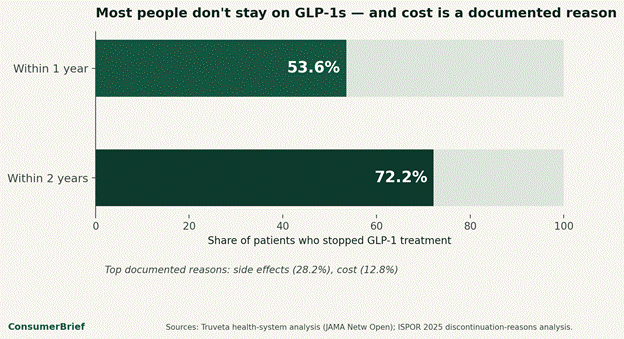
Most people stop anyway. Real-world data shows 53.6% quit within one year and 72.2% within two. The top documented reasons: side effects (28.2%) and cost (12.8%).
Which means the price you can sustain matters more than the price you can start at. A $100/month difference is $3,600 over three years. The month-13 price (not the intro promo) is the number that decides whether treatment lasts.
The cheapest legitimate route in 2026 is a certified flat-price program, advertising roughly $99-$297/month for compounded semaglutide, versus $299-$499+ for brand-name pens. See the ranked comparison of flat-price GLP-1 programs →
Three things to check before enrolling anywhere: flat pricing across doses (your dose will go up; your price shouldn't), no separate membership fee stacked on the medication price, and included clinical support (since unmanaged side effects are the #1 reason people quit).
In a hurry? The current programs are ranked here on ongoing monthly cost, what's included, and which hold independent certification.

The rest of this article covers the evidence behind each of those points: what the trials found, what happens in the real world, and how to read a program's pricing before committing to something you may be paying for in three years.
It is the question most people ask last, and it is the one that should be asked first.
Before starting a GLP-1 medication, prospective patients tend to research effectiveness, side effects, and how quickly the scale moves. What gets researched far less often is duration: how many months, or years, the medication is meant to be taken. That omission is understandable. The marketing in this category is built around transformation, and transformation implies an endpoint.
The clinical evidence points somewhere else. GLP-1 medications work while they are being taken. For most people, according to the trial data, they largely stop working once they are stopped. Researchers who followed patients after discontinuation have described obesity in the same terms as hypertension or high cholesterol - a chronic condition managed with ongoing treatment rather than a temporary problem cured by a course of medication.
That changes how the purchase should be evaluated. A medication taken for three months is a project with a budget. A medication taken for three years, or indefinitely, is a recurring household expense that deserves the same scrutiny as an insurance premium or a car payment. The question stops being "can I afford to start?" and becomes "can I afford to continue?"
This article covers what the published data says about duration, what happens when people stop, what actually occurs in real-world practice (which turns out to be quite different from the trials), and why, for anyone paying cash, the monthly price becomes the single most consequential variable in the entire decision.
What GLP-1 medications do, and why it matters for duration
Understanding the duration question requires a brief detour through mechanism.
Semaglutide, the active ingredient in Wegovy and Ozempic, belongs to a class of drugs that mimic glucagon-like peptide-1, a hormone the gut releases after eating. That hormone signals fullness to the brain, slows the rate at which the stomach empties, and helps regulate blood sugar. A synthetic version, dosed weekly, keeps those signals elevated well beyond what a meal alone would produce.
Tirzepatide, the active ingredient in Zepbound and Mounjaro, works on that same GLP-1 pathway and a second one, GIP, simultaneously. An oral form of semaglutide is also now available as a daily tablet.
The practical experience patients describe is a quieting of appetite. Portions shrink without deliberate restriction. The mental preoccupation with food that many people with obesity describe, sometimes called food noise, tends to fade.
The detail that determines everything about duration: the medication doesn't retrain the body's underlying weight-regulation system. It supplements a signal the body is not producing sufficiently on its own. When the supplement stops, the signal returns to its previous level, and appetite behaves the way it did before treatment.
None of this is unusual; most medications for chronic conditions work the same way. Blood pressure medication doesn't cure hypertension; it manages it while taken. Statins do not permanently reset cholesterol. The GLP-1 class operates on the same logic, which is why the withdrawal studies found what they found.
What the trial data shows about stopping
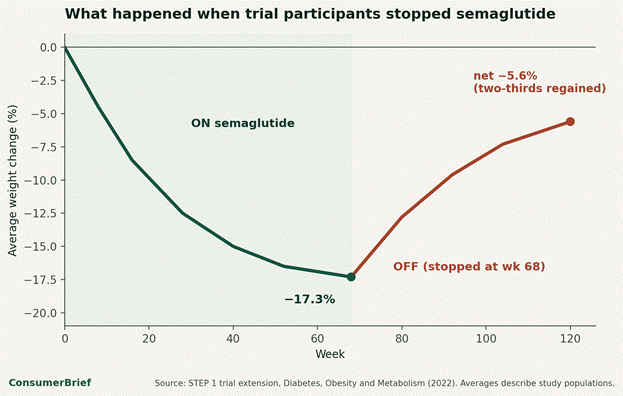
The most-cited evidence on discontinuation comes from the extension phase of the STEP 1 trial, published in Diabetes, Obesity and Metabolism. Researchers followed 327 participants for a full year after they stopped taking semaglutide 2.4 mg and ended the structured lifestyle program that accompanied it.
The results were unambiguous. After 68 weeks of treatment, participants had lost a substantial share of their body weight; one year after stopping both the medication and the lifestyle intervention, they had regained a mean of two-thirds of their prior weight loss. By the study's end at week 120, the semaglutide group had regained an average of 11.6 percentage points of lost weight against 1.9 percentage points in the placebo group, leaving net losses of 5.6% and 0.1% respectively from the study's start.
The authors' own conclusion was direct: the findings confirm the chronicity of obesity and suggest ongoing treatment is required to maintain improvements in weight and health.
The pattern is not unique to semaglutide. SURMOUNT-4 examined what happens when tirzepatide is stopped, and participants who discontinued and switched to placebo regained an average of 14% of the weight they had lost. Longer-term data from participants who stayed on treatment points the same direction from the opposite angle: three-year results from the SURMOUNT-1 trial, published in the New England Journal of Medicine, tracked sustained outcomes in people who continued therapy rather than stopping it.
A few caveats before treating this as settled.
These are averages describing study populations, not predictions about any individual. Individual responses to both treatment and discontinuation vary considerably.
The STEP 1 extension participants stopped the structured lifestyle intervention at the same time they stopped the medication. Real-world patients who maintain the behavioral changes may see different trajectories. One small observational study of women with PCOS who continued metformin after semaglutide withdrawal found roughly one-third of the weight regained at two years rather than two-thirds, with most participants still below their starting weight.
And some people do maintain. Real-world data suggests regain may be slower outside clinical trial conditions, and a meaningful minority of patients maintain or continue losing after stopping.
The reasonable interpretation is not that stopping is impossible. It is that stopping and maintaining is the exception rather than the expectation, and planning a budget around being the exception is how people end up surprised.
The real-world picture: most people stop anyway
The evidence gets uncomfortable from here on, and also more useful.
The trial data says ongoing treatment is generally required to maintain results. The real-world data says most people do not manage ongoing treatment. One analysis of US health-system records found that 53.6% of patients discontinued GLP-1 receptor agonists within one year, and 72.2% within two years. A separate analysis of electronic health record data on more than 125,000 adults newly prescribed a GLP-1 for overweight or obesity found that within twelve months, 46.5% of patients with type 2 diabetes and 64.8% of patients without diabetes had discontinued therapy.
The pattern holds internationally. A nationwide Danish registry study found that just over half of adults without diabetes who started semaglutide for weight loss discontinued within a year, with younger adults dropping off fastest. In the United States, research presented to the Endocrine Society using insurance records from more than 60,000 Americans with type 2 diabetes found roughly four in ten stopped their GLP-1 medication within the first year. A broader review of real-world evidence puts first-year discontinuation across studies in the range of 20% to 50%, with real-world weight outcomes generally falling below trial results, except among the most adherent patients, whose outcomes approach what trials reported.
That last detail carries most of the story. The gap between clinical trial results and real-world results is largely an adherence gap. The medication performs; people stop taking it.
So why do they stop? Analysis of documented discontinuation reasons found side effects were the leading cause at 28.2% of all discontinuations, with cost a notable barrier accounting for 12.8%. The Danish researchers also documented a steep socioeconomic gradient in who gets prescribed these medications in the first place, with prescription rates nearly three times higher in the highest income quartile than the lowest.
Two of the top three reasons people abandon treatment - cost directly, and side effects that go unmanaged without accessible clinical support - are addressable at the point of choosing a program. The discontinuation literature documents this directly.
The three phases of GLP-1 treatment
Duration is easier to think about in phases, because each one behaves differently.
Phase one: titration, roughly months one through three. Every program and every provider starts at a low dose and steps up gradually, typically at four-week intervals, because starting at a full therapeutic dose produces intolerable gastrointestinal side effects in most people. During titration the medication is not yet at full strength. Some weight change usually begins, but this phase is primarily about the body adapting.
This is also the phase with the highest dropout, which the discontinuation research consistently shows as a steep early drop followed by a slower decline. Nausea, constipation, and fatigue are most pronounced during dose increases. People who abandon treatment in month two frequently do so believing the medication didn't work for them, when it hadn't yet reached the dose at which it was studied.
Phase two: active loss, roughly months four through twelve. Once a maintenance-level dose is reached, this is the period the trials measured and the advertising depicts. The major studies ran 68 to 72 weeks, and the bulk of weight reduction in them accumulated across this window. Side effects typically become more manageable as the body adjusts, though they rarely disappear entirely.
Phase three: maintenance, year one onward. This is the phase nobody advertises and the one the withdrawal data is about. Once a person reaches a weight they want to hold, the clinical question shifts from losing to maintaining, and per the trial evidence, maintaining generally requires continuing.
What continuation looks like varies. Some patients remain at their full dose indefinitely. Some providers step patients down to a lower maintenance dose. Some experiment with extended intervals between doses. These are individual clinical decisions made by a licensed provider based on the person's history, response, and goals; the prescribing decision belongs to that provider, not to a program's marketing page.
The practical implication for anyone budgeting: a person planning for six months of treatment is, in most cases, planning for the wrong number. Comparing programs on their ongoing monthly price rather than their introductory promotion is the only version of this comparison that survives contact with phase three.
Why monthly price becomes the deciding variable
If treatment is measured in years rather than months, the arithmetic of small monthly differences becomes difficult to ignore.
A $100 per month difference between two programs is $1,200 over a year. Over three years it is $3,600. Over five it is $6,000 - for the same active ingredient, prescribed by a licensed provider in both cases, differing only in which company processed the order.
Set against the discontinuation data, that arithmetic stops being an abstraction. Cost is a documented driver of people abandoning treatment. Someone who enrolls in a program at the edge of what their budget tolerates is, statistically, entering the group most likely to discontinue - and discontinuation is the outcome the withdrawal studies describe. The most expensive program is not the one with the highest monthly price. It is the one a person can't sustain, because the money spent getting to phase three is largely undone by leaving in phase three.
This reframes what "a good deal" means in this category. The relevant number is not the first-month promotional price, which nearly every program discounts aggressively. It is the price in month thirteen: the ordinary, unpromoted, full-dose monthly cost of continuing. That is the number that determines whether treatment lasts.
For readers running that comparison on their own budget, the current field of flat-price programs is ranked here on ongoing monthly cost rather than introductory offers.
The insurance question, and why it rarely settles the duration problem
A reasonable objection to all of this: why treat GLP-1 treatment as a cash expense at all, when insurance exists?
Because for weight management specifically, it frequently doesn't. Many commercial plans exclude weight-loss medication as a category, distinct from how they treat the same molecules prescribed for type 2 diabetes. Employer plans that do cover it often layer on prior-authorization requirements, documented BMI thresholds, step-therapy rules requiring a failed attempt with an older medication, and annual or lifetime caps. Coverage for these medications has also proven unusually volatile. Several large employers and state plans have narrowed or dropped weight-management coverage after seeing the aggregate cost, sometimes mid-plan-year.
That volatility is the part that matters for a multi-year treatment. Insurance coverage secured in January isn't guaranteed in December, and the discontinuation research consistently identifies coverage loss and cost as drivers of people stopping. Someone whose entire treatment plan depends on a benefit that can be revised at the next renewal is carrying a risk they may not have priced.
None of which means insurance should be ignored. For people whose plans do cover these medications, coverage remains by far the cheapest path, and programs with dedicated prior-authorization support can meaningfully improve the odds of approval. The practical approach for anyone starting treatment: pursue coverage if it is plausibly available, and know the cash-pay number regardless, because the cash-pay number is the floor under the plan if coverage never materializes or later disappears. It is also, for a growing share of patients, simply the faster route: cash-pay telehealth programs skip the authorization process entirely, which for some people means starting treatment in days rather than months.
The pricing structures that separate programs
Two programs advertising the same headline number can cost meaningfully different amounts over a year. The differences live in structure, and there are four to check before enrolling anywhere.
Flat pricing versus dose-tiered pricing. Some programs charge one price regardless of dose. Others charge more as the dose titrates upward. Since standard treatment involves stepping up through several dose levels and then remaining at a maintenance level, dose-tiered pricing means the advertised entry price is temporary by design. A program advertising a low starting price on a starting dose is quoting a number the patient will occupy for roughly one month.
Membership fees layered on medication cost. A program advertising medication at $149 per month with a separate $75 monthly membership is a $224 per month program. Both numbers are disclosed, but only one is in the headline. The all-in monthly figure - medication, program fee, supplies, and shipping combined - is the only number that can be compared fairly across providers.
Promotional versus ongoing pricing. First-month discounts are standard and not inherently problematic. They become a problem when they are the number a person budgets against. Anyone comparing programs should locate the ordinary price for their expected maintenance dose and compare on that.
What is actually bundled. Programs vary in whether the monthly price includes the provider consultation, follow-up visits, injection supplies, shipping, and ongoing clinical messaging, or whether those arrive as separate charges. Given that unmanaged side effects are the leading documented cause of discontinuation, included clinical access is the part of the package that keeps people on treatment through phase one.
A useful comparison marks which providers price flat across doses, and what each monthly price actually includes.
What the market costs in 2026
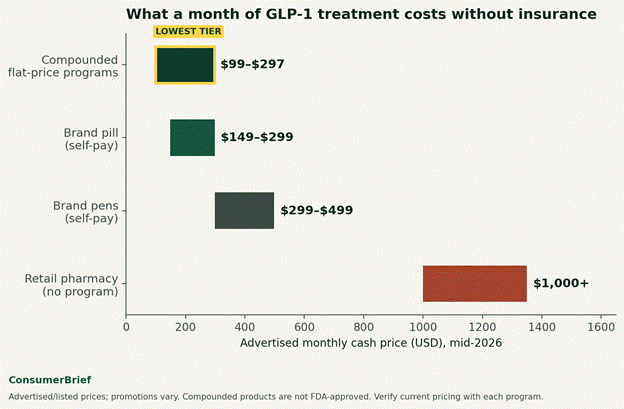
Cash prices in this category have fallen substantially, and the current landscape divides into four tiers.
Compounded telehealth programs anchor the low end, with leading programs advertising roughly $99 to $297 per month for compounded semaglutide and roughly $180 to $399 for compounded tirzepatide, typically bundling the provider evaluation, supplies, and shipping into one flat figure.
The brand-name oral pill has run roughly $149 to $299 per month through manufacturer self-pay channels, making it the lowest-cost FDA-approved path for most cash payers.
Brand-name injection pens through manufacturer self-pay programs have generally run $299 to $499 or more monthly depending on medication and dose tier.
Retail pharmacy without any program remains above $1,000 per month at list price and is essentially nobody's best option.
The compounded tier requires specific diligence, and the reasons should be stated plainly. Compounded semaglutide and tirzepatide contain the same active ingredients as their brand counterparts but are prepared individually by licensed U.S. pharmacies and are not FDA-approved finished products. Regulators have documented counterfeit products with falsified pharmacy labeling, and clinicians have raised specific concerns about the variability of the compounded market. The market also consolidated sharply in 2026 as regulators moved to restrict large-scale bulk compounding.
The markers that separate the legitimate operators from the rest: independent LegitScript certification, which can be verified directly rather than taken on a program's word; a disclosed U.S. pharmacy source; plain-language disclosure that the product is compounded and not FDA-approved; transparent pricing with no fees appearing at checkout; and a stated refund policy if a provider declines to prescribe. Programs clearing all five exist; programs clearing none should be avoided regardless of price.
Making treatment sustainable: what long-term patients do differently
Patterns emerge among people who stay on treatment through phase three and beyond.
They confirm the exit terms before entering. Cancellation and pause policies vary widely: some programs allow self-service cancellation in a patient portal, others require phone calls during business hours. Life interrupts treatment for reasons unrelated to the medication, and a program that makes pausing difficult converts a temporary interruption into a permanent discontinuation.
They treat side effect management as an adherence strategy. Since side effects are the leading documented reason people stop, the difference between a program with responsive clinical support and one with a slow message queue is often the difference between adjusting a dose and abandoning treatment. This is where the value of included clinical access shows up - not in the first month, but in the month someone is deciding whether to continue.
They ask about maintenance dosing. Once a target weight is reached, some providers step patients down to lower maintenance doses. Where clinically appropriate, that can reduce cost. It is a provider decision, not a patient one, but it's a conversation to have rather than assuming the full dose is permanent.
They re-shop periodically. Pricing in this category has declined nearly every year as competition increased and new formats arrived. A program that was competitively priced eighteen months ago may not be today, and switching between programs is routine: the new provider reviews the history and typically continues from the established dose rather than restarting titration. The current program comparison is updated as advertised prices move.
They budget for the year, not the month. The most consistent difference between people who complete a year of treatment and people who do not is whether they entered with an accurate picture of what a year would cost.
What to ask a provider about duration
Duration is ultimately a clinical question, but it has financial consequences. Questions to raise at an initial consultation:
What is a realistic expected duration of treatment given this specific history and these goals?
What does the maintenance phase typically look like - same dose, reduced dose, or extended intervals?
At what point, if any, would stopping be considered, and what would that transition involve?
What is the plan if side effects become difficult during titration?
What happens to dosing if treatment is interrupted for several weeks?
The answers vary by person, which is the point. A program that can't provide a clinician to answer these questions before enrollment is a program answering a different question than the one being asked.
Frequently asked questions
Can someone stop once they reach their goal weight? That decision belongs to the patient and their provider. What the evidence says is that in the STEP 1 extension, participants regained roughly two-thirds of their lost weight within a year of stopping, which is why many providers now frame goal weight as the beginning of a maintenance phase rather than the end of treatment.
Does everyone regain the weight? No. Averages describe populations, not individuals, and a meaningful minority maintain or continue losing after stopping, particularly those who sustain substantial behavioral changes. But the trial data indicates regain is the more common outcome, and planning around the less common one carries obvious risk.
Do doses stay the same for the entire duration? Not necessarily. Titration upward is standard in the early months. Some providers later reduce maintenance patients to lower doses. This is one more reason flat-across-doses pricing matters: the dose is likely to change, and a price that follows it introduces uncertainty into a multi-year budget.
Is long-term use safe? Published trial data now extends to multiple years and post-market safety monitoring continues. A broad review of real-world evidence found frequent gastrointestinal effects consistent with the trials, without clear increases in rates of several severe outcomes that had been raised as concerns. That said, individual safety is a question for a licensed provider who knows the person's full history. It's also a strong argument for choosing a program with real clinical support rather than the fastest checkout.
What is the cheapest way to stay on treatment long-term? For cash payers, certified compounded programs currently occupy the lowest price tier, with the brand-name oral pill as the lowest-cost FDA-approved option .The full ranked comparison covers current advertised pricing and which programs hold independent certification.
What happens if treatment is interrupted for a few weeks? Depending on the length of the gap, a provider may resume at the previous dose or step back down to reduce side effects. Interruptions are common and manageable; the relevant question is whether a program makes pausing and resuming straightforward.
Is it possible to switch programs mid-treatment? Yes, and it is routine. The new program's intake documents current medication, dose, and duration, and the reviewing provider typically continues from the established dose. This is what makes periodic re-shopping practical rather than theoretical.
Why do so many people stop within the first year? The documented reasons, in order: side effects - most pronounced during titration and most manageable with responsive clinical support - followed by cost, followed by a mix of access, supply, and personal circumstance. Both leading causes are influenced by which program someone chooses, which is why that choice deserves more weight than it usually gets.
The bottom line
The published evidence points in one consistent direction. GLP-1 medications manage a chronic condition rather than curing it; the trial extensions found that most participants regained the majority of lost weight within a year of stopping; and the researchers who ran those studies concluded that ongoing treatment is generally required to sustain results.
Set against that, the real-world data shows the majority of patients discontinue within a year anyway, with side effects and cost as the two leading documented reasons. Both are influenced, before treatment even begins, by which program a person selects.
That is the practical conclusion of the duration question. If treatment is likely to be measured in years, the decision worth agonizing over is not which program has the most attractive first-month offer. It is which program's ordinary monthly price, clinical support, and cancellation terms can be sustained through year two and year three. That is a comparison of programs rather than promotions. For readers ready to make it, the certified flat-price GLP-1 programs are ranked side by side here on the numbers that matter after month one.
This article is for informational purposes only and is not medical advice. GLP-1 medications are prescription drugs available only after evaluation by a licensed healthcare provider; not everyone qualifies. Clinical trial findings describe study populations and do not predict individual outcomes. Compounded medications are prepared by licensed U.S. pharmacies but are not FDA-approved products. Treatment duration and dosing are individual clinical decisions made by a licensed provider. Advertised prices change; confirm current pricing directly with each program. Consult a qualified healthcare provider about whether treatment is appropriate.
Contact:
+1 (332)213-1783
[email protected]
SOURCE: ConsumerBrief