




Thursday, 21 May 2026 11:00 PM
Advertorial
New 2026 Review Outlines Seller-Attributed Cartekit FuelSync Claims, 12V Plug-In Device Limitations, Return Policy Details and Evidence-Backed Fuel-Saving Alternatives for Drivers Researching Aftermarket Gas-Saving Products
LOS ANGELES, CA / ACCESS Newswire / May 21, 2026 / Disclaimers: This article contains affiliate links. A commission may be earned on qualifying purchases made through links in this content, at no additional cost to the reader. Affiliate relationships do not influence editorial content or the evaluation of products. Disclosure is provided in accordance with FTC 16 CFR Part 255. All brand claims in this article are attributed to the seller and should not be interpreted as independently verified outcomes. This content is for general consumer information only and does not constitute automotive, mechanical, engineering, or emissions-compliance advice. Individual results and experiences vary.
Cartekit FuelSync Consumer Report Examines Plug-In Fuel Saver Claims, Gas Price Pressure, and FTC/EPA Regulatory Context
Updated May 2026: Regulatory guidance, federal agency positions, and gasoline pricing data reviewed for current publication. AAA national average pricing reflects May 19, 2026 data. FTC and EPA positions reflect published guidance current as of this review.
TL;DR - Cartekit FuelSync Quick Answer: Gas prices are at $4.53 nationally and rising - and plug-in fuel-saving devices are everywhere in your feed. The Cartekit FuelSync is one of them: a compact 12V cigarette-lighter plug-in that, according to the brand, is designed to stabilize voltage and support smoother engine operation. No tools or setup required. 30-day money-back guarantee offered. Before ordering: the FTC and EPA have formally addressed this product category, and their findings - covered in full below - are the most important thing to read first. This review presents all of it with clear attribution and no spin.
Gas prices just crossed $4.53 a gallon nationally - and products promising better fuel economy are exploding across social media. The Cartekit FuelSync is one of them. Before spending a dollar on any device in this category, there is a regulatory record you need to read. Federal regulators have spent decades scrutinizing these exact products, and their findings change the conversation entirely.
Important: Federal regulators have formally addressed the plug-in fuel-saver device category. According to the FTC, the EPA evaluated more than 100 purported gas-saving products across decades of testing and has not identified any device in this category that significantly improves gas mileage. The EPA's own stated position is that it does not approve, certify, endorse, or register aftermarket fuel-saving products.
According to AAA, the national average for a gallon of regular gasoline hit $4.533 as of mid-May 2026 - up more than $1.40 from the same time last year. California drivers are paying $6.15. That economic pressure is real, and it's exactly why search interest in plug-in fuel-saving devices has surged. The Cartekit FuelSync ads are running everywhere right now because the timing works for them. Whether the product works for you is a different question - and one this review answers with evidence, not optimism.
The FTC has also established - through its 1979 Notice of Penalty Offenses - that representing expected fuel savings to consumers who will not ordinarily realize them is an unfair and deceptive practice subject to civil penalties. Enforcement actions in this category have resulted in lifetime bans on selling comparable products. That context belongs at the top of any honest review of this product category. Here it is, before paragraph four.
From here, this review covers exactly what Cartekit claims the device does and does not do, why the technical mechanism is contested, the company details and return policy you need before spending money, and the complete picture to make your own informed call. All brand claims are seller-attributed throughout. Nothing here is independent validation of the product's performance.
"Federal regulators have spent decades scrutinizing plug-in fuel-saving devices - and most buyers never read that history before purchasing."
This review was prepared using publicly available regulatory guidance from the Federal Trade Commission and Environmental Protection Agency, published testing records, AAA gasoline pricing data, and seller-published materials. No brand compensation was received for this coverage. All brand claims are attributed to the seller throughout.
View the current Cartekit FuelSync offer and pricing on the advertiser's page
Disclosure: If you buy through this link, a commission may be earned at no extra cost to you.
What Cartekit Claims the FuelSync Does - Their Words, Attributed
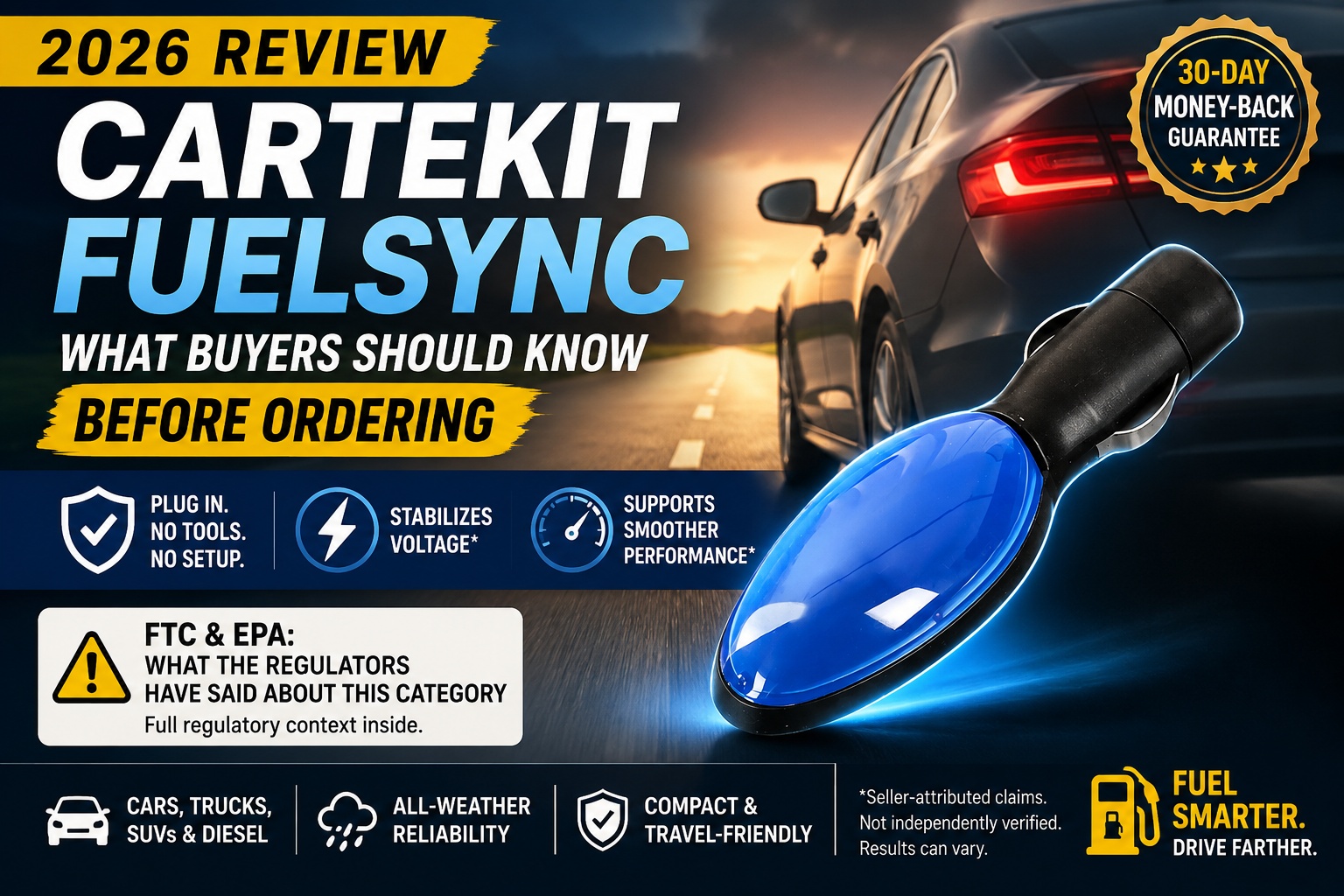
The Cartekit FuelSync is sold by Cartekit Technology International Co., Limited. Per the brand's official product page, the device is designed to plug directly into a vehicle's standard 12V cigarette lighter socket - the same port you use for phone chargers, GPS units, and portable fans.
According to the brand, the device works by stabilizing the vehicle's electrical system and reducing voltage fluctuations. The company states this is intended to support smoother engine performance and help improve fuel efficiency. Per Cartekit's description, the device operates passively in the background once plugged in, with no apps, tools, or manual calibration required after that initial connection.
One thing worth noting about the brand's specific language: Cartekit uses qualified, hedged wording throughout - "helps your car save fuel," "supporting smoother engine performance," "designed to enhance fuel efficiency." The company does not publish a specific miles-per-gallon improvement figure or cite EPA certification in its core materials. Some sellers in this category use far more aggressive language. Whether Cartekit's more measured framing reflects product conservatism or legal caution, buyers should still treat all fuel-efficiency claims in this category as seller-attributed and unverified unless independent substantiation is published - which Cartekit has not done.
Per the brand's official materials, the device is described as designed to:
Plug into any standard 12V cigarette lighter socket - the LED indicator confirms operation immediately
Stabilize voltage in the vehicle's electrical system per the brand's stated mechanism
Support smoother engine performance and operation according to the company
Work across cars, trucks, SUVs, and diesel engines per the brand
Operate in all weather conditions year-round per Cartekit's published description
Require zero ongoing maintenance or adjustment after plugging in
What the brand does not state anywhere in its official materials: a specific fuel savings percentage, EPA certification, independent third-party laboratory test results, or engineering validation of how voltage stabilization affects fuel consumption. Those omissions are noted here rather than passed over.
Why Most Plug-In Fuel Saver Devices Fail EPA Testing - And What That Means for Cartekit FuelSync
This is the question buyers are actually typing into Google - and it deserves a direct answer, not a careful dodge. Here it is: independent testing of products in this category has not produced what the marketing promises. The EPA's record across more than 100 devices tells a consistent story. Understanding why requires understanding one technical limitation that most sellers never mention.
Short Answer: Federal testing has not identified any plug-in fuel-saving device that significantly improves gas mileage. The EPA has evaluated more than 100 products in this category across multiple decades without identifying significant mileage improvements in any tested device. That is the documented record as of this review.
The EPA's record across more than 100 tested products in this category has not turned up a single device that significantly improves gas mileage. That is not a fringe opinion - it is documented federal agency testing spanning decades. No independent test results for the Cartekit FuelSync specifically were located in published sources at the time of this review. What follows is the technical reason why those results keep coming back the same way, regardless of which device gets tested.
Here is the technical reason why the results consistently come back this way. Your car's 12V cigarette lighter socket is an auxiliary power supply port. It exists to power accessories. In most modern vehicles, the auxiliary 12V circuit does not provide direct access to ECU programming or fuel-management controls. The Engine Control Unit - the onboard computer that actually governs fuel injection timing, air-fuel ratio, and combustion parameters - is a managed system with its own separate circuit. Devices that legitimately modify ECU behavior, such as professional performance tuners, connect through the OBD2 diagnostic port and require manufacturer-specific software. A device plugged into the cigarette lighter socket has no equivalent access pathway.
The brand's stated mechanism - voltage stabilization within the electrical system - is the most physically plausible part of the claim for a 12V-connected device. Based on the architecture of most modern vehicles, a device connected through the auxiliary 12V circuit would not ordinarily be expected to directly modify the combustion parameters governed by the ECU - which is where fuel consumption is ultimately determined.
Consumer Reports has published multiple rounds of testing on fuel-economy devices with consistent findings of no measurable improvement. An independent teardown of a FuelSync-category device by a third-party reviewer found the internal components to consist of a basic capacitor, resistors, and an LED indicator - a circuit designed to power the light, with no capability to affect fuel system behavior.
That is the honest picture. The brand's 30-day return window exists precisely for buyers who want to test the device against their own vehicle and driving pattern and return it if the experience does not match the marketing.
Cartekit FuelSync: Company and Seller Information
The company behind this product is Cartekit Technology International Co., Limited, registered in Wan Chai, Hong Kong - Room 702, 7/F, Spa Centre, No. 53-55 Lockhart Road. The product page displays "Designed in the U.S.A." - a design-origin claim. Under FTC guidelines, "Designed in the U.S.A." and "Made in the U.S.A." are distinct designations with different legal standards. The brand's Terms of Service are governed by Hong Kong law, which is a practical consideration for US buyers: any formal dispute beyond the standard return process would involve a foreign legal jurisdiction.
The brand publishes a 30-day money-back guarantee. Per the product page, buyers who are not satisfied can return the package within 30 days for a full refund, no questions asked. Customer support is listed in the Terms of Service as [email protected]. If there's any chance you'll use the guarantee, note that email address and your purchase date immediately when you order - don't hunt for it later when you need it.
The brand's product page describes the product as "Rated Excellent" based on thousands of customer reviews. This is brand-reported data. Ratings reflect the seller's published figures. Individual experiences and results vary.
Important context for buyers doing research: "FuelSync" as a product name is used by multiple unrelated sellers in the plug-in fuel-saver category. Cartekit FuelSync is specifically the product sold by Cartekit Technology International Co., Limited. Other sellers use similar names independently, with different company entities, policies, and return terms. When reading third-party reviews, pricing comparisons, or complaint threads, verify the source refers specifically to Cartekit - not a different seller operating under a similar name. This review covers only the Cartekit product.
Consumers should independently evaluate any aftermarket automotive product and review all current seller terms, return policies, and disclosures before purchasing.
What Actually Saves Gas According to DOE and AAA Data
With the national average above $4.50 a gallon, fuel economy genuinely matters. The irony of the plug-in fuel-saver category is that the approaches with the strongest evidence behind them are free or nearly free - and most sellers in this space never mention them. According to the U.S. Department of Energy and EPA fuel economy guidance, these are the methods with documented, measurable effects on real-world fuel consumption:
Tire pressure: Properly inflated tires improve fuel economy by up to 3% per AAA and DOE guidance. Under-inflated tires are one of the most common and most correctable fuel economy losses.
Smooth acceleration and braking: Aggressive driving - rapid acceleration and hard braking - can reduce fuel economy by 15% to 30% at highway speeds according to DOE data. Smooth throttle management is free and immediately effective.
Reducing excess weight: Every 100 pounds of unnecessary weight in a vehicle reduces fuel economy by roughly 1% according to DOE estimates. Cleaning out the trunk is a genuine, if modest, improvement.
Air conditioning use: Running AC at low speeds uses more fuel than opening windows; at highway speeds, the reverse is generally true. Reducing unnecessary AC use has a measurable effect.
Regular maintenance: A properly tuned engine, clean air filter, and fresh motor oil all contribute to efficiency. A severely misfiring engine can reduce fuel economy by up to 40% according to DOE figures - fixing it immediately restores that loss.
These approaches cost little or nothing and have independent, peer-reviewed substantiation behind them. They are included here not to dismiss the Cartekit FuelSync, but to give buyers the full picture of what the evidence supports in the fuel economy space.
Cartekit FuelSync vs. Other Fuel Economy Approaches: What the Evidence Supports
Buyers researching plug-in fuel-saving devices often want to understand how they compare to other options on the market - from OBD2 performance tuners to fuel additives to simple driving habit changes. Here is what the evidence actually supports across each comparison, using verified sources rather than seller claims.
Cartekit FuelSync vs. OBD2 performance tuners: This is a meaningful technical distinction worth understanding. OBD2 devices connect to the vehicle's diagnostic port, which can allow devices to read data from the vehicle's computer systems and, on some vehicles, adjust certain parameters. Professional-grade ECU tuners that work through OBD2 represent a legitimate - if more expensive and vehicle-specific - performance modification category. The Cartekit FuelSync connects through the 12V cigarette lighter socket, not the OBD2 port. These are different connection types with different access to vehicle systems. Whether consumer-grade OBD2 plug-in devices deliver meaningfully different results than cigarette lighter-connected devices is a contested question - the FTC and EPA's documented findings cover more than 100 tested products across both port types with consistent results.
Cartekit FuelSync vs. fuel additives: Fuel additives - products added directly to the gas tank - operate on a different claimed mechanism: chemical modification of combustion efficiency rather than electrical system interaction. The FTC has also addressed the fuel additive category with similar scrutiny. The EPA evaluates fuel additive claims separately and has issued enforcement actions in that category as well. Neither category has produced a consumer product with independently verified significant fuel economy improvement at the category level. Buyers comparing the two should understand they represent different unverified mechanisms, not a verified vs. unverified comparison.
Cartekit FuelSync vs. verified driving habits: This is where the evidence gap is most visible. DOE and AAA data document that smooth acceleration and braking can improve fuel economy by 15% to 30% at highway speeds. Correct tire pressure adds up to 3%. These approaches have peer-reviewed substantiation, cost nothing, and are available immediately. They do not require a purchase, a return window, or a regulatory risk assessment. For buyers whose primary goal is genuinely improving fuel economy rather than testing a product, the driving habit and maintenance approaches represent the most evidence-supported path available.
Cartekit FuelSync vs. hypermiling techniques: Hypermiling - the practice of maximizing fuel economy through deliberate driving strategies including anticipatory braking, reduced highway speeds, and route optimization - has documented real-world results in the 20% to 40% improvement range according to DOE data. These techniques require no device purchase and no return window. For drivers serious about reducing fuel costs, hypermiling represents the highest-evidence, zero-cost option available. It also has no regulatory controversy attached to it.
The comparison picture is consistent across every category: approaches that involve changing vehicle systems through unverified plug-in devices have not produced independently confirmed fuel economy improvements at scale. Approaches that change driver behavior and vehicle maintenance status have documented, reproducible results.
Pricing and Guarantee: What Is Actually Confirmed
The Cartekit product page does not display static pricing. The brand advertises a 50% introductory discount at the time of order, but the actual per-unit cost is confirmed at checkout - not on the landing page. The brand's page includes language noting the offer "may be taken down at any moment." That is standard promotional urgency framing in direct-to-consumer marketing - buyers benefit from making decisions on their own timeline rather than in response to countdown pressure.
What is confirmed from brand-published materials:
Introductory discount: 50% off advertised at time of order per the product page
Return window: 30 days from purchase, no questions asked per the brand
Customer support: [email protected] per Terms of Service
Shipping: Fast shipping noted on product page; specific delivery timeframes not published
Company entity: Cartekit Technology International Co., Limited, Wan Chai, HK
Governing law: Hong Kong per Terms of Service
A practical note on the guarantee: if you're buying to test and potentially return, document the support contact and purchase date immediately. Initiate any return request with time to spare - not on day 29. And keep your order confirmation. A guarantee is only as useful as the documentation you have when you actually need it.
See current Cartekit FuelSync pricing and package options on the advertiser's page
Who This Product Makes Sense For - and Who It Doesn't
Consumers are right to research this category before buying. The regulatory record is severe, the category-level evidence is consistent, and the FTC has made clear that sellers bear the burden of substantiation before making fuel-economy claims. With all of that established, here is the honest assessment of which buyers this product is worth considering for - and which buyers it isn't.
It makes sense for drivers who are curious about low-effort plug-in automotive accessories and are comfortable using the 30-day return window as their personal trial - testing the device against their actual driving, then deciding from real experience rather than advertising language. Drivers of older vehicles, where auxiliary electrical system consistency is a more variable factor than in newer tightly managed systems, may find the brand's stated mechanism more relevant to their specific situation. And buyers who go in understanding the FTC and EPA's documented category findings - not expecting a dramatic, measurable fuel economy transformation - are best positioned to evaluate whatever experience they have.
It is not a fit for buyers who need documented, independently verified fuel economy data before purchasing. It is not a fit for buyers expecting specific percentage savings - Cartekit's own materials don't make those claims, and the broader category's regulatory record makes any unsubstantiated percentage a red flag regardless of which seller it comes from. And it is not designed to deliver engine management-level performance changes from a device connected to a 12V auxiliary circuit.
Most buyers in this category purchase on impulse and only read the regulatory record afterward - if at all. The sequence that protects your money is the reverse: read the FTC and EPA context first, understand what independent testing has and has not found, and if curiosity still outweighs skepticism, the 30-day return window exists as a risk-limited personal test. That is the sequence that prevents buyer regret in this category.
Cartekit FuelSync Frequently Asked Questions
What does Cartekit say the FuelSync device does?
According to the brand's official product page, the Cartekit FuelSync is designed to stabilize the vehicle's electrical system by reducing voltage fluctuations. The brand states this is intended to support smoother engine performance and help improve fuel efficiency. Per Cartekit's description, the device works passively once plugged into the 12V cigarette lighter socket - no apps, setup, or tools required after that initial connection. The brand does not publish a specific fuel savings percentage in its core materials. All mechanism descriptions are the seller's stated intended function, not independently verified outcomes.
What do the FTC and EPA say about plug-in fuel saver devices?
Both agencies have formally addressed this product category, and their findings are relevant to any purchase decision here. The FTC states the EPA evaluated more than 100 purported gas-saving devices without finding any that significantly improve gas mileage. The EPA's own stated position is that it does not approve, certify, endorse, or register aftermarket fuel-saving products. The FTC requires marketers to hold scientific substantiation for energy-saving claims before making them - and has pursued enforcement actions in this category resulting in lifetime marketing bans and civil penalty exposure under the 1979 Notice of Penalty Offenses. Cartekit has not published independent substantiation for its claims.
Why don't cigarette lighter plug-in devices improve fuel economy?
The 12V cigarette lighter port is an auxiliary power supply port, not a control interface into the engine management system. In most modern vehicles, the auxiliary 12V circuit does not provide direct access to ECU programming or fuel-management controls. Your car's fuel injection timing, air-fuel ratio, and combustion parameters are governed by the ECU - a separate system that, on most modern vehicles, requires manufacturer-specific software and security protocols to access. That architectural separation is why the EPA's testing of more than 100 products in this category - across different connection types and claimed mechanisms - has consistently found no significant fuel economy improvement. The auxiliary circuit and the engine management system operate independently in most modern vehicle designs.
Is the Cartekit FuelSync compatible with my vehicle?
Per the brand, the device is designed for cars, trucks, SUVs, and diesel engines - compatible with virtually any vehicle with a standard 12V cigarette lighter socket. The brand doesn't publish a specific vehicle exclusion list in its main materials. Drivers of vehicles with 24V electrical systems - common in some larger commercial vehicles - should verify compatibility directly with the brand before purchasing. For most standard personal vehicles manufactured in the past two decades, the connection compatibility question is straightforward per the brand's description.
What is the return process if I want my money back?
The brand publishes a 30-day money-back guarantee - no questions asked, per the product page. Customer support per the Terms of Service is [email protected]. Note that email address and your purchase date the moment you order. If you decide to return the device, start that process with plenty of days remaining in the window - last-minute return requests carry more friction than early ones. Keep your order confirmation and any shipping documentation. The brand's Terms of Service are governed by Hong Kong law, which is relevant context if any dispute extends beyond the standard return process.
How does installation work?
Per the brand, installation requires no tools, apps, or setup of any kind. Plug the device into the vehicle's 12V cigarette lighter socket and the LED indicator illuminates to confirm it's active and receiving power. Cartekit describes the setup as taking seconds - no calibration, no pairing, no ongoing maintenance after that initial plug-in. The device draws from the vehicle's auxiliary circuit while driving and requires nothing further from the driver.
What does "Designed in the U.S.A." mean for this product?
It is a design-origin claim, not a manufacturing-origin claim. The company entity - Cartekit Technology International Co., Limited - is registered in Hong Kong. Under FTC guidelines, "Designed in the U.S.A." and "Made in the U.S.A." are legally distinct designations with different standards and different implications for domestic production. Buyers who prioritize domestic manufacturing should note this distinction. The brand's Terms of Service are governed by Hong Kong law.
Is "FuelSync" a name used by multiple sellers?
Yes - and this is genuinely important context for buyers researching this product. "FuelSync" appears as a product name across multiple unrelated sellers in the plug-in fuel-saver category. Cartekit FuelSync is specifically the product from Cartekit Technology International Co., Limited. Other sellers using similar names operate independently with different entities, policies, pricing structures, and return terms. When reading reviews, ratings, or complaint data online, confirm the source is discussing Cartekit specifically. Applying return-policy information or review data from a different seller to this purchase could lead to inaccurate expectations.
Are there other ways to improve fuel economy that have better evidence behind them?
Yes. Several approaches have documented, independently verified effects on fuel consumption. Maintaining correct tire pressure can improve fuel economy by up to 3% according to DOE and AAA data. Smooth driving habits - eliminating rapid acceleration and hard braking - can improve fuel economy by 15% to 30% at highway speeds per DOE figures. Reducing unnecessary vehicle weight, keeping up with regular engine maintenance, and managing air conditioning use all have measurable, evidence-backed effects. These approaches are free or low-cost and have the independent substantiation that plug-in fuel-saving devices in this category generally lack.
Does the device work differently in older versus newer vehicles?
The brand describes compatibility across vehicle types without distinguishing by age. From a technical standpoint, older vehicles generally have less integrated and less secured auxiliary electrical systems than newer vehicles with advanced ECU architectures. That context is relevant to evaluating how plausible the brand's stated mechanism is for a specific vehicle - but it does not change the EPA's category-level findings, which have been consistent across vehicle types and ages. Neither older nor newer vehicles have produced independently verified significant fuel economy improvements from products tested in this category.
Where can I purchase the Cartekit FuelSync?
The Cartekit FuelSync is sold through the brand's official direct-to-consumer offer channel. The 30-day money-back guarantee applies to purchases made through that channel. Given that multiple unrelated sellers use similar product names in this space, buyers considering marketplace platforms - Amazon, Temu, AliExpress, or similar - should verify the specific seller entity before purchasing, as guarantee coverage and return terms will differ by seller.
Do plug-in fuel saver devices like the Cartekit FuelSync actually work? What buyers are asking.
This is one of the most searched questions in this category, and it deserves a precise answer. The FTC's documented enforcement record shows that sellers who make unsubstantiated fuel economy claims for plug-in devices can face enforcement actions including lifetime marketing bans - and several have. Consumer teardowns of devices in this category have found internal components - typically a capacitor, resistors, and an LED - that power the indicator light but have no documented mechanism to affect fuel system behavior. Whether any specific device constitutes a "scam" depends on whether its specific claims are substantiated. What the EPA's testing of more than 100 products in this category shows is that significant fuel economy improvement from plug-in devices has not been independently verified in any tested product. Buyers should weigh that documented record when evaluating any seller's claims, including Cartekit's.
Has the EPA approved or tested the Cartekit FuelSync specifically?
No. The EPA's stated position is that it does not approve, certify, endorse, or register aftermarket fuel-saving products. This applies to all products in this category, including the Cartekit FuelSync. The EPA has evaluated more than 100 products across this category and has not identified any that significantly improve gas mileage - but this category-level testing should not be read as product-specific EPA testing of Cartekit's device. No product-specific EPA testing results for the Cartekit FuelSync were located in published sources at the time of this review. Any marketing language that implies EPA approval or EPA testing of this specific device would not be supported by the public record.
What does the FTC specifically say about fuel-saving devices?
The FTC has addressed this product category through multiple channels over multiple decades. Its published consumer guidance on gas-saving products advises skepticism of fuel economy claims and cites EPA testing showing no significant mileage improvement across more than 100 tested devices. The FTC's 1979 Notice of Penalty Offenses Concerning Energy Saving Claims established that representing expected fuel savings to consumers who will not ordinarily realize those savings is an unfair and deceptive practice subject to civil penalties - not just regulatory guidance, but an active enforcement standard. The FTC has pursued enforcement actions in this category resulting in lifetime bans on selling comparable products and consumer redress requirements. The FTC also requires that marketers of energy-saving products hold scientific substantiation for their claims before making them. Cartekit has not published such substantiation in its product materials.
View the Cartekit FuelSync current offer, pricing, and guarantee terms here
Contact Information
Company: Cartekit Technology International Co., Limited
Email: [email protected]
Address: Room 702, 7/F, Spa Centre, No. 53-55 Lockhart Road, Wan Chai, HK
Governing Law: Hong Kong
Disclaimers:
Editorial Methodology: This article was researched using primary source regulatory documents from the Federal Trade Commission and Environmental Protection Agency, AAA published gasoline price data, U.S. Department of Energy fuel economy guidance, and publicly available seller materials. Research methodology prioritizes primary government sources over secondary reporting. All statistics cited in this article are attributed to their original source.
Regulatory Sources Referenced: Federal Trade Commission consumer guidance on gas-saving products and energy-saving claims: ftc.gov. Environmental Protection Agency position on aftermarket fuel-saving products: epa.gov. FTC 1979 Notice of Penalty Offenses Concerning Energy Saving Claims. FTC enforcement actions in the fuel-saving device category, including settlements with lifetime marketing bans. AAA national average gasoline price data as of May 2026: gasprices.aaa.com.
Automotive and General Information Disclaimer: This content is for general consumer information only and does not constitute automotive, mechanical, engineering, or emissions-compliance advice. Readers with specific vehicle performance questions or concerns should consult a qualified automotive professional.
FTC Affiliate Disclosure: This article contains affiliate links. A commission may be earned on qualifying purchases made through links in this content, at no additional cost to the reader. Affiliate relationships do not influence editorial content or the evaluation of products featured. Disclosure is provided in accordance with FTC 16 CFR Part 255.
Results Variability Disclosure: Individual results and experiences with the Cartekit FuelSync will vary based on vehicle type, age, driving patterns, route conditions, and other factors. The brand's product description reflects the seller's stated intended function. No specific fuel economy outcome is guaranteed. The regulatory context documented in this article - including the FTC and EPA's published findings and enforcement record in the plug-in fuel-saving device category - is material to any purchase decision and is disclosed in full within the body of this article.
Brand Claims Attribution: All product claims in this article are attributed to Cartekit Technology International Co., Limited as the seller. No claims in this article should be interpreted as independently verified outcomes. This article does not constitute an endorsement of the product or a representation that the product will perform as described by the seller. Consumers should independently evaluate any aftermarket automotive product and review all current seller terms, return policies, and disclosures before purchasing.
Pricing Disclaimer: Pricing for the Cartekit FuelSync is subject to change without notice. The introductory discount referenced reflects the advertised offer at time of research. Verify current pricing at point of purchase. This article is not responsible for pricing changes after publication.
Publisher Independence Disclosure: The editorial content of this article reflects independent research and analysis of publicly available brand and regulatory information. The content is produced independently of the brand featured. The brand has not reviewed, approved, or paid for the editorial content of this article. Affiliate compensation, if any, is earned through purchase links only, not through editorial placement.
Regulatory Context Disclosure: The Federal Trade Commission has published consumer guidance on gas-saving products and has conducted enforcement actions in the plug-in fuel-saving device category. The EPA has evaluated more than 100 purported gas-saving devices and does not approve, certify, endorse, or register aftermarket fuel-saving products. The FTC's 1979 Notice of Penalty Offenses Concerning Energy Saving Claims establishes civil penalty exposure for unsubstantiated energy-saving representations. This regulatory history is material to any purchase decision in this category and is disclosed in full within the body of this article.
Platform and Retailer Disclosure: This article is distributed via press release wire services. The content is the responsibility of the article's publisher, not the distribution platform. The distribution platform does not independently verify the claims of brands featured in distributed content.
SOURCE: Cartekit Technology International Co., Limited