



Tuesday, 16 June 2026 08:15 PM
Advertorial
Carbon Monoxide, Natural Gas, Propane, and Smoke - What the Brand Claims About Live PPM Readings and 4-in-1 Detection, and the Certification Question Every Buyer Needs to Answer
FOUNTAIN VALLEY, CA / ACCESS Newswire / June 16, 2026 / Title Reference Notice: The phrase "Legit 4-in-1 CO Detector or Just Hype" uses the approved editorial verification-question construction - it identifies the buyer's core decision intent (is this legitimate?) without making a bare accusation in either direction. "Legit" reflects the question buyers are asking, not this publication's independent certification finding. "4-in-1 CO Detector" reflects brand-stated product positioning published by CarbonOne Safe at onninest.com/carbononesafe/inter5. "What to Verify Before You Order" refers to the attribution, context, and verification framework in this article - not laboratory testing conducted by this publication. "Reviews and Complaints 2026" is verification-intent framing that reflects genuine buyer search behavior; "Complaints" is a verification-intent term, not an accusation against the product. Readers who want the brand's full promotional language should visit the official CarbonOne Safe website. Readers who want to know what's verified, what's brand-stated, and what remains an open question should keep reading.
ADVERTORIAL - Affiliate Disclosure: This is promotional content containing affiliate links. A commission may be earned on qualifying purchases at no extra cost to you. Product claims reflect what CarbonOne Safe's brand has published - not independent lab testing or verified certification by this publication. This article is not a substitute for professional safety advice, local fire code guidance, or direct verification from the brand. Customer ratings are brand-reported and have not been independently audited. Results vary. Full disclosures are in the Disclaimer Bundle at the bottom of this article. Disclosure provided per FTC 16 CFR Part 255.
Your Green-Light CO Detector May Already Be Dead - CarbonOne Safe Reviews and Complaints 2026: Real-Time Display Claims, Certification Gap, Pricing, and What to Verify Before Your Family Relies on It
View the current CarbonOne Safe offer (official CarbonOne Safe partner page)
TL;DR - CarbonOne Safe in 60 Seconds
The green light on your current CO detector doesn't necessarily mean it's working. Most standard detectors won't sound an alarm until CO has been building in your home for up to four hours at 70 PPM - and when the electrochemical sensor inside wears out, that green light keeps blinking anyway. CarbonOne Safe is designed around a different idea: show you the actual CO level in your air, right now, in real time - starting at 0 PPM, before any alarm threshold is crossed. That's the pitch. Here's the honest breakdown.
According to the brand, CarbonOne Safe is a plug-in unit that monitors carbon monoxide, natural gas, propane, and smoke from fire - four hazard types, one device, no tools required to install. At $69 for a single unit (or as low as $41.40 per unit in a 5-pack with promo SAFE26), with a 90-day money-back limited guarantee, it's accessible for whole-home coverage. The 90-day guarantee requires original packaging and the refund is less shipping and handling - worth knowing before you order five.
The one thing to sort out before you buy: third-party safety certification. UL 2034, ETL, or equivalent listing isn't disclosed on the official product page as of June 2026. In 48 states with CO alarm legislation, that listing is what the code requires. One call to 1-888-814-2188 answers it. This entire article is designed to make that call productive - and everything that follows tells you what to ask, what to verify, and what to expect.
If you already know what CarbonOne Safe is and you're here to check pricing, bundles, and the current promo code, you can skip the full breakdown and go straight to the current CarbonOne Safe offer on the official partner page. If you want the full verification picture first - certification gap, refund terms, what the reviews actually tell you - keep reading. That's what this article is for.
How This Article Was Researched - and What It Can and Cannot Tell You
This article draws on three source categories, stated upfront so you know exactly what weight to give each claim:
Brand-published materials: The official CarbonOne Safe product page at onninest.com/carbononesafe/inter5, the brand's FAQ section, Terms of Service, Privacy Policy, and published guarantee terms. Claims from these sources are labeled "according to the brand," "brand-stated," or "per the official website."
Authoritative public health and safety guidance: Published data from the CDC and CPSC on CO risk, residential exposure thresholds, and alarm recommendations - named by source and attributed directly.
Industry certification standards context: Publicly available information on UL 2034 residential CO alarm requirements, including the time-weighted alarm threshold design and end-of-life signaling requirements - cited for consumer context, not as editorial performance verification of CarbonOne Safe.
What this article cannot tell you: whether CarbonOne Safe's sensor performs to a recognized safety standard, because that certification status is not publicly disclosed by the brand. No physical device was tested. No lab was involved. Every performance claim here traces to a named source - and where no named source exists, the gap is flagged, not assumed.
Buyer Takeaway: The research methodology above is what separates this article from results that either uncritically repeat brand claims or make accusations without documentation. Read every section with source awareness - and use the certification call to fill the gap this article cannot fill for you.
Quick Verification Snapshot - CarbonOne Safe, June 2026
Product name: CarbonOne Safe
Operator: Onninest (onninest.com/carbononesafe/inter5)
Category: Plug-in residential gas and smoke detection device
Brand-stated detections: Carbon monoxide (CO), natural gas, propane, smoke from fire
Brand-stated display: Live digital CO readout from 0 PPM
Brand-stated sensor type: "Certified electrochemical sensor technology" (sensor component description - not a disclosed finished-device certification)
Brand-stated service life: 5 years
Brand-stated guarantee: 90-day money-back limited guarantee, less S&H on returns, original packaging required
Base price (brand-stated, June 2026): $69.00/unit (1x); bundles from $62.10 (2x) to $41.40 (5x) with promo code SAFE26
Shipping: Free (brand-stated); return shipping is the buyer's responsibility
Third-party certification: Not disclosed on official product page as of June 2026 - verify directly with the brand
Company address: 18627 Brookhurst St #1300, Fountain Valley, CA 92708
Return address: CarbonOne Safe, 1777 Abram Ct #1692, San Leandro, CA 94577, USA
Customer support: 1-888-814-2188 | Monday-Friday, 9:00 am-5:00 pm
Brand-reported reviews: 4.8/5 based on 17,127+ customer reviews (brand-reported; not independently audited)
Information current as of: June 2026. Verify pricing, availability, and certification status on the official website before purchase.
Buyer Takeaway: This snapshot reflects brand-stated information from the official CarbonOne Safe product page and published Terms of Service. Pricing, promotions, shipping policies, and guarantee terms are subject to change. Verify current totals at checkout before completing any purchase. Certification status is the single item this snapshot cannot confirm for you - that requires a direct conversation with the brand.
View the current CarbonOne Safe offer (official CarbonOne Safe partner page)
About the Promotional Language in This Article's Title
You're here because you saw a CarbonOne Safe ad somewhere - and instead of just clicking "buy," you searched first. That's exactly the right move when you're buying a device you're going to rely on for home safety. This article uses the brand's own promotional language in its title because that's the bridge between the ad you saw and the honest information you're looking for right now.
Here's what each promotional phrase actually means - and what it doesn't:
"4-in-1 Detection Claims": The brand states CarbonOne Safe monitors four hazard types - carbon monoxide, natural gas, propane, and smoke from fire - from one plug-in unit. "Claims" in the title is deliberate: this publication has not conducted independent laboratory testing of detection performance across those four hazard types. Detection capability is brand-stated. One additional note: the brand's FAQ section primarily describes CO, natural gas, and propane; smoke detection appears on the main product page. If smoke detection is a deciding factor for you, verify that directly with the brand before ordering.
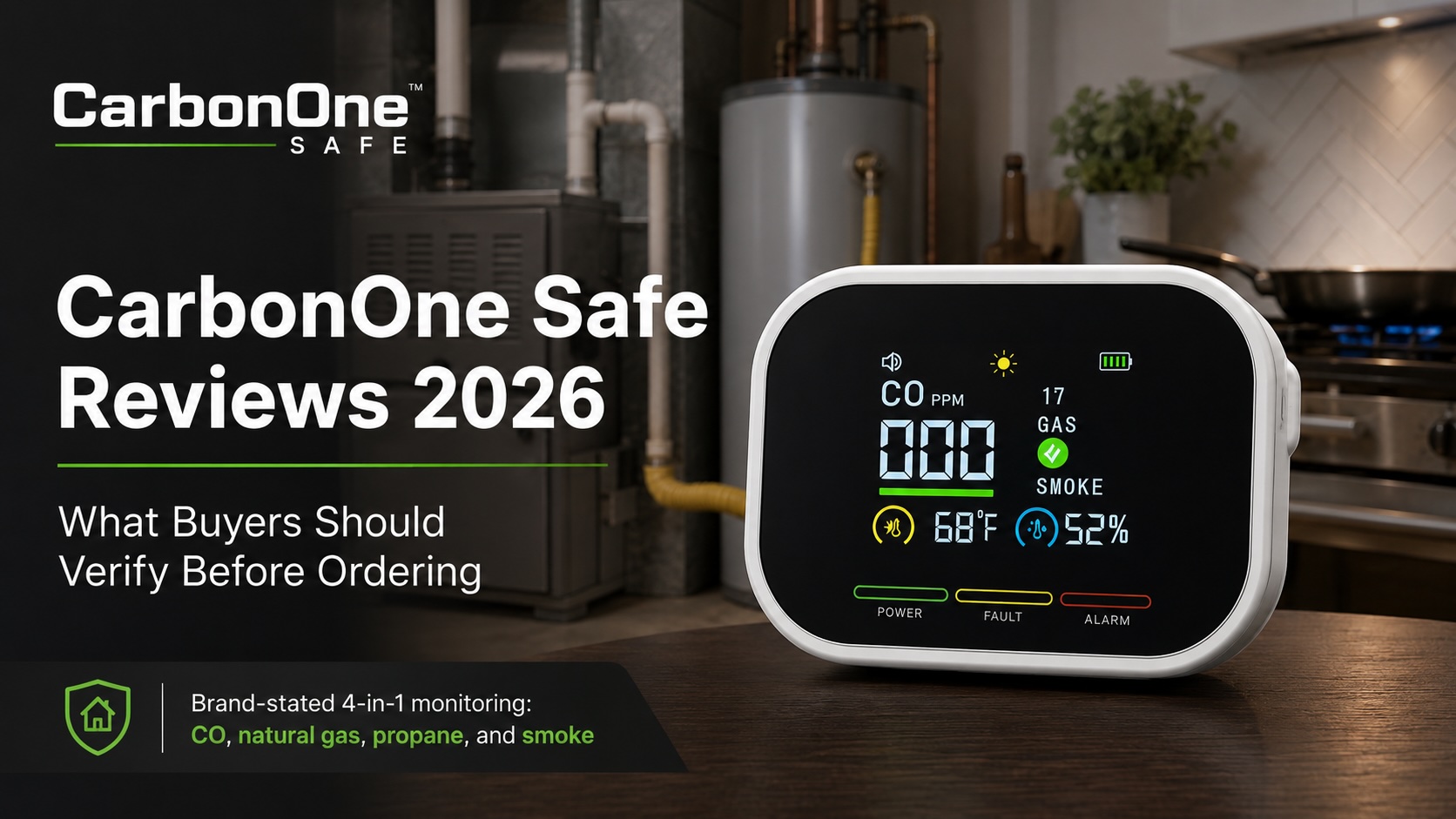
"Real-Time CO Display": The brand states CarbonOne Safe features a live digital readout showing carbon monoxide concentration in PPM starting from 0, updating continuously. This publication has not independently validated display accuracy, calibration methodology, or PPM measurement precision. The real-time display functionality is brand-stated.
"Reviews and Complaints 2026": This phrase captures what buyers are actually searching - people want to know if there are problems with this product before they buy it. The complaints framing is a buyer-verification lens, not an accusation. What this article covers is what the brand says, what it doesn't say, and what you need to confirm yourself.
"What to Verify Before You Order": The certification gap, the smoke detection scope question, the battery backup duration - these are the specific items this article identifies as open verification points for buyers. The title delivers what it promises.
Buyer Takeaway: Every promotional phrase in the title originates with either CarbonOne Safe's own brand materials or reflects genuine buyer-intent search behavior. This article uses them to connect ad-driven readers with honest verification information - not as this publication's independent endorsement of any performance claim.
Why CarbonOne Safe Is Getting Attention in 2026
You saw the ad. The number on the screen. The sleeping family. The line about the green light on your current detector being meaningless. And you did the right thing - you searched before you bought.
Here's the honest answer to whether the urgency is real: yes, with context.
Carbon monoxide is exactly the threat the brand describes. According to the Centers for Disease Control and Prevention (CDC), more than 400 Americans die from unintentional CO poisoning not linked to fires every year, and more than 100,000 visit emergency departments annually. CO is colorless, odorless, and kills without warning - it can cause sudden illness and death before a sleeping person ever wakes up. That's not marketing copy. It's the CDC's own public-health data, cited here from the original source, not through the brand.
The brand's argument about standard detector limitations also has documented basis. Many residential CO alarms are built around time-weighted alarm thresholds rather than continuous real-time displays. A standard audible-alarm device tells you when CO has crossed a trigger threshold. A real-time display tells you what the CO level is right now - including at readings below any alarm trigger. Those are two genuinely different tools serving different information functions. CarbonOne Safe is positioned to provide the second type of visibility, according to the brand.
The next section explains exactly why the green light isn't a reliable indicator of whether your detector is actually working. It's the most important thing in this article to understand before you make any purchase decision - whether you buy CarbonOne Safe or not. For buyers who want additional context, prior coverage of CarbonOne Safe from earlier in 2026 examined the same UL 2034 standards context and the certification gap in detail - it's worth reading alongside this article.
Buyer Takeaway: The CO risk is real and documented by the CDC. The monitoring gap between real-time display and alarm-only detection is real and documented by how UL 2034 works. Whether CarbonOne Safe is the right tool for your home is what you figure out in the next few sections.
The Problem With Your Current CO Detector That Nobody Talks About
Here's something worth knowing before you decide whether you need CarbonOne Safe at all - and it applies to whatever detector is currently plugged into your wall, including any certified alarm you bought at a hardware store.
Electrochemical CO sensors have a defined, finite lifespan. Manufacturers who build to the UL 2034 standard are required to include an end-of-life warning - typically a specific chirp pattern that's distinct from a low-battery alert - because when the sensor wears out, the device stops detecting CO accurately. The green indicator light, however, keeps blinking. It looks exactly the same as when the device was working. The alarm never sounds. You have no way of knowing the difference without either testing the sensor with calibrated gas - which requires specialized equipment - or checking the manufacture date against the replacement schedule printed on the device.
This isn't a CarbonOne Safe claim. It's documented by Underwriters Laboratories, the organization that sets UL 2034, and by manufacturers across the category. The CPSC's own guidance recommends following manufacturer replacement timelines specifically because of this failure mode. Since 2009, all retail CO alarms certified to UL 2034 have been required to include an end-of-life signal - which means if your detector predates 2009 and you can't find a manufacture date on the back, you may have no warning mechanism at all when the sensor goes.
The second issue: even a fully working standard alarm operates on a time-weighted curve, not a real-time display. At 70 PPM, a UL-listed alarm isn't required to sound for up to four hours. At lower levels, it may not sound at all. That's intentional - the standard is designed to reduce nuisance alarms from brief, normal fluctuations. But it means the absence of an alarm doesn't mean the absence of CO. It means CO hasn't crossed the alarm trigger threshold yet, or hasn't held there long enough.
These two facts - sensor degradation without visible indication, and alarm thresholds that don't capture every level of exposure - are the real-world basis for why real-time PPM monitoring exists as a product category. CarbonOne Safe is positioned directly against both of them, according to the brand. Whether it solves them depends on its own sensor reliability and certification status - which loops back to the verification section below.
Buyer Takeaway: Go check the back of your current detector right now. Find the manufacture date. If it's more than five years old - or if there's no date on it at all - that green light doesn't guarantee the sensor inside is still working. That's not a sales pitch. That's documented category behavior that applies to every brand. CarbonOne Safe is positioned to solve exactly this problem. Whether it solves it reliably is what the certification call confirms.
CarbonOne Safe Fast Facts 2026: What Every Buyer Should Know in 30 Seconds
CarbonOne Safe is a plug-in, outlet-mounted home gas detection device - no tools, no ladder, no electrician required, per the brand.
Detections (brand-stated): Carbon monoxide, natural gas, propane, and smoke from fire - four hazard types in one device.
Display (brand-stated): Live digital PPM readout starting at 0 - not a static green indicator light.
Sensor technology (brand-stated): "Certified electrochemical sensor technology" - this describes the sensor component type, not a disclosed UL or ETL listing of the finished device.
Self-testing (brand-stated): Continuous automated self-checks without user action, with alerts if a problem is detected.
Battery backup (brand-stated): Operation continues through power outages via built-in battery backup - duration not disclosed on the product page.
Service life (brand-stated): 5 years.
Setup (brand-stated): 5 seconds - plug into any standard wall outlet.
Guarantee (brand-stated): 90-day money-back limited guarantee; original packaging required; refund is less shipping and handling; return shipping is the buyer's responsibility.
Price (brand-stated, June 2026): $69.00 single unit (promo SAFE26) down to $41.40/unit on a 5-unit bundle.
Shipping (brand-stated): Free 2-3 day delivery from a US warehouse; dispatched within 48 business hours.
Third-party certification: UL 2034, ETL, or equivalent not disclosed on the product page as of June 2026 - contact the brand to verify.
Operator: Onninest; registered in California; operates as CarbonOne Safe.
Dispute resolution: Arbitration via JAMS, governed by Florida law, per published Terms of Service.
Return address: CarbonOne Safe, 1777 Abram Ct #1692, San Leandro, CA 94577, USA.
Brand-reported customer satisfaction: 98.4% of brand-reported reviewers say they would recommend this product - brand-reported, not independently audited.
Critical emergency note: No consumer detection device replaces professional appliance maintenance, HVAC inspection, or emergency response. If you suspect gas or CO exposure: leave immediately and call 911.
Buyer Takeaway: These fast facts come directly from the official CarbonOne Safe product page and published Terms, current as of June 2026. The one item this list can't confirm: third-party certification. That's the phone call you make to 1-888-814-2188 before you decide on quantity.
View the current CarbonOne Safe offer (official CarbonOne Safe partner page)
The Certification Question - The Most Important Thing on This Page
Before anything else, here's the fact every serious buyer needs to see clearly.
As of June 2026, the official CarbonOne Safe product page does not disclose third-party safety certification from UL Solutions (UL 2034 for CO alarms, UL 217 for smoke alarms, UL 2075 for gas detectors) or from ETL/Intertek under equivalent standards.
The brand describes its sensor as using "certified electrochemical sensor technology." That language describes the sensor component type. A sensor component description is not the same as a finished-device certification. A device can use electrochemical sensors - a real, widely-used technology - and still not hold a UL listing for the complete, finished product. These are genuinely different things, and conflating them is the most common source of confusion in this category.
Why does it matter? The CDC and the U.S. Consumer Product Safety Commission (CPSC) both recommend working CO alarms in every home. The CPSC specifically recommends CO alarms that meet UL standard 2034. And here's where it gets practical for most buyers: as of 2025, 48 states have some form of CO alarm legislation or code requirements in place - with the majority of those state codes and the International Fire Code (IFC) referencing UL 2034 listing directly. New York, California, Texas, Minnesota, and dozens of other states require CO alarms listed to UL 2034 in residential occupancies. Many lease agreements and homeowner insurance policies mirror those same requirements. If you're in a rented home, own a home with a mortgage, or live in one of those 48 states - that's probably you.
This does not mean CarbonOne Safe is unsafe or ineffective. It means the device's performance against recognized safety standards has not been confirmed through a disclosed third-party audit of the finished product. For a device that is your household's first and only warning of an invisible, odorless, life-threatening gas, that distinction is not a technicality. This certification gap was also flagged in an earlier buyer analysis of CarbonOne Safe - the consistency of that finding across independent evaluations makes it the most important pre-purchase verification step regardless of when you're reading this.
What to do: contact the brand at 1-888-814-2188 (Monday-Friday, 9:00 am-5:00 pm) and ask specifically whether CarbonOne Safe holds a current UL 2034 listing or ETL equivalent. Ask for the listing number or certification documentation. If the brand has it, they can provide it. If your local code, lease, or insurance requires certified equipment and this device doesn't qualify, it cannot substitute for a listed alarm - it can only supplement one.
Buyer Takeaway: Certification verification is the first phone call, not an afterthought. The brand's contact number is 1-888-814-2188. Make the call before you choose a bundle size.
What CarbonOne Safe Claims to Do: Every Feature With Full Attribution
The brand's official product page makes the following claims. Every one is presented here with explicit attribution so you know precisely what the brand is saying versus what's been independently confirmed.
Real-Time CO Display From 0 PPM
According to the brand, CarbonOne Safe features a live digital display showing actual carbon monoxide concentration in parts per million starting at zero, updating continuously. The brand's website contrasts this with what it calls standard detectors that "just show a green light and don't alarm until CO hits 70 PPM." The brand's position is that by the time a standard alarm sounds, buyers may have already been breathing higher CO concentrations for hours.
What a live display actually does for you: it gives you information visibility that a status-light-only device doesn't. You can see whether readings are stable at zero or trending upward - which is different from waiting for an alarm to tell you something is wrong. That's a genuinely useful feature if the display is accurately calibrated. Calibration accuracy is what independent certification testing typically validates - which is why the certification gap matters here specifically.
One important framing point: when the display reads zero, that means the device is reading zero CO in the surrounding air at that moment. It's not a professional air-quality clearance, a guarantee of safety, or proof that no hazard exists elsewhere in the home. It's a real-time reading - which is more information than a green light, but not the same as a certified clean-air assessment.
4-in-1 Hazard Detection
According to the brand, CarbonOne Safe monitors four hazard types from one plug-in unit: carbon monoxide, natural gas, propane, and smoke from fire. The brand calls this "4-in-1 Protection" and positions it against basic detectors that cover only CO.
One detail buyers should verify before ordering: the brand's main product page references smoke detection as part of the 4-in-1 coverage, while the brand's own FAQ section primarily describes detection of carbon monoxide, natural gas, and propane - three gases. The FAQ states: "It detects carbon monoxide, natural gas, and propane. Most cheap detectors only cover CO. This one covers all three." Buyers for whom smoke detection is a deciding factor should confirm the smoke-alert function directly with the brand before purchase.
Buyer Takeaway: Multi-hazard detection from one plug-in unit is a legitimate category differentiator. The 4-in-1 claim is brand-stated. Smoke detection specifically has an inconsistency between the main page and the FAQ that's worth a quick confirmation call.
Electrochemical Sensor Technology
The brand states CarbonOne Safe "uses certified electrochemical sensor technology found in professional-grade detection equipment across the US." Electrochemical sensors are a real, widely deployed technology in CO detection - both consumer and industrial-grade devices use them. The brand-stated description positions the sensor type as equivalent to professional-grade equipment.
What it doesn't mean: "certified electrochemical sensor technology" is a component description. The word "certified" here refers to the sensor type, not to a UL listing or ETL certification of the complete CarbonOne Safe device. That's the distinction covered in the certification section above, and it's the most important technical framing to carry into your purchase decision.
Battery Backup During Power Outages
Per the brand, CarbonOne Safe continues operating on built-in battery backup when household power fails. The brand positions this as especially important because power outages often occur during storms - the same conditions when heating equipment malfunctions that produce CO are more likely. Battery backup is a real feature worth having in a home detection device.
What the official product page doesn't disclose: backup battery type, estimated backup duration, and battery replacement protocol. Before purchasing with battery backup as a deciding factor, ask the brand how long the backup sustains operation and what the end-of-battery-life process looks like.
Continuous Automated Self-Testing
According to the brand, CarbonOne Safe runs automated self-checks continuously, without user action, and will alert users if something goes wrong with the device. The brand positions this as a solution to a real failure mode: traditional detectors whose green status lights continue illuminating after sensor failure, creating a false sense of security.
What isn't specified on the product page: how the device communicates a self-test failure to the user - whether through an audible signal, a visual indicator, or a display message. If the self-test notification method matters to your purchase decision, ask the brand directly at 1-888-814-2188.
5-Second Plug-In Setup
Per the brand, installation requires only plugging the device into a standard wall outlet - no tools, no ladder, no electrician needed. The brand states it takes 5 seconds. For buyers who want protection without complex installation, this is a genuine practical benefit. Brand-reported testimonials on the official product page consistently mention setup simplicity as a highlight - including from buyers who describe themselves as older adults or non-technical users.
5-Year Service Life
The brand states CarbonOne Safe is rated for 5 years, positioning this against what it describes as standard detectors that burn out in 2 to 3 years with the green light still glowing. The 5-year rating is brand-stated. CO sensor degradation is a real industry consideration in electrochemical detectors - the CPSC recommends following manufacturer guidance on replacement timelines. Confirm the brand's end-of-life indicator and replacement protocol before purchasing.
CarbonOne Safe Quick Answer: How Does the Live Display Work?
CarbonOne Safe's live display shows CO concentration in PPM starting at 0, updating continuously, according to the brand - giving you a number, not just a green light. A "0" reading means the device reads zero CO in the surrounding air at that moment; it's not a certified air-quality clearance. If CO starts rising, you see it before the alarm triggers. Display accuracy has not been independently verified by this publication.
CarbonOne Safe vs. Standard Detectors: An Honest Feature Breakdown
The brand's product page includes a comparison table that positions CarbonOne Safe against what it calls "standard detectors." That table is brand-authored - which means the brand is grading itself. Here's a more neutral read of the same categories.
Real-time CO display vs. status light: This is an accurate category distinction. Most basic consumer CO alarms show a green status indicator that changes only when an alarm threshold is crossed. A live PPM display gives you information visibility between zero and the alarm trigger. Many professional-grade and mid-range consumer detectors also offer digital readouts - this feature is not exclusive to CarbonOne Safe, but it is a meaningful differentiator from entry-level indicator-only devices.
Multi-gas detection: Most basic CO-only alarms don't cover natural gas or propane. Combination CO and combustible gas detectors do exist in the market at various price points; some also include smoke. CarbonOne Safe's 4-in-1 positioning is a legitimate differentiator from single-hazard CO-only devices.
Battery backup: Battery backup is available across a range of consumer CO detectors, including several that carry UL 2034 listings. This feature is not exclusive to CarbonOne Safe.
Self-testing: Continuous automated self-testing is described as a differentiator. Many modern consumer CO detectors include self-test functionality. The specific self-test failure notification method for CarbonOne Safe is not detailed on the product page.
Service life (5 years): A 5-year rated life is reasonable for the category. Many UL 2034-listed CO alarms are rated for 5 to 10 years. The brand's "2-3 year" comparison figure for standard detectors represents the low end of the consumer market, not the category average.
Guarantee (90 days): A 90-day money-back limited guarantee is the brand's documented policy. It includes conditions: original packaging required, refund is less S&H, return shipping is the buyer's responsibility. It's a genuine consumer protection - and it's a limited warranty, not a full warranty, under Magnuson-Moss terminology.
Price ($69 single unit; $41.40/unit on 5-pack): Consumer CO detectors span a wide range - from under $20 for basic indicator-only models to over $100 for UL-listed multi-gas combination units. At $69 for a single unit, CarbonOne Safe sits in the mid-to-upper-mid range. Buyers comparing it to UL-listed alternatives should look specifically at certified combination CO and gas detectors in this price range.
Buyer Takeaway: The brand's feature comparison is self-authored. The features it highlights are real categories worth evaluating. Before making a final decision, look at UL 2034-listed combination CO and gas detectors in the same price range - not because CarbonOne Safe is necessarily worse, but because you deserve to know what your alternatives are.
View the current CarbonOne Safe offer (official CarbonOne Safe partner page)
CarbonOne Safe Quick Answer: Is CarbonOne Safe Legit or Just Hype?
CarbonOne Safe is a commercially available product from Onninest with published contact details, a documented return policy, and brand-reported 4.8/5 customer reviews - not flagged as fraudulent by any regulatory body as of June 2026. The real-time monitoring gap it describes is a documented category consideration. The open item: third-party certification status is not disclosed on the product page. That's the verification call you make before you order - not after.
How to Read CarbonOne Safe's Marketing Language
CarbonOne Safe's advertising knows what it's doing. It leads with a real and documented risk, wraps it in emotional storytelling, and makes the product feel like the obvious answer. Nothing wrong with that - but you're smart enough to want the translation before you hand over $69 or $200 for a multi-pack. Here it is.
"Trusted By 151,637+ American Families" - This is a brand-stated cumulative figure published on the official product page. It reflects the brand's own reported customer count and has not been independently audited. A product used by a large number of buyers is not the same as a product that has been independently certified to perform to a safety standard.
"Built to Professional Standard" - This is the brand's own positioning language for its sensor technology. The brand describes the sensor as comparable to professional-grade equipment. This publication has not conducted laboratory testing to evaluate that claim. It's brand-asserted positioning.
"Certified Electrochemical Sensor Technology" - As discussed in the certification section: "certified" here describes the sensor component type, not a UL or ETL listing of the completed finished device. The distinction between a certified sensor type and a certified finished product is meaningful for a life-safety device.
"17,127+ Five-Star Reviews" and "4.8 out of 5" - These figures are brand-reported data published on the official product page. Customer ratings and testimonials are brand-reported and have not been independently audited by this publication. Individual experiences vary. Review data hosted on a brand's own platform should be read with awareness that the brand controls the collection and display environment.
"Order Now & Save 50% Off" - The 50% discount with promo code SAFE26 is presented against the brand's stated reference price of $138.00 per unit. Comparison prices are the brand's stated reference points and may not reflect prevailing market prices for comparable devices. Confirm the final price at checkout, including any applicable taxes.
"90 Day Money Back Guarantee - No Questions Asked" - The guarantee documented in the brand's Terms of Service requires original packaging and excludes shipping and handling from the refund. "No questions asked" is promotional language; the original packaging requirement is the material condition. Return shipping is the buyer's responsibility.
Buyer Takeaway: The brand's marketing is doing what marketing does - leading with the most compelling version of its story. Reading the actual Terms, FAQ, and published policies alongside the promotional copy gives you the complete picture. That's what this article is for.
CarbonOne Safe Quick Answer: What Gases Does It Actually Detect?
CarbonOne Safe is positioned by the brand to detect carbon monoxide, natural gas, propane, and smoke from fire - four hazard types in one plug-in unit. One detail to verify: the brand's FAQ section describes three gases (CO, natural gas, propane), while smoke detection appears on the main product page separately. If smoke detection is a deciding factor, confirm it directly with the brand at 1-888-814-2188 before ordering.
CarbonOne Safe Reviews and Complaints: What Brand-Reported Feedback Actually Tells You
The brand reports 17,127+ customer reviews at a 4.8/5 average - Easy Setup 4.9, Detection Accuracy 4.8, Display Clarity 4.8, Alarm Response 4.9, Value for Money 4.9. And 98.4% say they'd recommend it. Those numbers would be impressive for any product. For a life-safety device, they're a starting point, not a conclusion.
Here's the honest framing: these are brand-reported reviews collected and displayed on the brand's own platform. They haven't been independently audited by this publication, and individual experiences vary. A review that says "plugged it in and it worked great" tells you about the setup experience. It doesn't tell you whether the sensor is performing accurately. Keep that distinction in mind as you read.
With that context, here's what the brand-reported feedback consistently highlights: setup simplicity is the most frequently mentioned positive - multiple brand-reported reviewers describe installing the device in under a minute with no tools. The live display is the second most common theme, with several testimonials describing the psychological value of seeing a "0" reading each morning as meaningfully different from a passive green light. Multi-unit purchases appear frequently - several brand-reported reviewers describe ordering additional units for other floors or family members after their initial purchase.
What the brand-reported feedback doesn't address: no brand-reported reviews discuss third-party certification status; none describe testing device performance against measured CO or gas concentrations; none describe battery backup duration during extended outages; none describe what a self-test failure alert looks like in practice. Those gaps are exactly what your conversation with the brand at 1-888-814-2188 should cover.
Buyer Takeaway: Brand-reported satisfaction at 4.8/5 across 17,000+ reviews is a positive signal. But for a life-safety device, satisfaction scores are a starting point, not a substitute for verified performance data. Use the testimonials to evaluate setup experience and display usability. Use the phone to evaluate certification status.
CarbonOne Safe Pricing: Every Bundle Tier Explained
The brand's current pricing structure, with promo code SAFE26 applied (confirm at checkout - promotional pricing is subject to change without notice):
1x CarbonOne Safe: $69.00/unit - brand-stated 50% off from reference price of $138.00
2x CarbonOne Safe: $62.10/unit - brand-stated 55% off from reference price of $276.00
3x CarbonOne Safe: $55.20/unit - brand-stated 60% off; listed as "Most Popular" on the brand's checkout page
4x CarbonOne Safe: $48.30/unit - brand-stated 65% off; listed as "Best Deal"
5x CarbonOne Safe: $41.40/unit - brand-stated 70% off from reference price of $690.00
Shipping is brand-stated as free on all orders. Return shipping is not covered - that's the buyer's responsibility if using the 90-day guarantee. Taxes are calculated separately at checkout; confirm the final total before completing your purchase. Comparison reference prices are the brand's stated reference points and may not reflect prevailing market prices for comparable devices.
For context on coverage: the brand's own FAQ recommends one unit per floor, plus one near each gas appliance and one outside each sleeping area. For a two-story home with gas appliances on the main floor and bedrooms upstairs, that guidance maps naturally to the 3x or 4x tier - which also happen to carry the largest per-unit discounts. That's worth noting not as urgency language but as practical math for whole-home coverage planning.
One note on sequencing: figure out the certification question before you commit to a bundle size. If the device works for your situation, the 3-pack at $55.20/unit is the sweet spot for most two-story homes with gas appliances. If you're still waiting on a callback from the brand, start with one unit - the 90-day guarantee gives you time to get that question answered before the return window closes.
Buyer Takeaway: The bundle math is genuinely good - each tier gives you meaningful per-unit savings. Check that SAFE26 still applies at checkout (promo pricing can expire), and confirm your final total before paying since taxes are calculated separately.
View the current CarbonOne Safe offer (official CarbonOne Safe partner page)
CarbonOne Safe Quick Answer: Is the 90-Day Money-Back Guarantee Real?
CarbonOne Safe's 90-day money-back guarantee is documented in published Terms of Service as a limited guarantee - real, but with conditions. Items must be returned in original packaging; the refund is less shipping and handling; return shipping is the buyer's responsibility. "No questions asked" is promotional language - the packaging requirement is the material condition. Use trackable shipping for returns over $75. Call 1-888-814-2188 before sending anything back.
Where CarbonOne Safe Fits in a Home Safety Setup
This device isn't the right tool for every buyer in every situation. Here's an honest breakdown.
More suitable contexts: Homeowners or renters who want real-time CO monitoring visibility as a supplementary layer alongside certified alarm equipment; buyers who find value in a live PPM readout for ongoing air quality awareness rather than relying entirely on audible alarm thresholds; households with multiple gas appliances who want multi-hazard detection from one plug-in unit; buyers who want low-friction setup without tools or professional installation; households that want battery backup coverage during storm-related power outages.
Less suitable contexts: Buyers whose lease, insurance policy, or local fire code requires a UL 2034-listed CO alarm - certification status must be verified with the brand before this device serves that function; buyers looking for Bluetooth, Wi-Fi, or smart-home app integration (no app connectivity is described on the product page); buyers in jurisdictions with specific listed-device requirements for natural gas or propane detection; buyers who need a device they can show a code inspector or landlord as compliant - certification verification is required first.
One line to be clear on: don't treat CarbonOne Safe as a drop-in replacement for a code-required certified alarm until you've confirmed with the brand - in writing - that it meets your jurisdiction's requirements. In most cases, if your home or lease requires a UL 2034-listed device, you need that listing confirmed before this device can fill that role. It can absolutely run alongside your certified alarm as an additional layer of real-time visibility. That's a genuinely useful setup. Just don't skip the verification step.
Buyer Takeaway: This device is best suited for buyers who want more than a status light - and who either already have certified alarms in place or are willing to verify this device's certification before relying on it as their primary protection. Both are valid use cases. The certification call is what determines which one you're in.
Where to Put CarbonOne Safe in Your Home
Per the CarbonOne Safe brand's published FAQ, recommended placement includes: near gas appliances such as furnaces, water heaters, and stoves; in hallways outside sleeping areas; and one per floor for general coverage. The brand states most families need two to four units for full-home protection.
A practical note: for a combination CO and gas detector, placement optimization depends on the sensor configuration inside the device. Natural gas is lighter than air and tends to collect near the ceiling; propane is heavier and settles lower. A device monitoring both gases may have an optimal height recommendation based on its specific sensor arrangement. The brand's product page doesn't specify this detail - it's worth asking during your certification verification call.
Buyer Takeaway: The brand's FAQ gives a practical starting point. For multi-gas detection, ask the brand about optimal placement height during your pre-purchase conversation - it's the same call where you ask about certification.
CarbonOne Safe Quick Answer: How Long Does Shipping Take?
CarbonOne Safe ships within 48 business hours and standard delivery takes 2-3 days from a US warehouse, per the brand. Shipping is free on all orders. Buyers receive a tracking link by email when the order dispatches. If your tracking confirmation hasn't arrived within 48 hours of purchase, call 1-888-814-2188 to confirm your order status with the brand directly.
What To Do If a CarbonOne Safe Alarm Sounds
If CarbonOne Safe sounds an alarm - indicating that CO, gas, or smoke has been detected at a level that triggers the device - treat it as a real emergency. Do not stay inside to investigate the source.
Leave the building immediately, taking all household members with you. Call 911 from outside. Report the alarm and describe what type of hazard the device indicated. Do not re-enter the building until cleared by emergency responders or qualified professionals. Contact your gas utility if a natural gas or propane leak is suspected.
Emergency response is the correct first action - not troubleshooting the device, not opening windows, not looking for the source of the hazard while still inside.
And one more layer of context worth stating plainly: if anyone in your household is experiencing symptoms consistent with CO exposure - headache, nausea, dizziness, confusion, weakness - don't wait for an alarm to confirm it. Get outside, get fresh air, and call 911. The CDC notes that CO can cause sudden illness before a person realizes what's happening. The device is there to give you earlier warning. Your response to that warning is what determines the outcome.
Buyer Takeaway: An alarm means leave first, investigate never. The device's job is to give you enough warning to get out safely. Your job is to take that warning seriously every single time.
The Carbon Monoxide Risk: What Public Health Data Actually Shows
CarbonOne Safe's advertising builds on public health data that deserves to be cited accurately rather than as marketing copy. Here's what the authoritative sources actually say.
According to the CDC's published CO poisoning data, more than 400 Americans die from unintentional CO poisoning not linked to fires each year, and more than 100,000 visit emergency departments annually. More than 14,000 are hospitalized. The CDC describes CO as an odorless, colorless gas that kills without warning - it can cause sudden illness and death, and people who are sleeping can die from CO poisoning before they ever experience symptoms.
The CPSC describes CO as a "deadly, colorless, odorless, poisonous gas" produced by the incomplete burning of fuels including natural gas, propane, charcoal, oil, and wood. The CPSC reports that more than 200 people die annually from CO produced specifically by non-automotive consumer products - a subset of the broader CDC total that includes all unintentional CO deaths. The CPSC specifically recommends that every home have at least one working CO alarm.
The brand's lander states that 84% of fatal CO incidents occur from September to April. This figure appears in publicly available reporting - including a USAFacts analysis citing CPSC data - and reflects the seasonality of CO risk from heating equipment use. Buyers seeking to verify it should check CPSC and CDC source data directly.
What this means for the CarbonOne Safe purchase decision: the public health case for CO monitoring is solid and well-documented. The question isn't whether you should have CO detection in your home - you should. The question is which detection solution meets both your monitoring needs and your compliance requirements. That's the evaluation this article is designed to help you make.
Buyer Takeaway: CO is a real, documented, and serious risk. The public health data the brand uses in its advertising is accurate and attributable to the CDC and CPSC. The monitoring gap between real-time display visibility and alarm-only detection is real. Whether CarbonOne Safe fills that gap for your specific situation depends on the certification verification step.
CarbonOne Safe Quick Answer: Does Battery Backup Actually Keep It Running During an Outage?
CarbonOne Safe includes built-in battery backup that maintains CO monitoring during power outages, per the brand - a meaningful feature given that outages often coincide with storms when heating equipment CO risks are highest. The backup duration and battery replacement process are not specified on the product page as of June 2026. If backup duration is a key factor in your decision, ask the brand directly at 1-888-814-2188 before ordering.
How to Contact CarbonOne Safe and What to Ask
The brand's published contact channels are straightforward:
Phone: 1-888-814-2188 (Monday-Friday, 9:00 am-5:00 pm)
Email: Via the contact form on the official website at onninest.com
Company address: 18627 Brookhurst St #1300, Fountain Valley, CA 92708
Return address: CarbonOne Safe, 1777 Abram Ct #1692, San Leandro, CA 94577, USA
Before you order, the phone call has three questions worth asking: (1) Does CarbonOne Safe hold a current UL 2034 listing or ETL certification - and if so, what's the listing number? (2) How long does the battery backup sustain operation during a power outage? (3) Is smoke detection included in the device, and if so, how does it work - separate sensor or integrated?
After you order (if applicable), the phone line handles delivery status, return initiation, and any product questions. For returns, call before shipping - the brand may have a return authorization process, and you want documented confirmation of your return for refund tracking purposes.
Buyer Takeaway: The brand has accessible contact channels. Use them before your purchase for the three questions above. Use them after if you have a shipping or return issue within the guarantee window.
CarbonOne Safe Quick Answer: How Many Units Does My Home Need?
CarbonOne Safe's FAQ recommends one unit per floor, one near each gas appliance, and one in the hallway outside sleeping areas - with most families needing two to four units, per the brand. A two-story home with main-floor gas appliances and upper-floor bedrooms maps naturally to two to three units under that framework. Verify local fire code requirements separately, as they may specify certified alarm placement independent of supplementary monitoring devices.
CarbonOne Safe's Return Policy: The Full Picture
The 90-day guarantee is real - but "no questions asked" and "100% risk-free" are the promotional version. The actual Terms are more specific, and they're worth knowing before you decide on a bundle size.
Here's what the brand's published Terms of Service actually say: you have 90 days to return in original packaging for a full refund or replacement, less shipping and handling. Return shipping is your cost. For returns over $75, use trackable shipping - the brand's own Terms note they can't guarantee receipt of untracked packages. Under Magnuson-Moss Warranty terminology, this is a limited warranty, not a full one, because of those conditions and cost exclusions. Still a genuine consumer protection - just not the unlimited backstop the promotional language implies.
To initiate a return: call 1-888-814-2188 or use the contact form before shipping the package. Keep your original packaging from the moment you receive the order. Keep your tracking number and shipment confirmation until your refund or replacement is confirmed. Ship to: CarbonOne Safe, 1777 Abram Ct #1692, San Leandro, CA 94577, USA.
For VIP or membership billing: the brand's Terms reference a VIP membership program with auto-renewal. The standard device purchase is a one-time transaction. If any membership offer appeared during checkout, cancellation must be made at least 3 days before the next billing cycle by contacting customer support. Confirm your order type at checkout.
Buyer Takeaway: The 90-day limited guarantee is a genuine consumer protection. Keep the original packaging. Use tracking on returns. Call the brand first before shipping anything back.
If You Decide to Order: Three Things to Confirm at Checkout
Before you finish the checkout: make sure SAFE26 applied and the price is what you expect. Check that you're looking at a one-time purchase, not a subscription. And hold onto the original packaging - you'll need it if you decide to use that 90-day guarantee.
Readers who want to compare current bundle pricing and confirm the offer details before deciding can View the current CarbonOne Safe offer (official CarbonOne Safe partner page).
If you want to start with a single unit to evaluate the real-time display and setup experience before committing to whole-home coverage, you can View the current CarbonOne Safe offer (official CarbonOne Safe partner page).
If you've already verified certification status with the brand and you're ready for multi-unit coverage, readers considering the 3x or 4x bundle can View the current CarbonOne Safe offer (official CarbonOne Safe partner page).
If you want to review the brand's published specifications, confirm current guarantee terms, or access contact information before calling about certification, you can View the current CarbonOne Safe offer (official CarbonOne Safe partner page).
The Bottom Line on CarbonOne Safe in 2026
Here's where everything in this article lands: CarbonOne Safe is a direct-to-consumer plug-in gas monitoring device built around a genuine consumer insight - that most households are relying on alarm-only CO detectors that tell them nothing until CO has already been present at concerning levels, and that sensor failure happens invisibly while the green light keeps blinking. Those aren't invented problems. They're documented category realities, and CarbonOne Safe is positioned to address both of them.
The feature case - live PPM display from 0, four-hazard detection from one unit, battery backup during outages, continuous self-testing, 5-year stated service life, bundle pricing down to $41.40 per unit, 90-day limited guarantee - is commercially reasonable and priced accessibly for whole-home coverage. The public-health urgency the brand builds on is real, attributed to the CDC and CPSC, and not exaggerated.
The most important open item before you order is third-party safety certification status. UL 2034, ETL, or equivalent listing is not disclosed on the official product page as of June 2026. For a device positioned as a household life-safety monitor - the thing standing between your family and an invisible gas - that disclosure gap matters. Not because the device is necessarily performing below standard, but because you have no way to know it's performing to standard without that confirmation.
One call closes it: 1-888-814-2188, Monday through Friday, 9:00 am to 5:00 pm. Ask for the UL 2034 listing number or ETL certificate. If they have it, you have your answer and the purchase decision is straightforward. If they don't, you know to treat it as a supplementary monitoring layer alongside your certified equipment - which may still be exactly the right use case depending on what your current detector situation looks like.
Either way, that call costs you nothing. Not making it before you buy costs you the one piece of information that determines how this device fits into your home's actual safety setup.
Buyer Takeaway: The case for CarbonOne Safe is real. The urgency is documented. The certification gap is the one open item - and it's one phone call away. Make it first. Everything else follows from the answer.
CarbonOne Safe Scam Warning: What the Skeptical Searches Are Really Asking
If you searched "CarbonOne Safe scam," "CarbonOne Safe complaints," or "is CarbonOne Safe legit" - that search behavior is exactly right for a home safety device sold direct-to-consumer. It's not an indicator that something is wrong with the product. It's the appropriate level of skepticism before you trust any device to protect your household from an invisible, odorless gas.
Here's what the available information shows, stated plainly. This article isn't the first to examine that question - an earlier evaluation of CarbonOne Safe's claims reached similar conclusions on the brand's commercial legitimacy while surfacing the same certification question. Multiple independent analyses arriving at the same finding is useful signal for buyers trying to separate genuine due diligence from isolated skepticism.
Here's what the current information confirms:
CarbonOne Safe has not been flagged by the FTC, CPSC, or any consumer protection agency as a fraudulent product, as of June 2026. The brand - Onninest - operates with published Terms of Service, a Privacy Policy, an arbitration clause, a return address, a phone number, and a documented 90-day money-back limited guarantee. Those aren't the hallmarks of a disappearing scam operation. They're the hallmarks of a direct-to-consumer brand that's operating with legal and business infrastructure in place.
What the skeptical searches are actually probing - and what this article is designed to answer - are three specific questions: Does the device work as claimed? Is the guarantee real? And is it certified to the safety standard that regulators and codes require? The first two have clear answers in this article. The third is the open verification item that requires a direct call to the brand at 1-888-814-2188 before the purchase decision is final.
The pattern of "Reviews and Complaints" searches reflects where buyers are in the funnel: they've seen the ad, they're interested, and they want a reason to either trust or walk away. This article gives you the verified facts to make that call yourself - without telling you what to decide. That's a more honest framing than either "this is a scam" or "this device will protect your family no matter what."
Buyer Takeaway: CarbonOne Safe is not flagged as a scam. The brand has documented legal and business infrastructure. The open question - the one that separates a confident purchase from a gamble on a life-safety device - is certification status. One call closes it. That's not a scam-avoidance step. That's a due-diligence step for any direct-to-consumer safety device.
CO Season Is Coming: Why September Through April Changes the Calculation
Carbon monoxide risk isn't evenly distributed across the year. Publicly available data - including analysis from USAFacts drawing on CPSC reporting - indicates that approximately 84% of fatal CO incidents occur between September and April. That's not a coincidence. It's heating season: the months when furnaces cycle on after sitting idle all summer, when gas water heaters run harder in cold weather, when windows stay closed and ventilation drops, and when portable generators run during winter storms.
If you're reading this between September and April, you're in the higher-risk window right now. If you're reading it in summer, you have a narrow planning window before the risk curve climbs again.
This seasonal pattern is the reason the brand's "early alert" positioning - show you rising CO levels before they trigger an alarm - has specific practical value during heating season. A furnace that developed a heat exchanger crack over summer sits dormant until the first cold snap. When it kicks on, CO can begin building in the home before any alarm-threshold-only device says a word. A real-time display that starts at 0 PPM gives you visibility during exactly that window: the first night the heat turns on, every morning during the coldest months, every time the generator runs during a winter outage.
That's not manufactured urgency. That's seasonal physics - documented by public health data and built into how every serious CO safety professional thinks about detection risk.
Buyer Takeaway: If you're planning to order CarbonOne Safe, September is a better time to act than December - not because of any promotional deadline, but because of when CO risk actually climbs. Make the certification verification call now, decide on your bundle size, and have units in place before heating season starts rather than after.
CarbonOne Safe Frequently Asked Questions 2026
What does CarbonOne Safe actually detect?
According to the brand's main product page, CarbonOne Safe is positioned to detect four hazard types from one plug-in unit: carbon monoxide (CO), natural gas, propane, and smoke from fire - described as "4-in-1 Protection." However, the brand's own FAQ section primarily describes three gases - carbon monoxide, natural gas, and propane - with smoke detection referenced separately on the main feature page. The FAQ states: "It detects carbon monoxide, natural gas, and propane. Most cheap detectors only cover CO. This one covers all three." All detection capabilities are brand-stated and have not been independently verified by this publication. Buyers for whom any specific detection capability is a deciding factor - particularly smoke detection - should confirm with the brand directly at 1-888-814-2188 before placing an order.
Is CarbonOne Safe UL-certified or ETL-listed?
As of June 2026, the official CarbonOne Safe product page does not disclose UL 2034 (carbon monoxide alarm), UL 217 (smoke alarm), or UL 2075 (gas detector) certification, nor ETL/Intertek equivalent listing. The brand describes its sensor as using "certified electrochemical sensor technology" - but that language refers to the sensor component type, not to UL or ETL listing of the complete finished product. A sensor component description is not the same as a finished-device certification. The CPSC recommends CO alarms that meet UL 2034 requirements. Buyers whose local fire code, lease agreement, or insurance policy requires certified equipment should contact the brand at 1-888-814-2188 to verify current certification status before purchasing.
What is the CarbonOne Safe 90-day guarantee and how does it work?
The brand's 90-day money-back limited guarantee, as documented in published Terms of Service, allows buyers to return the device in original packaging within 90 days for a full refund or replacement - less shipping and handling costs. Return shipping is the buyer's responsibility. The brand recommends trackable shipping for returns over $75 and cannot guarantee receipt of untracked returns. This is a limited warranty - it has conditions (original packaging) and excludes S&H costs. To initiate a return, contact the brand at 1-888-814-2188 or via the contact form before shipping your return package to: CarbonOne Safe, 1777 Abram Ct #1692, San Leandro, CA 94577, USA.
How does the live CO display work?
CarbonOne Safe features a live digital display showing carbon monoxide concentration in parts per million (PPM), starting at 0 PPM, updating continuously, according to the brand. A "0" reading means the device is reading zero CO in the surrounding air at that moment - not a professional air-quality clearance or a guarantee that no hazard exists elsewhere in the home. If CO begins accumulating, the display shows the rising reading before it crosses an audible alarm threshold - which is the core value proposition of real-time monitoring versus alarm-only detection. Display accuracy and calibration methodology are brand-stated and have not been independently verified by this publication.
Where should I place CarbonOne Safe in my home?
Per the brand's FAQ, recommended placement includes near gas appliances (furnaces, water heaters, stoves), in hallways outside sleeping areas, and one per floor for whole-home coverage. The brand states most families need two to four units. For a combination CO and gas detector, placement optimization can depend on sensor configuration - natural gas rises toward the ceiling, while propane settles lower. Since CarbonOne Safe monitors both, the brand's optimal placement height recommendation is worth confirming before deciding on installation locations. Ask during your pre-purchase call at 1-888-814-2188. Local fire codes may also specify separate minimum placement requirements for certified CO alarms.
Can CarbonOne Safe replace my current carbon monoxide alarm?
Whether CarbonOne Safe can replace your current CO alarm depends on what requirements your existing alarm is meeting. If your local fire code, lease agreement, or homeowner's insurance policy requires a UL 2034-listed CO alarm, verify CarbonOne Safe's certification status with the brand before using it as a replacement. If it doesn't hold a current UL 2034 listing, it cannot substitute for a code-required certified alarm - it can only serve as a supplementary monitoring device. If you're using a basic single-gas CO alarm with no code-compliance requirements and want to upgrade to a multi-gas real-time display device, the evaluation is more straightforward - but you should still verify certification status before treating it as your primary life-safety device.
What should I do if my CarbonOne Safe alarm goes off?
If CarbonOne Safe sounds an alarm indicating CO, gas, or smoke detection: leave the building immediately. Don't investigate the source. Take all household members with you. Call 911 from outside and report the alarm. Don't re-enter until cleared by emergency responders or qualified professionals. If a gas leak is suspected, contact your gas utility. If anyone is experiencing symptoms consistent with CO exposure - headache, nausea, dizziness, confusion - get outside and call 911 regardless of whether the alarm has sounded. Emergency response is always the first action. The device's role is to give you early warning so you can leave faster - not to guide any investigation inside the building.
How long does the battery backup last during a power outage?
The brand states CarbonOne Safe includes built-in battery backup that maintains operation when household power fails. The specific backup duration - how many hours the battery sustains monitoring - is not disclosed on the official product page as of June 2026. Battery type and replacement protocol are also not described in the published brand materials. Before making battery backup duration a deciding factor in your purchase, contact the brand at 1-888-814-2188 to get those specifics confirmed before ordering.
Does CarbonOne Safe have a subscription or auto-renewal?
The standard CarbonOne Safe device purchase is a one-time direct sale - no subscription, no auto-renewal on the device itself, per the brand's pricing and checkout page. The brand's Terms do reference a VIP membership program with auto-renewal billing. If any VIP or membership offer appeared during your checkout, cancellation requires contacting customer support at least 3 days before the next billing cycle. Confirm your order type at checkout and review your order confirmation to ensure no subscription was added during the purchase process.
What should I verify before ordering CarbonOne Safe?
Before ordering, confirm five things: (1) Third-party certification - call 1-888-814-2188 and ask whether CarbonOne Safe holds a current UL 2034 listing or ETL certification, and request documentation; (2) Local code requirements - check whether your fire code, lease, or insurance requires a certified CO alarm and whether this device meets that standard; (3) Battery backup duration - ask the brand how long the backup battery sustains operation and what the replacement process is; (4) Smoke detection scope - ask the brand to confirm whether smoke detection is included and how it functions, given the inconsistency between the main product page and the FAQ; (5) Promo code and final price - verify SAFE26 is active at checkout and the final total matches the advertised offer before completing payment.
What makes CarbonOne Safe different from a basic CO alarm?
The brand positions CarbonOne Safe as differing from a basic CO alarm in four ways: (1) multi-gas detection - CO plus natural gas, propane, and smoke versus CO-only; (2) live digital PPM display from 0 versus a status indicator light that only changes at alarm thresholds; (3) continuous automated self-testing versus user-initiated periodic testing; and (4) a 5-year stated service life. All four are brand-stated differentiators. A basic CO alarm holding a UL 2034 certification has been independently tested to a recognized safety standard. CarbonOne Safe's certification status is not disclosed - which is the most material difference between the two categories for buyers with code-compliance requirements.
How do I initiate a return?
To initiate a return within the 90-day window: call 1-888-814-2188 (Monday-Friday, 9:00 am-5:00 pm) or use the contact form on the official website before sending your return. Keep the original packaging - it's required for the guarantee. Use a trackable shipping carrier for returns valued over $75; the brand's Terms state it cannot guarantee receipt of untracked returns. Keep your tracking number and shipment confirmation until your refund or replacement is confirmed. Return address: CarbonOne Safe, 1777 Abram Ct #1692, San Leandro, CA 94577, USA. The refund is less S&H costs; return shipping is the buyer's responsibility.
Are the customer reviews on CarbonOne Safe's website reliable?
CarbonOne Safe's brand-reported reviews are published on the brand's own product page and reflect reviews submitted through the brand's collection and display system. Customer ratings and testimonials are brand-reported and have not been independently audited by this publication. The brand reports 17,127+ reviews at 4.8/5. Individual experiences vary. Per FTC Fake Review Rule guidance (16 CFR Part 465, effective October 2024), buyers should approach reviews on a brand's own platform with awareness that the brand controls the display environment. For independent perspective, search third-party discussion forums and review aggregators where buyers post independently of the brand's own site, and weigh what you find there alongside the brand's reported data.
What does CarbonOne Safe's self-testing feature actually do?
According to the brand, CarbonOne Safe runs continuous automated self-checks without user action, monitoring its own sensor and electronics functionality. The brand positions this as a solution to a common failure mode: detectors whose green status light stays on long after the internal sensor has degraded or failed - leaving the household with a false sense of protection. CarbonOne Safe, per the brand, will alert users if it detects a problem with its own operation. What the product page doesn't specify: the exact nature of that alert - whether it's audible, visual on the display, or another indicator. If the self-test failure notification method is important to your purchase decision, ask the brand directly at 1-888-814-2188. All self-testing functionality is brand-stated and has not been independently verified by this publication.
What's the strongest case for buying CarbonOne Safe right now?
The strongest case for CarbonOne Safe rests on three verified facts and one brand-stated advantage. First: CO poisoning is a documented, serious public health risk, confirmed by the CDC and CPSC. Second: real-time display monitoring and alarm-threshold-only detection serve different consumer information functions - a live display shows you what's in your air right now, while an alarm-only device tells you after a threshold is crossed. Third: multi-hazard detection from one plug-in unit with battery backup and a 90-day money-back limited guarantee lowers the barrier to trying the device in your own home. The brand-stated advantage: 4-in-1 coverage and a 5-year rated service life at a per-unit price that drops meaningfully with multi-unit orders. The remaining action item - certification verification - determines whether this device is your primary CO detection solution or a supplementary monitoring layer. Make that call first. The rest of the decision is simpler once you have that answer.
When does CO risk peak during the year - and does timing matter for buying CarbonOne Safe?
CO risk peaks between September and April, when heating season drives heavier use of furnaces, gas water heaters, space heaters, and portable generators during storms - with publicly available analysis citing approximately 84% of fatal CO incidents occurring in this window. Timing matters for purchasing decisions in a practical sense: getting monitoring in place before heating season starts is more useful than ordering in December after the furnace has already been running for months. CarbonOne Safe's real-time display would be most actively useful during exactly this seasonal window - which means if you're reading this in summer, you have a planning window before the risk curve climbs. If you're reading this between September and April, the seasonal context is active right now.
Can I use CarbonOne Safe in an RV, camper, or vacation property?
The brand's product page doesn't specify RV or vacation-property use cases, and this publication hasn't independently verified suitability for those applications. Standard plug-in CO detectors require an AC outlet to operate, which means RV use would require shore power or an inverter connection. For vacation properties that sit unused for extended periods, the 5-year stated sensor life and continuous self-testing features the brand describes could theoretically be relevant - but sensor performance in unoccupied or temperature-variable environments is not addressed in brand-published materials. Contact the brand at 1-888-814-2188 to confirm suitability for any use case beyond standard residential installation before purchasing for those applications.
View the current CarbonOne Safe offer (official CarbonOne Safe partner page)
Full Disclosures - Please Read
What this article is. This is a paid advertorial - promotional content prepared by an independent publisher, not editorial journalism. It contains affiliate links: if you purchase through those links, a commission is earned at no extra cost to you. That relationship doesn't change what's written here, but you deserve to know it exists. All product claims in this article come from the CarbonOne Safe brand's own published materials - not independent lab testing, not third-party certification verification, not this publisher's independent evaluation. For professional safety advice, local fire code guidance, or emergency instructions, don't rely on this article - contact the appropriate qualified professional or authority. Disclosure per FTC 16 CFR Part 255.
If an alarm goes off. Leave immediately. Don't investigate. Call 911 from outside. No detection device - certified or otherwise - replaces emergency services, professional appliance maintenance, or code-required alarms. Don't re-enter until emergency responders clear the building.
Health note. CarbonOne Safe is a consumer monitoring device, not a medical device. Nothing in this article is medical advice. If you or someone in your home has symptoms of CO exposure - headache, dizziness, nausea, confusion - get outside immediately and call 911. Don't wait for a detector to confirm it.
About the reviews. The customer ratings and testimonials in this article are collected and published by the brand - they haven't been independently verified by this publisher. Individual experiences vary. A good review on a brand's own website tells you something useful, but it's not the same as independent testing. Take them as one data point among several. Commission disclosure per FTC 16 CFR Part 255.
Brand names. "CarbonOne Safe" is Onninest's brand name for this product. No ® symbol appears in their official materials as of June 2026, so none is used here. All brand names are the property of their respective owners and are used here only to identify the product being discussed.
California buyers (Prop 65). CarbonOne Safe is a plug-in electronics device. Check the product label for any Proposition 65 chemical exposure warnings before use. Questions: 1-888-814-2188 or 18627 Brookhurst St #1300, Fountain Valley, CA 92708.
Where this applies. This article is written for US buyers. Pricing and policies reflect June 2026 US-market information from the brand - confirm current terms at checkout before purchasing. Non-US buyers should verify availability and local consumer protections directly with the brand. EU buyers: the "before" prices are the brand's reference points, not independently verified market prices. Verify EU pricing compliance per EU Omnibus Directive Art. 6a.
The guarantee fine print (Magnuson-Moss). The 90-day guarantee is a limited warranty - not a full one - because it has conditions: original packaging required, refund is less S&H, return shipping is yours. Terms can change; confirm current terms on the official site before purchasing.
Certification - the most important disclosure. As of June 2026, CarbonOne Safe's official materials don't disclose a finished-device UL 2034, UL 217, UL 2075, ETL, or equivalent listing. If your local code, lease, or insurance requires a listed device, verify certification directly with the brand before using this as your primary alarm. Call 1-888-814-2188 | CarbonOne Safe, 18627 Brookhurst St #1300, Fountain Valley, CA 92708.
Pricing note. Prices shown reflect brand-stated pricing with SAFE26 applied as of June 2026 and can change without notice. The "before" comparison prices are the brand's own reference points. Taxes are added at checkout - confirm your final total before paying. Return shipping costs are your responsibility if you use the guarantee.
What this review is based on - and what it isn't. This article draws from publicly available sources: the CarbonOne Safe product page, FAQ, Terms of Service, Privacy Policy, and published public-health guidance from the CDC, CPSC, and UL Standards. No product samples were tested. No brand personnel were interviewed. No lab testing was conducted. Every claim labeled "according to the brand," "brand-stated," or "brand-reported" is exactly that - what the brand has published publicly, not what this publisher has independently verified. Promotional phrases in the title and body - including "4-in-1 Detection Claims," "Real-Time CO Display," "24/7 Trusted Protection," and "Built to Professional Standard" - come from the brand's own materials and are used here for reader context, not as independent endorsements. For anything that matters to your purchase, call the brand directly at 1-888-814-2188.
Third-party reviews. If you go looking for CarbonOne Safe reviews on Reddit, Facebook, or other platforms, evaluate them the same way you would any product review: look for verified-purchase indicators, consider the reviewer's context, and weigh individual experiences against the verified facts in this article. This publisher doesn't vouch for or audit third-party review content.
Accuracy and timing. This article reflects what was publicly available as of June 2026. Pricing, shipping times, promo codes, guarantee terms, and certification status can all change after publication. Before you finalize any purchase, confirm current details directly on the official CarbonOne Safe website - it's the only source with up-to-date information.
Reading this article as a reasonable adult (Reasonable Consumer Standard - California UCL §17200 / CLRA §1770). When this article says "according to the brand" or "brand-stated," that means exactly what it says - the brand claims it, not this publisher. Phrases like "4-in-1 Protection," "24/7 Trusted Protection From the Silent Killers," "Built to Professional Standard," and "Trusted By 151,637+ American Families" come from CarbonOne Safe's own marketing. They're used here to help you recognize what the brand is saying - not to independently endorse it.
About brand-hosted reviews (FTC 16 CFR Part 465). The review counts, ratings, and testimonials in this article come from CarbonOne Safe's own platform. The brand controls what's collected and displayed. That doesn't mean the reviews are fake - it means you're reading curated feedback in a brand-controlled environment, which is worth keeping in mind. Individual experiences vary.
SOURCE: CarbonOne Safe