



Wednesday, 17 June 2026 12:15 AM
Company Update
MUMBAI, IN / ACCESS Newswire / June 17, 2026 / Financial institutions generate huge volumes of operational data every second. Trading platforms, payment gateways, mobile banking applications, fraud detection engines, cloud workloads, and customer-facing services all produce streams of logs, metrics, traces and events. The list can go on and on. Yet despite huge investments in monitoring tools, many firms continue to struggle with escalating observability costs.
The problem is not a lack of tooling. Most financial organisations already have multiple monitoring platforms in place. The challenge lies in scattered visibility, duplicated data collection and disconnected operational workflows. As digital ecosystems become more complex, costs rise faster than the value extracted from observability investments.
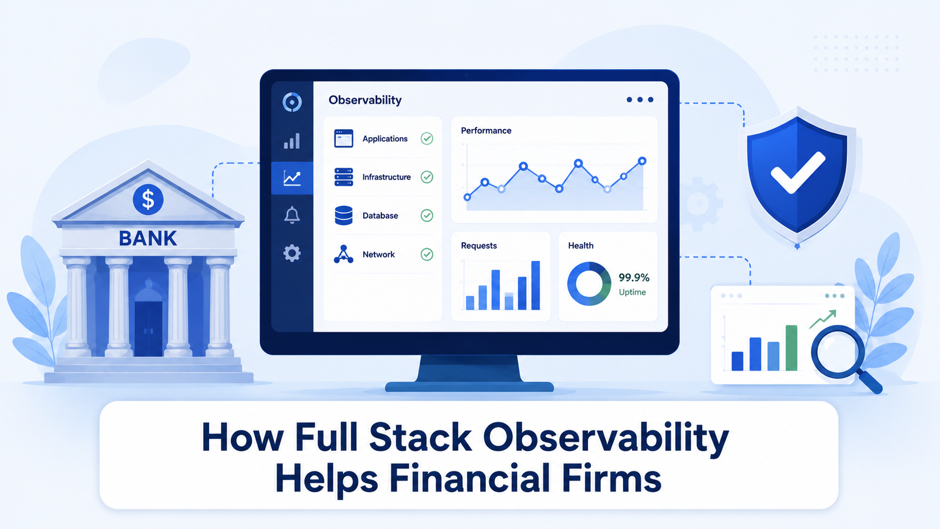
Here is where full stack observability can really help. It offers a single picture on how infrastructure, applications, networks and user experiences behave and interact. The result is better visibility, improved operational efficiency and less spending.
The Cost of Traditional Monitoring
Many financial firms adopted monitoring tools over time rather than through a unified strategy. Different teams selected solutions based on immediate requirements.
Infrastructure teams implemented server monitoring platforms.
Application teams adopted application performance monitoring tools.
Security teams introduced their own visibility solutions.
Cloud teams deployed cloud-native monitoring products.
While each tool solved a specific challenge, the combined environment often became difficult to manage. Data silos emerged. Teams spent time correlating information across platforms rather than resolving issues.
A payment processing delay, for example, may require investigation across network dashboards, application monitoring consoles, cloud monitoring systems and database logs. Multiple teams are involved and troubleshooting cycles increase.
Meanwhile, duplicate data collection is an unnecessary expense. Many tools may collect the same data points, store them separately, and charge for volume of ingestion. The result is predictable. Costs go up and efficiency of operations goes down.
Why Financial Institutions Feel the Pressure More Than Others
Observability challenges are present in all industries, but financial services have unique requirements.
The regulatory expectations are getting more and more stringent. Service outages can create compliance issues and damage the brand. No matter how many transactions you do, customers want simple digital experiences.
Many organisations also have hybrid environments that combine legacy infrastructure with modern cloud platforms. This creates visibility holes in the mixture that are hard to fill with traditional monitoring approaches. A modern banking transaction may pass through multiple layers:
Mobile application
API gateway
Authentication service
Core banking platform
Payment processing engine
Third-party integrations
When performance degrades at any point in this chain, identifying the root cause becomes challenging without complete visibility.
This complexity drives many organisations to purchase additional monitoring solutions rather than improving existing observability strategies.
Where the Spending Leak Begins
The financial impact of fragmented observability is often larger than expected. Below are a few common issues and their business impact:
Multiple monitoring tools: It leads to increased licensing costs
Duplicate telemetry collection: It leads to higher storage and ingestion expenses
Manual investigations: This can potentially lead to longer incident resolution times
Isolated team visibility: This can lead to reduced operational efficiency
Limited root cause analysis: This can increase the downtime risk
The issue is not simply spending more money. The real concern is spending more while receiving less actionable insight. As environments scale, these inefficiencies compound quickly.
How Full Stack Observability Changes the Model
Full stack observability gives you visibility into all the layers in your technology ecosystem through a connected approach. Instead of looking at individual components, teams get an understanding of relationships between applications, infrastructure, networks, databases, cloud services and user experiences.
This connected view helps organisations answer critical questions faster:
What happened?
Why did it happen?
Which systems are affected?
What is the business impact?
How can the issue be resolved?
Instead of switching between multiple dashboards, operational teams can trace incidents from customer-facing symptoms to the underlying technical cause. The result is faster resolution and more efficient resource utilisation.
The Visibility Journey
The following framework shows how organisations move from scattered monitoring to comprehensive observability:
Collect Data: Gather logs, metrics, traces, and events from all environments.
Connect Systems: Establish relationships between applications, infrastructure, cloud resources, and services.
Detect Issues: Identify anomalies and performance degradation in real time.
Find Causes: Trace incidents across dependencies to pinpoint root causes.
Optimise Operations: Reduce downtime, improve performance, and eliminate unnecessary observability costs.
This progression highlights why full stack observability delivers value beyond simple monitoring.
Better Decisions Through Unified Context
One overlooked benefit of full stack observability is decision-making quality. When teams lack context, responses often become reactive. Additional infrastructure is deployed to compensate for performance concerns. New tools are purchased because existing visibility appears insufficient.
Unified observability changes this dynamic. Technology leaders gain a clearer understanding of application behaviour, resource consumption, and system dependencies. Investments become more targeted because decisions are based on evidence rather than assumptions.
This often reveals unexpected optimisation opportunities.
Applications may be overprovisioned.
Unused telemetry may be consuming storage budgets.
Cloud resources may be generating costs without delivering business value.
Without complete visibility, these inefficiencies remain hidden.
Supporting Compliance and Operational Resilience
Financial institutions operate within highly regulated environments where operational resilience has become a strategic priority.
Regulators expect companies to demonstrate visibility into critical services and technology dependencies. Observability therefore plays an important role beyond performance management. Full stack observability supports resilience initiatives by providing:
End-to-end service visibility
Faster incident response
Improved audit readiness
Better dependency mapping
Enhanced risk management capabilities
When technology teams can quickly understand how distractions affect business services, they are better positioned to maintain continuity and meet regulatory expectations.
Why the Shift is Happening Now
A number of industry trends are propelling the adoption of full stack observability:
Operational complexity is increasing as we move to the cloud.
Digital banking services generate ever-increasing volumes of telemetry data.
Customer expectations for frictionless experiences still run high.
The intensity of regulatory oversight on operational resilience keeps growing.
Traditional monitoring architectures cannot meet these requirements. Consequently, financial institutions are looking for ways to cut through the complexity and increase visibility.
That move to full stack observability reflects a bigger realisation that monitoring individual pieces isn't enough anymore. Organisations need to understand how technology services work holistically and in a connected way.
Conclusion
Financial firms often assume observability costs are an unavoidable result of digital transformation. In reality, much of the overspending originates from fragmented tooling, duplicated telemetry, and disconnected operational processes.
Full stack observability addresses these challenges by providing visibility across applications, infrastructure, cloud services, networks and user experiences. Instead of adding more monitoring platforms, organisations can get deeper insight from a connected observability strategy while improving performance, reducing operational overhead and strengthening resilience.
For organisations seeking to improve visibility, governance, compliance readiness, and operational efficiency, CyberNX can help. Through its expertise in compliance and digital risk management, CyberNX provides full stack observability services that support businesses in building stronger operational foundations.
Media Info
CyberNX Team
CyberNX
[email protected]
https://www.cybernx.com/
9082352813
SOURCE: CyberNX