



Wednesday, 24 June 2026 10:00 AM
Awards
Tencent, Huawei and Haier ranked the top three, with 146 Chinese brands valued at more than 100 billion RMB
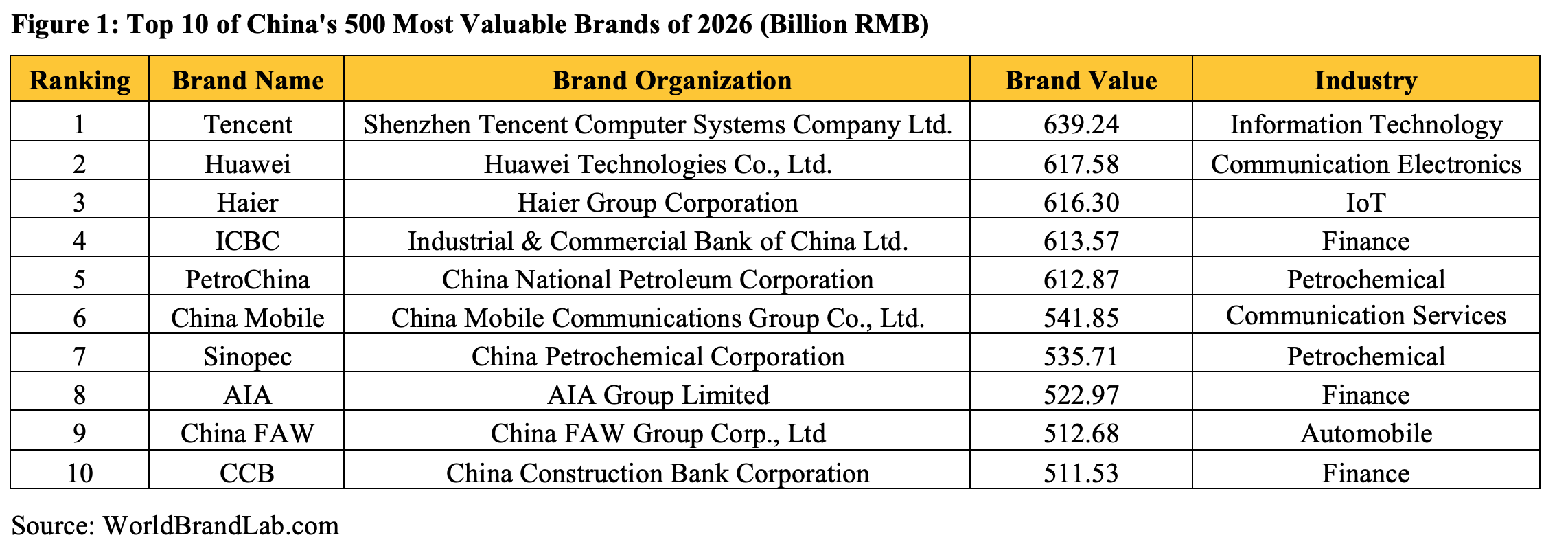
NEW YORK CITY, NY / ACCESS Newswire / June 24, 2026 / The 23rd World Brand Summit was held on June 24th in Beijing. The organizer, World Brand Lab, released the report of "2026 China's 500 Most Valuable Brands" list. In this annual report based on financial data, brand strength, and consumer behavior analysis, Tencent topped the list with a brand value of 639.24 billion RMB. Also among the top five are Huawei (617.58 billion RMB), Haier (616.30 billion RMB), ICBC (613.57 billion RMB), and PetroChina (612.87 billion RMB). These brands have entered the ranks of world-class brands. Academic authorities from Harvard University, Yale University, the University of Oxford, Peking University, together with a renowned American economist, attended the summit and delivered keynote speeches. They engaged in interactive discussions with 400 entrepreneurs and managers on the theme of "Future Brand Management: From Brand Equity to Brand Science".

The total value of China's 500 Most Valuable Brands of 2026 is 45.29 trillion RMB, an increase of 3.26 trillion RMB or 7.76% over last year. The growth rate has continued to slow compared with previous years. Dr. Steve Woolgar, Chairman of the Academic Committee of World Brand Lab and WorldBrand.AI and Emeritus Professor of Marketing at the University of Oxford, said, "Over the past 20 years, I have witnessed the rapid growth of Chinese brands. Tencent, Huawei, Haier, ICBC, China Mobile, China Construction Bank, Tongwei, Shougang, Bosideng, Jingye, Feihe, M&G Stationery, JOMOO and Sungrow have become the best-performing brands of 2026. Looking ahead, AI is becoming a new decision interface for brands. Users are increasingly relying on AI-generated answers to discover, compare and choose companies, which is shifting brand competition from search ranking to answer inclusion. As a result, before users even enter a brand's own channels, brands may already face risks such as AI-generated misinformation, brand omission, ranking misalignment and sentiment drift."
This is the 23rd year that World Brand Lab has compiled the China brand report. In 2004, the entry threshold was only 500 million RMB, and the average value of the top 500 brands was 4.94 billion RMB. In 2026, the entry threshold has been raised to 5.09 billion RMB, and the average value of the top 500 brands is as high as 90.57 billion RMB, representing an increase of 1,732.35%. A total of 146 Chinese brands are valued at more than 100 billion RMB this year, an increase of 11 brands from last year, highlighting the prosperity of China's brand economy. Brand is an intangible asset, reflected in the reputation a company holds in the eyes of its customers. It is part of a company's capital and determines its market value. As with S&P 500 companies, among Chinese listed companies, especially technology companies, intangible assets represented by brands account for more than 90% of market value.
According to the analysis by World Brand Lab's expert panel, the core of regional competitiveness lies in comparative advantages, and brand building is a key factor in shaping such advantages and driving regional economic development. A brand is an important symbol of a region's development, and brand development and regional economic growth are closely interlinked. In terms of the regional distribution of China's 500 Most Valuable Brands this year, Beijing ranked first with 84 brands. This result is closely related to Beijing's position as the national center for politics, economy and technology, as well as a hub for the headquarters of central enterprises. In particular, the concentration of large central enterprises with strong profitability in Beijing has further strengthened the city's brand portfolio. Guangdong remained in second place with 77 brands. Shanghai ranked steadily in third place with 50 brands. Brands on the list can be divided into national and global brands according to the scope of their influence. There are 404 brands with national influence, accounting for 80.80% of the list; and 96 brands with global influence, accounting for 19.20%.
In this year's "China's 500 Most Valuable Brands" list, brands from 26 industries, including food and beverage, communication electronics and IT, light industry, finance, machinery, media, and automobile, were selected. The food and beverage industry remains the industry with the most brands selected, with a total of 71 brands, accounting for 14.20% of the list. The industries ranking second to fifth are communication electronics and IT (54), light industry (41), finance (35), and machinery (33), respectively. It is worth noting that World Brand Lab included the AI Influence Index in its evaluation system for the first time this year. A higher AI influence indicates that a brand has stronger voice and communication power within the AI ecosystem. In measuring brand loyalty, World Brand Lab referred to the rating data from iTrust Rating. In measuring brand leadership, especially ESG (environmental, social, and governance) scores, World Brand Lab referred to the ESG database of SuperFinance.
The topic of this year's World Brand Summit is "Future Brand Management: From Brand Equity to Brand Science". Dr. Arthur Laffer, a renowned American economist and former White House economic adviser, said that he is a super fan of China and has long followed China's economic development. He noted that the integration of China and the United States, two major powers, can create the prosperity that the world urgently needs. Dr. Laffer emphasized that with the rise of intangible assets such as brands, intellectual property, data and human capital, the mobility of capital has far exceeded that of the industrial era. In his view, this mobility has positive implications. He argued that to retain and increase domestic intangible wealth, countries should create a more attractive environment by lowering taxes, reducing regulation, clarifying property rights and enhancing market freedom. On the issue of job displacement brought by artificial intelligence, Dr. Laffer suggested that companies should incentivize employees to undergo technical retraining, embrace change by mastering AI technologies, and improve work efficiency.
Dr. Elie Ofek, Professor of Marketing at Harvard Business School, pointed out that AI is becoming increasingly integrated into professional work and personal life, and is reshaping the way consumers discover, evaluate and purchase products. The customer journey is shifting from a search-engine, link-oriented model to an AI-generated, answer-oriented model. Brand success is no longer just about being found through search; it is about being included and recommended by AI answer engines. Brands need to strengthen the 4Cs: being Current in information, Clear in expression, Consistent across channels, and Corroborated by third-party validation. In the next stage, Agentic AI may independently complete tasks, make purchase decisions, drive personalized marketing, participate in retail transactions, and dynamically adjust prices. This will create opportunities for efficiency and scale, but will also generate new risks.
Dr. Ravi Dhar, Professor of Management and Marketing at the Yale School of Management, pointed out that AI agents are driving marketing from content visibility toward brand evaluation based on actual performance. AI is no longer just a tool for brand creativity and marketing campaigns; more importantly, it is participating in consumers' research, comparison and decision-making processes. This brings three core responsibilities for chief marketing officers (CMOs): brand management, market and customer insights, and customer experience reconstruction. Brands must narrow the gap between promises and actual performance, because AI agents will identify and amplify inconsistencies in operations, products, services and public opinion. Answer Engine Optimization (AEO) should therefore not be viewed as a simple extension of Search Engine Optimization (SEO), but as a cross-functional trust and reputation management system.
Dr. Jing Xu, Professor of Marketing at Guanghua School of Management, Peking University, believes that the globalization of Chinese brands is entering a new stage of development. Chinese enterprises are gradually moving from product globalization and channel globalization to brand globalization, with more companies beginning to focus on building global consumer mindshare and shaping brand influence. With emerging digital infrastructure such as AI Q&A engines, companies can not only improve the efficiency of brand information dissemination, but also build stronger brand awareness in global markets by continuously developing authoritative knowledge systems and credible content networks. WorldBrand.AI, newly launched by World Brand Lab, combines its long-term experience in brand value evaluation with brand visibility, recommendation logic and digital reputation analysis in the era of large language models, providing new tools and methods for companies to manage future brand assets.
Dr. Haisen Ding, CEO of World Executive Group and World Brand Lab and a PhD from the University of Oxford, stated that future brand competition will no longer be limited to occupying consumer mindshare; it will also require leaving an indelible mark in AI's algorithmic map. Whoever has a stronger voice in the AI ecosystem will hold the digital key to the next decade of brand value growth. For brand management, this is not only a technological transformation, but also an upgrade in brand governance and value creation models. In a future dominated by AI agents and answer engines (AEO), the consumer decision-making chain will be shortened, and AI will become the de facto gatekeeper of traffic. Higher AI influence not only means that a brand has stronger voice, network-wide communication power and technological visibility in the AI ecosystem, but also means that the brand has successfully crossed the barriers of traditional search engines.
World Brand Lab is an international brand value research institute wholly owned by World Executive Group, a leading digital technology and strategy consulting firm. It was founded on the initiative of Nobel Laureate Robert Mundell, who served as its first chairman. Its experts and consultants hail from Harvard, Yale, MIT, Columbia, Oxford, Cambridge, INSEAD and other top universities. Its research results have become an important basis for intangible asset valuation in many M&A transactions. Published for 23 consecutive years, the "China's 500 Most Valuable Brands" list uses the present earning value method to measure brand value.
Jason Wang
Communications Manager
[email protected]
212-208-1429
SOURCE: World Brand Lab