




Tuesday, 19 May 2026 03:50 AM
Company Update
UV-blocking nanoparticle additives are transforming agricultural films by improving durability, light control, and performance in protected farming systems.
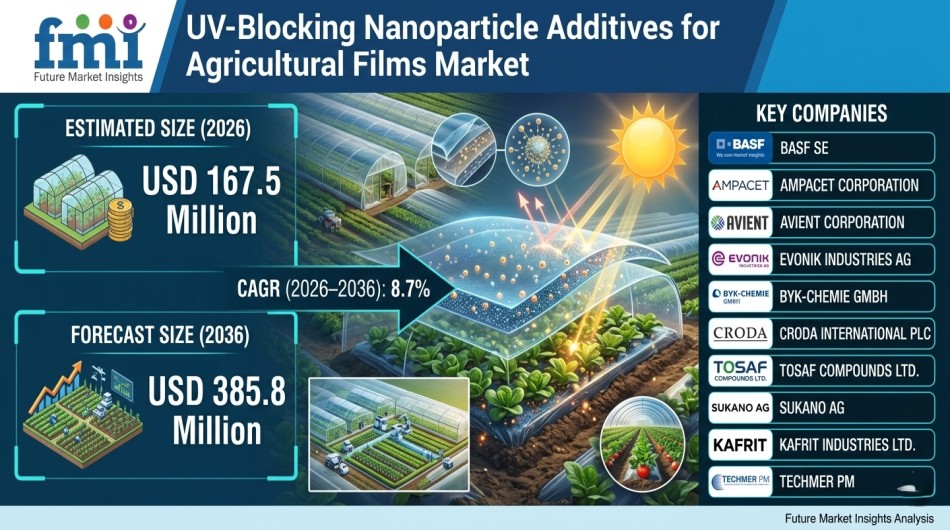
NEWARK, DE / ACCESS Newswire / May 19, 2026 / According to the latest market analysis by Future Market Insights, the global UV-blocking nanoparticle additives for agricultural films market is projected to grow from USD 167.5 million in 2026 to USD 385.8 million by 2036, registering a CAGR of 8.7% during the forecast period.
The market is being driven by rising protected cultivation practices, increasing demand for durable greenhouse films, and growing focus on UV-resistant agricultural plastics. Agricultural film manufacturers are increasingly adopting nanoparticle additives to improve film longevity, optimize light transmission, and reduce ultraviolet degradation across multi-season crop cycles.
Quick Stats for UV-Blocking Nanoparticle Additives for Agricultural Films Market
Market size (2025): USD 154.1 million
Estimated size (2026): USD 167.5 million
Forecast (2036): USD 385.8 million
CAGR (2026-2036): 8.7%
Incremental opportunity: USD 218.3 million
Leading polymer matrix: Polyethylene (64.0% share in 2026)
Top additive form: Masterbatch (58.0% share in 2026)
Key companies: BASF SE, Ampacet Corporation, Avient Corporation, Evonik Industries AG, BYK-Chemie GmbH, Croda International Plc, Tosaf Compounds Ltd., Sukano AG, Kafrit Industries Ltd., Techmer PM
Get detailed market forecasts, competitive benchmarking, and pricing trends: https://www.futuremarketinsights.com/reports/sample/rep-gb-33135
Market Size and Growth Outlook
The UV-blocking nanoparticle additives for agricultural films market is expected to more than double over the next decade as greenhouse farming, tunnel cultivation, and mulch film applications expand worldwide. Demand growth is supported by the increasing need for longer-lasting agricultural films capable of maintaining optical performance under intense sunlight exposure.
The market is shifting from conventional UV screening solutions toward advanced nanoparticle-based additive systems that combine ultraviolet protection, durability, and processing stability. Film converters are increasingly prioritizing additive systems that support high-volume extrusion while maintaining consistent haze control and light transmission properties.
Growth Drivers: Durability and Optical Performance
Demand for UV-blocking nanoparticle additives is accelerating as agricultural film manufacturers seek improved performance across protected cultivation systems.
Greenhouse operators require films that can withstand repeated sunlight exposure without compromising crop productivity. Nanoparticle additives help maintain structural integrity while preserving visible light transmission essential for plant growth.
Masterbatch-based additive systems are also gaining traction because they improve dosing precision during film production and reduce variation in nanoparticle dispersion. Agricultural film makers are increasingly using these systems to improve extrusion consistency and extend replacement cycles.
Expanding global greenhouse cultivation is another key demand driver. Large-scale horticulture programs across Asia and Europe continue to strengthen the requirement for advanced UV-resistant films in vegetable, fruit, and specialty crop production.
Challenges: Dispersion, Cost, and Regulatory Scrutiny
Despite strong growth prospects, the market faces several operational and regulatory challenges.
Nanoparticle dispersion remains a critical issue for film manufacturers. Poor dispersion can increase haze and reduce the optical clarity needed for greenhouse crop production. Maintaining balance between UV protection and visible light transmission continues to be a major formulation challenge.
Cost pressure also affects adoption, particularly in price-sensitive agricultural film segments. Advanced nanoparticle systems remain more expensive than conventional UV stabilizers, limiting penetration in lower-cost film grades.
Regulatory attention surrounding agricultural plastics and nanoparticle migration is increasing globally. Film manufacturers are now expected to provide stronger evidence regarding additive loading, environmental behavior, and field durability performance.
Opportunities: Protected Cultivation and Bio-Based Films
The market is creating new opportunities across high-performance agricultural film applications.
Greenhouse films remain the leading demand segment as growers increasingly adopt multi-season protective covers. Longer replacement cycles and better crop protection are improving the value proposition for nanoparticle additives.
Bio-based agricultural films are also opening new opportunities for low-loading UV-blocking systems that can preserve film functionality without compromising end-of-life sustainability goals.
Emerging demand for advanced mulch films, tunnel films, and specialty horticulture covers is expected to create additional growth potential across both developed and emerging agricultural economies.
Segmentation Insights
By Nanoparticle Type
Titanium dioxide is projected to account for 40.0% of nanoparticle additive demand in 2026 due to its strong ultraviolet scattering capability and broad compatibility with greenhouse film formulations.
Zinc oxide and silica-based additives are also gaining adoption in applications requiring lower haze and enhanced surface durability.
By Film Type
Greenhouse films are expected to hold 42.0% market share in 2026 as growers seek durable covers capable of maintaining stable light transmission across multiple crop seasons.
Mulch films and tunnel films continue to gain traction in soil-cover and early crop protection applications.
By Polymer Matrix
Polyethylene is forecast to dominate the polymer matrix segment with 64.0% share in 2026. Its flexibility, extrusion efficiency, and compatibility with agricultural film production make it the preferred resin among converters.
By Additive Form
Masterbatch is projected to lead with 58.0% market share in 2026 as pellet concentrates simplify additive dosing and improve production consistency during film extrusion.
Customize insights for your business strategy@ https://www.futuremarketinsights.com/customization-available/rep-gb-33135
Regional Dynamics: Asia Pacific Leads Market Expansion
Asia Pacific remains the dominant production and consumption hub for UV-blocking nanoparticle additives used in agricultural films.
China is projected to register the fastest growth at a 9.6% CAGR through 2036, supported by extensive greenhouse cultivation infrastructure and expanding horticulture output.
India is expected to grow at 9.2% CAGR due to rising investments in protected farming programs and government-backed horticulture initiatives.
Spain continues to be a major European market driven by intensive greenhouse agriculture and export-oriented vegetable production systems.
Mexico and Turkey are also emerging as important markets due to increasing adoption of protected cultivation techniques across high-value crop production.
Competitive Landscape: Innovation Through Masterbatch and Dispersion Expertise
The competitive environment remains moderately consolidated with major additive manufacturers focusing on formulation expertise, converter partnerships, and masterbatch innovation.
Key companies operating in the market include:
BASF SE
Ampacet Corporation
Avient Corporation
Evonik Industries AG
BYK-Chemie GmbH
Croda International Plc
Tosaf Compounds Ltd.
Sukano AG
Kafrit Industries Ltd.
Competition is increasingly centered around nanoparticle dispersion capability, haze reduction performance, and long-term field durability validation. Companies offering strong converter trial support and customized agricultural film formulations are expected to strengthen their market positions.
Strategic Implications for Industry Stakeholders
For agricultural film manufacturers, additive suppliers, and protected cultivation operators, UV-blocking nanoparticle additives are becoming critical to long-term product differentiation.
Manufacturers investing in advanced masterbatch systems and precision dispersion technologies are expected to gain stronger relationships with greenhouse film converters.
Supply chain coordination and formulation optimization will become increasingly important as regulatory scrutiny around agricultural plastics intensifies.
Companies that can balance UV protection, optical performance, and sustainability objectives are likely to secure long-term competitive advantages.
Future Outlook: From Basic UV Protection to Advanced Film Engineering
The UV-blocking nanoparticle additives for agricultural films market is evolving beyond traditional ultraviolet stabilization into a broader performance-engineering segment.
As protected cultivation expands globally, demand for agricultural films with longer service life, higher clarity, and improved environmental performance will continue to rise.
Advancements in nanoparticle dispersion, lower-loading additive systems, and bio-compatible film technologies are expected to accelerate adoption across greenhouse, mulch, and tunnel film applications over the next decade.
Executive Takeaways
UV-blocking nanoparticle additives are becoming essential for high-performance agricultural film production.
Greenhouse cultivation growth is driving long-term demand for durable UV-resistant films.
Polyethylene and masterbatch systems continue to dominate market adoption.
Asia Pacific, led by China and India, remains the fastest-growing regional market.
Dispersion quality, haze control, and regulatory compliance remain key competitive factors.
Long-term opportunities are emerging across bio-based films, greenhouse farming, and protected horticulture systems.
For industry participants, the focus is no longer only on ultraviolet protection-but on delivering complete film performance solutions that support productivity, sustainability, and operational efficiency.
Unlock 360° insights for strategic decision making and investment planning@ https://www.futuremarketinsights.com/checkout/33135
Explore More Related Studies Published by FMI Research:
Agricultural Films And Bonding Market: https://www.futuremarketinsights.com/reports/agricultural-films-and-bonding-market
Toughening Nanoparticle Additives Market: https://www.futuremarketinsights.com/reports/toughening-nanoparticle-additives-market
UV-Blocking Nanoparticle Additives Market: https://www.futuremarketinsights.com/reports/uv-blocking-nanoparticle-additives-market
Additives for Metalworking Fluids Market: https://www.futuremarketinsights.com/reports/additives-for-metalworking-fluids-market
Agricultural Fumigant Market: https://www.futuremarketinsights.com/reports/agricultural-fumigant-market
About Future Market Insights (FMI)
Future Market Insights (FMI) is a leading provider of market intelligence and consulting services, serving clients in over 150 countries. Headquartered in Delaware, USA, with a global delivery center in India and offices in the UK and UAE, FMI delivers actionable insights to businesses across industries including automotive, technology, consumer products, manufacturing, energy, and chemicals.
An ESOMAR-certified research organization, FMI provides custom and syndicated market reports and consulting services, supporting both Fortune 1,000 companies and SMEs. Its team of 300+ experienced analysts ensures credible, data-driven insights to help clients navigate global markets and identify growth opportunities.
For Press & Corporate Inquiries
Rahul Singh
AVP - Marketing and Growth Strategy
Future Market Insights, Inc.
+91 8600020075
For Sales - [email protected]
For Media - [email protected]
For web - https://www.futuremarketinsights.com/
For Web : https://www.factmr.com/
SOURCE: Future Market Insights, Inc.