




Wednesday, 20 May 2026 05:10 AM
Company Update
Ursolic acid market growth is driven by pharmaceutical formulation demand, nutraceutical standardization, cosmetic applications, and quality-focused sourcing.
NEWARK, DE / ACCESS Newswire / May 20, 2026 / According to the latest market analysis by Future Market Insights, the global ursolic acid market is entering a more quality-sensitive growth phase driven by rising pharmaceutical formulation activity, expanding nutraceutical standardization requirements, and increasing cosmetic adoption of plant-derived active ingredients.
The market is evolving from a broad botanical extract category into a specification-driven active ingredient ecosystem where buyers increasingly prioritize assay validation, solvent control, repeat batch consistency, and documentation transparency before approving commercial supply relationships.
Quick Stats Snapshot
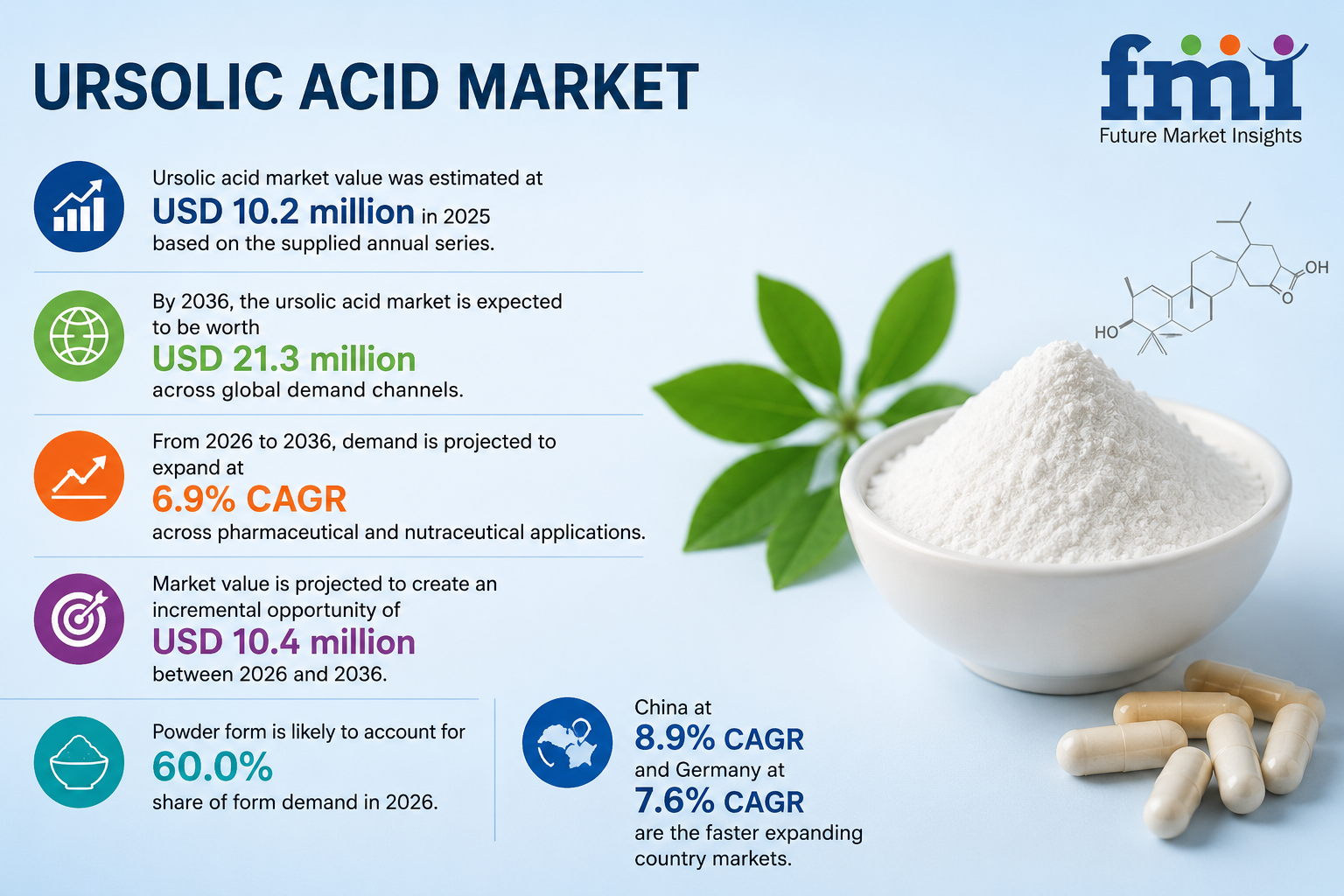
Global market value (2025): USD 10.2 million
Estimated market value (2026): USD 10.9 million
Forecast market value (2036): USD 21.3 million
Global market CAGR (2026-2036): 6.9%
Leading form segment: Powder Form (60.0% share)
Leading distribution channel: Direct Sales (58.0% share)
Leading application segment: Pharmaceutical Applications (30.0% share)
Top growth market: China (8.9% CAGR)
Fast-growing regulated market: Germany (7.6% CAGR)
Get detailed market forecasts, competitive benchmarking, and regional insights: https://www.futuremarketinsights.com/reports/sample/rep-gb-2675
Market Outlook: Pharmaceutical Qualification and Botanical Standardization Support Long-Term Growth
The ursolic acid market is projected to witness sustained expansion through 2036 as pharmaceutical formulators, nutraceutical brands, cosmetic manufacturers, and botanical extract suppliers increasingly focus on standardized active ingredients with validated purity profiles and repeatable performance.
Powder ursolic acid formats continue dominating commercial demand because they simplify dry blending, improve capsule filling efficiency, and support large-scale nutraceutical manufacturing systems. Pharmaceutical buyers are simultaneously increasing qualification checks as regulatory review processes place greater emphasis on ingredient specifications, testing records, and traceable sourcing.
At the same time, cosmetic and personal care applications are creating additional commercial momentum as formulators evaluate ursolic acid for antioxidant, anti-aging, and skin-conditioning applications.
The category is increasingly positioned as a strategic botanical active ingredient supporting pharmaceutical formulation, nutraceutical standardization, cosmetic innovation, and research-driven product development.
Growth Drivers: Regulatory Documentation and Botanical Ingredient Demand Accelerate Expansion
Several structural factors are supporting market growth:
1. Pharmaceutical Formulation Activity Increases Ingredient Qualification Demand
Drug formulation teams increasingly require defined assay records, impurity control documentation, and repeat batch consistency before approving ursolic acid for evaluation programs.
2. Nutraceutical Standardization Supports Botanical Active Ingredient Adoption
Supplement manufacturers are prioritizing standardized botanical ingredients with validated quality records and stable powder grades for capsule and tablet production.
3. Cosmetic Industry Interest in Plant-Derived Actives Continues Expanding
Skin care formulators are evaluating ursolic acid for antioxidant positioning, anti-aging applications, and premium botanical ingredient formulations.
4. Powder Form Preference Strengthens Industrial Processing Efficiency
Powder ursolic acid remains highly preferred due to easier storage, simplified handling, improved dosing precision, and compatibility with dry blending operations.
Key Challenges: Purity Control and Supplier Qualification Remain Critical
Despite favorable growth prospects, the industry continues facing several operational and commercial challenges:
Residual solvent control requirements across regulated applications
Purity variation among botanical extract suppliers
Increasing documentation and traceability expectations
Energy-driven extraction and purification cost pressure
Raw material sourcing variability linked to botanical feedstocks
Companies capable of maintaining stronger purity control, validated assay systems, manufacturing transparency, and regulatory-ready documentation are expected to strengthen competitive positioning across pharmaceutical and nutraceutical ingredient markets.
Emerging Opportunities: High-Purity Grades and Research Applications Expand Commercial Potential
Key opportunities are centered around regulated ingredient adoption and premium botanical positioning:
Expansion of pharmaceutical-grade botanical active ingredients
Rising nutraceutical demand for standardized plant-derived compounds
Increasing use in skincare and antioxidant formulations
Stronger research interest in assay-defined ursolic acid material
Greater demand for traceable and compliance-ready botanical supply chains
Segmentation Insights: Powder Formats and Direct Supplier Relationships Dominate Market Demand
By Application
Pharmaceutical applications are forecast to capture 30.0% share in 2026 as formulation teams increasingly require defined active ingredient concentration and validated supplier qualification systems.
By Form
Powder form is projected to account for 60.0% share in 2026 due to easier handling, stable storage performance, and compatibility with capsule filling and bulk blending systems.
By Distribution Channel
Direct sales are expected to represent 58.0% share in 2026 as industrial buyers prioritize direct supplier qualification, testing discussions, and long-term sourcing relationships.
By Extraction Method
Solvent extraction is forecast to account for 48.0% share in 2026 because established extraction systems help producers manage yield efficiency and bulk production economics.
By Purity Level
Below 95% purity grades are anticipated to capture 45.0% share in 2026 as cost-sensitive industrial formulations continue supporting practical assay-grade demand.
Customize insights for your business strategy: http://futuremarketinsights.com/customization-available/rep-gb-2675
Regional Analysis: China and Germany Lead Growth Momentum
China (8.9% CAGR)
China remains the leading growth market supported by deep medicinal plant cultivation capacity, expanding botanical extraction infrastructure, and broader traceability implementation across plant-derived ingredient supply chains.
Germany (7.6% CAGR)
Germany continues emphasizing pharmaceutical-grade ingredient review, advanced quality documentation, and biotechnology-linked ingredient qualification systems.
United States (7.0% CAGR)
The United States market is supported by growing dietary supplement compliance review and rising demand for documented botanical ingredient supply.
Brazil (6.9% CAGR)
Brazil's market expansion is supported by phytotherapeutic regulation and stronger GMP-related ingredient qualification standards.
India (6.0% CAGR)
India continues benefiting from expanding herbal exports, nutraceutical manufacturing growth, and stronger demand for standardized botanical ingredients.
Spain (5.5% CAGR)
Spain's pharmaceutical manufacturing infrastructure supports demand for controlled botanical active ingredient sourcing and formulation trials.
Japan (4.9% CAGR)
Japan maintains selective, quality-driven demand supported by disciplined herbal medicine review systems and research-oriented botanical applications.
Asia-Pacific markets are expected to outperform mature regions due to stronger medicinal plant supply networks, growing nutraceutical manufacturing capacity, and increasing adoption of standardized botanical active ingredients.
Competitive Landscape: Documentation Strength and Purity Control Shape Competition
The ursolic acid market remains moderately fragmented, with branded nutraceutical ingredient firms, botanical extract manufacturers, and regional active ingredient suppliers competing across pharmaceutical, nutraceutical, cosmetic, and research applications.
Key companies include:
Sabinsa
Sami Labs
Geneham Pharmaceutical
Changsha Staherb Natural Ingredients
Changsha Luyuan Bio-Tech
Shaanxi Hopeland Chem-Tech
Hunan NutraMax
MicroHerb
Leading suppliers continue strengthening market position through extraction scale, purity optimization, documentation readiness, and pharmaceutical-grade quality systems.
Analyst Opinion
Nandini Roy Choudhury observes, "Ursolic acid demand is increasingly defined by grade credibility instead of broad botanical availability. Buyers now evaluate purity consistency, solvent control, assay validation, and documentation readiness together before expanding commercial sourcing relationships. Suppliers with stronger quality files and repeat batch performance will strengthen access across pharmaceutical, nutraceutical, and cosmetic ingredient markets."
Strategic Implications for Industry Leaders
For pharmaceutical formulators, nutraceutical brands, cosmetic ingredient suppliers, and botanical extract manufacturers, the market presents several strategic priorities:
Powder ursolic acid remains essential for nutraceutical and pharmaceutical manufacturing efficiency
Direct sales channels continue supporting specification-sensitive industrial procurement
Purity validation and solvent control are becoming central supplier qualification factors
Cosmetic applications are creating additional premium growth opportunities
Botanical traceability and documentation readiness are strengthening purchasing influence
Manufacturing consistency is becoming a key differentiator for repeat commercial contracts
Future Outlook: From Botanical Extract Category to Specification-Driven Active Ingredient Market
The ursolic acid market is expected to evolve beyond a conventional botanical extract segment into a more regulated active ingredient ecosystem focused on pharmaceutical qualification, nutraceutical standardization, cosmetic innovation, and documentation-backed supply reliability.
Key trends expected to shape the market include:
Expansion of pharmaceutical-grade botanical ingredient supply
Greater investment in traceable extraction systems
Rising demand for standardized nutraceutical actives
Increasing cosmetic use of antioxidant botanical compounds
Stronger regulatory focus on ingredient specifications and testing methods
Continued demand growth for powder-format botanical active ingredients
Unlock 360° insights for strategic planning and investment decisions: https://www.futuremarketinsights.com/checkout/2675
Executive Takeaways
Powder ursolic acid continues dominating industrial formulation demand
Pharmaceutical applications remain the leading commercial use segment
Direct sales channels support long-term specification-sensitive procurement
China and Germany are leading growth momentum across regulated ingredient markets
Documentation readiness and purity control are shaping supplier competitiveness
Nutraceutical and cosmetic applications are expanding premium growth opportunities
Traceability and regulatory compliance are becoming central procurement priorities
As pharmaceutical, nutraceutical, and cosmetic demand for standardized botanical active ingredients continues expanding, companies capable of combining purity consistency, manufacturing transparency, validated documentation, and scalable extraction capability will be best positioned to capitalize on long-term ursolic acid market growth.
Related Reports:
Demand for Ursolic Acid in EU: https://www.futuremarketinsights.com/reports/demand-for-ursolic-acid-in-eu
Acidified Whey Protein Market: https://www.futuremarketinsights.com/reports/acidified-whey-protein-market
Folic Acid Market: https://www.futuremarketinsights.com/reports/folic-acid-market
Fatty Acid Supplements Market: https://www.futuremarketinsights.com/reports/fatty-acid-supplements-market
Food Acidulants Market: https://www.futuremarketinsights.com/reports/food-acidulants-market
About Future Market Insights (FMI)
Future Market Insights (FMI) is a leading provider of market intelligence and consulting services, serving clients in over 150 countries. Headquartered in Delaware, USA, with a global delivery center in India and offices in the UK and UAE, FMI delivers actionable insights to businesses across industries including automotive, technology, consumer products, manufacturing, energy, and chemicals.
An ESOMAR-certified research organization, FMI provides custom and syndicated market reports and consulting services, supporting both Fortune 1,000 companies and SMEs. Its team of 300+ experienced analysts ensures credible, data-driven insights to help clients navigate global markets and identify growth opportunities.
For Press & Corporate Inquiries:
Rahul Singh
AVP - Marketing and Growth Strategy
Future Market Insights, Inc.
+91 8600020075
For Sales - [email protected]
For Media - [email protected]
For web - https://www.futuremarketinsights.com/
For Web - https://www.factmr.com/
SOURCE: Future Market Insights, Inc.